Wednesday, January 31, 2007

Khmer Intelligence News - 31 January 2007

31 January 2007

No stock market in Cambodia in a foreseeable future (2)

Contrary to several official announcements in a recent past, Cambodia will not be able to set up any stock market in a foreseeable future. Even the South Korean companies the Cambodian authorities had strongly hoped that they would help establish a Bourse in Phnom Penh, have given up the idea because there is no reliable accounting system in Cambodia. Any listed companies would have to present credible financial statements and records over several consecutive years, which is virtually impossible to obtain in a country plagued with corruption and lawlessness.

Vietnam has already developed a relatively small but booming stock market whose value grew 20-fold in 2006 and by over 30 per cent this year, which probably represents the best performance in Asia.

CPP has already won the control of 10 communes before Voting Day (1)

Out of the country's 1,621 communes there are 10 communes situated in the most remote districts of some remote provinces where the Cambodian People's Party is the sole party to have fielded candidates for the commune council election that will take place on April 1 this year. Therefore, the CPP can already be considered as the winner for those 10 communes (6 in Ratanakiri, 2 in Pursat, 1 in Preah Vihear and 1 in Koh Kong province).

The CPP will compete only with the opposition Sam Rainsy Party, giving voters a clear-cut choice in a two-party race, in 12 communes (5 in Phnom Penh, 3 in Kompong Cham, 3 in Mondulkiri and 1 in Kandal province).

The CPP will compete only with the SRP and the Norodom Ranariddh Party, in a 3-party race, in 154 communes where the pro-CPP Funcinpec has not been able to field any candidate. Among the 154 communes, 69 are in Kompong Cham province, 42 in Kandal province and 14 in Phnom Penh.

Ranariddh prolongs self exile (2)

Fearing possible arrest in relation to several criminal lawsuits that have been or could be filed against him (fraudulent sale of the Funcinpec headquarters, dubious contract with a Taiwanese company for the renovation of the Phnom Penh Olympic Stadium, violation of the monogamy law), Prince Norodom Ranariddh is currently prolonging his self exile in Malaysia after staying in France for several weeks. He has recently sent two letters to Prime Minister Hun Sen and tried to call him several times on the phone, but has not received any response.

Jobs and justice versus alms (2)

The CPP is intensifying its electoral campaign based on massive donations in preparation for the commune council election to be held in two months. Money, food and clothes are being distributed to villagers throughout the country by CPP officials who are conducting an unprecedented membership drive. The SRP responds to the CPP propaganda by calling on the people's common sense and their aspirations for justice and a clean society. "They are stealing millions from the country and giving back pennies; take whatever they donate but vote for a new leadership that will fight corruption and provide the jobs you need to live decently [by bringing about an investment-friendly environment to soundly develop the economy while ensuring social justice]."

Click here for full text in Khmer.

[End]

Cambodia justice 'fails children' [-Gov't spokesman indirectly admits failure]

Child prisoners reportedly suffer beatings from inmates and guards

Wednesday, 31 January 2007

By Guy De Launey
BBC News, Cambodia

Human rights organisations have criticised the way children are treated in Cambodia's justice system.

They say there are hundreds of under-age prisoners in the country's jails and many of them are forced to share cells with adults.

A coalition of local and international groups has called on the government to pass legislation to protect the children.

Conditions in Cambodia's jails are notorious.

There can be as many as 60 inmates in a single cell, food is scarce, and standards of hygiene are poor.

Life is difficult enough for adult prisoners but human rights groups say it is unacceptable that children are sharing the same conditions.

Beatings

There is only one facility in the country designed for juvenile prisoners. The rest of the rising number of under-age detainees have to take their chances with adults.

The local rights organisation, Licadho, says that children have reported beatings from prison officials and fellow-inmates alike.

An official from the United Nations' children's organisation, Unicef, warned that the problem was getting out of hand.

Sandy Feinzig has also been working with the government to introduce a juvenile detention law and a new criminal procedure code.

''This year our hopes are to get these two laws passed, which could do a tremendous amount to reduce the sentences for children, divert them into projects, provide alternatives to sentencing, all of which will lessen the overcrowding in the current prison facilities,'' she says.

The need for reform is clear. This week local newspapers reported that a prisoner in a provincial jail died from a "hunger-related disease".

A government spokesman said it was difficult to justify spending more on food for convicts, when many public sector workers earned just $20 a month.

Hundreds of children abused in Cambodian jails [-Khieu Sopheak denied the accusations]

Thursday, 1 February 2007

Reuters

PHNOM PENH: Sothon was 10 years old when he first saw the inside of a Cambodian prison.

A street-kid in the booming tourist town of Siem Reap, he had stolen a small roll of electric wire that he hoped to sell for enough money to buy a few bowls of rice.

It cost him a month behind bars.

"I missed my parents. They did not allow me to meet my mother," Sothon, now 11, told a news conference on Wednesday to highlight the plight of the hundreds of children locked up, often for spurious reasons, in the war-scarred southeast Asian nation.

"I had no blanket, no pillow and not enough food to eat," he told reporters from behind a screen to protect his identity.

"Every morning, they forced me to carry water."

Human rights groups and Unicef, the United Nations children's agency, say there are 497 documented cases of children under 18 in provincial jails in Cambodia.

Many of them were abused, said Kek Galabru, director of human rights group Licadho, and as many as 40 per cent had never been tried for their alleged crimes.

Those that had appeared in court were often forced to make false confessions and seldom gained a fair hearing in a notoriously corrupt and arbitrary judicial system. Sentencing of children was also "extremely harsh", Unicef said.

One boy, Heng, was jailed in 2005 as a 12-year-old for raping a 9-year-old girl, although Licadho said the allegations were baseless. Heng's case is now under appeal.

"Children should not be in prison," said Unicef legal consultant Sandy Feinzig. "It is a very serious issue."

The situation, which is compounded by massive prison overcrowding in what is one of Asia's poorest countries, is likely to get worse, she added, due to high poverty and unemployment rates in the 13 million population, half of which is under 18.

Donor countries, which give Phnom Penh around $600 million in aid each year, should push for better legal representation for minors and adequate food and medical facilities for those in detention, she said.

"We have to have more lawyers and we need better facilities. We need better-trained judges and prosecutors to keep children who've committed misdemeanours out of prison."

Government spokesman Khieu Sopheak denied the accusations.

Rough diamonds [- Global Witness]

Global Witness was set up stop the use of natural resources to fund corruption and human rights abuses. But, as Alison Benjamin discovers, its covert and unconventional methods set it apart from other NGOs

Wednesday January 31, 2007
The Guardian (UK)

A few minutes into Blood Diamond, the Hollywood film staring Leonardo DiCaprio that opened last week in Britain, the action switches from the bloody civil war in Sierra Leone to a G8 summit in Antwerp, where a senior US state department official tells representatives from governments: "According to a devastating report by Global Witness, diamonds are being used to fund the conflict."

The report he refers to is A Rough Trade, which in 1998 exposed the illegal export from war-torn African countries of diamonds that bankrolled rebel groups notorious for mass rape and cutting off hands.

By uncovering the role both of companies and governments in the illicit trade, the report was the first rung in a Global Witness campaign that led to the establishment five years later of the Kimberley Process Certification Scheme, an international agreement to prevent the trade in conflict diamonds by tracking diamonds from the mines to the jewellers.

Changing the workings of an opaquely-run, billion-dollar industry was the second success for the fledgeling non-governmental organisation (NGO). Founded in London in 1995 by three campaigners - Simon Taylor, Patrick Alley and Charmiane Gooch - to stop the use of natural resources to fund conflict, corruption and human rights abuses, its first investigation exposed the secret timber trade that was funding the Khmer Rouge guerrillas in Cambodia.

Armed with a secret pinhole camera stitched into a bag, fake business cards for a company called Universal Export (a cover stolen from James Bond books and films), a stills camera and a GPS navigation system to pinpoint exact locations, Taylor and Alley drove 8,500km along the Thai-Cambodian border and discovered 18 different companies engaged in a trade that officially did not exist.

Three weeks after Global Witness unveiled evidence of illegal logging exports to Thailand, the border between the two countries was closed, depriving the Khmer Rouge leader, Pol Pot, of $90m a year. Some 13 months later, the Khmer Rouge in that part of Cambodia defected to the government. "We'd cut off their income," Taylor says.

Name and shame

The Global Witness founders met while working for the Environmental Investigation Agency, an offshoot of Greenpeace that conducted undercover investigations into environmental crime. They describe their methodology as gathering detailed, first-hand evidence of the problem, seeking to name and shame those responsible for mismanagement and misappropriation of revenues from natural resources, telling everyone about it in comprehensive reports meticulously checked by teams of lawyers, then following up with relentless lobbying for long-term solutions.

Alex Yearsley, a senior Global Witness campaigner, describes his job as "part undercover cop, lawyer, investigative journalist, TV presenter and chess player". He hands me a fake business card that reads: "Roger Ing, journalist, Central Productions, 46 Charlotte Street, London."

Not taking itself too seriously is clearly one of the ways Global Witness differs from other campaigning organisations. "NGOs can be very grey people in grey suits," Taylor says. It also does not do demos, has no membership base, and does not actively fundraise from the public.

Its first major donor was the Dutch arm of Oxfam. Today, almost half its £2.3m income is from charitable trusts and foundations and 15% from larger NGOs.

What really sets it apart, however, is that investigators double up as lobbyists, briefing policy makers and the media. There are no separate policy wonks or press officers. Taylor explains: "That way, no one can turn round and say: 'But you've not been there, you don't know.'"

Yearsley, for example, briefed the UN security council about the conflict diamond trade he had personally witnessed. "Our niche is to collect irrefutable evidence to force change," Taylor says.

Apart from some mishaps - including smoking cameras, being arrested as tourists and almost having their cover blown by a South African arms dealer - the approach has served them well. Other notable successes include the imposition of UN security council sanctions preventing the import of Liberian timber into member states. This deprived the former Liberian president, Charles Taylor, of vital revenue, and established international recognition of the role of the timber trade in arms trafficking.

The exposure of corruption in oil, mining and gas industries in developing countries, led to the creation of the Publish What You Pay coalition of 300 local NGOs, which in 2003 resulted in the UK government's Extractive Industries Transparency Initiative. The EITI aims to stop billions of pounds of revenue from oil, gas and mining in developing countries being siphoned into off-shore bank accounts by increasing transparency in transactions between governments and companies.

Jonathan Winer, former US deputy assistant secretary of state for international law enforcement in the Clinton administration, was contacted by Global Witness when he was trying to set up controls to tackle transnational organised crime. "They [Global Witness] played a catalytic role in moving certification, enforcement and regulatory regimes forward in illicit activity that no government had yet touched, including diamonds, timber and oil," he recalls. Winer now heads the Global Witness US foundation.

Surprisingly, around a third of Global Witness income is from governments. But Alley denies any criticism that it is getting into bed with the enemy. "Being campaign-led, rather than funding-led, means that our independence is never comprised," he argues. "The Department for Trade and Industry did once ask if we'd like to sign a confidentiality clause. We said we wouldn't take the funding under those conditions. No other government has ever tried to impose any restrictions."

Massive shakeup

It would be difficult to see how Global Witness could achieve its goal if it did accept any funding with strings attached. "We want a massive shakeup in the rules for international trade so that natural resources can fund peaceful development and reduce poverty in the world's poorest countries, instead of being asset stripped to fuel wars," Taylor explains. That involves taking on governments, global institutions, companies, financial institutions and the global legal framework.

Asked if other NGOs are becoming part of the problem, Taylor replies: "Some have swallowed the line that forestry concessions for industrial logging can work for local people." But he adds: "We don't want to be seen squabbling among ourselves. I hope to be able to sit down with them."

Global Witness now has 43 staff in London and two based in Washington. It deliberately does not employ local people on the ground. "It would put them in serious danger," Alley says. "We can publish very nasty information and then go." Indeed, Alley and his colleagues are personae non gratae in countries ranging from Cambodia to Angola and Equatorial Guinea. Their enemies are a rogues' gallery of the world's worst despots.

They are none too popular either with the diamond industry, which has spent millions of dollars heading off a potential public relations disaster from the release of Blood Diamond. However, a spokesman for the De Beers diamond company says: "The success of the Kimberley Process is down to the leadership Global Witness has shown in wanting to engage with governments and the diamond industry."

Global Witness has teamed up with Amnesty International to raise awareness, in partnership with the film, that conflict diamonds are still being smuggled into international markets and that the Kimberley Process needs independent monitoring to police compliance.

Last year, Global Witness grew by a fifth to run two new campaigns. One aims to nail individuals responsible for exploiting natural resources; the other to expose the global financial system that is complicit in the exploitation by banking the spoils.

Taylor dislikes any David versus Goliath analogy. He says: "When you have the evidence and strategically place it, size is irrelevant."

Close encounters

Environment and development NGOs come in all shapes and sizes, but some of the best known have recently found themselves in new territory. For the first time, the likes of Greenpeace, Friends of the Earth and WWF find themselves not only agreeing with the government and big business but cheering them on. Having leaned on the door of power for so long, it has opened - and they are falling over themselves to kiss their old enemies.

Climate change has brought business, government, and what used to be called pressure groups, together like old buddies. They make almost interchangeable statements, they sit at the same tables, consult each other, shape each other's policies and even swap staff. They now find their old antagonists have not only stolen their ideas but are proposing to run with them further than they would ever imagine.

Many green groups receive significant government funding via action funds and other grants, but it is far worse for international development groups. Some now depend on the government for so much of their operating budgets that they are in danger of becoming their service arm. Some are loth to criticise the Department for International Development, even when they can see money being spent badly.

This cosy world in which NGOs become extensions, or clients, of the government may have started back in 1997, when many NGOs had directors who were so close to New Labour that there was almost no criticism of the government for two years.

The government loves the new, responsible groups and is happy to pay money to the Soil Association, the National Trust, WWF and others. In the words of one former head of a major environment group, it's the "toothless poodle syndrome".

Now NGOs spend more time branding themselves and writing policy papers, and less time campaigning, investigating and holding the powerful to account. The closer they get to business, the more corporate they become.

WWF has partnered loggers, GM soya companies and palm oil plantation owners in the belief that this will stop them ravaging a nation. Other groups take money from banks and oil and car companies. The companies that once feared environment groups now feel safe and hold their chequebooks open.

History suggests that the only time governments or businesses ever really shift is when confronted by their critics or shamed by evidence that exposes and lays bare their policies. When the NGOs start sounding like civil servants and accountants, they might as well disappear.

John Vidal, environment editor

Spanish Queen To Visit Cambodia

January 31st 2007

DPA

Queen Sophia of Spain will pay an official visit Cambodia on February 8 and 9 at the invitation of Cambodia's King Norodom Sihamoni, the Foreign Ministry said Wednesday.

The ministry said the queen will and visit Spanish-funded projects and tour the famous Angkor Wat temple complex in the northern city of Siem Reap.

The ministry announced the visit the same day it announced Swiss Foreign Minister Micheline Calmy-Ray would pay a separate state visit to the king, on February 6 and 7.

Calmy-Ray will also meet with Prime Minister Hun Sen, her Foreign Minister counterpart Hor Namhong, inspect Swiss-assisted repairs to the famous Banteay Srei temple at Angkor Wat and visit a children's hospital run by Swiss philanthropist Beat Richner, according to the Foreign Ministry.

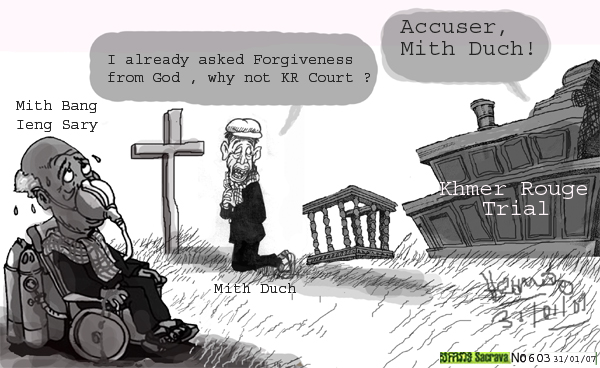
Political Cartoon: Khmer Rouge Trial's Saga

Cartoon by Sacravatoons

Clear and Convincing Evidence

July 2006

Article written by KA Golden West Press

KI-Media would like to thank the author of the article
for graciously allowing us to publish it here.

Looking at Cambodian historical events in retrospective, regardless of the loss of nearly 3 millions innocent Cambodian lives and Cambodian border violations, Vietnam has incessantly been and is continuing to exploit Cambodia for their national political and security interests. The great powers, on the other hand, appeared to show an intense interest in helping to rebuild Cambodia; however, with their own political agenda, their aid has been mismanaged by the Hun Sen government.

It is noteworthy that since the 1960’s, the great powers had been taken Cambodia for granted and used Cambodia as a pawn for their continuing containment policy in the Southeast Asia Region - to reinforce their communist policy on one side and to anti-communist political ideology on the other side. Both sides, were and continue to recruit other countries to be their allies, provide logistical support, and globalize their economy. As a result, it cost the lives and the well-being of nearly 3 millions innocent Cambodian people who perished, and it was imperative that they decided whether the trouble caused by the Cold War Policy/Vietnam war is still worth the price.

In 1978, using “genocide” as pretext, Vietnam diplomatically proposed to ASEAN that they grant them the authority to invade Cambodia. Despite the unanimously rejection voted by the ASEAN against their political scheme, the Hanoi Government of Vietnam executed their vicious political strategy and illegally invaded Cambodia.

In December 1978, of over a hundred thousand Vietnamese troops with heavily arms included armored units, tanks, and aerial bombardment, and accompanied by the lightly armed and brainwashed paramilitary Khmer Rouge defectors, forced their way into Cambodia. Within two weeks, the Vietnamese troops, not only they had occupied, Phnom Penh, capital city of Cambodia, but also swept their Khmer Rouge counterpart up across Cambodia to the jungle in the Northwestern, Cambodia-Thailand border.

The Hanoi Government with a crafty political blueprint at hand, chose not to inform the international community authorities about the atrocities that they had witnessed after they had completely taken over Cambodia, instead, they resolutely planned their political scheme on how to: (1) frame Pol Pot and among a few other Khmer Rouge leaders as the Angkar Leu of the Higher Organization and (2) issue political propaganda to rake up all the Khmer Rouge leaders to capitulate to the new installed government, and (3) the Hanoi government, as a result, was hoping to bring the Khmer Rouge leaders to trial for their alleged war criminals, crime against humanity, and “genocide”.

For that evidentiary reason, in January 1979, the two Vietnamese military photojournalists, Ho Van Tay and Mai Lam, discovered the corpses of several murdered people at the compound/facility, later was identified as “Tuol Sleng Center”, they then informed their Vietnamese authority in Hanoi, Vietnam. David Chandler, in his book, “Voices from S-21 – Terror and History in Pol Pot’s Secret prison”, page 2-6, has summed up the political manipulation and propaganda ramification by the Vietnamese authorities, which deliberately attempted to organize Tuol Sleng Center as the so-called the “The Tuol Sleng Museum of Genocide Crime” for the political purpose of deceiving the Cambodian people as well as the international community:

Sensing the historical importance and the propaganda value of their discovery, the Vietnamese closed off the site, cleaned it up, and began, with Cambodian help, to examine its voluminous archive.

A Cambodian survivor of S-21, Ung Pech, became the director of the museum when it opened in 1980. He held the position for several years and traveled with Mai Lam to France, the USSR, and Eastern Europe in the early 1980s to visit museums and exhibits memorializing the Holocaust. Although Mai Lam remained in Cambodia until 1988, working at Tuol Sleng much of the time, he concealed his “specialist-consultant” role from outsiders, creating the impression that the initiatives for the museum and its design had come from the Cambodian victims rather than from the Vietnamese—an impression that he was eager to correct in his interviews in the 1990’s.

In February or March 1979, Mai Lam, a Vietnamese colonel who was fluent in Khmer and had extensive experience in legal studies and museology, arrived in Phnom Penh. He was given the task of organizing the documents found at S-21 into an archive and transforming the facility into what David Hawk has called “a museum of the Cambodian nightmare.” The first aspect of Mai Lam’s work was more urgent than the second. It was hoped that documents found at the prison could be introduced as evidence in the trials of Pol Pot and Ieng Sary, DK’s minister of foreign affairs, on charges of genocide. These took place in Phnom Penh in August 1979. Although valuable information about S-21 was produced at the trials, none of the documents in the archive provided the smoking gun that the Vietnamese and PRK officials probably hoped to fine. No document linking either Pol Pot or Ieng Sary directly with orders to eliminate people at S-21 has ever been discovered, although the lines of authority linking S-21 with the Party Center (mochhim pak) have been established beyond doubt.

In addition, “The Lost Executioner – A Journey to the Heart of the Killing Fields”, on page 184-185, Nic Dunlop is offered valuable political and conspiratorial information relevant to the “genocide”, which implicates the Hanoi government showing their deliberately attempt to deceive the international community.

There were plans to begin one, hence by Van Tay. Cambodians had only known the leadership as the Organization and not who was behind it; most knew nothing beyond their cooperatives. Ironically it was the Vietnamese, one of the sworn enemies of the Khmer Rouge, who personalized the regime. Democratic Kampuchea became ‘the Pol Pot time’.

By drawing on the parallels with the Nazi death camps, the Tuol Sleng museum was organized as a deliberate attempt to distance the Vietnamese from their former allies the Khmer Rouge. They wanted to vilify the Khmer Rouge and its leaders still further as part of a propaganda war to justify their invasion. Visitors to the museum were encouraged to think of the Vietnamese as akin to the liberators of Europe’s concentration camps.

There was no text narrating progress from room to room. Visitors viewed the museum through a series of images and objects. The intention was to provoke outrage through a primarily sensory experience rather than to enlighten. The Cold War was at its height and, for many in the West, Tuol Sleng was a propaganda tool for a regime that had seized power through an illegal invasion.

All museums are manipulations. Apart from the map made of skulls created by the Vietnamese, the raw displays were graphic and chilling and, although inaccurate in form, were real in substance. The atrocitious nature of the place itself was hard to contrive. The fact that visitors were being manipulated and that the information on display was there to serve a political purpose seemed to pale in comparison when faced with such overwhelming viciousness.

When the United Nations withdrew from Cambodia in 1994, the war between the Hun Sen government and the Khmer Rouge was still intensified in the Northwestern Cambodia. The United Nations had spent 2 plus billion dollars to help rebuild Cambodia, especially, to restore order and to promote justice and monitor fair elections. However, when the United Nations left, Cambodia had to dig her way out of internal social as well as international political issues. There was a lack of security, government safety nets, and especially, the lack of highly qualified appointed representatives in the government administrations. Inevitably, Cambodia fell to the hands of a small notorious groups who had been practicing grafts, human rights violations, and human, arms, and drug trafficking, poverty, child labor, prostitution, land grabbing, deforestation, and serious health issues (HIV/AIDS). Internationally, Cambodia also has to deal with the four plus million illegal Vietnamese immigrants that are already living inside Cambodia and hundreds, if not thousands, which are coming freely into Cambodia everyday, and the illegal border encroachment by the Hanoi government.

Given this golden opportunity and having had their men well-trained and experienced in military combat already positioned on Cambodia soil, the Hanoi Government had the best opportunity to map out their conspiratorial frameworks and politically strategy on how to build the case against Pol Pot and his Khmer Rouge regime. So as part of the political scheme, the Hanoi government imposed on their puppet government to carry out the plans: 1) to outlaw the Khmer Rouge – the purpose of which was to weaken the Khmer Rouge by breaking up their movement, 2) amnesty to be given to the Khmer Rouge soldiers who would choose to surrender to the installed government, and 3) some of the Khmer Rouge defectors would also be rewarded with promotions within the ranks of the Cambodian army.

In 1997, having had the United Nations to help and win as the politically neutral and national reconciliation and unity figures, the two co-Prime Ministers, Hun Sen and Prince Rannaridh engaged in intense negotiations to set up a tribunal to try the former Khmer Rouge leaders. However, due to their disagreements reflecting on their political interests, the tribunal process had never got off the ground.

So as the talks about the tribunal continued, in 1998, Khieu Samphan and Nuon Chea and with a small group of their Khmer Rouge comrades acquiesced to the puppet government. As part of the political negotiations, Khieu Samphan and Nuon Chea were given amnesty and were freely to live in Cambodia, and at the same time, some of their comrades were also given position in the Hun Sen government army.

The Hanoi government had successfully captured two important Khmer Rouge commanders, who had allegedly been involved in the murder of thousands of innocent Cambodian people. The Vietnamese wanted to serve their political interests by putting up some key piece of evidences in the tribunal and to profess to the world that the two alleged war criminal suspects were, in fact, the masterminds behind the mass murder of innocent Cambodian people during the period from 1975-1979. The two alleged war criminal suspects were Ta Mok (the butcher) and Kaing Guek Eav (alias Comrade Duch). Both were arrested in early 1999. Since then, they were being detained and serving time in the same military detention center, Tuol Sleng district of Phnom Penh, waiting for trial.

Voila! Even a Genie could not have granted better wishes or predicted better result. The appropriate term use to describe this political maneuver is the, “3-Hole Cylindrical Fish-Trap”. The Truo Preus Bi in Khmer, which is commonly used by Khmer farmers to trap all kinds of fish, big or small, in the rice paddy fields when water rises or recedes. The Hanoi Government, as planned, had finally auspiciously rounded up all the Khmer Rouge leaders and their comrades, like cowboys round up a herd of cows to go into the corral.

Seven years after the initial talks about the tribunal, in October of 2004, the Hun Sen Government under the Hanoi government’s political domination formed an agreement with the United Nations to try the surviving Khmer Rouge leaders. It was clear that the Hanoi government was in cooperation with the puppet government and had utilized the seven-year delayed to strategize their political objection and in fact, by 1999, they trapped all the Khmer Rouge leaders. And now that the Khmer Rouge leaders are in their cylindrical fish-trap, the green light is on for tribunal.

The tribunal is set to go and the national and international judicial officers have recently sworn in, but not without the great disappointment, especially, for the Cambodian people. The Khmer Rouge tribunal will be conducted using Cambodian judicial systems rather than the international judicial standard. The legal experts, Human rights organizations, and the public have raised important legal and political concerns about this tribunal that is set to convene: (1) it would be subject to political bias, corruption, and manipulation, (2) it would be likely to go on for more than three years and by then the alleged war criminal suspects would probably be dead (due to old ages, medical problems, and/or to “mysterious” death while in jail because of the lack of proper witness protection programs), and the court would have no verdict to render to the Cambodian people other than the verdict of “no verdict” due to “technical errors”, and (3) therefore, real justice would not be forthcoming and the victims, once again, would have left with nothing but their painful memories.

For more than 30 years, the hope and dream for justice that we the victims have been waiting for is finally in the hands of those thirty judges. Although, this tribunal is set to focus on political implications and legal issues within the specific window periods (i.e., war criminal activities, crimes against humanity, and political implication that led to the death of nearly 1.7 million Cambodian people from 1975 to 1979), let’s hope the legal issue of “following orders” would come up during the trial. Although the prosecution teams may have objected to the issues of “following orders” raised by the defense counsels and the judges may have sustained the objection due to irrelevant and/or speculations, but it would be very an eye-opening for the world to at least hear from the mouths of those alleged war criminals testifying in court, “I was following orders from the Angkar Leu of the Higher Organization”. Kaing Guek Eav (alias Comrade Duch) confessed during the interviewed by Nate and Nic in Samlaut, April 1999, “Once you were given an order by the Organization, you couldn’t refuse.” Most importantly, it would be a very important testimony that could lead to the questions as to whom were the real Angkar Leu (Higher Organization) that slaughtered nearly 1.7 million innocent Cambodian people from 1975-1979.

Based on my infinitesimal legal and political observation on Khmer Rouge tribunal, regardless the result of the verdict “guilty” or “not guilty”, we, Cambodians, have already lost. We lost since the 1960’s, when the 14 SEATO Nations and the great powers denied our requested to recognize our country, Cambodia, as an independent, neutral, and territorial integrity. For most Cambodian survivors who had never seen the true light of justice for more than 30 years, the tribunal is all their only hope for closure. As for me, the Khmer Rouge tribunal is so complex and cryptic – political-motivated and manipulated as well as internationally controversial, which even the great powers would neither acknowledge nor to get involved in. Thus, what is left is our courage and conviction. We Cambodian people should come together and continue to use democratic and non-violent principles to fight for justice, peace, and freedom, and at the same time let’s we all pick up what is left and build for our Kuon Khmer future generations to come because there are many great challenges ahead of us. I personally believe a true road to a more stable, peaceful, and free for Cambodia would be for us, to bring in all the resources that we now have to help rebuild our beloved Cambodia.

Henceforth, let’s make no mistake! There is nothing affirmative about the future of Cambodia, but for the past four decades we have learned important lessons that we, Cambodians, could to prevent a similar atrocity from happening again in the future. We have also learned what really happens when the final decision in matters of war and peace is left solely in the hands of a few corrupt and ruthless dictators/political leaders. In our history, there has never been a better time, at least since the time I was born, for Cambodian people to examine the facts and to exercise our democratic right to be heard. Although, we still have one important question that remains to be answered, “How can we, the Cambodian people, best save Cambodia from future wars that could lead to another Killing Fields and lose of our territory?” The Cambodian people in this early 21st Century of democracy should at least have the power to participate in the most important decisions of our future.

Finally, it is time we recognize that ours loses were tragic and unfortunate that led to nearly 3 million deaths of our innocent Cambodian people and “possible” lost of territory (i.e. territory that was illegally encroached by Vietnamese and the 2005 “Unconscionability” Cambodian-Vietnam Border Treaty). Frankly, we would be dishonored the memory of our Khmer people who were viciously murdered, died of starvation, and illnesses under that “mysterious” regime and by the Vietnamese invasion if we now give way to feelings of “apathy”. Every one of our beloved Khmer people who had lost their lives during that dark times, deserve our gratitude, our respect, and our continuing concern.

Sources and Supplemental Readings:

David Chandler (1999): Voices from S-21 – Terror and History in Pol Pot’s Secret Prison

David P. Chandler (1991): The Tragedy of Cambodian History – Politics, War, and Revolution since 1945

Nic Dunlop (2005): The Lost Executioner – A Journey to the Heart of the Killing Fields

http://www.aiipowmia.com/sea/nurouge.html

http://www.washingtontimes.com/commentary/20040502-121032-5549r.htm

http://amekhmer.free.fr/index_files/1photo-choc1/K5-en.htm

http://www.dailyexcelsior.com/99jan22/inter.htm#5

Cambodia's infamous motorbike taxi drivers to learn their lessons

Jan 31, 2007

DPA

Phnom Penh - Cambodia's cavalier motorbike taxi drivers, or motodops, are to be provided with a school to try to reign in their notoriously dangerous driving, an official said Wednesday.

Ung Chung Hour, director of the Land Transport Department of the nation's Transport Ministry, said media reports detailing litanies of dangerous and sometimes drunken exploits of motodops who understand little about road rules and care about them even less had prompted him to set up a school.

'The school will teach them how to drive for free. However, at the end of the course, they will have to pay about 10 dollars to sit an exam and receive a license,' Chung Hour said.

'The idea is to encourage them to do a driving course before they start their business, the same as in more modern countries. I will be very happy if the idea runs smoothly, and I have asked the government for financial assistance to get it started.'

At least one private company has also already donated chairs for the budding students and will provide the licenses for those who pass, he added, and he hopes aid organizations will also help.

Chung Hour has tailored his own course, including writing the lessons himself. The course will cover basic road rules as well as safety modules on issues such as effects of drinking and driving in a country where prosecution for the offense is unknown.

'I want to make a difference. I want to make an achievement to public safety that is remembered,' Chung Hour said.

There are no statistics for the number of motodops operating in Cambodia at any one time as they are not licensed and there are currently no restrictions on who can up take the occupation.

The streets of major towns and cities are filled with motorbikes offering the cheap door-to-door moto taxi service and it is a popular way for provincial people seeking work in the capital to earn an interim living after they arrive.

News of the course was met with indifference by motodops surveyed Wednesday, many of whom saw it as an additional tax and worried that time spent in the classroom would take away from time that could be spent earning money.

But the rapidly increasing road toll has become a cause of concern to the government as roads improve and traffic increases, and there is increasing pressure to improve road safety measures from both the government and concerned non-government agencies.

These concerns could be at least partially allayed by ensuring taxi drivers know the rules of the road, according to Chung Hour, who says his free course will soon be followed by tougher measures.

'The course begins in February. After six months or so, when we know how long it takes to teach, we will look at imposing fines for drivers who do not have a license,' he said.

Cambodia hosts Corps for first time

1/31/07

By Rachael Moreau
The Daily Reveille (Louisiana State University, LA, USA)


Molly Sheffield, University alumna, is taking 27 months of her life to live in a remote area of the world and work in less-than-desirable conditions for no pay.

Sheffield is one of 30 Peace Corps volunteers who left today for Cambodia.

According to a news release by the Peace Corps, Cambodia is the 139th country to host volunteers. This is the first time Cambodia will host Peace Corps volunteers.

"The primary goal of this first group will be education," said Shannon Borders, Peace Corps public affairs specialist.

In Cambodia, Sheffield will serve as an English teacher supporting and teaching local teachers.

"Molly's work and education experience indicated that she would be a very strong education volunteer. She automatically qualified," said Michael Salazar, Peace Corps regional coordinator.

According to another Peace Corps news release, Sheffield was involved in many volunteer organizations while at the University. She volunteered frequently with Chapel on the Campus, tutoring international students in English. Sheffield also studied abroad and later went to Asia.

"I've always had a passion for other cultures, and that encouraged me to pursue my degree in international relations," Sheffield said in a news release.

According to the news release, the volunteers will also work on "community-initiated programs, the promotion of life skills and the achievement of sustainable community activities."

Salazar said Sheffield had to be cleared on many different levels in order to finally be admitted into the Peace Corps program.

Once Sheffield arrives in Cambodia, she will "spend three months in intensive training where she will learn the language, have cross-cultural training as well as learn more technical skills to help her be more proficient in her profession," Borders said.

After completion of her training, Sheffield will be officially sworn in as a Peace Corps volunteer on April 4, 2007, and begin her two years of work in Cambodia.

-----
Contact Rachael Moreau at rmoreau@lsureveille.com

Cambodian airline to open Wuhan-Siem Reap direct service

January 31, 2007

Cambodia's Angkor Airways is to launch a direct flight between the central Chinese city of Wuhan and Siem Reap, home of Cambodia's famous Angkor temples from Feb. 12.

Lin Hua, of the Tianhe Airport in Wuhan, capital of Hubei Province, said the airline would operate a regular service every six days between Feb. 12 and March 10, before raising the number to two flights per week.

The flight would take three hours and 40 minutes one way, Lin said.

The flight would depart Siem Reap at 9:40 a.m. local time and land in Wuhan at 2:20 p.m. local time, and the return flight would depart at 3:20 p.m., Lin said.

"The new international flight will boost the tourism cooperation between Cambodia and central China's regions," Lin said.

Angkor Airways also planned to open a direct service between Wuhan and Phnom Penh before the traditional Chinese Spring Festival which falls on Feb. 18, said Zheng Min, a senior executive of the company's China office.

Last year, the company launched a direct flight between Phnom Penh and the southwestern Chinese city of Chengdu, and between Siem Reap and the southwestern city of Kunming, she said.

"Ever since, Chinese tourists to Angkor have been increasing," she said.

Source: Xinhua

Hunger Cited in Death of Jailed Hilltribe Man

Wednesday, January 31, 2007

By Kuch Naren
THE CAMBODIA DAILY


A hilltribe minority man, jailed for almost a year without trial for allegedly destroying property on a Mondolkiri province land concession, died Monday of hunger-related complications, hospital and rights workers said.

A human rights worker in the province said Tuesday the death was the result of neglect at Mondolkiri Provincial Prison. A high-ranking prison official said he would investigate the matter.

Nhoeth Thy, 47, a member of the Phnong ethnic minority from Pou Trou village in O’Reang district's Sen Monorom commune, died at 10 am, according to Nou Somethea, a doctor at Sen Monorom Referral Hospital.

Nhoeth Thy was pale and suffering from a severe protein deficiency when he arrived at the hospital at 9:30 am, Nou Somethea said.

The prisoner convulsed and died 30 minutes after arriving at the hospital, the doctor said adding that hospital staff were unable to revive the man.

Nou Somethea said he suspected the detainee had also contracted malaria, which may have brought on a blood disorder called hemolysis, in which red blood cells degenerate rapidly.

"There was no torture involved in the death," he added.

Em Veasna, an investigator for the human rights NGO Vigilance, who visited the prisoner in hospital, said Nhoeth Thy had been left to die by prison authorities.

"This is absolutely the mistake of prison guards who neglected to provide medical treatment and supply enough food for prisoners," he said. "Prison guards failed to send the victim to hospital, which aggravated the victim's sickness, and he could not survive."

Mondolkiri Provincial Prison Director Ang Kimleng could not be reached for comment Tuesday.

Prison guard Prum Vanna, who accompanied Nhoeth Thy to hospital, said Tuesday that hunger was a problem at his prison but said the detainee had only begun to have stomach problems Sunday evening.

Two other prisoners are also being treated at the hospital for other hunger-related sicknesses, Prum Vanna said, adding that Nhoeth Thy may have been underfed but had not starved to death.

"That prisoner never had any sickness in prison before because he could work, walk and exercise well," he said.

Nhoeth Thy was arrested early last year and held without trial after being accused of burning grasslands which resulted in the destruction of trees on the Wuzhishan pine tree plantation, according to Em Veasna.

Nhoeth Thy had also protested against the plantation, according to Sam Sarin, provincial coordinator for the rights group Adhoc.

"Only one villager was arrested last year over the allegation of destroying the company's pine trees," he said.

Heng Hak, the newly appointed director-general of the Prison Secretariat, which was created earlier this month, said Tuesday that he had not yet been informed of the death but that he would investigate.

"I haven't received information about this case yet, but I realize that there is some problem with the food supply because the prisoners in each prison used to get only [$0.25] per day [in food]," Heng Hak said.

"Recently the government increased the food per diem to [$0.38] so we can help them a little right now with the food supply," he said.

"I will investigate this case to verify whether he died because our food supply was not enough to feed him," he said

Cambodia's notorious prisons have consistently been criticized over poor conditions and the mistreatment of inmates.

Video footage obtained in August appeared to show police special forces gunning down unarmed prisoners, at least eight of whom were killed, in the June 18 siege at Battambang Provincial Prison. Prison officials claimed at the time that the inmates had committed suicide with a grenade.

Violent suppression of a March 2005 siege at Kompong Cham province's CC3 prison left 17 inmates dead. Prison officials later denied that unarmed inmates had been gunned down despite published newspaper photographs, which appeared to show handcuffed bodies in the prison.

Interior Ministry spokesman Lieutenant General Khieu Sopheak said Tuesday that his ministry was making sustained efforts to improve conditions for inmates, such as allowing exercise, vocational training and agriculture programs.

Food for prison inmates, however, had to compete with other needs, such as the low salaries of Interior Ministry officials, some of whom make as little as $20 a month.

"I think that [between whether] to increase the amount of money for the prisoners [or] to increase the salary of government officials, the government must be top priority," he said.

"If we take the blanket to cover our feet, our heads will be cold. If we cover our heads, our feet will be cold. That is the situation today."

(Additional reporting by Douglas Gillison.)

Defendant Must Appear Once for KR Trial To Proceed

Wednesday, January 31, 2007

By Erika Kinetz and Pin Sisovann
THE CAMBODIA DAILY


The Khmer Rouge tribunal's rules committee has tentatively agreed that trials will be permitted if a defendant appears in court at least once, and that victims can participate as civil parties to the court, sources close to the tribunal said Tuesday.

By the end of its two-week deliberations Friday, the nine Cambodian and international judges on the rules committee had agreed in principle that if a defendant appears in court once or more, a trial may proceed, three people close to the court said on condition of anonymity.

In addition, the committee has tentatively agreed that victims will be allowed to file claims as civil parties to the Extraordinary Chambers in the Courts of Cambodia, but financial compensation has been ruled out, another person close to the court said.

Helen Jarvis, the ECCC's chief of public affairs, declined comment Tuesday on the question of trials in absentia and the participation of civil parties, and said she could not comment further on the rules committee's discussions.

The committee failed to reach a final agreement on the rules Friday, and will meet to continue its negotiations in March.

Several international legal experts Tuesday said the provisional agreements are consistent with international legal norms.

But Kek Galabru, president of local rights group Licadho, said there needs to be assurance that defendants spend more than one day in the dock.

"Why only one time? They should come all the time," she said.

The conditions under which a defendant might be allowed to leave the courtroom after a single appearance remain unclear.

"The only way this would be a problem is if they brought someone to trial but didn’t arrest them and the person fled," one legal observer said on condition of anonymity.

Local rights group Adhoc, among others, has argued that permitting individual victims to file civil claims will add to the breadth of the trial.

Youk Chang, director of the Documentation Center of Cambodia, said compensating individuals for the crimes of the Khmer Rouge was "impossible," but urged the court to examine the assets of the regime's former leaders.

"There's so much money that has been routed to the Khmer Rouge, by China, for example," he said.

"If those assets can be located and used for a public monument it could be beneficial."

Child-Rapist Gets 15 Years; Youngest Victim Was 6

Wednesday, January 31, 2007

By Chhay Channyda and Elizabeth Tomei
THE CAMBODIA DAILY


A former children's NGO worker was sentenced to 15 years in prison for raping four young girls in Pursat province, one of whom was around 6 years old when the attacks started, officials said Tuesday.

Pursat Provincial Court Judge Son Neatheavy said that Oeu Yoeum, 55, was also ordered at his trial Thursday to pay $1,500 in compensation to his four victims, now aged between 8 and 13.

Oeu Yoeum was arrested and confessed in May 2006, after mothers of the girls complained to police, said Sy Kiry, deputy provincial police chief. The oldest of the girls, who is now 13, said Oeu Yoeum began raping her in 2000, Sy Kiry added.

Ven Lonn, provincial monitor with local rights group Licadho, said that Oeu Yoeum was a part-time employee at the Light of Children aid organization in Talou commune's Tuol Thmar village located in Bakan district, where he and all four girls lived.

"He was a friendly guy in the village, so villagers liked and trusted him," Ven Lonn said. "He threatened the girls not to tell their parents, otherwise they would be killed," he said, adding that Oeu Yoeum raped the children repeatedly, often in their houses or at his own.

Contact details for the Light of Children organization were unavailable Tuesday.

Ven Lonn added that the girls are currently receiving care from a reputable aid organization in Phnom Penh.

60 macaque monkeys caught taking taxi out of Stun Sen

Wednesday, January 31, 2007
Taxi Driver Caught With 60 Monkeys in Backseat

By Kay Kimsong and Elizabeth Tomei
THE CAMBODIA DAILY

More than 60 macaque monkeys discovered in the back of a taxi are being held in Kompong Thom province while officials try to determine whether they were being transported illegally, officials said.

The 64 macaques were confiscated in Stung Sen district Jan 23 and are now being held at the Kompong Svay district forestry office, said Chea Chan Thoeun, the office's deputy chief.

"We have to keep the monkeys for evidence," he said.

Police confiscated the primates from a driver carrying photocopied government documents stating that a breeding farm in Kompong Cham province's Cheung Prey district had permission to buy monkeys, he said. The farm breeds and sells monkeys for medical research purposes, he added.

But officials are concerned that the documents may have been forged. They also suspect that the monkeys were being illegally smuggled, either by the farm, which may have wanted more monkeys than it was officially allowed, or to Vietnam, Chea Chan Thoeun said.

He declined to provide the contact information for the farm in question.

There were originally 67 macaques, but three of them have died at the office because they were young and sick, Chea Chan Thoeun said. The driver of the vehicle, who was carrying the monkeys in sacks, was not arrested.

Nev Broadis, animal husbandry specialist at environmental NGO WildAid, said WildAid is ensuring the macaques are cared for while they are held at the forestry office, though he did not elaborate.

Nick Marx, also an animal husbandry specialist at WildAid, said illegally traded macaques can fetch about $90 each.

"There's a huge illegal trade," he said.

He added that the officials in Kompong Svay are trying their best to look after the primates, but that the odds are ultimately against them.

"They're doing great work confiscating more wildlife, but they don't have the facilities [to care for the monkeys]," he said.

Retired King Seeks Jobs for Repatriated Women [- One China Policy detrimental to help for abused women]

Wednesday, January 31, 2007

By Yun Samean and Douglas Gillison
THE CAMBODIA DAILY


Retired King Norodom Sihanouk has requested that the government find work for any Cambodian women repatriated at his expense after being forced into prostitution or left homeless in foreign countries. In a handwritten note—added to a letter—the retired King asks the National Assembly, the Senate and the government to find "honorable employment" for the women that the retired King offered to have flown back to Cambodia in a statement Saturday. National Assembly First Deputy Resident Nguon Nhel said that he supports the retired King's decision to transport the women home, but added that it could be difficult for destitute Cambodians living in Taiwan to return because of Cambodia's lack of diplomatic relations with the island state.

General Khieng Savorn released due to poor health, Mu Sochua demands for all charges against him to be dropped

Wednesday, January 31, 2007
RCAF General Released on Bail in Battambang

By Saing Soenthrith and John Maloy
THE CAMBODIA DAILY


Battambang Provincial Court on Monday released on bail the second of three RCAF generals arrested earlier this month on suspicion of involvement in organized crime. Brigadier-General Khieng Savorn, a member of the SRP’s steering committee, was released on bail due to poor health, said his lawyer Kim Meng. Kong Naren, Battambang prison chief, said he had a release letter from investigating judge In Sophors allowing the release, which was guaranteed by his lawyer. SRP Secretary-General Mu Sochua said that the general's deteriorating health proves he wasn’t involved in organized crime. "We want all charges to be dropped," she added.

UNHCR Awaits Gov't OK For Montagnard Mission

Wednesday, January 31, 2007

By Douglas Gillison
THE CAMBODIA DAILY

Two weeks have elapsed since the UN High Commissioner for Refugees asked the government to allow a joint mission to retrieve 10 Montagnard asylum seekers from the jungles of Ratanakkiri province, a spokeswoman for the UN agency said Tuesday. "We're waiting for a green light from the government," Inge Sturkenboom said. Foreign Ministry Secretary of State Long Visalo did not comment. Adhoc's provincial coordinator in Ratanakkiri, Pen Bonnar, said the 10 are in two groups of four and six. Sturkenboom also said Tuesday that three Montagnard women, three men and five children had traveled to UNHCR’s offices Jan 24 and had begun seeking asylum.

Council of Ministers May Allow Civil Servants To Extend Service [- Son Chhay: Gov't should be trying to reduce the number of aging officials]

Wednesday, January 31, 2007

By Yun Samean and John Maloy
THE CAMBODIA DAILY

The Council of Ministers is considering a proposed decree that would ensure the right of civil servants to be promoted just before they retire, thereby deferring their official retirement age by two years, officials said Tuesday.

Low-ranking government officials are currently required by law to retire at 58, but medium- and high-ranking officials can continue in their positions until they are 60.

Many low-ranking officials are currently being refused promotion as they approach 58, said Touch Seang Tana, undersecretary of state at the Council of Ministers, but the draft decree would change this.

The proposed legislation states that age should not be taken into consideration when promoting somebody.

This would eliminate the barrier to promotion, Touch Seang Tana said, and give an extra two years of service to people the government finds useful. "We just want to give a fair chance to all the people," he said

Some civil servants currently continue to work for the government after retirement, but as paid consultants, Touch Seang Tana added.

CPP lawmaker Nguon Nhel said that all civil servants must retire by 60, but some with "special skills or knowledge" are allowed to hang on to their positions after this. These officials are paid "special bonuses" for their expertise, he said, but did not elaborate.

The government should be trying to reduce the number of aging officials in Cambodia's corpulent civil service, rather than lengthening their contracts, SRP lawmaker Son Chhay said.

Elderly and often under-qualified civil servants are employed in nearly every government institution and ministry, despite the country having plenty of better-educated young people who can’t find work, he said.

Koul Panha, director of the Committee for Free and Fair Elections, said that the compulsory retirement age is commonly ignored already, particularly in the case of high-ranking officials.

Political Cartoon: Dalai Lama & One CHINA policy

Former KR Families Will Honor Regime's Ambush Victims

Wednesday, January 31, 2007

By Kay Kimsong
THE CAMBODIA DAILY

More than 100 former Khmer Rouge families living around Phnom Voar in Kampot province will hold a Buddhist ceremony on Thursday to honor at least 10 Cambodians and three Westerners killed in a 1994 Khmer Rouge train ambush, officials said. The ceremony will also honor thousands of villagers from the area who died during the Khmer Rouge regime, said Keo Kim, chief of Dang Tong district's Sre Chea Khang Choeung commune. Invitations to the ceremony have been sent to the parents of the Australian, British and French victims and to their embassies in Phnom Penh, said Chen Chanrathana, president of Phnom Voar Development Community, the NGO organizing the ceremony. So far, only the French Embassy has confirmed attendance, he said. The ceremony will take place at Snach Prey Baramei Phnom Voar, a wat that was turned into a prison by the Khmer Rouge, according to Dien Dy, who is bringing more than 90 monks from Phnom Penh to attend the ceremony.

Theft of $12,000 cash carried by CPP MP reveals that she is also moonlighting at a private school

Wednesday, January 31, 2007
School Payroll Stolen From CPP Lawmaker's Purse

By Chhay Channyda
THE CAMBODIA DAILY

A thief relieved CPP lawmaker Khuon Sodary of $12,000 in cash on Tuesday morning while the female parliamentarian attended a conference on administrative reform at a Phnom Penh hotel, police said. Khuon Sodary left her cash-filled handbag unattended during a bathroom break at the conference for National Assembly and Senate members, and when she returned the cash was gone, police said. "She left her seat for the restroom, leaving her black handbag on her chair," said Song Ly, Phnom Penh's minor crime police chief. Contacted by telephone, Khuon Sodary said the wedge of money was the January payroll for a private school where she works but which she declined to name. "Coming back, I saw my bag was moved to another seat," she said, adding that she felt she was in safe company. Khuon Sodary said she had filed a complaint with the Interior Ministry over the theft.

Saddam Execution Bad Omen for ECCC, Former Khmer Rouge Say

Wednesday, January 31, 2007

By Thet Sambath and Erica Kinetz
THE CAMBODIA DAILY


BANTEAY MEANCHEY PROVINCE – For many former Khmer Rouge cadres in the border districts of Malai and Pailin municipality, the recent trial and execution of Iraqi dictator Saddam Hussein has come to serve as a miserable yardstick of international justice. And thanks to the televised images of a harangued Saddam seconds from death on the gallows, a troubling new image hovers over the work of the Extraordinary Chambers in the Courts of Cambodia.

The majority of those interviewed in these former rebel strongholds sharply questioned the quality of justice the Khmer Rouge tribunal is likely to deliver and many said they would rather the ECCC not proceed.

The first lesson of the Iraq Special Tribunal, several former Khmer Rouge members said, is that a trial for crimes committed in the past does not guarantee peace and reconciliation today.

The execution of Saddam only added fuel to the fire of war in Iraq, said Keut Sothea, deputy governor of Pailin municipality.

Keeping in mind the religious and political factionalism that has sundered Iraq, Keut Sothea said the ECCC should proceed with caution. "There should not be discrimination against the Khmer Rouge," he added.

When asked why he thought the Khmer Rouge tribunal has faced so many delays and obstacles, Long Narin, who worked at Democratic Kampuchea's Foreign Ministry under minister Ieng Sary, said that Prime Minister Hun Sen knows what’s best for the country.

"Hun Sen thinks about what is good and not good for this trial," Long Narin said. "For example, if you have a trial and people are not happy and they protest, what will they do to them? Use the police. Then there will be a problem."

Though technically a domestic court, the Iraqi court is widely perceived by former Khmer Rouge to have been stage-managed by the US, which has thus deepened skepticism of Cambodia's tribunal.

Jeff Daigle, US Embassy spokesman, said speculation about US control of the Iraqi court was unfounded. 'The trial was completely in the hands of the Iraqis," he said. "It was an Iraqi process."

But former cadres such as Phe Tha, 47, are not convinced by such denials and also unconvinced that the tribunal in Phnom Penh won’t be a similar exercise in victor's justice.

"Right now, the weak people are always wrong. The strong people are always right," he said.

Despite their unease and mistrust of the ECCC, the only fight left in the former rebel zones these days is the struggle to make a living.

"The Khmer Rouge had many wars," said Sear Mot, 55, a former cadre who owns a carpenter's shop in Pailin. "It’s enough."

Beneath the peace that has come to the former rebel areas on the border, the image of a beautiful, lost revolution, presided over by men who made mistakes but loved their people, still burns quietly.

The Khmer Rouge, said Long Narin, created more than a killing machine; they launched a strike against US imperialism.

"It was also an idea, a protest," he said of the Khmer Rouge revolution and the Democratic Kampuchea regime it fostered. "People forget that," he added "Now it is just about killing."

Heng Samrin is wooing Russia with Cambodian oil

31/01/2007
Russia eyes Cambodia's potential oil wealth Cambodia

Australian Broadcasting Corporation

Cambodia says Russia has joined a number of foreign powers eyeing Cambodia's petroleum reserves.

The President of Cambodia's National Assembly, Heng Samrin, says Russian officials have expressed interest in oil exploration off Cambodia's southern coast.

The expression of interest came during a recent meeting of regional legislators.

He says while Cambodia welcomes Russia's overtures, no firm agreement has been made.

Two years ago, petroleum was discovered by US energy giant Chevron Corporation off Cambodia's coast.

Since then, firms from France, South Korea and Japan are reportedly seeking exploration licenses.

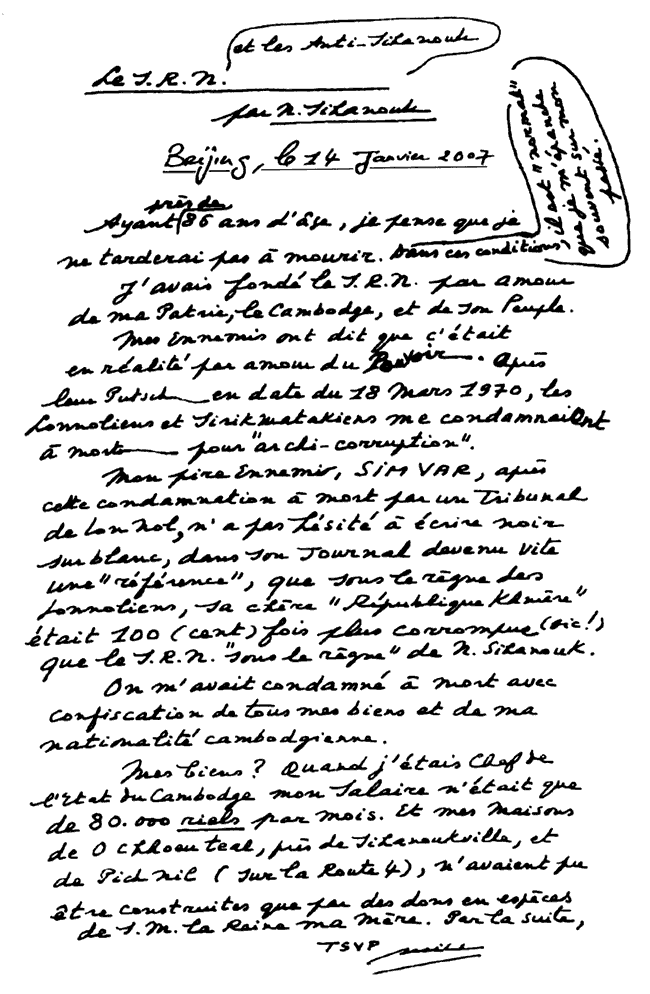
The Sangkum Reastr Niyum (SRN) and the Anti-Sihanouk [people]

Translated from French by Luc Sâr

The Sangkum Reastr Niyum (SRN) and the Anti-Sihanouk [people]

By N. Sihanouk
Beijing, January 14, 2007

Being almost 86-year-old, I believe that I will die soon. Under this condition, it is “normal” that I often pour out my feelings on my past.

I founded the SRN because of my love for my Homeland, Cambodia, and for her People.

My enemies are saying that it was in reality for my love of Power. After their putsch dated March 18, 1970, the Lonnolians and Sirikmatakians sentenced me to death for “ultra-corruption.”

My worst enemy, Sim Var, following this death sentence by a Lon Nol Tribunal, did not hesitate to write, black on white, in his newspaper which quickly became a “reference,” that under the reign of the Lonnolians, his dear “Khmer Republic” was 100 (one hundred) times more corrupt (sic!) than the SRN “under the reign” of N. Sihanouk.

They sentenced me to death with the confiscation of all my wealth and my Cambodian citizenship.

My wealth? When I was Head of State of Cambodia, my salary amounted to only 80,000 riels per month [approx. US$ 2,700 in the 60s]. And my houses in O Chhoeu Teal, near Sihanoukville, and in Pich Nil (on National Road 4), could only be built through cash donations by H.M. the Queen, my Mother. Later on, I offered the ownership of these 2 villas (O Chhoeu Teal and Pich Nil), as well as my birth home (Teak Sen Phirum) located near the Independence Monument, to the Cambodian State.

The royal villas located in Kirirom belong to the Khmer State.

As for my bank accounts, they are zero in Switzerland, and zero in the UK, in contradiction to the accusations made by the like of In Tam.

Currently (2007), my “estate” in a French bank and in a Chinese bank amounts, in total, to about US$ 150,000 (one hundred and fifty thousand).

Lon Nol, Sirik Matak, Cheng Heng and Co. only knew, before their putsch, the high point of [their] honors, rank and money, thanks to the SRN.

They shot down the SRN and dragged it to the mud, with the help of the like of Bernard Hamel, Charles Meyer, etc…, because the SRN, being one hundred times less corrupt than their “Khmer Republic” – from the (written) confession of Sim Var itself – prevented them to push [too] far their corruption and fought “with too much ardor and seriousness” against all form of corruption. And since the Lon Nol, Sirik Matak, Sim Var, Cheng Heng, Trinh Hoanh, and the like, only dreamt of selling Cambodia to the super powerful and rich USA in order to bring in all kinds of benefits for themselves, these Anti-Sihanouk [people] ended up tolerating the survival of the SRN whose sacred mission was to safeguard at all cost the total independence of the Homeland, its neutrality and territorial integrity.

Last but not least, the Anti-Sihanouk [people] considered as an “unforgivable crime” the choice of Buddhist Socialism, i.e. pro-Little People [ordinary citizens] and anti-Social Justice, i.e. anti-Capitalist.

A “crime” “against the Army”: the rejection of the (too conditional and shameful) aid by Uncle Sam.

Too many unforgivable “crimes.” The sentence to death on Sihanoukism (SRN) became unavoidable.

“Alas” for them, these super-intelligent Lonnolians, Sirikmatakians, Simvarists, did not foresee the State Power grabbing in Kampuchea by the Khmer Rouge, nor the vile defeat of their Boss, the USA, on April 17, 1975.

(Signed) Norodom Sihanouk

Duch-the-Executioner may be the first one to be accused by the KR Tribunal

30 Jan 2007
By San Suwith
Radio Free Asia

Translated from Khmer by Socheata

Kaing Guek Eav, Former Tuol Sleng (S-21) warden and also known as Duch, could become the first person accused and brought to justice regarding the genocide committed under the Khmer Rouge regime.

The name of Duch being the first one to be accused, was revealed during an information visit of the Khmer Rouge Tribunal by a group of more than 500 commune and sangkat councilors this Tuesday.

It is expected that the revelation of Duch’s name could lead to the fact that other Khmer Rouge leaders – such as Khieu Samphan, Nuon Chea and Ieng Sary – will also be brought in to face justice.

Ieng Sary undergoing heart treatment in Thailand [- He may not come back home this time: Ieng Vuth]

30 Jan 2007
By San Suwith
Radio Free Asia

Translated from Khmer by Socheata


Ieng Vuth said this Tuesday that Ieng Sary, his father and an important former Khmer Rouge leader, is currently undergoing medical heart treatment in a hospital in Bangkok.

Ieng Vuth declined to provide details on his father’s condition except to say that his father usually go to Thailand for regular heart checkup, however, he said that he is not sure if his father will be allowed to return back home or not this time.

The 77-year-old Ieng Sary who could be brought to face justice by the Khmer Rouge Tribunal for genocide, underwent two previous heart surgeries in the past.

Cambodia's "One China Policy" is detrimental to abused Cambodian women stranded in Taiwan

Hor Nam Hong on Cambodian women stranded in Taiwan

30 Jan 2007
By Hassan
Radio Free Asia

Translated from Khmer by Socheata

Following news of Cambodian women being mistreated by their Taiwanese husbands or fiancés once they arrived in Taiwan, what plan does the Royal Government of Cambodia has to help protect the rights of its own citizens when they suffer hardship overseas?

Hor Nam Hong, Minister of Foreign Affairs and International Cooperation, told reporters that some of these women are also at faults: “We don’t know their exact number because (1) they left in secrecy on their own, and (2) they are tricked by people who cheated them and took them there. Therefore, we don’t have the exact number. It’s only when they show up in our embassy that we learn about it. In the past, we ask the International Organization for Migration (IOM) to transport some [women] from Malaysia, Indonesia. Now we have problems in Taiwan which we read about on the Internet, we are currently asking the IOM to investigate because we don’t have [diplomatic] relationships with Taiwan. Only NGOs can follow up with Taiwan.”

The uneducated "doctor in education" PM and his "tourist doctor" minister

Hun Sen thanks Vietnamese University

30 Jan 2007
By Hassan
Radio Free Asia

Translated from Khmer by Socheata

Prime Minister Hun Sen displayed his gratefulness to the Vietnamese high level education institution which recognized his craftsmanship in education, and bestowed upon him an honorary doctorate degree for this recognition.

During the ceremony where he was presented with the honorary doctorate degree in Phnom Penh on 29 Jan, Hun Sen said: “On this grand occasion, I am honored and very delighted, I am moved by the decision of the Hanoi National Education University and the Vietnamese University of Economy, in the name of the Royal Government of Cambodia and in my own name, as well as that of H.E. Sok An, I am deeply thanking the leadership evaluation committee, as well as all doctors, professors, and members of the Hanoi National Education University, and the Vietnamese University of Economy, who conferred on me the honorary doctorate degree in education, and the honorary doctorate degree in tourism to H.E. Sok An.”

The tribulations of an Aussie football (soccer) coach in Cambodia

Cambodia national soccer team coach Scott O'Donell (L) of Australia gives instructions to Cambodia's under-23 national team before a friendly soccer match at the national stadium in Phnom Penh January 28, 2007. Despite his on-screen, laid-back demeanour while working as a television soccer pundit, O'Donell reckons his job is one of the toughest in the game. When away from air-conditioned Singapore TV studios, the lofty Australian has been dealt the unenviable task of turning Asian strugglers Cambodia into a respectable soccer team. Photo taken January 28, 2007. To match feature SOCCER-ASIA/CAMBODIA REUTERS/Chor Sokunthea

Cambodia under-23 national soccer players warm up before a friendly match against South Korea's Ulsan FC at the national stadium in Phnom Penh January 28, 2007. Despite his on-screen, laid-back demeanour while working as a television soccer pundit, Cambodia national soccer team coach Scott O'Donell reckons his job is one of the toughest in the game. When away from air-conditioned Singapore TV studios, the lofty Australian has been dealt the unenviable task of turning Asian strugglers Cambodia into a respectable soccer team. Photo taken January 28, 2007. To match feature SOCCER-ASIA/CAMBODIA REUTERS/Chor Sokunthea


Australian coach wants respect for Cambodia

By Martin Petty


PHNOM PENH, Jan 31 (Reuters) - Despite his on-screen, laid-back demeanour while working as a television soccer pundit, Scott O'Donell reckons his job is one of the toughest in the game.

When away from air-conditioned Singapore TV studios, the lofty Australian has been dealt the unenviable task of turning Asian strugglers Cambodia into a respectable soccer team.

With unfit players, a shortage of cash and only a couple of decent soccer pitches, he says being national team coach is far from a breeze.

"It's tough and I didn't really know what I was getting into," O'Donell told Reuters in an interview.

"It's no real surprise Cambodia hasn't had much success. Some of the teams have to train on basketball courts. That's a real struggle when you're trying to develop footballers."

The former Australian, Malaysian and Singaporean league player admits he has his work cut out if Cambodia are to climb from their position of 176 in the FIFA rankings.

His priorities, he says, are to improve facilities, promote professionalism and make his team of students and security guards work harder for their meagre $80-a-month salaries.

"I've tried to instil some discipline and commitment. I've got a great bunch of boys, they're working hard and they're responding well," said the 39-year-old.

"But I have to start right from the bottom because most of the players have never been coached. They taught themselves how to play, so I'm always having to correct their mistakes."

BUMPY PITCHES

O'Donell admits he is desperate to improve facilities for his team but in a war-scarred country where a third of the people live on less than $1 a day, there is little in state coffers for decent training surfaces.

"Our pitches are bare and bumpy, you can't even pass the ball properly," he said. "We don't need new balls or shirts, just somewhere to play will do."

"I know I've given everything I can to improve Cambodia but everyone has to be realistic. I have limits on what I can do," added O'Donell, who is better known for his work as an English Premier League soccer analyst with Asian cable TV network ESPN Star Sports.

The Australian has endured one of the most tumultuous periods in Cambodian soccer and surprised many in 2005 when he refused to quit following a bizarre intervention by Cambodian Prince Norodom Ranariddh in the run-up to the South East Asian Games.

O'Donell's team had bought flight tickets and were being fitted for suits when Olympic committee chief Ranariddh replaced the squad with his own seven days before the Games.

"He thought his team would do a better job," O'Donell said. "We were so shocked. I wanted to quit and the players wanted to quit. No one had a clue what was going on.
"If I had known that would happen, I wouldn't have come here."

THREATENED BAN

Cambodia were also threatened with a ban by FIFA following allegations of political interference after military police chief Sao Sohka, a close associate of Prime Minister Hun Sen, was appointed president of the soccer federation in place of the incumbent Khek Ravy, a rival politician.

A defiant Sao Sokha vowed never to bow his head to FIFA but still asked for money to help improve the national team.

O'Donell and his wife adopted two Cambodian children eight years ago and have since settled in Phnom Penh, a colourful city of one million where rich meets poor and French colonial architecture sits close to squalid urban slums.

He says he has adjusted well to life in Indochina and like a true local has been seen arriving for work on an old Honda motorcycle.

O'Donell says he is committed to his job and has set himself the goal of improving his players and helping Cambodia to avoid a heavy trouncing every time they play internationals.

"It's not an easy job but what keeps me going is the faith I have in the players. If I walked out now, I'd be letting them down," he said.

"I want to bring some respect to Cambodia. I don't want them to be the whipping boys of South East Asia."

Shouldn't the Phnom Penh vassal regime follow suit with its Hanoi master?

Jan 30, 2007
Vietnam's military told to get out of business

DPA

Hanoi - The Vietnamese military has been told it must get out of the business of running private companies, a senior communist party official said Tuesday.

The communist party has ordered the army and the Ministry of Public Security to transfer corporations under their control to the state, said Dao Duy Quat, the vice chairman of the Commission on Ideological and Cultural Affairs.

'This move will help the party and the military to better concentrate on their work, and also help the enterprises to operate more effectively in the market economy,' said Quat.

Military-run businesses are found throughout Asia, and are a way for many countries to pay for a standing army.

Vietnam's military first went into business at the end of the war with the US in 1975, when the country was on the brink of economic collapse.

Today, Vietnam's People's Army is involved in numerous highly profitable enterprises, ranging from industrial to agriculture production.

One of the military's most successful companies is Viettel, the third-largest telephone network and Internet service provider in the country. Last year, Viettel was given permission to expand its operations into Cambodia.

Le Kha Phieu, the former secretary general of the Communist Party Central Committee, applauded the move.

'This will help create a better business climate,' Phieu said in a recent interview with the online news service, VietnamNet Bridge. 'Only by doing so can we create the most favourable conditions for healthy competition. Enterprises cannot fairly compete with each other if they are in different positions.'

The decision, handed down during the Central Party Committee's fourth plenary ending January 24, does not automatically mean the companies will suddenly be privatized.

'These enterprises will still either be state-owned companies or will be privatized, with many of them having the government being the controlling shareholder,' said Quat.

The transfer of companies is expected to begin this year.

VOA Tuesday’s News Briefs

Mean Veasna
VOA Khmer
Washington
30/01/2007


Opposition Sam Rainsy party (SRP) legislator, Kuoy Bun Roeun asks the National Election Committee (NEC) Tuesday, to take legal action against communal chief Kong Salieng for threatening seven SRP’s activists in Svay Rieng.

In a letter sent to NEC's chairman Im Suosdei, Kuouy Bun Roeun stated that Kong Salieng harassed the activists for being members of the opposition party. Kong Salieng is alleged to has threatened the men to pulling out their names from the communal election registration's list.

x X x

Two human rights groups (Ad Hoc & Licadho) investigators Tuesday probe into a case involving NRP’s member Say Sok, who sustained a head wound allegedly by a member of the CCP.

The investigators conclude that the incident was not politically motivated, as claimed by NRP officials on Monday. Ad Hoc's investigator, Chan Soveth says that the victim had a fall out with the perpetrator. NRP spokesman Muth Chantha says that he has yet to receive the investigator’s reports.

x X x

Chea Mony, president of Free Trade Union of Workers for the Kingdom of Cambodia appeals to Prime Minister Hun Sen Tuesday, for garment factory’s owners to invest their profits and earnings in a Cambodian bank.

According to Mony, this will allow the government to withdraw the money, should the owners decide to close up their businesses without paying their workers.