Wednesday, November 30, 2005

King Sihamoni Ratified Supplemental Border Treaty

<Click on the letter to view a larger size>


[Translation from Cambodian]
Royal Message
His Majesty Preah Bat Samdech Preah Baromneath Norodom Sihamoni
King of Cambodia

Phnom Penh, November 30, 2005

To The Two Respected Buddhist Patriarchs,
To all Respected Monks,
To all Respected and Beloved Compatriots

I am reporting to you the following:

1- Samdech Hun Sen, Prime Minister of Cambodia, and his colleagues came to the Khemarin Palace on November 6, 2005 to show me the Supplemental Treaty between the Kingdom of Cambodia and the Socialist Republic of Vietnam to the 1985 Treaty on the delimitation of border. They also stressed that the territorial integrity of the Kingdom of Cambodia of 181,035 square kilometers which was internationally recognized between 1963-1969 is not lost.

Samdech Hun Sen, Prime Minister of Cambodia, had already declared in front of the nation and the people of Cambodia that it is the Royal Government of Cambodia and the National Assembly who had been elected by the people, are those who have the power and who are wholly responsible for the resolution of border issue with the Socialist Republic of Vietnam.

2- Samdech Krom Preah Norodom Ranariddh, President of the National Assembly, came to Khemarin Palace on November 10, 2005, said and clearly stressed that the Supplemental Treaty to the 1985 Treaty on the delimitation of border is right, and does not cause any loss of territory from the part of the Kingdom of Cambodia.

3- The royal family including Samdech Sisowath Chivoan Monireak, first Vice President of the Senate, Samdech Norodom Sirivudh, Vice Prime Minister and co-Minister of the Interior, and Samdech Preah Mohissira Norodom Chakrapong, the advisor to the Royal Government of Cambodia, had explained to me that the decision made by the Royal Government of Cambodia and the National Assembly in the resolution of Cambodian border issue with the Socialist Republic of Vietnam is right because the legislative and the executive branches of the government which are the representatives of the Cambodian people, and the power holders are fully responsible in front of the Cambodian nation and people, and in front of history.

4- The National Assembly and the Senate had already approved and agreed to the examination of the Supplemental Treaty between the Kingdom of Cambodia and the Socialist Republic of Vietnam to the 1985 Treaty on the delimitation of border.

Based on the above, I am informing the two Buddhist Patriarchs, all monks, and the respected and beloved compatriots, that I had signed the decree legalizing the approval on the Supplemental Treaty between the Kingdom of Cambodia and the Socialist Republic of Vietnam to the 1985 Treaty on the delimitation of border, in order to preserve peace and stability of our nation.

Thank you,

Signed Norodom Sihamoni

Monday, November 28, 2005

SRP Perspective on its 10th Anniversary (Cambodge Soir)

The following is a translation of an interview with SRP Senator Kong Korm published in French by Cambodge Soir newspaper. The interview provides the current SRP perspective at the dawn of its 10th anniversary as the only opposition party in Cambodia.

Follow this link to read the original Cambodge Soir article: http://tinyurl.com/anbm3

Kong Korm: “In 2008, I believe that we will obtain 40 seats of the National Assembly”

The Sam Rainsy Party (SRP) is celebrating tomorrow its 10th anniversary. Founded in 1995 under the name of Khmer Nation Party by Sam Rainsy following his expulsion from Funcinpec, the party is the only opposition party represented at the National Assembly, with 24 elected MPs in 2003. Under the blows of legal lawsuits for defamation, Sam Rainsy saw his parliamentary immunity lifted in February and now lives abroad. In his absence, Kong Korm, a former member of the CPP, is assuming the role of interim President. Interview.

Cambodge Soir [CS]: In 10 years, what has the party done for the country?
Kong Korm [KK]: At the social level, we taught the workers to organize themselves as unions, and to express themselves without fear. And we were able to obtain better working conditions and better salaries for the workers. We also taught the inhabitants to resist the men of power who rob their lands. We also fought so that the government is taking care of the standard of living of primary school and secondary school teachers. Another important fight for us: the legal reform. You will remember that in 1997, we had organized a demonstration in favor of legal reform. The result: almost 20 people were killed and several were injured by the grenades tossed against this demonstration. At the political level, even though the party was formed under difficult conditions, it was able to attract local and international supports.
CS: What are the difficulties encountered by your party during the last 10 years?
KK: There were a lot. There were attempts to buy out our members. Before each election, some of our militants were killed or threatened. Our MPs were excluded from parliamentary committees. One of our MP [Cheam Channy] was thrown in jail. Before, they use guns to intimidate us. Now, the court is being used to threaten us.
CS: Your President is abroad. This [fact] and the obstacles you talked about earlier, are they weakening you party?
KK: No, to the contrary. These obstacles are making us popular. And the absence of Sam Rainsy does not damage at all the functioning of the party. We do not want Sam Rainsy be thrown in jail as Aung San Suu Kyi [leader of the Burmese opposition, she is deprived of freedom for more 10 years already]. We prefer that he works for the party from abroad. Recently, a group of about 30 members of our party went to meet him in Manila. In his absence, our elected [members] are working hard and at the base level, a lot is happening. This is due to the reform of our party where from now on, the leaders will be elected from the bottom up. I see the SRP as a child with normal growth.
CS: What are your predictions for the 2008 elections?
KK: In 2008, I believe that we will be able to have 40 MPs elected. We now have 24 versus 15 from the past legislative. That being said, for the 2003 elections, we thought we were able to obtain about 30 seats at the National Assembly.
CS: Rumor has it that the party is fraught with internal disputes …
KK: Our party is a democratic party. Therefore, there are times when people do not speak the same language. But this does not mean that there are internal disputes. Furthermore, each responsible member is trying to develop his or her own popularity. And, contrary to what was said, Keo Remy, the Phnom Penh MP, had assured the party of his trustfulness [the possibility of his return to the Funcinpec was speculated in the last few weeks].

Interviewed by Ky Soklim
Cambodge Soir
Monday, 28 November 2005

Friday, November 25, 2005

Senator Kong Korm wrote this open letter appealing to King-Father Norodom Sihanouk to seek help from signatory countries to the 1991 Paris Peace Agreement on Cambodia for the cancellation of border treaties concluded under the Vietnamese occupation of Cambodia.

The original Cambodian version of the letter can be found at: http://tinyurl.com/au6wn
[Translation from Cambodian]

Kingdom of Cambodia
Nation – Religion – King
Senate
Committee No. 7

Open Letter

I, Kong Korm, former Minister of Foreign Affairs of Cambodia under the 7 January Vietnamese occupation, and currently a Senator and Vice-President of the Sam Rainsy Party, am confirming that the Supplemental Treaty between the Kingdom of Cambodia and the Socialist Republic of Vietnam to the 1985 Treaty of delimitation of border will impair the national unity, sovereignty, and national integrity of Cambodia.

At least four main Cambodian regimes: the Sangkum Reastr Niyum, the Khmer Republic, the Democratic Kampuchea, and the People’s Republic of Kampuchea which was placed under the tutelage of the 7 January Vietnamese, had their respective issues and positions regarding the Cambodian-Vietnamese borders. Even though the Sangkum Reastr Niyum recognized the borders based on 1/100,000 scale map between the years 1933-1953 and internationally recognized between the years 1963-1969, it still did not agree with the resolutions imposed by the [French] Protectorate administration. The Khmer Republic and the Democratic of Kampuchea maintained the position and the actions they inherited from the previous regime. However, the People’s Republic of Kampuchea which was placed under the tutelage of the 7 January Vietnamese came up with the 1982, 1983, and 1985 treaties to delimit the Cambodian-Vietnamese border – treaties which the national and international communities considered as being imposed by foreign occupiers.

The continuous two decades dispute from the 70s all the way to 1991 was terminated by the Paris agreements with the participation of the four Cambodian parties involved, and 19 other countries. According to the Paris Agreement, Article 1, Paragraph 4, Item No. 3 stipulated that: “Cambodia undertakes to terminate treaties and agreements that are incompatible with its sovereignty, independence, national unity …”

I believe that the Supplemental Treaty which was issued from the 1985 Treaty was not concluded under an atmosphere of national unity, independence, and sovereignty, and it must be terminated according to the Paris Agreement. The recent Supplemental Treaty to the 1985 Treaty which was signed between Prime Minister Hun Sen, the Kingdom of Cambodia, and Prime Minister Phan Van Khai, the Prime Minister of the Socialist Republic of Vietnam, on 10 October 2005, and which was approved on 11 November 2005 by the National Assembly is a violation of the Constitution of the Second Kingdom of Cambodia in its Article 55 stipulating that “Any treaty and agreement incompatible with the independence, sovereignty, territorial integrity, neutrality and national unity of the Kingdom of Cambodia shall be annulled”.

I continue to always respect His Majesty Norodom Sihanouk who represents the Cambodian party signatory of the 1991 Paris Agreement, and I am supporting the position taken by the Sam Rainsy Party Members of the National Assembly and Senate who are requesting His Majesty Norodom Sihanouk to demand the help from all signatory countries to the [1991] Paris Agreement to terminate treaties and agreements that are incompatible with its sovereignty, independence, territorial integrity and inviolability, neutrality, and national unity of Cambodia.

Only the official cancellation of the 1982, 1983, and 1985 Treaties which were concluded during the Vietnamese occupation, and the negotiation for the installation of border posts as defined in the 1/100,000 scale map between the years 1933-1953 and internationally recognized between the years 1963-1969 as indicated in Article 2 of the Constitution of the Second King of Cambodia will truly bring back the national unity and the respect of independence, sovereignty, national integrity, and neutrality to the Second Kingdom of Cambodia.

I was pleased, supported, and had high hope in the meeting of the Supreme National Council on Border Affairs held in Beijing on 11-12 May 2005. I had read the Royal Message dated 30 June 2005 asking the National Assembly and the Government of Thailand, Laos and Vietnam to return farmlands back to Cambodian people. Cambodian People from all walk of life and from everywhere are always ready to participate in the defense and building of their beloved Cambodia homeland.

We are requesting His Majesty Norodom Sihanouk who represents the signatory of the Cambodian party, all signatory countries to the [1991] Paris Agreement, and in particular the Constitutional Council of the Kingdom of Cambodia to please help examine and resolve the issue of sovereignty and national integrity of Cambodia.

Phnom Penh, 24 November 2005

(Signed)

Kong Korm
President of Senate Committee No. 7

Tuesday, November 22, 2005

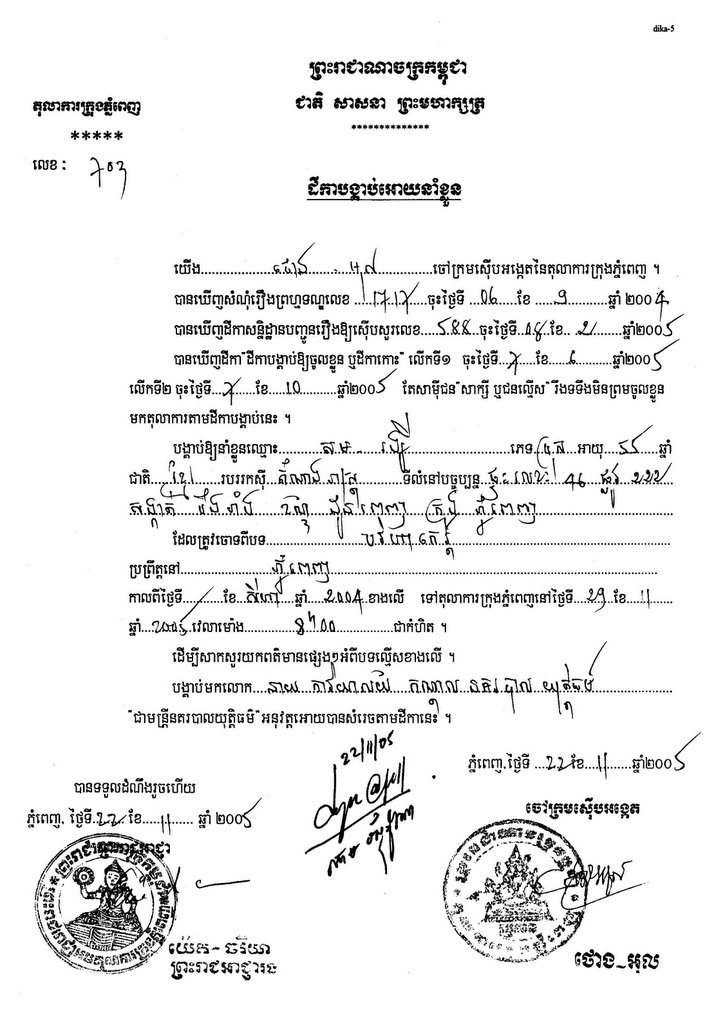
Arrest Warrant Issued for Sam Rainsy

<Click on document to view a larger size>

On 22 November 2005, judges Yet Chariya and Thoang Ol ordered the arrest of opposition leader Sam Rainsy stemming from a defamation lawsuit launched by Prince Norodom Ranariddh, the President of the National Assembly, against Sam Rainsy. The opposition leader saw his parliamentary immunity lifted after Prince Ranariddh forced a hand vote at the National Assembly on this matter. During that hand vote, two other opposition MPs also saw their immunity lifted, and subsequently, MP Cheam Channy was arrested. Justice in Cambodia is a self-serving business: lawsuits against opposition members always resulted in a triumph for the accusers, however, lawsuits against those in power always ended being summarily dismissed by the court.

Second Letter From Opposition Leader Sam Rainsy to King Norodom Sihamoni

LETTER FROM OPPOSITION LEADER SAM RAINSY TO KING NORODOM SIHAMONI

[Translation from French]

Paris, 21 November 2005

Majesty,

In addition to my letter dated 4 November 2005, I am taking the liberty to respectfully write to You again to renew the plea I made to my King not to put His signature on the “supplemental border treaty” as it is currently submitted to Him.

As His Majesty the revered King-Father never ceased to underscore – in particular during the historical meeting of the Supreme National Council on Border Affairs held under His chairmanship in Beijing on 11-12 May 2005 – all the “technical” arguments put forward by some political leaders in an attempt to justify border agreements they had concluded with a powerful neighboring country in a recent past, are merely paper justifications and “theoretical” assurances. That is why His Majesty the King-Father stresses with insistence that nothing is worth more than a thorough inspection on the spot to learn about the fate actually sustained by our lands. In spite of His old age, Samdech Euv wanted to go by Himself along the border in order to verify the effective delineation of the latter “kilometer by kilometer,” and even, if necessary in certain areas, “meter by meter.”

Nevertheless, no independent and objective verification process on the spot, as His Majesty the King-Father wanted, has been authorized up to date in preparation for the signing and the promulgation of the “supplemental border treaty.” In fact, the latter only serves to impose a treacherous recognition of the original 1985 treaty that His Majesty the King-Father considered as part of a group of “illegal” (because they were concluded by authorities not entitled to represent Cambodia) and “unequal” (because they were concluded to the detriment of Cambodia to which they cause serious damage) treaties. His Majesty the King-Father also made it clear that such a treaty was “contrary to the [1991] Paris Agreements” because it violates the territorial integrity of Cambodia.

Since territorial integrity is an issue of life and death for Cambodia, and since no consideration was given to warnings provided by His Majesty the King-Father on this issue, Your loyal subjects would not understand the merit of a promulgation by their beloved Sovereign of the above “supplemental border treaty.” Currently submitted to intimidation and threat, Your subjects humbly, but ardently, hope for a postponement of the treaty’s promulgation until the legitimate wishes of His Majesty the King-Father are respected and until the citizens are better informed of what is happening in the border zones.

His Majesty the King-Father, Preah Karuna Samdech Preah Norodom Sihanouk, embodies the purest patriotism, and the most complete selflessness when serving the homeland. It is in this spirit that Samdech Euv had obtained national Independence for our country and laid the foundations of modern Cambodia. This is the reason why the Khmer people devote Him the deepest respect and the most unswerving love, and confer to Him the title of Father of the Nation.

All His life, revered Samdech Euv never ceased to defend the supreme interest of the Nation. In particular, He firmly and constantly defended the territorial integrity of Cambodia which was continuously threatened. To ignore His advice and to endorse the “supplemental border treaty” would be tantamount to rejecting an important part of His legacy and to killing somewhat morally the Father of the Nation, which could lead to serious consequences for the future of Cambodia.

Please accept, Majesty, the expression of my respectful loyalty.

[Signed]

Sam Rainsy
---------------------------
[Original Letter in French]
A LA TRES HAUTE ATTENTION DE
SA MAJESTE PREAH BAROMNEATH NORODOM SIHAMONI
ROI DU CAMBODGE


Palais Royal
Phnom Penh

Paris, le 21 novembre 2005

Majesté,

En complément à ma lettre du 4 novembre 2005 je me permets de Vous écrire très respectueusement à nouveau pour renouveler la supplique que je fais à mon Souverain de ne pas cautionner par Sa signature le « traité frontalier additionnel » tel qu’il Lui est actuellement soumis.

Comme ne cesse de le souligner Sa Majesté le Roi-Père vénéré – notamment lors de la réunion historique du Conseil National Suprême chargé des Questions Frontalières qui s’est tenue sous Sa présidence à Pékin les 11 et 12 mai 2005 – tous les arguments « techniques » qu’avancent certains dirigeants politiques pour tenter de justifier des accords frontaliers qu’ils avaient conclus avec un puissant pays voisin dans un passé récent, ne sont que des justifications et des assurances « théoriques » sur le papier. C’est pourquoi Sa Majesté le Roi-Père souligne d’une façon insistante que rien ne vaut une inspection minutieuse sur le terrain pour connaître le sort qui est fait réellement à nos terres. Malgré Son grand âge, Samdech Euv a voulu aller Lui-même le long de la frontière afin de vérifier la délimitation effective de celle-ci « kilomètre par kilomètre » ou même, s’il le faut en certains endroits, « mètre par mètre ».

Or, aucune procédure de vérification indépendante et objective sur le terrain, telle que voulue par Sa Majesté le Roi-Père, n’a été autorisée à ce jour, en préparation à la signature du « traité frontalier additionnel ». Celui-ci ne sert en fait qu’à faire reconnaître traîtreusement le traité originel de 1985 que Sa Majesté le Roi- Père considère comme faisant partie d’un groupe de traités « illégaux » (car signés par des autorités qui n’étaient pas habilitées à représenter le Cambodge) et « inégaux » (car conclus au détriment du Cambodge auquel ils portent gravement préjudice). Sa Majesté le Roi- Père a aussi précisé qu’un tel traité était « contraire aux Accords de Paris » de 1991 car il viole l’intégrité territoriale du Cambodge.

Etant donné que l’intégrité territoriale est une question de vie ou de mort pour le Cambodge, et que l’on n’a pas tenu compte des mises en garde éclairées de Sa Majesté le Roi-Père sur cette question, Vos loyaux sujets ne comprendraient pas le bien-fondé d’une promulgation par leur Souverain bien-aimé du « traité frontalier additionnel » ci-dessus. Soumis actuellement à l’intimidation et à la menace, Vos sujets espèrent humblement mais ardemment un report de cette promulgation jusqu’à ce que les souhaits légitimes de Sa Majesté le Roi-Père soient respectés et les citoyens mieux informés de ce qui se passe réellement dans les zones frontalières.

Sa Majesté le Roi-Père, Preah Karuna Samdech Preah Norodom Sihanouk, incarne le patriotisme le plus pur et l’abnégation la plus totale au service de la patrie. C’est dans cet esprit que notre Samdech Euv a obtenu l’Indépendance nationale pour notre pays et jeté les bases du Cambodge moderne. C’est la raison pour laquelle le peuple khmer Lui voue le respect le plus profond et l’amour le plus indéfectible, et Lui a conféré le titre de Père de la Nation.

Toute Sa vie durant, Samdech Euv vénéré n’a eu de cesse de défendre l’intérêt supérieur de la Nation. En particulier, Il a défendu avec fermeté et constance l’intégrité territoriale du Cambodge sans cesse menacée. Négliger Son avis et avaliser maintenant le « traité frontalier additionnel » serait renier une partie importante de Son oeuvre et tuer un peu moralement le Père de la Nation, avec les conséquences les plus graves pour l’avenir du Cambodge.

Daignez agréer, Majesté, l’expression de mon déférent dévouement.

Sam Rainsy

Tuesday, November 15, 2005

Son Chhay Request Annulment of Supplemental Treaty

In a letter dated 14 November 2005 addressed to the President of the Consitutional Council, Bin Chhin, Son Chhay, the SRP opposition Member of the National Assembly, requested the annulment of the Supplemental Treaty recently approved by the National Assembly. Along with the letter, MP Son Chhay also included a list of questions he asked during the National Assembly full session held on 11 November 2005.


A translation of the letter and question list is provided below:

Kingdom of Cambodia
Nation - Religion - King


National Assembly
No. SC 05/76

To The Attention of H.E. Bin Chhin
President of the Constitutional Council


Subject:

Request for annulment of the decision taken by the National Assembly regarding the Supplemental Treaty between the Kingdom of Cambodia and the Socialist Republic of Vietnam to the 1985 Treaty on the delimitation of border adopted by the National Assembly on 11 November 2005.

Based on:

  • Article 92 of the Constitution stating: Laws adopted by the Assembly which run counter to the principles of preserving national independence, sovereignty, territorial integrity, and affect the political unity or the administration of the nation shall be annulled. The Constitutional Council is the only organ which shall decided upon this annulment.
  • Article 2 of the Constitution stating: The territorial integrity of the Kingdom of Cambodia shall absolutely not be violated within its borders as defined in the 1/100,000 scale map between the years 1933-1953 and internationally recognized between the years 1963-1969.

After noting up to today that the Constitutional Council did not assume its proper function in the probe and annulment of the Supplemental Treaty with Vietnam as prescribed in Articles 2 and 92 of the Constitution, I am reminding the Constitutional Council to meet urgently on this case because this Supplemental Treaty:

  • Completely violates Article 2 of the Constitution since the documents used by the Government for the border delimitation with Vietnam are not based on 1/100,000 scale maps printed between the years 1933-1953 and internationally recognized between 1963-1969.
  • The 1985 Treaty on the delimitation of border was concluded with Vietnam when Cambodia was under the occupation of foreign invasion troops, when the People’s Republic of Kampuchea at that time was not even recognized by the United Nations and it was still under the pressure and duress of foreign troops at that time.
  • The Supplemental Treaty approved by the National Assembly on 11 November clearly showed that it runs counter to the principles of preserving national independence, sovereignty, territorial integrity of Cambodia, and in particular, it affects the political unity which includes the opposition from King-Father and the opposition party as well as that of a very large number of the population, even though the National Assembly voted for approval under pressure and duress.

Therefore, I am requesting that the Constitutional Council annul this Supplemental Treaty based on the importance it stresses on its own national and constitutional consciousness.

Please accept, Your Excellency and Members of the Constitutional Council my regards.

Phnom Penh, 14 November 2005,

Son Chhay
Member of Parliament of Phnom Penh

Cc: His Majesty the King of Cambodia

Questions and Opinions
Regarding the Supplemental Treaty
between the Kingdom of Cambodia
and the Socialist Republic of Vietnam
on the Document concluded on 27 December 1985

By Member of Parliament Son Chhay
For the National Assembly Full Meeting held on 11 November 2005

I- The National Assembly cannot approve the Supplemental Treaty because:

  1. The Supplemental treaty is in complete violation of Article 2 of the Constitution which stated that: “The territorial integrity of the Kingdom of Cambodia shall absolutely not be violated within its borders as defined in the 1/100,000 scale map between the years 1933-1953 and internationally recognized between the years 1963-1969.”
  2. According to the Government declaration No. 77 S.C.N. dated 20 October 2005 which is based on the 1985 Treaty on the delimitation of border as defined by the 1/100,000 scale maps prepared by the Service Géographique de l’Indochine (“SGI”) which are not the same as the maps defined in Article 2 of the Constitution.

The reason the 1/100,000 scale maps between the years 1933-1953 were internationally recognized between the years 1963-1969 was because:

  • a) The Cambodia-Thailand boundary (1/200,000 scale) maps were “made” in 1907, based on the 1904-1907 Treaty; however, the 1:200,000 maps were re-examined, re-verified, converted into a larger scale (1/100,000) and re-published in the early 1950s.
  • b) The Cambodia-Laos Boundary maps were prepared in the 1930s and “made” in 1940-1950 and based on French Decrees in 1904-1929.
  • c) The Cambodia - (French) Cochinchina boundary was prepared in 1913-1914 (Svay Reing-E.), 1920 (Tay Ninh-Memot etc), 1930 Hatien-Kampot. The maps were re-examined and verified and “made” in 1951-53. They were based on the 1870-1873 Decrees and a Convention.
  • d) The Cambodia-Annam boundary maps were prepared in the 1920s (Yali sheet) and in 1930s (Poste Maitre). The maps were re-examined, re-verified by air photography and were re-made in 1940s-1950s based on French Decrees.
  • e) The colonial Service Géographique de l’Indochine (“SGI”) 1:100,000 maps are not all accurate, but the larger U.S. Army Topographic Command, known as the Army Map Service (“AMS”) 1/50,000, also contains errors such in Dak Dam, Ap Phuoc Thien, Bu Gia Map, Khum Trapeang Phlong, Tan Chau sheets. The difference is that the SGI 1/100,000 maps were made by more than one party, but AMS 1:50,000 maps were the product of the United States government alone.
  • f) Maps defined in Article 2 of the Constitution:
    In the 1950s, Cambodia corrected errors in some sheets of the SGI 1/100,000 maps. In 1964, Cambodia submitted these corrections to the United Nations. The changes were internationally recognized in 1963-1969, especially by Vietnam.4

It was these maps which the UN Security Council Decision (Doc.S/5741) of 4 June 1964 referred to, and they were printed between 1933-1953, referred to as the 1/100,000 scale maps defined in the 1993 Constitution, and is a reference map used for the legal defense of the territories of Cambodia. We also know that the Government also has copies of these maps.


II- Territorial Losses Claimed by Cambodia from the Supplemental Treaty

Based on the research document published by Steven R. Ratner in the Americal Journal of International Law (1993), and the article published in the Far Eastern Economic Review magazine titled “Land Erosions: Cambodians Question Status of Country’s Border” dated 3 September 1992, the US State Department suggested that under the 1985 Treaty on the delimitation of border between the People’s Republic of Kampuchea and the Socialist Republic of Vietnam gave all the “disputed” areas to Vietnam.

Furthermore, the minute of the meeting of the Permanent Committee of the Council of Minister held in the afternoon on 29 July 1991 with the participation of comrades Hor Nam Hong and Ith Prang in which the discussions of lots division of Khmer maritime domain for auction to foreign companies for oil exploration were contested by Vietnam. We note the following opinion expressed by comrade Hor Nam Hong who said on that occasion: “If the [oil] exploration is not started yet, it is easier during the negotiations. Regarding the issue of the Brévié Line, I clearly understand that the reference made by the French [colonial administration] is only an administration line in order to facilitate the population in that area to complete paper work so they do not have to come all the way to Kampot which is too far, during that time, the three countries [Cambodia, Vietnam, and Laos] were under the French administration, in truth, the Brévié line is not a border, and during that time it [Koh Tral or Phu Quoc in Vietnamese] was ours, but let’s not care about it, they [the Vietnamese] took it already, let’s give it to them, let’s not care to claim it back so that we can be at peace, and if they [the Vietnamese] will not recognize this situation, it will be a complicated issue in the future, but let’s solve that another day, for now, we need to resolve the other issue first because we already have arrangements made.”

The [declaration included in the] above document is further proof indicating that the upper officials of the State of Kampuchea had major difficulties regarding the border with Vietnam, and that the delimitation of border between the People’s Republic of Kampuchea and the Socialist Republic of Vietnam dated 27 December 1985 (itself a result of previous treaties dated: 18 February 1979, 7 July 1982, 20 July 1983) actually caused Cambodia to lose disputed territories to the benefit of Vietnam.

III- Can Vietnam Be Trusted In Bilateral Negotiations?

History has shown that Vietnam never accepted the territorial integrity of Cambodia in honesty, and in the recent history, even though Vietnamese leaders had officially promised to our King-Father the respect of Khmer territorial integrity in gratitude to the help provided during the struggle for the unification of South Vietnam, the promises had all been forgotten.

In addition, we also note the report provided by H.E. Var Kim Hong to the meeting held by the Permanent Committee of the Council of Ministers regarding the results of the negotiations over the Cambodia-Vietnam land border, and the request for the decision on the draft Supplemental Treaty to the 1985 Treaty on the delimitation of border between the People’s Republic of Kampuchea and the Socialist Republic of Vietnam dated 8 August 2005 stating: “It is noted that since 1996, the Vietnamese party had changed the President of their border committee 4 times already, whereas Cambodia never made any change. This is a complicated issue as Vietnam always raised new questions during all meetings by claiming that they did not know or they did not have time to study. This cause delays on several occasions, and this requires the patience to explain to the newcomers for them to agree on the work performed by their outgoing president.”

All this shows that even if we currently agree to give the disputed Khmer lands to Vietnam, we will not have peace because when there will be further dispute in the future, since our country is poor, having a small population, and having weak national defense, we will surely lose more disputed territories to the benefit of Vietnam.

[Therefore,] we are asking: If according to the 1991 Paris Peace Agreement which guaranteed the Khmer territorial integrity by the 6 former ASEAN member countries, by the member countries of the Security Council of the United Nation, and by all signatory countries, including Vietnam, why the Royal Government does not seek help to internationally resolve this issue so that we have clear guarantee and equal justice with Vietnam in the final resolution on the issue of Khmer territories? With this question, we are requesting the National Assembly not to provide its support the Supplemental Treaty yet, and it should urgently form an expert and able border committee, and come up with sufficient method to study new alternatives guaranteeing Khmer territories with justice, and also guaranteeing our territories in the future as well so that the Khmer race can also survive.

    Saturday, November 12, 2005

    SRP Mourning Day

    <Click on the photo to view a larger size>

    On 11 November 2005, prior to the vote by 97 Members of Parliament belonging to the Funcinpec and CPP parties to approve the Supplemental Treaty to the illegal 1985 Treaty on delimitation of border between Cambodia and Vietnam, all Sam Rainsy Party MPs walked out in protest of this vote. They later held a press conference to declare their mourning for the loss of Khmer territories through the ratification of this Supplemental Treaty.

    (You will need Adobe Acrobat to read the press release)

    Friday, November 11, 2005

    Interview With Mr. Sean Pengse on Supplemental Border Treaty

    This aticle is reproduced from VOA produced by Sarem Neou on 10 November 2005.
    The Cambodian National Assembly is scheduled to ratify the controversial supplemental border treaty which Prime Minister Hun Sen signed with Vietnam on October 10.
    Cambodian lawmakers are expected to raise their hands to approve the treaty. In a phone interview with VOA Khmer Service, President of the Paris-based Cambodia's Border Committee Sean Pengse said the hand-raising tactic is illegal. He said the secret ballots should be used.
    The outspoken border activist called the 1985 treaty and the supplemental treaty to the 1985 Cambodia-Vietnam border treaty illegal ones because it violates the 1991 Paris Peace Accord. Sean Pengse said under the Paris Peace Accord all treaties that affect Cambodia's sovereignty are considered null.
    Sean Pengse said he does not believe King Sihamoni would sign this controversial treaty since his father, former King Sihanouk, does not recognize the supplemental treaty and any other treaties that were signed when Cambodia was under Vietnam's military occupation from 1979 to 1991.
    Sean Pengse said if King Sihamoni signs the supplemental treaty, then his subjects will question his Majesty's principles and integrity.
    Sean Pengse said before the formation of the government for the third term, FUNCINPEC party said that this treaty was illegal, but now that it is part of the coalition government, the royalist party changed its position.
    The border activist also said that his Cambodia's Border Committee will continue its stand on the border issue.

    Wednesday, November 09, 2005

    Canada concern on the lifting of immunity of SRP MPs

    In a reply to concerns raised by Cambodian-Canadian citizens about the lifting of immunity of 3 SRP Members of Parliament - Sam Rainsy, Cheam Channy and Chea Poch - the Honourable Pierre S. Pettigrew, Minister of Foreign Affairs of Canada sent the following reply message expressing the importance that Canadians attach to good governance, democracy and the rule of law in Cambodia.

    From: min.dfaitmaeci@international.gc.ca
    To: xxxxxxxxxxxxxxxxxxxx@yahoo.ca
    Cc: MLellan.A@parl.gc.ca
    Subject: A18597-2005 IN REPLY TO YOUR E-MAIL OF FEBRUARY 2, 2005
    Date: Tue, 8 Nov 2005 13:44:32 -0500

    Mr. Chinlong Hak

    xxxxxxxxxxxxxxxxxxxx@yahoo.ca
    c.c. McLellan.A@parl.gc.ca

    Dear Mr. Hak:

    Your Member of Parliament, the Honourable Anne McLellan, has forwarded to me your e-mail of February 2, 2005, regarding the lifting of parliamentary immunity from opposition party members in Cambodia. I regret the delay in replying to you.
    Foreign Affairs Canada is aware of these events and has been following political developments in Cambodia closely. We share your concerns for Cambodian democracy and for the welfare of these opposition party members, and have made Cambodian authorities aware of our position on this matter. Shortly after the parliamentary immunity of Sam Rainsy, Cheam Channy and Chea Poch was lifted, the Canadian Ambassador to Cambodia raised these issues in a letter to His Royal Highness Prince Norodom Ranariddh. The Ambassador also attended the trial of Cheam Channy on August 9, 2005, and will continue to follow his case closely.

    Canada remains committed to supporting democracy and good governance in Cambodia. During Cambodia's most recent elections, held in July 2003, Canada contributed $500,000 to the election process via the United Nations Development Fund. In addition, a small monitoring team of locally based Canadians, led by the Canadian Ambassador to Cambodia, helped to ensure that the election was fair and credible. Furthermore, Canada encourages long term efforts to foster the democratic transformation of Cambodian institutions; the Canadian International Development Agency funds a variety of initiatives in support of good governance and democratic practice in Cambodia. Canada has also committed $2 million to fund the Extraordinary Chambers in the Courts of Cambodia to try surviving Khmer Rouge leaders, which will further contribute to fostering values of justice and responsible governance. We will maintain our monitoring of the situation in Cambodia and will encourage the Cambodian government to continue to improve its respect for democratic principles and the rule of law.

    I assure you that the importance that Canadians attach to good governance, democracy and the rule of law will continue to inform our efforts as we further our bilateral relationship with Cambodia.

    Thank you again for keeping me informed of your concerns.

    Sincerely,

    Pierre S. Pettigrew