Friday, March 31, 2006

FUNCINPEC Officials Say Ranariddh Can Return as Leader If Conditions Fulfilled

Prince Norodom Ranariddh, Funcinpec President, currently enjoying life in France away from the political heat of Phnom Penh (Photo VOA)

By Chey Dara
30 March 2006
Sralanh Khmer newspaper


Original title: : "If Samdech Krom Preah Wants To Return as FUNCINPEC Leader, He Must Accept Eight Conditions...; the Prince Is Punished!"

The pro-opposition Sam Rainsy Party [SRP] newspaper Phnom Penh Sralanh Khmer in Cambodian on 30 March carries a report saying FUNCINPEC [National United Front for an Independent, Neutral, Peaceful, and Cooperative Cambodia] Party officials have "called on Prince Norodom Ranariddh to go into temporary retirement in order to give clean party leaders, with genuine nationalism, the opportunities to reinstate the party's popularity." The majority of those officials are supporters of FUNCINPEC Secretary General Nhiek Bun-chhai.

The FUNCINPEC officials also said that Prince Norodom Sirivudh and Prince Norodom Chakkrapong "should as well take early retirement, because lately, they, too, have played part in plunging FUNCINPEC into a deep abyss."

A dean of the FUNCINPEC Party said, the report adds, "If Prince Ranariddh returned and wanted to hold on the historic party leadership, he should comply with eight conditions that are not too severe." He should:

"1. Put an immediate end to making unilateral decisions;
"2. Stop exploiting FUNCINPEC for his own interests;
"3. Dismiss all the flatters and crawlers;
"4. End the culture of receiving envelops [containing kickbacks],
"5. Stop lending an ear and knowing how to ask for advice from competent elder officials;
"6. Stop behaving like a hooligan, indulging in women and alcohol, and snatching his official's wife (Mrs. Ouk Phalla, the lawful wife of State Minister in Charge of Special Mission Veng Sereivut);
"7. Stop making deceptive promises to the people, the ballot owners, and his own officials; and
"8. End the culture of ingratitude toward the [party] members who are former FUNCINPEC resistance fighters."

The report says the FUNCINPEC officials' desire to have Prince Ranariddh accept those eight conditions is a "good idea that is aimed restoring FUNCINPEC's face, preventing it from sinking like Titanic as the King Father [Sihanouk] predicted last year."

The report also says that Princess Norodom Vacheara, realizing that there is a movement barring Prince Ranariddh from coming back to lead the FUNCINPEC Party anew, asked to "change the FUNCINPEC name and turn the party into a new one as well as returning the name to the former King." She was "displeased with the internal rift among FUNCINPEC officials." She said, "The republicans plundered FUNCINPEC by trying to push the members of the royal family out of politics."

Yu Hockry, who is also a supporter of Nhiek Bun-chhai, said, the report says, FUNCINPEC "should come in out of the rain and become cognizant that the number of its parliamentary seats has dropped from 58 to 48 and that now it has only 26 left."

The FUNCINPEC officials also pointed out that, the report adds, FUNCINPEC might be "restored in time if Nhiek Bun-chhai uses his power as the party secretary general in agreement with principles and ideals without being harassed by Princes Ranariddh, Sirivudh, and Chakkrapong as well as Princess Vichara and the republicans."

When the FUNCINPEC leadership held a meeting a few days ago under Nhiek Bun-chhai's chairmanship, the report says, the members of the royal family "refused to participate." This demonstrates that the FUNCINPEC Party is facing "serious problems."

A FUNCINPEC official disclosed that, the report further says, Nhiek Bun-chhai is leading the party by "following in Prince Ranariddh's footsteps and by attaching importance to the republicans," who have made FUNCINPEC deteriorating as at present. Nhiek Bun-chhai's action is tantamount to "deceiving the FUNCINPEC-defending activists like Prince Ranariddh's."

To conclude, the Sralanh Khmer report says the FUNCINPEC officials also underscored that Nhiek Bun-chhai had to "reorganize the party steering committee and elect its 39 members in accordance with the party's statute. Anyway, he should never dream that there would be the possibilities uniting the republicans with the elder FUNCINPEC members."

Round 3 of Hun Sen's howling


Cambodia accuses "lazy" U.N. human rights workers of misrepresenting the country

By KER MUNTHIT
AP

PHNOM PENH, Cambodia (AP) - A government minister on Friday branded U.N. human rights workers in Cambodia "lazy" and "clueless," accusing them of giving their supervisors inaccurate information about the Southeast Asian nation.

In the latest verbal assault on the world body, Information Minister Khieu Kanharith said the United Nations must reform its 13-year-old human rights office in Cambodia by bringing in "new blood" to do the job.

His comments came after the U.N. expressed concern about the recent vebal attack Cambodia's Prime Minister Hun Sen made against Yash Ghai, Secretary-General Kofi Annan's special envoy.

Hun Sen called Ghai "totally deranged" and demanded that Annan sack him for saying that the Cambodian government is not committed to human rights.

In a statement Wednesday from Geneva, High Commissioner for Human Rights Louise Arbour said her Cambodian office has a mandate from "the international community to monitor respect for human rights and fundamental freedoms and to cooperate with the government and civil society in order to ensure that the standards accepted by the government are observed."

She called on the government to continue full cooperation with the field office headed by Ghai, who is not based in Cambodia but visits every few months.

Ghai voiced his criticisms Tuesday at the end of a 10-day Cambodia trip.

Khieu Kanharith, who is also the government spokesman, blamed "extremely lazy" officials a the U.N. human rights office in Cambodia for giving Ghai an inaccurate picture of Cambodia.

"They spend their time drinking coffee, tea and alcohol with those who can speak English with them," he said. "They are absolutely clueless. The primary reform the U.N. must undertake is to replace all of them."

Cambodia's human rights situation suffered a severe setback last year when Hun Sen launched lawsuits against more than half a dozen critics, including an opposition leader, a journalist and human rights activists. The Cambodian leader dropped his actions earlier this year following strong condemnation at home and abroad.

Mussomeli: "...as long as the government works with civil societies and with other groups the situation will improve over the next few years"

AFP/File Photo: US Ambassador Joseph Mussomeli, seen here in August 2005, said Cambodia had made steady progress...

Cambodian reforms on track, UN row a 'misunderstanding': US

AFP

The United States defended Cambodia's human rights reforms and said a vicious spat between the country and the United Nations over alleged abuses was just a "misunderstanding."

US Ambassador Joseph Mussomeli said Cambodia had made steady progress and played down this week's row, which flared up following critical comments by UN rights envoy Yash Ghai.

"Cambodia's government is moving in the right direction and we are all very optimistic," Mussomeli told AFP when asked about the verbal skirmishes between Prime Minister Hun Sen and Ghai.

"I think perhaps there is a misunderstanding," Mussomeli said.

Hun Sen on Thursday described UN human rights envoys as "gods without virtue" and "long-term tourists," and criticized the United Nations for its silence during the Khmer Rouge genocide of the 1970s.

He has also demanded that Ghai, who was appointed in November, be sacked for criticising the government's lack of reform.

Ghai had said that nothing had been done to speed reforms in Cambodia and criticised donors for not pushing the government over human rights violations.

UN Secretary General Kofi Annan has expressed concern over Hun Sen's volley of abuse targeting the world body, and rights groups have demanded international condemnation of the premier's comments.

Mussomeli downplayed Cambodia's slow pace of reform.

"I think that the UN envoy understands the gestures and the steps that have been taken for the last few months are very positive and very good steps on human rights and democracy," he said.

"Everyone knows, the prime minister knows, the government knows and the UN knows that we have a long way to go," Mussomeli added.

"I think as long as the government works with civil societies and with other groups the situation will improve over the next few years."

Hun Sen, who has enjoyed a firm grip on the country since ousting his co-premier in a 1997 coup, has won praise for recent moves to free jailed government critics and to reconcile with opposition politicians.

Nearly a dozen dissidents, including human rights leader Kem Sokha, were either jailed or faced punishment under criminal defamation laws which rights groups had said Hun Sen was using to silence dissent.

Last month the premier also orchestrated a royal pardon for opposition leader Sam Rainsy, who had received an 18-month jail sentence on defamation charges.

Storm damages Cambodia's Angkor-era temples

Koh Ker Temple
Mar 31, 2006
Associated Press


PHNOM PENH, Cambodia -- Three Cambodian temples built more than a 1,000 years ago were damaged when dozens of trees collapsed on them during a heavy rain storm this week, an official said Thursday.

Heavy rains and gusting winds on Tuesday dislodged several trees, which fell on the roofs of three stone temples in the Koh Ker complex, said Seung Kong, deputy director-general of Apsara Authority, a government body managing temples built during the Angkor era.

The 10th century Koh Ker temples -- opened to the public two years ago -- are about 130 kilometers (85 miles) northeast of Siem Reap province, home of the famed Angkor Wat complex and Cambodia's main tourist destination.

Seung Kong said the damage to the three temples was not serious as the trees did not hit their main structures.

"The damage was regretful, but compared with the damage done by humans during the war, it was much smaller," he said, adding that the fallen trees were so old and decayed that they could not withstand the storm.

The temples were damaged and looted during a series of civil wars in the 1970s and 1980s.

Seung Kong said other old trees still standing near the temples will be cut down to prevent similar incidents in the future.

AIDS Healthcare Foundation and the Royal Government of Cambodia Partner to Bring Free Anti-Retroviral Treatment to People With HIV/AIDS in Cambodia

PHNOM PENH, Cambodia and LOS ANGELES, March 31 /PRNewswire/ -- AIDS Healthcare Foundation (AHF), the largest AIDS organization in the United States, which operates free AIDS treatment clinics in the US, Africa, Central America, and Asia, has joined together with the Ministry of Health, Royal Government of Cambodia and Cambodia's National Center for HIV/AIDS, Dermatology and STI Control (NCHADS) in a new partnership to provide life-saving anti-retroviral therapy (ART) to people living with HIV/AIDS in Cambodia. The partnerships were recently formalized in a memorandum of understanding (MOU) between AHF and the Cambodian Ministry of Health, and in a letter of agreement (LOA) with AHF, the Ministry of Health, and the National Center for HIV/AIDS, Dermatology and STI Control. Through its new partnerships, AHF, the Cambodian Ministry of Health and NCHADS plan to work together on ART scale up in three Cambodian Provinces with the goal of bringing 3,000 Cambodian HIV/AIDS patients into treatment over the next five years.

"We are honored to announce that we have joined together to work with the Ministry of Health, Royal Government of Cambodia and the National Center for HIV/AIDS, Dermatology and STI Control to scale up delivery of medical care and anti-retroviral treatment to people living with HIV/AIDS throughout Cambodia," said Dr. Chinkholal Thangsing, Asia Pacific Bureau Chief for AIDS Healthcare Foundation in a statement from AHF's Asia Pacific Bureau in India. "During the next five years, AIDS Healthcare Foundation will collaborate with our esteemed partners to provide technical support to increase and strengthen the ART roll out and scale up of ART delivery services via designated facilities in three provinces in Cambodia. We will also work closely together to support the Royal Government of Cambodia's overall HIV/AIDS ART treatment initiatives. We believe that this collaboration between AHF and NCHADS will improve access to HIV/AIDS care and treatment throughout the country."

The collaboration between AHF and these respected Cambodian institutions are being celebrated and marked this week in Cambodia with formal ribbon-cutting ceremonies at two of these new free AIDS treatment facilities. Yesterday, a ribbon-cutting ceremony was held in Kampong Thom at one of the new ART clinics that will be run by AHF in collaboration with Cambodia's NCHADS, a partnership whose goal is to bring 3,000 Cambodians living with HIV/AIDS into treatment over the next five years. Tomorrow -- Saturday, April 1st -- a separate ribbon-cutting ceremony will be held at another new free AIDS treatment clinic to be located at the Preah Ket Mealea Hospital in Phnom Penh. This collaboration was formalized in an additional MOU between AHF and the Preah Ket Mealea Hospital of the Royal Government of Cambodia, and its goal is to bring medical care and anti-retroviral treatment to an additional 300 Cambodians.

The free OI and ART sites supported by AHF will be located at Kampong Thom Referral Hospital in Kampong Thom Province, at Rattanakiri Referral Hospital in Ratanakiri Province and at Stung Treng Referral Hospital in Stung Treng Province AHF will assist the local partners to provide OI and ART with high quality of HIV/AIDS care to patients at these three Referral Hospitals.

The first case of HIV infection in Cambodia was reported in 1991 and was followed by a rapid rise in transmission. Cambodia's national HIV prevalence rate -- around 3% in 1997 but decreasing to 1.9% in 2003 -- is understood to be one of the highest in Asia.

"We welcome the presence of AHF as one of the new partners for increasing the access to ART. This contribution is critical for moving towards the Universal Access to Care and Treatment for PLHA in Cambodia," said Dr. Mean Chhi Vun, Director of the National Center for HIV/AIDS, Dermatology and STI Control.

"This collaboration will include innovative medical and non-medical interventions; provide technical support and training resources to increase and strengthen the diagnostic and treatment capacity and skills of HIVAIDS, ART treatment services providers in Cambodia," said Henry E. Chang, AHF Chief of Global Affairs in a statement from the AHF Global secretariat in Amsterdam. "AHF has significant expertise and experience in ART service delivery and skills and capacity building related to HIVAIDS treatment and care, and we are therefore well positioned to complement the Cambodian Ministry of Health in its efforts to enhance access to prevention, treatment and care in Cambodia."

"We recognize the important and laudable efforts undertaken by the Government of Cambodia to treat its people living with AIDS and to arrest and eliminate the HIVAIDS epidemic in Cambodia," said Michael Weinstein, President of AIDS Healthcare Foundation. "This partnership brings together many respected stakeholders with expertise and clinical, public health and management skills that are essential for any successful HIV treatment program, and we are honored to partner with the Ministry of Health, Royal Government of Cambodia and the National Center for HIV/AIDS, Dermatology and STI Control to support the government's program to scale up HIVAIDS treatment through this exciting initiative."

AHF, under its AHF Global program, has previously joined forces in Asia -- in India -- (starting in July 2004) with Swami Vivekananda Youth Movement (SVYM), to provide ART to patients at two clinic facilities in Mysore and Koppal in Karnataka State in Southern India. As of January 2006, close to 400 clients were receiving life-saving anti-retroviral treatment and care through the partnership's clinic in Mysore in the Government District Hospital as well as at the Koppal facility. AHF, which has more than 18 years experience providing HIV/AIDS medical care at its clinics and hospice in the US (and for over four years at its global clinics in Africa, Central America and Asia) oversees the HIV/AIDS clinical care; SVYM, handles the social service, organizational and operational needs on the local level.

AHF's strategy is to provide support and technical assistance to ensure the highest quality of care to patients at these two Indian facilities. This includes the training and capacitating of local Indian groups to provide adherence support and counseling, a key to the success of all of AHF's global ART delivery programs. In its new Cambodian partnership, AHF expects work in close cooperation with the Ministry of Health and NCHADS to pursue similar success in treatment and adherence.

Cambodia's population is just over 14 million people. Approximately 123,100 (the latest sentinel surveillances survey in 2003) adults Cambodians aged 15-49 years are thought to be living with HIV/AIDS, and of these, 10,537 are currently receiving anti-retroviral treatment. Nearly 20,000 (the latest sentinel surveillances survey in 2003) are in urgent need of such life-saving ART.

AIDS Healthcare Foundation

CONTACT: United States, Ged Kenslea, Communications Director,+1-323-860-5225, or cell, +1-323-791-5526, gedk@aidshealth.org, or LoriYeghiayan, Communications Specialist, +1-323-860-5227, or cell,+1-323-377-4312; or India, Chinkholal Thangsing, MD, Asia Pacific BureauChief, +91.11. (0) 98.1827.0687, chinkholal.thangsing@aidshealth.org; or TheNetherlands, Henry Chang, Chief of Global Affairs, +1-917-400-8900,henry.chang@aidshealth.org, all of AIDS Healthcare Foundation

CAMBODIA: Garment exports grow 10.6 percent because of restrictions on Chinese

PHNOM PENH: Despite healthy growth in 2005, Cambodia's economy is a matter of concern because of its narrow base; diversification is needed to sustain economic growth in the country; the World Bank said on March 30.

Bank's latest report on the Asian region's economic development says that Cambodia's economy showed unexpected strength in 2005 with initial estimates of GDP growth at 7 percent.

Rob Taliercio, a World Bank senior country economist, said at a news conference discussing the findings, that the new figure is almost a full point higher than the last projection, of 6.1 percent, that the bank had made in November for 2005 growth.

The bank said the increased growth was due to a surging agricultural sector, with crop production -- especially rice -- and fishery yields significantly higher than in 2004. Expansion of international trade also was a contributor.

Garment exports, Cambodia's main dollar earner, grew 10.6 percent last year to US$2.2 billion (euro1.8 billion) largely because of the restrictions imposed by the United States and the European Union on Chinese garment imports, the bank said.

About 71 percent of Cambodian garments were exported to the U.S. and 23 percent to EU markets, it said.

Although last year's growth was impressive, diversifying the economy is necessary to keep it expanding, Rob Taliercio said.

"The Cambodian agricultural sector seems to be characterized by a boom and bust cycle,'' he said, noting that growth in the sector was negative in 2002 and 2004, but positive in 2003 and 2005.

The fluctuation in the agricultural growth rates creates a lot of vulnerability for poor people, commented Nisha Agrawal, the bank's country manager, calling for the government to implement a better irrigation policy and investment program to sustain the sector's growth.

An increase in tourist arrivals and stable fiscal and monetary performance also boosted growth.
Cambodia received more 1.4 million visitors and produced nearly 6 million tons of rice last year, according to government statistics.

Prime Minister Hun Sen said on March 29 that Cambodia has a surplus of more than 2 million tons of rice above that needed for domestic consumption that can be exported.

Source: BharatTextiles.com

Cambodia's GDP grows nearly 10 percent in 2005 [but Cambodian people still lack basic necessities]

Cambodia had good economic performance with a growth in GDP (gross domestic product) of nearly 10 percent for 2005, higher than the predicted 7 percent growth, local media reported on Friday.

Preliminary estimates from the government indicate that Cambodia's GDP grew at a strong 9.8 percent in 2005, up from a recent 7 percent estimate and dire predications of 2 percent growth made in 2004.

While the final 2005 GDP growth rate will be released in about one month, World Bank representatives, government officials and the Economic Institute of Cambodia (EIC) said Thursday that the high figure is most likely correct, making 2005 the best year for the Cambodian economy since 1999, The Cambodia Daily reported.

The apparent growth was driven by the country's growing agricultural, garment and tourism sectors.

The country's tourism rose by 35 percent, and its garment sector by 10.6 percent to 2.2 billion U.S. dollars in 2005, which was forecast to be a "dangerous year" for the Cambodian garment industry due to the end of the global quotas.

The second surprise factor was a boom in agricultural production with a 17 percent growth last year up from the negative two percent growth in 2004, thanks to good rainfalls and improvements in plantation techniques, according to the newspaper.

But World Bank country economist Robert Taliercio said that the agricultural growth, mostly stemmed from fortunate weather rather than increased irrigation.

World Bank also praised the government's better tax collection, increased foreign investment and loans in the private sector.

The rate of tax collection stood at 11.7 percent of the GDP in 2005, compared to 11.3 percent in 2004. Foreign investment grew to 216 million U.S. dollars in 2005 from 121 million in 2004, while private loans were up by 21.3 percent last year.

Source: Xinhua

Weekend Reading: Ghosts of a Genocide Past

Posted on Chiang Mai Citylife
chiangmainews.com


The man with the one eye stood staring at us and it was hard to look and perhaps even harder to look away. There was something behind that solitary eye that intrigued, something hidden beneath the acid scars of his face, something that made it seem like his story would devastate and sadden even the most hardened of souls. Maybe it was his proximity to the genocide museum that piqued such a curiosity, the location perhaps a fitting back-story to his personal journey to this place, a survivor amidst the ghosts that haunted the hallowed hallways of the concrete structure behind him. And perhaps it was this idea _ this hope, really _ that this man with the single eye may have been one of few fortunate to survive that enabled us to confront his reality and see past the devastation to the truth.

Between the years of 1975 and 1978, the Tuol Sleng prison, or S-21 as it was referred to then, held nearly 13,000 people incarcerated by the Khmer Rouge regime of Cambodia. Housed in a former high school, S-21 was intended to be a secret internment camp, a place where those who opposed the party could be interrogated and imprisoned. The majority of those who passed through the gates of S-21 were members of Cambodia's elite and intelligentsia, as they were the ones whom the party viewed as a direct threat to their Marxist mission of creating a completely agrarian society. The Khmer Rouge's enigmatic leader, Pol Pot, became increasingly paranoid as his reign over the country persisted, causing him to order the detainment, torture and murder of his own people at alarming rates. For Pol Pot and his followers, this ardent belief in the quest for purity and equality amongst his people somehow justified the ultimate extermination of between one and two million people, all the while echoing the insanity and extreme paranoia that has come to define genocide on such a mass scale. Yet despite the ongoing devastation and carnage, the world looked the other way, and the haunted halls of the S-21 prison stand as a testament to the brutality perpetuated by this indifference.

"The Khmer Rouge, like the Nazis before them, were notorious for the meticulousness with which they documented their victims"

The dirt road that leads to the Tuol Sleng Genocide Museum is unassuming and not unlike any other street amongst the mass of motos and crumbling building facades that clutter Phnom Penh's cityscape. There are no signs, no markings of any sort, to indicate that one is approaching the museum; rather, the building just sort of emerges into your line of sight, a vision of concrete and shaded courtyards, surrounded by flowering bougainvillea and swaying palm trees. There is an imposing sense of calm that pervades the structure, an effect which is simultaneously eerie and comforting. Yet one needs only to step inside the rooms of the compound in order to eliminate any prior feelings of tranquility. The muted yellow walls, pock-marked and faintly splattered with rust-coloured blood, the broken, tiled floors, and the iron-gated windows all serve to create a sense of fear and horror that is so palpable it permeates the skin, the mind and the soul. The entire first floor of the complex consists of room after room like this, identical in shape and size, each containing a single metal bed, attached to which is an instrument of torture, such as an iron ball and chain, or a steel animal trap. Adorned on one of the walls is a black-and-white photograph of a prisoner, mouth agape, eyes wide, having obviously met his demise in that very room. The effect is chilling, and one is nearly suffocated by an intense sense of restricted vision and limited freedom-a feeling of wanting to escape from this place but of being unable to.

And then there are the photos of the prisoners: black-and-white and haunting. The Khmer Rouge, like the Nazis before them, were notorious for the meticulousness with which they documented their victims; the picture of each stolen life existing as a testament to this methodical madness. Women with shallow eyes and sallow skin. Men with cavernous clavicles and frightened faces. Mothers, fathers, sisters, brothers, lovers, friends _ one after the other, their faces stony and stoic, as if their bodies are vessels already devoid of their souls. They are young, they are old, they are beautiful. They are the faces of the innocent made to look guilty, yet their only crime was their integrity. They are given no names, no ages; they are stripped of their identity save for the number that is pinned to their shirt, and in some cases, their skin. Yet in their anonymity they document the atrocity of genocide, their numbers signifying a value that is beyond numerical. The power of their powerlessness is overwhelming and upon exiting the building in which their photos are held, one feels deflated, as if the absence of so many relevant lives has somehow deemed one's own superfluous.

There is an art gallery at the museum, a space where artists and historians come together to convey their interpretation of the tragedy. The work currently on display features a photography exhibit of former officers of the Khmer Rouge who are still alive and living in Cambodia. Each frame contains two photos _ one from the past, of the soldier in uniform, and one from the present-day, of the 'reformed' soldier, fully integrated into contemporary Cambodian society. The former is a colourless vision of stoicism and dedication to the cause; the latter, a vivid testament to humanity's ability to forgive, forget and forgo a once-tortured soul. Yet it is not the photos that most astound, but rather the written testimony provided by these former officers that speaks volumes about the tragedy of genocide. Asked to speak retrospectively about the war, and their involvement in it, the majority of the respondents proclaim little remorse or apologetic sentiment. It is this indifference that is most alarming _ their insistence that they did nothing wrong somehow deeply perturbing.

Yet upon examining these statements with a more finely-tuned microscope, one is confronted by a plethora of questions about the general state of humanity and what it is, specifically, that allows for a willful participation in such atrocities. What was it about these men and women-and about their situation that enabled them to blindly kill their own people without so much as a saddened look over their shoulder? Could it truly have been that simple for them? Or is there something deeper, darker, hiding behind the blankness of their faces, the indifference of their words? Looking through the hardened pupils of the soldiers' eyes to the depths of their souls, one can almost see the fear and the trepidation that lurks within and for a brief, flickering moment, an understanding surfaces, a knowledge that there is an underlying psychology behind any mass genocide so complex that we may never know the truth, never fully understand the mentality that defines such evil, and will continue to live with the questionable nature of humanity plaguing us evermore.

The man with the one eye is gone, the place were he once stood is now empty. The late-day sun splays its rays across the concrete edifice of the museum like wax melting slowly from a candle. It is hauntingly beautiful. In this brief moment between day and night, each minute yearns to be held a bit longer. Cambodia must have been like this once _ a place where time longed to be kept still. And now? The languid past has been overshadowed by a tragedy, vast and ruthless. A belaboured future lies ahead. And so it goes. The sun finally descends behind the building, marking the start of its journey through space, and through time, only to emerge again at the yawning dawn of a new day. And so it goes.

PM Steps Up Attack on UN And Its Envoy

Friday, March 31, 2006

By Yun Samean and Erik Wasson
THE CAMBODIA DAILY


Prime Minister Hun Sen on Thursday expanded his verbal assault on UN Special Representative for Human Rights in Cambodia Yash Ghai, while rights workers said they supported Ghai's controversial findings and diplomats declined to comment on them.

Speaking at a Royal University of Phnom Penh graduation ceremony, Hun Sen called Ghai "rude" and accused UN officials of "violating other countries' sovereignty."

"I don't like Ghai...when we were in difficulties you didn't come to monitor human rights in Cambodia," he said. "When Pol Pot killed people, where were you?"

Hun Sen recalled that in 1999 he told the UN General Assembly that if the UN wanted to reform, it should start by replacing its officials who are "not virtuous angels and violate other countries' sovereignty."

Repeating an anecdote he told in January 2005, Hun Sen said he had to resort to threatening Untac administrator Yasushi Akashi in 1993 in order to have criticism from Untac spokesman Eric Falt silenced.

Hun Sen said he told Akashi that he would allow Khmer Rouge soldiers to attack Untac soldiers in Siem Reap town if Falt did not stop criticizing the State of Cambodia.

"I set the condition that if you didn't control Untac spokesman Eric, I would allow the Khmer Rouge to attack," he said. Such an attack on Untac never materialized, Hun Sen said.

At a press conference on Tuesday, Ghai said that despite the welcome release of government critics in January and the return of SRP leader Sam Rainsy in February, fundamental regulations and institutions remain too weak in Cambodia to say that human rights have fundamentally improved. He added that his report in January, saying that the Constitution had been largely ignored, remained valid.

Ghai's January report and his statements on Tuesday for the most part repeated longstanding criticisms of the government such as a lack of judicial independence and a lack of basic criminal and civil codes. But at his press conference, he said that concentration of power in one unnamed individual was hampering human rights.

"Everything depends on one individual and as I said earlier that is not really a precondition under which human lights can flourish," he said.

In his January report, Ghai noted that with six of its nine members affiliated with the CPP, the Constitutional Council's impartiality is in question. The report criticized Hun Sen for dissolving the secretariat of the Supreme Council of Magistracy last year and using the Council as a "rubber stamp."
Hun Sen on Wednesday called for UN Secretary-General Kofi Annan to replace Ghai.

Officials from the Canadian and British embassies and from the European Union said they could not comment on whether Ghai's assessments were accurate.

But senior NGO officials said they agreed with Ghai. Outgoing Center for Social Development Executive Director Chea Vannath said that rather than firing Ghai, Annan should promote him.

"I think Yash Ghai is doing a good job of letting the prime minister know what is going on," she said. Sometimes when you are high up in the government you cannot see what is going on."

She said the prime minister is right to say that Ghai knows relatively little about Cambodia. But she added, Ghai's findings are not his own theories.

Sam Oeun said Hun Sen might be angry because Ghai did not focus closely on recent improvements in the political situation, such as the release of government critics from prison.

But he agreed that human rights are no more secure now in Cambodia than they were before the men were released. "The situation now is relieved but there is no firm democratic process," Sok Sam Oeun said.

He said Hun Sen has claimed he will make reforms, including strengthening the independence of the judiciary, which would improve human lights.

But the real reform process has not yet started, he said. "We want a clear process where the executive cannot do whatever it wants," he said.

"What he is writing is what government officials and civil society told him," she said. "In my own organization we have audits and sometimes the critics are annoying. But if you are professional you take the criticism to improve yourself."

Koul Panha, director of the Committee for Free and Fair Elections, also said Ghai was on target. "The report has reflected the truth. This is a critical report," he said, adding that Hun Sen should engage Ghai rather than attack him.

PM Has History of Belittling Rights Envoys

Friday, March 31, 2006

THE CAMBODIA DAILY

Prime Minister Him Sen's verbal assault on UN envoy Yash Ghai may appear unique—unprecedented, even. And while the description of the envoy as a "long-term tourist" may certainly be Hun Sen at his most acerbic, it is by no means the first time that the leader has unloaded on UN representatives.

The relationship between Hun Sen and UN envoys has been as fractious as it has been long, and the language as colorful as it has been blistering.

In January 1998, then-UN High Commissioner for Human Rights Mary Robinson was taken to task by Hun Sen, then second prime minister, when he accused the UN center for human rights in Phnom Penh of "exaggerating the facts" regarding extrajudicial executions following the July 1997 factional fighting.

On publication of the UN's report several months earlier, Hun Sen took issue with UN envoy Thomas Hammarberg's use of the term "coup" to describe the July 1997 fighting, when Hun Sen's troops defeated then-First Prime Minister Prince Norodom Ranariddh's forces.

When Peter Leuprecht took over from Hammarberg as rights envoy, he was accused early on of meddling in the country's sovereignty.

Later that year, Hun Sen called Leuprecht "stupid," saying he was angry at the envoy for "talking ill" of Cambodia in a report.

In the report to the UN General Assembly rights committee, Leuprecht recounted how he had met poor people who had been expelled from the land on which they lived and were relocated to "appalling conditions on heavily mined land."

"He accused us of evicting thousands of people to live in a minefield. What a stupidity," Hun Sen said at the time.

Leuprecht’s rocky relationship with Hun Sen continued until 2005, when it culminated in a report that claimed democracy was sliding backward.

"What we are witnessing at present does not demonstrate progress on the road to democracy, rule of law and respect for human rights, but an increasingly autocratic form of government and growing concentration of power in the hands of the prime minister behind a shaky facade of democracy," Leuprecht said.

In September 2005, Hun Sen took on an unnamed UN representative, who he claimed "came [to Cambodia] just for money." "He regarded Cambodians as thieves," Hun Sen said.

Hun Sen's outburst followed a visit by Miloon Kothari, UN special rapporteur on housing rights to the rights committee.

Kothari had given a scathing assessment of the government's state land-swap policies and warned that unless land-grabbing by the rich stopped, civil conflict could erupt.

As for justice ... she had given up hope: Ly Neary mother of '97 grenade attack victim

A wheelchair bound victim of the 30 March 1997 grenade attack participated at the memorial for the victims of the attack. (Photo: Keo Nimol, RFA)

Friday, March 31, 2006

Grenade Attack Survivors Mark Nine Years

By Whitney Kvasager and Lor Chandara
THE CAMBODIA DAILY

The memories of the day shrapnel tore through her body, deadening her legs and leaving a jagged reminder across her stomach, still fill Or Sina with fear.

Sitting in her wheelchair at a commemorative service for the March 30, 1997, grenade attack's ninth anniversary, the 47-year-old wrung her hands and said she recalled the day with perfect clarity.

"I was raising my fist demanding the government stop factory abuses. We were all so happy to be there," she said.

"Then there was a grenade flash."

Or Sina, then a garment factory worker, was among the 120 wounded when four grenades were thrown into a peaceful demonstration led by Sam Rainsy, president of the party that bears his name, in front of the National Assembly building. More than a dozen people were killed.

On Thursday, monks prayed for the dead and SRP members gave small sums of money to injured victims and $50 each to the families of those who died.

"I just want the government to find the killers," Or Sina said in a speech. "I just stay at home. I still feel scared."

Rights groups and citizens at large said they, too, want the crime solved, saying that officials have never launched a serious investigation.

In a statement issued Wednesday, New York-based Human Rights Watch said the Cambodian government has made "no progress in bringing the perpetrators to justice," and called on the US to reopen its investigation of the attack. The US investigated because American Ron Abney was wounded in the incident.

"The grenade attack sent a message that to oppose those in power is dangerous, even lethal, while those in charge who commit the worst kinds of human rights violations will get away with murder," Human Rights Watch Asia Director Brad Adams said in the statement.

The Rights Watch statement questioned the absence of any investigation and the decision of Prime Minister Hun Sen to arrest protest organizers and prevent them from leaving the country shortly after the attack. It also said government officials had failed to adequately respond to witnesses' accusations that the prime minister's bodyguard unit helped tire attackers escape.

No one has ever been arrested for the attack.

Information Minister and government spokesman Khieu Kanharith said the grenade attack investigation has stalled because leads have fallen through.

"Now we are back to square one.... We have nothing to go on," he said, adding that the government would appreciate "if someone can provide some clues." He added: 'Every country has cold cases."


Khieu Sopheak, Interior Ministry spokesman, said that more time was needed for results.

"Police are still investigating. But we need time. Once we get more relevant information, we will add it to the record," he said.

Human Rights Watch also blasted the US government and National Police Commissioner Hok Lundy.

"The [US Federal Bureau of Investigation] this month awarded a medal to the Cambodian Chief of National Police, Hok Lundy, for his support of the US global 'war on terror,'" read the report "Hok Lundy was chief of the national police at the time of the grenade attack and has long been linked to political violence," Rights Watch added.

Khieu Sopheak said the rights organization had defamed the national police chief "That is defamation. I deny this," Khieu Sopheak said.

"If they say this they could be thrown in jail" he added.

Ron Abney who was country director for the International Republican Institute in 1997, said in a statement Thursday that he felt government officials had tried to "laugh off these killings."

"When people talk about a democracy existing in Cambodia, let them first ask, 'Are the people's basic rights upheld?'" he said. Abney dropped a lawsuit against Hun Sen over the attack in February.

"You cannot have so many people killed and so many people injured and have no investigation," SRP lawmaker Son Chhay said at the memorial. "You cannot run away from it... People will continue to ask for this justice," he added.

As the memorial ceremony ended, Ly Neary sat on a mat clutching a framed photograph of her son, 29-year-old Ly Daravuth, who died in the explosions.

"I look at his picture every day and miss him," she said. As for justice, Ly Neary said she had given up hope.

Concerns Voiced Over Village Chief Appointments

Friday, March 31, 2006

By Pin Sisovann and Ethan Plaut
THE CAMBODIA DAILY

The bad blood of political partisanship that separated father from son and kept neighbors from each other's weddings during the 1990s could return if the election of village chiefs is not democratic, villagers said this week.

Divisiveness has faded at the village level, said Daun Penh district resident An Veng, but he fears the conflict may return with the Interior Ministry's recent directive empowering the mostly CPP-dominated commune councils to choose new village chiefs.

Village chiefs are largely considered a holdover from the communist 1980s, appointed by the government with an unlimited mandate to manage local affairs.

Hopes for popular elections at the village level were quashed earlier this month when the Interior Ministry issued instructions to commune councils to vote internally for new village chiefs.

"Such an election is like [political] appointment" An Veng said.

"They pick the man who would serve their political party—not the people," he said, adding that villagers know their neighbors and are better qualified to choose a chief by direct election.

Giving commune councils the power to choose village chief rather than local constituents, the government may stoke dormant partisanship in villages, some villagers said.

"Some families argued during meals—now it is not as bad as in 1993 and 1998," An Veng said, referring to earlier general elections. New village chiefs may stir up problems again, he added.

Also on Thursday, the US Embassy announced a new $14.4 million program aimed at increasing citizen participation and strengthening the commune councils' transparency and accountability.

Prey Veng province farmer Houth Sameth said that decentralization through commune councils had failed because councilors are elected from party lists, rather than campaigning as individuals.

He added that village chiefs should be elected directly by villagers to a three-year term rather than an indefinite mandate.

"If they stay long, the roots of their corruption will be strong," Houth Sameth said.

Committee for Free and Fair Elections Director Koul Panha said that the planned vote by commune councilors for village chiefs is a ruse to create the image of democracy, because the CPP dominates the councils.

Pursat province farmer and land rights activist Kuch Veng said that party-affiliated village chiefs would simply follow orders from above.

"Why can't villages be free from politics?" he asked.

More bird flu discovered in Cambodia

A chicken seller prepares chickens at a market in Phnom Penh, Cambodia. REUTERS/Chor Sokunthea

03.31.2006

PHNOM PENH (AFX) - Bird flu has been found in chicken samples taken from a Cambodian village where a toddler died of the virus last week, health officials said.

The outbreak is the second to be reported in two days in Cambodia, where the virus has struck for the fourth time since February after a year without any reported cases.

A three-year-old girl died of the virus March 21 after playing with sick chickens in the village, becoming Cambodia's first bird flu victim this year and the fifth since 2003.

One of the birds on her family's farm in Kompong Speu province's Tuol Prich village, 45 kilometers (28 miles) west of the capital Phnom Penh, tested positive for H5N1, the agriculture ministry said.

It was previously unknown where she caught the virus from.

The infected chicken was among 95 birds recently tested, the ministry said, adding that health officials would destroy the hundreds of chickens and ducks remaining in the village after a mass die-off earlier this month.

No new human infections have been found, officials said.

The discovery follows another bird flu outbreak reported yesterday in ducks on two family farms in southwestern Cambodia near Vietnam.

The virus has also been found in ducks in the eastern province of Kompong Cham twice since February, triggering the slaughter of hundreds of birds.

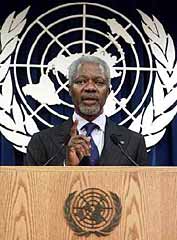
Annan Tells Cambodia to Maintain Cooperation on Human Rights

Kofi Annan, UN Secretary-General

March 31 (Bloomberg) -- Cambodia should maintain its cooperation on human rights, United Nations Secretary General Kofi Annan said after Cambodia's Prime Minister Hun Sen criticized the work of UN officials.

"The secretary general trusts that the Cambodian authorities will continue to offer their cooperation" to UN human rights bodies, Annan said in a statement, issued yesterday. UN mandates for the country "have been renewed in full consultation with the Cambodian government."

Hun Sen, in comments yesterday, described human rights envoys as "gods without virtue" and "long-term tourists," Agence France-Presse reported from the capital, Phnom Penh. The prime minister earlier this week called for the removal of Yash Ghai, the UN special human rights representative, after Ghai said human rights workers were restricted in their activities.

Cambodia was criticized by the UN and U.S. late last year after opposition politicians and human rights leaders were charged and tried for defaming the government. Hun Sen in January ordered courts to drop charges in the latest cases and ended a dispute with Sam Rainsy, the main opposition leader, who returned from self-imposed exile in France in February.

There is a continuing need for the UN's "essential work" in Cambodia, Annan said. Louise Arbour, the UN High Commissioner for Human Rights, said yesterday she wanted her officials to receive the full cooperation of the Cambodian government, according to the UN's Web site.

Political Changes

Ghai said earlier this week that political changes aren't taking place in Cambodia, AFP reported at the time. The envoy, in a report in December drawn up after meeting Cambodian non- governmental organizations, said the government had increased restrictions on freedom of expression, the UN said.

Cambodia and the UN are working together to organize the trials of leaders of the Khmer Rouge accused of genocide.

Annan earlier this month nominated seven international judges to sit on special tribunals that will hear the cases of between five and 10 surviving members of the Khmer Rouge, which ruled from 1975 until its overthrow in 1979.

The Khmer Rouge drove people out of Cambodia's cities to work at forced-labor collective farms as it attempted to impose a communist agrarian state. An estimated 1.7 million people died during its rule.

Hun Sen criticized the UN for failing to take action during the regime's years in power, AFP reported.

"At the time the Khmer Rouge were killing people why didn't you bark?" Hun Sen said yesterday, according to the news agency.

Please Help Soben Huon, First Cambodian-American to go to Miss USA Pageant

Miss Utah, Soben Huon, is the first Cambodian-American to compete in the Miss USA Pageant.

Soben Huon, Cambodian-American Miss Utah needs funds for national competition

By Rodger L. Hardy
Deseret Morning News


PROVO — When Miss Utah/USA 2006 Soben Huon (pronounced "who on") won her title last November, she had sponsorship money and was ready to compete in the Miss USA Pageant on April 21.

Now all that has changed, said Provo businessman Rick Kinateder. Huon, 22, a student at Brigham Young University from Long Beach, Calif., was caught in the transition when the Miss Utah/USA franchise changed hands. In the process existing sponsorships ended and new ones signed on, but Huon found herself in the middle of the transition without sponsorship money.

"She needs to raise $5,000 to meet the expenses of the national competition," Kinateder said.

The Miss USA Pageant is in Baltimore, Md.

Kinateder organized a paella dinner to be held on March 29, 7 p.m., in the Provo City Library at Academy Square ballroom, 550 N. University Ave to raise funds for her. The paella dinner is the national dish of Spain. Kinateder has done specialty dinners in the past, which he calls a "hobby-service."

All the foods are donated and include a variety of meats and seafood, he said.

In addition to dinner, the BYU Ballroom Dance Team will provide entertainment and Huon will model her contestant wardrobe. Tickets are available at the door for a minimum donation of $20. The Provo mayor's office is assisting and taking RSVPs at 852-6108.

As Miss Utah/USA, Huon makes public appearances, gives speeches and represents Utah in certain events. A senior and political science major at BYU, she plans to take next semester off to fulfill her new duties as Miss Utah/USA. She is the first Khmer-American to compete for the title of Miss USA. She has received several awards as a Cambodian classical ballet dancer and plays violin and piano. Huon speaks fluent Khmer, the official language of Cambodia and is learning Spanish and French.

Supporters have created a Web site for her, http://www.sobenhuon.com/. According to the Web site, "Cover Girl" is having a Countdown to the Crown Challenge. By registering, folks can help Huon and possibly win a trip to the Miss USA Pageant.

Smell a Dendrobium Norodom Sihamoni lately?

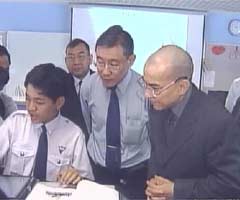
King Norodom Sihamoni visiting a school in Singapore. The king also visited the National Orchid Garden where a new orchid hybrid - the Dendrobium Norodom Sihamoni - was named after him. (Photo Channel News Asia)

Posted: 30 March 2006

Cambodian king visits Nan Hua High School, Asian Civilisations Museum
By Dominique Loh, Channel NewsAsia

SINGAPORE : It was a packed programme for King Norodom Sihamoni of Cambodia on the second day of his official visit to Singapore.

The king is on a three-day state visit at the invitation of Singapore President S.R. Nathan.

King Sihamoni's morning started in Clementi.

His first stop was at Nan Hua High School, where he was warmly greeted by the principal and students.

The school is 89 years old, and home to more than 1,700 students.

The king was particularly interested in learning more about how the school employs technology in the classroom.

There, Secondary One and Two students use a tablet PC in learning up to seven subjects, and the entire school is also wirelessly connected to the Internet.

The king saw for himself how the students make use of computers in a laboratory session.

In one of the lessons, a student explained to the Cambodian king on how they mix several essential oils to make perfume.

Then it was off to a geography lesson.

The school's teachers explain that using the laptops means lessons are not confined to just textbooks and students can even use resources from the Internet.

Even homework is mostly done using their laptops, which are optional for students at the cost of $2,800.

The only time the students use pen and paper is for their examinations.

Next, it was another lesson for the king - this time in history when he visited the Asian Civilisations Museum.

The king also visited the National Orchid Garden where a new orchid hybrid - the Denbrodium Norodom Sihamoni - was named after him.

The robust and free-flowering hybrid has about 15 to 25 richly coloured flowers per spray.

Its petals are gracefully twisted with slightly wavy margins and its floral parts are violet-purple with white borders.

King Sihamoni wraps up his state visit to Singapore on Friday. - CNA/de

Civil Societies and Opposition Protest Against Mr. Yash Ghai Attacks

Thida Win
Voice of America
Phnom Penh, Cambodia
30/03/2006


The civil societies and opposition Sam Rainsy party (SRP) legislators do not support Prime Minister Hun Sen's decision not to welcome U.N. special envoy on Human Rights to Cambodia Yash Ghai.

In the Ministry of Agriculture's annual meeting, Mr. Hun Sen makes this comment Wednesday.

Mr. Yas Ghai gave a press conference and said Tuesday that there is a big centralization of power in the government of Cambodia and that the power rests in the hands of one man, this one man decides everything.

Even though he did not specify anyone by name, it was perceived that he meant Mr. Hun Sen.

Mr. Ghai also criticized Mr. Hun Sen of using his iron hand in the justice system that is not independent.

SRP legislator Eng Chhay Eang says that the government should reflect on Mr. Ghai criticism as being constructive.

PM Hun Sen's Attack on U.N. Representative Must be Condemned

Yash Ghai, speaks at a press conference at the conclusion of his 10-day visit to Cambodia, March 28, 2006

Khemara Sok
Voice of America
Washington, D.C.
30/03/2006


At the end of his second mission as the Special Representative of the Secretary General on human rights in Cambodia, Mr. Yash Ghai pointed to the stark fear present throughout Cambodia due to the one-man rule of Prime Minister Hun Sen, which prevents the growth of democracy and the possibility of human rights protection in the country.

The prime minister responded by telling the special representative hs is no longer welcome in the country.

The Asian Human Rights Commission's (AHRC) long involvement and study of Cambodia confirms the valitity of the special representative's comments.

In order to move away from the present framework of repression, it is also necessary that such comments be made strongly.

Mr. Ghai's comments on the obligations of donor countries, which provide more than half of Cambodia's total budget, to effectively engage with the Cambodian government to bring an end to the absolute control and repression by one indivudual, are particularly significant.

Had such a position been taken earlier, the situation in Cambodia today may have been different. It its previous statements on Cambodia, the AHRC has referred to the connivance of the donor community in preventing genuine democracy and human rights from taking root in Cambodia through its unwillingness to impose aid conditionally.

The AHRC strongly condemns Prime Minister Hun Sen for attacking the special representative for comments he made in the course of duty.

Mr. Hun Sen says that the U.N. human rights monitors are merely 'long-term tourists]. He recommended U.N. Secretary-General Kofi Annan to sack the special representative. This attack calls for international condemnation, as well as a response from the U.N. itself.

Round 2 of Hun Sen's howling

UN Special Envoy for human rights in Cambodia must have hit Hun Sen right where it hurts the most. As a proof to that, Hun Sen had been howling in pain and anger in the last 2 days. (Photo BBC)

Cambodian leader blasts UN's 'gods without virtue'

PHNOM PENH (AFP) - Cambodian Prime Minister Hun Sen launched a second day of angry attacks on the United Nations in an ongoing row over a UN envoy's scathing assessment of the country's human rights reforms.

Hun Sen described rights envoys as "gods without virtue" and "long-term tourists", and criticized the United Nations for its silence during the Khmer Rouge genocide of the 1970s.

"Talking about human rights, isn't the right to live considered the top right? At the time the Khmer Rouge were killing people why didn't you bark?" he said.

His comments at a gathering of university students came a day after he demanded special envoy Yash Ghai be sacked for criticising the government's lack of reform.

"When we were in trouble did you come to check human rights in Cambodia? You can only come to bark at us," Hun Sen said.

Up to two million people died of starvation, overwork and execution between 1975 and 1979 as the ultra-left Khmer Rouge erased all vestiges of modern life in their drive to create an agrarian utopia.

The genocide was largely ignored by the rest of the world, and the Khmer Rouge continued to be recognized by the United Nations as Cambodia's legitimate government throughout the 1980s.

Hun Sen, a former Khmer Rouge military commander who has enjoyed tight control over the country since ousting his co-premier in a 1997 coup, has frequently clashed with the UN over reform.

Previous envoys have taken the government to task for everything from land seizures to the jailing of dissidents, but have been stonewalled by Cambodian leaders claiming to be victims of personal vendettas by the world body.

Ghai's predecessor Peter Leuprecht resigned early from his post last year over repeated attacks by the government for his critical reports to the UN.

Ghai, a well-known legal academic from Hong Kong who was appointed in November, said Tuesday on his second visit to Cambodia that nothing had been done to speed reforms and criticized donors for not pushing the government over rights violations.

UN human rights chief Louise Arbour defended Thursday Ghai and his predecessors saying they had all been "mandated by the international community to monitor respect for human rights and fundamental freedoms."

Their role was to "cooperate with the Government and civil society in order to ensure that the standards accepted by the Government are observed," said Arbour, the UN High Commissioner for Human Rights.

"I trust that they will continue to receive the full cooperation of the Government," she said in a statement.

Hong Kong's Asian Human Rights Commission condemned Hun Sen's attack against the envoy, saying "democracy in Cambodia remains stillborn" and that Ghai should be allowed to do his job.

"In order to move away from the present framework of repression, it is ... necessary that such comments be made strongly," it said in a statement.

"This attack calls for international condemnation, as well as a response from the United Nations itself."

The commission also accused Cambodia's international donors, who contribute half of the national budget, of wasting time and money by refusing to take a stronger stand against Hun Sen's government.

Hun Sen suggested Thursday that Cambodia was being unfairly singled out because worse abuses were being committed in other Asian countries.

"You can only bark in Cambodia. If you dare do so in Myanmar, surely you will be hit. And if you go scream in the Philippines, you would probably be hit there too," he said.

"You know nothing of Cambodian history ... I hate some foreigners who always come here to give advice" about things they are ignorant of, he said.

Ghai, a Kenyan, vowed to return to Cambodia despite Hun Sen's threats that he would be ignored by the government.

"I am appointed by the Secretary General of the United Nations under an agreement that was endorsed by the Security Council and, indeed, all the particular factions in Cambodia," he was reported as saying.

"And so I have all these obligations to report and therefore I will go," Ghai added.

Thursday, March 30, 2006

Cambodia: UN rights chief urges Government cooperation after reported criticism

30 March 2006 – United Nations High Commissioner for Human Rights Louise Arbour today called on the Cambodian Government to continue to cooperate fully with UN rights officials in the country following reports that the Prime Minister had denounced them.

“The different Special Representatives over the years and the staff of my Office in Cambodia, established in 1993, have been mandated by the international community to monitor respect for human rights and fundamental freedoms and to cooperate with the Government and civil society in order to ensure that the standards accepted by the Government are observed”, High Commissioner Louise Arbour said.

I trust that they will continue to receive the full cooperation of the Government,” she added, expressing concern over reports that Prime Minister Hun Sen had denounced Secretary-General Kofi Annan’s Special Representative for human rights in Cambodia, Yash Ghai, and the work of the rights office’s staff.

In January, Ms. Arbour expressed “deep regret” over the Government’s arrest of two more human rights activists and warned that this trend threatened to undo efforts to build a just society in Cambodia.

A month earlier, Mr. Ghai met with representatives of non-governmental organizations (NGOs) who complained of the constraints they face in the performance of their duties, including increasing restrictions on their freedom of expression.

Cambodian opposition party calls for grenade attack inquiry

Buddhist monks in Cambodia chant prayers at a memorial for victims of a grenade attack that killed 16 anti-government protesters in Phnom Penh nine years ago. (Photo BBC)

Cambodian opposition leader Sam Rainsy light candles in front of victims' portraits at a memorial for victims of a grenade attack, which took place near Cambodia's National Assembly on March 30, 1997, during the ninth anniversary of the attack in Phnom Penh March 30, 2006. REUTERS/Chor Sokunthea

PHNOM PENH, March 30 (Kyodo) - Cambodia's opposition Sam Rainsy Party urged the government on Thursday to seriously investigate a grenade attack in the capital nine years ago that killed 16 people.

"The Sam Rainsy Party asks the Royal Cambodian government to start to seriously investigate this heinous crime in order to render justice to the victims," the party said in a statement released on the ninth anniversary of the attack.

"Justice that has been delayed so far must not be denied forever," it added.

The attack, which also injured more than a hundred people, occurred in front of the National Assembly during a peaceful protest led by party leader Sam Rainsy.

The Asian Human Rights Commission also released a statement Thursday saying it was concerned that the investigation may have ended.

"After nine years, the police investigation has not led to a single arrest. No progress report has been made known to the public or the relatives of the dead and the survivors. There are concerns that inquiries have been closed," it said.

"All this only adds to the already strong suspicion that the attack was intended as a blatant assassination and that Cambodia's investigating agencies are mere instruments of the country's rulers," it added.

Also on Thursday, the New York-based Human Rights Watch issued a separate urging the U.S. government to reopen its investigation because one American was among the injured.

No Cambodian government officials commented on the issue Thursday.

Cambodia has no need for Vietnam's assistance when Vietnam couldn't resolve border issues equitably

Viet Nam to assist Cambodia in natural resource management
03/30/2006

Ha Noi (VNA) - Viet Nam will share experiences and lend assistance in natural resource management and environmental protection with Cambodia at the upcoming 8th session of the Viet Nam-Cambodia Joint Committee.

Pham Khoi Nguyen, Deputy Minister of Natural Resources and Environment, made this pledge during his working session in Ha Noi on Mar. 30 with the Cambodian Ambassador to Viet Nam, Long Kem.

Nguyen revealed that his ministry has helped Cambodia develop projects to upgrade its hydrometeorology station and information system; restore and complete the national altitude system; and draw a geological and mineral map of Cambodia's northeastern region and areas bordering Viet Nam.

Viet Nam has recently cooperated with Cambodia to train personnel for bio-diversity management and discussed a project on bilateral cooperation in environmental protection, he said.

Cambodia's Ministry of Land Management, Urban Planning and Construction plans to send a delegation to Viet Nam to learn from the country's experiences and boost cooperation with the Vietnamese Ministry of Natural Resources and Environment.-Enditem

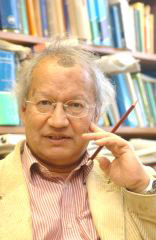
Yash Ghai: "I have all these obligations to report and therefore I will have to go back"

Envoy Yash Ghai said the humanrights situation has not fundamentally improved in Cambodia. (Photo: HKU)

UN human rights envoy wants to return to Cambodia

Yash Ghai says he wants to go back to Cambodia to continue his work despite opposition by the Cambodian Prime minister.


Phnom Penh (AsiaNews/Agencies) – United Nations human rights envoy Yash Ghai said he wants to go back to Cambodia to complete his mandate despite demands by Cambodian Prime minister Hun Sen he be fired.

Mr Hun Sen said that he won’t meet Mr Ghai since the UN envoy suggested he ran the country with an iron fist and was driving it into the ground and poverty. He warned Mr Ghai that should he come back he would be ignored by the authorities.

“Mr Ghai has accused me of using an iron fist to violate the independence of the courts. What he said is wrong. He should not give me advice,” Hun Sen said.

Cambodia’s PM also described the United Nations human rights panel and its special representative as “long-term tourists” and called Professor Ghai “totally deranged”, asking UN Secretary-General Kofi Annan to fire him as a special envoy.

“Kofi Annan should remove him. He knows nothing [about Cambodia],” Hun Sen said.

Mr Ghai said on Tuesday that “one individual” continued to control all the levers of power in Cambodia despite its gradual recovery from the Khmer Rouge era.

“I have been quite struck by the enormous centralization of power, not in the government but in one individual,” he told reporters. “That’s not really a precondition under which human rights can flourish”.

What is more, “I am appointed by the Secretary-General of the United Nations under an agreement that was endorsed by the Security Council and, indeed, all the particular factions in Cambodia,” Ghai said. “So I have all these obligations to report and therefore I will have to go back.”

World Bank: Cambodia's Economy Too Narrow

A Cambodian man walks his cattle on a rural road on the outskirts of Phnom Penh, Oct. 13, 2004. High agricultural output, especially of rice, and expansion of international trade expanded Cambodian economic growth last year, the World Bank said Thursday, March 30, 2006. Cambodia received more 1.4 million visitors and produced nearly 6 million tons of rice last year, according to government statistics. (AP Photo/David Longstreath, File)

The Associated Press/PHNOM PENH, Cambodia
By Ker Munthit


PHNOM PENH, Cambodia (AP) - Despite healthy growth in 2005, Cambodia's economy gives cause for concern because of its narrow base, the World Bank said Thursday.

"Cambodia's economy showed unexpected strength in 2005 with initial estimates of GDP growth at 7 percent," said the bank's latest report on the Asian region's economic development.

The new figure is almost a full point higher than the last projection, of 6.1 percent, that the bank had made in November for 2005 growth.

The bank said the increased growth was due to a "surging agricultural sector," with crop production -- especially rice -- and fishery yields significantly higher than in 2004. Expansion of international trade also was a contributor.

Although last year's growth was "impressive," diversifying the economy is necessary to keep it expanding, Rob Taliercio, a World Bank senior country economist, said at a news conference discussing the findings.

"The Cambodian agricultural sector seems to be characterized by a boom and bust cycle," he said, noting that growth in the sector was negative in 2002 and 2004, but positive in 2003 and 2005.

The fluctuation in the agricultural growth rates "creates a lot of vulnerability for poor people," commented Nisha Agrawal, the bank's country manager, calling for the government to implement a better irrigation policy and investment program to sustain the sector's growth.

Garment exports, Cambodia's main dollar earner, grew 10.6 percent last year to US$2.2 billion (euro1.8 billion) largely because of the restrictions imposed by the United States and the European Union on Chinese garment imports, the bank said.

About 71 percent of Cambodian garments were exported to the U.S. and 23 percent to EU markets, it said.

An increase in tourist arrivals and stable fiscal and monetary performance also boosted growth.

Cambodia received more 1.4 million visitors and produced nearly 6 million tons of rice last year, according to government statistics.

Prime Minister Hun Sen said Wednesday that Cambodia has a surplus of more than 2 million tons of rice above that needed for domestic consumption that can be exported.

Cambodian PM says U.N. has no right to lecture him on human rights

In his anger towards the "just" criticisms leveled against his regime by the UN Special Envoy for human rights in Cambodia, Hun Sen, a former Khmer Rouge soldier, is showing his old self by lashing out at the UN. Earlier this year, he backed down from the international community by releasing all those he jailed in order to receive international aid.

By SOPHENG CHEANG

PHNOM PENH, Cambodia (AP) - The United Nations is in no position to lecture anyone about human rights after its failure to act when the genocidal Khmer Rouge regime was killing more than a million Cambodians in the 1970s, Prime Minister Hun Sen said Thursday.

Earlier this week, the U.N. secretary-general's special representative for human rights in Cambodia, Yash Ghai, told reporters that the country's power is concentrated around "one individual" - a thinly veiled reference to Hun Sen - and that his government is not very committed to human rights.

Though democratically elected, Hun Sen is widely seen as an authoritarian ruler who exercises near total control over all aspects of Cambodia's administration.

Hun Sen on Wednesday described Ghai as "totally deranged" and demanded that U.N. Secretary-General Kofi Annan sack him.

On Thursday, Hun Sen castigated the U.N. for its failure to act in 1975-1979 when the Khmer Rouge were committing atrocities that led to the death of some 1.7 million people.

"When (Khmer Rouge leader) Pol Pot killed the Cambodian people, where were you? Isn't the right to live the primary essence of human rights?" he said at a graduation ceremony. "So, why did you not shout about human rights when they killed people?"

Hun Sen said he disliked "this man Ghai" as well as his predecessors, whom he singled out by name. Ghai is not based in Cambodia but has an office managed by other U.N. staff. He voiced his criticisms at the end of a 10-day Cambodia trip Tuesday.

"I hate it so much when certain foreigners give such a lecture," Hun Sen said.

Recently, Hun Sen has partnered with the United Nations to help set up a special court to prosecute the remaining Khmer Rouge leaders for their atrocities.

Hun Sen was once a Khmer Rouge soldier but he defected to lead a Vietnam-backed resistance to overthrow the ultra-communist movement. Researchers say there is no evidence linking him to the Khmer Rouge crimes.

Cambodia's human rights situation suffered a severe setback last year when Hun Sen launched lawsuits against more than half a dozen critics, including an opposition leader, a journalist and several prominent human rights activists. The Cambodian leader dropped his actions earlier this year following strong condemnation at home and abroad.

Justice Must Be Rendered To The Victims Of The 1997 Grenade Attack

Flanked by unidentified person, Cambodian opposition leader Sam Rainsy, right, burns incense sticks and prays at a memorial of victims of a grenade attack in front of Cambodia National Assembly, Phnom Penh, Cambodia, Thursday, March 30, 2006. On the ninth anniversary of the grenade attack March 30, 1997, the opposition party on Thursday renewed their demand for a serious and independent investigation into the grenade attack that killed some 16 peaceful anti-government demonstrators and injured 114 others. (AP photo/Heng Sinith)

PUBLIC STATEMENT
March 30, 2006

JUSTICE MUST BE RENDERED TO THE VICTIMS OF THE 1997 GRENADE ATTACK

  1. Today, the Sam Rainsy Party (SRP, formerly Khmer Nation Party) commemorates the ninth anniversary of the March 30, 1997 grenade attack where at least 16 of its supporters were killed and over 100 others wounded in a peaceful protest in front of the National Assembly in Phnom Penh. As every year on the same day and on the very scene of the attack, SRP members and supporters pay their respects to the memories of those who sacrificed their lives for the cause of democracy and justice.
  2. The SRP asks the Royal Cambodian Government to start to seriously investigate this heinous crime in order to render justice to the victims. It reminds the Government that on March 29, 1997 it received an official authorization from them to hold its peaceful protest that was intended to demand the formation of an independent Judiciary. The authorization was signed by then Interior Co-Ministers Sar Kheng and You Hockry.
  3. The SRP believes that until there is an independent Judiciary in Cambodia, there is little hope to see the perpetrators of the attack and its mastermind be brought to Court and punished according to the law.
  4. The SRP will continue to strive to bring an end to the culture of impunity that prevails in Cambodia. Justice that has been delayed so far must not be denied forever. Victims of the Khmer Rouge regime and their families have been waiting for justice since 1979. Victims of the attack on the SRP-led protest and their families have also been waiting for the past nine years.
  5. The SRP is convinced that only Democracy will allow the formation of an independent Judiciary. Therefore, it calls on all democrats to unite in order to bring about a democratic regime with an effective separation of powers that would allow the Judiciary to be free from political interference.
  6. In order to bring about a democratic regime in Cambodia the SRP, as the only parliamentary opposition party, must absolutely win the next legislative elections in 2008.
  7. In order for the SRP to win the next elections, opposition members and supporters must work harder so as to convince all Cambodians of the need for a democratic change in this lawless country. This is the only way to actually render justice to the heroic victims of the March 30, 1997 grenade attack.
SRP Members of Parliament

PM's Directive Spells Out Top Officials' Roles [more than one year later]

THURSDAY, MARCH 30, 2006

By Yun Samean
THE CAMBODIA DAILY


Prime Minister Hun Sen has moved to clarify his own role in government and to explain how individual CPP and Funcinpec ministers and deputy prime ministers should assist him, according to a directive obtained Wednesday.

Hun Sen stated in the directive, dated March 21, that he is responsible for disaster management general leadership of the Council of Ministers, the ministries of economics and finance, and the Council for the Development of Cambodia.

Funcinpec's Deputy Prime Minister Nhiek Bun Chhay is responsible for assisting Hun Sen with the ministries of public work and transport as well as health, culture and tourism, the directive states.

Hun Sen told CPP Minister of Interior Sar Kheng to handle routine work in his absence, and to assist with national security, counternarcotics, human trafficking, terrorism and decentralization.

Sok An, CPP minister of the Council of Ministers, is told to assist Hun Sen in conducting investigations and providing coordination for Cambodia's reform efforts, particularly in the judiciary.

Lu Laysreng, Funcinpec's minister of rural development is to assist Hun Sen in coordinating both that ministry and the ministries of women's affairs and cult and religious affairs.

CPP Minister of Defense Tea Banh is to assist with national defense, the military police and coordinating the ministries of agriculture, social affairs, and water resources and meteorology.

Hor Namhong, the CPPs minister of foreign affairs, is told to assist the prime minister in foreign affairs and commerce.

Hun Sen also stated that each deputy prime minister could have only four advisers and three aides.

Koul Panlia, director of the Committee for Free and Fair Elections, said it was rather late for Hun Sen to be explaining the roles of top officials, adding that an excess of senior ministers and deputy prime ministers has brought confusion to the government's bloated ranks.

"It is very confusing. [Officials] have overlapped each other," he said.

Nhiek Bun Chhay said it is not excessive to have six deputy prime ministers, adding that he has been given more responsibilities following the March 2 removal of his colleague Prince Norodom Sirivudh from his position as co-minister of interior.

Also on Wednesday, a royal decree was issued to remove Funcinpec's governor of Mondolkiri province, Thou Son, and replace him with the CPP's Takeo deputy provincial governor Lay Sokha.

China winning hearts and minds

By Evan Osnos
Chicago Tribune foreign correspondent

Published March 29, 2006

PHNOM PENH, Cambodia -- More than 700 students stream in each morning to the Newton Thilay Chinese school on a cramped Cambodian street, and enrollment is on track to double this year.

"More Cambodians are needing to learn Chinese," said Principal Vann Sony, "and more Chinese are coming to live in Cambodia."

Not long ago, it was unthinkable for Cambodia to seek closer ties with Beijing. That is because Cambodians have scarcely forgiven Chinese communists for propping up the Khmer Rouge regime, which was responsible for the deaths of 1.7 million Cambodians in the 1970s.

Yet, in a striking sign of China's swelling profile, the two countries have mended fences. China emerged as Cambodia's No. 1 foreign investor in 2004, while trade between them climbed 50 percent over the previous year. Beijing has waged a charm offensive with splashy donations, such as a new $49 million Council of Ministers building scheduled to begin construction soon in the capital—the equivalent of China donating a new Eisenhower Executive Office Building to downtown Washington.

A generation after the U.S. withdrew from Indochina, a different sort of "domino theory" is reordering power and loyalty across Southeast Asia. Once considered a threat by its neighbors—for its territorial claims and economic power—China is deftly wielding soft power in diplomacy, commerce and aid to win resources and influence.

The changes pose a growing challenge to the U.S. to shore up its eroding authority across the Asia-Pacific region. When U.S. Secretary of State Condoleezza Rice talked tough on China's rising military strength and other issues last week in Australia, she drew a harder line than her counterpart, Australian Foreign Minister Alexander Downer, who asserted that trying to contain a rising superpower would be a "very big mistake."

Southeast Asia is a major front in the new Great Game unfolding in the early years of the 21st Century. As China trolls the globe for new friends and resources—whether oil in Sudan or timber in Burma—countries are balancing or choosing between two world powers for the first time since the end of the Cold War.

"It's natural that you want to have as many friends as possible," said political scientist Kao Kim Hourn, president of the University of Cambodia. "The dynamics of relations have been transforming, and right now the priority is on economic development."

The region's center of gravity has shifted most noticeably since the late 1990s, when the Asian financial crisis struck Cambodia, Laos and Thailand. While the U.S. was tarred by backing unpopular International Monetary Fund strategies, China resisted pressure to devalue its currency and distributed hundreds of millions of dollars in loans and aid.

To its smaller neighbors, China has proved a generous trading partner; it is proposing a mammoth free-trade zone—from the edge of Siberia to Indonesia—that would be the world's largest by population when it is completed in 2015. At the same time, China is stepping up security cooperation, including joint military exercises with Australia, the Philippines and Thailand.

This comes as Asian leaders grumble that the Bush administration seems distracted by the Middle East. In her first chance to attend a key regional forum, in July 2005, Rice sent her deputy instead, making her the first secretary of state to miss a meeting of the Association of Southeast Asian Nations Regional Forum since 1982. Afterward, attendees pointedly praised the Chinese delegate for offering uncritical input on issues such as human rights and economic openness.

In Cambodia, a country of just 13.6 million people, China's influence is striking.

"When I came here 10 years ago, if you went to the wholesale market, most of the goods were from Thailand, Singapore and Japan," said Jimmy Gao, president of the Chinese Chamber of Commerce in Phnom Penh. "Now more than 60 percent of the products are from China."

Midsize Chinese textile makers are opening factories in search of labor that is even cheaper than home; Chinese construction companies are underbidding their Korean and Japanese rivals; a Chinese-built dam and power plant is keeping the lights on in Phnom Penh. A Shanghai construction company is building Road No. 7, a new overland route to link China and all of Southeast Asia, in what China proudly calls its single largest foreign-aid project ever.

The largesse has yielded tangible benefits. Gao and others successfully lobbied the Cambodian government to shut down the representative office in Phnom Penh of Taiwan, the renegade province claimed by mainland China. Isolating Taiwan's government is part of the "one-China policy" that Beijing encourages among its friends.

"Of course the economic relations contribute to good political relations, and that makes us more like brothers," Gao said.

It is classic soft power, what Harvard political scientist Joseph Nye calls "co-opting people rather than coercing them." And these days, China hopes its millions in military training and loans will eventually pay off with the right to build a dock complex on the Cambodian coast, where Chinese naval vessels could monitor the Straits of Malacca, a crime-ridden choke point, through which 80 percent of China's oil must travel.

The U.S. has called on China to become a responsible "stakeholder" in world affairs with a moral authority to match its economic weight—for instance, by loosening its embrace of Sudanese leaders who permit the genocide in their country's Darfur region.

Yet in Cambodia, for instance, the U.S. is flagging in the war of perception. Officials and scholars here criticize the Bush administration for declining to provide direct funding for a new international tribunal established to try senior leaders of the Khmer Rouge. The U.S., which instead funds NGOs that will support the trials, has said it will not give cash to the $53 million tribunal until Cambodian Prime Minister Hun Sen takes steps to curb rampant judicial corruption and impunity.

But Cambodian officials are quick to point out that concerns about competence or impartiality have not deterred the U.S. from spending millions on Iraq's turbulent trial of Saddam Hussein. Cambodians see a double standard, in contrast with China's laissez-faire approach.

"China is not taking any bullying positions. China has been behaving like a benign power, a responsible power," said Kao Kim Hourn, who also advises the government on foreign policy. "It has been very constructive, very supportive."

eosnos@tribune.com