Showing posts with label 1904 and 1907 Franco-Siamese treaties. Show all posts

Wednesday, September 28, 2011

Boundary issue [with Thailand] likely to be stalled

September 28, 2011
Supalak Ganjanakhundee
The Nation
The boundary between Thailand and Cambodia was delimited and demarcated more than a century ago, when the neighbouring country was still a French colony. Most of the 800-kilometre boundary is marked with pillars with the exception of areas near the Preah Vihear Temple.
No matter who ends up leading the Thailand-Cambodia Joint Boundary Commission (JBC), the task of demarcating the border between the two countries will never be completed if the Kingdom is unable to de-politicise the issue.

The opposition Democrat Party started campaigning against the reshuffle of the JBC once it learned that Foreign Minister Surapong Towichukchaikul had replaced the previous government’s man, Asda Jayanama, with career diplomat Bandit Sotipalalit.

Asda was made JBC chief in much the same way as Bandit, when Kasit Piromya, foreign minister under the Democrat-led government, had him replace career diplomat and legal expert Vasin Teeravechyan last November. Kasit never explained why the move was made and Vasin never complained about the move being unfair.

While Asda was in charge, the JBC only held one meeting in Indonesia this April and made no significant progress on demarcating the boundary or easing the strained relations with Cambodia.

Saturday, July 23, 2011

Reneging an agreement signed by Thailand in 1907? ... Dream on

Preah Vihear and the old map we should never have agreed to

July 23, 2011
By Nophakhun Limsamarnphun
The Nation

The International Court of Justice issued an order last Monday for both Thailand and Cambodia to withdraw their military from a disputed border area covering a total of 17.3 square kilometres.

The demilitarised zone consists of 8.5 sq km of Thai territory and 8.8 sq km of Cambodian territory.

This includes a Thai portion of 4.6 sq km next to the Phra Viharn/Preah Vihear temple which was earlier listed unilaterally by Cambodia as a World Heritage Site.

Back in 1962, the court ruled that the ancient Hindu temple belonged to Cambodia, but it stopped short of making any ruling on border demarcation, which went beyond its authority.

Due to the legacy of colonial rule in Indochina, border demarcation has been a highly sensitive issue between Thailand and Cambodia ever since the 1962 ruling.

To date, there has been no mutually acceptable demarcation along the border between the two countries.

Monday, July 04, 2011

France ready to help resolve Cambodian, Thai border dispute [-How about the problem with Vietnam???]

July 03, 2011
Xinhua

The Prime Minister of France, Francois Fillon said Saturday that France is ready to help resolve the simmering Cambodian and Thai border conflict, through map provision and other means of peaceful solution.

Fillon's promise was made during a one-hour meeting with Cambodian Prime Minister Hun Sen on Saturday afternoon at the Peace Palace in Phnom Penh.

"At the request by Prime Minister Hun Sen, Fillon said France is ready to provide copies of maps it made at the start of the last century when it ruled Indo-China to help solve out the Cambodian and Thai border dispute," Srey Thamrong, a minister attached to the Prime Minister Hun Sen, told reporters after the meeting.

Wednesday, April 06, 2011

Treaty of March 23 1907 Between France and Siam and the Return of Battambang and Angkor to Cambodia

Published in the The Far Eastern Quarterly, Vol. 5, No. 4, Aug., 1946 - pp. 439-454

Treaty of March 23 1907 Between France and Siam and the Return of Battambang and Angkor to Cambodia
http://www.scribd.com/full/52376977?access_key=key-cx9302xijvkdom5v4g8

Wednesday, March 09, 2011

Maps and borders

A top view of the 11th century Preah Vihear temple in Cambodia on the border with Thailand. The temple overlooks the Cambodian plain, but it faces in the direction of Thailand. Its main access is from the latter direction.


ESSAY
A.G. NOORANI
Frontline
Volume 28 - Issue 06 :: Mar. 12-25, 2011
INDIA'S NATIONAL MAGAZINE
from the publishers of THE HINDU

The Thai-Cambodia border clashes show yet again that maps have no binding juridical significance unless they are accepted by both sides.

INFORMATION is sparse about the recent clashes on the frontier between Thailand and Cambodia. At the centre of the dispute is the 11th century Khmer temple of Preah Vihear. The International Court of Justice at the Hague ruled in favour of Cambodia on June 15, 1962, upholding its claim to the temple. It was designated a World Heritage Site under Cambodia's management in July 2008. The temple looks out from the edge of a steep escarpment over a wide area of northern Cambodia. At its front entrance, away from the cliff, is Thailand, which never quite reconciled itself to the ICJ's adverse ruling.

On July 4, 1962, Srindi Dhanarajata, Prime Minister of Thailand, said that while Thailand would honour its obligations under the United Nation's Charter “it will do so under protest and with reservation of her intrinsic rights”. Two days later Foreign Minister Thanat Khoman wrote to United Nations Secretary-General U Thant in even more ominous terms:

“I wish to inform you that, in deciding to comply with the decision of the International Court of Justice in the case concerning the Temple of Phra Viharan [as Thailand calls the temple], His Majesty's Government desires to make an express reservation regarding whatever rights Thailand has, or may have in future, to recover the Temple of Phra Viharan by having recourse to any existing or subsequently applicable legal process, and to register a protest against the decision of the International Court of Justice awarding the Temple Phra Viharan to Cambodia.”

Thursday, February 17, 2011

The 1904-1907 Franco-Siamese Treaties (in French and in English by Google translation)


KI-Media Note: The following is a rough translation from the text in French into English by Google

Historical summary
The Franco-Siamese Treaty of 1904 and 1907
=====
On October 30, 2008, after the parliamentary vote authorizing the Thai Government to negotiate with Cambodia on border issues, in Preah Vihear and elsewhere, the Thai Ministry of Foreign Affairs said that "Thailand will reject any move by Cambodia of use maps drawn by France in 1904 as the basis for the demarcation (the borders between the two countries). The rejection of Thai Franco-Siamese treaties of 1904 and 1907 is not new, and the excuse is always the same: they are treated as 'patchy', imposed by France in Siam at the time (1). The recall some historical facts to understanding why and how these treaties have been concluded.

Ben's secession?

In 1791, a major dignitary Khmer, Chauvea Ben, fled to Siam with the young King Ang Eng. In 1794, the King of Siam, Chakri Rama-1, was crowned the new King Ang Eng of Cambodia, Bangkok, to mark the suzerainty of Siam in this country. After returning to Ang Eng Oudong with a Siamese army, Ben, to escape his enemies Khmer folds in the north-west, where it grants itself a large area comprising the provinces of Battambang and Angkor Sisophon ( Siem Reap), with, it seems, the consent of King Ang Eng (2). Obviously, Ben is put under the protection of the King of Siam also, to whom he sends tributes of vassalage, as the king of his Oudong. Since it is not a secession of Ben - maybe it dare not do so or refuses to do as well - the King of Siam Khmer accentuates the division by decreeing that abused the office of Governor of the territory be inherited by the family of Ben. The administration of this territory remains fully Khmer until 1867. Despite this internal division, Cambodia is still a united state until the arrival of the French in Indochina. However, in 1851, Bangkok introduces Westerners maps showing that the Khmer provinces of Koh Kong, Kratie, Chantabor, Battambang, Siem Reap, Mlou-Prey Tonle Repou and Stung Treng are already part of Siam and the rest of Cambodia is under the joint suzerainty siamo-Annamite.

The 1904-1907 Franco-Siamese Treaties (in Khmer)

Click on the text in Khmer to zoom in


Wednesday, August 18, 2010

Parliament delays debate on border talks

August 18, 2010
The Nation
Thai nationalists and some senators want the government to revoke the 2000 MoU because they fear losing territory to Cambodia, as the document recognises a French map that suggests areas adjacent to Preah Vihear temple on the border belong to Cambodia.
Reports from recent Thai-Cambodian Joint Boundary Committee (JBC) meetings were not considered by MPs in Parliament yesterday after pressure from a nationalist group protesting over the border dispute.

Parliamentary Speaker Chai Chidchob said he did not put the JBC reports on the agenda, despite saying the gathering of a nationalist group led by activist Veera Somkwamkid in front of Parliament was nonsense.

Yesterday's session only heard a proposal from a parliamentary committee to keep reports from the session on boundary demarcation secret.

Foreign Minister Kasit Piromya said he had submitted agreed minutes from three JBC meetings on boundary talks held over the past two years, but he had no idea when they would be on the agenda for MPs to consider.

Article 190 of the Constitution requires the ministry to submit any negotiation framework, which could lead to changes of borders or territory, so they are approved by Parliament.

The JBC was set up in accordance with a memorandum of understanding (MoU) signed with Cambodia in 2000 to survey and demarcate the boundary line with officials from the neighbouring country.

Thai nationalists and some senators want the government to revoke the 2000 MoU because they fear losing territory to Cambodia, as the document recognises a French map that suggests areas adjacent to Preah Vihear temple on the border belong to Cambodia.

Thailand and Cambodia have been at loggerheads over the temple and adjacent territory after it was listed as a World Heritage site in 2008. Thailand fears the listing process may undermine its claim to disputed areas adjacent to the temple.

The last JBC meeting was in April last year and talks are only able to continue once the Thai Parliament has endorsed the agreed minutes from the three last meetings.

Veera told his supporters to disperse from their rally outside Parliament after a news report revealed consideration of the JBC documents had been delayed.

Monday, August 16, 2010

Thais want table for two [-After all the war threat, bilateral negotiations with Thailand are useless...]

ANALYSIS: The Foreign Ministry is seeking a bilateral resolution to the Preah Vihear land dispute

16/08/2010
Saritdet Marukatat
Bangkok Post

[Thai negotiators] believe there is room for negotiations if Cambodia accepted the international accepted practice on border demarcation in which the watershed is used as the dividing line for any area where the borderline is in dispute. That would include the 4.6 square kilometre area near Preah Vihear temple. (sic!)
Thailand's push for a fresh meeting of the Joint Boundary Commission with Cambodia is aimed at preventing international interference in the dispute over the border area near the Preah Vihear temple.

The Foreign Ministry will table the outcome of previous meetings of the JBC held last year and in 2008 for parliament's approval tomorrow, said Chavanond Intarakomalyasut, secretary to the foreign minister.

Among the items up for parliament approval will be an aerial map of the border dividing the two countries and an agreement to establish a working group to demarcate the boundary.

The constitution requires that all matters that could affect sovereignty be subject to parliamentary approval.

The move follows Foreign Minister Kasit Piromya's announcement last Tuesday that Thailand wanted to hold the JBC meeting soon to place all disputed areas on the negotiating table.

Parliamentary approval of the outcome of the previous two meetings would send a signal to Cambodia that Thai negotiators were ready to deal with the dispute over the unsettled border areas and that foreign assistance was not required.

Thailand and Cambodia would use the memorandum of understanding signed in 2000 by then deputy foreign minister Sukhumbhand Paribatra and Var Kim Hong, the Cambodian adviser on border affairs, as a framework to demarcate the border lines.

The JBC has been assigned to implement the memorandum.

Prime Minister Abhisit Vejjajiva stressed his intention for the Preah Vihear matter to be resolved bilaterally in a letter sent last Tuesday to the United Nations General Assembly and UN Security Council.

"The intention of the Royal Thai Government is to solve the problem of land boundary between Thailand and Cambodia through the implementation of the 2000 memorandum of understanding between the government of the Kingdom of Thailand and the government of the Kingdom of Cambodia on the survey and demarcation of land boundary," the letter says.

The Thai government has reason to emphasise this stance, as the Cambodian government has recently gone on the offensive, asking for help from other countries to help resolve the border dispute with Thailand.

On Saturday, Cambodian Foreign Minister Hor Namhong sent a letter to current Asean chair Vietnam asking the country to intervene.

That request followed a letter sent on Aug 8 by Cambodian Prime Minister Hun Sen to the UN General Assembly and the UN Security Council in which he said the dispute over Preah Vihear could lead to bloodshed without international intervention.

The Thai side believes that bringing in outsiders would only further complicate the issue.

The memorandum uses treaties signed by Thailand and France in 1904 and 1907, as well as maps from that time, as a basis for negotiations.

Thai negotiators have said the two treaties reflected France's power in the region at the time and put Thailand at a disadvantage.

However, they believe there is room for negotiations if Cambodia accepted the international accepted practice on border demarcation in which the watershed is used as the dividing line for any area where the borderline is in dispute. That would include the 4.6 square kilometre area near Preah Vihear temple.

A breakthrough in negotiations will take time and will only be possible when relations between the countries warm.

Ties have soured in recent years, first after Thailand tried to block Cambodia's sole listing of Preah Vihear on the world heritage list in 2008, and then after former prime minister Thaksin Shinawatra was appointed an economic adviser to the prime minister in Phnom Penh.

Thailand's opposition to Cambodia's management plan for Preah Vihear at the recent World Heritage Committee (WHC) meeting widened the rift.

The WHC deferred its decision on the plan partly because of Thailand's opposition to its inclusion of a buffer zone that included land claimed by the two countries. The issue must be resolved before the WHC considers the plan at its meeting next year in Bahrain.

Phnom Penh now wants the dispute over the overlapping area settled quickly, so its plan would not face any further obstacles at next year's WHC meeting.

It hopes that bringing regional or international pressure to bear on Thailand would force the country into a quick settlement on the issue.

The challenge Thailand now faces is to bring Cambodia back to the negotiation table with the JBC.

As evidenced by the letter from the Cambodian foreign minister to Vietnam, Phnom Penh is not keen on working the matter out bilaterally.

"As the current stalemate has extinguished any hope of further bilateral negotiations and in order to avoid any large scale armed conflict... I earnestly seek assistance [from Asean]," the letter quoted by AFP stated.

But acting government spokesman Panitan Wattanayagorn said he hoped there would not be any outside interference.

Friday, February 19, 2010

1962 World Court Identified Thai Border: Official


By Sok Khemara, VOA Khmer
Original report from Washington
18 February 2010


Thai officials should seek clarification from the International Court of Justice if they believe a 1962 judgment does not explain the boundaries between the two countries, Cambodia’s top border negotiator said.

Thai officials have been quoted in the media saying the 1962 judgment of the court awarded Preah Vihear temple to Cambodia, but did not address adjacent land.

However, Var Kimhong, head of the Cambodian Border Committee, said the court used a map that was agreed on by both sides at the time to reach its decision—that the 11-th Century Hindu temple belonged to Cambodia and that Thai forces would have to vacate it.

In its judgment, the court cited a map from a French survey conducted in the early 1900s, which delineated the frontier between Cambodia, then under French protection, and Thailand, then called Siam. The border was to follow the watershed of the Dangrek mountains, except where it circumvented Preah Vihear temple, which sits on a high escarpment overlooking the Cambodian plains.

Thailand has since claimed it does not recognized the survey map and subsequent 1904 and 1909 border agreements and has laid claim to a small strip of land west of Preah Vihear temple, land that is also claimed by Cambodia.

The 4.6-kilometer area is now in the middle of a longstanding military standoff that has left eight soldiers dead and created a tense build-up of forces between the neighbors. The dispute was sparked by the addition of Preah Vihear temple to Unesco’s World Heritage list, under Cambodian jurisdiction, in July 2008.

Prime Minister Hun Sen said recently he may seek an international solution if the two sides cannot diffuse the situation alone. Multiple rounds of bilateral talks have so far failed.

Meanwhile, Thailand should submit evidence or arguments over the disputed area rather than act outside the World Court decision, Var Kimhong said.

He blamed internal politics in Thailand, which has been shaken by instability in recent years, as the cause behind the intractability of the dispute.

Thai officials have said they believe the problem will be solved at an upcoming Unesco meeting in Brazil in July.

Monday, November 30, 2009

Thailand and Cambodia Maritime Disputes: Thai Navy's perspectives

Click on the map to zoom in

By Captain Somjade Kongrawd
Originally posted at http://www.navy.mi.th/judge/

Introduction

An acre of sea is worth much more than an acre of infertile land, if there is oil and gas. Thus a number of coastal states have excessive maritime claims in order to fully utilize the benefits potentially empowered by international law, including UNCLOS. In the case of Thailand and Cambodia they have claimed their maritime zones to benefit their national interest leading to a huge overlapped claimed area. However, both try to solve this problem by reaching the memorandum of understanding to negotiate the maritime delimitation and establish the joint development area (JDA).

These disputes were initiated by different interpretation of the Francois-Siamese boundary treaty 1907 . Background fact as a matter of disputes and some arguments of both sides and the principal of delimitation, including scholar's views are given. Activities and conflicts in this area are also presented, followed by the way ahead and conclusion.

Monday, November 09, 2009

PAD calls on PM to revoke 1907 map, push Cambodian soldiers off Thai soil

November 9, 2009
The Nation

The People's Alliance for Democracy Monday called on Prime Minister Abhisit Vejjajiva to revoke the 1:200,000-scale map that demarcates the Thai-Cambodian border as per the 1907 treaty between Siam and France, and push Cambodian soldiers off Thai territory.

Pipop Thongchai, a PAD leader, said his group had submitted 11 documents detailing agreements signed between Thailand and Cambodia since the reign of King Rama V.

The group has also proposed that the government review eight issues that put the country at a disadvantage due to certain pacts signed by previous governments.

Friday, October 16, 2009

Opinion: Know history, Cambodia must do the right thing

His Majesty King Prajadhipok,the last of Chakri house --Photo by Wikipedia

14/10/2009
Updated 15 Oct 2009
By Kok Sap
Originally posted at http://khamerlogue.wordpress.com


In reality whether a royalty or a commoner, all Bangkok politics are most involved with the wealthy protecting personal interest.

The smell of royal exploitation remains odorous in Siam modern undemocratic society. Siam extremists have used Cambodia and its sacred temple, Preah Vihear, as a new spark for its new imperialistic war in 21st century. Siam extremists most are wealthy Chinese ethnic have politicized the 900 year old Khmer built temple to advance personal agendas.

A wealthy Chinese Sondhi Limthongkul and posy Democrats Party ruled by another half-Siam literate and Chinese Abhisit Vejjajiva at the half-Siam filthy rich Queen Sirikit blessings have stepped the bound of treason and lèse majesté laws.

Present Siam laws; lèse majesté offense is a crime in the court of law with the punishment up to 15 year imprisonment. This brings our attention to the recent rages and rants caused by PAD and Siam extremists used lèse majesté offense to rid of rival wealthy Chinese like Thaksin Shinawatra from power in 2006.

In Beck’s East Asia to 1800 and up to 1950 book, it apparently showed indifferences in all PAD and posy claims. Beck showed how imperialistic French, British, and Japan worked with neo-imperialist Siam in staking and dividing Khmer territories in the end of 19th and early of 20th century.

The Bhumibolist mouthpiece, the Nation, on 10/7/2009 published a story unraveled the truth about Chakri royalties relationship with French Indo-China and Preah Vihear. It says, "On 30 January 1929, Prince Damrong Rajanuphab (21/6/1832-1/12/1943) arrived at Preah Vihear as head of an official expedition from the Siamese court of King Prajadhipok (Rama VII). With cheers and cordial reception under French flag, Prince Damrong accepted that Preah Vihear belonged to French Indochina.”

Apparently King Prajadhipok (Rama VII 8/11/1893-30/5/1941) had approved and accepted his minister expedition report. After his return to Bangkok, Prince Damrong sent a letter to thank French Indo-China officials for the reception and the guide for his expedition. Likely it’s a royally done deal.

But 80 year later, the current monarch household member, the remotely Chakri kin, seems confused and backed PAD and posy to ignore King Prajadhipok and Prince Damrong royal deal. Obviously PAD and Democrats Party were perpetuated by the Queen Patronage have openly insulted late King Prajadhipok, who was the last of the great Chakri dynasty, noted Beck.

Beck’s chronicle recorded many events and facts are critically challenging Siam history book that filled with myths for later generations to believe and learn. The Nation quoted “This is recorded history – a history that must not be forgotten by Thai students. But by ignoring Prince Damrong’s visit in 1929, it effectively tells us to forget about the truth.” The critic, Mr. Charnvit Kasetsiri, is a historian himself.

“French Indo-China defeated Siam in a brief war that led to the treaty signed in October 1893 gave France the east bank of the Mekong River south from the Chinese border, a demilitarized zone of 25 kilometers on the west bank of the Mekong, protégé status for all the Vietnamese, Laos, and Khmers in Siam, and Siam had to pay a large indemnity.”

“After the 1893 treaty, Siam increased the number of their European advisors to 139 within four years. King Chulalongkorn had been ill during and after the defeat at Paknam, and Damrong Rajanuphap (king half-brother) persuaded the King that Siam would be better off avoiding military confrontations with Europeans while pursuing administrative reforms.”

The panic King Chulalongkorn (Rama VI) royal purse was nearly broke. He needed to devise new strategy to buy time and to forestall French from pushing northward and westward of its occupied provinces Trat-Chanthaburei along the gulf coast line and Nokor Reach-Surin-Bureiriam along old Khmer Angkor highway stretching from Angkor to Phimai in Nokor Reach. Beside hospitals,guest houses a chain of shrines i.e Phimai,Phnom Rong were constructed along this importnat road. The hospitals and guest houses must be wooden and gone with time. Now only the shrines remain standing evidenced Khmer old land.

That’s a new tactic in strategy to counter French for expansionist Siam in its eastward quest.

During this period, French and British were the power brokers in Asia. They both agreed on many secretive treaties that hindered Cambodia and S.East Asian nations internal rule and autonomy. They used Siam, a proxy colony and a buffing zone, to divide and conquer Southeast Asia.

“In 1896 the British and French agreed to guarantee the inviolability of the Chao Phraya River basin, recognizing the independence of Siam. Several villages in Khon Kaen revolted in 1895 and excluded Siam officials from ruling them for three years. 1897 Siam made the secret agreement with the British not to cede territory north of 11 degrees latitude or give anyone else privileges without British approval.” It appeared the author failed to note the Khmers and Laos were involved in uprising against Siam genocidal rule.

“In the northeast 2,500 rebels in Ubon and Laos joined a millenarian movement, and more than 1,000 men led by the superstitious Thao (means old man or Ta in Khmer) Thammikarat (Dhammik raj) black magic practioner sacked Khemmarat (Khmer rath presently west of present Laos) in 1901; but the Siamese army killed three hundred and captured four hundred rebels.” Likely Khmer rath was under a Khmer aristocrat turned Siam collaborateur.

“In 1897 Siam made the secret agreement with the British not to cede territory north of 11 degrees latitude or give anyone else privileges without British approval. The next year the southern border was unstable.”

Subsequently, in 1902 the British gave the Sultanate Pattani-Yala to be under Siam rule.

“In 1904 Chulalongkorn made a treaty with France. In April 1906, the Governor-General crowned 64 year old Sisowath King of Cambodia and attended the Colonial Exhibition at Marseilles with the royal dance company. In Paris King Sisowath concluded the negotiations for the treaty with Siam that returned the provinces of Battambang, Siem Reap, and Sisophon to Cambodia and in 1907 Siam gave up the northwestern Khmer provinces of Siem Reap, Battambang, and Sisophon for France’s renouncing the extraterritorial privileges of its protégés in Siam. The French and Cambodians began to restore Angkor Wat in Siem Reap. The 1908 French census counted 60,000 Vietnamese in Cambodia and nearly that many Chinese."

In parallel, “In 1909 the British gave up the same privileges in exchange for the Malay states of Kedah, Kelantan, Trengganu, and Perlis. The Federated Malay States loaned £4,000,000 to complete the railway system between Siam and Malaya.”

“In a short war with Thailand the French planes bombed Nokor-Phnom (Nakon Phanom) on November 28, 1940. Siam forces advanced toward Battambang, but the French claimed victory at sea. A cease-fire was ordered on January 28, 1941, and the Japanese persuaded the French to return Battambang, Sisophon Sereisophon), Siem Reap (except Angkor), and parts of Laos to Thailand for 6 million piastres.” The battles took place in Phoum Yiang-Dangkum,Phriav-Kaun Tei located adjacent to Kok Khposs (Siam called Kok Soong) that’s not too far from Phoum Kor -Russei Srok-Ang Seila, 1977 battlefield between Democratic Kampuchea and Siam 1977. This package included 420,000 inhabitants. France was weak and strapped of cash while engaging in war at home with powerful Germany.

“In January 1941 Phlaek ( old last name Kattisungkha) Phibunsongkhram (21/7/1897- 11/6/1964) sent troops to take over parts of French Cambodia, and after three weeks Thailand had regained much Cambodian territory. Japan mediated an agreement signed in March that allowed Thailand to keep most of what it had occupied. Then in December 1941 the Japanese army invaded Cambodia through Battambang, and by August 1942 the Japanese had posted 8,000 troops in Cambodia.”

Phlaek was more Siam ethnocentric than his contemporaries in politics including the royalties. His fascist view had a lot to do with his ethnic cleansing in Siam. His primary targeted ethnic was Chinese who were persecuted relentlessly. But it was ironic that Phlaek changed country name from Siam to Thailand which was relative to Tai tribal ethnic living in south China.

Between 1940-1942 Siam promulgated hatred culture toward Khmer heritage. Many Khmers and Laos in Nokor Reach region were forced out of old Khmer provinces to resettle in Phibunsongkhram province which was made up of Battambang- Siem Reap-Sisophon. Use of Khmer language was forbidden in public places. Also it can’t be taught or learned in private homes. Folks were conscripted as war slaves whom Siam can do whatever it pleased with them.

“Then 1940 League of Nations- Treaty Series. 147 No. 4709. Commercial and Customs agreement between France and Siam concerning Indo-China signed at Bangkok December, 9th 1937 stipulates: In accordance with the provisions of Article 14 of the Convention of August 25th, 1926, the undersigned, being duly authorized by their respective Governments, have agreed as follows:
Article I.
Article 5 of the Treaty 3 of October 3rd, 1893, shall be annulled.”

For Siam, this new treaty is a new attempt for Dictator Phlaek to resume Siam imperialistic war on Cambodia beside Shan state in the north and Laos in the northeast. The weakening Chakri dynasty was threatened and on the sunset. Then the speculation was King Prajadhipok was the last of Chakri brand. This could be true, if it wasn’t for the world war interruption and Japan imperialism demise; the powerful Phlaek Phibunsongkhram could have been the new Siam emperor.

Nonetheless, after the War ended in 1945, King Sihanouk did not demand Japan for Cambodia reparation. It appeared he saw something on the horizon that most politicians didn’t. Now that Siam seems to go back on its own words, Japan owes Cambodia and King Sihanouk a great deal, thus in its conscionable obligation and peace loving spirit, Japan ought to come forward to clarify and speak in Cambodia behalf that Siam claims territorial and Preah Vihear ownership losses to Cambodia are baseless.

All these times, Cambodia seems focusing on Siam and France records. However, Japan can do justice for Cambodia once for all. To date Siam insists it can solve its problems with Cambodia. Most unlikely so, Cambodia needs to move beyond Siam empty words. One can’t expect thousands of fool to see rightly one sane individual.

For centuries, Siam had been so confused in its identity and history. Therefore in the best interest of generations and justice, Cambodia can’t allow itself to be fooled by Siam thousands of fool when come to do the right thing for the Khmer people.

Tuesday, September 29, 2009

Hun Xen praises Pol Saroeun for tearing up [Thailand’s unilateral border] map [-How about the unilateral border map imposed by Vietnam?]

Tuesday, September 29, 2009
Everyday.com.kh
Translated from Khmer by Socheata

PM Hun Xen praised General Pol Saroeun, the RCAF chief of staff, for tearing up the map unilateral drawn by Thailand in the past. During a speech given at the inauguration of the new building for the ministry of Tourism on Monday, Hun Xen said that he personally praised General Pol Saroeun who took the map unilaterally drawn up by Thailand and tore it down at the negotiation table. Hun Xen said: “I praised him, let him tear up any map that is not internationally recognized. If the Thai PM put this map in front of me, I will tear it down in front of the Thai PM also.” Hun Xen indicated that he does not allow any Cambodian official to negotiate based in Thailand’s unilateral map, and he said that any negotiation should be based on maps left over from France.
---
KI-Media Note: It's good to hear that Hun Xen accepts to use the internationally-recognized border map with Thailand as the basis of border negotiation with Thailand, however, it would have been even better if he would also do the same with the border with Vietnam. In fact, Hanoi and the Vietcong provisional government recognized Cambodia's border prior to 1970.

Monday, September 21, 2009

Cambodian scholars ask Thai "Yellow Shirts" to respect international laws

(Photo: DAP)

PHNOM PENH, Sept. 21 (Xinhua) -- Cambodian historians and scholars have appealed to the Thai "Yellow Shirts" protesters to stop demanding the land of 4.6 square kilometers near the 11th-century Khmer Preah Vihear temple, the website of DAP News said on Monday.

"Those Thai protesters have confused the history and their demands are incorrect," IV Chan, a deputy chairman and historian of the Royal Academy of Cambodia (RAC) was quoted by DAP Cambodia news as saying.

"We also requested those Thai protesters to respect international border treaty between Siam ( Thailand) and French colony (representative of Cambodia) in 1904-1907 and the verdict of international court which claimed in 1962 that Preah Vihear temple belongs to Cambodia."

"There is no overlapping area at the area and both countries have boundary line for over 100 years," he said.

Additionally, Kim Saron, a senior member of history and culture affairs department of RAC said that Cambodia and Thailand have already established the committee of Khmer-Thai culture and they have met each other for several times to write important documents of the two countries.

"Those Thai extremists have to know about their history and culture, and should also know the cultures and histories of neighboring countries like Cambodia," Kim added.

A group of Thai protesters from People's Alliance for Democracy (PAD), also called "Yellow Shirts," held a rally near Preah Vihear Temple at the weekend to protest the mishandling of Thai governments over the disputed border area with Cambodia, and planned to move into the are that is claimed by Thailand to hold the protest rally at the areas.

Cambodian and Thai armed forces have tightened security at border near the temple to prevent any rally protests.

The two neighboring countries share a nearly 800-kilometer-longcommon border and they have never fully demarcated their land border.

The UNESCO (United Nations Educational, Scientific and Cultural Organization) approved Cambodia's bid to list Preah Vihear Temple as the World Heritage Site, in July 2008. Since then, the temple and its adjacent area have become the sites of border conflict between Cambodia and Thailand.

Thai nationalists disperse

Army keeps tight lid on border protesters; 'red shirts' vow to hold further protests in Bangkok

Sep 21, 2009

By Nirmal Ghosh, Thailand Correspondent
Straits Times (Singapore)

BANGKOK - THAI nationalists who clashed on Saturday with locals and police near an ancient temple on the Cambodian border dispersed on Sunday, after making speeches in an event tightly controlled by the army.

The group from the royalist yellow-shirted People's Alliance for Democracy (PAD) said it had come to the border to fight for Thailand, and that it was the 'duty of every Thai'.

It brushed off resentment from locals, who were fearful that the activists would provoke a war with Cambodia, saying local villagers did not understand the issue.

And though the mood at the border was calm on Sunday - in contrast to the violent clashes a day earlier - there was every indication that the contentious Preah Vihear temple issue will continue to pose a challenge for the Thai government as domestic political players use it to inflame passions.

On Sunday, a group of 33 activists from the People's Rights and Liberty Protection Group, led by Mr Veera Somkwamkid, was taken by the army in a bus to a cliff called Mo I Daeng, from where the main structure of the Preah Vihear temple was visible on the next ridge. Journalists travelled in a separate bus.

From the cliff, the activists unfurled a white banner that said 'Get out of our land'. Some carried pictures of King Bhumibol Adulyadej, and one held aloft a figure of a garuda, which is half-man and half-bird and carries the Hindu god Vishnu. It signifies the King's reign and is Thailand's official symbol.

The group is part of the PAD and while senior PAD leaders have distanced themselves from Mr Veera, he and others said on Sunday that they remained very much a part of the PAD. The PAD activists demanded that the military push out Cambodians from the disputed land, an area of about 485ha.

Citing a 1904 border demarcation, Mr Veera said: 'The PAD would like the Cambodian government to quickly move its people and soldiers out of this area, or else Thai people will have to do their duty in protecting the country's sovereignty.'

Asked whether he was conscious that his actions might ignite a war with Cambodia, Mr Veera replied that the war had already been started - by Cambodia.

Locals in the area remained deeply resentful of the PAD, and the military personnel at the site also appeared clearly unhappy with the turn of events on Saturday. Between 3,000 and 5,000 of the nationalists fought local Thai residents and police that day after trying to reach the temple. Dozens of people were injured.

Wednesday, August 26, 2009

Phay Siphan: The Preah Vihear issued with Thailand is merely a technical issue ... it is not a dispute between nations -sic!-

Phay Siphan: International resolution of the Preah Vihear dispute is the destruction of Hun Xen’s concluded 2000 MOU

Wednesday, August 26, 2009
Everyday.com.kh
Translated from Khmer by Socheata

Phay Siphan, spokesman of the Council of Ministers, said that the resolution of the Preah Vihear temple dispute with Thailand through an international court is tantamount to the destruction of the 2000 Memorandum of Understanding (MOU) [KI-Media note: the 2000 MOU was concluded between Hun Sen’s government and Thailand]. Phay Siphan told The Phnom Penh Post regarding the opposition wanting the government to bring this dispute issue to be resolved by an international court, that: “This is the freedom of the opposition. Up to now, we do not consider the Preah Vihear temple dispute as a dispute between nations. We consider the Preah Vihear temple dispute as a separate issue because we have prepared 70% of the map from Anlong Veng down to the Cham Yeam point already.” He added: “Therefore, if we take this dispute to resolve outside [of the bilateral discussion with Thailand], this means that we are destroying the 2000 achievement. Therefore, the opposition party should revisit what was the gain from the 2000 MOU to the good cooperation between Cambodia and Thailand, in the sense of preserving peace, in the sense of the application of what we have agreed on since 1904 and 1907 and the map preparation in 1908. Do we want to sue each other to come up with a new map? In summary, the Preah Vihear issue is merely a technical issue, i.e. it is not a political affair.”
-----
KI-Media note: Phay Siphan seems to forget that the 2000 MOU did not stop Thailand from invading part of Cambodia. How many more Cambodian soldiers need to be killed for Phay Siphan to acknowledge this fact? As is, Thailand is also questioning the validity of all the treaties it concluded in 1904 and 1907.

Friday, March 06, 2009

Senior Cambodian official reacted to news of Thai encroachments


Radio Free Asia
By Zakariya
4th March, 2009
Reported in English by Khmerization

A senior official of Cambodian Foreign Ministry dismissed Radio Free Asia's report that Thai soldiers had moved border markers deep inside Khmer territories.

Mr. Long Visalo (pictured), Secretary of State of Ministry of Foreign Affairs, said that he does not believe that Thailand had moved border markers deeper inside Khmer territories in Battambang province as reported by RFA.

He said: "The French colonial authority had planted 73 border markers. In mid 2003 we and Thailand had planted the border markers in the areas and Thailand fully agreed with the new border markers that we planted. I don't believe that there is a movement of border markers because our technical teams from both countries went to examine the locations together. Secondly, we both used the 1:200,000 scale maps drawn by the Franco-Siamese Mixed Border Commission in 1907-1908. And the 2000's Memorandum of Understanding stressed that we need to use maps drawn by the Franco-Siamese Mixed Border Commission to solve the border disputes. But when they (the Cambodian army) use the 1961 maps, I cannot be responsible for that (for any loss of our territories)."

On 1st March, 2009, the commander of division 817, Mr. Srey Sokhorn, told Radio Free Asia (RFA) that Thai soldiers had moved border markers deeper inside Khmer territories from between 40-150 metres at various points at Phnom Preuk in Battambang province, according to the 1961 maps.

Asked whether Thai soldiers had really moved the border markers deep inside Khmer territories or not, Mr. Long Visalo said: "I cannot comment because I don't know anything about it. But if our border soldiers saw that the Thais had moved the border markers deep inside our territories, they should report to the Ministry of Interior or Border Committee. But they didn't report, they only talk, how do I know anything?"

According to Mr. Srey Sokhorn, Thai soldiers had moved the border markers deep inside Khmer territories from 40-150 metres and they have built a paved road cutting through Khmer territories at Phnom Preuk in Battambang province, opposite of Thailand's Sakeo province.

Wednesday, December 10, 2008

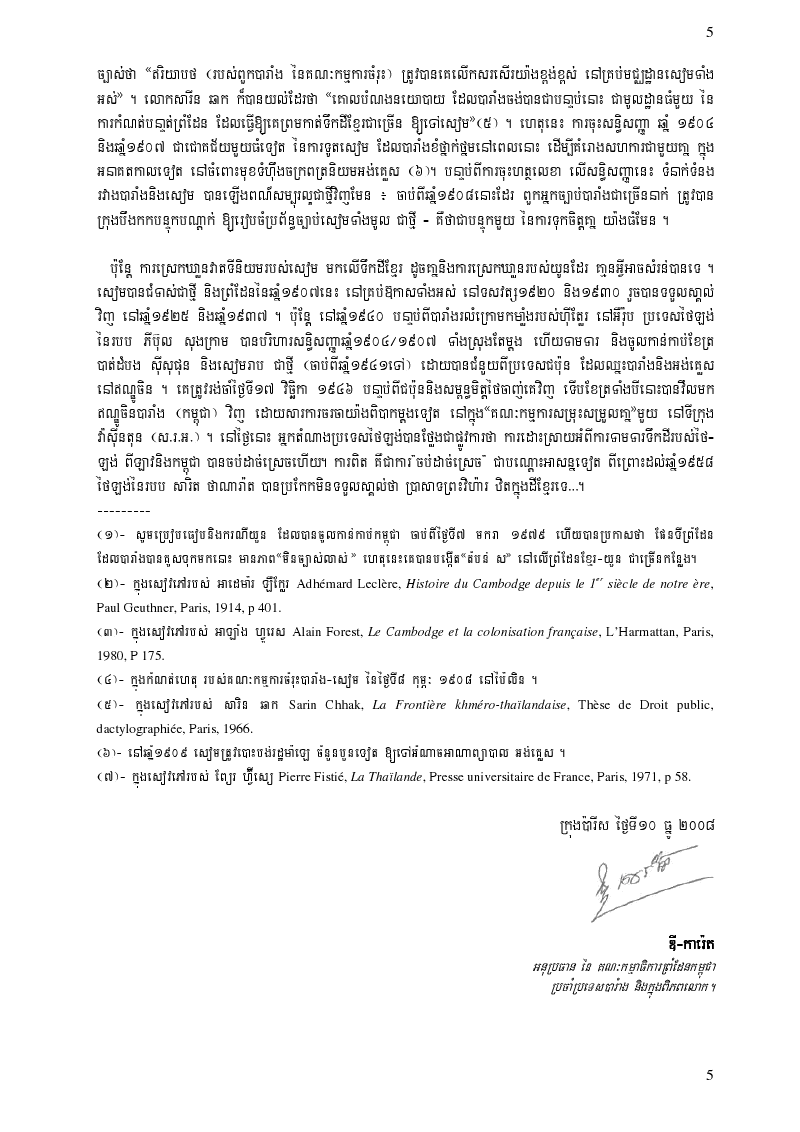
History on the 1904 and 1907 Franco-Siamese Treaties (Article in Khmer and French)


KI-Media note: We hope to bring the English translation of this very interesting article soon, as soon as Luc Sâr or Tola Ek wake up from their afternoon siesta in France.

COMITÉ DES FRONTIÈRES DU CAMBODGE (CFC/CBC), FRANCE

Rappel historique sur
Les Traités franco-siamois de 1904 et de 1907
=====

Le 30 octobre 2008, après le vote du Parlement thaï autorisant son Gouvernement à négocier avec le Cambodge sur la question des frontières, à Preah Vihear et ailleurs, le ministère thaï des Affaires Etrangères a déclaré que « la Thaïlande rejettera toute initiative du Cambodge d’utiliser les cartes dessinées par la France en 1904 comme base de la démarcation (des frontières entre les deux pays) ». Le rejet thaï des traités franco-siamois de 1904 et de 1907 n’est pas nouveau, et le prétexte est toujours le même : ce sont des traités « inégaux », imposés au Siam par la France de l’époque (1). Le rappel de quelques faits historiques permet de comprendre pourquoi et comment ces traités ont été conclus.

Une sécession de Bèn ?

En 1791, un grand dignitaire khmer, le Chauvea Bèn, s’enfuit au Siam avec le jeune roi Ang Eng. En 1794, le roi du Siam, Chakri-Rama 1er, fait couronner de nouveau Ang Eng roi du Cambodge, à Bangkok, pour marquer la suzeraineté du Siam sur ce pays. Après avoir ramené Ang Eng à Oudong avec une armée siamoise, Bèn, pour échapper à ses propres ennemis khmers, se replie dans le nord-ouest du pays, où il s’octroie un grand territoire comprenant les provinces de Battambang, Sisophon et Angkor (Siemreap), avec, semble-t-il, le consentement du roi Ang Eng (2). Evidemment, Bèn se met sous la protection du roi du Siam aussi, auquel il envoie des tributs de vassalité, comme le fait son roi d’Oudong. Ne s’agissant pas d’une sécession de Bèn – peut-être que celui-ci n’ose pas le faire ou s’y refuse également - le roi du Siam accentue la division khmère en décrétant abusivement que la charge de gouverneur du territoire soit héréditaire pour la famille de Bèn. L’administration de ce territoire reste donc entièrement khmère jusqu’en 1867. Malgré cette division interne, le Cambodge est toujours un Etat uni jusqu’à l’arrivée des Français en Indochine. Cependant, dès 1851, Bangkok présente aux Occidentaux des cartes géographiques montrant que les provinces khmères de Koh Kong, Krat, Chantabor, Battambang, Siemreap, Mlou-prey, Tonlé-repou et Stung Trèng font déjà partie du Siam et que le reste du Cambodge est sous la co-suzeraineté siamo-annamite.

Le Siam entre la Grande-Bretagne et la France

Cette situation perdure jusqu’en en 1863, quand la France, après avoir colonisé Saigon en 1859 et le Bas-Cambodge (appelé plus tard Cochinchine) en 1861, conclut directement avec le roi Norodom le traité du Protectorat du Cambodge. Ce traité mécontente profondément le Siam qui se dit toujours suzerain de ce pays et qui multiplie des pressions sur le roi Norodom pour que celui-ci le révoque. A l’époque, Bangkok, qui vient aussi d’obtenir que la France vienne à son aide et développer le commerce avec le Siam, n’ose pas dénoncer ouvertement l’acte français au Cambodge. En effet, la grande menace pour le Siam est la Grande-Bretagne, celle-ci venant d’annexer la Birmanie à son Empire des Indes (1852), de rattacher l’Inde elle-même à la Couronne britannique (1858), et de contrôler fermement plusieurs Etats de la Malaisie - des Etats théoriquement vassaux du Siam. Le contexte général est que la région entière devait être partagée entre ces deux grandes puissances européennes. La préoccupation du Siam est alors de préserver l’indépendance politique de Bangkok, en faisant jouer de la rivalité entre la Grande-Bretagne et la France, tout en essayant de garder le maximum de ses « acquis » antérieurs dans la région.

En réalité, conscient de l’infériorité technique du Siam, le roi Mongkut-Rama IV, dès son avènement en 1851, ouvre largement son pays au commerce et aux méthodes de gouvernement de l’Occident. Des Anglais et d’autres Européens et Américains sont appelés à diriger directement des administrations civiles et militaires du royaume. D’autre part, le roi dépêche ses ambassadeurs pour négocier des «traités d’amitié, de commerce et de navigation» avec la Grande-Bretagne, les Etats-Unis, la France, le Danemark, la Hollande, la Prusse... Un traité franco-siamois est conclu le 15 août 1856, donnant à la France des avantages commerciaux, assurant la liberté religieuse et permettant aux navires de guerre français, sous certaines conditions, l’accès du fleuve Ménam jusqu’à Bangkok. Le 27 juin 1861, l’empereur français Napoléon III, en signe de considération particulière pour le Siam, reçoit ses ambassadeurs en grande pompe au château de Fontainebleau. Ces prémices de modernisation et ces reconnaissances diplomatiques ont évidemment grandi le prestige du Siam aux yeux de l’Occident – qui le trouve « viable ». La Grande-Bretagne et la France finiront par lui accorder les statuts d’un «Etat tampon». Au Cambodge, le successeur de Bèn, qui gouverne alors le territoire de Battambang-Sisophon-Siemreap, est totalement acquis à la Cour de Bangkok.

Une victoire diplomatique du Siam (1867)


A la signature du traité de protectorat français du 11 août 1863, le Cambodge, qui englobe toujours ces trois provinces du nord-ouest, s’est débarrassé de facto de la suzeraineté siamoise. Mais, le 15 juillet 1867, le gouvernement de Paris décide soudainement, par un traité, de les livrer au Siam, ainsi que les provinces côtières de Chantaboun (Chantabor) et Krat (Trat) et les îles environnantes, soi-disant en échange de la reconnaissance formelle siamoise du protectorat français au Cambodge, donc du renoncement du Siam à sa prétendue suzeraineté sur ce pays. Paris a conclu ce traité simplement sur des rapports de son consul à Bangkok – donc sur les indications siamoises -, sans que le roi khmer, le résident français du Cambodge et le gouverneur de la Cochinchine soient consultés, et sans que la situation démographique et politique sur le terrain soit changée. C’est une grande victoire diplomatique de Bangkok. Ce n’est qu’après cette date que commence la siamisation « en douceur » de ces provinces khmères, face, en fait, à de fortes résistances de la part des populations autochtones – qui refusent d’abord d’apprendre et de parler le siamois (3).

La France se rend compte rapidement de son erreur, en particulier à cause de son manque à gagner sur les richesses agricoles de ces provinces amputées du Cambodge, alors que les activités économiques de la région sont tournées vers le Cambodge que vers le Siam et la Grande-Bretagne. Les Français tentent donc de s’implanter plus solidement à Battambang et à Siemreap, cherchant simplement à y faire des affaires, dans le but de ramener ces provinces dans leur sphère économique. Les Khmers, eux, continuent à réclamer auprès des résidents français le retour de ces provinces au Cambodge, mais rien de concret n’est entrepris.

Pour le Laos, au détriment du Cambodge (1893)


La France se préoccupe alors du Laos qu’elle voudrait coloniser et agrandir. En 1886, Auguste Pavie (alors consul français à Luang Prabang) soulève la question de frontière entre le Siam et le Laos, et une confrontation globale est amorcée afin de déterminer les compétences respectives de la France et du Siam dans la région. Les discussions durent trois ans, sans aucun résultat positif. Pour donner du poids à ses revendications, Bangkok décide d’envoyer ses troupes le long de la rive gauche du Mékong et dans les provinces méridionales laos, de Champasak jusqu’au flan de la chaîne annamitique, cela en dépit des mises en garde répétées des Français. En 1893, les Français passent à la contre-attaque avec ses troupes venant d’Annam, délogent rapidement tous les postes siamois créés le long de la rive gauche du Mékong et commencent d’occuper toute la partie méridionale du Laos. D’autre part, des incidents sont nombreux aussi entre les navires français et les garde-côtes siamois dans le golfe du Siam. En juillet 1893, deux canonnières françaises forcent l’embouchure du fleuve Ménam et sont pris sous les feux des forts siamois, causant des blessés et des morts. Les canonnières ripostent violemment et se dirigent vers Bangkok où elles menacent directement, le 14 juillet, le palais du roi Chulalongkon-Rama V, et imposent le blocus du Ménam. Le 20, Auguste Pavie (devenu ministre de la France à Bangkok depuis février 1892) présente au roi un ultimatum dans lequel il réclame la cession par le Siam à la France la ville lao de Luang Prabang et toute la rive gauche du Mékong, y compris les îles du fleuve, ainsi que la province khmère de Stung Trèng – qui sera intégrée au... Laos. C’est la Grande-Bretagne qui presse alors le roi Chulalongkon d’accepter les termes de l’ultimatum français, ultimatum assorti de garanties telles que la démilitarisation d’une bande de 25 Km de large sur la rive droite du Mékong – qui n’est qu’une ancienne bande des territoires lao et khmer -, la démilitarisation également du territoire de Battambang-Sisophon-Siemreap et l’occupation française de la province côtière de Chantaboun (Chantabor), peuplée de Khmers. Mais, le Siam conserve toujours la province de Krat (Trat) et l’île Koh Kong. Le traité franco-siamois est signé le 3 octobre 1893, pour une nouvelle existence du Laos, même au détriment des droits du Cambodge. A partir de 1901, avec l’accord de Bangkok, l’ancienne province khmère de Krat (Trat), sera également occupée par un résident et une garnison français, sans doute pour un meilleur contrôle français des transports maritimes le long du littoral cambodgien du golfe du Siam.

Pour les frontières de l’Indochine française (1904)

Mais, ailleurs, les rapports franco-siamois restent difficiles, car Bangkok ne tient pas à respecter les termes politiques du traité de 1893. En violant les zones démilitarisées, les incursions des forces siamoises se sont poursuivies au Laos et dans les provinces du nord du Cambodge, et ont sans cesse, selon les rapports français, commis des actes de piraterie et de sabotage en Battambang (Aranh, Poïpet, Sisophon), ainsi que dans les provinces côtières khmères. D’autre part, en Malaisie, les Anglais décident de nommer des commissaires dans deux Etats, le Trengganu et le Kelantan, et comptent traiter directement avec ces derniers, en violation de la Déclaration franco-anglaise de 1896 sur la région, sans que le Siam n’ait réagi. Paul Doumer, gouverneur général de l’Indochine, renoue ainsi les conversations avec le Siam et, en 1899, les deux parties reprennent de véritables négociations sur les questions pendantes du Laos en particulier. Cette fois-ci, les négociations durent, non pas quelques mois comme en 1893, mais cinq ans, pour aboutir à la Convention signée le 13 février 1904. Si l’idée de la rétrocession au Cambodge des provinces Battambang et Siemreap revient alors confusément dans les esprits, elle n’est pas dans les revendications françaises.

La France tient d’abord à fixer du nord et au sud la frontière de l’Indochine française avec le Siam. Il est à noter que les discussions franco-siamoises se déroulent sur la base des traités et conventions liant les deux parties depuis un demi siècle et sur des principes de droit régissant les gens et les relations internationales de l’époque. Sans aucun doute, elles se font aussi sous la surveillance intéressée d’autres Puissances occidentales présentes alors au Siam et dans la région, particulièrement de la Grande-Bretagne. Ainsi, malgré son évident avantage dans le rapport de force, la France se montre bien modérée dans ses exigences vis-à-vis du Siam, par rapport à celles de la Grande-Bretagne et, surtout, par rapport aux revendications légitimes du Laos et du Cambodge.

Par le traité de 1904, la France conserve pour le Laos tout le territoire lao de la rive gauche du Mékong, mais laisse celui de la rive droite au Siam, sauf le territoire de Luang Prabang. Le royaume de Champasak (Pasak), qui doit être Khmer, est rattaché au Laos. Pour le Cambodge, elle lui ramène les petites provinces de Melou-prey et Tonlé-repou, et accepte que la ligne de crête de la chaîne du Dâng-rèk constitue la frontière avec le Siam. Au sud, les Français reprennent l’île (Koh) Kong et la province de Krat (Trat) pour les Khmers et laissent Chantaboun (Chantabor) aux Siamois, cela pour fixer leurs compétences respectives dans les eaux du golfe du Siam, après l’incidence de 1893. La Convention de 1904 donne des précisions topographiques des frontières et une Commission mixte pour leur délimitation est nommée. Mais, les « gains » français ne sont pas à la hauteur des attentes du Cambodge. Loin de là.

Les revendications du roi khmer Sisowath (1906)

La Convention de 1904 ne rend pas au Cambodge les provinces de Battambang et Siemreap. Devant les protestations des Khmers, la France préfère leur retourner Stung Trèng, qui a été récupérée et donnée injustement au Laos en 1893. Le roi Sisowath, qui vient d’être couronné, réagit vigoureusement. Dans une lettre du 5 novembre 1906 au résident supérieur français au Cambodge, avant que ne soient commencés les travaux de la Commission de délimitation de la frontière, le roi énumère « (ses) observations et (ses) réserves ». Il estime que si les Siamois acceptent de rendre ces provinces khmères, c’est parce qu’ils « n’ont voulu garder plus longtemps en raison du peu d’importance de ces districts ne compensant point leurs frais d’exploitation, d’administration et d’entretien », mais ils gardent « les provinces les plus riches de Battambang et de Siemreap », alors que « ces deux provinces, pas plus que d’autres, n’ont jamais été données au Siam par aucun de mes prédécesseurs ». Le roi revendique donc le retour au Cambodge de Battambang et de Siemreap – en précisant que « dans cette dernière subsistent encore les ruines de l’ancienne puissante capitale de notre royaume, preuve éclatante de la grandeur de nos ancêtres ». Il réclame aussi la rétrocession d’autres provinces septentrionales comme Kuckhân, Prey-Sâr, Stung-Por, Sorén (Surin), Sangkéac, Néang-Rong, Nocoréach-Séma (Corat), en refusant de considérer la chaîne du Dâng-rèk comme frontière entre le Cambodge et le Siam. A l’ouest, en plus de Koh Kong et Krat, Chantabor (Chantaboun) devra revenir aussi à son royaume, comme « toutes ces provinces (qui) sont encore peuplées de Cambodgiens et conservent leur patriotisme absolûment khmer ». Enfin, conclut le roi, si les provinces de Battambang et Siemreap avec toutes leurs dépendances ne sont pas rétrocédées au Cambodge, « nous demandons à nous réserver toujours, pour nous et tous nos successeurs, le droit de faire valoir nos revendications jusqu’à ce que entières justice et satisfaction nous soient rendues ».

Les échanges et les oublis du Traité de 1907

Les revendications du roi Sisowath semble être entendues, concernant Battambang et Siemreap seulement, eu égard aux données démographiques et géographiques du terrain et d’autant plus que ces riches et peuplées provinces sont prometteuses d’importants apports financiers pour le budget du Protectorat. D’ailleurs, le retour de ces provinces au Cambodge n’est que la réparation de l’erreur commise par la France en 1867. La Commission de délimitation de la frontière décide donc d’intégrer Battambang, Sisophon et Siemreap au Cambodge, mais cède au Siam la localité d’Aranh et ses environs de 60 Km², Krat et le territoire stratégique de Dan-saï, ainsi que quelques districts du Laos. En même temps, la Commission décide de fixer définitivement dans le golfe du Siam la frontière maritime entre ce pays et l’Indochine française (Cambodge) par une ligne reliant le plus haut sommet de l’île Koh Kut à un point du littoral situé en face de cette île (4). Ces délimitations sont confirmées par un nouveau traité du 23 mars 1907, sans que les statuts des autres provinces et leurs populations khmères au nord du Dâng-rèk et à l’ouest de Battambang, légitimement réclamées par le roi Sisowath, ne soient mentionnés quelque part.

En somme, le Cambodge n’a pas recouvré grand-chose de ce qui a été pris par le Siam, selon le roi Sisowath, « par la force et l’hypocrisie » au 19e siècle, un peu avant l’arrivée des Français. La France, dans ses successives négociations avec le Siam, est loin d’imposer sa force et sa volonté, mais a toujours opéré des échanges « équitables » avec celui-ci, soit au niveau local (Cambodge ou Laos), soit au niveau de l’Indochine française. Les travaux de la Commission franco-siamoise pour la délimitation de la frontière se déroulent jusqu’en 1908, « dans un esprit d’entière confiance », d’après une lettre de remerciements du 9 juin 1908 du ministre siamois des Affaires Etrangères au ministre français des Colonies, précisant que « l’attitude (des Français membres de la Commission) a été hautement appréciée dans les milieux siamois ». Sarin Chhak a noté d’ailleurs que « le but politique poursuivi par la France occupa une grande place dans la délimitation et il devait coûter des cessions territoriales (au Siam) au dépens du Cambodge » (5). Les traités de 1904 et 1907 sont donc une autre victoire diplomatique pour Bangkok, que la France tient alors à ménager pour d’autres projets communs à venir, face à l'ardeur impérialiste de la Grande-Bretagne (6). Après leur signature, les relations franco-siamoises s’améliorent visiblement : dès 1908, des juristes français reçoivent la charge de la refonte du droit siamois - une charge effectivement de grande confiance (7).

Mais, les appétits expansionnistes du Siam (Thailande), comme ceux de l’Annam (Vietnam), au détriment Cambodge, sont insatiables. Ces frontières de 1907 sont remises en cause par le Siam en toutes occasions, dans les années 1920 et 1930, mais sont confirmées de nouveau en 1925 et en 1937. En 1940, toutefois, après l’effondrement de la France devant les forces d’Hitler, la Thaïlande de Phibul Songkhram les dénonce une nouvelle fois et réclame le retour des provinces cambodgiennes de Battambang, Sisophon et Siemreap, qu’elle occupe à partir de 1941, avec l’aide du Japon. Ce n’est que le 17 novembre 1946, après la défaite du Japon et de son allié thaï, que les territoires précédemment annexés reviennent, non sans peine, à l’Indochine française, par décision d’une Commission de Conciliation tenue à Washington (USA). La Thaïlande déclare alors que le règlement de ses revendications territoriales sur le Laos et le Cambodge est « définitif ». Provisoirement « définitif », puisqu’en 1958 Bangkok, sous Sarit Thanarat, conteste l’appartenance du temple Preah Vihear au Cambodge...
---------
(1)- A comparer avec le cas du Vietnam qui, durant son occupation du Cambodge à partir du 7 janvier 1979, a soutenu que les cartes de frontières laissées par les Français sont "floues", d'où l'invention des soi-disant « zones blanches » le long la frontière viêtnamo-khmère.
(2)- Adhémard Leclère, Histoire du Cambodge depuis le 1er siècle de notre ère, Paul Geuthner, Paris, 1914, p 401.
(3)- Alain Forest, Le Cambodge et la colonisation française, L’Harmattan, Paris, 1980, P 175.
(4)- Voir notamment le Procès-verbal de la Commission mixte franco-siamoise du 08/02/1908 à Païlin.
(5)- Sarin Chhak, La Frontière khméro-thaïlandaise, Thèse de Droit public, dactylographiée, Paris, 1966.
(6)- En 1909, Bangkok devra abandonner au protectorat britannique quatre Etats malais encore.
(7)- Pierre Fistié, La Thaïlande, Presse universitaire de France, Paris, 1971, p 58.


Paris, le 10 décembre 2008

Dy Kareth
Vice-Président
du Comité des Frontières du Cambodge
en France et dans le Monde

Friday, November 14, 2008

Thailand must use Cambodian maps

Friday, 14 November 2008
Written by Chan Veasna
Letter to the Editor of The Phnom Penh Post

Dear Editor,

Thailand is not keen on settling border disputes amicably and mutually, but on Thailand's terms. Thailand has consistently reiterated that it will only agree to negotiate based on maps unilaterally drawn by Thailand. In other words, Thailand will not settle the current border disputes with Cambodia if Cambodia does not allow Thailand to keep the territories it had claimed and occupied to date. So, is peace and a border solution possible between Cambodia and Thailand in the future?

Thailand's insistence on the use of maps drawn by itself, without Cambodia's agreement, is against the spirit of good neighbourly respect and contrary to international laws. Those maps have no legal basis under international laws.

If the 1904, 1907 maps are not used, it would be a betrayal of the treaties and a tragedy, as it will set a precedent that triggers future violations of subsequent [border] treaties.

So, if Thailand is insisting on using the maps unilaterally drawn by Thailand itself, will there ever be an agreement and peace at all?
If that is the case, is there any room for Cambodia to manoeuvre in the negotiations?

If Thailand does not conform to international laws by accepting the internationally-recognised treaties of 1904, 1907, the Khmer-Thai border disputes will become a quagmire and result in future deadly armed conflicts, similar to what already happened on October 15.

That would be a tragedy in Khmer-Thai relations. Not one single country, but both countries, will lose from these insignificant and petty disputes.

Chan Veasna
Cabramatta, NSW, Australia