http://www.youtube.com/watch?v=JUP0CHmavys
Showing posts with label 1975-1979 Life under the KR. Show all posts
Showing posts with label 1975-1979 Life under the KR. Show all posts
Tuesday, September 04, 2012


Wednesday, August 29, 2012
Cambodia makes first Oscars submission in 18 years

ScreenDaily.com
Cambodia has submitted Chhay Bora’s Lost Loves to the best foreign-language film category of the Academy Awards, marking the first time in 18 years that the country has sent a film to the Oscars.
The Cambodia Oscar Selection Committee (COSC) voted unanimously for the historical drama, which follows the experiences of a middle-class woman during Pol Pot’s genocidal regime.
Chhay Bora and his wife Kauv Sotheary, who are both university professors, used 15 years of personal savings to finance the film, one of the first historical dramas made by Cambodians about life during the Khmer Rouge regime.
Tuesday, August 14, 2012
In The 'Shadow' Of Death, Stories Survive

 |
| Vaddey Ratner's novel is derived from her own experiences — she spent four years of her youth working in forced labor under the Khmer Rouge. (Kristina Sherk/Simon & Schuster) |
By Lynn Neary
National Public Radio (USA)
I actually want to tell a story about the power of storytelling to transcend suffering. Because it was the stories that saved me.
When she was just 5 years old, Vaddey Ratner's comfortable and protected life as the child of an aristocratic Cambodian family came to an abrupt end, as Khmer Rouge soldiers entered the capital, Phnom Penh. They banged on the gates of the family compound and ordered them to leave — it was the start of the Khmer Rouge reign of terror, which left hundreds of thousands of Cambodians dead, including all of Ratner's family except her mother.
She tells a fictionalized version of her story in her first novel. In the Shadow of the Banyan follows Raami, a little girl from an aristocratic Cambodian family who loses everything when the Khmer Rouge take over.
Ratner says she always felt like an oddball as a child. She was self-conscious because she walked with a limp as a result of polio — an affliction shared by her fictional heroine, Raami. One day, some of the children in Ratner's extended family began to tease her, saying she was not part of the family, that she must have been found in the street. Ratner ran to her father for comfort
"He said, 'You know, they were probably right. I did find you, and I found you in a bird's nest. You wobbled when you walk, but you know, there are these things, these wings coming out of your back,' " she recalls. "I looked at him skeptically, and he said to me, 'Well, you know, that's what I dreamt.' "
Thursday, July 26, 2012
WAR AND GENOCIDE - By Chanda Chhay (Part 1)

Special Announcement:
From today onward, the book: WAR AND GENOCIDE will be posted in sequence (every week) at http://www.cambodianchildren.blogspot.com/. If you are interested in reading this book from beginning to end, please bookmark this blog's address or visit it weekly to follow the story.
Turmoil
March 18, 1970. The date was historical for Cambodia and the Cambodians. But for the rest of the world, it was just one of those normal cycles of the week, the month, the year, and the century. Nothing would ever stop the inexorable evolution of time. The sun would rise and set as it had for millennia. The new day arrived, the old day disappeared. Everything seemed to move forward peacefully. However, being caught on the verge of a civil war, Cambodia appeared to fall into a world of uncertainty. News of the Americans invasion and bombardments on the Viet Cong’s (North Vietnamese Communist guerrillas) sanctuaries in northeastern Cambodian territory had spread as fast as the blasting sounds of those bombs. Every day, rumors and gossips about Cambodia being dragged into the tumult of the Vietnam War began to diffuse from town to town. Despite lack of information from the media, the earth trembling caused by the explosions of the American secret bombardments in Cambodia spread even faster than the press release. Day after day, the explosions of cluster bombs dropped down by the U.S.’s B-52 war planes had sent plenty of clear messages to the local people indicating that Cambodia’s independence, neutrality, and territorial integrity, which were guaranteed by the Geneva Conference in 1954, were now threatened, and devil and danger were on the way to steal their souls. Though it seemed a bit premature to predict any possible disaster at the moment, based on the ever present sounds of explosions, the smell of destruction was unmistakable. It was at that point in time that I began learning and memorizing life’s lesson about being caught in a war--a war that was to forever shape and change the course of my life. At the age of six, I had my first taste of escaping the destructive forces of war.
Thursday, February 23, 2012
Reporter recalls rare trip to Pol Pot's Cambodia
 |
| Former Washington Post correspondent Elizabeth Becker speaking during an interview at the Foreign Correspondents' Club (FCC) in Phnom Penh. Photo courtesy: AFP |
 |
| Former Washington Post correspondent Elizabeth Becker showing the book that she wrote during her photo exhibition at Bophana center in Phnom Penh. Photo courtesy: AFP |
 |
| Former Washington Post correspondent Elizabeth Becker standing next to a photo of former Khmer Rouge leader Pol Pot during her photo exhibition at Bophana center in Phnom Penh. Photo courtesy: AFP |
 |
| A Cambodian man looking at photos during the photo exhibition of former Washington Post correspondent Elizabeth Becker at Bophana center in Phnom Penh. Photo courtesy: AFP |
By Michelle Fitzpatrick
PHNOM PENH, February 23, 2012 (AFP) - When the Khmer Rouge invited a pair of American journalists to Cambodia in the late 1970s for a rare glimpse of the revolution, they found empty streets and schools in a city with no laughter.
"There was nobody there. It was like walking into the Twilight Zone," recalled one-time Washington Post correspondent Elizabeth Becker.
Invited by the hardline communist regime to visit the capital Phnom Penh in 1978, she jumped at the rare chance to see the secretive revolution in action and meet its leader Pol Pot.
Saturday, January 28, 2012
Author Hopes To Shed Light Khmer Rouge Trauma
 |
| “Out of the Dark: Into the Garden of Hope” by Sam Keo, a Cambodian psychologist. (Photo: Courtesy of Dr. Sam Keo) |
Thursday, 26 January 2012
Men Kimseng, VOA Khmer | Washington, DC
“The disease that we endured during the genocidal Khmer Rouge regime cannot be completely healed.”
Click the control below to listen to the audio program:
Cambodians who survived the Khmer Rouge will have to live with the emotional scars of the regime, but staying positive can help them move forward, says Sam Keo a Cambodian psychologist who has written a new book.
“Out of the Dark: Into the Garden of Hope” is an attempt to help Cambodians move past the trauma, he said on “Hello VOA” Monday.
“The disease that we endured during the genocidal Khmer Rouge regime cannot be completely healed,” said Keo, who is a clinical psychologist in Los Angeles. “It stays on. But we can help them work as normal for certain periods of time, until they run into big stresses.”
Monday, April 11, 2011


Friday, April 18, 2008
Part 1 of life story under the KR regime: April 1975 … that I remember
April 1975 … that I remember
April 2008
By Krakmo Kaing
Translated from Khmer
April 15th was the day that my wife just had her surgery at the Russian Hospital (Phnom Penh), and she was just released from the surgery room, and she was sent to the post-surgery room, located along the back of the hospital, on the first floor of the Tuberculosis (TB) building.
The surgery was a total failure, my wife had high fever, she was shaking and her stomach was swollen. Panic and hopelessness started to get the better of us. We were somewhat fortunate that my father was staying there and he gave us some highly needed encouragements in this time of panic. Meanwhile, rockets launched by the Khmer Rouge (KR) fell down regularly at 5-minute interval. The rockets fell around the hospital and they shook the hospital building.
The next morning, on April 16th, at 10:00AM, I decided to drive my Peugeot 404 car which I parked underneath the hospital building, to go fetch Dr. Sun Lay, a surgery doctor who lives along Preah Monivong Boulevard. The street was eerily quiet, there was no traffic at all, only my car was moving at a deadly speed. I no longer care about the rockets explosions that rain down on Phnom Penh city anymore. When I reached Dr. Sun Lay’s home, I told him about my wife’s illness which necessitated another surgery. Dr. Sun Lay told me that he regretted he did not take care of my wife from the start, otherwise, she would not be facing danger as she is now. He agreed with me to undertake another surgery in the surgery room which was already prepared by the nurses. I was amazed to see the professional dedication of the hospital personnel who remained at their posts in spite of the upheaval taking place outdoor.
The surgery took more than one hour long, and my wife was brought back on a stretcher to the hospital room. Dr. Sun Lay then left to return back home, I did not even know how he went home, it could be that a hospital personnel gave him a ride back.
My wife’s care fell entirely on my shoulders. I had to give her intravenous fluid injection 24-hour long, as well as injecting a high dose of antibiotic into the serum fluid. I was lucky that the hospital pharmacy stockroom door was smashed open and medicines were spread all over the place two days earlier. I went in to look and found the medicines I needed to care for my wife after her surgery and I also took the opportunity to collect all that I needed for myself in case of a minor surgery, because I knew that the KR will surely evict us and send us somewhere far, and that we will not have the opportunity to return back home anymore.
At the back of the Russian hospital, there was also a building for TB care, during that time, the building was almost empty, except for two or three patients who still remained there. Other than these, all the other patients were taken home by their relatives because they knew that upheaval will occur in the next few hours. Among those still remaining in the hospital, there was a pregnant young woman, she was all by herself, no relative or husband was there with her. She came near me and begged me to help her when she will deliver the baby. In my mind, I was already prepared to help her when the time comes.
In the morning of April 17th, after an entire night of rocket rain, the situation became quieter. I was standing along the hallway in front of the room where my wife was resting, waiting to see how the situation would turn out to be. At around 08:00AM, a group of about ten KR soldiers appeared, they were all dressed in black uniform, armed with AK-47 rifles, their faces serious, they look as if they were about to shoot in a battlefield. The soldiers walked towards me, before they asked me anything, I smiled to them and explained to them that I had to wait for my wife to recuperate and I told them that by the next day, my wife would be able to walk. The soldiers agreed for me to stay in the hospital, but all the patients must gather into the contagious disease building instead. This building is located next to the personnel building at the Russian hospital. The KR soldiers also gathered all the hospital personnel who could not return home in this building as well. By then, there was no electricity, no water and no food anymore. Everything was cut off, each person had to feed themselves. As for me, I did not have any food with me at all, as I did not bring anything from home. I had to scrounge for rice leftover from patients who left the hospital.
A surprising event took place during that time: among the patients whom the KR soldiers forced to leave the hospital, if they were accompanied by their relatives, the latter must take them out, for the others, the Angkar transported them for healthcare in the so-called back of the battlefield. Two GMC trucks can be seen transporting the patients out nonstop, however, these trucks took only 10 minutes to come back. Everybody was wondering why the Angkar hospital is located so close by.
 Sacrava cartoon
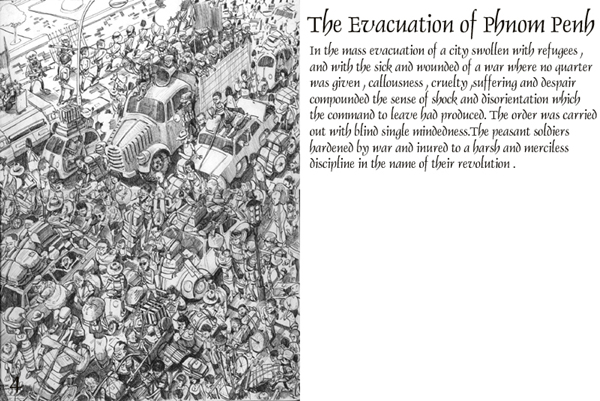
Traffic in front of the Russian hospital was jammed for the past three days. People were traveling out of the city, using any means they can find: some were leaving in slowly moving cars, some even had to push their cars forward, while others were carrying their belonging on their shoulders or on their head, and others were pushing their relatives on wheeled-stretchers out of the hospital. Under the scorching sun of April, most likely, these patients may not be able to go anywhere far…
As for us who are packed inside the small contagious disease building, we were waiting for the traffic to become lighter so we can leave also. However, during the wait, we were ordered by the KR soldiers to carry dead bodies left in the surgery room and those who died and left behind by their relatives on the hospital beds, and burry them in the open hospital courtyard. While we were resting at night, the KR soldiers were patrolling, they would shine their flashlight on us, and they would mumble to their comrades that we were the imperialists who sleep inside mosquito nets and on comfortable mattresses.
Two days later, we saw the KR soldiers bringing two trucks to park near the building where we stayed. In our minds, we were wondering which mysterious place will they take us to, but maybe it was also our luck that they gave us a truck ride rather than having to walk, especially with my wife recent surgery condition. I overheard some of the soldiers said among themselves that they prepared a special place for my wife who needed to lie down on a stretcher. As for my car which I parked underneath the TB building, the Khmer Rouge requested it from me since the very first day. I gave it to them with a broad smile, trying to act as if I had no regret whatsoever, but I asked them to keep a small kerosene lamp which I kept in the trunk of my car. We climbed on the KR truck on our first leg out of Phnom Penh, we arrived at the round about in Kbal Thnâl. However, instead of crossing the bridge, the truck headed to Takhmao instead. Along the roads, there were numerous cars parked along the roadside. When we reached Takhmao, the truck did not stop, and it kept on moving until it dumped us out at a village called Svay Rolum village.
To be continued...
April 2008
By Krakmo Kaing
Translated from Khmer
April 15th was the day that my wife just had her surgery at the Russian Hospital (Phnom Penh), and she was just released from the surgery room, and she was sent to the post-surgery room, located along the back of the hospital, on the first floor of the Tuberculosis (TB) building.
The surgery was a total failure, my wife had high fever, she was shaking and her stomach was swollen. Panic and hopelessness started to get the better of us. We were somewhat fortunate that my father was staying there and he gave us some highly needed encouragements in this time of panic. Meanwhile, rockets launched by the Khmer Rouge (KR) fell down regularly at 5-minute interval. The rockets fell around the hospital and they shook the hospital building.
The next morning, on April 16th, at 10:00AM, I decided to drive my Peugeot 404 car which I parked underneath the hospital building, to go fetch Dr. Sun Lay, a surgery doctor who lives along Preah Monivong Boulevard. The street was eerily quiet, there was no traffic at all, only my car was moving at a deadly speed. I no longer care about the rockets explosions that rain down on Phnom Penh city anymore. When I reached Dr. Sun Lay’s home, I told him about my wife’s illness which necessitated another surgery. Dr. Sun Lay told me that he regretted he did not take care of my wife from the start, otherwise, she would not be facing danger as she is now. He agreed with me to undertake another surgery in the surgery room which was already prepared by the nurses. I was amazed to see the professional dedication of the hospital personnel who remained at their posts in spite of the upheaval taking place outdoor.
The surgery took more than one hour long, and my wife was brought back on a stretcher to the hospital room. Dr. Sun Lay then left to return back home, I did not even know how he went home, it could be that a hospital personnel gave him a ride back.
My wife’s care fell entirely on my shoulders. I had to give her intravenous fluid injection 24-hour long, as well as injecting a high dose of antibiotic into the serum fluid. I was lucky that the hospital pharmacy stockroom door was smashed open and medicines were spread all over the place two days earlier. I went in to look and found the medicines I needed to care for my wife after her surgery and I also took the opportunity to collect all that I needed for myself in case of a minor surgery, because I knew that the KR will surely evict us and send us somewhere far, and that we will not have the opportunity to return back home anymore.
At the back of the Russian hospital, there was also a building for TB care, during that time, the building was almost empty, except for two or three patients who still remained there. Other than these, all the other patients were taken home by their relatives because they knew that upheaval will occur in the next few hours. Among those still remaining in the hospital, there was a pregnant young woman, she was all by herself, no relative or husband was there with her. She came near me and begged me to help her when she will deliver the baby. In my mind, I was already prepared to help her when the time comes.
In the morning of April 17th, after an entire night of rocket rain, the situation became quieter. I was standing along the hallway in front of the room where my wife was resting, waiting to see how the situation would turn out to be. At around 08:00AM, a group of about ten KR soldiers appeared, they were all dressed in black uniform, armed with AK-47 rifles, their faces serious, they look as if they were about to shoot in a battlefield. The soldiers walked towards me, before they asked me anything, I smiled to them and explained to them that I had to wait for my wife to recuperate and I told them that by the next day, my wife would be able to walk. The soldiers agreed for me to stay in the hospital, but all the patients must gather into the contagious disease building instead. This building is located next to the personnel building at the Russian hospital. The KR soldiers also gathered all the hospital personnel who could not return home in this building as well. By then, there was no electricity, no water and no food anymore. Everything was cut off, each person had to feed themselves. As for me, I did not have any food with me at all, as I did not bring anything from home. I had to scrounge for rice leftover from patients who left the hospital.
A surprising event took place during that time: among the patients whom the KR soldiers forced to leave the hospital, if they were accompanied by their relatives, the latter must take them out, for the others, the Angkar transported them for healthcare in the so-called back of the battlefield. Two GMC trucks can be seen transporting the patients out nonstop, however, these trucks took only 10 minutes to come back. Everybody was wondering why the Angkar hospital is located so close by.
Svay Rolum village
 Sacrava cartoon
Traffic in front of the Russian hospital was jammed for the past three days. People were traveling out of the city, using any means they can find: some were leaving in slowly moving cars, some even had to push their cars forward, while others were carrying their belonging on their shoulders or on their head, and others were pushing their relatives on wheeled-stretchers out of the hospital. Under the scorching sun of April, most likely, these patients may not be able to go anywhere far…
As for us who are packed inside the small contagious disease building, we were waiting for the traffic to become lighter so we can leave also. However, during the wait, we were ordered by the KR soldiers to carry dead bodies left in the surgery room and those who died and left behind by their relatives on the hospital beds, and burry them in the open hospital courtyard. While we were resting at night, the KR soldiers were patrolling, they would shine their flashlight on us, and they would mumble to their comrades that we were the imperialists who sleep inside mosquito nets and on comfortable mattresses.
Two days later, we saw the KR soldiers bringing two trucks to park near the building where we stayed. In our minds, we were wondering which mysterious place will they take us to, but maybe it was also our luck that they gave us a truck ride rather than having to walk, especially with my wife recent surgery condition. I overheard some of the soldiers said among themselves that they prepared a special place for my wife who needed to lie down on a stretcher. As for my car which I parked underneath the TB building, the Khmer Rouge requested it from me since the very first day. I gave it to them with a broad smile, trying to act as if I had no regret whatsoever, but I asked them to keep a small kerosene lamp which I kept in the trunk of my car. We climbed on the KR truck on our first leg out of Phnom Penh, we arrived at the round about in Kbal Thnâl. However, instead of crossing the bridge, the truck headed to Takhmao instead. Along the roads, there were numerous cars parked along the roadside. When we reached Takhmao, the truck did not stop, and it kept on moving until it dumped us out at a village called Svay Rolum village.
To be continued...
Sunday, March 30, 2008
Cambodian-Americans discuss atrocities at Cal hearing
03/29/2008
The Associated Press
The Associated Press
LONG BEACH, Calif.—The Cambodian genocide that claimed 1.7 million lives a generation ago continues to cast a shadow on both survivors and their American-born children, panelists said Saturday.
About 100 people attended a daylong workshop at California State University, Long Beach, that aimed to discuss the effects of the 1975-79 slaughter under the Khmer Rouge. Nearly a quarter of the population died from disease, overwork, starvation and execution in the notorious "killing fields."
The workshop was one of the first U.S. events to target Cambodian-Americans and solicit their participation in an international war crimes tribunal under way in their homeland.
Panels of experts discussed psychological and other aspects of the genocide.
Lakhena Nget, 24, was on a youth panel. A child of Cambodian refugees, the CSULB junior said she only learned of her parents' past in high school, when she interviewed them as part of a history project.
Nget said she grew up in an American culture and didn't understand her parents. Cambodian culture had called for them not to express their emotions over their experiences, she said.
She learned that her grandparents starved to death, several uncles with government ties were executed, and her father was imprisoned for suspicion of being in the despised educated class.
Her mother walked to a refugee camp, carrying her children.
"It broke my heart," Nget said.
Nget said the genocide can affect generations of Cambodian-Americans who know nothing about it, Nget said.
Parents haunted by their experiences may drink or find other ways of dulling their pain, or their perceived coldness may leave their children disaffected.
"I see how the pain and the struggles are still perpetuated in the community," Nget said. "There's a lot of young people that do not do well in school. They join gangs...I believe that a lot of it comes from broken communication in the home."
One of the workshop organizers was Leakhena Nou, a Cambodian-American and sociology professor at Cal State Long Beach.
Before the workshop, she said many survivors are still afraid to get involved in the tribunal by sharing their stories. Organizers urged attendees to apply for formal victim and civil party status and volunteer as translators or witnesses.
Subscribe to:
Posts (Atom)