Showing posts with label CPP-controlled media. Show all posts

Tuesday, June 05, 2012

Monitor scrutinises poll for irregularities

A voter looks for his name on lists posted outside a polling station in Prey Veng province on Sunday. Photograph: Derek Stout/Phnom Penh Post

Tuesday, 05 June 2012
Joseph Freeman and Vong Sokheng
The Phnom Penh Post
“The state media has been used freely by the ruling party.”
While the main election monitor in Cambodia praised the lack of violence during Sunday’s commune elections, it also observed a host of irregularities, including the ruling party using civil servants and state media to campaign, polling sites set up in police stations and residences, and voters turned away for lack of sufficient ID.

The Committee for Free and Fair Elections in Cambodia met yesterday at its headquarters in Phnom Penh to discuss what monitors saw in the field and release initial results of an election in which the Cambodian People’s Party once again trounced all comers.

“There are many complaints from political parties,” Koul Panha, the director of Comfrel, told reporters.

Comfrel will investigate all of them, he said, but so far it hasn’t found any polling stations where the results are unacceptable.

Monday, June 04, 2012

Observers: Cambodian Vote Improved but Problems Remain

A woman finds her name on a list during a local commune election in Phnom Penh, June 3, 2012.
June 04, 2012
Irwin Loy
Voice of America
"Free and fair, with the international standard - no, not at all. Because you see the CPP controls the important media, especially the television, all the radio, and also the newspapers ... They control the media. And they also have a lot of the money. They donate to, not every voter, the voters that they know support them."
PHNOM PENH - Cambodia's ruling party won the majority of seats in local elections nationwide Sunday, but observers say the vote was not without its problems.

Even going into Sunday's election, there was little doubt which party would come out on top. But critics say the dominance of the ruling Cambodian People's Party (CPP) has been aided by past irregularities at the polling booth. This year was no different.

Mu Sochua is a lawmaker with the opposition Sam Rainsy Party (SRP). Early results suggest the SRP lost ground this election, even in its traditional strongholds like the capital, Phnom Penh.

Speaking by phone, Sochua said she witnessed subtle attempts at voter intimidation on Sunday. She said she saw influential local officials, aligned with the CPP, standing near polling stations as Cambodians arrived to vote.

"It has an effect, it does. It is one of the factors, in terms of voters not voting their conscience," said Sochua.

គណបក្ស​សមរង្ស៊ី​ បដិសេធ​លទ្ធផល​បោះឆ្នោត​ - SRP rejects commune election results

ថ្ងៃទី 4 មិថុនា 2012
ដោយ: លីនណា
Cambodia Express News

ភ្នំពេញ: ​លោក យឹម សុវណ្ណ អ្នកនាំពាក្យ​គណបក្ស​សមរង្ស៊ី បាន​ប្រកាសបដិសេធ​មិន​ទទួលស្គាល់​លទ្ធផល​បោះឆ្នោតឃុំ​សង្កាត់ កាលពី​ថ្ងៃទី​៣ ខែមិថុនា​។ ប៉ុន្តែ​លោក ​ទេព​ នីថា​ អគ្គលេខាធិការ​រៀបចំ​កា​របោះ​ឆ្នោត បាន​និយាយថា​ រហូតមកទល់​ពេលនេះ​ គណៈកម្មាធិការ​ជាតិ​រៀបចំ​ការបោះឆ្នោត (គ​.​ជ​.​ប​.) មិនទាន់​បានទទួល​ព័ត៌មាន​ផ្លូវការ​នៅឡើយ​ទេ​។​

​នៅក្នុង​សន្និសីទ​សារព័ត៌មាន លោក យឹម សុវណ្ណ បាន​និ​យា​ថា លោក​មិន​ទទួលស្គាល់​លទ្ធផល នៃ​ការបោះឆ្នោត​ជ្រើសរើស​ក្រុមប្រឹក្សាឃុំ​សង្កាត់ អាណត្តិ​ទី​៣​នេះ​ទេ​។ លោកបញ្ជាក់ថា “​ប្រព័ន្ធ​ឃោសនាបោះឆ្នោត​ ជា​ប្រព័ន្ធ​អាក្រក់​បំផុត ប្រជាជន​មិនមាន​សិទ្ធិ​ស្មើគ្នា​”​។​

​នៅក្នុង​សន្និសីទ​នេះដែរ លោក យឹម សុវណ្ណ បាន​ទទួលស្គាល់ថា អំពើហិង្សា​នយោបាយ​បាន​ថយចុះ តែ​បាន​កើនឡើង​នូវ​រូបភាព​គំរាមកំហែង។​

Thursday, December 15, 2011

Cambodia must address electoral capacity gaps to ensure freedom of speech – UN expert

Surya P. Subedi, Special Rapporteur on the Situation of Human Rights in Cambodia

9 December 2011
UN News Centre

Cambodia must address the capacity gaps within its electoral system to ensure freedom of speech and encourage debate among its political parties, a United Nations expert said today, urging the Government to take the necessary measures to ensure free and fair elections next year.

Special Rapporteur Surya P. Subedi, who just finished a six-day visit to the country, said that he was particularly concerned about access to mass media in the lead-up to the commune elections next year and the 2013 parliamentary elections.

“I have had concerns expressed to me that a number of political parties have been denied access to the mass media on an equal footing, or have encountered difficulties with local authorities when they try to claim their right to participate in a free and fair election campaign,” he said.

Monday, December 12, 2011

Cambodia must address electoral capacity gaps to ensure freedom of speech – UN expert

Surya P. Subedi, Special Rapporteur on the Situation of Human Rights in Cambodia

9 December 2011
UN News Centre

Cambodia must address the capacity gaps within its electoral system to ensure freedom of speech and encourage debate among its political parties, a United Nations expert said today, urging the Government to take the necessary measures to ensure free and fair elections next year.

Special Rapporteur Surya P. Subedi, who just finished a six-day visit to the country, said that he was particularly concerned about access to mass media in the lead-up to the commune elections next year and the 2013 parliamentary elections.

“I have had concerns expressed to me that a number of political parties have been denied access to the mass media on an equal footing, or have encountered difficulties with local authorities when they try to claim their right to participate in a free and fair election campaign,” he said.

Thursday, November 03, 2011

The Unbearable Lightness of Being a Dictator!


Thursday, November 03, 2011
Op-Ed by School of Vice

Another groundbreaking ceremony (the construction of a Chinese-funded bridge), another platform for Mr Hun Sen to unleash his pent-up frustration and anger against his critics in "the media" and elsewhere who lately have seen it fit to dangle the ignominious and humiliating fate of Libya's Col Gaddafi before him as a timely reminder of what dictators and violent rulers could look forward to at the end of their lengthy but equally violently terminated political careers.

As usual, it is left to a bunch of much condescended "puny" online, and largely anonymous news blogs - need I name them? - to do the work no ‘respectable’ news outlets in Cambodia would contemplate doing, out of fear of undermining carefully constructed network vis-a-vis the corridors of power. Contrary to the quoted statement of the publisher of the Phnom Penh Post - a foreign-managed news outlet - Cambodia does not enjoy the "freest media climate in Asia,” or something to that effect. There is certainly much perceived lack of professionalism among the local Khmer press and media community, but this situation or short-coming being the case as it were ought to call for appropriate remedy in the form of the existence of an independent national media watch dog or tribunal. Moreover, considering the existence of anything 'independent' (beside regime-affiliated institutions) is out of the question under a dictatorship, any perceived issues we have with press and media codes of conduct and professionalism seem either irrelevant or secondary so long as such 'professionalism' comes about on the back of the sacrifice by the media community as a whole, made upon fundamental principles associated with the freedom of expression of diverse opinions.

So at least, a student graduation ceremony, an inaugural address at a construction site would always be a monopoly for the "Prime Minister" to launch his war-talk and threaten violence against potential rivals to the political throne. Even as he infuriatingly dismisses the comparison made, the man unwittingly justifies it by ruling out or outlawing any opinion other than his own and by holding forth the spectre of punitive violence as the only fate awaiting those who attempt to remove him from his throne. If he is democratically and legitimately elected by the Cambodian people as he claims to be, then why not engage dissenting opinions through independent democratic forums rather than using one-sided, state-led party apparatus to throttle them, in addition to these constant verbal threats and murderous sanctions against anyone who manages to get under his skin? That would appear to be at odds with most people's understanding of parliamentary democracy where the administration of public affairs (outside of exceptional national emergencies or circumstances) is expected to be enacted by way of consensus, transparency and open public debate, the absence of which cannot be said to be conducive to the developmental process of sound governance or professional ethics in all spheres of public and civil life, including journalism and the media.

How important is the role and relevance of professional ethics to a Khmer reporter, a journalist, a teacher or anyone who immerses his/her existence in, and derives life’s meaning or fulfilment out of, the knowledge that such immersion positively affects the cause, or facilitates the aspirations, of the society to which they feel they belong in some way when an individual stands powerless in defending his/her actions anyway, be they meet some accepted personal or professional moral standard or otherwise so long as the ability and right to legislate what is ‘right’ and ‘wrong’ remain the monopoly of the powerful few or - in this case - that one person who is only accountable to Himself? With every general election over the last 20 years invariably having delivered a “landslide” mandate, why agonises over this comparison to a Middle-Eastern dictator, unless, that is, some elements of truth are embedded in the comparison somewhere? Or, is truth as it is, simply too much for some to bear?

Monday, March 14, 2011

Festival addresses Cambodian repression

Monday, March 14, 2011
By Sarah Mancone
Staff Writer
The Brown Daily Herald

For the event program, click here

In Cambodia, all news is good news. Or at least, all news broadcast in the media is good news. The lack of freedom of the press in Cambodia, Vietnam and other Southeast Asian countries is the topic of this year's week-long International Freedom-to-Write Literary Festival.

The annual festival, started and run by the Program in Literary Arts and International Writers Project, begins on Monday at 4 p.m. in Smith-Buonanno 106 with readings by Vietnamese author Linh Dinh and American playwright David Rabe.

"Every year, we have a fellow running some kind of (International Writers Project) literary festival about the art, culture and politics of that country or region," said Robert Coover, visiting professor of literary arts. "We choose our fellow on basis of need, of threat against him. Sometimes they are in exile," he said.

The festival provides an opportunity to celebrate the fellow and also to "become more knowledgeable about the literature and culture of that nation," as well as the problems of the nation, said Gale Nelson MA'88, assistant director of the literary arts program.

The focus on Cambodia and neighboring countries was sparked by this year's visiting fellow Tararith Kho.

Tuesday, October 05, 2010

Third BarCamp Tech Conference Sees Attendance Rise

An attendee views VOA Khmer Facebook Page at Puthisastra University in Phnom Penh, where more than 800 computer enthusiasts gathered last week to exchange Information Technology knowledge. (Photo: Bun Tharum, VOA Khmer)
Tharum Bun, VOA Khmer
Phnom Penh Monday, 04 October 2010
The social media of this Internet generation is modern and enables us to publicizie information about human rights. Old media like radio, TV or print newspapers can be controlled by someone in power, or not aired or broadcast freely. But over the Internet, we can publish news for the public. So that's the best means to advocacy and to post breaking news on human rights issues, in particular.”
Technology is playing a much greater role in the lives and businesses of Cambodians. In response, some 800 tech enthusiasts gathered at a conference in September in an event that has grown steadily over the years.

The two-day event, called BarCamp, brought togehter experts and novices alike, who shared information on a range of topics, from information on applications for computers and mobile devices to access of human rights information.

“The social media of this Internet generation is modern and enables us to publicizie information about human rights,” Chor Chanthida, a project officer for the Cambodian Center for Human Rights, told VOA Khmer at the conference. “Old media like radio, TV or print newspapers can be controlled by someone in power, or not aired or broadcast freely. But over the Internet, we can publish news for the public. So that's the best means to advocacy and to post breaking news on human rights issues, in particular.”


This BarCamp was Cambodia's third annual gathering, but it has seen a doubling in attendance since 2008. The idea, a free exchange of information, originated with tech fans in Palo Alto, Calif., in 2005 and has since become an international network of events.

“There are many participants and they are keen to share,” said Dara Saoyuth, a student at the Royal University of Phnom Penh. “Our break-out session rooms are not enough to accomodate them.”

Dara Saoyuth attended a session on time management, which, though short, was informative.

“What I'm impressed by is that the presenters are willing to share and are open,” he said. “They are experts, and they can actually make money offering training, but they want to share their skills with young people for free. And even though it's free, they do their best to explain and help answer questions from the audience.”

Be Chantra, a lead organizer for this year's BarCamp, said he hoped partipants learned something new from presenters and more about Cambodia's software industry.

Friday, April 30, 2010

Exiled Journalists Worry Over Press Freedom

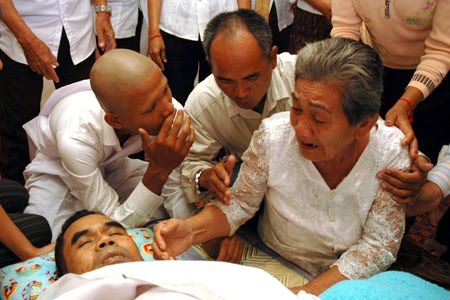
Journalist Khim Sambo's funeral (Photo: Xinhua)

Sok Khemara, VOA Khmer
Washington, DC Thursday, 29 April 2010

“First, it’s a question of political will from authorities, coming from the government, from the judicial system, from police also."
With World Press Freedom Day approaching next week, two Cambodian journalists living in exile say Cambodia needs to improve its media environment or risk becoming more dangerous, or an authoritarian state.

The vast majority of Cambodia’s TV, radio and newspapers are controlled or influenced by members of the ruling party and the government, with few outlets for alternative news or opposition voices. Cambodia's media was described as ''not free'' Thursday in Freedom House's annual international press freedom report for 2010. Last year, Freedom House ranked Cambodia’s media as “partly free,” and Reporters Without Borders ranks the country No. 117 of 174 in press freedom.

Un Sokhom was the editor in chief of the Neak Prayuth newspaper until he fled to the US in 2004 in fear of his safety. He says a more open press will bring more safety to society.

“This is important, what impacts the life of a journalist,” he told VOA Khmer from his home in Lowell, Mass., where he eventually settled. “What we have seen is that journalists dare not express their freedom [leading to] society’s covering up a lot of bad social issues.

Cambodian media have under-covered important issues like forced evictions, corruption and sex trafficking, he said, when they should act as a “mirror of society.”

Without journalists pointing out social ills, “people live in more fear than before,” he said, adding that if Cambodian journalists do not stand on their principles, the next generation will suffer.

Reporting in Cambodia can be dangerous.

In 2008, opposition journalist Khim Sambor was killed along with his son, and just last year, opposition editor Hang Chakra was jailed for nearly a year after reporting on alleged corruption at the powerful Council of Ministers; he was only recently released.

Twelve Cambodian journalists have been killed since 1995, while others have faced imprisonment through criminal defamation laws brought in courts largely seen as biased or influenced by money. Still others have fled the country after receiving death threats to themselves or their families. These journalists were usually reporting on incendiary issues like corruption, deforestation, drug trafficking and others.

Lem Piseth is a former reporter for Radio Free Asia. He now lives under political asylum in Norway, after receiving death threats in 2008 as he reported on illegal logging in Kampong Thom province’s Prey Lang forest.

“Cambodia will be an authoritarian country,” he said. “We can’t express our opinions, we don’t have enough freedom in writing, we can only have a level of writing for one’s favor. Then the country will not have democracy.”

Press freedom is especially important during election time, he said, but Cambodia’s airwaves and newspapers are full of news on the ruling government’s activities, providing a skewed view of news.

“In Cambodia, if we look at it from the outside, we see that the freedom of expression, and the freedom of the press as well, almost fully exist,” he said. “But such freedom is on terms, that it is not affecting the power of the country’s leaders. And if the expression and writing affect their power, especially in digging into corruption, the destruction of national property, deforestation and so on, that which involves the top leaders, then those who publish the report and those who write such a report will be in trouble.”

For Vincent Brossel, the Asia Pacific director for Reporters Without Borders, press freedom means creating conditions for political alternatives. The best way for governments to stay in power, then, is to control the media, a trend across Asia, he said.

“In all countries, especially developing countries, without a free media you can’t get accountability and good governance,” he told VOA Khmer from France. “Investigations are very important to create awareness.”

“In Cambodia, we can’t expect TV channels to play this role, and independent newspapers are very rare,” he said. “But radio stations are playing a very important role. It’s an alternative to the official news.”

Brossel said the government and journalists need to work to reform press freedoms.

“First, it’s a question of political will from authorities, coming from the government, from the judicial system, from police also,” he said. “They have to create a positive environment for the free media. But it’s also the responsibility of journalists themselves, because they have to respect ethical standards, they have to keep away from corruption, they have to have balanced reports, and they have to investigate all the stories, not just take things that are easy to take.”

While Cambodian TV cover only the government’s agenda, he said, Cambodia has made some progress relative to other countries, moving in ranking from 126 to 117, at least from September 2008 to September 2009, just above some of the worst countries.

However, the jailing of Hang Chakra signaled a deterioration of the situation, he added.

Government spokesman Phay Siphan told VOA Khmer that he regrets such negative evaluations by international organizations, because press freedom and the professionalism of journalists are improving.

“Such criticism we always welcome, but we ask [journalists] to avoid disinformation and news that attacks,” he said. “We do not want to see our society fall into what is called a state receiving only untrue stories or exaggeration or rumor. What we want is the press responding to the public, not a press that just exposes the opinion of any one individual.”

Cambodia does not restrict the press, he said, pointing to the English-language Phnom Penh Post and Cambodia Daily as examples.

“In Cambodia, there is [Radio Free Asia], which broadcasts in Khmer for US interests,” he said. “We have the Voice of America, which uses Cambodian airwaves to broadcast unlimitedly and freely.”

Phay Siphan also pointed out the dangers of the media, claiming political turmoil in Thailand was helped by broadcasts that incited people to violence.

“If the press lacks a conscience and professionalism, that causes society’s destruction,” he said, “like war crimes in Africa, in which the media caused killings, and this is condemned from internationals as well.”

Saturday, February 27, 2010

Media progress when reporters are sent to jail for their opinion?

Hang Chakra, editor-in-chief of Khmer Machas Srok newspaper, is still in jail (Photo: The Phnom Penh Post)

Minister hails media progress in ’09

Friday, 26 February 2010

Kim Yuthana
The Phnom Penh Post


CAMBODIA’S media sector improved in both quality and quantity in 2009, providing more Cambodian news and entertainment, and moving the country further along the path to freedom of expression, Minister of Information Khieu Kanharith said Thursday.

“The media and broadcasting sector in Cambodia has been improving continually, which means a lot of contribution to the strengthening of democracy and guarantees of press freedom in Cambodia,” he said at the launch of the ministry’s annual report.

The minister also applauded the efforts of journalists, who have all “tried their best” to give people the highest-calibre media services possible and to create information links between citizens and the government.

Khieu Kanharith’s comments, however, come just days after a report by the Paris-based Reporters Without Borders, which documented the government’s legal cases against journalists in 2009.

The report says the jailing of Khmer Machas Srok publisher Hang Chakra in July last year broke a pledge made by Prime Minister Hun Sen in 2006 that journalists would no longer be jailed for what they wrote.

“The jailing of several opposition journalists has cruelly shown that the promise has not been kept. It has been compounded by judicial harassment of government opponents and the journalists who interview them,” it stated.

Moeun Chhean Nariddh, director of the Cambodia Institute for Media Studies, said that even though the media sector in Cambodia had improved remarkably, press freedom had fallen away.

He said that action against journalists now takes the form of defamation lawsuits rather than street violence, but that legal threats are as much an “obstacle” to the proper performance of their profession.

According to a ministry report summing up its work in 2009, Cambodia is now home to 385 national newspapers, 172 national magazines, 43 international newspapers, 28 international magazines, 10 imported newspapers, 11 international news agencies, 21 journalist associations, 133 printing houses and six publishing establishments.

Tuesday, January 05, 2010

Six Questions for John Scott-Railton on Cambodia

December 23, 2009
Ken Silverstein
Harper's Magazine (USA)


While completing a master’s degree at the University of Michigan, John Scott-Railton helped develop “participatory mapping” projects aimed at protecting the fragile property rights of poor families living in Phnom Penh. While there he became an advocate of transparency in Cambodia’s natural resource management. Scott-Railton, now a doctoral student at the University of California-Los Angeles, has traveled extensively in Cambodia and throughout Southeast Asia. I recently asked him six questions about the political situation in Cambodia and the role there of the international community. (Note: For a look at the apparel industry in Cambodia, which is promoted by industry as the “anti-sweatshop country,” see my piece in the January issue of Harper’s.)

1. In theory, Cambodia has emerged as a multiparty democracy with political freedoms. What’s the general state of democracy in Cambodia?

Faltering. You can still find opposition members in the National Assembly, but the ruling party has overwhelming political, social, and military power. The stubborn few parliamentarians who refuse to play along have been stripped of immunity. Right now several face prosecution. The royalists were the last rival to the ruling Cambodian People’s Party (CPP), but they split in 2007. Many suspect the CPP orchestrated the breakup. In the 2008 elections the party further consolidated its power, facing only a hodgepodge of smaller parties vying for a few seats.

Radio and television are tightly controlled in Cambodia. Public dissent can also be dangerous. Journalist Khem Sambo and his son were publicly gunned down in the run up to the 2008 elections. He’d been investigating high-level corruption. A local human rights group has documented at least 40 extrajudicial killings by police, soldiers and officials in 2008 alone. I’ve witnessed the fear of Cambodian colleagues who have received threats. It doesn’t really matter whether these acts were sanctioned by the regime or were committed by party loyalists for personal reasons: Cambodians can see that violence happens to dissidents. It doesn’t take many deaths to make many feel it is prudent to keep criticisms to themselves.

2. What’s the status and impact of the genocide trials?

After years of negotiation, the UN managed to orchestrate the Extraordinary Chambers in the Courts of Cambodia, aka the Khmer Rouge Tribunal. The first trial just wrapped up. Kaing Geuk Eav, prison warden of notorious S21 prison, faces a life sentence. The verdict should be handed down in January.

The calculated barbarities of the Khmer Rouge touched every family in the country. Cambodians yearn for the airing of testimony and the public trial of those responsible. But many clearly weren’t satisfied by the limited opportunity for victims’ testimony, or the slow pace of the proceedings, which are not expected to end before 2015. After waiting three decades for justice, it’s easy to see why many are impatient. Cambodians see the high-profile accused perpetrators are old and frail. One already has died in custody. It’s anybody’s guess how many will be alive to face potential life sentences.

Many Cambodians aren’t convinced about the independence of the process. The trials have been plagued with financial trouble as donors struggle to negotiate funding amid corruption allegations against trial officials and concern about the impartiality of the proceedings. They have also been subject to a great deal of interference from the regime. This has led many to believe that the trials will not address the links between powerful figures in the current regime and the Khmer Rouge.

3. How’s the economy doing? Is there a risk of the “resource curse”?

Cambodia’s natural resources (old growth forests, precious and metallic minerals, and oil) are disappearing into the opaque maw of the ruling elite. Take forestry: Over 30% of the country’s forest cover disappeared in the first half of this decade. But accurate maps of what the regime sold and to whom remain hidden behind the tinted windows of the Forestry Administration.

In the 1990s, so-called anarchic logging was the problem. Under substantial international pressure, the government shut down those small operators. But logging didn’t even pause. It just became a military operation, under the pretext of developing the forests for agriculture. Global Witness has shown that close associates of the Prime Minister were involved in these dealings. Cambodia banned their reports and kicked the organization’s team out of the country.

The discovery of oil came relatively recently. Proven reserves are capable of generating an estimated $1.5 billion plus peak yearly revenue. When rights were negotiated in a secret bidding process, Chevron got the largest bloc. Whatever Chevron paid for the privilege doesn’t show up in the national budget. I don’t think anyone expects oil revenues will do much for the average Cambodian.

4. What’s the role of the international community, especially the United States?

The regime has been dependent on Western aid from day one, and knows that allowing the international community access to policy-making is a good way to raise revenue. The regime sees new revenue on the horizon, including from Chevron, and it has responded by closing some of these doors. The international community is having a hard time adjusting to this.

I’m not sure that the U.S. thinks that our assistance is effectively promoting democracy at the moment. Direct aid to Cambodia was blocked until 2007, a legacy of the Khmer Rouge era. In a quid-pro-quo, the US agreed to restore direct aid in exchange for greater protection for opposition leaders and civil society freedoms. It was an interesting move, but not very effective. Several vocal parliamentarians have had their immunity stripped. Although some U.S. congressmen have voiced some strong concerns at home, we haven’t frozen the aid.

Many suspect that U.S. competition with the expansion of Chinese ‘soft power’ in Southeast Asia helps explain why aid continues to flow. Although its ambitions aren’t clear, China has worked hard to make itself a more attractive partner to the regime, offering aid and investments with fewer strings attached. The U.S. knows this isn’t exactly a hard sell, and may be reluctant to use aid to foster democracy when it is trying to keep a seat at the table. The regime has loosened the conditions on its aid by encouraging two powers to compete for influence.

5. What about the World Bank? Has it played a positive role?

Many feel that the Bank hasn’t consistently monitored its projects on the ground, resulting in a lot of waste, and a lack of accountability. But the Bank’s strategy may be changing. Partly in response to corruption, it has frozen funding for several projects in the past few years. This fall, it scrapped a massive, underperforming land-titling program. It also officially protested the epidemic of Cambodian government land-grabbing. Many observers hope the Bank will seek much more accountability from the government in the future. It can certainly improve its relationship with civil society groups in Cambodia by becoming more accountable and transparent itself.

6. Cambodia is flooded with international NGOs. What sort of impact have they had?

The record of NGOs in Cambodia is very mixed. If you want to see successes, look at the sectors where aid compliments the government, like public health, education and infrastructure. True, the projects are sometimes wasteful. But this is money that the regime doesn’t have to spend, and progress it can take credit for. The picture is different in sectors key to the regime’s revenue and political control. Organizations working on governance, natural resource management or civil society keep getting out-maneuvered. Some great people have dedicated themselves to Cambodia for the long haul. Unfortunately, there are also a lot of well-intentioned Westerners who show up without the background, experience or language to match the regime’s politicking. This plays into the regime’s efforts to paint international campaigners as clueless meddlers. Resentment of foreign influence and national pride continue to alienate many Cambodians from the NGOs.

Wednesday, December 02, 2009

In Resource Management, Media Can Play a Role

By Im Sothearith, VOA Khmer
Original report from Washington
30 November 2009

Local media rarely broadcast about natural resource management. They broadcast mostly about improvement or development. But they have some short radio and TV spots to educate us not to kill wildlife and promote the government’s tree planting day, but other sensitive issues have never been broadcast.” Sarom, Phnom Penh resident
[Editor’s note: VOA Khmer recently spoke with specialists in the field of natural resource management in developing countries and learned that Cambodia is not alone in struggling to use natural resources to benefit its citizens. The resource curse, where natural riches fail to help the poor, is a worldwide scourge, the global experts told VOA Khmer in numerous interviews. Below is Part 13 of the original VOA Khmer weekly series, airing Sundays in Cambodia.]

Media outlets can play a critical role in natural resource management, but that has not been the case so far in Cambodia, where experts say exploitation of the country’s timber, minerals and other resources is often undertaken by political elites or businesses heavily involved in politics.

In order to build an informed society, according to Paul Collier, an Oxford University economist and author of “the Bottom Billion: Why the Poorest Countries Are Failing and What Can Be Done About It,” good media are needed, to inform citizens on issues of public interest.

Collier refers to these informed citizens as an important “critical mass,” which can help hold a government accountable on issues like natural resource management. However, he said, it is hard to build critical mass where good media are not in place.

“It doesn’t require everybody in the society to be well informed,” he said. “We need what’s called a critical mass, which is several thousand people who understand the issue and hold government to account.”

In the case of Cambodia, the local media have not been capable of informing people about the natural resource issue, said Chea Vannath, and independent analyst and former director of the Center for Social Development.

“Local media rarely broadcast about natural resource management,” one Phnom Penh resident, who gave only his given name, Sarom, said. “They broadcast mostly about improvement or development. But they have some short radio and TV spots to educate us not to kill wildlife and promote the government’s tree planting day, but other sensitive issues have never been broadcast.”

Puy Kea, Kyodo news correspondent and member of the Club of Cambodian Journalists, acknowledged that local media have limited coverage on the natural resource issue, while international media do better on sensitive issues.

Natural resources are not a priority for local media, he said. And there is a safety issue, as well.

“The real concern is when [journalists] go out to report on regions or institutions involving sensitive issues, such as corruption or irregularities,” he said. Meanwhile, he said, “in Cambodia nowadays, media have the tendency of leaning to the government and ruling party.”

Lao Monghay, a researcher for the Hong Kong-based Asian Human Rights Commission, said Cambodia has a number of media outlets; however, “people are scared.”

“We must have information to make judgments, and we must have freedom of expression too,” he said. “It’s also the responsibility of the media, newspapers and radio to report and publish or broadcast to the people.”

Eleanor Nichol, a campaigner for the watchdog Global Witness, which has had two of its reports on natural resources banned in Cambodia, said full freedom to cover the issue would bring an element of transparency to the process.

“If they allow the publication of information about who has access to what resources so that people on the ground and civil society in Cambodia are able to see what and who has control of their resources, [they can] begin to call the government to account on that,” Nichol said.

Thursday, November 12, 2009

Journalist Lauds Cambodian Media Ethics

Pen Samithy, editor-in-chief of Rasmei Kampuchea newspaper. [KI-Media Note: Rasmei Kampuchea is a mouthpiece of the CPP]

By Sok Khemara, VOA Khmer
Washington
11 November 2009


Thai media has served to conflate diplomatic issues with Cambodia, with more nationalism than professionalism, a leading Cambodian journalist said Monday.

“If all the journalists respect the truth, people on both sides would understand the truth, and they would see which country is acting improperly,” said Pen Samithy, president of the Club of Cambodian Journalists, as a guest on “Hello VOA.”

But as we have seen, in Thailand there are many media that still have a nationalist view, very much, which makes it so the Thai people can’t receive the truth,” he said.

Pen Samithy was discussing a new draft code of ethics for journalists, at a time when Cambodia’s opposition media has come under increasing pressure.

At least one opposition editor, Hang Chakra, was jailed recently, after publishing stories alleging corruption in the Council of Ministers. A second, Dam Sith, closed his newspaper rather than face similar charges.

Meanwhile, Cambodia and Thailand have become embroiled in an increasingly complicated diplomatic row over Prime Minister Hun Sen’s support of Thaksin Shinawatra, the deposed prime minister wanted on corruption charges in Thailand, even as troops on both sides are massed on the border near Preah Vihear temple.

Pen Samithy praised Cambodian journalists for their help to the nation. While a code of ethics already existed among journalists, he said, the new one was a good sign of further cooperation, especially regarding the pursuit of “truth.”

Saturday, September 12, 2009

‘Limited’ Freedom in Radio: Broadcaster

Mam Sonando at his release from jail in 2005

By Sok Khemara, VOA Khmer
Washington
11 September 2009


Cambodia’s airwaves are suffering from limited freedom of expression and political bias, a prominent radio station director said Thursday.

“If we take a look, we don’t clearly know about the freedom of press in Cambodia,” Mam Sonando, who runs Beehive Radio on FM105, told “Hello VOA” during a studio visit to Washington. Speaking only for his own radio station, “freedom of expression exists, but is limited,” he said.

There are limitations on what can be said, while stations friendly to the ruling Cambodian People’s Party seem more able to increase their coverage.

“We’ve asked for permission to do so, but have been turned down,” said Mam Sonando, who is on a fund raising visit to the US.

Twenty radio stations operate in Phnom Penh, with another 25 in the countryside, while nine television stations can be found across the country.

Political observers say the ruling party tends to receive much coverage of development projects and other positive events, helping it at the polls, while opposition parties are often limited to brief media access during campaign periods, a requirement of election law.

Mam Sonando has been jailed twice by the government, most recently in 2005, for programming related to border agreements between Cambodia and Vietnam.

He emphasized the importance of freedom of expression to improve the country, and he allowed the government to allow more.

Tuesday, May 05, 2009

Organization Ranks Cambodia Media ‘Not Free’

By Sok Khemara, VOA Khmer
Original report from Washington
04 May 2009


Harassment of Cambodian journalists and the murder of an opposition reporter during 2008’s national election period contributed to Cambodia’s “not free” press status by the organization Freedom House, an official said.

The “not free” status is shared by countries such as Burma, China, Cuba, Iran and North Korea, and was issued by Freedom House in its annual report.

“It was actually the impact of the election last year and greater harassment and the murder of the journalist in Cambodia,” said Karin Karlekar, managing editor for freedom of the press at Freedom House. She spoke at a ceremony in Washington marking the release of the report.

Opposition journalist Khim Sambo was shot dead along with his son in July 2008, just two weeks before Cambodians went to the polls to elect National Assembly representatives. That murder, for which no arrests have been made, followed the detention of Dam Sith, the editor of the same opposition paper, Moneaksekar Khmer.

The “not free” rating was a slide for Cambodia, which was given “partly free” status the previous year.

Phay Siphan, a spokesman for the Council of Ministers, said by phone the murder was under investigation and Freedom House’s rating did not accurately reflect Cambodia’s media environment.

Cambodian journalists “can write whatever, even criticizing the prime minister, which does not happen in other countries,” he said, adding that the “effectiveness and quality are another matter.”

Most of Cambodia’s media, especially broadcast, provide favorable coverage of the ruling party, and critics say biased coverage affects the outcomes of elections.

The opposition Sam Rainsy Party, responding to a recent story about land grabbing, called one of the largest papers, Reaksmey Kampuchea, a mouthpiece for the ruling Cambodian People’s Party.

Cambodia ranked 61st of 132 countries in the Freedom House report, in a year where the organization said press freedom had declined in every region for the first time.

Monday, May 04, 2009

2009 LICADHO Report: Cambodia’s Media Continue to be Attacked, Threatened and Censored


May 2, 2009
Source: Licadho

Cambodia's media is often described as one of the freest in the region, especially relative to the likes of Vietnam, Myanmar, Laos or China where the media is all but controlled by the government1. But the reality is that Cambodia's media still exists in a repressive environment where the government controls the majority of the media. Those that it does not control, it is not afraid to attack, threaten or censor.

The 15 months reviewed in the latest LICADHO briefing paper - from January 1, 2008 to March 31, 2009 - saw a number of cases of defamation lawsuits, repeated censorship, attacks, threats and intimidation.

The period review was crucial politically with the national election held in July 2008. The murder two weeks before the vote of opposition-aligned journalist Khim Sambo was a chilling reminder of the risks Cambodian journalists face for doing their job.

"The continued intimidation of the media through physical attacks, threats, charges of defamation and disinformation and murder ensure the lack of an environment free from political pressures for media to cover sensitive and important issues affecting Cambodians," says Naly Pilorge, Director of LICADHO.

As yet, no one has been arrested for the killing of Khim Sambo, a pattern consistent with the murders of journalists in Cambodia since 1993. In 2008, another journalist fled Cambodia with his family and has since been granted asylum in Norway after receiving death threats for his work for Radio Free Asia (RFA).

Most of the Kingdom's media outlets are aligned to a political party and most favor the Cambodian People's Party (CPP). All eight television channels are aligned with the CPP, as are 11 of the main 22 Khmer-language stations, and 13 of the 24 larger Khmer-language newspapers.

The briefing paper is titled Restrictions on the Freedom of Expression in Cambodia's Media, and is published in celebration of World Press Freedom Day on May 3, 2009. The briefing paper is an update to LICADHO's previous report on the subject of media restrictions which was published in May 2008 - Reading Between the Lines: How Politics, Money and Fear Control Cambodia's Media.

The report is available from http://licadho-cambodia.org/reports.php?perm=130

For more information, contact:

Dr. Kek Galabru, President of LICADHO at 012 940 645

World Press Freedom Day

03 May 2009
By Im Navin
Cambodge Soir Hebdo
Translated from French by Luc Sâr
Click here to read the article in French

On 03 May, to mark the World Press Freedom Day, Licadho publishes a report on the situation in Cambodia.

According to France-based Reporters Without Borders, Cambodia dropped dramatically in the press freedom ranking: ranked 85th in 2007, Cambodia ranked 126th in 2008. Even though Cambodia’s ranking is better than that in neighboring countries (Vietnam, Laos, Burma, China), the press situation in Cambodia seems to be degrading.

In July 2008, two weeks before the general election, Khim Sambo, a reporter close to the opposition party, was assassinated with his son in Phnom Penh. The police still has not found the killers yet. According to Licadho’s report, 14 reporters were threatened in 2008, as compared to 7 in 2007; 10 reporters were arrested, as compared to 6 in 2007. A Cambodia journalist even received asylum in Norway in 2008 following death threats he received.

Licadho, the human rights NGO, selected to underscore the fact that Cambodian journalists continue to be threatened, attacked, and censored. “The continued intimidation of the media through physical attacks, threats, charges of defamation and disinformation and murder ensure the lack of an environment free from political pressures for media to cover sensitive and important issues affecting Cambodians,” Naly Pilorge, Licadho’s director, declared.

The NGO recalled also that the majority of newspapers and TV stations are attached or aligned with one political party. The majority of them support the ruling CPP: all TV channels, half of the radio stations and 13 out of 24 main publications in Khmer.

On the other hand, the Club of Cambodian Journalists chose to focus on the border conflict with Thailand. It assures that reporters in the disputed area could help resolve this conflict. It also underscores that the authorities let reporters do their work on the spot and that soldiers assure their security. However, on the Thai side, Thai army upholds information and prevents reporters from moving freely.

Tuesday, September 02, 2008

Many Factors Availed CPP Sweep: Monitors

By Pin Sisovann, VOA Khmer
Original report from Phnom Penh
01 September 2008


The ruling Cambodian People's Party had among other assets a broad political organization to help its big win in July, election monitors say.

The ruling Cambodian People's Party did even better than its own predictions in July's election, and monitors said in recent interviews it had done so by exploiting the election process and a position of advantage rather than an outright theft of votes.

The CPP dominated the polls in July, winning 90 of 123 National Assembly seats, more than enough to enact legislation, quorum and amend the constitution.

The opposition Sam Rainsy and Human Rights parties have accused CPP of stealing votes, but two top monitors said last week that the CPP was able to earn a high number of seats through myriad factors much more complicated.

These included loopholes in the election law, the deletion of voter names from registries, the abuse of administrative forms, widespread use of state assets and local authorities and the help of broadcast media, according to Koul Panha, executive director of the Committee for Free and Fair Elections, and Hang Puthea, executive director of the Neutral and Impartial Committee for Free and Fair Elections in Cambodia.

Koul Panha pointed out that the election law didn't stipulate a budget limit for campaigning, giving the CPP another advantage.

"A lot of upper-hand factors" have not been investigated, he said, "such as money and materials, giving out money to voters, support from local officials who knew which groups of people would vote for what party, messy voter lists and irregularities."

"The loopholes in the law and management of the election did not guarantee a fair election," he added.

The CPP also leveraged other advantages, such as a widespread political organization, the construction of infrastructure and a pre-election row with Thailand over Preah Vihear temple, both monitors said. Broadcasts on television and radio amplified these factors, they said.

"The CPP used the media to propagate its achievements and attract voters," Koul Panha said.

Commune and village chiefs were also a decisive factor this year, Hang Puthea said.

These authorities were able to exercise pressure on voters through a local ballot count, a new procedure this year that allowed them to identify opposition supporters, Hang Puthea said.

Local officials were able to instill bias by warning voters that the CPP would need to win in order for a community to have peace and security, he said.

Though many of the winning factors did not meet international standards for a fair and free election, both monitors said, the CPP also had legitimate reasons for winning seats.

These included economic achievements of the party, its grassroots political networks, powerful officials that solved some crises ahead of the election, and the party's ability to lure supporters away from its rivals.

National Election Committee Chairman Im Suosdey denied the CPP had unfair advantages in the election.

NEC officials followed election law without giving advantages to the CPP, he said, including in the recruitment of officials, the ballot count and throughout the complaints procedure.

Critics argue the NEC is dominated by a majority of CPP-appointed officials, and opposition leader Sam Rainsy said during hearings last week the Constitutional Council, which arbitrates appeals beyond the NEC, followed the CPP line as well.

"I don't think the election made any party gain the upper-hand over other parties," Im Sousdey said. "You claimed alleged upper-hand factors only after the election results had come out. It is not true. The NEC only abides by the law and doesn't want to give anyone the upper-hand."

Amendments to the election law will have to be done democratically, through legislation passed by the National Assembly, he said, and not through "groundless allegations" made by the losers of an election.

SRP lawmaker Son Chhay, however, said a biased NEC colluded with the ruling party to help it win, by allowing the use of state property and media in the election and not enacting a election finance law.

"The NEC is not independent," Son Chhay said. "It was created to help steal votes for the CPP. There is no neutral institution to file complaints with about the theft of votes. Going to the NEC, it is a puppet of the CPP. Going to Constitutional Council, it is the ruling party's puppet."

CPP lawmaker Chiem Yeap, who is also a member of the CPP's central committee, said the party had won its 90 seats legitimately.

Voters showed their gratitude to a party that liberated them from the Khmer Rouge, built peace, rebuilt the nation and its infrastructure and reduced poverty, he said.

"Let me ask you, where can a vote be stolen?" Chiem Yeap said. "The Sam Rainsy Party had agents who signed the proper electoral process report and party agents of all parties signed this to accept the election results."

The 90-seat win was a surprise, he said, but signaled a trend that could go on in the next commune elections and beyond. The party was looking for 84 or 85 seats this year, but it could win as many as 100 seats in the next general election, he said.

"As soon as I heard the NEC announcement of the unofficial result," he said, "tears of emotion came out of my eyes."

Friday, June 27, 2008

Report Highlights Fear Among Media


By Taing Sarada, VOA Khmer
Original report from Washington
26 June 2008


The rights group Licadho has issued an 80-page report, "How Politics, Money and Fear Control Cambodia's Media," which details government restriction on media from the French colonial period to present.

Licadho president Kek Galabru said the report was compiled after interviews with 150 journalists and reporters. She also said there is a strong restriction on media in Cambodia, especially on TV and radio, minor restrictions on newspapers and magazines, and few on the Internet because only small amount of people can access the Web.

"Not many Cambodian people can access to the Internet," she said. "But people can access TV and radio more, so we can see the government always restricts freedom of expression through these two media instruments. But newspapers and magazines have some more freedom to publish." Kek Galabru said.

The report found that 91 out of 150 journalist said they work with fear, while 31 others said they were not afraid and 19 others dare not to speak out.

"A lot of reporters reported that they work with fear," Kek Galabru said. "If they work with fear, we can't say there is a freedom of media and expression."

Regarding the opinion about the restriction on media in Cambodia, a director of the rights group Adhoc, Thun Saray, said the media system in Cambodia has some positive and negative points.

"The positive point is that they allow some political parties to open their election campaign through radio channels," he said. "Before, we didn't see such thing, but now we see some space for that."

Recently, however, opposition editor Dam Sith was arrested and Angkor Ratha radio in Kratie was closed, while the legal system does not respect the media law, he said.

"We have already erased and pulled out the defamation law, which could be used to detain people, but now they use the disinformation law to restrict the media," he said. "The definitions between the two laws are totally different. The disinformation [article] can be used on a person who tries to make the situation and security in the country chaotic, but the charge of disinformation that involves with an individual is called defamation."

Tuesday, June 17, 2008

TVK announces allocation of air time for parties [... TVK "fair and balanced" campaign coverage is mainly a "fairy" tale]

Tuesday, 17 June 2008
Dan Poynton
The Mekong Times


Leading state TV channel TVK announced yesterday its allocation of air time to political parties competing in the national election for its daily Equity News election program.

Equity News is funded by the UN Development Program (UNDP) and the Australian government.

The daily 15-minute program – broadcast after the 7pm news – provides “fair and balanced campaign coverage” during the month-long run-up to the July 27 election, according to a TVK/UNDP press statement.

The allocation of air time to the 11 parties running in the election has been endorsed by the National Election Committee and this year gives greater weight to parties fielding candidates in the 2008 election rather than the role they played in past elections, according to the statement.

An 80 percent loading goes to parties fielding candidates in all 123 constituencies, and a 20 percent loading to their past performance in the 2003 and 2007 national elections.

“Less emphasis has been placed on past history and the privileges of incumbency and more opportunity accorded to opposition and emerging parties with less access to the media between ballots,” said the statement.

The Equity News website claims that the program is “seen as a breakthrough in Cambodian broadcasting for its balanced and impartial coverage of the election campaign.”

Koul Panha, director of the Committee for Free and Fair Elections in Cambodia (COMFREL), told The Mekong Times he agrees with the Equity News claim, but stressed all TV channels and media – including TVK – should increase their political coverage between election periods, and should include more opposition opinions about government projects.

“The other channels and media should adopt this [Equity News] model; they should be enforced [to do so] through the legal framework,” he said. “Between elections [however] TV channels don’t cover enough. There are a lot of social and development programs, but there should be more political opinion about these programs from the opposition.”

Koul Panha said most people in Cambodia watch so much television, that its influence by far out-dominates all other media, and so it is important that TV coverage is more equitable.

“In [the] 2003 and 2007 [national elections], the program was fair. In 2008 we will observe,” he said.

In conjunction with Equity News, TVK’s Equity Weekly program – running since May 2007 – provides a 40-minute weekly summary of election news every Saturday.