Showing posts with label Cambodian art exhibit. Show all posts

Monday, January 10, 2011

Is Phnom Penh ready to turn into a new center for arts in Southeast Asia?


INTERVIEW WITH RIEM EM, CAMBODIAN ARTIST AND OWNER OF AN ART GALLERY

09.01.2011
Von Luc Citrinot,
eTN

As Phnom Penh will play host to the ASEAN Travel Forum, Southeast Asia's largest international tourism event, eTurboNews Asia Senior Editor Luc Citrinot takes a look at the latest changes in the Cambodian capital in a series of articles.

PHNOM PENH (eTN) - Phnom Penh is a rapidly-changing city. Ten years ago, the Cambodian capital was seen as a laid-back destination where gardens, the Mekong River, and derelict colonial villas gave a distinctive atmosphere to the city. Less than a decade later, skyscrapers started to invade the city skyline, while the surviving colonial buildings were turned into luxurious hotels, trendy restaurants, or chic design shops. With Phnom Penh enjoying a new sense of wealth, a Cambodian art scene is slowly emerging with artists and gallery owners exhibiting promising young artists. Riem Em, a well-established designer and painter talks exclusively to eTurboNews about Phnom Penh's new art scene.

eTN: Do you think that Phnom Penh is a city giving a chance to young artists? Are there structures in place to showcase new talents?

RIEM EM: I do believe that Phnom Penh is a city offering a chance to young artists to create as the art scene is far [from] being saturated. We have little tradition in innovative contemporary art. This new spirit is a good source of creativity. However, we have a far too small number of venues to expose our works. I opened a gallery a few years ago [La Galerie, n°13, Street 178], which is probably the only "true" art gallery to date in Phnom Penh. It is opened everyday, and it is fully dedicated to exhibiting art. People can come and go as they want... Otherwise, some NGOs or some foreign cultural centers, such as the Alliance Française or the Meta House, offer spaces for art, or also Java Café and Gallery, which combines a coffee place with three exhibition rooms.

Thursday, November 18, 2010

Cambodian Exhibition Shows Cultural Aesthetics, History [in Long Beach]

Wednesday, November 17, 2010
By Jonathan Van Dyke
Staff Writer
Downtown Gazettes (Long Beach, California, USA)

The Second Annual Cambodian Arts and Culture Exhibition will give younger members of the community and outsiders a sense of the diverse and interesting Cambodian culture, organizers say.

“We expect probably between 500 and 600 people and it’s going to be a very diverse group,” said Richer San, exhibitions coordinator. “This year’s program is going to be much better (than last year’s).”

There will be events from 10 a.m. until 3 p.m. on Saturday, split between MacArthur Park and Mark Twain Library, that will demonstrate a number of the cultural aesthetics and history that make up Cambodian culture, San said. Admission will be free, and attendees will have an opportunity to participate in several different interactive demonstrations.


San said the exhibition also is a chance for local artisans and vendors to show off an area that not everyone in Long Beach may be familiar with.

“We do this to bring in some traffic to central Long Beach for the business folks who need this,” he said.

There will be textiles, dressmaking, weddings, games, Yantra Mantra, cooking, costuming, painting, drawing, shadow puppets, Cambodian Court Dance, music and different musical instruments.

At 11:30 a.m., curator Jeffrey Weaver of the J. Paul Getty Museum will make a special presentation on the Gods of Angkor in the community room of the Mark Twain Library. He will talk about the Getty Center’s (in Los Angeles) upcoming exhibition on the subject, which opens in February of next year.

At 2 p.m., there will be a movie screening of “Twilight.” King Norodom Sihanouk made the film in 1969, during a strong period of Cambodian cinema, San said. It follows the story of a prince falling in love, and demonstrates a great deal of what Cambodia was like before war changed it. There will be English subtitles. Former United Nations Ambassador Sichan Siv will introduce the screening.

“This is before the war came to Cambodia,” San said. “It’s going to be so important for the younger generation (to see). It shows Cambodia back in the 1960s, when it was very peaceful and vibrant.”

Both the movie and presentations will provide an important opportunity to remind the youth in the community of a heritage they may feel removed from, while introducing the rest of the community to it, San said.

“It is important,” he said. “Mainly we want to share with our neighbors and our new generation. We want to show them our heritage and rich culture — to promote harmony. People can communicate through culture.”

The Second Annual Cambodian Arts and Culture Exhibition will take place from 10 a.m. until 3 p.m. on Saturday at MacArthur Park, 1321 E. Anaheim St. The special presentation and movie screening will take place at Mark Twain Library, 1401 E. Anaheim St. Admission will be free.

For details, call Sixth District Councilman Dee Andrews’s office at 570-6816.

Pop-up Art Space During Water Festival: Installation Performance by Loeum Lorn

a Pop-up Art Space presented by Our City Festival

Melting Motion
An installation performance by visual artist Loeum Lorn

Location: Near Java Cafe on Sihanouk Boulevard
Times: 2 - 8pm, Sat 20th and Sun 21st November

To coincide with this year’s Water Festival taking place across 20-22 November, acclaimed artist Loeum Lorn will create a new work as a part of his ‘Melting Motion’ series live on Sihanouk Boulevard.

Lorn’s performance uses paint and ice to produce a ‘sculpture’ that constantly evolves in colour and in form. Subject to the forces of nature, each performance results in a unique sculpture, which can never be replicated. Viewers will be witness to the creation and decline of this sculpture, which becomes a testament to the potential beauty held by artistic processes where the final outcome of actions are outside of the artist’s control. Lorn uses the melting of ice not only as a metaphor for the transiency of human existence, but also emblematic of the rapidly changing urban environment of Phnom Penh.

This event is presented by Our City, the annual urban arts and architecture festival, which recently took place throughout September. In taking art in to the city’s street, Pop-up Art Spaces seeks to further people’s experiences of contemporary art and engage with urban issues such as globalization and notions of public and private space.

On a larger scale than previous works, and situated within the Water Festival activities, this performance promises to be visually inspiring. Lorn hopes that through this event, his work will successfully engage with a new, broader audience who will be visiting the city during this period.

Pop-up Art Spaces is a new series of art events curated by ArtXprojects. Once a month they will appear in new and ingenious places around Phnom Penh inviting audiences to explore and perceive their city in new ways led by contemporary artists. For more information visit www.artxprojects.org.

Talk: Art in Public Spaces

The event will followed by an artist talk and discussion on art made for city streets around the world. Thursday 25th November at 6.30pm. Sa Sa Art Projects, situated in the White Building, Sothearos Boulevard. Limited capacity so please reserve a place by contacting 092 953 567.


Wednesday, May 19, 2010

Launch of Sa Sa Art Projects and opening of art exhibition ‘Phal’ by Kong Channa Fri May 21 at 6pm

Dear friends and art lovers,

After a successful fundraiser in March, Sa Sa Art Gallery now opens Sa Sa Art Projects!

I am pleased to invite you to the official launch of Sa Sa Art Projects and the opening of art exhibition entitled ‘Phal’ by our current artist in residence Kong Channa, on Friday May 21, 2010 at 6pm at Sa Sa Art Projects, the Building, Sothearos Blvd (see map for direction).

Sa Sa Art Projects is an alternative art space dedicated for experimental art practices, residencies, artist talks, meetings, and art classes. One of the Art Projects’ main goals is to create opportunities for young artists to realise new ideas and bodies of work without limitations that normally encountered in commercial galleries. The Art Projects also aims to foster a community of knowledge sharing amongst artists.

Sa Sa Art Gallery and Sa Sa Art Projects are artist-founded and operated programmes by a group of six artists called Stiev Selapak. Currently we rely mostly on funding from the public. If you would like to contribute to the ongoing programming of the Gallery and the Art Projects, please contact us at info@sasaart.info.

Sincerely,
Lyno

Vuth Lyno
Manager
Sa Sa Art Gallery
www.sasaart.info

Sunday, May 16, 2010

Master Bronze Works on Display in Washington

On the metro platform, in Washington DC, a billboard highlights the “Gods of Angkor” exhibit. (Photo: by Soeung Sophat)

Men Kimseng, VOA Khmer
Washington, DC Friday, 14 May 2010

"I am happy that Cambodian culture is being shown here, and the benefit from this will be more tourists coming to Cambodia."
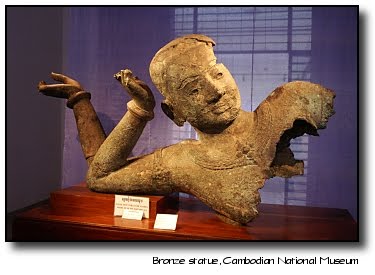
Thirty-six master bronze works from Cambodia are being exhibited now at the Smithsonian’s Sackler Gallery in Washington, part of a collection of 7,000 bronzes from the National Museum.

Curators of the exhibit say they hope “Gods of Angkor” will raise international awareness of the richness of Cambodia’s artwork, and possibly convince more tourists to visit the country.

The bronze works are from prehistory—somewhere between 300 BC and 400 BC—and from the Angkorian period—from about the 9th to 13th centuries AD.

“Despite it’s title, ‘Gods of Angkor,’ even before Angkorian time we were advanced in bronze work,” Chea Socheat, deputy chief of the conservation office at Cambodia’s National Museum, told VOA Khmer Wednesday.

The exhibit is meant to celebrate “the accomplishments of the Khmer bronze casters” as well as the conservation work of the National Museum, Julian Raby, director of the Freer and Sackler galleries, told reporters.

“I am happy that Cambodian culture is being shown here, and the benefit from this will be more tourists coming to Cambodia,” Chea Socheat said.

The bronzes represent Buddhism and Brahmanism and are set amid three linked galleries. They include an urn, bell, a naga-protected Buddha, Ganesh, Shiva, and other ritual objects.

Some are on display for the first time, such as a group of seven bronzes that were only unearthed in 2006.

The exhibit will be open to the public from May 15 to Jan. 23, 2011, before it moves to the J. Paul Getty Gallery in Los Angeles in February 2011.

Thursday, April 29, 2010

Rare Khmer Bronzes To Show in Washington

(Photo: Mekong.net)

An art exhibition of Cambodian bronzes to open in Washington next month, featuring Khmer sculptures and ritual objects from late prehistory through the Angkorian period.

Men Kimseng, VOA Khmer
Washington, DC Wednesday, 28 April 2010

“These bronzes are among the most exquisite expressions of Khmer ideals of religious imagery and ritual implements.”
An art exhibition of Cambodian bronzes opens for the first time in Washington next month, featuring Khmer sculptures and ritual objects from late prehistory through the Angkorian period.

Thirty-six masterworks from the National Museum of Cambodia’s collection of some 7,000 bronzes will show at the Smithsonian’s Sackler Gallery under “Gods of Angkor: Bronzes from the National Museum of Cambodia.”

“This exhibition presents the stunning accomplishments of Khmer bronze casters,” Louise Allison Cort, the gallery’s curator of ceramics, said in a statement. “These bronzes are among the most exquisite expressions of Khmer ideals of religious imagery and ritual implements.”

The works include a rare and highly valued urn and bell, seven diverse bronze figures, ritual paraphernalia and Buddhist and Hindu sculpture.

The exhibition, a collaboration between the Freer and Sackler galleries and the National Museum of Cambodia, explores significant developments in bronze casting, as well as cultural and religious developments that coalesced during the Angkor period into a recognizable Khmer style.

The exhibition will show from May 15 through Jan. 23, 2011, in Washington and is scheduled to travel to the J. Paul Getty Museum in Los Angeles in February 2011.

Tuesday, March 02, 2010

Asian Arts Exhibit Opens in Maryland

By Nuch Sarita, VOA Khmer
Original report from Maryland
01 March 2010


A variety of Asian arts are being shown to the American public through an exhibition at Asian Arts Gallery of the Towson University of Maryland this month. The artworks for the Asian Sacred Arts exhibition, which runs through May 15, come from 14 private collections in Baltimore, Md., and the Washington area.

Collections of paintings and sculptures are from across Asia, displaying the depth and range of Asian sacred arts, the forms of their multi-level functions, and the transformation of the profound into the world of today.

“There are a lot of nice works from Far East, China, Tibet, Cambodia and other countries,” said Reza Sarhangi, a professor of math at Towson. “This is good for public awareness to know about other people’s cultures, so I encourage the art exhibit and TowsonUniversityto bring more diversity by bringing different cultures and art exhibits there to present different parts of the world.”

Ancient and modern art works from Burma, Cambodia, China, India, Japan, Korea, Nepal, Pakistan, Thailand and Tibet are all on display.

But this year, Tibet holds the key spot, said John Gilmore Ford, curator of the exhibition.

“The focal point of the gallery is a Tibetan shrine,” he said.

Suewhei Sheih, the director of the Asian Arts and Culture Center, asked him to focus on Tibet because the theme of her festival for 2009 and 2010 is based on the “esoteric world of Tibetan Buddhism,” he said.

Ford said the most auspicious piece in the exhibition is cloisonné bronze sculpture of Tsongkapa, a Tibetan who lived from 1357 to 1419. He is credited with melding various sects of Tibetan Buddhism into one practice, and many Tibetans hail him as an emissary of Buddha.

A Tibetan stupa of bronze and jade, crafted in the 18th Century, demonstrates the power of the symbol, which, like the cross in Christianity, is associated with triumph over death. Initially, stupas like these contained Buddha relics, but later, any devout follower could erect a stupa in Buddha’s memory.

The exhibit also carries modern pieces by Tibetans who have lived in the past 50 years. East is unique and demonstrates inspirations from tradition and heritage and modern times, which is one of the reasons old and new art works are being shown together.

Director Shieh said the Asian Arts and Culture Center had been created to house such collections and make them accessible to students and has since grown to include works of art in all media from a variety of Asian cultures.

Asian Sacred Arts includes three Islamic paintings and two paintings by Michael Griver, a long-time Baltimore artist, “Buddha Reinvested” and “Envisioning Nirvana.”

Some works reflect Cambodia.

“The lips here of the Buddha, if you look at the lips of the Cambodian sculpture of the Buddha, they are shaped in that form,” Ford said. “So to that degree it is a representation of Cambodia."

Tuesday, February 17, 2009

Cambodian art: Past to present

Leang Seckon's "Prison Guard" depicts Duch, who is facing a genocide tribunal starting Tuesday.
Sopheap Pich's "Cycle 2" depicts joined stomachs showing the ties and strains of communities.
Story Highlights
  • Fourteen artists, ranging in age and practice, displaying their works
  • One work depicts Duch, a former Khmer Rouge leader facing genocide tribunal
  • Cambodia's arts were stunted by the 1970s genocide and civil war
  • Some 50 artists now practicing their craft in the Southeast Asian country
Tuesday, February 17, 2009
By Miranda Leitsinger

Hong Kong, China (CNN) -- Bamboo, woven into the shape of human stomachs. Red, sky blue and orange pencil shavings glued onto a large canvas form a woman's traditional hair clip. A collage of magazine clippings, drawings and found materials depict Cambodia's tumultuous modern history.

These are a few of the offerings on hand in Hong Kong at one of the first large international exhibitions of artists from Cambodia. The work by 14 artists varies in practice-- video, photography, collage, wood shavings, paper, bamboo and painting-- as well as in themes, from reflecting on the Southeast Asian nation's genocidal Khmer Rouge regime to the emerging modern Cambodia, with traffic lights and all.

"Every artist in this show is referencing ancient tradition and recent history," said Phnom Penh-based curator Erin Gleeson, noting the wall-size depiction in folded paper of the serpent Naga (which in Cambodian culture represents the people's mythical birth) to a collage of 20th-century Cambodia and its six different regime changes.

"The show is looking at the present -- 'Forever Until Now' is the title -- and it is this lineage of the past, you see that in the show, and then you see artists that arrive at the present," she added.

The show opens Friday and runs through March 22 at 10 Chancery Lane Gallery. Gallery owner and director Katie de Tilly said she believed it was important the artists get international exposure.

" ... it's really at the beginning of their art emergence. Obviously, they've had a very hard history," she said. "This is really the beginning of contemporary Cambodians who are expressing very original ideas in their artworks and I think that that's what makes it very unique and to show to the rest of the world."

Cambodia, which lost an estimated one-quarter of its population or at least 1.7 million people -- including an estimated 90 percent of its artists -- under the 1970s Khmer Rouge regime, has a small but growing artistic community: there are some 50 practicing artists out of its 14 million people, Gleeson said.

The genocide and ensuing war, which only ended in the last decade or so, stifled the development of the arts in one of the world's poorest countries.

"The legacy of that is now in every facet of a developing society," said Gleeson, who noted the country had no art books when she arrived in 2002 on a fellowship to teach art history. "There's an absence of infrastructure for them, there's an absence of materials, there is no art store. ... they are quite inventive about mixing materials to make them of a higher quality or last longer, but in many cases they don't know archival techniques."

The harsh weather conditions -- a dusty, hot season and a rainy monsoon -- add to the trying work conditions.

"Everything's against them," she added. "Their parents in many cases are coming from a really disadvantaged background, as the majority of the country is economically."

Some of the art included in the show looks at the Cambodia of today, such as Leang Seckon's "Three Greens" -- an acrylic painting showing children in school uniform crossing a road with a yellow light, red light and three green lights, along with cows and roosters. The piece shows the changes in a country that recently got stop lights, with animals, people and traffic mingling on the main roads of the capital.

Sopheap Pich, a Cambodian-American whose family migrated to the U.S. in 1984, works with bamboo and rattan -- materials often used in Cambodian traditional farming and crafts -- to make sculptures.

His work, "Cycle 2," is the joining of the stomachs of an infant and an elderly person that for him brought up ideas of Cambodian traditional village life.

"You belong to each other, you help each other out," he said. "But also, if you look at the lines and you see how it's shaped by hand, it's not very perfect, so it's also about struggle...

"You could say it's a cycle of trying to hold onto each other, now we are living everywhere in the world, Cambodians are all over the planet," he added. "All this technique and pattern that I am quite obsessed with ... it's about this idea of trying to hold on with very simple means."

Chan Dany, a 25-year-old artist who graduated from one of the country's three art schools, creates textured patterns that appear almost like tapestry using pencil shavings in various colors. The works on display in the show are from a series based on Cambodian architectural decor, such as door and window shutter carvings, and include ancient Khmer forms whose shapes are derived from nature.

"When I started learning art, the teacher introduced a lot of new ways of making art, new ideas that were very difficult for me, so I had to think a lot," he said through a translator. "So then I looked around at what my classmates were doing and I started to think about what they weren't using for their work, so I started to collect the things that they didn't use when they were making art and started to think about my way of making art using those materials."

"I like the first piece I did (using the pencil shaving technique) because I had never done it this way before and since then I kept on making it," he said.

The younger artists "seem to be expressing something more fresh," while the work by artists from the older generation is "much more heavy," de Tilly said.

Some of the works of the Khmer Rouge period include a painting by Vann Nath, one of seven people to survive the regime's infamous S-21 torture prison. His painting, "Pray for Peace," depicts women wearing traditional Cambodian funeral scarves praying en masse under troubled skies by stormy seas.

Another work, Leang's "Prison Guard," tells the life of Duch, a former teacher who ran S-21 and goes on trial Tuesday before a U.N.-backed tribunal on charges that include crimes against humanity.

The art scene has been growing slowly in the Cambodian capital of Phnom Penh over the last few years: Sopheap started a group to promote contemporary Cambodian art practices and two art institutes offer programs apart from the Royal University of Fine Arts.

One factor that has also made Cambodian contemporary artists different from their counterparts, for example in neighboring Vietnam, has been the lack of outside influence, such as was the case with Chinese contemporary art 30 years ago, de Tilly said.

"Cambodia still is very much influenced by itself and so the development is happening on a slower pace but as well very interesting," she said. "They seem to not have as much international exposure to materials, magazines, publications, so you really do feel -- it was the same just after the Cultural Revolution in China -- that they didn't have exposure to many publications and things, and so their art was developing at that moment in time."

" ... it's very interesting to document it and see what's going to happen in the future," she said.

Part of the exhibit will be shown at another of the gallery's venues in Hong Kong and will run through April 25.

Thursday, October 18, 2007

Khmer Here

Ty Tim - Paul l. Merideth (portrait)
King Jayavarman VII posed as Buddha - Paul l. Merideth (portrait)
Food caravan bas-relief - Paul l. Merideth (portrait)

A new collection in Chicago shows there’s more to Cambodian culture than the Killing Fields.

October 18, 2007
By Deanna Isaacs
Chicago Reader (Chicago, Illinois, USA)


Ty Tim was a high school teacher in Cambodia in 1975 when the Khmer Rouge took over. The country, which had suffered years of strife during the Vietnam war and massive U.S. bombing in its wake, now fell victim to Pol Pot’s efforts to transform it into a land of peasant farmers. The plan called for the eradication of religion, culture, and history, and it was brutally enforced. The calendar was reset to year zero, temples were destroyed, educated city dwellers were declared the enemy. Capital city Phnom Penh was emptied—“turned into a ghost town,” Tim says. He and his family were among the thousands forced to trek through the jungle to labor camps, where they were subjected to inhumane conditions and fed a starvation diet. During the three years and eight months of the Khmer Rouge regime, about 1.7 million Cambodians—more than 20 percent of the population—died. Tim and his wife lost four children, as well as his parents and two brothers.

When Vietnam invaded Cambodia in 1979, the Khmer Rouge enforcers abandoned the camps and the workers dispersed. Tim, his wife, and a daughter eventually made their way to Thailand. In 1982, with the help of a sponsor in Mokena, they came to Illinois. Tim, who’d specialized in Khmer (Cambodian) literature, culture, and philosophy, found work as a bilingual teacher, and he and his wife had three more daughters.

Retired from full-time teaching, Tim now works as the archivist at the Cambodian American Heritage Museum, which opened in 2004 as a project of the Cambodian Association of Illinois. Started by a few refugee families in the western suburbs 31 years ago, the association has been located in Chicago since 1980, providing resettlement help and basic social services to Cambodian immigrants. In 1999 it purchased and moved into an old building at 2831 W. Lawrence with an empty lot next door. It also began a capital campaign, not only to add office space but to build a dream: a museum that would tell Cambodians’ story, honor their dead, and display their culture. It would be for the public but also for the elders forced to leave everything behind and for their American children, making their way in a very different society.

The golden age of Khmer culture lasted from the 9th century through the 13th century, when the Angkor empire included all of current Cambodia and extended into what are now Thailand, Laos, and Vietnam. An agricultural and artistic society rooted in the cycles of the Mekong River, it was characterized by tall, elaborately decorated stone and brick temples (or wats) and temple cities. The most impressive of them was the fabulous 500-acre Angkor Wat, built in the 12th century and dedicated to the Hindu god Vishnu. The arts of the period included ritual music and dance and the masterful stone bas-reliefs and sculptures still visible in the temples.

After raising $1.3 million, the Cambodian Association added a handsome 4,000-square-foot museum to its building three years ago. It opened with a permanent Killing Fields memorial and a text-and-photo exhibit that explained what had happened to Khmer Rouge survivors, but it had no collection of its own—none of the ancient artifacts.

A member of the museum board, Northern Illinois University anthropologist Judy Ledgerwood, suggested that the museum and the university might partner on a grant proposal. NIU is home to a center for Southeast Asia studies, started in 1963 to train Peace Corps volunteers, and the university was looking to mount an exhibit on Cambodia’s current economic and cultural recovery. Ledgerwood’s research has been focused on that part of the world, and in the past she’d received funding from the Henry J. Luce Foundation, which she says has a history of supporting projects on Southeast Asia and an interest in helping young institutions. They submitted a proposal with three components: an exhibit for NIU, a collection of art and artifacts and staff training for the museum, and an oral history. The Luce foundation gave them $116,000, and in June 2006 Tim set off with NIU’s anthropology museum director, Ann Wright-Parsons, on a buying trip to his homeland—only his second visit since he and his family had fled.

Even with the money, however, Tim wouldn’t be acquiring any ancient treasures: Cambodian law now prohibits taking them out of the country. He’d be shopping for reproductions. Tim says that, with the $6,000 he had to spend, he was determined to find the items most deeply connected to the Cambodian spirit. “Before the infiltration of the Indian religion,” he says, “we had our own culture. We worshipped the parents—the living god as the mother and father, mother as earth and leader, father as water and protector.” If Cambodians lose their reverence for these traditional things, he says, “we lose our identity.” The core pieces of the 16-item collection he brought back—which includes finely hewn musical instruments, a pair of dazzling costumes, and a 12th-century caravan in bas-relief—are a large, flawlessly crafted wood carving representing the mother and two banners like waterfalls representing the father.

Both the NIU exhibit and the museum show opened within the last few weeks; in the spring they’ll change places for six months or so. (The project’s final component, the Killing Fields oral history, is scheduled for completion by 2009.) Ledgerwood says both exhibits are about Cambodia’s recovery under what is still a relatively authoritarian government: the rebuilding of temples, the resurgence of arts and crafts, and the emergence of an economy that, besides rice growing, includes the mass manufacture of clothing and a booming tourist business. Museum chairman Leon Lim, another Killing Fields survivor, says the gleaming new collection is a way for people who lost their homeland, families, belongings, and culture to claim their identity and celebrate the lives they’ve found in Chicago.

Meanwhile, back in Cambodia, recovery aside, the wheels of justice barely turn: Pol Pot’s second-in-command was arrested only last month; no other Khmer Rouge officials have ever been brought to trial.

Khmer Spirit: Arts & Culture of Cambodia

Through June 2008: Mon-Fri 9 AM-5 PM, weekends by appt., Cambodian American Heritage Museum, 2831 W. Lawrence, 773-878-7090, ext. 201. Free

Cambodia Born Anew

Through May 2008: Mon-Fri 9 AM-5 PM, Anthropology Museum, Northern Illinois University, Stevens Building, DeKalb, 815-753-0246. Free