Showing posts with label Cambodian refugees. Show all posts

Friday, February 03, 2012

Seeing Through the Eyes of ‘Ghosts’

International
February 1, 2012
UCAnews

They were given point-and-shoot cameras, two hours of training and two months to put into pictures a narrative of their lives in the Thai capital.

http://www.youtube.com/watch?v=yjKchFpIgdQ

Monday, December 12, 2011

Congratulations to Youhorn Chea, 3-time Mayor of Dandenong, Australia

Mayor Youhorn Chea with his grandsons Aiden Darith-Tang and Tristan Sachakrya-Youhorn.

Chea mayor for the third time

12 Dec 11
By Nicole Precel
Dandenong Leader

YOUHORN Chea has big plans for the city.

Councillor “Uncle” Chea was voted Greater Dandenong mayor for the third time at last week’s council meeting, beating out candidates Angela Long and Yvonne Herring.

Joining the council in 1997, Cr Chea became the first Cambodian-born mayor in Australia in 2001/02 and donned the robes again in 2006/07.

As a refugee, he escaped the killing fields of Cambodia in 1982, and started his life in Australia at the Enterprise Migrant Hostel in Springvale. He has not left the suburb since.

Thursday, November 17, 2011

Trial and tribulations of a Cambodian refugee in Norway - Lim Piseth's fight for his rights

លោក ឡឹម ពិសិដ្ឋ

កិច្ច​សម្ភាសន៍ជាមួយលោក ឡឹម ពិសិដ្ឋ Interview with Lem Piseth for his recent sad story in Norway

ពុធ 16 វិច្ឆិការ 2011
The Free Press Magazine


សូមចុច​ស្តាប់កិច្ចសម្ភាសន៍​រវាងលោក យូ សារ៉ាវុឌ្ឍ និង​លោក ឡឹម ពិសិដ្ឋ ចាង​ហ្វាង​ទស្សនាវដ្តី​សារ​ព័ត៌មាន​សេរី ស្តីអំពី​បញ្ហា​របស់​លោកកាល​ពី​ពេល​ថ្មីៗនេះ។

Wednesday, October 26, 2011

A cultural look at policing

Changing families: Cabramatta police multicultural liaison officer Phiny Ung says cultural and generational change can be difficult for families. Picture: Chris De Jong

26 Oct, 2011
BY JENNA DAROCZY
Fairfield City Champion (Australia)

AS A mother of four and grandmother of more, Phiny Ung has had her fair share of ups and downs in raising teenagers.

But she says they've been her best teachers in terms of helping other families in Cabramatta with troubled youth.

"My eldest was born in Cambodia, the others were born here and they never let me get away with comparing how things are here with how I was raised," she said.

"It never works because the children don't understand how different it is.

"I tell parents that here all the time. Just because they see their children as having every benefit, their kids don't understand what their parents' culture was like."

Friday, September 16, 2011

Forced to become Viet citizens

Nguyen The Tai (right) and his sister Le Ngoc Hai outside their mother's house near Viet Nam's Ho Chi Minh City. The ex-refugees from Cambodia were stateless until they received Vietnamese citizenship last year. (UNHCR/K. McKinsey)

Statelessness: Former refugees win citizenship, and now dream of home ownership

HO CHI MINH CITY, Viet Nam, September 15 (UNHCR) – When the coconut groves of this city's Thu Duc district became a refugee camp nearly 30 years ago, the area was so remote it was a five-hour commute from the centre – by rowboat.

Now called District Nine, today it's one of the most fashionable areas of the booming southern metropolis of Ho Chi Minh City (formerly Saigon), where wealthy business people build villas and fanciful walled castles, which they reach in less than an hour over bridges and wide highways.

Luxury property has always been out of the reach of Nguyen The Tai, who fled Cambodia and came here as a refugee when he was just 11, and has been stateless all his life. In fact, he never even dreamed of buying the small cinder-block row house built by UNHCR where he lives with his 75-year-old mother.

But his dreams expanded exponentially after he finally got Vietnamese citizenship last year, along with some 2,300 other former stateless Cambodians. Thanks to UNHCR's efforts, he now has a chance to buy his rented house from the local authorities at just two per cent of the market price.

Monday, September 05, 2011

How Sophalay De Monteiro, a Cambodian citizen, became Tran Hoang Phuc, a citizen of Vietnam

Tran Hoang Phuc and his wife display their wheel power in Cu Chi, Viet Nam. Formerly stateless, he could not legally buy a motorbike until he became a Vietnamese citizen recently. (UNHCR/K.McKinsey)


Statelessness: Giving up a beloved name and lifetime limbo for citizenship

CU CHI, Viet Nam, September 5 (UNHCR) – Tran Hoang Phuc is proud of his name, one he chose himself. It means "golden happiness" in Vietnamese.

After more than 35 years in a Kafkaesque stateless limbo, the former Cambodian refugee gave up his birth name and selected a distinctly Vietnamese name as a condition of acquiring citizenship in Viet Nam, his home since 1975. It did indeed symbolize a happy ending for some of the very last victims of the anarchy unleashed by Cambodian dictator Pol Pot in the 1970s.

His original name, Sophalay De Monteiro, carried with it a proud ancestry – Portuguese missionaries to Cambodia in the 18th century – but also made him stand out in his adopted homeland every day of those 35 years.

Thursday, July 07, 2011

Cambodian refugee's new mushrooming career

Mushrooming the business (Sarina Locke)

Thursday, 07/07/2011
By Sarina Locke from Murrumbateman 2582
ABC Rural (Australia)

"I survived through the war by eating caterpillars, I survived through the war by eating cockroaches."

"We were forced to come out (to Australia), if not we get raped or killed. "

Helen Chu is not angry or bitter, but she does carry the mental scars of seeing Khmer Rouge soldiers torture and murder friends and family.

She was lucky enough to arrive in Australia as a child and to benefit from a good education, despite her experience of racism in Cabramatta, Sydney.

She attended University, became a teacher and then five years ago, bought land at Murrumbateman to establish a sophisticated mushroom farm, selling to Canberra consumers.

Helen Chu was born Heang Pao, but she doesn't know her exact date of birth, as the documents were destroyed before she arrived in Australia in 1982.

Tuesday, June 28, 2011

Survivors of The Killing Fields Revisited


FOUR CORNERS
Investigative TV journalism at its best.
Australian Broadcasting Corporation
Program Transcript

Reporter: Marian Wilkinson Producer: Janine Cohen


Date: 27/06/2011


SURVIVORS OF THE KILLING FIELDS REVISITED


UNG BUN HEANG: I think the refugees should allow to live, if they are genuine refugee they should allow to live in this society. You know look back, you know we were refugee too. We came here, we worked so hard and we contribute everything what we have.

And right now I can - I don't want to say anyone else but my family - I have four kids, beautiful kids, good citizen, and I can guarantee they're going to be a good taxpayer for this country.

KERRY O'BRIEN, PRESENTER: One view on Australia's refugee policy from someone who knows what it's like to be one.

Ung Bun fled the Killing Fields of Cambodia nearly three decades ago.

Welcome to Four Corners.

From the mid-70s to the mid-80s after the Vietnam War, Australia accepted some 90,000 Indo-Chinese refugees. Some came by boat, many more were accepted from camps across South-East Asia and Hong Kong.

But at various points through that decade controversy raged over whether too many Asians were being settled here.

Thursday, June 23, 2011

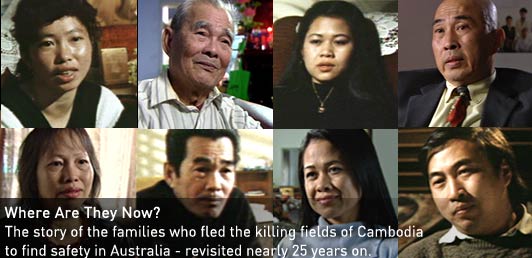
Where Are They Now?


Reporter: Marian Wilkinson
Producer: Janine Cohen
Broadcast: 27/06/2011
Four Corners - ABC Australia

The story of the families who fled the killing fields of Cambodia to find safety in Australia, revisited nearly 25 years on. What are they doing? Did they find a home? And what does their experience tell us about the current debate over refugee arrivals?

In 1987, with debate raging over refugee policy in Australia, Four Corners told the story of four families who came to this country in search of refuge and a future. The stories they told about life under Pol Pot were difficult to hear. Now reporter Marian Wilkinson returns to those same families and asks them about their struggle to remake their lives in a new country. Speaking frankly, they tell her the good and the bad - the moments of triumph and despair, and what it means for them to be an Australian.

For many Cambodian refugees, their story began on 17th April 1975 when Pol Pot's murderous Khmer Rouge took over the capital of their country, Phnom Penh. What followed was horror on a shocking scale. People were driven into the countryside where hundreds of thousands were killed. Others were forced into labour gangs and worked to death. In all, 1.7 million people lost their lives. In the years between Pol Pot's arrival and the tumult of the Vietnamese invasion of the country, many Cambodians fled seeking refuge.

Monday, January 31, 2011

Congratulations to Greater Dandenong Young Achiever Kalyan Ky!

Young achiever: Kalyan Ky. (Pictures: Ted Kloszynski)

Greater Dandenong honours Kalyan Ky and other key achievers

31 Jan, 2011
BY SARAH O'CONNOR
Great Dandenong Weekly (Australia)

GREATER Dandenong's 2011 Young Achiever of the Year is using her experiences as a refugee to help other young people in the area.

Kalyan Ky, 24, was awarded at the City of Greater Dandenong Australia Day celebration last week along with Citizen of the Year Ruth Hartnett, Good Neighbour of the Year Raymond Johnston and Non-Resident of the Year Barbara Siddall.

Ms Ky's parents left Cambodia as refugees in the late 1980s, first heading to Malaysia, then New Zealand, before settling in Australia about seven years ago.

Saturday, July 24, 2010

Phiny Ung’s migration story

My husband drew this portrait of myself soon after my baby was born. There were no oils. He would go around the street trying to look for paint in the big, big sea of rubbish. He was really thrilled in gaining his skill back after it got rusty for four years. I had to sit for him to draw for a few hours and I had to run to feed the baby and come back. We really, really fell in love; it was really sentimental. We built up our relationship through hardship. I know many couples divorce soon after Pol Pot because that was the circumstance that they decide to tie the knot.
  • cultural background: Cambodian
  • town, region, country of origin: Phnom Penh, Cambodia
  • start of migration journey: Bangkok, Thailand, 1980
  • place of arrival in australia: Brisbane on 25th May 1980
  • first home in australia: We were sponsored by my brother-in-law and lived with his family in Brisbane.
  • first job in australia: I volunteered as a receptionist for a small taxation office to practice my English, then a TAFE teacher for young, unemployed Cambodians in Sydney.
  • other jobs in australia: Interpreter for health department; restaurant owner; Cambodian liasion and multicultural lisasion officer, NSW Police – all located in Sydney.


Phiny Ung’s migration memories:

I was born in 1956 in the capital city of Cambodia, Phnom Penh. My parents were usually away from home so I spend most of the time with my grandmother and grown-up siblings in Phnom Penh.

Agriculture is a big influence [on] our economy and [we] have very natural gift of plenty of fish around December to February. I was so amazed how we can get close to nature. That goes back to the way that grandma used to do things. She passed it on and made sure we learned. She usually had the tamarind paste – put a bit of water to get some juice – and mix with some garlic and onion, brown it. Then she cooked with some fish sauce and also with some meat, then we can go with a very nice fish. It was very, very happy time. I was fortunate to be a favourite granddaughter.

Mum and Dad go to different province where [Dad] was the governor. Summer in Cambodia were with my parents and the younger siblings. Dad attend[ed] a special school to train for diplomat [and] my [eldest] brother was an army lieutenant in the Sihanouk regime. He got married in early January [1975 and] it was fortunate he got injured a few months before the country fall onto Pol Pot regime otherwise we would have been separated from him.’

Phiny’s eldest brother’s wedding, Phnom Penh, Cambodia, January 1975
“I got that photo from his wife’s relative who lives in France, otherwise I wouldn’t have anything. I couldn’t carry much of a memory from my past during my escape to the Thai border.”

The evacuation of Phnom Penh was in April 1975 when Pol Pot came to power. The Khmer Rouge told [us] that the Americans will bomb soon so to survive we have to get fast out of the city.

We learned later that they just want to punish people who live in the city because we were the enemy of state. They said people who [worked] with the government would be called back in a few weeks when they install the new regime. Who is to know that they kill because they want to clean the old regime and start the new one?

They evacuate three or four million people in a few days. It was shock and disbelief. It was terribly chaotic, there was no planning. A big tragedy unfolded, we did not know what to say except follow orders. There’s always a gun fired to the air, to push and order people to move on. The streets were full of people. People died along the street, some woman gave birth to a baby on the street. It was horrible, horrible.

My father inherit a sword from his family heirloom. It’s been passed on a few generations. Mum used to tell us not to take the sword out from the case, only in a very emergency situation when it needs to be used and that meant killing people. Our great, great grandfather had used the sword to fight. I think it is more than a good 200 years. I recall Mum and my biggest sister work hard trying to hide this sword into a long pillow where she can also fit some other valuables, belongings and currency. When we settle in the countryside, Mum told one of our brothers to bury the sword. We can only take it out when Pol Pot finish or we return to capital city.

My parents were born in Phnom Penh so my father decided to follow his good friend (Bunheang’s[1] uncle), to the eastern part of Cambodia, about 100 kilometres away. Dad’s philosophy is that if we can go somewhere with water and rice plantation then we will survive. I remember we would take a break and try to feed two abandoned children because they’re separated from their parents. It just fit perfectly to the saying, ‘Every man for themselves’. Those babies were about 20 months old, just lay on the concrete floor. I spent some time to put food in their mouth but I could not take the baby with me because I have other things for my family and we had to move on, we’re not allowed to stay and do what we want – the Khmer Rouge soldier would move people on every minute. We would be shot.

During Pol Pot, regardless of what government ranking you were, [you] fall into enemy of state category, what they consider to be educated or intellectual. Even my [siblings who] were high school students, the widow of the army officer and a primary school teacher. Mum came from a very well trained family. The way she talked, the way our family was set up, we’d been accused that we were connected to royal family. That put us into a class. The ideology created hostility between two groups of people who live in the city and in the countryside. I was very angry, very upset about the way we’d been treated but then again you look at the primitive [life] of the farmers.

We were accused of being corrupt, having lifestyle of imperialism, capitalism, that we’d been brainwashed. We were treated as traitors. [There] was a very severe sentence for that. Usually they take to the pagoda and interrogate people there. All I know is that my father and eldest brother [had] their hands tied to their back, taken away to the re-education camp which was the gaol. The villagers [said] they’d been beaten and taken away. We never seen them [again].

They planned to take us all, they really made us go through a very, very traumatic time. It was torture, psychological torture, where we had to prove that we’re loyal to the government organisation, Angkar, they want to test our resilience. [When] taking family member, we’re not to show any emotion because we had to be very strong and work very hard to prove our loyalty. We cannot cry or display any emotion in public [otherwise] we’re having the same fate, we’d be taken away.

The only thing we can focus or encourage to do so is to work 15 or 16 hours a day, wearing the black pyjama – a wrap type thing – and no school, no market, no money. It just was purely working seven days a week. We just had to follow the instruction by getting up at dawn, working on rice field production, and come home at dusk.

When we reach 16 we had to join the mobile brigade or conscription to join the battlefield. Some children never return to their family. When we get married we are allowed to work at the local village and do rice production, dig the dam and many other heavy work.

We had been put into lots of assignments risking life: we’d been ordered to do some work on the other side of a river without knowing how to swim. I would just hang onto a buffalo tail, there’s no OH&S (occupational health and safety) for people because it’s Communist. They don’t respect life and there’s no humanity; it’s just survival.

The Communists are trying to control people, everything belonged to Angkar with very, very grass roots people to take power. You just had to follow what they say. You cannot take your own knowledge and say, “Look, this is not the right way”. You just have to be dumb, deaf and blind to follow the order. In order to be alive you have to be obedient. They’d been trained to dislike or be hostile with the city people.

Bunheang was a student at the university of fine arts and a cartoonist [for] a well-known newspaper. He’d been strong in political cartoons since he was 17 years old so he had been [well] trained in Cambodian politics. We decided to ‘tie the knot’.

I was worried that we will be accepted for marriage; I was a daughter of a government official and [his] family also from ‘imperialist’ background. We’re not allowed to hold hands, walk side by side, call each other [names to] show affection like ‘honey’, ‘darling’. Every night they have spy to check.

We cannot pick any time to get married because Angkar permit[ted] people to get married only twice a year; it is a mass wedding. Both families have to put an application to the chief of the village. On 5th October 1977 we had to walk about five kilometres from our village to attend one of the temples. Angkar [use] it as the big centre because it was no longer to practice religion. They divide the wedding into morning and afternoon, the morning for people very close to the organisation, the grass root people.

It was a very sad but funny business if you compare to the normal life wedding, like my brother’s and sister’s. You don’t have to prepare anything, you just have to go to work until the eve of the wedding. I had to borrow some good clothes from the neighbour because my black pyjama that I had been issued was so worn out.

I still recall that day. I was so upset and sad because my father was taken away two years before that and I lost three siblings so it wasn’t really a joyful day. We don’t even know what our future would be like.

The way of the wedding is to go in front of the chief of the village. There was a long table and a list with names. Because they’re not able to read and write that well and we cannot show them that we know how to, we just put our thumb into that stamp pad and print our thumb next to our name, so we don’t actually have a marriage certificate! That was the main ceremony. Next day we had to go to work, business as usual.

Soon after the Vietnamese regime came in we knew there was going to be a change. We don’t trust that Vietnam will bring any peace or stabilisation to Cambodia apart from looking for their own interest to invade.

I get pregnant with my first daughter so the first thing to do is to look for some place I can give birth with comfort. Living in the countryside there is no hospital and I’m not comfortable to follow traditional midwife. Knowing it is a big risk, we try to join the new government installed by the Vietnamese army. My husband joined with the department of information [with] his skill of drawing. We have regular ration for our salary and a really nice hospital. That was in 1979 and my daughter was born in July.

My husband had been told he would be sent to do training in Vietnam or East Germany. We suspect it might not be the case because of the racial hostility [for] ethnic Chinese which falls into my husband’s family. So we knew we’re not really that safe.

After Pol Pot we cannot go back to our own family home because it’s been occupied by the government official because that’s quite a big house. Nothing is belonging to you anymore, everything is to the government.

To travel to the Thai border is almost impossible at that time, only the people that transport food. So we bribed the driver of the truck that carried rice to Battambang, the province close to the border. It’s about 250 kilometres away but it took us ten days because the road had been badly damaged during the war. We paid them in gold and have to go on top of rice which is really dusty. That is really hard with the five months old baby.

We almost got killed several times; sometimes the lorry capsized. We had to pass through many checkpoints and don’t have any more valuable thing to trade, so I have to make the decision to follow my husband and [his] family because my mother-in-law had some gold. It was a tough decision to leave my mother and younger siblings behind. If I survive, then I will find a way for them to follow me.

Mum lost Dad and four other children, it was tough enough, but to lose me again, not knowing what’s going to happen because I might not be successful with my escape and the grandchild? But if I don’t come then my husband would not come, so I just had to be brave. We were so upset knowing we were going to be apart. I don’t know where the strength came from. She gave me a statue of Buddha and the photo of my great-uncle dressed as a very high ranking senator.

I had to leave behind lots of significant things including the sword. Another memorable thing was the portrait my husband draw of myself soon after my baby was born. There were no oils. He would go around the street trying to look for paint in the big, big sea of rubbish. He was really thrilled in gaining his skill back after it got rusty for four years. I had to sit for him to draw for a few hours and I had to run to feed the baby and come back.

We really, really fell in love in that I never knew before. It was really sentimental. We built up our relationship through that hardship and get to know each other. I know many couples divorce soon after Pol Pot because that was the circumstance that they decide to tie the knot.

But I knew I could do something with this education certificate. I learn the skill of hiding things during Pol Pot because it’s a matter of life and death. I insert that small certificate into the waistband in several folds. I knew it’s a big risk because it explains what I do, where I was born, even the table number I sat during the exam. It prove[s] my level of education, which isn’t very high but high enough for guards to consider I would be a threat to the government. I don’t know whether I’ll be alive or dead during my escape but I’m just looking for something to represent me and that’s the only thing I had at that time.

We present a false document at every checkpoint. Our original application is to attend the wedding of a relative near the border. Smuggling and bribery is in full practice so we pay those guards but the photo and Buddha statue [were] confiscated. They said, “You connected to the high ranking government?” so I had to make up story, but they have the small statue and said, “You’re trying to smuggle out of the country with this”. They just kept accusing and accusing and I said, “No, with baby I do not go anywhere, this is for my family heirloom, it’s left over from the Pol Pot regime. This is sacred for our family”. So we pay them gold or some bracelet and they keep quiet but then they took away the photo and the Buddha. But I’m glad I make the good decision of folding that certificate into my trouser waistband.

It was very, very scary experience, it was a miracle. We follow the guide we hired to show us the way to the Thai border. For local villagers, this is their trade; it’s a clandestine type of smuggling. I didn’t know I was pregnant with my second child, too stressed to know what’s happening.

For about 12 kilometres that would be about six or seven hours’ ride. Sometimes you’re slow, there’s several checkpoints and the very difficult part was to pass guerillas – Khmer Rouge resistance – and the Vietnamese troops which represent the government.

When we pass the Vietnamese we say we go to the next village to express our loss during Pol Pot. The Vietnamese have to give compassion to prove that they are friend to Cambodia. Then we go to Khmer Rouge and I pretend to be the wife of that [local villager]. It’s really hard to hide skin colour, the appearance, when you’re not really a farmer or villager. For me I can blend in alright but my husband, it was so terrible.

We managed to get to [the border] and were trying to get to the camp [to] access international aid. We registered with the United Nations High Commission for Refugees to get our rations. There were several camps. There was a horrible experience where some refugees in the next [camp] were taken back by the Thai government. We had to take risks all the time, we were not sure whether we were being totally protected or not, we could not communicate with the Thai driver.

Finally we [were] taken to the proper camp and stayed there for about three months. I managed to contact my aunty in Paris, so she sent money. Straight away I found someone to go back to Cambodia and then trying to get my surviving relatives, my mother and siblings, to the camp. My husband has a brother who lives in Australia so he sponsored us. That was [why] we left so quickly and move[d] to a holding centre [for two months], waiting for the flight. We were held back for six weeks because my daughter was very ill and had been taken to hospital.

Each day we go to the big centre to see [if] our name is on the board [to depart]. Your destiny [is] from day to day. Once we [were] called, I cannot lose the opportunity [but] then was so worried I would leave before my mother and sibling arrived. I can’t telephone, there’s no means of communication. We were so fortunate that they arrived just 10 days before I left. I managed to take a photo of them and I treasure that Polaroid. I was just overwhelmed with joy to be reunited with them and at the same time knowing there was only half of [the family] that made it.Phiny’s family reunite at Khao-I Dang refugee camp, Thailand, January 1980
“Mum, my sisters and brothers arrived and reunited with me. It was one of my happiest times to be together again [but] only half of [the family] made it.”

I accomplished one of the tasks I promised my mother [but she] was upset I left her again. That’s the second time we had to say goodbye but this time we would have more of a hope. I would try to get them out and I did.

[Coming to Australia was] the feeling of the unknown, the feeling of surviving, feeling to be grateful. I can’t deny I feel relieved and happy but it’s mixed with that sadness. [On] 25th of May 1980, I arrived in Brisbane and that was such a wonderful experience.

We were greeted by one of the immigration officials and it was so warm a welcome. I just never thank enough to the Australian government and the people the gratitude that [they] gave me life. This is the first thing I can put my trust in. I’m no longer cheating death, we were not at risk. I have a place to live without fear of being killed. And when I met that officer although we cannot communicate, I can understand and they really do their best to make the three of us feel welcome. Once we touched down, we were so overwhelmed.

The officer put us in a taxi. We saw the big road, the city and things like that and then the taxi driver happened to be female!! It was a Sunday and I did not know shopping wasn’t open so the city is quite deserted. We have a sense of suspicion all the time because we’d been through too much and I said, “What’s happening? Where’s the people?” Later we learned many people go to church.

My brother-in-law did not know the day we arrive [so] when we arrive to their house it was a complete surprise! They’re all scream[ing]. Then my daughter is so dehydrated because she had diarrhoea and didn’t eat. She looked half-dead and didn’t talk. It was so horrific. That night my sister-in-law call her friend, a paediatrician. It’s so lucky we have the top class treatment.

She had to be hospitalised that night and it was so difficult to let her go. We’re curious about [the hospital] and it was just a big experience. It was like coming out from hell and then we see different faces, different way of people treating. That is really mesmerising.

We stayed there until I gave birth to my second daughter in September. Then we move out from my sponsor to try and settle ourselves. During that time my husband managed to get a part-time job soon after he finished his English class. I was busy with two babies, so he’s the only one who can earn. I got home tutor and I learn English with the children [watching kids’] TV programs. That was a very good experience.

Phiny & Bunheang with their two young daughters, Brisbane, Australia, 1980
“[On] 25th of May 1980, I arrived in Brisbane and that was such a wonderful experience. This is the first thing I can put my trust in. I’m no longer cheating death, we were not at risk. I have a place to live without fear of being killed. Once we touched down, we were so overwhelmed.”

It took us a few weeks before we get rid of all the jetlag and of course adjust our way of life. The cooking – we didn’t really have difficulty comparing to other refugees [who] have to get used to lamb. So we did not experience the government migrant hostel so we accommodate to our liking with the rice and things like that, so I have no trouble.

When we come home, after the daily chore, we say, “What can we tell?” because even our own relative, my brother-in-law who sponsor us, find it hard to believe what happened. So we had to tell. Luckily Bunheang can use his skill of drawing.

He get the Indian ink, cardboard and some pointy pen. He said, “You have to remind me what you saw”. So we talked together, combined [our] experiences and then he start into his drawing. So every night when I put the children to sleep, we sit together, concentrate and recall. This is our homework [for] nearly four months. Every night.

We have no photograph and we worry we may forget. So it’s sort of an archive. After it’s built up for more than 90 drawings, then he start to show people. Much later he [worked with] a Queensland University lecturer to publish a book called Murderous Revolution.

» Khmer Rouge Toons illustration website

We have nightmare all the time. When I hear the knock at the door, I just don’t want to open [it]. We do not know who’s there, who will bring bad news; my mother and surviving relatives are still at the camp. So I hate to answer door. I had enough bad news. I was so afraid.

I did not know until much later that [the drawings were] helping us let our traumatising experience flow out. When you were the victim of terrible experience you can only think about what’s happening. You don’t have time to think what you’re going to do next. At that time there wasn’t a system of having counselling and with our culture, counselling is very much talking to your religious leader, relative or someone elderly in the community.

We have French as our second language. We [studied a little] English during secondary school but we only start to learn English when we arrived in Australia. When I arrive[d] in Australia the language experience was [intertwined with] discrimination. I can understand English but I can’t speak [much] just yet because I need a lot of practice. I recall when I went to greengrocer and trying to pick a few pears, that shop owner snatched that bag out and pour out the pears, grab all of the second grade and then charge me. I used my gesture not accepting that and protest. He just show me out of the shop, like, “You’re not accepted”. I recall I haven’t seen much of Asian appearance at that time so I was really the new face of physical appearance of the migration in the 1980s on the streets of Brisbane.

It’s sad but I cannot take that sort of racial discrimination as a very serious thing because I’ve been through too much. We learn to accept that we are newcomers so maybe this is the way it is? Communication was a really big problem but we try hard to learn and win the support by just being nice and friendly to others, not respond in a negative way. That’s the only way I can put myself into facing the discrimination which is a thousand things – on the bus, the train, sometime we got spat at but it’s [not] life threatening. It hurts, it’s really hard to take, but then we [had] a lot more to deal with, so we managed to toss it aside.

There’s no need to get involved in that kind of provocation. “Well you think you are the winner, so be it. We are the loser? Yes, of course I’m a loser; I lost my land, I lost my home country, I lost everything and I’m just coming to look for peace”. So we have to stick to that peaceful life.

Bunheang got an illustrator job in Brisbane three months after he attended the English class with the migrant education centre but it was only part-time, only about $10 more than the unemployment benefit because we have two small children and I wasn’t working.

I sponsor my mother [and siblings?] and they join me a year after [in Brisbane but] late ’81 [we came to Sydney]. My husband got a very good job he always dreamed to do, working in the animation studio. The studio in Sydney offered that position for a trial for 10 days. Bunheang did not believe that he get paid while on trial and the pay was almost double.

When he told me [he got the job], first I was so thrilled but then again it hit me hard I had to leave my mother again because I can’t afford to take them with me. So Mum again had to go through with a sense of loss, the third time.

Mum followed me [to Sydney] a year after, [she] missed her grandchildren. There is more opportunity in Sydney, we have more cosmopolitan, more Asian sort of concentration than Brisbane at that time. We become tourist at many occasion by learn[ing] the public transport. [Even] though it was very limited resource we were so happy.

Many other fellow refugee were not able to gather their strength to pick up the pieces in settling with the new life. The lack of confidence has really deterred [some] and I was able to work with many to build confidence and [improve their] education levels. I started as a receptionist with a small taxation office [where] I brought our tax return, but that was volunteering. It was only for a short time, trying to practice my English. Later I got a very good job as a part-time teacher with TAFE to work with young, unemployed Cambodians [aged] between 15 and 24 for three years. I also worked as a healthcare interpreter with the health department.

Australia [was] about to celebrate the bicentennial year, ’88, and the market crashed. The company my husband worked for suffered a great loss, so we [were] nervous because we bought a home. We thought maybe we look at a new venture by starting our own business. That was in 1988 and we went to Mosman [on Sydney’s lower north shore]. We found an old Bulgarian restaurant, Sofia, so there is no connection to Cambodia at all! We introduce[ed] our food to the Australian community in the upmarket northern suburbs. We travel three hours a day from the Fairfield area [in south-west Sydney] and we decide I have to resign from my government position. if I can escape from one country to another I [shouldn’t] worry too much!

Apsara, the dancing angel [which] culturally is very Cambodian, went surprisingly well thanks to my grandmother and mother who passed on the cooking skill. I use[d] all the family recipes. It lasted about four years [but] it was hard to run with small daughters and we didn’t close until two in the morning.

My husband decorated the restaurant with his drawings; that captured lots of attention. Word of mouth really did us a big favour; we seem[ed] to attract professionals and politicians. I recall Mr and Mrs Greiner[2] came to dinner and the producer, Bruce Dover, from A Current Affair with Channel Ten, was a regular face.

Bruce talked about the Pol Pot drawings and our life experiences. He said, “Do you think you can go back?” That was in 1989. At that time, it wasn’t really accessible [for] Cambodians to return because of the political situation with Vietnam. We had to get permission from the government because they control everything.

Mum was so shocked. How could I be so silly to leave [my] husband and children behind to take such a big risk? I said, “Mum, it’s not about money, it’s about confronting my past and the hope that I might find my sibling or Dad”. I heard people united after many years [after] they separate. If I knew [where] Dad is buried or siblings were killed, then I would be able to [have] closure because we did not really have a chance to grieve properly.

So I was an interpreter with the film crew to do the documentary, that’s all I knew. But once I got there it turned out I was the person that they were going to make the documentary about! They called it The Waiting Fields[3].

It was a really big experience and I spent about two weeks in Cambodia. The focus was on the refugee experience. I met my surviving relatives and went to the site where it was still fresh with mass graves. I didn’t go to Tuol Sleng prison because I wasn’t ready to. That was the place they held my father, brothers and sister and kill or torture them. I’ll never be ready to go to a place like that. I went to a place not far [away] and saw the remaining clothing still scattered everywhere. I learned [my grandmother] passed away when Pol Pot came to evacuate people from the city to the countryside.

I met my aunty. It was a complete surprise [for her]. I recognised her straight away but she took awhile to just absorb the reality. She didn’t know that I return to my homeland, nobody know. After we escape, we don’t communicate [for] a long time. Through another refugee friend we know she is still alive and okay in Phnom Penh. They film[ed our reunion] after nine years.

She said I am welcome to take whatever I want to take back, especially the sword and my portrait. I was speechless. I knew if I go myself as a tourist, I wouldn’t be allowed to take it because the government controls everything.

I arrange with the film crew to look for my family home. They organised to have a big family gathering. Finally we found it and I took some photos. People get really excited as it’s obviously it’s filming [by] foreigners. What shocked me most was that the orchard garden and big playground we all loved had been replaced by ugly timber. Another shock was that people were quite withdrawn.

Phiny revisits her family home, Phnom Penh, Cambodia, 1989
“I was so excited when the film crew finally found my family home. [But] I walk in and it’s totally different. The look of it is run down, disgusting, old paint and the second shock is new faces I don’t know. They speak my language but I had never met them before.”

Everybody is grateful I’m back alive. I leave Mum to make the decision who is to inherit the sword and [she] pick one of my brothers and I picked up [its] wooden case. So I take that as my belonging even though I’m a girl and not right [to] continue that inheritance. It’s part of the culture, you know. Too bad I was born a woman!

In 1993, the Dateline program at SBS television [wanted] me to confront the Khmer Rouge chief of our village. I’d been working voluntarily with the Khmer Community of New South Wales in 1984. One day I saw the Khmer Rouge chief of our village talk to our welfare worker for housing commission. I recognised him straight away and I believe he would feel the same way.

He accept[ed] he was the Khmer Rouge cadre but denied the killing. That’s another tragedy unfold I’ve got to learn to live with. A person involved with the life and death of my family is here with his ten surviving children. It was really tough. For my part I have to talk about it for the sake of my own history, but some people in the community portray me as the troublemaker and that I am jealous of his family’s business success.

There are people who have done some terrible crime but then live with us every day and pretend to be a good person or try to forget their past without asking proper forgiveness. He was trying to hide that and if I’m not exposing it the story would just go untold. Many have recognised him but wouldn’t dare take the same step.

My pure intention is I want to rest, I want to find closure for my personal tragedy. I cannot find my father’s body, I cannot find my father’s grave, I cannot locate the place where he was killed so what else do I have? [If I] hear the perpetrator apology I can forgive them.

Other people have difficulty to face the truth and try to sweep [it] under the carpet. The Khmer Rouge trial taking place in Cambodia [with] United Nations [support] also opens cans of worms.

In 1993 I fell pregnant with my third child and it happened to be a boy. We believe that was the gift from the big Buddha and my wish was granted. There’s 11 years gap so we decided to have another one, so we have four children, two girls and two boys.

That was in 2001 when my brother who inherited the sword got married in Melbourne. It is family tradition to take a photo before we carry the dowry to the bride’s family. That took me back to the time when I reunite with my family at the camp, but now we have triple numbers in that photo.

Phiny’s youngest brother’s wedding, Melbourne, Australia 2001
“It is family tradition to take a photo before we carry the dowry to the bride’s family. That took me back to the time when I reunite with my family at the camp, but now we have triple numbers in that photo.”

I know it’s difficult to be an individual who lives in constant fight of the difference in society and I just want to help the disadvantaged where they cannot use their intellectual ability or language skill to guide themselves. That’s what I’ve been doing for the last 25 years with serving the community [in a] development job. I [currently] work with the New South Wales police force as ethnic community liaison officer.

I work with any community, particularly the new emerging community where I have a lot of experience about understanding issues on prejudice, discrimination, racial tension. We tackle the problem about social hatred or why the community not really trust police or why the police don’t understand the community perception.

I decided not to go back to Cambodia. I can’t stand the corruption. I can’t stand the different level of life with poor and rich. I cannot tolerate the social injustice. It doesn’t matter how much I miss Cambodia, my homeland. I know I won’t return until the country goes back to the standard I would like to see.

PHINY UNG was interviewed on 20 January 2010

Interview, research, text edit, photography & film production by Andrea Fernandes, NSW Migration Heritage Centre

Film edit by Linda Kruger

Web layout by Annette Loudon, NSW Migration Heritage Centre

With assistance from Bunheang Ung and Cambodian Buddhist Society

--------------------------------------------------------------------------------
[1] Bunheang and I later married.

[2] Nick Greiner was the NSW Premier at the time.

[3] A few years beforehand the movie The Killing Fields came out. (This film was based on Cambodian life during the Pol Pot regime.)

Tuesday, July 20, 2010

Viet Nam ends stateless limbo for 2,300 former Cambodians

Some of the former Cambodian refugees at Friday's ceremony in Ho Chi Minh City proudly hold their citizenship certificates. (Photo: UNHCR/S.Vu Anh)

HO CHI MINH CITY, Viet Nam, July 19 (UNHCR) – In a joyous citizenship ceremony, Viet Nam took a ground-breaking step towards closing the last chapter in a 35-year-long statelessness saga for some 2,300 former Cambodians.

"I'm so happy," said a beaming Luong Ve, 77, the oldest among 287 former refugees to receive a Vietnamese naturalization certificate last Friday, a valuable document that will now entitle him to a huge number of rights others take for granted.

It is the culmination of UNHCR's efforts, together with the Vietnamese government, to resolve one of the lingering legacies of Cambodia's bloody 1970-75 Pol Pot regime. The 2,357 former Cambodians who will receive citizenship had fled in 1975 to Viet Nam, where they learned the language and fully integrated into their new country.

The 287 naturalized on Friday in the southern Vietnamese city formerly known as Saigon, live in what used to be two refugee camps set up by UNHCR in 1980. The rest are on track to get their papers by the end of this year.

"This sets an excellent example in the region for resolving statelessness and is a great way to start commemorating the 50th anniversary of the 1961 Convention on the Reduction of Statelessness," said Thomas Vargas, UNHCR's regional protection adviser, who attended the ceremony. He encouraged other Asian countries to take a lead from Viet Nam in finding solutions for statelessness.

Last year, Viet Nam also enacted a new law to plug gaps that had left thousands of women stateless after they married and divorced foreign men.

The valuable new citizenship documents – handed out on a flag-draped stage at Ho Chi Minh City's Department of Justice – will confer the all-important family registration book and ID card that will open the door to health and social insurance, buying a house, higher education and better jobs.

Ho Manh Cong, whose family came to Viet Nam in 1975, was born in Ho Chi Minh City 28 years ago but has never even been able to own a motorbike because he is not a citizen.

"Not having Vietnamese citizenship has created a lot of troubles in my daily life," he said. "I've been working for a company for more than five years but still cannot enjoy social insurance."

For Vu Anh Son, head of UNHCR's operations in Viet Nam, the ceremony was nearly as emotional as for the 287 receiving their certificates.

"I have known most of these people for 10 years," he said. "All they wanted was for UNHCR to help them obtain legal status so that they could live in Viet Nam permanently because there was no other solution that would give them a good future."

"This is what I have been working on with the government of Viet Nam for five years. I'm so thrilled to share the happiness with all the people with citizen certificates in their hands."

Wednesday, June 30, 2010

Mu Sochua to visit Khut Kong Kea and others in Bangkok


Dear compatriots,

Please be informed that I will visit him this week end. I will stop in Bangkok for him and others. They must be kept in hope. I will return to Cambodia, Monday 5 July.

On behalf of SRP, I wish to thank you all for your most generous contributions.

In Solidarity,

Sochua

Tuesday, June 08, 2010

Refugee corrects birthday after 10 years

STOCKHOLM, Sweden, June 7 (UPI) -- A Swedish court ruled to allow a Cambodian man to change his Swedish Tax Agency records to reflect his true age, 12 years older than the records indicate.

The man, who was brought to Sweden by the Office of the U.N. High Commissioner for Refugees after his release from a Cambodian military prison, told the court he gave the agency false information -- a birth date of Jan. 1, 1960, to make it more difficult for Cambodian authorities to track him down, The Local reported Monday.

However, he told the administrative court of appeal that he now feels secure enough after 10 years in Sweden to give authorities his true birthday, Aug. 12, 1947.

The Tax Agency previously rejected the man's claim for what officials claimed was lack of sufficiently reliable proof. However, the appeals court accepted the evidence, including copies of an identification card and his release form from the Cambodian prison.

"The court considers that it should be sufficient if on assessment the new details appear to be correct when compared to the older information and taking into account the wider circumstances," the court's decision read.

Tuesday, April 06, 2010

Monk’s Poetry Describes Grim Refugee Camps

(Photo: AP)

By Im Sothearith, VOA Khmer
Original report from Washington
05 April 2010


A recently discovered book of poetry by a Cambodian monk paints a grim picture of the refugee camps established in Thailand after the Khmer Rouge period.

The poems of the late venerable monk Akaktipo Ly Van, the former abbot of the Glory Temple in Lowell, Mass., describes crimes committed by Thai armed forces, as well as landmines.

The book, “O! Maha Mount Dangrek,” was discovered on January 12, 2008 on the day of the abbot’s death, hidden among his possessions for nearly 30 years.

It was translated and edited by Samkhann Khoeun, co-chair of Cambodian Expressions, and published in English and Khmer. Cambodian Expressions has now launched the bilingual Cambodian Refugee Poetry and Smot Project, which will tour 14 Cambodian-American communities across the US.

“The main objective is to promote poems about the tragedy of Cambodian refugees,” he said. “We are also asking for Cambodians’ help to purchase the books and CDs and make some contributions, so that we are able to further promote the poetry books and bring them to Cambodia in the future.”

The poetry describes the plight of thousands of refugees who traveled to camps along the Cambodian-Thai border in 1979 and the early 1980s after the Khmer Rouge were toppled. Many suffered attacks by bandits and Thai border rangers. Thousands of their families made it to the Dangrek Mountains. Many were gunned down or suffered from landmines.

Samkhann Khoeun said the books and CDs will be accompanied by chanting and classical music performances by Cambodian Living Arts.

“The money is to support the Light of Cambodian Children organization, which educates Cambodian children in Lowell to be good people,” Samkhann Khoeun said. “We will also use the money to set up scholarships under the name of late venerable Akaktipo Ly Van for Cambodian students.”

The tour started on April 1 and will travel through Lowell and Lynn, Mass., Providence, R.I., Philadelphia, Penn., and Long Beach, Calif., among others. The book is also available at www.reaksmey.org.

Monday, March 29, 2010

Tour To Start On Late Mass. Cambodian Monk's Book

Mar 28, 2010

LOWELL, Mass. (AP) ― Organizers behind the publication of a poetry collection by a late Lowell Cambodian monk are scheduled to launch a nationwide tour promoting the book.

The Light of Cambodian Children and Cambodian Expressions will release the book by Ly Van Aggadipo (AHG'-gah-DEE'-poh) on Thursday at Middlesex Community College in Lowell.

The book describes the horrors of the Khmer Rouge regime through the eyes of Ly Van, who died in January 2008.

Following the Lowell event are stops in Chicago, Philadelphia, St. Paul, Minn., and Long Beach, Calif. Tour stops will feature readings and accompanying musical performances by two Cambodian artists.

The book's editor, Samkhann Khoeun (SAM'-Khan COW'-un), said the tour will bring the monk's story to various Cambodian American communities across the country.

Friday, February 26, 2010

"Oh! Maha Phnom Dangrek Mountain" - Poem by Ven. Ly Van Aggadipo


Excerpt from the poem "Oh! Maha Phnom Dangrek" written by Ven. Ly Van Aggadipo. The poem recounts the plight on Cambodian refugees near Phnom Dangrek when they were deported back to Cambodia by the black heart and cruel Thai soldiers. Poem reading by Yan Borin, accompanied with music by Sork Bora.

Tuesday, February 09, 2010

Cambodian Refugee Poetry & Chanting (Smot) Project

Venerable Ly Van Aggadipo's book (Photo: AP)

Monday, February 1, 2010

Dear Friends:

How are you doing? I just want to reach out to you about a possibility of bringing the Cambodian Refugee Poetry & Smot Project to your area in April 2010. It was kind of a serendipity that we discovered the writing of the late Venerable Ly Van on the very same day of his passing on January 12, 2008. He was one of the Cambodian Buddhist monks in Lowell. Found among his belongings were Khmer handwritten manuscripts containing two lengthy poems...one autobiographical describing Ven. Ly Van's experiences during the Khmer Rouge regime, the other a biography of Sophoan Chea, a dear friend of Ly Van's who was actually his sponsor for resettlement in the U.S. The poems are beautifully written, poignant, and reflect the richness of Khmer culture. They have been translated into English and are currently scheduled for publication in March 2010.

We titled the poetry book "O! Maha Mount Dangrek: poetry of Cambodian Refugee Experiences", a quote that the author wrote in one the poetic stanzas, which recaptured his experience during the inhuman ordeal at mountainous plateau where some 45,000 Khmer refugees were violently shot, killed and pushed over the cliff of Mount Dangrek by the Thai soldiers in the mid-1979. The author and his family were among the victims, but fortunately survived yet another sad episode of Cambodian refugee experiences. We are so fortunate to have discovered such writing.

The overall project itself is called. the "Cambodian Refugee Poetry Book & CD", to be published in bilingual, Khmer and English, with full color case bound and black and white photos inside. It is about 200 pages in length. The book will be jointly produced by the Light of Cambodian Children, the Glory Buddhist Temple and the Cambodian Expressions. There have been several funding organizations and foundations supporting this poetry book & CD project. We still need to fundraise for the poetry book touring and community reading and all of that. We estimate the budget to be about $35,000. We already secured $5,000 from the Cambodian Living Arts, a project of the Marion Institute based in Marion, Massachusetts.

We are also in the process of sponsoring two Cambodian students of traditional smot chanting and Khmer instrument to come and visit the U.S. in order to participate in poetry readings at various Cambodian communities around the country, including Lowell, Rhode Island, New York, DC/Maryland/Virginia, Philadelphia, Chicago, Minnesota, Stockton, Fresno, San Diego, Long Beach, Portland, OR, Tacoma, Seattle and other cities and towns where there are large concentration of our Cambodian Americans.

I believe that your Cambodian community, particularly the Cambodian Buddhist Temple will be the perfect venue for such community reading event. If this idea interests you, I would love to arrange a possible tour of your community in April 2010 along with the two students/artists from Cambodia. Better yet if you, friends and community leaders can help us with hosting and sponsoring the event itself, it will mean a great deal to our Cambodian Refugee Poetry & Smot Project. Please see attached documents, one in Khmer and another is an English translation of one the late monk's poems.

Thank you in advance for your support and I look forward to hearing from you soon.

Best Regards,

Samkhann C. Khoeun
Editor/Translator,
Cambodian Refugee Poetry Book & CD Project
email: samkhannkhoeun@lhs.lowell.k12.ma.us

Sunday, November 01, 2009

[Cambodian-American] Girl killed after Poly-Wilson game called 'innocent bystander'

Melody Ross, 16, seen on the LCD monitor of a friend's camera.
LONG BEACH, Calif. -- Friends and classmates of Wilson High School junior, Melody Ross, 16, gather on Ximeno Ave. between 7th and 10th streets adjacent to Wilson on Saturday, October 31, 2009 to mourn Ross s death in a Friday night shooting. Ross and friends were leaving the school s football game against crosstown rival Poly when Ross was struck by a stray bullet. Two other males were wounded. (Diandra Jay/Press-Telegram)

Man wounded in second incident Friday night

10/30/2009

By John Canalis and Greg Mellen, Staff Writers
Long Beach Press Telegram


LONG BEACH -- The 16-year-old girl shot and killed after the football game between Poly and Wilson high schools was believed to have been "an innocent bystander who was not involved" in the altercation, City Councilman Gary DeLong said Saturday morning.

The girl went to Wilson High School, the 3rd District councilman said. Her identity was not released by officials but she was identified Saturday morning as Melody Ross by a cousin, Han Yin, who was among mourners gathering at the scene near the high school.

The girl, a junior and one of three victims in the 10 p.m. Friday attack near 10th Street and Ximeno Avenue, died in an area hospital, the Long Beach Police Department reported.

Two men, ages 18 and 20, were also injured in the shooting. They were hospitalized with injuries not believed to be life-threatening.

The other two victims are not believed to be students at either Wilson or Poly, DeLong said, citing preliminary police information.

The shooting occurred sometime after 10 p.m., shortly after Wilson had lost to arch-rival Poly High School 34-15.

Friends said that the dead teen's parents had come to the United States fleeing the "Killing Fields" of Cambodia, and had recently moved to a new home that they considered a safer place to live.

DeLong, whose district includes Wilson High, said he was told police have strong leads in the case but was not yet aware of any arrests.

"It's a horrific event," DeLong said, "and my heart goes out to the families."

DeLong said police have not yet been able to determine what led to the altercation.

LBPD is the finest law enforcement agency in California and I have no doubt they will find and arrest the criminals who committed this horrific act.

I've been in constant contact beginning last evening with Deputy Chief Luna, City Manager Pat West, both Wilson Co-Principals and concerned parents. All City resources will be available for Wilson High School to access both over the weekend, and continuing as necessary.

"Having a daughter who recently graduated from Wilson High, I feel a personal connection to the family who lost a daughter as a result of this atrocity," DeLong said.

By mid-Saturday morning, friends and classmates had gathered at the scene and a temporary memorial of flowers, signs and balloons had begun to grow. On the nearby football field, young players were tossing around balls.

Anyone with information, video or photos involving the shooting is asked to call Long Beach Police Homicide Detectives Scott Lasch and Malcolm Evans at (562) 570-7244.

In a second incident, police were flagged down in the area of Atlantic Avenue and 4th Street at about 9:30 p.m. Friday by a person who had just been carjacked. He pointed out his vehicle, which was leaving the scene.

Officers stopped the vehicle in the area of 4th Street and Cerritos Avenue where an officer-involved shooting occurred. The suspect refused to exit the vehicle after numerous attempts were made to get him out. SWAT came to the scene and the suspect was taken into custody. He was transported to a hospital, where is being treated for his life-threatening injuries. No officers were injured.

In addition to the Long Beach Police Department's ongoing investigation, the Los Angeles County District Attorney's Office is also conducting an independent investigation, which is routine for all "hit" officer involved shootings that occur in Los Angeles County.

Anyone with any information regarding this incident is urged to contact Long Beach Police Homicide Detectives Bryan McMahon and Teri Hubert at (562) 570-7244.

Press-Telegram photographer Jeff Gritchen contributed to this story.