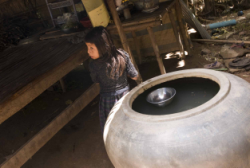
 Young children are at risk of contracting dengue fever if they live and play around standing water - the perfect breeding ground for dengue carrying mosquitoes (Photo: John Vink/ UNICEF Cambodia)
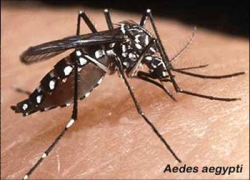 The `Aedes aegypti’ mosquito which is the carrier of dengue fever (Photo: WHO)
 A child with dengue fever at a Phnom Penh hospital (Photo: WHO)
PHNOM PENH, 15 January 2008 (IRIN) - Cambodia could be facing another severe dengue fever outbreak, according to health workers.
“If not this year, then next year - it will certainly come,” warned the leading dengue fever specialist with the World Health Organisation (WHO) in Cambodia, Chang Moh Seng. “It’s only a matter of time.”
Last year 407 people died of dengue fever, which is caused by a mosquito-transmitted virus, and nearly 40,000 cases were reported during 2007.
“This was the most serious dengue epidemic I have experienced in nearly 30 years of working in the area,” Chang told IRIN. “And the death rate in Cambodia’s outbreak of reported cases was extraordinarily high,” he said.
“Health education regarding the prevention, diagnosis, and treatment of dengue fever is insufficient, under-funded, and irregular,” according to a 2007 study - Community and School-Based Health Education for Dengue Control in Rural Cambodia: A Process Evaluation in PLoS (Public Library of Science) Neglected Tropical Disease - by Sokrin Khun from Cambodia's Ministry of Health and Professor Lenore Manderson of Monash University in Australia.
WHO specialists are warning that now is the time to prepare for the next epidemic. According to Chang, in the next few months of the dry season, the authorities and international aid organisations need to be extremely vigilant. “We need to minimise the outbreak… It’s very difficult to diagnose, treat and control the disease,” Chang said.
Diagnosis is made all the more difficult because the symptoms vary greatly. They include rashes, blistering headaches, nausea and excruciating joint aches. The most serious form of the disease can cause internal bleeding, liver enlargement and circulatory shutdown.
Four strains
There are four different strains of the virus - D1, D2, D3 and D4. When a new strain emerges a serious outbreak of dengue fever is almost certain to follow. But it is impossible to predict when or why a new strain emerges, according to health specialists.
“Our worry now is that the next outbreak will be D1 or D4, the two strains of the virus that have not emerged in Cambodia in the recent past,” said Chang. That is why monitoring of new cases now is critical. “There needs to be increased virus surveillance,” he said.
“But it [surveillance and diagnosis] is very technically demanding and involves very costly biological tests,” said Chang. “The provincial hospitals just don’t have the facilities to conduct this kind of research.”
Health officials in Cambodia said it was essential the diagnosis process be improved so patients are referred to hospital earlier, as this would reduce mortality rates. The Cambodian Health Ministry, with medical and expert assistance from Thai health officials and WHO, has been training rural doctors to recognise the symptoms of dengue fever.
Tourism, migrant workers help spread disease
Chang said a key reason for the massive outbreak of dengue in 2007 was that the D3 strain emerged in the Battanbang area, northwestern Cambodia, where the historic site of Angkor Wat in Seam Reap is located: The increase in tourism and migrant workers spread the disease throughout Cambodia, according to the WHO in Cambodia.
“There is no vaccine [so far] to prevent dengue fever, so the best way to combat the virus is to control the breeding grounds of the mosquitoes,” Chang insists.
But in Cambodia that is a Herculean task. “The magnitude of mosquito breeding in Cambodia is the worse in the world; it’s much worse than either Laos and Vietnam,” says Chang.
Anti-mosquito projects lack resources
Jars of water are the most common breeding ground for mosquitoes. Almost every household in Cambodia has large, uncovered water storage jars and tanks, as well as discarded containers and tyres and coconut shells that trap water - perfect breeding grounds for mosquitoes.
Cambodian health authorities and the WHO have been experimenting with other prevention options with some success. These include using chemicals which are safe for people but kill mosquitoes and larvae, using different water storage containers with lids, and even breeding small fish in the water containers which feed on the mosquito larvae.
These schemes, especially the fish project, show promise in the long run, but it will take several years before prevention measures are sufficiently widespread to be effective, according to Chang.
The Cambodian government is keen on several of these projects but lacks the finances to implement a rigorous and co-ordinated plan of action. “The political will is there, but not the resources,” one government health official who declined to be identified, told IRIN.
Clinical preparedness
WHO and the Cambodian Health Ministry are concentrating on clinical preparedness in case another significant dengue fever outbreak occurs in 2008.
Mobile clinical and health teams at provincial level are currently being trained; they are doing their best with limited resources to stockpile essential medical supplies in several provinces and district hospitals.
But the fear amongst foreign health experts is that this is still too little too late.