Showing posts with label Education. Show all posts

Saturday, May 26, 2012

Universities must teach how to think

May 26, 2012
A. Gaffar Peang-Meth
PACIFIC DAILY NEWS

It is no small accomplishment that the Territorial College of Guam -- since 1968 the University of Guam -- is celebrating its 60th anniversary this year as an American institution of higher learning. As Scottish novelist Robert L. Stevenson once wrote, "Everyone who got where he is, had to begin where he was." Guam invested in the Territorial College to bring the University of Guam to this significant moment.

Nearly 40 years after the founding of that proud Territorial College, I joined the University of Guam as a "raw recruit." Arriving on Guam in 1991 after a stint as a visiting associate professor at Johns Hopkins University, I was quite new to teaching. Most of my professional career had been spent in service to the Khmer People's National Liberation Front, a nationalist resistance movement at the Khmer-Thai border, fighting Vietnam's 1979-1989 military occupation of my birthplace, Cambodia.

I knew little of Guam, but was fascinated with Hollywood's depictions of island life and ever attached to the tropics when I applied for a three-year assistant professor position in political science at UOG.

Ironically, it was current UOG President Robert Underwood, who was academic vice president in 1991, who introduced me to the UOG community. But he soon left the university to serve as Guam's delegate to the U.S. House of Representatives. Guam became my academic home for the next 13 years. And as Underwood returned to Guam in 2003, eventually to assume the university presidency, I was arranging for my own retirement in June 2004, having come to love the island.

Wednesday, December 14, 2011

Engineering, science studies seen as way forward for youth

Wednesday, 14 December 2011
Shane Worrell
The Phnom Penh Post

Vocational training and engineering and science education are crucial to the future of Cambodia’s youth if the country hopes to capitalise on new agricultural and industrial opportunities, education specialists said yesterday.

A panel of government officials and UNDP, ILO and UNESCO representatives spoke to journalists at Better Factories Cambodia ahead of the nation’s first National Youth Employment forum, which will be held tomorrow and Friday at the capital’s Phnom Penh Hotel.

Seng Sakda, director general of the Ministry of Labour and Vocational Training, said it was important to give young people skills relevant to Cambodia’s labour market.

Tuesday, March 29, 2011

Garment Workers Open University: Can Education Better Factory Conditions?

Monday 28 March 2011
By Anne Elizabeth Moore
t r u t h o u t
News Analysis

(Photo: Anne Elizabeth Moore)
Bright and extremely early one Sunday morning in January, slightly more than 400 young women and a handful of young men trundled out of bed to attend class on the east side of Phnom Penh, Cambodia. (While the notion of a Christian day of rest doesn't exist in the Buddhist country, it was their day off - for some, the only one they have for weeks.) Students sat in classes, repeated lessons back to instructors, took breaks to laugh and play in the courtyard and dreamed about their futures. It looked and felt like any college campus in the world - at least, any low-income college campus. Except that these women were learning about labor law. Because - oh yeah, did I forget to mention this? - they're garment factory workers.

Over a series of consecutive Sundays, 500 textile laborers per day were invited to an experimental educational initiative of the International Labour Organization's Better Factories Cambodia, held at the National Technical Training Institute on Russian Boulevard, next door to the June Textiles Company. A full day of classes, lunch, entertainment, health services, fiscal advice, job training information and free gifts were offered to more than 2,000 workers at factories around the city, all in an effort to make laborers aware of their rights under the complex Cambodian legal system.

Wednesday, March 16, 2011

CITA Press Conference on 16 March 2011

នាព្រឹកថ្ងៃទី១៦ ខែមីនា ឆ្នាំ២០១១ លោក រ៉ុង ឈុន ប្រធានសមាគមគ្រូបង្រៀនកម្ពុជា បានធ្វើ សន្និសីទកាសែតមួយ ក្នុងគោលបំណងចង់ឲ្យក្រសួងអប់រំទទួលយក និងដាក់បញ្ចូល      សំឡេងគ្រូបង្រៀននៅក្នុងរាល់ការធ្វើគោលនយោបាយអប់រំជាពិសេស ក្នុងសន្និបាតអប់រំថ្នាក់ ជាតិប្រចាំឆ្នាំរបស់ក្រសួងអប់រំ ដែលនឹងប្រព្រឹត្តទៅចាប់ពីថៃ្ងទី២២ ដល់ថ្ងៃទី២៤ ខែមីនាឆ្នាំ២០១១។

In the morning of 16 March 2011, Mr. Rong Chhun, CITA President, held a press conference with the aim of having the ministry of Education accepts and includes the teachers' opinion in every education policy, in particular during the upcoming national congress on education which will take place between 22 and 24 March 2011.


Friday, December 17, 2010

Cambodian students increasingly drawn to Vietnam [-Forming a new generation of Khmer-Vietminh?]

12/17/2010
VOV News (Hanoi)

More than 1,100 Cambodian students have been received by Vietnamese educational institutions since 2006, according to a conference held in Hanoi on December 17 to review training cooperation between Vietnam and Cambodia from 2006 to 2010.

About 600 Cambodian students are present in Vietnam each year. Most of them take courses in medicine, pharmacy, agriculture, economics, architecture, and technology.

Addressing the conference, the Cambodian Ambassador to Vietnam, Hul Phany, said the Vietnamese State also undertakes many programmes to assist Cambodia in training its human resources.

Mr Phany said the Vietnamese Ministry of Education and Training helped his country build a college, a hostel accommodating 150 students, and six classrooms for a high school. He added that the ministry is going to build another college and a 150-student dormitory in Mondulkiri province.


Vietnamese Deputy Minister of Education and Training Bui Van Ga said the knowledge that Cambodian students acquired in Vietnam has proved highly effective in boosting Cambodia’s socio-economic growth.

Mr Ga added that in the time to come, Vietnam will encourage Cambodian students to come to Vietnam for self-funded study or to receive training on contracts.

Meanwhile, under a bilateral agreement, each year the Cambodian Government provides 10-15 tertiary education scholarships and about 20 two-year Khmer-language courses for Vietnamese cadres and students to study in Cambodia.

Wednesday, December 08, 2010

Letter from abroad: Chanmony Chea, Long Beach, California, USA

Wednesday, 08 December 2010
Chanmony Chea
Letter to The Phnom Penh Post

Fail to plan, plan to fail. We all know this very well. So when do I need to plan my class schedule for spring semester, which will not start until late January? The answer is as early as mid-November, though the earlier I start planning, the better and easier it will be for me.

Just like other university students in the United Stated, I am responsible for my own degree of progress. At first, it did appear to me as a challenge, considering my past experience as a student at Royal University of Phnom Penh.

Back then I did not have to worry about which courses I was required to take to graduate or who my professors would be because school took care of these hassles. All I needed to do at the beginning of every semester was to obtain a copy of the pre-arranged schedule and find out who my assigned professors turned out to be.


That is not the case here, obviously.

A few months before semester starts, the university will list all the classes being offered along with the information about instructors, room numbers and day and time of the class meeting. Once the information becomes available to students, my planning will soon follow.

I may have to decide whether to take an accounting course in spring or save it for fall semester and take marketing instead. Once I have chosen to take one particular course, the next question will be who the potential instructors are. Very often I need to weigh the benefits of having a strict professor from whom I will learn a great deal against the luxury of not having to write a thick report should I take that same course with a relatively easier professor.

To be able to make an informed decision, the process may involve some research. I usually consult Ratemyprofessors.com and seek advice from fellow students who have taken the course.

It didn’t take me long to adapt to this routine. I no longer consider it a challenge as I once did. Rather, I now appreciate and even enjoy the advantages that come with the freedom to make decisions regarding my own academic path.

One of the major benefits is I get to decide who I want to have for my professors. Taking classes with instructors whose teaching styles match my study techniques makes learning significantly easier and more effective and ultimately is good for my GPA.

There is also the freedom to select courses also allow me to efficiently balance my workload. By planning ahead, I can spread the deemed-to-be-hard classes instead of taking them all at once, so I hardly find myself in the situation of either under-load or over-load.

The distinct sense of independence and responsibility I have experienced is probably the greatest nonacademic reward. Not only do I get to make critical decisions, but I also learn to take full responsibility for the consequences that follow. I very much like the feeling of being in charge of navigating my own journey.

Personally, I find the education system in the United States more flexible than that in Cambodia. In addition to promoting independence, it encourages individuals to take charge of their education in a way that students in Cambodia cannot.

Tuesday, December 07, 2010

Empowering Cambodian women--and themselves

Paonessa (left in blue) and Moore (back) with Harpswell students at a town hall meeting hosted by Hillary Clinton. Courtesy photo
December 6, 2010
news@Northeastern.edu

Danielle Moore and Kristen Paonessa knew they wanted to do a cubicle-free international co-op that enabled them to apply their skills, and fulfill their passion for empowering women. But they didn’t know that their experience working for the Harpswell Foundation in Phnom Penh, Cambodia, would, in turn, empower them.

Since July, they have been providing supplementary education — English language classes, leadership training and current-event discussions — to young women from rural Cambodia who are attending universities in the capital city.

One of their ongoing projects has been to help organize Harpswell’s first conference, "Women Innovators in Cambodia," taking place on January 22, 2011. Six Cambodian women from the medical field, the arts and social entrepreneurship will discuss the challenges and successes of being an ambitious woman in Cambodia.

Moore and Paonessa, who won Presidential Global Scholar awards from Northeastern to support their co-op, are serving as leadership residents in one of the two women’s dormitories built by the foundation in Phnom Penh.


They also had the opportunity to meet Secretary of State Hillary Clinton, who visited Cambodia while on a tour of Asia. Clinton summoned a Town Hall meeting for the country’s youth and asked the U.S. ambassador to invite 50 Harpswell students, and their leadership residents.

Both Northeastern students say they have gained insight into themselves and their future careers by upholding the mission of the Harpswell Foundation to empower a new generation of women leaders in Cambodia and throughout the developing world.

"Convincing the women of (their equality) is also convincing me of the strength I have as a woman and what I could be back home in the States," said Paonessa, an international affairs major and economics minor.

She said the experience has helped her cultivate her leadership skills and made her realize that she wants to pursue a career that will allow her to impact people’s lives on a daily basis.

Moore, a dual major in human services and international affairs with a minor in Spanish, said it is "very fulfilling to feel as though Harpswell’s mission is being carried out each and every day and we’re contributing to that."

The co-op is providing Moore with a glimpse into what her chosen career path — to work in conflict and disaster situations — might be like.

As the first American students and first Northestern co-ops to work for the Harpswell Foundation, they are also helping to forge a global partnership.

"They are both so smart and dedicated," said Harpswell’s founding director, Alan Lightman. "They have really done a superb job. I’m really delighted with the co-op program at Northeastern, and the opportunity to have two star students working at Harpswell."

For more information, please contact Kara Thompson at 617-373-2802 or at kara.thompson@neu.edu.

Friday, September 10, 2010

Serving rural students in Cambodia

Men Sotharin, deputy director of St. Paul’s Agriculture and Information Technology Institute in Takeo, Cambodia

September 9, 2010
By Men Sotharin, Takeo
UCANews.com


Men Sotharin is deputy director of the newly opened St. Paul’s Agriculture and Information Technology Institute in Takeo province, the only Church-run tertiary institute in Cambodia.

She was the only Cambodian representative at the recent 18th conference of the Association of Southeast and East Asian Catholic Colleges and Universities, held in Bangkok.

Following are her reflections on the conference, the education situation in her country, and how her newly opened St. Paul’s institute is serving Cambodian students:

The conference of the Association of Southeast and East Asian Colleges and Universities (ASEACCU) in Thailand Aug. 26-28 focused on Caring in Truth: Catholic Perspective in Education Challenges. We discussed the issue of care because Catholic educational institutions have to be at the service of the Church. We are called to be guides for young minds and to care for the next generation.

Discussions at the conference were relevant to the situation in Cambodia, one of which was the challenges posed by globalization.

Cultures and traditions are all being affected as economic activities have become more profit-driven with the focus on manufacturing, technology and services.

In many places, the traditional reverence for persons and the human body has disappeared. The person has now become a commodity, and if we can earn money by selling things, then the human body is no different.

We Catholic educators should explore new avenues in serving the truth and in promoting the dignity of the human person.

Here in Cambodia, we see that young people crave for modernity even though their parents don’t have money. For example, they want to study in Phnom Penh because they are attracted to the modern lifestyle and many entertainment outlets in the city.

That is why we opened St. Paul’s institute in a suburban area.

We realize young people here want to study but they don’t have the chance. Most are from farming families. Many drop out after junior high school because it costs lots of money – school fees, study materials and accommodation, food and water etc – for higher studies in the city.

If their families want to support them, they must sell their property such as cows or rice fields. Many thus choose to stay at home and work in the fields with their families.

Because of these difficulties, we are trying to help young people receive higher-level education so they can enjoy more job opportunities.

Here in Takeo, the Catholic Church has a new high school – St. Francis’ – and an institute – St. Paul’s.

Our mission is not only providing skills but also help foster love and a fraternal spirit among students. We also try to teach students solidarity and honesty, which make us different from other schools.

St. Paul’s institute, which started in 2009, has classes of 80 students each in its agricultural science and information technology programs.

The school also provides free hostel accommodation for poor students from other provinces.

After they graduate, they can earn up to US$300 per month, which is good enough to lift them from poverty. With this they can support their parents and siblings, or continue studies in the university.

But we are not free from problems. For example, within the first few months of enrolment, more than 10 students dropped out due to various reasons.

We have not started moral education classes yet. But we talk to students and explain the importance of studying in the local area rather than migrating to the city.

Next year, we are going to teach two more subjects – tourism studies and English language. And we are going to start a weekend course leading to a bachelor’s degree in agriculture.

Thursday, May 13, 2010

Sorry, NO universities in the top 200 from Cambodia

ASIA: Hong Kong and Japan top latest rankings

13 May 2010

Yojana Sharma
University World News


Universities in Hong Kong and Japan dominate the upper echelons of the QS Asian university rankings released today, with universities in Singapore and South Korea also making a strong showing in the top 20. But China's universities have not performed as well as expected in the regional comparison.

The 2010 Asian rankings drawn up by QS (Quacquarelli Symonds), which also issues annual world university rankings, show the most economically developed countries of Asia also have the region's top universities.

Despite rising numbers of citations by top Chinese universities such as Peking and Tsinghua, they came 12th and 16th in this year's table respectively, Hong Kong's more international outlook meant several of its universities outperformed the best of Japan, China and South Korea.

The University of Hong Kong, Hong Kong University of Science and Technology, and Chinese University of Hong Kong took first, second and fourth places respectively.

Meanwhile, Japanese universities, with Tokyo highest at 5th place, occupied 57 of the top 200 and five of the top 10 places in this year's table, only the second time QS has produced Asian rankings since the inaugural Asian rankings last year.

"The Japanese and Hong Kong universities have been investing a lot in faculty and in improving their international profile, and that has fed through into the rankings," said QS Managing Director Nunzio Quacqarelli.

National University of Singapore's showing at third place was underpinned by a drive to internationalise, according to QS. Strong academic peer recognition also benefited NUS as well as 15 South Korean universities and seven Indian Institutes of Technology placed in the top 100.

QS researcher John O'Leary said: "The rise of Chinese universities is not much in evidence in this table. Although there are Chinese universities in the top 15, the Chinese higher education system as a whole is some way behind the Japanese.

"China's huge higher education system is not an advantage in rankings. It is going to take a while for government investment to have an impact. In smaller countries it is possible reforms can have an impact across all universities and come through within a short space of time such as in Hong Kong and Singapore."

Quacquarelli said that in larger countries there were more differences between universities but governments were beginning to focus on small groups of elite universities. He predicted the elite universities, particularly in China, would rise in future Asian rankings.

"We would expect the Chinese universities to improve steadily in the next few years with their massive investment in infrastructure, more autonomy and opening up to partner universities through exchange programmes," he said.

Top Indian institutions were also likely to rise through the ranks: "I think their standards of quality are very high as more companies seek to employ their graduates," Quacquarelli said.

But there were no universities in the top 200 from Cambodia, Vietnam or Laos, and just three in the top 100 from Thailand, two from Indonesia and one from the Philippines.

Universities in Asia were improving faster than institutions in the rest of the world, including in citation counts, and investing in faculty, Quacquarelli said. He pointed to a "pan-Asian trend to invest more in their higher education institutions and establish centres of excellence".

The QS Asian rankings do not simply extract the Asian institutions from the annual QS World University Rankings but employ slightly different criteria.

These include review by peer academics in the region, accounting for as much as 40% of the total measure, review by employers in the region, accounting for 10%, student/faculty ratio, 20% of the total, and citations per paper, as well as productivity in publishing papers. International students and staff amount to another 10%.

"The chief difference between the Asian rankings and the world rankings is that there are two bibliometric measures (of citations) and that's mainly to give credit or research in languages other than English," said O'Leary.

One of the criticisms of past QS-THE World Rankings was that they relied too heavily on publications in English.

The Asian table also differs from the better-known international rankings in gauging employer reaction with a questionnaire is sent out to major companies recruiting within Asia. The aim is to assess the employability of a particular university's graduates.

Richard Holmes*, a lecturer at Universiti Technologi MARA in Malaysia, and a commentator on global rankings, including those for Asia, said such rankings were open to manipulation.

"You can get a short term boost fairly quickly by recruiting staff and students internationally," Holmes told University World News. "Increasing publications take much longer to give a university a boost, as does increasing the staff-student ratio. But many universities are doing things like this to improve their positions."

Saturday, April 17, 2010

Preparing to graduate, Cambodian monk redefines life goals

Friday, April 16, 2010
By Erika Hafer
Special to the Pirate's Log
(Student newspaper of Modesto Junior College, California, USA)


Muny Korn has much more than a degree to be proud about. Underneath his gown on graduation night, Korn will be wearing different clothes than he would have three months ago; underneath his cap, he will be wearing a different hair style than he would have three months ago, and on his feet he will be wearing a different type of shoes as well.

Korn came to Modesto Junior College as a Buddhist Monk from Cambodia in late 2004. The 27-year-old spent his first 21 years in Cambodia, where he joined the monkhood at 15. “Because my country is under poverty the life of most people isn’t that easy. We lack access to schools; we lack pretty much everything,” Korn explained. Following the Khmer Rouge regime of Pol Pot, which was defeated in 1979, Cambodia’s economy was devastatingly affected by a shortage of jobs and the lack of a properly educated workforce. Though Korn’s family were farmers, his mother, father, sisters and young brother remained poor. Korn says that becoming a monk was a way to escape the grip of poverty. He felt with joining the monk community, he would have more support and, in return, could live to support his family.

“Buddhism is a good way to offer opportunity. Most people want to become monks because they have nothing to do. They are poor. We get more chances now,” he explains.

Similar to the many reasons U.S. citizens join the U.S. military system, many Cambodian citizens find support, guidance and direction in the Cambodian religious system. The schooling and living expenses of monks are paid by the charitable donations of others.

Because Buddhism is an integral part of Cambodian culture (the majority of Cambodians are Buddhist), Buddhist monks represent honor and strength along with respected social status.

“It is important to know about our religion to know how to discipline ourselves, how to behave in society,” he says, acknowledging that these skills served him well when he became an MJC student.

There are ten basic rules to life as a monk, Korn says: 1) no killing, 2) no stealing, 3) no sex, 4) no alcohol or drugs, 5) no lying, 6) no dinner, 7) no perfume, 8) no gambling, 9) no sitting higher than a Senior Monk, and 10) no happiness for belongings. Not even “fibbing” is permitted. Monks are not allowed to eat after 12 p.m., because food may interrupt afternoon contemplation and prayer. Monks wear orange robes draped around them to distinguish their “homelessness” from others; they shave their heads twice a month, so as not to worry about style, and they wear sandals for simplicity even when the weather is cold. The goal in life, Korn says, is simplicity.

“We are different. We are called a homeless person…. How can we train ourselves?... We are supposed to live our lives with lay people,” Korn explains.

Muny was a novice monk for five years before his promotion to a senior monk at the age of 21. The same year, 2004, Korn, along with many monks from his community, moved to the U.S. as a mission to help the U.S. Cambodian temples with religious services. He was brought to Modesto specifically to help the Wat Cambodian Church located on Paradise Avenue, now relocated on Grimes Avenue.

Muny started attending MJC in order to study sociology. He said the change of atmosphere and culture was surprising for him and all the monks, but they knew that they were different and so were other people. He learned tolerance and acceptance of others from Buddhist teachings. On the basis of human existence, all beings are the same, he says.

Korn said that as a student, the Modesto Junior College atmosphere was very warm and non-discriminatory. “People showed curiosity, not discrimination.” But Korn couldn’t say that for non-collegiate Modesto. In 2008, the Wat Cambodian Church requested rights from the County Planning Commission to build a temple on Grimes Avenue. But the church was denied this request by the commission due to the concerns of “worried neighbors” over possible conflicts. It took the Stanislaus County Board of Supervisors over a month to review the commission- denied case and override the building veto. The church was finally built.

“They [The County Planning Commission] voted against our request… We had nothing wrong with our regulations… They were discriminating against our people. Why did the commissioners not vote for us?”

Three months ago, Muny Korn took off his robe and sandals and replaced them with a cotton, collared shirt, jeans and a pair of Vans. He wore a ring on his right-hand finger. He had left the monkhood. Korn said it was a personal decision. He felt he could not go any farther as a monk; he had earned the merits of discipline.

“There is no expiration,” he says. “I knew how long I had been a monk in my previous life to lead me to this life, but I didn’t have a good feeling to go any farther.”

Muny had felt that what he had done as a monk before in his past life and in this one made up a satisfactory ending to his career as a monk. A religious ceremony based on the retirement of the robes was held for Korn to commemorate this event. He now bears two gold rings as gifts from his grandmother and aunt in blessing of his new life and his lives to come. With his goals of graduating this spring from Modesto Junior College and transferring to California State University, Stanislaus, he is focusing on his education. He plans to finish his bachelor’s degree, earn a nursing degree, and eventually bring his parents and siblings to the U.S.

Korn looks back at his monk experience now with great pride and appreciation, acknowledging that he grew in confidence and strength under the guidance of the Cambodian church. In the weeks to come, he will receive another merit of accomplishment as he is handed his diploma for an associates of arts degree in behavioral and social science.

Muny’s determination and radiance makes him a shining example of a Modesto Junior College graduate: a scholar with open ears, an open heart and a gallant stride.

“Never give up, whatever happens. Never give up hope, whatever happens. As long as we are still alive, we still have time to pursue our dreams. Do it with confidence, do it with a smile. We have a long way to go,” Korn offers.

The Modesto Junior College Graduation Commencement is April 30 at 6 p.m. at the MJC Stadium on East Campus. It is free and open to the public.

Friday, October 09, 2009

At Islamic School, a Separation of the Sexes

By Pich Samnang, VOA Khmer
Original report from Kandal province
08 October 2009


Classes are underway at the Cambodian Islamic Center in Kandal province, and at the nearby Al Rahmani mosque, a group of female students waited for their instructor on a recent day.

It is not by chance that the classroom was empty of men. Here, young women and girls are separated from their male classmates, in a bid to help them study, officials say.

“It is common that female and male students have love relationships, and this makes it difficult for us to control,” said Pich Solin, director of the Islamic Center’s secular studies.

Segregation helps earn the trust of parents and helps students concentrate on their studies, he said.

Cambodia has around 500,000 Muslims, many of whom are descendants of a lost kingdom in today’s Vietnam. Over the decades, they have lived side-by-side with their Khmer neighbors, but Muslim leaders maintain traditions in schools like the Islamic Center, underscoring the difference in cultures.

The Islamic Center has strict rules regarding relationships between its students.

“They don’t allow us to sit in the same class [with boys], as we may woo each other,” a shy, 15-year-old girl named You Sali said. This is for the best, she said.

The center has around 200 female students, who leave their homes across the country to study here, 20 kilometers outside Phnom Penh. Nearby, on the main grounds of the Islamic Center, 500 male students undertake secular and religious courses.

Kimri Safert, 18, said he wanted to study in a classroom with female students.

“I want to, but how can I if the tradition won’t allow it?” he asked with a sigh.

Nos Sles, an undersecretary of state at the Ministry of Education, said the separation of students does not affect quality of education.

“They just put female students in one place and male students in another, but the curriculum is the same,” he said.

Still, some students look forward to a day when they can mingle in a classroom.

Kimri Safert, a male student at the center, said he must wait three more years to graduate the school. “Then I will go to university with mixed sexes.”

Wednesday, October 22, 2008

Education key to gender equality

Participants at a recent Silika conference on women in politics. (Photo by: KHOUN LEAKHENA)

Tuesday, 21 October 2008

Written by Khoun Leakhana
The Phnom Penh Post


As part of the ongoing push for gender equality, women are urging the government to keep the focus on education and economic issues, particularly during financially difficult times

AS the push for greater representation in the National Assembly takes off, women are now looking to the broader social and economic issues that continue to hedge females out of positions of power.

"Economic issues, the issue of gender inequality in education and healthcare, these are all issues that contribute to the problem that women cannot join politics," Thida Khus, executive director on the NGO Silika's Committee to Promote Women in Politics (CPWP) told the Post.

"What we need now is the government to give women the opportunity to get education and give them the economic independence and freedom that they need to fulfill their many societal roles."

Despite a drive by CPWP to educate women across the country, Im Sithe, secretary of state for the Ministry of Women and Veteran's Affairs, said only a small number of women actually benefited from the training.

"According to our recent survey, out of the women who received workshop training throughout the provinces, only 30 percent said that they understand what they learned. This is a big problem."

Family factors
Im Sithe said that despite more women wanting to work in politics, some were unable to because of responsibilities they held at home.

"Family factors are a huge issue for women not being able to work in politics," she said, adding that on top of often being the breadwinners, women were also the main caregivers of children.

But Mu Sochua, an opposition politician who served as woman's affairs minister, said that the link between education and power has never been so obvious.

"Lack of education leads directly to dependency," she told the Post Monday. "We need to recognise women's role in society, as it is invaluable."

But, she warned, there were other important issues now at stake, with the global economic crisis having a huge effect on women's rights.

"The economic crisis is affecting poor people in Cambodia, and when we talk about poor people, we are talking about women and children, we are talking about houses run by women," she said. "Women are the main breadwinners, as well as the main educators and caregivers in Cambodia. It is economically crucial that we protect their needs."

Thida Khus said this still came down to education. "We think that the economic crisis is having an effect on women's rights, because women have such huge roles in Cambodian society, and they cannot compete without education," she said.
Im Sith, however, said that traditional family roles of women should be looked at as a means of empowering women, rather than dis-empowering them.

"Women traditionally manage the money in their households, so it is only unfortunate that the ministry of economic and finance does not have any women to work as leaders in these areas."

Wednesday, April 30, 2008

One man builds hope in Cambodia

Cambodia’s Rotary Elementary School of Mongkol Borei, founded by Foster City’s Hans Eide, has grown from 50 students in 2004 to to 249 students today. The school plans to extend to nine grades and is now approved to qualify graduates for higher education. (Photo courtesy of Hans Eide)

Wednesday, April 30, 2008
By Keith Kreitman
The San Mateo Daily Journal (California, USA)


In the sad past, the U.S. government reached across the oceans to Cambodia to deliver carpet bombings in pursuit of elements of the North Vietnam army in this neutral country.

Then this tiny land was further ravaged by the political insanity and “killing fields” of Pol Pot’s Khmer Rouge, taking the lives of millions more.

Today, private U.S. citizens and organizations are able to reach across the same seas to deliver “hope” instead of bombs. This can especially be directed for the children of the overlooked poor, who in this land of poverty are still, perhaps incredibly, a friendly, smiling people.

What can one private American of good will do?

There is Hans Eide of Foster City, now a member of the Rotary Club of Foster City.

During a tourist visit and later as the leader of a San Mateo Rotary Club’s 500 wheelchair delivery to Cambodia, he discovered the children of the very poor are even being deprived of participation in Cambodia’s compulsory educational system.

So, why not start a school for the very poor children in Cambodia?

The irony is, the cost of one single destructive American bomb could have built and funded a whole new school like this, but that was then and this is now.

Eide worked his way from his birth land Norway to San Francisco on a freighter for a life of better opportunity. After serving two years in the U.S. army, he found those better opportunities until he was able retire.

And that is what motives Hans Eide today.

“I have been very lucky in my life, and this school give me an opportunity to give something back to the less fortunate,” Eide said.

And as a private American, he has found ways to do it. He has borrowed school rooms free, saw to the hiring of teachers at a better salary than the national school system and at a cost of only $250 a year for each student, including free transportation and lunch — often their best meal of the day — he is helping poor children in Cambodia to a shot at what every deprived American child has come to expect, an avenue out of poverty.

Imagine! Only $250 a year, the cost of an American night on the town or a pair of fancy jogging togs for our kids can buy these children a future in a modern world where only an education can open most doors.

Should we be concerned about the children of Cambodia, half-a-world away from our shores?

In fact, should we be concerned about the impoverished children of all lands?

Of course, all, but we can’t help all, or even any, unless some machinery is set up to do so.

And that is when Americans traditionally respond with compassion and “know how” and Hans Eide is helping to pave a road for the children of the Cambodia’s poor by founding the Rotary Elementary School of Mongkol Borei.

After starting in April of 2004 with only 50 students, confirmed by home visits as being from the “poorest of the poor,” the school has grown to 249, and for these poor, a miracle. The school is planning to extend to nine grades and is now approved to qualify graduates for higher education and several of these students didn’t even begin their education until their early teens.

How is this being funded? Hans Eide has shown what one motivated American can do to deliver hope.

He has engaged support from friends, individual Rotarians, a number of Rotary Clubs and matching grants from Rotary International. He has even received donated equipment from Rotary chapters in other countries. A Rotary district from Japan sent over a 100 refurbished bikes. A matching grant funded by the Rotary Club of Solvang has purchased a truck converted to a bus for transporting 60 students to and from school each day.

So the school and “hope” are still growing.

For those who wish to help expand this hope, contributions may be sent to: Hans Eide, 720 Promontory Point, Foster City, 94404. Checks should be made out to “Foster City Rotary Foundation.”

Friday, April 25, 2008

Doris Dillon School opens in Cambodia

Bret Harte teachers Jim and Denise DeLong, center, with the students of the Doris Dillon School. The sign reads “The Doris Dillon School, donated by Bret Harte Middle School/Almaden community, The Ministry of Education and Sports and the Asian Development Bank, 2007.”

April 24, 2008
By Jeanne C. Carbone
Staff Writer
Almaden Times (San Jose, California, USA)

For exceptional teachers, inspiration for education never ends. Doris Dillon was one of those exceptional teachers. And now a world away in Cambodia, a school is built in her legacy.

“I would like to tell you of Doris Dillon, whom your school is named,” said Bret Harte Middle School teacher Jim DeLong in his speech for the inauguration of the school. “She was a teacher in Almaden Valley. All of you have a favorite teacher who is very special to you. Her students, even many years later, after they became adults, felt that way about her.”

During spring break DeLong and his wife Denise, who also teaches at Bret Harte, traveled to the Doris Dillon School in the Cambodian village of Banteay Meas. They were joined by DeLong’s sister Michaelene and her husband Rod Pyle as well as Bret Harte teacher Laura Fujikawa and her 17-year-old daughter Susan Gelman for the inauguration.

“Bernie Krisher, the 77-year-old founder of the American Assistance for Cambodia, the nonprofit organization that has built over 400 schools in Cambodia, told me that the inauguration of this school that we all worked so hard to build would be ‘one of the most memorable experiences of my life,’” said DeLong. “Needless to say it was.”

The genesis of the Doris Dillon School in Cambodia started on New Year’s Day 2007 when DeLong read about the American Assistance for Cambodia. Six months later, with the help of the Bret Harte Invisible Issues Club and Almaden community donations, the Doris Dillon School broke ground.

The need for schools started long before the American Assistance for Cambodia. In 1975 political leader Pol Pot who led Khmer Rouge guerrillas against the government proclaimed the country the Democratic Republic of Kampuchea and served as its premier [1976–79]. Under his rule there was a systematic murder of members of various groups; the complete destruction of individual rights; forced labor, disease and starvation in Cambodia. He transformed the developing country into a xenophobic agrarian society. Over 1.5 million out of a population of approximately seven million died during his rule, which ended with an invasion by the Vietnamese in late 1979. As any type of individual “thought” was forbidden, schools were closed.

Though the Doris Dillon School is now teaching 114 high school students in the five-room building, it still has needs. Currently, the school has one solar powered computer. DeLong would like to provide at least 10. He’d like them to set up and coordinate a fair-trade Web site to sell the unique handmade silk scarves made in nearby villages. He estimates the cost to be $6,000.

This year, Bret Harte’s Cultural Fair on May 21 and the Almaden Art and Wine Festival in September will be selling the scarves, leather shadow puppets, bamboo bracelets, woven handbags, framed artwork and banana leaf gift bags—all made by Cambodian crafts people. He also urges anyone interested in helping to donate cash or digital cameras and memory cards, photoshop software, art supplies, Microsoft Windows compatible webcams for computers, musical instruments and scanners.

“Or-goon in Khmer, or thank you all for any help you can give towards making this become a reality for these students.”

To send donations, make a check out to “American Assistance for Cambodia” and mail to Jim DeLong, 1021 Mount Darwin, San Jose, CA 95120 noting it is for the Doris Dillon School. For tangible goods, e-mail at James_DeLong@sjusd.org.

Tuesday, December 25, 2007

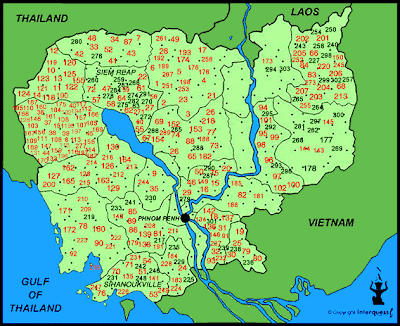
A brief look at Cambodian schools program

Click on the map to find out the names of all the schools funded

December 24, 2007
Newsday (Long Island, New York, USA)

NAME: American Assistance for Cambodia

WHAT: An independent, nonprofit organization dedicated to improving opportunities for youth in rural Cambodia; operates programs across Cambodia in the areas of education, health, rural development and technology. Has helped build nearly 400 primary and lower secondary schools in rural Cambodia since 1999.

START: Founded in 1993 by American journalist Bernie Krisher, former head of the Newsweek and Fortune Tokyo bureaus. He also started The Cambodia Daily, Cambodia's first English language daily.

PROGRAM: Donors raise $13,000 to sponsor the construction of a school in a village that currently lacks one. Matching funds are provided by the World Bank and Asian Development Bank.

After the school is built, donors are encouraged _ but not obligated _ to fund improvements for their school, such as providing English and computer teachers, computers powered through solar panels, Internet access, a well or water filter, a school nurse or a vegetable garden.

ON THE NET: http://www.cambodiaschools.com

Saturday, December 15, 2007

Donations aiding Asian kids in need

An elementary school built by AMATAK House of Cambodia in the village of Damrei Krom holds a completion ceremony in 2000. PHOTO COURTESY OF AMATAK HOUSE OF CAMBODIA

Schoolchildren who have received help from PAG-ASA Group Japan smile for a photo here. EDUCATIONAL RESEARCH AND DEVELOPMENT ASSISTANCE FOUNDATION PHOTO

Saturday, Dec. 15, 2007

READERS' FUND

By KAZUAKI NAGATA
Staff writer
The Japan Times


The organizations AMATAK House of Cambodia and PAG-ASA Group Japan have dedicated themselves to providing education to children and youths in Asia.

AMATAK House of Cambodia is led by the Rev. Fumio Goto of Tokyo's Catholic Kichijoji Church and has been building schools in poor villages in Cambodia since 1995 to spread education across the nation.

It has created 13 schools so far and another one will open in January in Pingpong village in Battambang province.

AMATAK, which gained governmental recognition as a nonprofit organization in 2005, received ¥228,000 from The Japan Times Readers' Fund in June. The money has been used to build schools in Pingpong.

The group's activities are rooted in Goto's experience as a foster parent for 14 Cambodian refugees. He started school-building in 1995 after one of his foster kids, Meas Bunra, who returned to Cambodia a year before, received a request from a Buddhist monk to build elementary schools. Goto joined the project with his group Cambodian House, AMATAK's predecessor.

Goto said that while a busy city like Phnom Penh has undergone development because it is receiving much help and attention, the rural situation is still tragic. He said his organization builds schools in areas where the reach of helping hands is limited by poor infrastructure.

"Without education, there is no reconstruction of the nation," Goto said of his motive for building schools. "I think education is the beginning of everything."

In the Philippines, meanwhile, PAG-ASA Group Japan has been raising funds to help educate street children and youths in poor areas since its foundation in 1989.

The group received ¥228,000 from The Japan Times Readers' Fund in June and sent it to the Manila-based Educational Research and Development Assistance Foundation, which supports underprivileged kids in the Philippines, many of whom are dropouts. The money has been used to support 65 impoverished elementary school children in Muntinlupa, south of Manila.

According to the group, it costs about ¥3,500 to ¥4,000 a year to support a student's education. This money goes to preparing school uniforms, bags and writing materials.

Masako Sumiya, a representative of the group, said the situation with public education in the Philippines is being made difficult by population growth, which is straining its supply of educational materials, schools and teachers.

"There are not enough textbooks for every student," said Sumiya, who added that books usually have to be shared by several students in many public schools.

Sumiya lived in Manila between 1985 and 1988 while her husband was posted at the Japanese Embassy there. Seeing the plight of underprivileged children made her want to do something to help.

"Children would come up to me on the street offering to sell something, and I was thinking what would happen to them in the future," she said.

According to the PAG-ASA Web site, it has helped 21,752 young people get educations ranging from elementary school to college so far.

Thursday, December 13, 2007

WFP grants $64 mil aid to Cambodia

Thursday, December 13, 2007
Japan Today

PHNOM PENH — The World Food Program has granted Cambodia $64 million for projects on education, health and disaster prevention, the government said Thursday.

Of the total $64,142,288, $56,926,108 will be used to prevention in 15 of the country's 24 provinces, according to a statement released by the Ministry of Foreign Affairs and International Cooperation. The remaining $7,216,180 will be improve education, health, disasterused to reduce the child mortality rate and improve maternal health care in five provinces, the statement said.

Tuesday, December 11, 2007

A Place of More

Dec. 11
By Debra Carney
Inside Higher Ed (Washington DC, USA)


Writing from the other side of the world, Sothearwath surprised me by asking a favor: “Do you have any research or study on reading and writing? I am here ok, but I have lots to read.”

Until recently, Sothearwath (not his real name) taught English at the Royal University of Phnom Penh (RUPP), in Cambodia. Now, he had just begun a doctoral program at a university in another Asian country. For the past four years, I’ve spent each January at RUPP working with him and his colleagues. I endeavor not only to help the Cambodian instructors teach more effectively, but also to learn how to be a better teacher back home. I lead workshops on various topics — learning theory, assessment, responding to student writing — usually in classrooms as dingy as they are airless. But, most importantly, I hold follow-up individual coaching sessions with the faculty. We meet in their departmental office, a cramped but slightly air-conditioned double room. Most of the teachers share “desk space” at three round tables and take turns sliding in and out of the seat next to mine at their appointment times.

There have been no head starts for these teachers, and they have very little usable history. In Cambodia, the living either survived the Khmer Rouge (1975-79) or descended from that era’s millions of dead or disabled. Despite these hardships, perhaps because of them, most of the teachers I’ve met are engaged, professional, thoughtful, immensely social and, frankly, fun. We work hard, but we also laugh often.

Sothearwath rarely laughed. In his early 40s, reserved, proud but diffident, he was an experienced English teacher, and his linguistic virtuosity — emblematic of his country’s tortured history of war, uneasy alliance, and occupation — included Russian and some Vietnamese as well. But his comfort zone was circumscribed by lexicons and rote-learning lesson plans. So, although he attended all of my workshops, Sothearwath was initially reluctant to meet with me and explore his teaching plans and practices in depth. By my second January, though, he began requesting individual consultations. Still, he was just as likely to cancel an appointment as keep it. By my fourth stay, we had achieved a polite rapport but not the kind of connection that would have made it easy for him to contact me.

I replied to his e-mail at once, reminding him of his strengths as an educator and his potential as a scholar. I urged him to define a narrow question that he could answer through his research, offering examples of hypotheses derived from broad topics, and reminded him to consult with his librarians, noting that I used their expertise often. I asked him to stay in touch.

I have provided long-distance academic coaching to several of my Cambodian colleagues now pursuing graduate work abroad. At home, they have reached the top of their fields. However, in foreign universities where they must work exclusively in another language, another culture, and to standards and conventions for which some are unprepared, they can quickly find themselves unmoored.

Yet they are far from alone in this dilemma. At Smith College, I work extensively with M.S.W. and Ph.D. candidates in the college’s School for Social Work, in an academic and writing support program I co-designed: a program consisting almost entirely of individualized academic coaching. These advanced students benefit from assistance with writing techniques, and we almost always discuss methods of analysis and critical thinking. Social work strategies are effective tools with all learners: Meet the learners where they are and start with the strengths they possess. From this point, one can begin to coach people to confidence in a world that many — even those accomplished in other or earlier pursuits — find strange and new.

Sothearwath responded to my e-mail as quickly as the 12 hour time difference would allow. His usually careful English was in chaos, and I had trouble understanding his dilemma: “I am only one foreign student in my class and the class started 2 day later after I arrived…I did not know anything about my school. Therefore the study topics that we needed were selected by others.” He listed three broad topics on literacy and asked me to e-mail scholarship on one of them. Sothearwath seemed to believe that the only research he required was what I would send him. I had no sense that he had been to his library — or wanted to go. He ended his e-mail, “Help me.”

Sothearwath’s anguish felt familiar. Recently, I worked with a middle-aged American who had returned to school for a Ph.D. in social work. A sophisticated, learned, and skilled professional, Nancy (another pseudonym) had managed to avoid typing anything for so many years that she had no idea about basic manuscript form, let alone how to use a computer or fathom the style requirements of the American Psychological Association used at Smith. Lacking these bedrock skills in a wired world so overwhelmed her ability to function that she was unable to address concepts and content that should have been readily accessible to her. She considered abandoning her program.

I find the Khmer phrase for one’s intense interests, chap arom, “to capture one’s consciousness,” useful at these moments. Before Nancy could move forward, she needed to reconnect to her original desire for her work. We talked about her satisfying experiences with clients, her successes with past writing projects and graduate programs, and the professional advantages a Ph.D. would bring. I also assured her that she could learn the skills she lacked. Our individual meetings were often bi-weekly, she was fragile but functioning, and she finished her first semester committed to the second. When I next saw Nancy, she was ebullient. In a card she wrote, “I passed. (Of course.)” She scheduled only a few appointments with me in her second term.

Clearly, and in very many ways, American and Cambodian educational settings are different. Yet one can use similar methods with advanced learners in disparate worlds. Personal coaching is well-established in professional environments and an increasing presence in undergraduate education. It can be labor-intensive and expensive — but also highly effective.

Teachers know that the single greatest predictor of all learners’ success is their engagement in their academic endeavors. Thus, to enable learning, academic coaches can explore and enhance each learner’s connection and commitment to the work, particularly when the learner is destabilized by finding him or herself stumbling. What captured his consciousness? Why? What sustains her interest and commitment? The details of your writing process: what works, what doesn’t?

Sothearwath had achieved his great goal: He was studying abroad, in a place of more. Still, in Cambodia, resources are few, Internet access expensive, and even the best professionals remain the products of an intensely traditional, hierarchal and dangerously dictatorial culture. All serious Cambodian learners must overcome this. What would enable him to do so now?

I continued my correspondence with Sothearwath, sometimes twice a day. (He was clearly awake all night, many nights.) I reminded him of his abilities and resilience; I sent research data bases; and I continued asking targeted questions about his research: What writing assignments build critical thinking skills? Why? How? His return e-mails revealed some progress, his language becoming more clear as his thinking found form. As did my American social work student, he needed confidence building as much as skill sets. But Sothearwath also, and expectedly, needed more. He revealed that facing what he felt was a dooming deadline to critique existing research, he took some of my curriculum materials (giving me full credit for my work), mocked up a study based on them, slapped together a power-point presentation, and presented it in a class. “I had no choice because I had to give them something,” he explained.

At least he met his deadline and passed the assignment. And he was honest with me about what he did. Still, I expressed my surprise to him in an e-mail, withholding (I thought) my disappointment — yet, he clearly seemed to sense it. He responded: “During the course work, it is hard for the scholars to consult with anyone. Actually, we can talk to the professor of each course, but you can imagine how much time the professor can have for students.”

“The worst thing that will ever happen to us,” another American consultant told me during my third January in Cambodia, “is that we’ll be escorted to the airport and deported. So never do anything to get a Cambodian in trouble — because they have to live here.” To that end, discussions of serious controversy, politics and religion are avoided at the university. So, in my workshops and coaching sessions with the RUPP faculty, I found safer ways to discuss questioning assumptions, assessing evidence, and crafting sound arguments. But could I have done this differently? I was an “expert,” modeling academic propriety. I might have reinforced Sothearwath’s limited sense of scholarship.

Yet, I also realize that the Cambodians I worked with who are flourishing both there and abroad, demonstrated in many ways that they were engaged and active — even when our discussion examples were more limited than I would have liked. They made extensive use of our coaching sessions, using the time to consider ideas and transfer knowledge to new situations; they argued and critiqued, sometimes even on risky topics. Sothearwath had been hesitant to accept coaching then; he was desperate to do so now.

Sothearwath — and many learners like him — knows he needs more. He needs time, some successes, and continuing coaching from educators. And with this assistance, he can achieve more: the original desire, context and self-assurance necessary for the work ahead of him. In a recent email, he attached a study he’d found and was beginning to evaluate. He was still struggling, but also beginning to make his own way in a world that he knew he had to make his own.

Monday, November 19, 2007

[MIT physicist and author] Lightman's dream

MIT physicist and author empowers young Cambodian women by building a dormitory for them in Phnom Penh

November 19, 2007
By Tinker Ready
Globe Correspondent
Boston Globe (Mass., USA)


The new three-story Harpswell Foundation Dormitory for University Women is named for a town in Maine. But it's on an unpaved street in Phnom Penh, Cambodia, populated with fried fish vendors, motorbike taxis, and roaming chickens.

The name is a nod to the building's founder and chief supporter, Alan Lightman, the MIT physicist and celebrated author. Lightman, a soft-spoken, deep-thinking Southerner who summers on a quiet island near Harpswell, said he now spends about a third of his time running the dorm for rural women he built in Cambodia. While working on another aid project there in 2003, Lightman learned that a lack of secure housing prevents many village women from going to college. All the schools are in the gritty capital, and few offer dormitories. Lightman saw a clear solution. He raised money, bought a piece of land, hired contractors, and built a dorm.

Now, he is "Dad" to more than 30 women. Until the dorm opened about a year ago, they faced lives as rice farmers, tour guides, or possibly brides in arranged marriages. Now they want to work for the government, earn PhDs, and study overseas.

"As unexpected as it was to find myself on the other side of the planet in the culture I knew nothing about, I felt like I could make a difference," Lightman said. "It wasn't a lost cause. This is something that was not beyond my reach."

Lightman's vision for the dorm goes beyond offering a safe haven and a leg up to young scholars. A brass plaque inside House 50 on Street 508 spells it out in both Khmer and English: "Our mission is to empower a new generation of Cambodian women." A similar bilingual plaque outside the building announced the name of the dorm, but it has disappeared twice. Local kids can get $5 for the brass, Lightman said.

A Memphis native, Lightman is a theoretical physicist by trade. In the 1980s he taught astronomy at Harvard and moved on to MIT, where he is still part of the science writing program. He has two adult daughters, and he and his wife, painter Jean Lightman, split their time between Concord and Maine.

Change within reach

A phone call from a stranger started Lightman's journey to Cambodia. Frederick Lipp, a Unitarian minister in Portland, Maine, wanted to use Lightman's book "Einstein's Dreams" in a sermon. The two men became friends, and eventually Lightman joined Lipp's effort to help a small, Spartan Cambodian village about 50 hard miles from Phnom Penh.

Lightman recalled the day he and his daughter Elyse first went to Tramung Chrum to meet the villagers. He was thinking he might want to join Lipp's effort, but he was unprepared for the emotions that hit him.

"The women started coming up to us, holding their babies, and said, 'Please help us build a school,' " he said. "I was just amazed that in this remote village with no electricity, no plumbing, no toilets, they were talking about education. . . . I was overwhelmed by their courage and their ability to think in the long term."

So Lightman - a serious and unflashy person - did something he finds extremely difficult. He asked family and friends for money. He talked about Cambodia's painful recent history, which remains defined by memories of the 1970s, when the United States bombed provinces at the Vietnam border and the Maoist Khmer Rouge marched into Phnom Penh. The Khmer Rouge emptied the cities and sent everyone to virtual prison farms. Almost four years later, the Vietnamese invaded, but not before about 1.7 million people were summarily executed or died of disease or starvation. In 1994, the Vietnamese left, and the United Nations sponsored elections, but the country still suffers from years of isolation, decay, poverty, and corruption.

What this meant for Tramung Chrum is that no one ever remembers having a "concrete" school, Lightman told potential donors. Instead, they hold classes in a makeshift palm-leaf shelter. The 50 or so contributors who stepped up became the core supporters of the Harpswell Foundation.

In the process, Lightman met Chea Veasna, a Cambodian lawyer working on the Tramung Chrum school project. She told him that she lived in an unfinished space underneath the law school building while studying there. There were no college dorms in the city then, and there are few now. Male students can bunk in the city's many temples, but Buddhist rules bar women, she explained.

"Veasna convinced me that this was a critical problem, and she and I together hatched the idea of building the dormitory," Lightman said. The dollar goes a long way in Cambodia; they were able to do it for $150,000.

Lightman travels to Cambodia several times a year. Even when the family retreats to the quiet of their purposely unwired house in Maine, Elyse Lightman said, her father often slips into town to check dorm-related e-mail.

"It's like anything else in his life; he puts a lot of his own care and time into," she said. "He is very passionate about it."

Lipp called the dorm project " 'Einstein's Dreams' live."

"In Alan's book, you're captured by something that you have never thought before," Lipp said. "You dream yourself into a new reality where the world has changed. . . . That's what happened here."

The smartest and bravest

For So Dany, a smiley 20-year-old from a village in western Cambodia, "new reality" might be an understatement. So's parents are farmers, and both are Khmer Rouge survivors. She wanted to go to college, she said, but her parents were afraid to send her to the city.

One day, dorm manager Peou Vanna appeared at her school, asking for the smartest, "bravest" girls in her class, she said. After a series of interviews and tests, So was chosen.

"If I did not have the opportunity to get a college education, I would end up being a market seller in my village," she said in Khmer.

Instead, she and the inaugural group of about 30 women - also plucked out of their villages - moved into the pinkish, cement building about 15 minutes from the city center. By habit, they head out to school on their bicycles wearing the traditional white shirt and pleated skirt uniforms. But unlike the generation before them, they tend toward jeans instead of sarongs.

In the dry season, Street 508 is dusty; during the rains, it is flooded. The air smells of cooking fires, roasted fish, or whatever street-food vendors have to offer. The dorm is set back a bit but stands out among the vegetable shops and run-down villas for its newness and for the large, medallion-like facade vents on each floor sculpted into the shape of Cambodian dancers.

Inside, some of the residents listen intently as an American volunteer teaches computer skills, in English. In addition to room and board, life in the dorm includes English classes, access to Internet-equipped computers, and weekly discussion of the news in The Cambodia Daily. They also have 24-hour security.

Back home in leafy Concord, Lightman tries to manage problems like sleeping guards via e-mail. He has other things to worry about - like reviews of his new book, "Ghost." But the dorm is now a part of each day. When he talks of what drew him so deeply into the project, he always goes back to that first day at Tramung Chrum. The well-traveled Lightman said he is sure he wasn't reacting to the shock of seeing desperate poverty firsthand.

"I was reacting to something that rose above the poverty," he said. "I guess hope is what really got under my skin. I found there was hope there."

Tinker Ready spent 1996 working with The Cambodia Daily in Phnom Penh. Lor Chandara, a senior writer at the paper, contributed to this report.