


 |
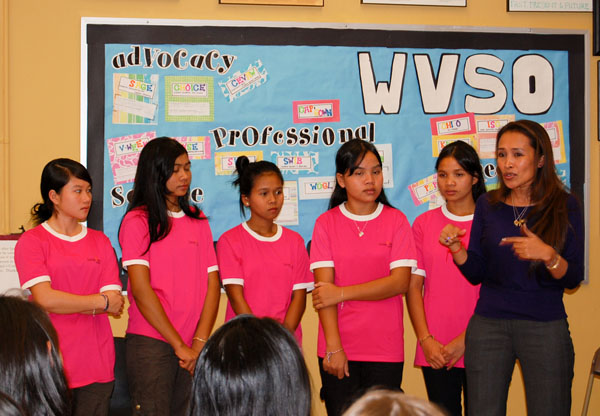
| Somaly Mam, former child sex slave and human rights advocate, speaks to the audience at the WCC Wednesday night. (FRANCISCA GILMORE/The Stanford Daily) |
By Marianne LeVine
The Stanford Daily (Stanford U., USA)
On Wednesday, Somaly Mam, one of Time magazine’s 100 most influential people, spoke out at the Women’s Community Center against human sex trafficking, drawing on personal experience as well as a lifetime spent combating the practice’s spread.
At a young age, Somaly Mam was sold into sexual slavery by a man pretending to be her grandfather. After witnessing the murder of her best friend, Mam escaped the brothel. In 1996, she established the Cambodian non-profit organization Agir Pour les Femmes en Situation Précaire (AFESIP), dedicated to saving young girls sold into sexual slavery. The victims range in age from 4 to 12, and the organization has rescued more than 6,000 young women since its founding.
In 2007, the Somaly Mam Foundation was established by two Americans to advocate for the victims of sexual trafficking and allow their voices to be heard in the world community.
Viviana Arcia ’13, the chair of women’s issues for ASSU and one of the event’s organizers, says Mam understands the importance of the survivor’s perspective.
“She’s a representative of victim-centered activism…that is, letting survivors choose their own path and method of healing, which sadly many activists working with abused women do not do,” Arcia said. “They [the survivors] are the experts, they are the only ones that truly understand their situation and Mam is conscious of the fact that these girls need to be viewed and treated as autonomous people who have agency.”
The event began with the performance of the traditional Cambodian blessing dance. The five dancers were victims of sex trafficking, and began to cry as they recounted their difficult pasts.
“I am happy to meet you all. I never thought today was possible,” said one performer through a translator. “I look at you like brothers and sisters that care about me. I have a father that is despicable and I was sold by my own sister so I never felt love.”
Sex trafficking is not limited to Cambodia. Bill Livermore, the CEO and the executive director of the Somaly Mam Foundation, spoke on the global nature of the problem.
“The UN estimates 12.5 million slaves in the world today,” he said, adding that 17,000 people are trafficked into the U.S. every year.
“This is a problem of historical proportions,” he said. “It’s devastating. $32 billion is made in slavery. It is the second most profitable crime after drugs.”
Livermore described the two main functions of the Somaly Mam Foundation: empowering survivors and ensuring that a strict rule of law is enforced.
The Somaly Mam Foundation helps to fund shelters throughout Cambodia and encourages victim rehabilitation through dance therapy.
The Voices for Change program, one program of the Foundation in which survivors help counsel recent victims, has also been successful. According to Livermore, the program has encouraged more women in brothels to seek assistance. Intake rates at Cambodian shelters have increased from 60 percent to 90 percent within the past two years. Mam said the victims gain a sense of solidarity that helps them recover.
“What I needed when I was young was a mother,” Mam said. “But I didn’t have a mother. My life started bad. It’s like all of their lives. We had been born without parents, without love. We were born in very bad luck.”
The Somaly Mam Foundation encourages its members to voice their opinions about the center.
“I always believe the idea comes from the center,” Mam said. “Every year we have the girls get together. They tell us what they want the center to do. They are not soft at all. Empower the survivor. Don’t start tomorrow. Start now.”
Contact Marianne LeVine at mlevine2@stanford.edu.








