KI-Media loves to hear from you, and we're giving you a bullhorn. We just ask that you keep things civil. Please leave out personal attacks, do not use profanity, ethnic or racial slurs, or take shots at anyone's sexual orientation or religion. We thank you for your cooperation!
MP Son Chhay with His Holiness the Dalai Lama at the 6th World Parliamentarians' Congress on Tibet which is held in Ottawa, Canada. April 28, 2012
Holywood movie star Richard Gere chaired the first cession of the convention of the 6th World Parliamentarians' Convention on Tibet which was held in Ottawa , Canada
Outside the convention building, unemployed Chinese in Canada were paid by the Chinese embassy in Ottawa to hold the protest against the international move to push for a dialogue between His Holiness Dalai Lama and Chinese government so that a solution can be found to end the suffering of the Tibetan people. This type of protest is not allowed in China but the communist Chinese enjoy freedom of expression which is allowed in the West
The convention believes that the change in Burma and in the middle east will affect the position of hardliners in China as the world is moving to recognize the right of self determination of minority groups, China will have no choice but to talk to HH Dalai Lama to find a suitable solution to the crisis.
Some speakers at the convention predicted that some serious change in china will occur and china could become a democratic nation with less than 10 years. What about Cambodia?
26 March 2012, Amsterdam - Mr. Son Chhay, a member of the National Assembly in Cambodia has in an open letter to President Hu Jintao (see here and here) called for negotiations to resolve the issue of Tibet as the Chinese President is scheduled to visit Cambodia from 30 March to 2 April, 2011.
In the letter dated 26 March, 2012, Mr. Chhay said: "The continuation of China's systematic repression of Tibetan people can not be ignored. Tibetans are gentle and peace loving people and they are seeking a level of autonomy to preserve their culture and their way of life. Surely it is not too much to ask. President Hu Jintao please use your authority to put an end to any further egregious human rights violations and begin to reconcile with the Tibetan Government-in-exile to settle the problem by beginning negotiations, without further delay, with His Holiness the Dalai Lama."
The letter also raising many concerns about China's policies which affect Cambodia while touching on the current situation in Tibet stated: "ln particular, recent events in Tibet have involved the self-immolation of a number of Tibetans - the last count was 30 confirmed self-immolations since February 2009. President, this is their desperate attempt to gain the world's attention over the plight of Tibet and the lack of religious freedom, some as young as 18 years old!
Mr. Chhay was one of the parliamentarians who joined the Tibetans on 2 September, 2010 to celebrate the 50th Anniversary of the Tibetan Democracy Day which took place at Sera Monastery in Bylakuppe, South India.
In solidarity for Free Tibet Bylakuppe, South India, September 1010 (Photo Son Chhay)
Tibetan monks in exile at Sera monastery to celebrate 50th anniversary of Tibetan Democracy Day.
Tibetan people! Waiting to return home from more than 50 years in exile (Photo-Son Chhay)
Died in hospital: A Tibetan monk reads a note written by protester Jamphel Yeshi and posted on a wall in New Delhi (Reuters: Adnan Abidi)
Exiled Tibetans and human rights activists participate in a candlelight vigil for Jamphel Yeshi (AFP: Dibyangshu Sarkar)
A Tibetan activist takes part in the Delhi protest (AFP: Manan Vatsyayana)
March 29, 2012 By Richard Lindell, wires ABC News (Australia)
The death of a Tibetan protester who set himself on fire in the Indian capital New Delhi has given new impetus to protests over China's rule in Tibet.
Jamphel Yeshi was at a rally protesting against the visit of Chinese president Hu Jintao on Monday when he doused himself with fuel and set himself alight.
He had burns to 98 per cent of his body and was declared dead at Delhi's Ram Manohar Lohia hospital yesterday.
Photos of Mr Yeshi on fire were sent out on news wires and have been turned into posters which have been put up in New Delhi and in Dharamsala, the Himalayan hill town which is home to thousands of exiled Tibetans.
At least 29 Tibetans - often monks and nuns - have died after setting themselves on fire in protests against Chinese rule in the past year.
Map of China locating protests reported this week in Sichuan's Tibetan-inhabited areas.
Photo shows police with arrested monks in a Tibetan area of China's Sichuan province
Wednesday, January 25, 2012 By Marianne Barriaux | AFP News
Police in China shot dead more protesters in Tibetan-inhabited areas as unrest spread, official media and an advocacy group said Wednesday, amid signs of a physical and virtual lockdown on the region.
China's Sichuan province, which has big populations of ethnic Tibetans, many of whom complain of severe repression, has been rocked by violent clashes this week -- some of the worst since huge protests against Chinese rule in 2008.
The United States on Tuesday said it was "seriously concerned" by the situation, calling on Chinese security forces to "exercise restraint" and urging authorities to allow journalists and diplomats into flashpoint areas.
January 24, 2012 By KEITH BRADSHER and RICK GLADSTONE The New York Times
HONG KONG — Deadly showdowns between Chinese security forces and Tibetans in a restive region of western China spread to a second town on Tuesday, outside advocacy groups reported. At least two and perhaps as many as five Tibetans were killed by gunfire and many more wounded, the groups said, in what appeared to be the most violent outbreak in the region in nearly four years.
The new confrontation, in the town of Seda, known in Tibetan as Serthar, was reported by Free Tibet, a London-based organization that advocates Tibetan autonomy, and by Phayul.com, a Tibetan exile web portal. Their accounts said that Chinese security forces opened fire on a crowd of Tibetan protesters in Serthar. Free Tibet said it had confirmed two deaths and an unspecified number with “serious wounds,” and said the town was under curfew.
“This is the second consecutive day that Chinese forces have opened fire and killed unarmed Tibetan protesters,” said Stephanie Brigden, director of Free Tibet.
DHARAMSHALA: A group of parliamentarians of Cambodia has made a strong call for an end to the human rights violations in Tibet, urging China to engage in sincere dialogue with the Tibetan side to resolve the issue of Tibet.
“It is with a strong sense of unity that we Cambodian parliamentarians support the recent move by British Parliamentarians to halt the continuing injustice in Tibet,” noted a press release issued by three MPs, Son Chhay , Cheam Channy and Yont Tharo from the opposition Sam Rainsy party.
Expressing serious concern over the recent spate of self-immolations in Tibet, the MPs said, “these acts of self-immolation make sense when one considers the decades of repression, intimidation, fear, and violence that Tibetans have endured daily under China’s rule which only appears to be worsening.”
Lobsang Sangay (L) with the Dalai Lama after being sworn in as prime minister of the Tibetan government-in-exile in Dharamsala, India, Aug. 8, 2011. (AFP)
The Tibetan government-in-exile slams the Chinese government over 'repression' in Tibetan areas.
2011-10-11
Radio Free Asia
"I may disappear tomorrow but I cannot hide this in my heart and have to share. There is no freedom and peace in this area. We are all frustrated and desperate.”
China hit out Tuesday at the Dalai Lama for not denouncing a string of self-immolations by Tibetan monks, drawing an immediate rebuke from the Tibetan government-in-exile which said Beijing's human rights abuses sparked the protests.
Beijing accused the Dalai Lama, Tibet's spiritual-leader-in-exile in India, of violating Buddhist teachings by not condemning the self-immolations by seven young Tibetan monks so far this year.
Four of the monks—who set themselves alight to protest Chinese rule in Tibetan areas and a Chinese siege on a key monastery—had succumbed to their burns.
SRP MP Son Chhay visiting the Dalai Lama on September 2010
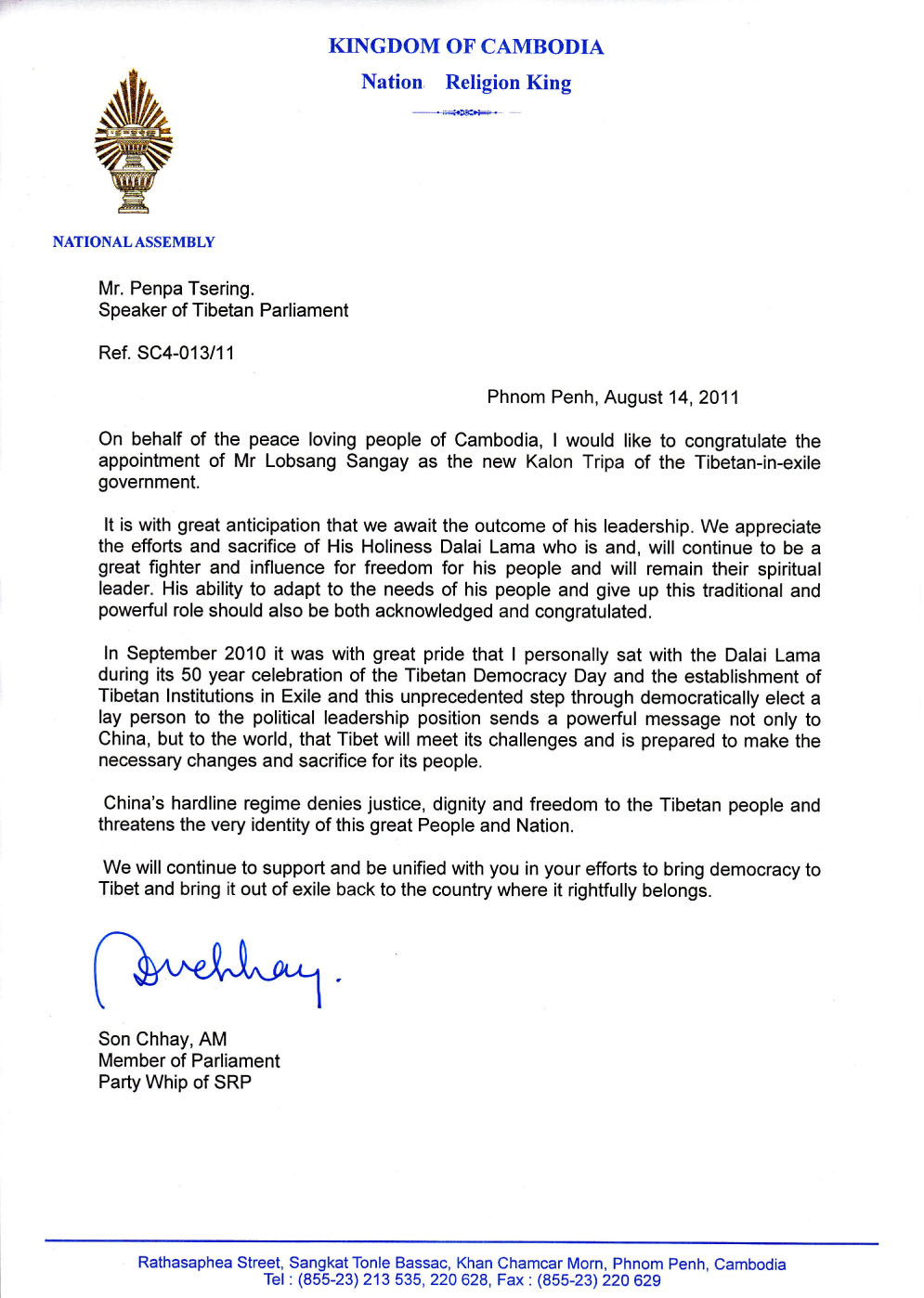
Mr. Penpa Tsering.
Speaker of Tibetan Parliament
Ref. SC4-013/11
Phnom Penh, August 14, 2011
On behalf of the peace loving people of Cambodia, I would like to congratulate the appointment of Mr Lobsang Sangay as the new Kalon Tripa of the Tibetan-in-exile government.
It is with great anticipation that we await the outcome of his leadership. We appreciate the efforts and sacrifice of His Holiness Dalai Lama who is and, will continue to be a great fighter and influence for freedom for his people and will remain their spiritual leader. His ability to adapt to the needs of his people and give up this traditional and powerful role should also be both acknowledged and congratulated.
In September 2010 it was with great pride that I personally sat with the Dalai Lama during its 50 year celebration of the Tibetan Democracy Day and the establishment of Tibetan Institutions in Exile and this unprecedented step through democratically elect a lay person to the political leadership position sends a powerful message not only to China, but to the world, that Tibet will meet its challenges and is prepared to make the necessary changes and sacrifice for its people.
China’s hardline regime denies justice, dignity and freedom to the Tibetan people and threatens the very identity of this great People and Nation.
We will continue to support and be unified with you in your efforts to bring democracy to Tibet and bring it out of exile back to the country where it rightfully belongs.
Son Chhay, AM
Member of Parliament
Party Whip of SRP
The Dalai Lama, centre, prays before performing a blessing ceremony at the Anacostia River in Washington Photo: AP
China has accused the United States of "grossly" interfering in its internal affairs and damaging relations after President Barack Obama met the Dalai Lama at the White House.
Sunday 17 July 2011
The Telegraph (UK)
Barack Obama met the Nobel Prize laureate for about 45 minutes on Saturday, praising him for embracing non-violence while reiterating that the US did not support independence for Tibet.
China, which accuses the exiled Tibetan spiritual leader of being a separatist who supports the use of violence to set up an independent Tibet, said Obama's meeting had had a "baneful" impact.
Xinhua, the Chinese government press agency, quoted Ma Zhaoxu, the Chinese Foreign Ministry spokesman, as saying: "Such an act has grossly interfered in China's internal affairs, hurt the feelings of Chinese people and damaged the Sino-American relations.
"We demand the US side to consider seriously China's stance, to immediately adopt measures to wipe out the baneful impact, to stop interfering in China's internal affairs and to cease to connive and support anti-China separatist forces that seek 'Tibet independence'."
His Holiness The Dalai Lama, the Nobel Prize winner, shook hands with MP Son Chhay after he spoke to more than 20000 Tibetan at the ceremony. MP Son Chhay with members of the Tibetan government in exile. The Tibetan prime minister is on the far left and the speaker of parliament is sitting in front. SRP MP Son Chhay spoke to the crowd while His Holiness The Dalai Lama looked on.
Sok Khemara, VOA Khmer Washington, DC Monday, 06 September 2010
“Pol Pot's regime was a regime that applied the policies of China...and the Cambodian people suffered in this regime..."
Opposition lawmaker Son Chhay has joined other international parliamentarians in a call for peaceful talks over an autonomous Tibetan territory.
“This is a push from internationals who participated as members of parliament from many countries,” Son Chhay told VOA Khmer.
Son Chhay said negotiations between Dalai Lama and the Chinese was a necessary first step that should be pushed.
Tibet has a government in exile led by the Dalai Lama, following a Chinese takeover of the territory in the 1950s.
In a speech to Tibetans in exile on the 50th anniversary of Democracy Day, Son Chhay said he sympathized with the Tibetan people.
“Pol Pot's regime was a regime that applied the policies of China...and the Cambodian people suffered in this regime, died, and were almost extinguished,” he said. “We understand that is the suffering of Tibet.”
“I also join with the Tibetans in wishing there should be an immediate resolution, in a good way, for giving the proper rights to thousands of [Tibetan] people who live on Indian land to return to their homeland,” he said.
He applauded the non-violent struggle of the exiled government in India to create an autonomous state.
Sok Khemara, VOA Khmer Washington, DC Friday, 27 August 2010
"The Dalai Lama's non-violent protests are an example to world leaders."
Opposition lawmaker Son Chhay is expected to join a major celebration for Tibet's government in exile, officials said.
Tibet's exiled government, led by the Dalai Lama to seek genuine autonomy within the Chinese state framework in the mountainous province, will hold the 50th anniversary of Democracy Day Sept. 2 in India, marking the formation of the first elected Tibetan Parliament in India.
Son Chhay told VOA Khmer he would give an address to the celebrants, “to applaud Tibetans, who have struggled strongly under the leadership of the Dalai Lama.”
The Dalai Lama's non-violent protests are an example to world leaders, he said.
Son Chhay will join representatives from 14 countries, including members of parliament from the EU, Africa and others.
At least 130,000 Tibetans live in exile in India, while 3 million more live under Chinese rule, where rights groups say they face rights abuses and persecution.
Tibet's government in exile now have an elected parliament, legislature and executive body, Urgen Tenzin, director of the Tibetan Center for Human Rights and Democracy, told VOA Khmer Thursday.
“It's very important for Tibetans living in exile to practice the democratic system,” he said.
(Reuters) - The new Chinese-appointed governor of Tibet said on Sunday that only socialism can "save" the remote region and guarantee its development, and blamed the Dalai Lama for Tibet's problems.
China has defended its iron-fisted rule in Tibet, saying not only did it free a million Tibetan serfs but it also poured billions of dollars into the Himalayan region for development.
Padma Choling, an ethnic Tibetan appointed governor in January, blamed the region's problems on exiled spiritual leader and Nobel Peace Prize winner the Dalai Lama, a man reviled by Beijing as a "separatist" and instigator of anti-Chinese violence.
"The main source of instability in Tibet is the Dalai Lama, and it is also he who causes trouble for Tibet's economic development and socio-economic progress," Padma Choling told reporters on the sidelines of the annual meeting of parliament.
"But I have to say, we are not the least bit scared ... as all the peoples of Tibet have already clearly realized that only the Chinese Communist Party and socialism can save Tibet, and only then can Tibet develop," he said in impeccable Chinese.
Protests led by Buddhist monks against Chinese rule in March 2008 gave way to torrid violence, with rioters torching shops and turning on residents, especially Han Chinese, who many Tibetans see as intruders threatening their culture.
At least 19 people died in the 2008 unrest, which sparked waves of protests across Tibetan areas. Pro-Tibet groups overseas say more than 200 people were killed in a subsequent crackdown.
The Dalai Lama, who fled into exile in India in 1959 after an abortive uprising, denies China's charges against him, and says he only seeks more meaningful autonomy for Tibet.
Several rounds of talks in recent years between the Chinese Communist Party and the Dalai Lama's envoys have yielded little. REINCARNATION POLITICS
Uncertainty also surrounds what will happen once the aging Dalai Lama passes away.
The Dalai Lama has floated several scenarios, including that his successor and reincarnation may not be found in Chinese-controlled territory.
Many Tibetans and pro-Tibet groups fear Beijing will simply announce its own Dalai Lama, as it did with the Panchen Lama, Tibetan's Buddhism's second-highest figure, in 1995. The Dalai Lama's choice for Panchen Lama, a six-year-old boy, was swiftly picked up and taken away by the Chinese authorities.
Human rights groups dubbed the child then "the world's youngest political prisoner."
Padma Choling said that boy was a "victim" of the Dalai Lama's unilateral decision in 1995 to recognize him as the 11th Panchen Lama, and that he was now living a quiet life in Tibet, out of the public gaze.
The governor also poked fun at what he said was the Dalai Lama's indecision on his succession.
"One minute he says he will be reincarnated, the next he won't ... One minute he says it can happen within China, the next it will happen overseas," he said. "I don't know which one is accurate.
"The Dalai Lama is still alive, let's talk about it (his reincarnation) again when he dies," the governor added.
China earlier this year held a work conference to decide future direction in Tibet, which was notable for covering all Tibetan areas, and not just those governed by the Tibet Autonomous Region. The wider scope may be a response to the 2008 uprising.
A similar work conference would be held for Xinjiang, the governor of that region said on Sunday, without giving details.
Xinjiang's capital Urumqi was the scene of deadly riots in July by Uighurs, a Muslim, Turkic-speaking people native to the arid region, after Han Chinese in south China attacked Uighur workers at a factory. Han residents of Urumqi attacked in revenge two days later.
Since those riots, 198 people have been tried in 97 cases, governor Nuer Baikeli told reporters. He did not give details on the fate of 20 Uighurs who had sought asylum from the U.N. refugee office in Phnom Penh in December, who were deported by Cambodia back to China.
"The press conference was a pretence to trick outsiders," World Uyghur Congress spokesman Dilshat Raxit told Reuters.
"Uighur people want to decide for themselves how to run their affairs."
March 4, 2010 By Supalak Ganjanakhundee and Pravit Rojanaphruk The Nation
Jetsun Pema, younger sister of Tibetan spiritual leader, the Dalai Lama, and her husband Tenpa Tsering, were denied an entry visa to Thailand due to fears their political message during a cultural event would upset "another country," the Foreign Ministry said yesterday - presumably meaning China.
Jetsun Pema, the younger sister of Tibetan spiritual leader, the Dalai Lama, and her husband Tenpa Tsering, were denied an entry visa to Thailand due to fears their political message during a cultural event would upset "another country," the Foreign Ministry said yesterday - presumably meaning China.
Jetsun Pema was supposed to be in Thailand from March 5-7 to join the Tibetan spirituality, art and culture event entitled "From the Himalayas to the Chao Phya River" hosted at the Bangkok Art and Culture Centre. She was scheduled to speak on Saturday on Buddhist education for Tibetan schools in exile, and about her book "Tibet: My story".
The pair's request for an entry visa was rejected as Thailand did not want to have any political difficulties with another concerned country, said the Foreign Minister's secretary, Chavanond Intarakomalyasut.
"We don't have any problem with cultural and art events from Tibet, but wanted to reserve our right to reject any politically related issue which might affect good relations with another country," he said, without naming the country.
A diplomatic source said officials from the Chinese Embassy in Bangkok had lobbied Thai autho-rities to block the entire event. A compromise was reached to retain only the cultural and arts sections of |the event after negotiations with |the organiser, the Sathirakoses-Nagapradipa Foundation.
Social critic Sulak Sivaraksa slammed Foreign Minister Kasit Piromya for the visa refusal, accusing the Thai government of caving in to pressure from China.
"We have allowed China to dictate to us [about whom to allow into the Kingdom and whom not to]. Four Chinese nationals were also recently arrested while protesting in front of the Chinese Embassy [in Bangkok] and are soon to be deported", he said.
Surasi Kosolnawin, chairman of the co-sponsor Sathirakoses-Naga-pradipa Foundation, personally lobbied Kasit but to no avail, he said.
Sulak claimed that Kasit told Surasi he did not want China to be upset with Thailand, now that both Cambodia and Burma are already upset with the Kingdom. He told [Surasi] that Cambodia and Burma already hated him.
Sulak urged Thailand to follow the US in handling the Tibetan issue and cited a recent meeting between US President Barack Obama and the Dalai Lama as an example.
Dubbed the "Mother of Tibet" by Tibetan People's Deputies in exile, Jetsun Pema, 70, has played a significant role in the Tibetan political movement. She became the first woman minister in the Tibetan government-in-exile. She has focused her work on education and received many world-famous awards for her work in education and peace, including the Unesco Medal in 1999.
Jetsun Pema played the role of her own mother in "Seven Years in Tibet", a 1997 movie about the young Dalai Lama.
The Dalai Lama walks outside the White House after his meeting with U.S. President Barack Obama on Thursday.
February 19, 2010
Beijing, China (CNN) -- China summoned the U.S. ambassador on Friday to express its "strong dissatisfaction" over the Dalai Lama's meeting with U.S. President Barack Obama a day earlier.
China didn't disclose what was discussed during the session with Ambassador Jon Huntsman at the Foreign Ministry. But Beijing had warned that a meeting between the president and the exiled Tibetan spiritual leader would damage its ties with Washington.
"The Chinese side expresses strong dissatisfaction and resolute opposition to this meeting," a spokesman for China's Foreign Ministry said in a statement after Thursday's meeting at the White House.
"China demands the U.S. seriously consider China's stance, immediately adopt measures to wipe out the adverse impact, [and] stop conniving and supporting anti-China separatist forces."
The U.S. Embassy didn't characterize Friday's meeting, but it provided the message Huntsman delivered to Deputy Foreign Minister Cui Tiankai.
"Now is the time to move forward and cooperate in ways that benefit our two counties, the region and the world," Huntsman said, according to the U.S. Embassy.
The meeting has the potential to further complicate Sino-U.S. tensions, which have been rising in recent months.
The Dalai Lama has said he favors genuine autonomy for Tibetans, not independence for Tibet. Beijing regards the Nobel Peace Prize laureate as a separatist who wishes to sever Tibet from China.
Obama's meeting with the Dalai Lama "runs against the repeated commitments by the U.S. government that the U.S. recognizes Tibet as part of China and gives no support to 'Tibet independence'," Chinese Foreign Ministry spokesman Ma Zhaoxu said.
During the meeting, Obama stressed his "strong support for the preservation of Tibet's unique religious, cultural and linguistic identity, and the protection of human rights for Tibetans," according to a White House statement.
The president praised the Dalai Lama's "commitment to nonviolence and his pursuit of dialogue with the Chinese government," the statement added. He also stressed the importance of having both sides "engage in direct dialogue to resolve differences, and was pleased to hear about the recent resumption of talks," it noted.
The Dalai Lama, while acknowledging that he raised concerns about Tibet during the meeting, did not provide further specifics about his home region's political situation while addressing reporters.
He said he admired America as a "champion of democracy and ... freedom," and cited the need to promote "religious harmony" and "human value."
He also met with Secretary of State Hillary Clinton.
The meeting between the Dalai Lama and Obama could "seriously undermine the Sino-U.S. political relations," Zhu Weiqun, a senior Communist Party leader in charge of ethnic and religious affairs, warned recently.
"We will take corresponding action to make relevant countries see their mistakes."
On Thursday, China's Foreign Ministry spokesman said the meeting "grossly violated the norms governing ... international relations."
Obama did not meet with the Dalai Lama when the spiritual leader visited Washington last fall, making it the first time since 1991 that such a meeting did not occur. Ahead of a summit with Chinese President Hu Jintao, Obama persuaded Tibetan representatives back then to postpone the meeting with the Dalai Lama.
Thursday's encounter took place against the backdrop of several contentious issues already threatening to sour the relationship between America and China, including trade disputes, a recent U.S. arm sales deal for Taiwan -- which China considers an illegitimate breakaway province -- and a censorship row over Internet search engine Google Inc.
The meeting is "another event in the recent, one has to say, downward spiral in U.S.-China relations," said China scholar David Shambaugh.
It's also troublesome for the Chinese for one other important reason, Shambaugh said.
"He could have met him as a spiritual leader in a neutral place like a church," he said. But receiving him in the White House "is a political act. And that is going to irritate China very much."
The meeting did not take place in the formal, official setting of the Oval Office. It was instead held in the White House Map Room, which is considered part of the presidential residence. The choice of settings was considered by many observers to be a sign of Washington's acknowledgment of Beijing's political sensitivities.
Some analysts said the Chinese government could retaliate by cutting off political exchanges as they did after the Dalai Lama met with the heads of state of France and Germany. And Hu could turn down an invitation to visit Washington in April.
Neither China nor the United States can afford strained relations, said Douglas Paal, a diplomat and investment banker who has served as a presidential adviser on China.
"We both need each other," he said. "We need each other for a number of international security issues -- to deal with the global climate crisis, to deal with the global financial crisis."
China is the largest growing export market for U.S. companies, Paal said, expanding by 65 percent last year alone.
Nearly three-quarters of all Americans think that Tibet should be an independent country, according to a new national CNN/Opinion Research Corp. poll.
But the survey, released Thursday, also indicates that most Americans think it is more important to maintain good relations with China than to take a stand on Tibet.