Showing posts with label KR victims participation. Show all posts

Wednesday, June 29, 2011

Victims demand key role at KRouge trial

Wed, Jun 29, 2011
AFP

PHNOM PENH - Victims who suffered under the Khmer Rouge more than 30 years ago took centre stage Wednesday at a key trial at Cambodia's UN-backed war crimes court, setting out their demands for reparations.

A remembrance day, memorials, education projects and free therapy for survivors were among the ideas listed by the civil parties, as the victims are known, on day three of the trial of four top regime leaders.

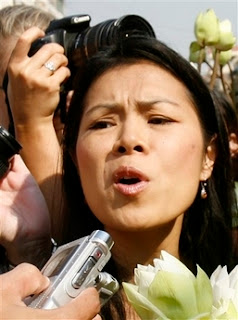
"This is part of the justice that we want," said Luk Sao, who lost her parents and five siblings at the hands of the Khmer Rouge. "It's right to demand reparations so victims can heal their trauma."

The 52-year-old is one of the 3,850 civil parties taking part in the trial of the regime's most senior surviving members, including "Brother Number Two" Nuon Chea.

Monday, February 08, 2010

CIVIL PARTY: Khmer Victim(s) v. Charged KR Senior Leader(s) for Crimes against Humanity (etc.)

First published in November 2007 in The Phnom Penh Post as part of the Voice of Justice columns. As we await the decisions of the judges of the Extraordinary Chambers (ECCC) on the scope of victims' participation as civil party, may we be reminded of what this unprecedented concept means, and may the judges not emasculate the civil party's roles and existence which they created as a matter of law. In particular, may they be reminded that civil parties may be represented by an association or by a lawyer, as clearly indicated by the ECCC Victims' Application Form and not reduce our existence further into solely a witness or complainant, and not a party. - A Civil Party, thearyseng.com
------
CIVIL PARTY:
Khmer Victim(s) v. Charged KR Senior Leader(s) for Crimes against Humanity (etc.)

It can be accurately stated that every Khmer is a "victim" of the Khmer Rouge soldiers, as virtually every Khmer has suffered loss of family members, house and home, rights etc. during the period of 17 April 1975 to 6 January 1979, the temporal jurisdiction of the Extraordinary Chambers in the Courts of Cambodia ("ECCC").

As a "victim", every Khmer has the choice to participate actively in the ECCC, as a matter of law, in three capacities: (i) be a witness, (ii) file a complaint to the Office of Co-Prosecutors, or (iii) be a civil party.

Witness and Complainant


The first 2 options are normally the ways victims participate in criminal proceedings, particularly of mixed tribunals, e.g. Special Courts of Sierra Leone.

Generally speaking, a common law witness helps the argument of a party (albeit the prosecutor or the defendant) and a civil law witness helps the investigating judge to find the "truth" of the matter.

Put simply, a complainant files a complaint to the office of prosecution, requesting that the prosecutor charge a particular defendant with a crime.

As either a witness or a complainant, one is not a party to the criminal proceeding and does not have access to the case files (or dossiers) or rights to any reparation (material, moral or otherwise). Here, the parties are only two: (i) Prosecutor v. (ii) Defendant.

Civil Party


The ECCC is unprecedented in giving the choice for a victim to become a civil party. No other mixed tribunals have such provision. In addition to the ECCC, the only other court, addressing mass crimes of international nature that permits civil party, is the International Criminal Court (and the ICC is an "international", and not "mixed", tribunal).

Unlike victim as a witness or victim as a complainant, victim as a civil party is a party to the criminal proceeding(s). Here, then, the parties are: (i) Prosecutor and (ii) Civil Party v. (iii) Defendant.

As a Civil Party to the criminal proceedings, one has most if not all the rights as a party: access to the case files (or dossiers), reparations etc.

How to become a civil party

How does a victim become a civil party normally and particularly with the ECCC?

First, there has to be a charge of a crime against a person by the investigating judge.

Second, there has to be an injury suffered by the applicant; it has to be a "legal" injury (for it to be admissible) in that the injury must be (i) physical, material and/or psychological and (ii) the direct consequence of (legal nexus/linkage to) the offense against the charged person.

At the ECCC, the Co-Prosecutors have forwarded five names to the Co-Investigating Judges ("CIJ"). The CIJ has publicly made known and charged two suspects, Kaing Guek Eav (alias Duch) with crimes against humanity, and Nuon Chea with crimes against humanity and war crimes.

Prior to these charges of the CIJ, it is possible to be a witness or complainant, but not possible to be a civil party (as there have been no charges); without the known offenses (crimes against humanity and war crimes) and persons (Duch, Nuon Chea), there's nothing or no one to link the applicant’s injury to.

Now, it is possible for a victim to become a civil party, either to the charge against Duch, or to the charges against Nuon Chea. And in the future, should the CIJ charge more person(s) with offense(s), a victim can join as civil party to that offense and person.

Example


To give concrete form to these concepts, below is the bulk of my civil party application (1 ½ pages in English) to the Office of CIJ which has been accepted:

I am applying to be joined as a Civil Party to the criminal proceedings and support the prosecution against Mr. Nuon Chea. Mr. Nuon Chea was arrested and provisionally detained by the ECCC on Wednesday, 19 September2007, on charges of crimes against humanity and war crimes committed in Cambodia between 1975 - 1979 ("Alleged Offenses").

As former Deputy Secretary of the Democratic Party of Kampuchea (or informally, the "Khmer Rouge") during this time, Mr. Nuon Chea was responsible for the Khmer Rouge forces under his effective command, control and/or authority as a result of his instructions or failure to exercise control properly over these forces.

I am a child female victim of the Alleged Offenses committed by and/or attributable to him during that time period.

As a direct consequence of the Alleged Offenses, I (at the age of4-8 years), among other things:

(a) lost my father, who was a victim of forced disappearance and was murdered by officers of the Khmer Rouge;
(b) was, together with my family, forcibly evacuated from Phnom Penh to Svay Rieng Province by officers of the Khmer Rouge;
(c) was imprisoned in Bung Rei in Svay Rieng Province for a period of approximately 5 months by officers of the Khmer Rouge;
(d) was deprived of access to food, medicine, education and other necessities by officers of the Khmer Rouge;
(e) suffered torture and other cruel or inhuman treatment by officers of the Khmer Rouge;
(f) witnessed other prisoners being tortured and/or murdered by officers of the Khmer Rouge;
(g) witnessed my mother being tortured or subjected to cruel and inhumane treatment by officers of the Khmer Rouge; and
(h) lost my mother, who was a victim of forced disappearance and was murdered by officers of the Khmer Rouge.

In the circumstances, I personally suffered physical, material and psychological injury and would like to participate in the criminal proceedings against Mr. Nuon Chea (and in the future, against any other senior Khmer Rouge leaders charged with crimes against humanity, war crimes and/or genocide).

Administration of Civil Party applications


Because many Khmers suffered as victims within the definition of a "civil party" and theoretically the Office of the Co-Investigating Judges may receive tens of thousands of applications requesting to become a civil party, the process can be administratively messy and unworkable. Hence, to lessen the administrative burden of and give order to this process, it is immensely important that victims who apply to be a civil party (i) use the standard form of the ECCC, and (ii) join a group or association with representation.

For example, civil party applications can be grouped by (i) zones, e.g. Eastern Zone, (ii) status, e.g. Orphans (victims, who under 18 years, lost both parents during 1975-79), (iii) etc.

The ECCC will soon have a working Victims Unit. Also, the Cambodian Human Rights Action Committee ("CHRAC") is interested in acting as a clearinghouse for victims (as witness, complainant or civil party). The Center for Social Development, in association with and as a member of CHRAC and on its own, will focus on assisting those who are only interested in becoming a civil party (as a matter of division or labor, making the process more concretely and manageable). I, in my personal capacity already as a civil party, am interested in representing those individuals, who as a child (under 18) lost both parents.

Unprecedented, awesome opportunity


The opportunity provided by the ECCC for victims to become a civil party is truly awesome and should be thoughtfully and meaningfully taken by any Khmer who wish to (i) bring justice (to whatever degree) for and in the memory of loved ones who died, and (ii) force charged senior Khmer Rouge leaders to own up to the horrific crimes which unfolded from which we are yet trying to recover, even almost 30 years later. This is not an issue of revenge, but of justice and responsibility.

Theary C. SENG, a member of the New York Bar Association, former director of Center for Social Development (March 2006—July 2009), founder and Board of the Center for Justice & Reconciliation (www.cjr-cambodia.org), founding adviser of the Association of Khmer Rouge Victims (www.akrvc.org), is currently writing her second book, under a grant, amidst her speaking engagements. For additional information, please visit Theary's website at thearyseng.com.

Saturday, December 12, 2009

Khmer Rouge victims seek new voice

PHNOM PENH, Cambodia, Dec. 11 (UPI) -- Victims of the brutal Khmer Rouge regime in Cambodia are seeking a new voice in the U.N. tribunal dealing with alleged atrocities of their day, observers say.

Five former Khmer Rouge leaders were charged with crimes against humanity are being tried in Phnom Penh.

Victims were allowed to take part in the first trial but they complained the court showed little interest in their testimony. They want more input as the second trial is about to begin, the BBC said.

The Khmer Rouge was a Maoist regime that ruled Cambodia from 1975 to 1979, founded and led by Pol Pot, who died in 1998. It abolished religion, schools and currency in a bid to create an agrarian utopia.

Friday, December 11, 2009

Khmer Rouge victims seek new voice at UN tribunal

Cambodians attend the first trial of ex-Khmer Rouge man Duch

Friday, 11 December 2009

By Guy Delauney
BBC News, Phnom Penh


Victims of the Khmer Rouge are holding a conference discussing the role they are playing at a UN-backed tribunal taking place in Cambodia.

Five former Khmer Rouge leaders have been charged with crimes against humanity.

A first trial ended with accusations the special courts had shown little interest in the victims' testimony.

This conference is a chance for victims to air their concerns to officials before a second case goes to trial.

As many as two million Cambodians died in the late 1970s because of Khmer Rouge policies.

'Civil parties'

The Khmer Rouge Tribunal seemed to offer survivors - and relatives of victims - a unique opportunity.

For the first time in an international criminal process, they would be given a voice in court proceedings.

The so-called "civil parties" would have a similar status to that of the prosecution or defence.

But the first trial brought a series of disappointments.

The civil parties' rights to speak or question witnesses were whittled away as the process moved on.

Their lawyers complained that the court showed little interest in the testimony of victims and their relatives.

And some civil parties contradicted themselves while giving evidence - which suggested a lack of proper preparation.

The experience left some feeling that they'd been guinea pigs in a judicial experiment - and a number boycotted the court.

This time the civil party system has already been streamlined in anticipation.

Tribunal spokesman Lars Olsen believes that should help to avoid a repeat of the first trial's frustrations.

He said: "There will be mainly one legal team representing the voice of the victim in the trial.

"But the most important thing will be that they will have a strong and consolidated voice in the trial.

"And there will be screening and better preparation for those victims who actually appear so they're not unprepared when they are testifying."

The Centre for Justice and Reconciliation has organised the conference.

It says the first trial caused a lot of frustration and nervousness - and that victims need more information about what it means to be a civil party at the tribunal.

Wednesday, January 21, 2009

Tribunal Calls for More Victims to File

By Kong Sothanarith, VOA Khmer
Phnom Penh
20 January 2009


Khmer Rouge tribunal officials on Tuesday called for more people to come forward to file complaints against jailed Khmer Rouge prison chief Duch.

The call, from the tribunals Victims Unit, comes as Duch, also known as Kaing Kek Iev, prepares for the initial hearing of his trial on Feb. 17.

Trial Chamber judges on Monday decided victims would be able to continue to file complaints to the Victims Unit in Duch’s case up until Feb. 2.

In order to encourage more complaints the Victims Unit said her unit would work during weekends, the unit’s director, Keat Bophal, said.

“We will have a team working Saturday and Sunday to provide a facility to victims who want assistance in the process,” she said.

The filing of complaints at this stage is important for people who want make a claim for compensation and participate in the procedures of the court, Keat Bophal said.

As Duch’s initial hearing approaches, the Victims Unit has so far received more than 100 complaints, more than 70 of which are from civil parties.

More than 20 are simple complaints from people who have signed on as a civil party. (Civil parties have lawyers and participate in the entire process of the tribunal.)

Hong Kim Suon, a lawyer for civil parties, said Tuesday the preparation of the Victims Unit was good, but its outreach was still lacking.

People can only file complaints if they understand the procedure, he said.

“Participation in the civil party proceedings is not only for justice, but also to remind victims who have died already that we are struggling for their justice,” he said.

Saturday, February 09, 2008

After 30 years, victim of Khmer Rouge faces leader in court

Saturday, 9 February 2008
By Andrew Buncombe, Asia Correspondent
The Independent (UK)


It has been three decades since the Khmer Rouge murdered the parents of Theary Seng and shackled her and her four-year-old brother in one of its jails.

But yesterday, she had only one question to ask of Nuon Chea, 81, one of the organisation's few surviving leaders, who is accused of genocide. "If Nuon Chea claimed he was not responsible, then who was for the loss of my parents and other victims' loved ones?" she asked. "What we know is that Nuon Chea was the second leader after Pol Pot."

Ms Seng came face to face with Mr Chea in the courtroom of the UN-assisted tribunal in Phnom Penh that has been established to try those surviving members of the Khmer Rouge, whose Maoist-inspired organisation seized power in Cambodia in 1975 and which was responsible for the deaths of more than 1.7 million of its own citizens.

There are five former regime leaders in the tribunal's custody – Mr Chea, Khieu Samphan, former foreign minister Ieng Sary and his wife, Ieng Thirith, and Kang Kek Iew.

Ms Seng, a Cambodian-American who works for a charity that monitors Cambodia's judiciary, says she felt no bitterness towards Mr Chea. "It is more exciting to see this [justice] being done. I have, in one small way, honoured my parents," she said.

Officials said it was the first time a victim had confronted a Khmer Rouge leader in a court. "It's extremely symbolic," Peter Foster, a tribunal spokesman, said. "We made history today."

Mr Chea has denied that he was involved in the genocide and insisted that he is not a "cruel man". Yet there is evidence that he was head of the regime's internal security division and he is widely credited with being the regime's main ideologist.

Friday, February 08, 2008

Cambodian genocide victim confronts former Khmer Rouge leader in courtroom

Theary Seng, Cambodian Executive Director of the Center for Social Development, talks to the media in this Jan. 20, 2008 photo, in Phnom Penh, Cambodia. Theary, whose parents died during the Khmer Rouge regime, took the stand as a representative of the civil party in the second day of a hearing for former leader Noun Chea's appeal against his pretrial detention on Friday, Feb. 8, 2008, at Cambodia's U.N.-backed genocide tribunal. (AP Photo/Heng Sinith)

By KER MUNTHIT, Associated Press Writer
AP


PHNOM PENH, Cambodia - A Cambodian genocide victim confronted a former Khmer Rouge leader for the first time in a courtroom Friday, demanding to know who was responsible for the "hellish regime" that caused the deaths of some 1.7 million people, including her parents.

Tribunal officials called it a historic moment when Theary Seng took the stand on the second day of a hearing of former leader Nuon Chea's appeal for release from pretrial detention at Cambodia's U.N.-backed genocide tribunal.

Nuon Chea has denied any guilt, saying he is not a "cruel" man.

"If Nuon Chea claimed he was not responsible, who was then for the loss of my parents and other victims' loved ones?" asked Theary Seng, a Cambodian-American. "What we know is that Nuon Chea was the second leader after (late Khmer Rouge leader) Pol Pot. It was a hellish regime."

No Khmer Rouge leaders have ever stood trial for their regime's activities, and there are fears the aging and infirm defendants could die before facing justice. Pol Pot died in 1998.

Nuon Chea, who was the main ideologist for the now defunct communist group, has been held since Sept. 19 on charges of war crimes and crimes against humanity for his involvement in the Khmer Rouge's ruthless 1975-79 rule.

He is one of five former Khmer Rouge leaders detained by the tribunal, which is expected to hold the first trials later this year.

Prosecutors have argued that continued detention is necessary to prevent Nuon Chea from pressuring witnesses, destroying evidence and escaping, as well as for his own safety, which could be at risk if he was released.

Nuon Chea sat stoically across from Theary Seng in the courtroom as she testified. When she was 7 years old, Theary Seng and her 4-year-old brother were "shackled and held under inhumane condition in a Khmer Rouge prison," she said.

"It's the first time a victim is able to stand up and confront a defendant. It's extremely symbolic," said Peter Foster, a tribunal spokesman. "We made history today."

Theary Seng's testimony was allowed under tribunal rules that give victims an unprecedented voice in the proceedings, the tribunal said.

"To date, no international or hybrid tribunal mandated to investigate war crimes, crimes against humanity or genocide has involved victims as civil parties, giving them full procedural rights," the tribunal's Victims Unit said in a statement.

Victims whose complaints have been accepted can participate in investigations, be represented by lawyers, call witnesses, question the accused and claim reparations for the harm they suffered.

Nuon Chea's defense had contested having victims testify at the hearing on his appeal for release, while accepting that victims have a right to participate in other aspects of the tribunal. However, the judges allowed their participation.

Robert Petit, a co-prosecutor, said the tribunal rules "state that the civil parties have a right to participate in the proceedings and they don't limit or qualify that participation in the types of proceedings."

Nuon Chea is the second defendant to appear before judges to appeal for release from pretrial detention. He has argued the tribunal's investigating judges did not have sufficient grounds to detain him.

The tribunal announced Thursday that it is seeking more funds from aid donors for a threefold increase in its budget.

The request to increase the budget to US$170 million (euro 116 million) from the original US$56.3 million would allow the tribunal to operate through March 2011, Foster said Thursday.

Tuesday, February 05, 2008

Khmer Rouge Victims Participate In 'Historic Day'

Press Release: United Nations

Khmer Rouge victims participate in 'historic day' at UN-backed tribunal

4 February 2008 - Cambodians who suffered under the rule of the Khmer Rouge participated for the first time today in the United Nations-backed tribunal trying the movement's leaders.

Their participation, through their lawyers, was described by the tribunal's Victims Unit as "a historical day in international criminal law."

"To date, no international or hybrid tribunal mandated to investigate war crimes, crimes against humanity or genocide has involved victims as civil parties, giving them full procedural rights," the Extraordinary Chambers in the Courts of Cambodia (ECCC) Victims Unit said.

Under the tribunal's rules, victims of crimes committed under the rule of the Khmer Rouge can play an active role in the court's proceedings as civil parties, with rights including participation in investigations, representation by a lawyer, the ability to call witnesses and question the accused, and to claim reparations for the harm they suffered.

Today's hearing on the appeal by former Khmer Rouge leader Nuon Chea (aka Brother Number Two) against his provisional detention was adjourned in response to a request by a defence lawyer. A decision on the date of its resumption will be announced on 6 February.

Nuon Chea faces charges of having planned and ordered the murder, torture and enslavement of civilians in the late 1970s.

Under an agreement signed by the UN and Cambodia, the ECCC was set up as an independent court using a mixture of Cambodian staff and judges and foreign personnel. It is designated to try those deemed most responsible for crimes and serious violations of Cambodian and international law between 17 April 1975 and 6 January 1979.

Thursday, November 15, 2007

Victims Left Wanting as Tribunal Proceedings Ramp Up

By Sok Khemara, VOA Khmer
Original report from Washington
14 November 2007


With two Khmer Rouge leaders arrested this week, one brought to hospital and public hearings scheduled for a fourth later this month, victims say they are still unclear on complaint procedures or other means of involvement in proceedings.

The $56-million tribunal has taken years to form, and one of its mandates is to encourage victim participation. Victims can file against cadre who killed family members, even though those cadre have not been charged, said Hisham Mousar, a legal expert with the rights group Adhoc.

The law only provides for the arrest of "top leaders," such as the four already in custody, but complaints against lower cadre will still be important for these cases, as cadre will be called as witnesses in those trials.

"I wish to appeal to victims: do not pay attention to the top leaders," Hisham Mousar said. "Work to submit a complaint, and then wait for the courts, especially the co-investigating and co-prosecuting judges, to work to identify which Khmer Rouge leaders are involved with [the victims] of a case."

If a victim can identify a perpetrator of a Khmer Rouge crime, the judges can assess whether to call that perpetrator as a witness "to show who ordered [the crime] at that time, and also to call those who were ordered to questioning," he said. This will help "identify who was the leader responsible in each case."

The tribunal has made available on its Web site the rules by which victims can participate.

Victims can be called as a witness, or victims may "participate actively…either by filing complaints with the co-prosecutors [or] applying to be joined as civil parties to co-investigating judges or before the Trial Chamber," according to the tribunal.

A Victim's Unit will become the office to file to, but it has not yet been established. Until it is set up, complaints should be filed with the offices of the prosecutors or investigators. Both of these offices can be found at the headquarters of the Extraordinary Chambers in the Courts of Cambodia, the official name for the tribunal, outside Phnom Penh.

Prosecutors are responsible for all written complaints or information on crimes under the courts, according to the tribunal. These complaints can be filed by "any person, organization or other source who witnessed or was a victim" of Khmer Rouge crimes. Victim associations and lawyers can also file complaints to the prosecutor's office.

The complaints should include the identity of the victim, subject of complaint, summary of alleged crimes, potential witnesses, evidence in possession of the victim and a note on whether the victim is willing to be part of a civil party suit.

When the Victims Unit is established, it can help administratively with the complaint, according to the tribunal, but a complaint will not automatically lead to criminal prosecution.

According to tribunal regulations, civil complaints—different from criminal complaints—must meet certain criteria, including the suffering of harm by the ordering of a Khmer Rouge crime. The harm can be physical, material or psychological, including the deaths of family members who were victims of a Khmer Rouge crime.

Only cases under tribunal investigation are eligible for civil complaints.

More information can be found at the tribunal's victim Web page:
http://www.eccc.gov.kh/english/victims_unit.aspx



