Showing posts with label Khmer art. Show all posts

Wednesday, July 04, 2012

Portland actress seeks to rescue ancient Cambodian opera by launching Save World Art

Helena de Crespo holds a Cambodian mask used in the ancient theatre art of Bassac

Members of the Reasmey Ankgor Bassac Theatre Troupe perform to large audiences.
The ancient art of Bassac theatre struggles to stay afloat in Cambodia.

http://www.youtube.com/watch?v=GK-Ksnj_LRw


July 3, 2012
By Holly Johnson
Oregon Music News

Portland actress Helena de Crespo was travelling through Cambodia about four years ago, when an accidental encounter changed her life.

After visiting the famed temples of Angkor Wat in that battle-scarred country near Siem Reap, she headed down a road with her interpreter. There on the side of the road was an ornate traveling theater. De Crespo, born in Spain and raised in Britain, was familiar with outdoor theatre, as years ago she had traveled in South America, performing with a troupe that mounted shows in various venues, some of them outdoors.

But she hadn’t seen anything like this, especially amid the poverty of the land.

“I told my interpreter ‘Stop the car, I want to meet them,” de Crespo recalled. The Cambodians along the roadside accepted her visit calmly. She urged her interpreter to ask them who they were and what they did, and in turn, to tell them that she was an actress. When they found out she was involved in theater, they welcomed her openly. They offered her what little food they had, and invited her to take photographs.

Thursday, April 26, 2012

Marion Institute helps Cambodia heal with art

http://www.youtube.com/watch?v=vEZSDQunxbw

http://www.youtube.com/watch?v=6Auye5LQ8WM

Apr 25, 2012
By Georgia Sparling
Sippican Week (Massachusetts, USA)


Marion — The massacre of over one million Cambodians by the Khmer Rouge between 1975 and 1979 left the country and its people devastated.

Over 30 years later, they are still struggling to heal. Cambodian Living Arts, in conjunction with the Marion Institute, is helping them do that through the country’s rich cultural heritage.

“Cambodian Living Arts is trying to heal a nation by retelling the narrative,” said Marion Institute executive director Desa Van Laarhoven, who spent three weeks with the group earlier this year.

The Institute first began working with the organization in 2009 when they took it on as a program to oversee their development, and bring them to a point of self-sustainability.

Thursday, March 01, 2012

Sotheby's trying to resolve Cambodia relic dispute

Wednesday, February 29, 2012
Associated Press

Sotheby's is working to help return an ancient statue to Cambodia after the government claimed it had been illegally removed from the country decades ago.

The auction house said Wednesday it took the 1,000-year-old relic off the auction block a day before a sale scheduled for March 24, 2011, after Cambodia sent a letter asking Sotheby's to do so and arrange for its return.

The 5-foot-tall sandstone sculpture of a mythical warrior in an elaborate headdress had been estimated to sell for up to $3 million.

Sotheby's identified the seller as a European collector who purchased the work from a London dealer in 1975, almost two decades before a 1993 Cambodia law prohibited the removal of cultural artifacts without government permission.

Monday, December 12, 2011

Wednesday, October 12, 2011

Cambodia’s Classical Culture Comes to Campbell Hall

11 Oct 2011
Oxana Ermolova
Staff Writer
The Bottom Line (UC Santa Barbara, California, USA)

Cambodia’s Khmer Arts Ensemble performed at UC Santa Barbara’s Campbell Hall on October 6, enchanting local audiences with its presentation of the classical Cambodian dance and music tradition.

The Khmer Arts Ensemble’s production, The Lives of Giants, is an original creation based upon an ancient Hindu epic, but its theme of violence breeding violence is poignantly relevant in light of Cambodia’s war-ravaged recent past.

In the 1970s the Khmer Rouge Communist regime ruthlessly persecuted the Cambodian population, resulting in genocide and famine. The regime also attempted to eradicate the historical and cultural heritage of Cambodia.

Only after the fall of the Khmer Rouge was the study of classical Cambodian dance and music revived. “I dedicate my work to the preservation of classic work but at the same time keeping classic work relevant,” said Sophiline Cheam Shapiro, choreographer of the production and artistic director of the Khmer Arts Ensemble.

Sunday, September 04, 2011

Cast of thousands

Khmer Bronzes: New Interpretations of the Past
Authors: Emma C Bunker and Douglas Latchford 544 Pages, 2011 Art Media Resources, Chicago 3,595 baht

3/09/2011
Sean Trembath
Bangkok Post

Over the hundreds of years the Khmer Empire reigned in what is now Cambodia, thousands of pieces of bronzeware were cast. As time passed, and casting techniques improved, the artworks grew more intricate, and depicted more complicated scenes.

Many of these pieces have been lost to time, making those that remain valuable collectors' items. Most of the known pieces are tucked away in private collections, or in museums around the globe. Now a new book gives readers an opportunity to see the breadth of Khmer bronze work, from the earliest pre-empire drums to the most fantastic statues.

With Khmer Bronzes: New Interpretations of the Past, Emma C Bunker and Douglas Latchford complete their trilogy of intensely detailed studies of Khmer art history. Along with 2004's Adoration and Glory: The Golden Age of Khmer Art , which looked primarily at stone, and 2008's Khmer Gold: Gifts for the Gods, which was about the precious metal, this new volume offers the most comprehensive study of the subject available.

Sunday, August 14, 2011

"Preah Thoang - Neang Neak" - A Royal Ballet performance in Paris, France (2010) "jeb hand composition​"

http://www.youtube.com/watch?v=i_k3tji2h4g&feature=related

http://www.youtube.com/watch?v=0hY6Ezc5iqE&feature=related

http://www.youtube.com/watch?v=gieVvECAzRs&feature=related

http://www.youtube.com/watch?v=Ym2ZSank51s&feature=related

http://www.youtube.com/watch?v=Pd48zLV0xbI&feature=related

Wednesday, July 27, 2011

In Pasadena Museum, a Trove of Khmer Treasure

Dr. Melody Rod-ari stands near Khmer statues at the "Where Art Meets Science" exhibition at Norton Simom Museum in Pasadena, California on July 1, 2011. Where Art Meets Science exhibition displays ancient sculptures from the Hindu-Buddhist World. (Photo: Cheang Sophinarath, VOA Khmer)
Dr.Melody Rod-ari, an assistant curator of Asian art, stands next to the god Harihara at the permanent collection of Khmer Arts at the Norton Simon Museum in Pasadena, California on July 1, 2011. (Cheang Sophinarath, VOA Khmer)

Tuesday, 26 July 2011
Sophinarath Cheang, VOA Khmer | California
"I think today it is easy to forget that Hinduism was a very important religion in Cambodia and all of Southeast Asia, because today everyone practices Theravada Buddhism.”
Here in Pasadena, California, the Norton Simon Museum is well known for extraordinary collections of art from around the world. The exterior is designed in a modern style, with a curvilinear face. It’s not the kind of place you would expect to find one of the best collections of Khmer art in the US. But it’s here.

Giant Khmer statues greet the museum visitor, but the real trove is downstairs, where the museum’s Khmer collection shines bright.

Melody Rod-ari is the curator of the collection. She walked me through her favorite works.

Tuesday, July 12, 2011

A Collection of Cambodian Sculpture by Alan Priest (1937)

A Collection of Cambodian Sculpture by Alan Priest (1937)
http://www.scribd.com/fullscreen/59843577?access_key=key-1k5vuq9gx9zp99rce63o

Thursday, June 23, 2011

George Groslier: The teaching and the practice of indigenous arts in Cambodia (1918-1930)

L' Enseignement et la mise en pratique des arts indigènes au Cambodge 1918-1930 par George Groslier
http://www.scribd.com/fullscreen/58507911?access_key=key-2ibvm5weocljqf1wo7mj

Sunday, June 12, 2011

Patina of the past

PHOTO: PORNPROM SATRABHAYA
PHOTOS COURTESY OF DOUGLAS LATCHFORD


A connoisseur of Khmer art talks about his latest tome on the subject


9/06/2011
Sean Trembath
Bangkok Post

For decades, Douglas Latchford has immersed himself in the world of Khmer art. Twelve years ago, he and co-author Emma C Bunker set out to write the definitive titles on the subject.

In less than a month, the final volume of the series will be released. Khmer Bronzes: New Interpretations of the Past, along with 2004's Adoration and Glory: The Golden Age of Khmer Art and 2008's Khmer Gold: Gifts for the Gods, form the most comprehensive study of Khmer art history ever published.

The 600-page tome has over 460 photographs, and compares Khmer pieces to bronzes from various other cultures of the same era.

Latchford spoke to Life about his collection of Khmer pieces, the process of finding new sculptures, and what is covered in the new book.

How did you build this collection of photographs?

Some of them are my collection, which my son took photos of. Some of them are from museums, like the Metropolitan New York or Phnom Penh museum. The other ones, in private collections, the owners provided the photographs.

Wednesday, May 25, 2011

Choreographer Emmanuèle Phuon breathes new life into ancient dance steps

"Blending two styles is dangerous and rarely works," Phuon concedes. "What I tried to bring to this project was to view this ancient dance with a modern and Western approach — to search for what it could become." (Courtesy of Esplanade Singapore)
In cambodian dance, women play male or female roles or Giants

May 25, 2011
Eastern Promises
By Patrick Sharbaugh
Charleston City Paper

In Pnomh Penh, the capital city of Cambodia, or in Siem Reap, the doorstep of the famous Angkor temple complex, tourists can drop anywhere from a few riel to a Franklin to watch reenactments — some more authentic than others — of the traditional Khmer dances that were an integral part of court life. The Khmer court ruled all of what is Southeast Asia today and luxuriated in the miraculous carved-stone metropolis known as the City of Temples.

Young girls — only girls — from every corner and social stratum of the empire were recruited for the hundreds-strong Khmer Royal Ballet, trained from the age of six for a repertoire of romances, myths, pieces about the Buddha's life, and ubiquitous South Asian epics such as the story of Sita and Rama known as The Ramayana. In elaborate, bejeweled costumes with improbable headdresses, temple dancers took on roles as the earthly representations of the heavenly apsaras and devatas, entertainers of the gods, whose figures Khmer artists portrayed on temple walls. Their highly stylized, graceful movements resembled a mercurial mashup of tai chi and American sign language, where each gesture, or kbach, has a specific meaning.

Saturday, March 26, 2011

Khmer Sculptures (in French) - Scupltures Khmères

KI-Media would like to thank Lok Bora Touch, Esq. for sharing this document.

Khmer Sculptures (in French) - Scupltures Khmères
http://www.scribd.com/full/51584571?access_key=key-1wl5fqbfojzff8gmy5y

Thursday, September 23, 2010

Sunday Performance by Chamroeun Yin to Open Monthlong Series on Cambodian Classical Arts

All events in the Cambodian Arts Series are free to Bryn Mawr, Haverford, and Swarthmore students, faculty and staff. The Oct.22 performance by the Khmer Arts Ensemble is part of the College’s Performing Arts Series; tickets for the general public are available online at Brown Paper Tickets. All other events are free to the general public, although reservations are required for some events. For more information, see the Performing Arts Series website.
September 22, 2010
Bryn Mawr University (Pennsylvania, USA)

Beginning this Sunday, Sept. 26, Bryn Mawr College will host a series of events focusing on the classical arts of Cambodia. Inspired by a visit from Cambodia’s Khmer Arts Ensemble scheduled for October, the series will include performances, lectures, and workshops conducted by members of the local Cambodian community of Philadelphia as well as the visitors from Cambodia.

The series opens Sunday at 7 p.m. in Goodhart Hall’s Katharine Hepburn Teaching Theater with “A Thousand Years in the Making: Cambodian Royal Court Traditional Dances,” a performance by Philadelphia-based Chamroeun Yin. Yin is a multitalented artist whose work in the visual arts includes preparing traditional costumes and masks for the dances he performs.

On Tuesday, Sept. 28, at 6:30 p.m. in Goodhart Music Hall, Yin will display and discuss some of the splendid and elegant costumes and masks he has created for Cambodian dance performances.

Other Events in the Series:

  • Monday, Oct. 4, 4:15 p.m. , Carpenter B21. Screening of Dancing through Death: The Monkey, Magic, and Madness of Cambodia, a documentary focusing on Thavro Phim, a classical Cambodian dancer who survived the genocide of the Pol Pot Regime. Phim, who will be on hand to discuss the film, continues to use dance with both youth and immigrant communities as a way of recovering and maintaining cultural identity. Co-sponsored by the Solomon Asch Center for the Study of Ethnopolitical Conflict.
  • Monday, Oct. 18, 7 p.m., Pembroke Dance Studio. “The Cambodian Monkey Dance: Trickster, Warrior, and King,” a workshop with Thavro Pim. Open to dancers, as well as to those with experience in other movement forms ranging from tai chi and capoeira to theatrical improvisation. Pim is one of only three trained dancers in the US who performs and teaches this important dance. Call the Office for the Arts (610-526-5210) to reserve a space.
  • Wednesday, Thursday, and Saturday, Oct. 20-23, various locations. Master Classes in Classical Cambodian Technique with members of the Khmer Arts Ensemble. See the Dance Program Events website for information about times, places, and how to reserve a space.
  • Friday, Oct. 22, 8 p.m., McPherson Auditorium, Goodhart Hall. The Lives of Giants, a performance by the 30 dancers and musicians of Cambodia’s Khmer Arts Ensemble. Drawing on the Cambodian Reamker (Ramayana), The Lives of Giants fuses classical and experimental dance techniques into a spare, complex, powerfully spiritual evening that delivers a resonant message about the effects of violence. Ticket information at the Performing Arts Series website.
  • Saturday, Oct. 23, 7 p.m., McPherson Auditorium, Goodhart Hall. Learning to Listen: explore the beauty and intricacies of Cambodian classical music as members of the Khmer Arts Ensemble both play and discuss both the instruments and the music. Call the Office for the Arts (610-526-5210) to make a reservation.
The Khmer Arts Ensemble residence and Cambodian Arts events are made possible, in part, by a grant from The Pew Center for Arts & Heritage through Dance Advance.

Sunday, May 30, 2010

In Modern Stoneworks, an Echo of the Past

A Cambodian sculpture, a naga-protected Buddha. (Photo: Men Kimseng, VOA Khmer)

Pich Samnang, VOA Khmer
Phnom Penh Friday, 28 May 2010

“If the sculptures showed us clearly what they were about, we would just have a look and then walk away. But with these abstract pieces, we have to spend time and think about what they want to tell us."
Though the temples of Angkor Wat have some amazing stone carvings, contemporary sculpture in the country has not been widespread.

But a group of 14 young Cambodian sculptors wants to change that. They currently have 26 pieces of modern stone sculptures on display at a new exhibition hall at the Royal University of Fine Arts in Phnom Penh.

The sculptures, whose meanings can be hard to decipher if not for the display tags, are the result of more than a year of hard work for the artists.

Sasha Constable, the curator of the first exhibition of its kind in the country, said the show is aimed at encouraging more young Cambodian contemporary artists and the Cambodian public to better support this kind of art.

“There is not really a market for contemporary Cambodian art within the Cambodian community,” she said in an interview at the opening session of the exhibition on Thursday night. “I really hope that will change soon, because it’s a shame really that the elder are not supporting the younger generations of artists when there is so much talent here.”

The sculptures depict animals, like fish, and forms of the human body, such as the clasped hands of a woman in front of a headless torso.

Ouk Chimvichet’s work includes “Wonder,” the carving of a male face with earrings and long hair curled into a question mark.

“The meaning of the sculpture is to have transsexual individuals consider thoroughly whether they should get their sex organs and identity changed,” the 30-year-old sculptor told VOA Khmer.

Chhea Bunna, another sculpture graduate from the Royal University of Fine Arts, brought seven of his pieces to the show. He said his efforts were to move Cambodian sculpture toward the international trend in modern art.

“When I was at school, I was taught only how to make traditional sculptures, so I want to leave these artworks of mine for the younger generations,” he said. “If we do not make something new and the next generations have to learn the old ones, we cannot move forward. The art of other countries is updated, so I want our art to go forward as well.”

Khmer traditional stone sculptures are internationally acclaimed for their detail and beauty, as shown on the walls of thousands of ancient temples across the country, especially at Angkor Wat, a national icon.

So Chenda, dean of the Royal University of Fine Arts, said the young sculptors’ work taught them about the efforts of their ancestors in building the famous temples and also showcased Cambodian ideas and imagination.

“These young sculptors are full of innovative ideas,” he said in an interview. “And they not only preserve our traditional artwork, but they also help develop our art as well.”

The exhibition is supported by Friends of Khmer Culture, a public charity registered in the US. Visitors can purchase individual pieces, and a percentage of the sales will be used for equipment and material for the university. The exhibit runs through June 6, after which it will move to the Hotel de la Paix in Siem Reap, through Aug. 8.

Culture Minister Him Chhem said Cambodia needs such artwork to help push local art onto the international stage.

“We want to see our artists and their work recognized overseas,” he said.

Taket Meta, an university student who was attentively examining a stone sculpture, said this kind of art made him think and try to read the mind of its creator.

“If the sculptures showed us clearly what they were about, we would just have a look and then walk away,” he said in an interview at the exhibition. “But with these abstract pieces, we have to spend time and think about what they want to tell us.”

Saturday, May 01, 2010

Lives of Seven Masters Documented in US [-Thank you Stephane Janin for the documentation!]

A group of young girls, performed a traditional Khmer dance, through the Buddhist Society’s cultural program. (Photo: Courtesy of Buddhist Society, Inc.)

Im Sothearith, VOA Khmer
Maryland Friday, 30 April 2010

“We woke them up in the morning to come to the temple to practice. Now they are grown up, and they look back, they can speak fluent Cambodian, they can dance."
The journey and struggle of seven Cambodian master artists in the state of Maryland have now been documented in a multi-media collection that will soon be available to the public.

The project, funded by a Maryland state grant, was issued through the Cambodian Buddhist Society, based at Wat Buddhikarama in the town of Silver Spring, Md., and enabled multi-media producer Stephane Janin a chance to capture the memories of the masters.

“I went to see the artists; I interviewed them,” said Janin, who spent six months and hundreds of hours on the project. “I went to see them at their work, taking photos of them at their work. I scanned their archives. I came here several times, 15, 20 times, for the last six months.”

The seven masters—Ny Jewell, Masady Mani, Ngek Chum, Sochietah Ung, Viphas Hang, Puthyrith Sek, and Kantya Non—all work to train young Cambodian-Americans in Khmer arts, including classical and folk dance and classical music. Their most recent works, which received wide acclaim, were “Agangamasor” and “His Magic Power.”

A DVD displaying the project will soon be available at www.cambodian-buddhist.org.

“The overall purpose of the grant is to document, preserve and strengthen Cambodian culture and traditions,” Cynthia Way, a volunteer grant coordinator for the Buddhist Society, told VOA Khmer. “So, we wanted to document their rich history and the amazing struggle, as most of them are refugees who escaped genocide from Pol Pot. And we also wanted to pay them tribute for the amazing accomplishment of building this community.”

Say Raci, the Buddhist Society’s cultural affairs president, said the Maryland Tradition Grant played an essential role in documenting the lives of the seven masters.

“We have been working on preserving our national culture in this country for so long, but had never thought of documenting it,” she said. “Our arts and culture are maintained in those children who come to train.”

Way, whose daughter is adopted from Cambodia, said few people know the full story of the cultural group and how it started. The DVD will help document it, she said.

“People like Raci, who is part of the story, know the story,” she said. “But people like me who [are] new… they don’t know the story. They don’t know how this came to be and the challenges and the journey of their teachers, like the obstacles they overcame in order to be here and their commitment to keeping the art alive.”

Say Raci said that through the Buddhist Society’s cultural program, the younger Cambodian-American generation can participate in preserving the arts, culture and pride of their heritage.

“They are so proud of the project, which we started with difficulty,” she said. “We woke them up in the morning to come to the temple to practice. Now they are grown up, and they look back, they can speak fluent Cambodian, they can dance. So, they start to appreciate it 20 years later.”

Parents, meanwhile, have “come to realize that it is very important that the time they spend with their children here is not a waste,” she said. “It changes your children’s lives from being totally American to being proud of your heritage.”

Thursday, April 29, 2010

Rare Khmer Bronzes To Show in Washington

(Photo: Mekong.net)

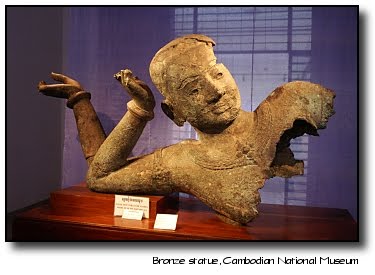
An art exhibition of Cambodian bronzes to open in Washington next month, featuring Khmer sculptures and ritual objects from late prehistory through the Angkorian period.

Men Kimseng, VOA Khmer
Washington, DC Wednesday, 28 April 2010

“These bronzes are among the most exquisite expressions of Khmer ideals of religious imagery and ritual implements.”
An art exhibition of Cambodian bronzes opens for the first time in Washington next month, featuring Khmer sculptures and ritual objects from late prehistory through the Angkorian period.

Thirty-six masterworks from the National Museum of Cambodia’s collection of some 7,000 bronzes will show at the Smithsonian’s Sackler Gallery under “Gods of Angkor: Bronzes from the National Museum of Cambodia.”

“This exhibition presents the stunning accomplishments of Khmer bronze casters,” Louise Allison Cort, the gallery’s curator of ceramics, said in a statement. “These bronzes are among the most exquisite expressions of Khmer ideals of religious imagery and ritual implements.”

The works include a rare and highly valued urn and bell, seven diverse bronze figures, ritual paraphernalia and Buddhist and Hindu sculpture.

The exhibition, a collaboration between the Freer and Sackler galleries and the National Museum of Cambodia, explores significant developments in bronze casting, as well as cultural and religious developments that coalesced during the Angkor period into a recognizable Khmer style.

The exhibition will show from May 15 through Jan. 23, 2011, in Washington and is scheduled to travel to the J. Paul Getty Museum in Los Angeles in February 2011.

Thursday, March 11, 2010

Children of the Bassac - A multimedia presentation by Nicolas Axelrod

Children of the Bassac from Nicolas Axelrod on Vimeo.


‘Children of the Bassac’ is a group of young theatre performers from an impoverished Phnom Penh neighborhood. For 5 years now they have been performing their work at cultural and religious ceremonies as well as on local television. Specializing in traditional songs and dances, they have done shows in England, Scotland and Japan.

For additional videos about Cambodia, please visit:


Saturday, February 27, 2010

For Abstract Painter, the Art of the Mind

Ancient Khmer painting, by Chhim Sothy.

By Pich Samnang, VOA Khmer
Original report from Phnom Penh
26 February 2010


For painter Chhim Sothy, standing in his Phnom Penh studio, the image of three deer trying to escape a forest under destruction is clear. For others, the mix of green, red and dark yellow makes less sense.

“At first glance, the painting depicts nothing, because abstract art requires more time to understand it,” said the 41-year-old abstract artist, who is currently displaying 22 of his latest paintings at the Reyum Gallery in Phnom Penh.

It has been a long road. Born in Kandal province, Chhim Sothy received his Bachelor of Arts, in painting, in 1995, after spending 10 years at the Royal University of Fine Arts in Phnom Penh. After graduating, he worked for several non-governmental organizations, as a painting instructor, until moving over to the Ministry of Culture and Fine Arts in 1998, where he is a deputy director in the department of craftsmen.

Along the way, he practiced painting and was noted for well-balanced traditional paintings. But in recent years, he has moved to abstract painting, a contemporary art form that eschews the traditional depiction of visible realty.

“It is of course hard to read the abstract ideas in the painting, but this kind of art enables people to learn so that they can understand our mind,” he said.

Abstract art, he now argues, can make Cambodia competitive with other countries. “We cannot use our traditional paintings to compete with others, as the paintings cannot be understood internationally, so we just preserve the traditional and use the modern art to compete.”

Chhim Sothy has won several prizes in painting competitions: an Asean Art Award in Singapore, in 2002, and 1st Prize for the best painter in 2003 and 2004 from the Cambodian Ministry of Culture and Fine Arts.

He has also displayed his paintings in galleries in Phnom Penh and the provinces of Battambang, Koh Kong and Preah Sihanouk. His abstract paintings were also displayed in the Philippines, Singapore, Thailand, China, Laos, Vietnam, France and the US.

“The more difficult to understand the painting is, the better,” Chhim Sothy, said, citing the works by Vasily Kandinsky and Pablo Picasso as examples. “Their paintings were unique; thus, they cost millions of dollars,” he said.

Abstract paintings also showcase freedom inherent in art, he said. “I can express my own feelings and use my imagination through this kind of abstract art.”