


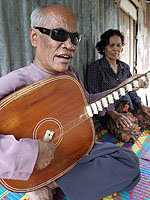
 Kong Nay (Photo: AP)
June 3, 2010
ABC Radio Australia
Cambodia's traditional music scene has gone through something of a revival in recent years. Almost all of the kingdom's musicians were killed during the Khmer Rouge years in the Seventies and the few masters who escaped have been busy passing on their knowledge to young Cambodians. One of the most famous masters is Kong Nai, a player of the two-string guitar-like instrument known as a chapei. Radio Australia's Liam Cochrane has been in Cambodia and went on a search for the authentic sounds of the chapei.
Presenter: Liam Cochrane
Speakers: Guitar shop owner; Chieng Ry, traditional instrument maker; Nou Narin, Chieng Ry's wife
COCHRANE: That's the sound of the old master Kong Nai, playing the chapei - a kind of two-stringed guitar found in Cambodia. The music is often described as the delta blues of Southeast Asia and often used for storytelling. Kong Nai, blind and wearing dark sunglasses, is the Ray Charles of the Cambodian chapei.
I've always loved the sound of this music and I've decided to go in search of an authentic chapei. But where to start looking? Well, taking a cue from a Cambodian pop song of the 60's, I head to Phnom Penh's Central Market, Psar Thmey.
Eventually I find a shop selling all kinds of guitars and mandolins, but do they have a chapei?
The owner of the shop says he doesn't stock any traditional instruments and if I want a chapei, I'll need to get one specially made. So I call a friend who works with Cambodian musicians. It just so happens that the master instrument builder Chieng Ree has recently finished a handmade traditional chapei and is willing to sell it to me.
COCHRANE: That's it that's the chapei. Wow so let's hear what it sounds like. While he tunes it up, maybe I'll just describe what this chapei looks like. It's a blonde ash coloured wood. Sort of looks like a guitar, with a very thin body to it and a long neck. And at the end of the neck, past where the strings stop, there's a long curved piece of wood. Now the strings are set about 3cms above the neck with pieces of black and white frets protruding up to fret the strings.
COCHRANE: So tell me about the making of this particular chapei. How long did it take him to build this? It took me 15 days to make it.
I asked Chieng Ree about a third string that ran through each fret but seemed to play no part it making music.
RY: In fact we use only two strings but the third one is for those who get blind because most chapei players get blind. Does that mean I'm going to go blind?
Chieng Ree assured me that blindness wasn't didn't come from playing the chapei but instead from not making good on our promises. He tells a story that echoes the legend of American bluesman Robert Johnson selling his soul to the devil at the crossroads in exchange for his amazing guitar-playing.
RY: Some people who get blind, because they do not keep their promise. For example in the case of Ne Prey, he give promise to the spirit that he would give offering if he could play in other countries. Then when he came back from Australia, he did not keep his promise and he got blind.
COCHRANE: Chieng Ree and his wife told me another story about promises not kept. They were one of several families of musicians that used to live on a central Phnom Penh block called Dey Krahom, or Red Earth. Their community had simple houses and had lived there for years, but it was prime real estate and a company bought the land from under them, offering paltry compensation. A local government official promised to help them.
RY: He told us not to worry because we are artists, he said he will solve the problem, like giving us compensation, like other artists get. But finally they were evicted.
COCHRANE: Chieng Ree's wife, Nou Narin, told me what happened next.
NOU: Before I got evicted, we had 30-thousand US dollars worth of instrument-making equipment, but after the evictions there was have nothing left, the only thing we rescued was this sofa we are sitting on.
COCHRANE: It was a sad story and one fitting of the blues tradition that the chapei invokes in Western musicians. But it was time to turn back to the chapei and get a few tips from Chieng Ry about how to play the thing.
I'm going to have to practice that. I think I'll stop now because that's absolutely awful and we'll leave it to the experts.
Presenter: Liam Cochrane
Speakers: Guitar shop owner; Chieng Ry, traditional instrument maker; Nou Narin, Chieng Ry's wife
COCHRANE: That's the sound of the old master Kong Nai, playing the chapei - a kind of two-stringed guitar found in Cambodia. The music is often described as the delta blues of Southeast Asia and often used for storytelling. Kong Nai, blind and wearing dark sunglasses, is the Ray Charles of the Cambodian chapei.
I've always loved the sound of this music and I've decided to go in search of an authentic chapei. But where to start looking? Well, taking a cue from a Cambodian pop song of the 60's, I head to Phnom Penh's Central Market, Psar Thmey.
Eventually I find a shop selling all kinds of guitars and mandolins, but do they have a chapei?
The owner of the shop says he doesn't stock any traditional instruments and if I want a chapei, I'll need to get one specially made. So I call a friend who works with Cambodian musicians. It just so happens that the master instrument builder Chieng Ree has recently finished a handmade traditional chapei and is willing to sell it to me.
COCHRANE: That's it that's the chapei. Wow so let's hear what it sounds like. While he tunes it up, maybe I'll just describe what this chapei looks like. It's a blonde ash coloured wood. Sort of looks like a guitar, with a very thin body to it and a long neck. And at the end of the neck, past where the strings stop, there's a long curved piece of wood. Now the strings are set about 3cms above the neck with pieces of black and white frets protruding up to fret the strings.
COCHRANE: So tell me about the making of this particular chapei. How long did it take him to build this? It took me 15 days to make it.
I asked Chieng Ree about a third string that ran through each fret but seemed to play no part it making music.
RY: In fact we use only two strings but the third one is for those who get blind because most chapei players get blind. Does that mean I'm going to go blind?
Chieng Ree assured me that blindness wasn't didn't come from playing the chapei but instead from not making good on our promises. He tells a story that echoes the legend of American bluesman Robert Johnson selling his soul to the devil at the crossroads in exchange for his amazing guitar-playing.
RY: Some people who get blind, because they do not keep their promise. For example in the case of Ne Prey, he give promise to the spirit that he would give offering if he could play in other countries. Then when he came back from Australia, he did not keep his promise and he got blind.
COCHRANE: Chieng Ree and his wife told me another story about promises not kept. They were one of several families of musicians that used to live on a central Phnom Penh block called Dey Krahom, or Red Earth. Their community had simple houses and had lived there for years, but it was prime real estate and a company bought the land from under them, offering paltry compensation. A local government official promised to help them.
RY: He told us not to worry because we are artists, he said he will solve the problem, like giving us compensation, like other artists get. But finally they were evicted.
COCHRANE: Chieng Ree's wife, Nou Narin, told me what happened next.
NOU: Before I got evicted, we had 30-thousand US dollars worth of instrument-making equipment, but after the evictions there was have nothing left, the only thing we rescued was this sofa we are sitting on.
COCHRANE: It was a sad story and one fitting of the blues tradition that the chapei invokes in Western musicians. But it was time to turn back to the chapei and get a few tips from Chieng Ry about how to play the thing.
I'm going to have to practice that. I think I'll stop now because that's absolutely awful and we'll leave it to the experts.








