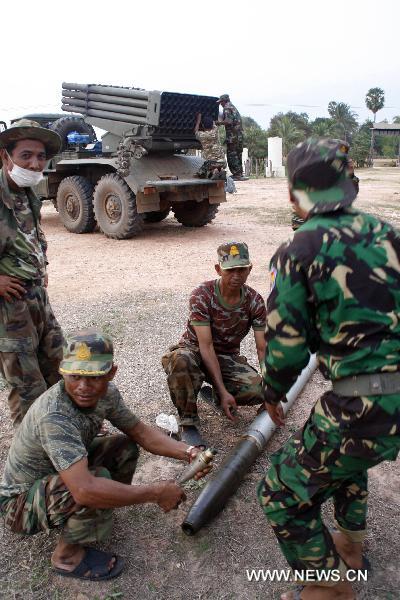
By Xia Lin, Liu Lu, Long Heng PREAH VIHEAR, Cambodia, Oct. 20 (Xinhua) -- Some local residents have been fleeing from the area near Preah Vihear temple amid concern of armed confrontation between Cambodia and Thailand after a deadly clash on the border last week.
"Three members of my family have moved back to Kandal province and I stay here to look after my small souvenir shop in front of the temple," local businessman Srun Sokhorn told Xinhua on Monday.
Some people living at the bottom of the mountain also fled, but some others did not. They watch movies and boxing matches on TV at small cafes, Srun Sokhorn said, adding that about 200 of 319 families still stay here.
"We hope the situation will be normal soon so that I can run my business again," he said.
Local residents are facing shortage of clean water, he said, so they made tent reservoir to collect rain water.
Some children are facing flu from bad weather at the mountain area near the Preah Vihear temple, Kim Ratana, said a doctor at the Preah Vihear provincial health office.
"We are treating a soldier who was infected with malaria," she said.
Meanwhile, the Cambodian and Thai troops have become friendly to each other, after the armed clash killed two Cambodian soldiers and wounded more Thais on Oct. 15 near the Preah Vihear Temple at the border area, officers told Xinhua on Monday.
"They are shaking hands, talking to each other and asking about daily food," said Thol Sovan, deputy military commander of the Cambodian side at the Keo Sikha Kiri Svara Pagoda, which is situated on the only way leading to the temple.
They have good relationship and both troops at the pagoda didn't exchange gunfire on Oct. 15, he said.
"The Thai side didn't (dare to) shoot at us here, because we were all around them at that time," he said.
But Thai soldiers elsewhere shot at us, he said, while pointing at newly fired branches of the jack fruit tree in front of the pagoda.
Meanwhile, Thai military major Apichaut Poo Paud told Xinhua that the troops themselves are like brothers and don't have problem with each other.
"We have good cooperation and relationship," he said, adding that 10 Thai soldiers and two interpreters stay in the pagoda compound.
In other places, Cambodia and Thailand are keeping the same number of soldiers, he added.
Srey Doek, regional military commander of Cambodia, told Xinhua that the situation near the temple is now normal and calm.
However, the number of both troops within the territory is roughly estimated at more than one thousand, he added.
After the Oct. 15 armed conflict, both troops have agreed to conduct joint patrol of the border area, but the two governments have postponed their talks from Tuesday (Oct. 21) to Friday (Oct. 24) to find peaceful solution for their border dispute.
In other developments, the engineering unit of the Royal Cambodian Armed Forces (RCAF) is rebuilding and expanding the current road to the Preah Vihear Temple.
"They are rebuilding the road single direction first to provide easiness for travelers and will also construct a few small bridges over the streams at the area," said Chan Thoern, receptionist working at a neighborhood hotel near the temple.
As the renovation ends, the road is expected to become double direction and remains the only way running along the mountain to the temple, Chan told Xinhua.
"With the road completed, it will be much easier for us and tourists to access the temple, although there are still some steep places," said Chan, who came from Kampong Cham province to help his uncle run his business.
Prime Minister Hun Sen, the government and some charitable people have funded the reconstruction, according to the reports of Chinese-language daily newspaper the Commercial News.
Tourists used to arrive at the 900-year-old temple from the Thai side, as the traffic facilities there are well-built.
In addition, the land price at the bottom of the mountain where the 900-year-old Preah Vihear Temple is situated atop, has been increasing rapidly, since it was awarded world heritage status by UNESCO in July, residents said.
"Here will be another popular destination for tourists," said taxi driver Sean Kim on Monday.
A piece of land measuring 1,000 square meters used to sell at 2,000 U.S. dollars, but now is up to 10,000 U.S. dollars, he said.
"I hope the government will build a market here soon," said Sean, adding that there is no bus station, either.
It is difficult to find a taxi car here leaving for the town or nearby province Siem Reap, he said, adding that current taxi car service and food are all expensive.
Local food vendor Neang Kheng said that the price is high because everything is brought from other provinces and the road is poor for transportation.
"Food is simple here, just drinks, rice, instant noodles, pork, fish and vegetables," she said.
The current military face off between Cambodia and Thailand has almost stalled the life at the foot of the mountain, she added.
In July, tensions ran high after the ancient Preah Vihear Temple was awarded world heritage status by UNESCO, angering nationalists in Thailand who still claim ownership of the site.
The tension later turned into a military stalemate, in which up to 1,000 Cambodian and Thai troops faced off for six weeks.
In early October, at least one Cambodian soldier and two Thai troops were wounded during sporadic exchange of gunfire and two other Thai soldiers were seriously injured after stepping on a landmine at the border area.