


Showing posts with label WWF. Show all posts
Showing posts with label WWF. Show all posts
Tuesday, September 11, 2012


Wednesday, September 21, 2011
Rare tiger prey at risk from land concessions
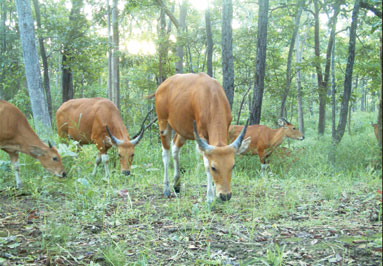 |
| A herd of banteng, an endangered species of wild cattle, in Mondulkiri province in this 2009 photo that was captured with a camera trap. The world’s largest population of banteng is at risk due to continued land concessions and poaching. Photo by: World Wildlife Fund |
Derek Stout
The Phnom Penh Post
Surveys conducted by the World Wildlife Foundation have revealed that the world’s largest population of banteng, an endangered species of cattle that once thrived in the Kingdom, remains at risk due to economic land concessions and poaching inside protected areas.
An estimated 2,700 to 5,700 banteng live on the eastern plains of Cambodia, primarily in the Mondulkiri province’s Protected Forest and the Phnom Prich Wildlife Sanctuary. The total global population is estimated to be between 5,900 to 11,000.
The number of banteng in Cambodia has decreased by more than 50 percent in the last 30 years causing them to be officially listed by International Union for Conservation of Nature as globally endangered in 1996, said the statement released yesterday by the WWF.
Wednesday, August 17, 2011
Mekong dolphins on brink of extinction - WWF
Tue, Jul 26 2011
TOKYO (Reuters) - The Irrawaddy dolphin population in the Mekong River numbers roughly 85, with the survival of new calves very low, suggesting they are at high risk of extinction, environmental group WWF said Wednesday.
The Irrawaddy dolphins live in a 190 km (118 mile) section of the Mekong between Kratie, Cambodia and the Khone Falls, which are on the border with Laos.
Fishing gear, especially gill nets, and illegal fishing methods involving explosions, poison and electricity all appear to be taking a toll, with surveys conducted from 2007 to 2010 showing the dolphin population slowly declining, the WWF added.
"Evidence is strong that very few young animals survive to adulthood, as older dolphins die off and are not replaced," said Li Lifeng, director of WWR's Freshwater Program, in a statement.
Monday, April 26, 2010
“Say No to Wild Meat and Illegal Wood Products”
 4kg of Muntjac were confiscated in February 2010. (Rihit Singh / WWF)
26 April 2010
Source: WWF
HELP STOP WILDLIFE CRIME !
I REPORT WILDLIFE CRIME, DO YOU?
HOTLINE NUMBER: 012 40 41 43
Sen Monorom – Mondulkiri province, 26 April: Today, H.E. Heng Samnang, Deputy Provincial Governor, announces an official order requiring all restaurants in Mondulkiri to stop serving wild meat and using illegal timber products. This announcement comes as part of the launch of the year-long campaign “Say No to Wild Meat and Illegal Wood Products” organized by the Forestry Administration, General Department of Administration for Nature Conservation and Protection and WWF. The aim is to educate and raise awareness of the residents of Sen Monorom, restaurant owners, who are also present at the event, and potential wild meat consumers about laws on forest crime (which include wildlife meat and timber trade).I REPORT WILDLIFE CRIME, DO YOU?
HOTLINE NUMBER: 012 40 41 43
Forest crime is often driven by consumers who want to eat wild meat and have luxury wood furniture. This demand leads to hunting and logging in protected areas and continues the trade in illegal goods.
“For a reduction in forest crime, not only the sellers but also the buyers need to say “No” to illegal wildlife and timber products. That is why this campaign is targeting the suppliers and reaching out to the demand side of wildlife market,” says Mr Seng Teak, WWF Country Director. “If someone buys wildlife and illegal timber products, they are supporting forest crime,” he adds.
Posters, t-shirts, stickers and signboard describing ‘say no to wild meat and illegal wood’, ‘we don’t serve wild meat’, and ‘help stop wildlife crime’ are used to get the message across to the audiences. Posters will be placed in high visibility public areas in Sen Monorom including restaurants, hotels, shops, market, schools, to draw attention from potential wild meat costumers, tourists and all other travellers.
In order to discourage restaurants in Sen Monorom from serving wild meat and customers from asking for it, a guideline for environmentally-friendly restaurants and hotels is developed by the Ministry of Tourism. The Ministry has the authority to inspect and provide restaurants and hotels with awarded certificates if they comply with the guideline. This helps reduce supply and demand for wildlife products.
“We need to remind tourists and residents that consuming wildlife products is not only illegal but also does irreversible harm to the environment because it encourages overexploitation of wildlife by illegal hunters and loggers,” says Mrs Amy Maling, acting Eastern Plains Project Manager with WWF.
In order to put pressure on the supply side of illegal wildlife and timber products, the campaign officially launch a provincial hotline number and encourage the public to report illegal wildlife activities. With the hotline number, reporting forest crimes to the authorities is a quick and easy way for the public to help stop the wildlife and timber trade.
“Recent successes in law enforcement have demonstrated a strong potential of how information from the public can help to interfere with the supply side of wildlife crime,” says Keo Sopheak, Forestry Administration Mondulkiri Protected Forest Manager. “In the end, more information on wildlife crimes will make for better and more effective enforcement.”
After the launching in Sen Monorom, the campaign will as part of the year-long programme continue in various villages around Mondulkiri Protected Forest and Phnom Prich Wildlife Sanctuary. In coordination with Forestry Administration and Department of Environment, WWF personnel will stage the campaign in villages to inform people about the hotline number and how to use it. WWF’s project and communications unit have developed an educational role-play on the harmful effects and the illegality of wildlife crime. This play will be performed by local students from WWF’s Eco-clubs in villages throughout Mondulkiri to reach out to target communities living in and around protected areas.
Wildlife crime in all its forms poses serious threats to Cambodia’s biodiversity. Illegal hunting has probably already extirpated Cambodia’s national animal, the Kouprey, from the wild and puts pressure on all wildlife species, especially endangered species like Tiger and its prey species such as Sambar deer, Banteng, Eld’s deer, Guar and Munjac. Illegal logging is a more general threat to the integrity of entire forest ecosystems.
Wednesday, March 31, 2010
Launch of Cambodia’s first Rattan Field Guide draws attention from national and international press
 Here in this rattan factory 'Kuy Meng' 30 people are employed. An average volume of monthly sales of 210 units is being supplied to markets in Preah Sihanouk, Kampot and Siam Reap provinces, as well as in the Phnom Penh capital.
31 March 2010
WWF
In the evening of Wednesday, 17th March, Cambodia’s most watched television channels Television of Kampuchea (TVK) and South-east Asia TV featured the launch of the first Field Guide to the Rattans of Cambodia in their primetime news programmes, while both radio and print press reported on the event the next day. The launch itself, organised on 17th March, was attended by more than 130 stakeholders from the Cambodian rattan sector including rattan collectors, processors, traders, small and medium entrepreneurs, Cambodian Government’s Forestry Administration, the General Department of Administration for Nature Conservation and Protection as well as WWF’s Rattan project and communications personnel. The event drew interest from Cambodia’s top 16 Khmer and English language press, all based in the capital of Phnom Penh.
Radio Australia aired the story twice via its large coverage network across Cambodia, first as a hot news and later as a feature story in its weekly programme on agricultural development and sustainable environmental practice.
“From the point of view of newsworthiness, Rattan is a good story to cover because it's about environment, community development and sustainability and it's also about bringing income to poor families whose livelihood rely on rattan products,” said Mr Alex Khun, a Khmer journalist and broadcaster based in Melbourne Office that features programmes in both Khmer and English.
Mr Khun said that in the past, not many people know about rattan products and its value chain. With WWF’s initiative, green and sustainable rattan industry has the potential to help hundreds of people earn extra income while promoting protection of rattan resources and forest ecosystems. These factors create, as Mr Khun believes, a great deal of interest among millions of listeners both locally and overseas.
“From community and social development standpoints, it's a good thing that people begin to understand the values and start to protect rattan resources. Local communities become aware that they are able to earn income from rattan, whereas before, people knew little about the benefits of rattan as they thought only for domestic use.” He continued that in Western countries such as Australia rattan products are quite expensive and popular and that high quality rattan products will find their ways into hotels, restaurants, and homes.
According to Mr Khan Sophirom, journalist with Raksmei Kampuchea - the most read Khmer language newspaper - the story is beneficial for readers who work in the Cambodian rattan sector. "It is a brand new story," he said.
At Radio France International (RFI) all news are interesting for their listeners. This Paris-based Radio aired the rattan story in its news programme in Khmer language via its FM frequencies that cover Phnom Penh capital and provinces of Siam Reap, Battambang, Kampong Cham and Preah Sihanouk.
Mr Leang Delux, RFI’s correspondent, thought that the story was very interesting because it informed the public about the diversity of Cambodian rattan growing across the whole country.
The main focus of the launch event – the first “Field Guide of the Rattans of Cambodia” – is the result of more than two years of research on rattan in Cambodia by Mr Khou Eang Hourt, senior botanist. The guide documents more than 20 rattan species across 13 provinces all over Cambodia and identifies five species with the highest market potential. Besides common and scientific names for all species, the book supplies detailed information on rattan characteristics and ecology. Detailed distribution maps provide information on where to find each species while descriptions and colour photographs support field identification.
For future reference, copies of the book were distributed to all stakeholders present at the launch. The book contributes an important step towards sustainable rattan management as it describes the diversity, ecology and characters of rattan.
For more information, email to Tep Asnarith asnarith.tep@wwfgreatermekong.org
Radio Australia aired the story twice via its large coverage network across Cambodia, first as a hot news and later as a feature story in its weekly programme on agricultural development and sustainable environmental practice.
“From the point of view of newsworthiness, Rattan is a good story to cover because it's about environment, community development and sustainability and it's also about bringing income to poor families whose livelihood rely on rattan products,” said Mr Alex Khun, a Khmer journalist and broadcaster based in Melbourne Office that features programmes in both Khmer and English.
Mr Khun said that in the past, not many people know about rattan products and its value chain. With WWF’s initiative, green and sustainable rattan industry has the potential to help hundreds of people earn extra income while promoting protection of rattan resources and forest ecosystems. These factors create, as Mr Khun believes, a great deal of interest among millions of listeners both locally and overseas.
“From community and social development standpoints, it's a good thing that people begin to understand the values and start to protect rattan resources. Local communities become aware that they are able to earn income from rattan, whereas before, people knew little about the benefits of rattan as they thought only for domestic use.” He continued that in Western countries such as Australia rattan products are quite expensive and popular and that high quality rattan products will find their ways into hotels, restaurants, and homes.
According to Mr Khan Sophirom, journalist with Raksmei Kampuchea - the most read Khmer language newspaper - the story is beneficial for readers who work in the Cambodian rattan sector. "It is a brand new story," he said.
At Radio France International (RFI) all news are interesting for their listeners. This Paris-based Radio aired the rattan story in its news programme in Khmer language via its FM frequencies that cover Phnom Penh capital and provinces of Siam Reap, Battambang, Kampong Cham and Preah Sihanouk.
Mr Leang Delux, RFI’s correspondent, thought that the story was very interesting because it informed the public about the diversity of Cambodian rattan growing across the whole country.
The main focus of the launch event – the first “Field Guide of the Rattans of Cambodia” – is the result of more than two years of research on rattan in Cambodia by Mr Khou Eang Hourt, senior botanist. The guide documents more than 20 rattan species across 13 provinces all over Cambodia and identifies five species with the highest market potential. Besides common and scientific names for all species, the book supplies detailed information on rattan characteristics and ecology. Detailed distribution maps provide information on where to find each species while descriptions and colour photographs support field identification.
For future reference, copies of the book were distributed to all stakeholders present at the launch. The book contributes an important step towards sustainable rattan management as it describes the diversity, ecology and characters of rattan.
For more information, email to Tep Asnarith asnarith.tep@wwfgreatermekong.org
Tuesday, February 16, 2010
WWF enforcement team cracks down on wildlife crimes in Mondulkiri province
 Wild boar meat on display at Sen Monorom market. (Rohit Singh / WWF)
 Five of the seven confiscated chainsaws at Namram outpost. (Rohit Singh / WWF)
 Recently confiscated luxury wood at Namram outpost. (Rohit Singh / WWF)
16 February 2010
WWF
February has been a busy but successful month for WWF’s enforcement team in Mondulkiri’s Eastern Plains Landscape. After a weekend of day- and night-patrols, members of the mobile team – a flexible enforcement unit working throughout the whole province – had just arrived at the office when an informant called them about wild meat for sale at the market in Sen Monorom, the province’s capital. Mr Tan Seron, Ranger with the Cambodian government’s Forestry Administration, quickly mobilised his team members to head for the market, where they confiscated 6kg of wild boar meat (Sus scrofa).
This success follows several crackdowns on illegal logging in the beginning of the month when the patrolling teams of Namram and Trapeag Thmear in Mondulkiri Protected Forest confiscated seven chain saws from four villages in the protected area.
“Cutting trees inside the protected area is a crime under the Forestry Law of Cambodia, and we issued warning letters to the chainsaw owners,” said Mr Keo Sopheak, Manager of Mondulkiri Protected Forest. This is part of the legal procedure, where first-time offenders face non-jurisdictional punishment and are given warning letters to scare them from repeating their offence. Criminals caught for the second time risk serious penalties of jail and/or fines.
Besides the chainsaws, rangers also confiscated large amounts of rosewood (Dalbergia cochinchiensis, locally known as Keinung). This luxury wood can fetch up to several thousand US$ per cubic metre on international markets – prices that unfortunately continue to motivate illegal loggers in the area.
The recent confiscations reflect the effective effort of the enforcement team in Mondulkiri Protected Forest. At the same time, they also demonstrate an increase in illegal activities that puts pressure on one of the last remaining dry forest habitats for tiger in Cambodia.
“Our team is working hard but we need to take more action against illegal activities. We have started vehicle checks at different points around the protected areas to monitor trade routes”, Mr Sopheak said. “We are also expanding our informant network. This will surely help us in curbing illegal wild meat trade in the area.”
Illegal logging as well as selling and buying of wild meat are punishable offences and can be charged under the Forestry Law of Cambodia. If you see or hear of any such misdoings, contact WWF’s Wildlife Crime Hotline Number at 012404143. It will be a small step for you but a large step for the animal kingdom.
This success follows several crackdowns on illegal logging in the beginning of the month when the patrolling teams of Namram and Trapeag Thmear in Mondulkiri Protected Forest confiscated seven chain saws from four villages in the protected area.
“Cutting trees inside the protected area is a crime under the Forestry Law of Cambodia, and we issued warning letters to the chainsaw owners,” said Mr Keo Sopheak, Manager of Mondulkiri Protected Forest. This is part of the legal procedure, where first-time offenders face non-jurisdictional punishment and are given warning letters to scare them from repeating their offence. Criminals caught for the second time risk serious penalties of jail and/or fines.
Besides the chainsaws, rangers also confiscated large amounts of rosewood (Dalbergia cochinchiensis, locally known as Keinung). This luxury wood can fetch up to several thousand US$ per cubic metre on international markets – prices that unfortunately continue to motivate illegal loggers in the area.
The recent confiscations reflect the effective effort of the enforcement team in Mondulkiri Protected Forest. At the same time, they also demonstrate an increase in illegal activities that puts pressure on one of the last remaining dry forest habitats for tiger in Cambodia.
“Our team is working hard but we need to take more action against illegal activities. We have started vehicle checks at different points around the protected areas to monitor trade routes”, Mr Sopheak said. “We are also expanding our informant network. This will surely help us in curbing illegal wild meat trade in the area.”
Illegal logging as well as selling and buying of wild meat are punishable offences and can be charged under the Forestry Law of Cambodia. If you see or hear of any such misdoings, contact WWF’s Wildlife Crime Hotline Number at 012404143. It will be a small step for you but a large step for the animal kingdom.
Thursday, October 01, 2009
First rattan association of Cambodia, a step to sustainable rattan industry
01 October 2009
World Wildlife Foundation (WFF)
World Wildlife Foundation (WFF)
Phnom Penh, Cambodia – Eleven rattan small and medium enterprise owners and other community rattan processors from Phnom Penh and provinces meet on September 28th to officially form Cambodia’s first rattan association. The agenda will focus on election of a management committee and discussion over conditions and roles of current and future memberships.
"While the association is perceived by members as creating space and opportunity for key actors in the rattan production chain to meet and work together, this institutional initiative is described as a fundamental first step to achieve the goal of maintaining sustainable rattan production and supply. We are delighted to support this project and this activity in particular," said the representative of the European Commission's Delegation in Phnom Penh.
“The formation of the rattan association is critical to ensure understanding of community suppliers, processors and traders about the need to maintain sustainable supply of rattan for clean and better production,” said Mr Lip Cheang, a founder of the rattan association and owner of Kampuchea Samay Thmei rattan factory.
Fast growing economies elsewhere in the region are motivating rapid expansion of processing activities leading to demand for rattan resource at an unsustainable level. There is urgent need to establish a model of sustainable production that can support continuous growth of rattan in forests, while maintaining seasonal harvesting and sustainable supply.
“This is the right time for moving forward with concrete actions that help the development of rattan industry of Cambodia if the country is to export clean and high quality products into international markets, while continuing to sustainably manage rattan resource in forest,” said Mr Ou Ratanak, Rattan Project Manager from WWF.
The rattan association will first of all put a legal identity to a group of rattan suppliers and processors. Such an identity is important for the recognition of their action and goal by national and international societies.
“As a legally established entity, we can make our voice heard when we need support from the Government, for instance, with coordination from WWF and NGO partners, we will meet and dialogue with relevant ministries to obtain licence for our business so that we can legally export our products in the future,” Mr Lip Cheang said.
One of the operational objectives of the association is to also provide Cambodian processors with new knowledge and experience related to rattan, processing techniques, trade and markets. This will be the key learning platform and guide for them to improve their processing and product quality.
“The project identified that processors and exporters are not familiar with using the environmentally-friendly production techniques and that there is lack of understanding about international market requirements,” Mr Ratanak said.
“Limited skill to creatively diversify design and style also refrain Cambodian products from being competitive in the international market,” he added.
WWF is working with Institute for Environmental Science and Technology based in Hanoi and Artisans Association of Cambodia to improve the current non environmentally friendly production practices of rattan as such: wasteful use of rattan during processing, poor grading and storing as well as chemical use, which has negative impacts on the environment and therefore affects the product quality.
“One of the project’s major objectives, funded by European Union, is to engage small and medium enterprises in Cleaner Production, which aim at introducing proper techniques for processing activities to ensure a system of quality assurance,” said Mr Thibault Ledecq, Rattan Programme Manager from WWF.
For more information, contact:
asnarith.tep@wwfgreatermekong.org
"While the association is perceived by members as creating space and opportunity for key actors in the rattan production chain to meet and work together, this institutional initiative is described as a fundamental first step to achieve the goal of maintaining sustainable rattan production and supply. We are delighted to support this project and this activity in particular," said the representative of the European Commission's Delegation in Phnom Penh.
“The formation of the rattan association is critical to ensure understanding of community suppliers, processors and traders about the need to maintain sustainable supply of rattan for clean and better production,” said Mr Lip Cheang, a founder of the rattan association and owner of Kampuchea Samay Thmei rattan factory.
Fast growing economies elsewhere in the region are motivating rapid expansion of processing activities leading to demand for rattan resource at an unsustainable level. There is urgent need to establish a model of sustainable production that can support continuous growth of rattan in forests, while maintaining seasonal harvesting and sustainable supply.
“This is the right time for moving forward with concrete actions that help the development of rattan industry of Cambodia if the country is to export clean and high quality products into international markets, while continuing to sustainably manage rattan resource in forest,” said Mr Ou Ratanak, Rattan Project Manager from WWF.
The rattan association will first of all put a legal identity to a group of rattan suppliers and processors. Such an identity is important for the recognition of their action and goal by national and international societies.
“As a legally established entity, we can make our voice heard when we need support from the Government, for instance, with coordination from WWF and NGO partners, we will meet and dialogue with relevant ministries to obtain licence for our business so that we can legally export our products in the future,” Mr Lip Cheang said.
One of the operational objectives of the association is to also provide Cambodian processors with new knowledge and experience related to rattan, processing techniques, trade and markets. This will be the key learning platform and guide for them to improve their processing and product quality.
“The project identified that processors and exporters are not familiar with using the environmentally-friendly production techniques and that there is lack of understanding about international market requirements,” Mr Ratanak said.
“Limited skill to creatively diversify design and style also refrain Cambodian products from being competitive in the international market,” he added.
WWF is working with Institute for Environmental Science and Technology based in Hanoi and Artisans Association of Cambodia to improve the current non environmentally friendly production practices of rattan as such: wasteful use of rattan during processing, poor grading and storing as well as chemical use, which has negative impacts on the environment and therefore affects the product quality.
“One of the project’s major objectives, funded by European Union, is to engage small and medium enterprises in Cleaner Production, which aim at introducing proper techniques for processing activities to ensure a system of quality assurance,” said Mr Thibault Ledecq, Rattan Programme Manager from WWF.
For more information, contact:
asnarith.tep@wwfgreatermekong.org
Rattan Association Aims To Boost Export
By Ros Sothea, VOA Khmer
Original report from Phnom Penh
30 September 2009
Original report from Phnom Penh
30 September 2009
Opened with cooperation from a wildlife conservation group and an artisan organization, the Rattan Association of Cambodia hopes to fill a gap in international demand for the material.
“If we want to export, we need a large amount of rattan,” said Ou Ratanak, head of the World Wildlife Fund’s rattan project. “So the association can deal with it. Moreover, [members] can share their experiences regarding design and quality.”
The association would take care natural rattan is not destroyed and new rattan is grown for sustainable use. It would also provide knowledge and new experiences in technical assistance, trade, and international market searches.
More than 20 species of rattan grow naturally in Cambodia. The vine has a small leaf and sharp thorns and grows on mountainsides. Much of the country’s natural rattan, however, has been depleted for export to Vietnam and Thailand.
From 1998 to 2006, an estimated 3,000 tons of rattan were illegally exported to Vietnam, and another 12,000 tons to Thailand, according to the WWF.
In 2008, the WWF created a community project to protect rattan in Kampot province, with the project expanding into Preah Sihanouk, Koh Kong, Kampong Thom and Preah Vihear provinces. Prek Tnorth, in Kampot, is growing rattan on 25 hectares of land.
Rattan is used in the production of furniture popular in Europe, the US and Canada, with production and trade valued at $4 billion a year, Ou Ratanak said. Indonesia is responsible for 80 percent of world export; Malaysia, Thailand and Vietnam also export rattan products.
Cambodia has yet to find an international market, and only 800 families in Kampot benefit from planting the vine and producing furniture from it for markets in Phnom Penh and Siem Reap. The community harvests more than half a ton of rattan per month, producing around 50 table and chairs.
“The quality is still poor, lacking in design skill, and we always produce the same model,” said Men Sineoun, president of the Artisan Association of Cambodia, which is also supporting the project. “We have no skill in marketing and communication, and we have no skill in exporting.”
Tep Asnarith, a spokesman for the WWF, said rattan furniture producers in Cambodia don’t yet follow an environmental policy required by international buyers. However, it is hoped the new association can help ensure high-quality production and other competitive advantages.
Kun Thorn, president of Kun Bun Lang Furniture, said he believed the association can boost exports, and the WWF hopes to export half the rattan produced in Cambodia to Europe, the US and Japan by 2015.
Lao Sethalphal, deputy director for the legal department of the Ministry of Agriculture’s forestry administration, said the success of rattan on the international market will improve the economies of rural communities and provide a better living to rural people.
“If we want to export, we need a large amount of rattan,” said Ou Ratanak, head of the World Wildlife Fund’s rattan project. “So the association can deal with it. Moreover, [members] can share their experiences regarding design and quality.”
The association would take care natural rattan is not destroyed and new rattan is grown for sustainable use. It would also provide knowledge and new experiences in technical assistance, trade, and international market searches.
More than 20 species of rattan grow naturally in Cambodia. The vine has a small leaf and sharp thorns and grows on mountainsides. Much of the country’s natural rattan, however, has been depleted for export to Vietnam and Thailand.
From 1998 to 2006, an estimated 3,000 tons of rattan were illegally exported to Vietnam, and another 12,000 tons to Thailand, according to the WWF.
In 2008, the WWF created a community project to protect rattan in Kampot province, with the project expanding into Preah Sihanouk, Koh Kong, Kampong Thom and Preah Vihear provinces. Prek Tnorth, in Kampot, is growing rattan on 25 hectares of land.
Rattan is used in the production of furniture popular in Europe, the US and Canada, with production and trade valued at $4 billion a year, Ou Ratanak said. Indonesia is responsible for 80 percent of world export; Malaysia, Thailand and Vietnam also export rattan products.
Cambodia has yet to find an international market, and only 800 families in Kampot benefit from planting the vine and producing furniture from it for markets in Phnom Penh and Siem Reap. The community harvests more than half a ton of rattan per month, producing around 50 table and chairs.
“The quality is still poor, lacking in design skill, and we always produce the same model,” said Men Sineoun, president of the Artisan Association of Cambodia, which is also supporting the project. “We have no skill in marketing and communication, and we have no skill in exporting.”
Tep Asnarith, a spokesman for the WWF, said rattan furniture producers in Cambodia don’t yet follow an environmental policy required by international buyers. However, it is hoped the new association can help ensure high-quality production and other competitive advantages.
Kun Thorn, president of Kun Bun Lang Furniture, said he believed the association can boost exports, and the WWF hopes to export half the rattan produced in Cambodia to Europe, the US and Japan by 2015.
Lao Sethalphal, deputy director for the legal department of the Ministry of Agriculture’s forestry administration, said the success of rattan on the international market will improve the economies of rural communities and provide a better living to rural people.
Monday, June 22, 2009
War and conservation in Cambodia
 Bokor National Park, Cambodia. Heavily armed forestry rangers and their Australian security consultant arrest a poacher with an endangered Hog Badger during a night patrol. TRAFFIC Asia 2006. Photo by: Adam Oswell with WWF.
 The Kouprey Bos sauveli, a species of wild ox. Illustration by: Helmut Diller.
  The Asian elephant has been hunted out of the forest around Sre Chis. Photo by: Rhett Butler.
 Critically Endangered Siamese crocodile in Thailand: the species has disappeared from the Sri Chis forests. Photo by: Rhett Butler.
 While tigers still reside in the forest around Sri Chis, their population has declined according to interviews. Photo by: Martin Harvey with WWF.
 Phnom Penh, Cambodia. An anti-wildlife trade billboard outside a local school. Part of a government education program that aims to educate Cambodians about the country's wildlife laws. TRAFFIC Asia 2006. Photo by: Adam Oswell of WWF.
June 21, 2009
Jeremy Hance
mongabay.com
The decades-long conflict in Cambodia devastated not only the human population of the Southeast Asian country but its biodiversity as well. The conflict led to widespread declines of species in the once wildlife-rich nation while steering traditional society towards unsustainable hunting practices, resulting in a situation where wildlife is still in decline in Cambodia, according to a new study from researchers with the World Wildlife Fund (WWF).
Although many biodiversity hotspots have seen their share of conflict—the Democratic Republic of Congo (DRC), Liberia, Vietnam—the relationship between war and conservation has rarely been studied. Social scientist Michael Mascia with WWF and Colby Loucks, Deputy Director of the WWF's Conservation Science Program interviewed Cambodian villagers to understand the impacts of war on village’s surrounding wilderness.
“Armed conflict is a social phenomenon often detrimental to wildlife and wildlife habitat, but the legacy of armed conflict for wildlife in post-conflict settings remains unexplored,” Loucks and Mascia, along with other authors, write in their paper published in Conservation Letters.
Since scientific data for wildlife abundance in Cambodia was lacking, Loucks and Mascia depended on the knowledge of locals in the Sre Chis commune, a collection of six villages in eastern Kratie province. Asking the interviewees about 18 different species, the researchers found that the decades-long conflict in Cambodia caused deep-declines in wildlife abundance, the loss of some species altogether, and moved the society from subsistence hunting to commercial exploitation.
“We looked at how conflict directly and indirectly shaped people’s use of wildlife – during and after conflict. The influx of guns, the emergence of new markets, the forced hunting teams – all were directly related to conflict. It was the conflict, lastly, for well over two decades that created the environment for permanent shifts in livelihoods to the dependence on the trade of wildlife,” Loucks and Mascia told mongabay.com
Wildlife declined from pre-1953 (when the conflict began) to 2005, but the most measured declines occurred in the 1970s—when the conflict was at its worst. The researchers found that 14 of 18 species declined, while five disappeared altogether, including the Asian elephant, the kouprey, Eld’s deer, hog deer, and Siamese crocodile. Before the conflict arrived in Sre Chis, the villagers only sold one species to outside markets—the guar—but by the 1970s seven more species were being trafficked: elephants, banteng, Eld’s deer, hog deer, tiger, leopard and sun bear.
“It is clear to [the villagers] that there are fewer individuals of the species…and that they need to go further from the villages to find them,” Loucks said.
Shockingly every one of these species (or subspecies) is threatened with extinction according to the IUCN Red List, except the Indochinese leopard which hasn’t been surveyed. The sun bear is considered Vulnerable, while the Indochinese tiger, Asian elephant, Eld’s deer, and hog deer are all listed as Endangered. The Siamese crocodile, the banteng, a species of wild cattle, and a wild ox known as the kouprey are each Critically Endangered.
As related by Loucks and Mascia, these declines consistently followed societal changes brought on by war: additional firearms, the beginning of a wildlife trade for international markets, and a Khmer Rouge policy that actually mandated hunting. Prior to the 1970s villagers hunted with the crossbow, since guns were either illegal or difficult to obtain, but when the Khmer Rouge came to Sre Chis they handed out guns to locals and paid them to hunt. During the conflict, wildlife meat went to soldier on the front lines.
The conflict in Cambodia ended in 1991, but the interviewers discovered that wildlife declines continued due to the technological and social changes brought on by war. Instead of hunting for soldiers, the villagers had now begun to hunt for commercial sale in markets both in Cambodia and abroad.
“Documenting these impacts and the subsequent ripple effects in post-conflict society – shifting livelihood strategies and the decline of wildlife – allow us to understand the links between conflict and wildlife decline,” Loucks and Mascia said. “This sheds light on the importance of re-engaging with communities, empowering them to manage their resources, and providing economic opportunities soon after the cessation of conflict. With this information, we can design more effective conservation strategies, tailored to local conditions.”
Importance of conservation to postconflict society
The UN has drafted important guidelines for ‘disarmament, demobilization, and reintegration’ of combatants (known as DDR), but they don’t take into account the conservation of natural resources, according to Loucks and Mascia. Even though many conflicts begin with—or in some way involve—over-exploitation of a nation’s resources.
Therefore the authors suggest “that conservation investments in postconflict societies should be integrated within and support broader peace-building efforts targeting combatants, noncombatants, civil society organizations, and the state”.
Mascia goes on to say that “many conservation strategies are consistent with current approaches to peace-building, such as capacity-building for government agencies and local communities, fostering good governance and rule of law, and promoting alternative livelihoods and income generating activities. In societies where natural resources are a source of conflict, strengthening civil society and good governance in the environmental sector is necessary not just for effective conservation of biodiversity, but for peace-building generally.”
Loucks and Mascia see conservation as a tool to aid with disarmament in postconflict society by justifying confiscating weapons when used for illegal hunting. In addition, conservation organization act as important support for newly formed governments by “promoting rule of law; encouraging participatory and transparent decision making; and supporting other activities that foster good governance within the conservation sector and beyond,” according to the paper.
Furthermore, the authors argue, conservation groups have the capacity to monitor postconflict efforts to make certain both individuals and large-scale investments are not engaging in unsustainable natural resource exploitation. Instead of handing such postconflict countries over to international corporations for large-scale monoculture plantations, industrial agriculture or mining—which may degrade the environment and stoke further conflict—conservation organizations could manage environmental restoration projects.
Such restoration projects “would serve multiple purposes” the authors write, including “employment of both ex-combatants and noncombatants, enhanced delivery of ecosystem services to resource-dependent communities, critical habitat for wildlife, and reduced wildlife trade by providing alternative sources of income.”
Finally, the authors recommend that conservation groups be allowed to perform capacity-building at the community level in order to reach out to remote areas, places where a new government may not have influence or even means of communication. According to the paper, such programs “can empower local actors and strengthen local governance regimes, absorb ex-combatants into the labor force, and provide legal economic opportunities for ex-combatants and noncombatants alike.”
The people—not just the wildlife—of post-conflict nations would benefit greatly from increased conservation and environmental awareness, according to the paper.
“We believe that the UN, governments, civil society, and NGOs all have a role they can play to integrate natural resource conservation, biodiversity protection, and peace-building efforts from the local to national or global scale. To design conservation strategies that are both ecologically and socially sustainable, we need to build tailored solutions that bridge the traditional divide between security and the environment.” Loucks and Mascia told mongabay.com.
Although many biodiversity hotspots have seen their share of conflict—the Democratic Republic of Congo (DRC), Liberia, Vietnam—the relationship between war and conservation has rarely been studied. Social scientist Michael Mascia with WWF and Colby Loucks, Deputy Director of the WWF's Conservation Science Program interviewed Cambodian villagers to understand the impacts of war on village’s surrounding wilderness.
“Armed conflict is a social phenomenon often detrimental to wildlife and wildlife habitat, but the legacy of armed conflict for wildlife in post-conflict settings remains unexplored,” Loucks and Mascia, along with other authors, write in their paper published in Conservation Letters.
Since scientific data for wildlife abundance in Cambodia was lacking, Loucks and Mascia depended on the knowledge of locals in the Sre Chis commune, a collection of six villages in eastern Kratie province. Asking the interviewees about 18 different species, the researchers found that the decades-long conflict in Cambodia caused deep-declines in wildlife abundance, the loss of some species altogether, and moved the society from subsistence hunting to commercial exploitation.
“We looked at how conflict directly and indirectly shaped people’s use of wildlife – during and after conflict. The influx of guns, the emergence of new markets, the forced hunting teams – all were directly related to conflict. It was the conflict, lastly, for well over two decades that created the environment for permanent shifts in livelihoods to the dependence on the trade of wildlife,” Loucks and Mascia told mongabay.com
Wildlife declined from pre-1953 (when the conflict began) to 2005, but the most measured declines occurred in the 1970s—when the conflict was at its worst. The researchers found that 14 of 18 species declined, while five disappeared altogether, including the Asian elephant, the kouprey, Eld’s deer, hog deer, and Siamese crocodile. Before the conflict arrived in Sre Chis, the villagers only sold one species to outside markets—the guar—but by the 1970s seven more species were being trafficked: elephants, banteng, Eld’s deer, hog deer, tiger, leopard and sun bear.
“It is clear to [the villagers] that there are fewer individuals of the species…and that they need to go further from the villages to find them,” Loucks said.
Shockingly every one of these species (or subspecies) is threatened with extinction according to the IUCN Red List, except the Indochinese leopard which hasn’t been surveyed. The sun bear is considered Vulnerable, while the Indochinese tiger, Asian elephant, Eld’s deer, and hog deer are all listed as Endangered. The Siamese crocodile, the banteng, a species of wild cattle, and a wild ox known as the kouprey are each Critically Endangered.
As related by Loucks and Mascia, these declines consistently followed societal changes brought on by war: additional firearms, the beginning of a wildlife trade for international markets, and a Khmer Rouge policy that actually mandated hunting. Prior to the 1970s villagers hunted with the crossbow, since guns were either illegal or difficult to obtain, but when the Khmer Rouge came to Sre Chis they handed out guns to locals and paid them to hunt. During the conflict, wildlife meat went to soldier on the front lines.
The conflict in Cambodia ended in 1991, but the interviewers discovered that wildlife declines continued due to the technological and social changes brought on by war. Instead of hunting for soldiers, the villagers had now begun to hunt for commercial sale in markets both in Cambodia and abroad.
“Documenting these impacts and the subsequent ripple effects in post-conflict society – shifting livelihood strategies and the decline of wildlife – allow us to understand the links between conflict and wildlife decline,” Loucks and Mascia said. “This sheds light on the importance of re-engaging with communities, empowering them to manage their resources, and providing economic opportunities soon after the cessation of conflict. With this information, we can design more effective conservation strategies, tailored to local conditions.”
Importance of conservation to postconflict society
The UN has drafted important guidelines for ‘disarmament, demobilization, and reintegration’ of combatants (known as DDR), but they don’t take into account the conservation of natural resources, according to Loucks and Mascia. Even though many conflicts begin with—or in some way involve—over-exploitation of a nation’s resources.
Therefore the authors suggest “that conservation investments in postconflict societies should be integrated within and support broader peace-building efforts targeting combatants, noncombatants, civil society organizations, and the state”.
Mascia goes on to say that “many conservation strategies are consistent with current approaches to peace-building, such as capacity-building for government agencies and local communities, fostering good governance and rule of law, and promoting alternative livelihoods and income generating activities. In societies where natural resources are a source of conflict, strengthening civil society and good governance in the environmental sector is necessary not just for effective conservation of biodiversity, but for peace-building generally.”
Loucks and Mascia see conservation as a tool to aid with disarmament in postconflict society by justifying confiscating weapons when used for illegal hunting. In addition, conservation organization act as important support for newly formed governments by “promoting rule of law; encouraging participatory and transparent decision making; and supporting other activities that foster good governance within the conservation sector and beyond,” according to the paper.
Furthermore, the authors argue, conservation groups have the capacity to monitor postconflict efforts to make certain both individuals and large-scale investments are not engaging in unsustainable natural resource exploitation. Instead of handing such postconflict countries over to international corporations for large-scale monoculture plantations, industrial agriculture or mining—which may degrade the environment and stoke further conflict—conservation organizations could manage environmental restoration projects.
Such restoration projects “would serve multiple purposes” the authors write, including “employment of both ex-combatants and noncombatants, enhanced delivery of ecosystem services to resource-dependent communities, critical habitat for wildlife, and reduced wildlife trade by providing alternative sources of income.”
Finally, the authors recommend that conservation groups be allowed to perform capacity-building at the community level in order to reach out to remote areas, places where a new government may not have influence or even means of communication. According to the paper, such programs “can empower local actors and strengthen local governance regimes, absorb ex-combatants into the labor force, and provide legal economic opportunities for ex-combatants and noncombatants alike.”
The people—not just the wildlife—of post-conflict nations would benefit greatly from increased conservation and environmental awareness, according to the paper.
“We believe that the UN, governments, civil society, and NGOs all have a role they can play to integrate natural resource conservation, biodiversity protection, and peace-building efforts from the local to national or global scale. To design conservation strategies that are both ecologically and socially sustainable, we need to build tailored solutions that bridge the traditional divide between security and the environment.” Loucks and Mascia told mongabay.com.
Friday, June 19, 2009
Mekong Dolphin in Danger
By Kong Sothanarith, VOA Khmer
Original report from Phnom Penh
18 June 2009
Original report from Phnom Penh
18 June 2009
Only between 64 and 74 Irrawady dolphins remain in the river between Cambodia and Laos, the World Wildlife Fund for Nature announced Wednesday.
Pollution from DDT, mercury and other toxins have led to a sharp decline in the rare species, with as many as 88 individuals dying since 2003, according to a recent report.
“These pollutants are widely distributed in the environment and so the source of this pollution may involve several countries through which the Mekong River flows”, said Verné Dove, report author and veterinarian with WWF Cambodia.
The organization is investigating the source of the contaminants, he said.
According to the international institution, high levels of mercury were found in some of the dead dolphins. Mercury, suspected to be from gold mining activities, directly affects the immune system, making the animals more susceptible to infectious disease.
WWF is working to conserve the species in Burma, Cambodia, China, Laos, Thailand and Vietnam.
Touch Sean Tana, secretary of state for the Council of Ministers and head of Cambodia's Commission to Conserve Mekong River Dolphins and Develop Ecotourism, denied the findings.
“Ninety-nine percent of the dolphins die because they are trapped in nets,” he said, denying that DDT and mercury were responsible.
“They want to cook their eggs, but they burn down our house,” he said of the WWF, adding that according to his estimates, 150 to 160 of the dolphins live in the Mekong between Cambodia and Laos.
Pollution from DDT, mercury and other toxins have led to a sharp decline in the rare species, with as many as 88 individuals dying since 2003, according to a recent report.
“These pollutants are widely distributed in the environment and so the source of this pollution may involve several countries through which the Mekong River flows”, said Verné Dove, report author and veterinarian with WWF Cambodia.
The organization is investigating the source of the contaminants, he said.
According to the international institution, high levels of mercury were found in some of the dead dolphins. Mercury, suspected to be from gold mining activities, directly affects the immune system, making the animals more susceptible to infectious disease.
WWF is working to conserve the species in Burma, Cambodia, China, Laos, Thailand and Vietnam.
Touch Sean Tana, secretary of state for the Council of Ministers and head of Cambodia's Commission to Conserve Mekong River Dolphins and Develop Ecotourism, denied the findings.
“Ninety-nine percent of the dolphins die because they are trapped in nets,” he said, denying that DDT and mercury were responsible.
“They want to cook their eggs, but they burn down our house,” he said of the WWF, adding that according to his estimates, 150 to 160 of the dolphins live in the Mekong between Cambodia and Laos.
Thursday, June 18, 2009
Mekong dolphins on the brink of extinction
 Irrawaddy dolphins (Orcaella Brevirostris) at Koh Kon Sat, Mekong River, Cambodia. The dolphins were photographed during the dolphin population research conducted by WWF Cambodia's Mekong Dolphin Conservation Project in November 2007.C Dave Dove /WWF Grea
 Irrawaddy dolphins (Orcaella Brevirostris) at Koh Kon Sat, Mekong River, Cambodia. The dolphins were photographed during the dolphin population research conducted by WWF Cambodia's Mekong Dolphin Conservation Project in November 2007. C Dave Dove /WWF Greater Mekong.
WildlifeExtra.com
Mekong RiverMekong River dolphins on the verge of extinction
WWF is working to conserve 600,000km2 of the world's most biologically diverse, economically viable and seriously threatened forests and rivers within the Greater Mekong, home and life source to over 300 million people in Cambodia, China, Lao PDR, Myanmar, Thailand, and Vietnam.
The Mekong River Irrawaddy dolphin is regarded as a sacred animal by both Khmer and Lao people, and is an important source of income and jobs for communities involved in dolphin-watching ecotourism initiatives.
More than 60 million people in the lower Mekong basin depend on the river system for food, transport and economic activity. The Mekong River produces an estimated 2.5 million tons of fish per year, with a value of at least US$2 billion, making it the largest inland fisheries in the world. Eighty percent of the animal protein for Mekong inhabitants comes from the Mekong, with 70 percent of the commercial catch being long distance migrant species.
June 2009. Pollution in the Mekong River has pushed the local population of Irrawaddy dolphins to the brink of extinction, according to a new WWF report.
Less than 80 dolphins left
The Mekong River Irrawaddy dolphin (Orcaella brevirostris) population inhabits a 190 kilomtere stretch of the Mekong River between Cambodia and Lao PDR. Since 2003, the population has suffered 88 deaths of which more than 60 percent were calves under two weeks old. The latest population is estimated between 64 and 76 members.
Immune system depressed by pollutants
"Necropsy analysis identified a bacterial disease as the cause of the calf deaths. This disease would not be fatal unless the dolphin's immune systems were suppressed, as they were in these cases, by environmental contaminants," said Dr Verné Dove, report author and veterinarian with WWF Cambodia.
Researchers found toxic levels of pesticides such as DDT and environmental contaminants such as PCBs during analysis of the dead dolphin calves. These pollutants may also pose a health risk to human populations living along the Mekong that consume the same fish and water as the dolphins.
"These pollutants are widely distributed in the environment and so the source of this pollution may involve several countries through which the Mekong River flows. WWF Cambodia is currently investigating the source of the environmental contaminants," said Dr Dove.
High levels of Mercury
High levels of mercury were also found in some of the dead dolphins. Mercury, suspected to be from gold mining activities, directly affects the immune system making the animals more susceptible to infectious disease.
"A trans-boundary preventative health programme is urgently needed to manage the disease affected animals in order to reduce the number of deaths each year," said Seng Teak, Country Director of WWF Cambodia.
Inbreeding
Limited genetic diversity due to inbreeding was another factor in the dolphin deaths.
"The Mekong River dolphins are isolated from other members of their species and they need our help. Science has shown that if the habitat of cetaceans is protected then populations can show remarkable resilience," said Mr Teak.
The Mekong River Irrawaddy dolphin has been listed as critically endangered on the IUCN Red List of Threatened Species since 2004.
Mekong river dolphin near extinct: WWF
Thursday, June 18, 2009
PHNOM PENH (AFP) — Pollution in southeast Asia's Mekong River has pushed freshwater dolphins in Cambodia and Laos to the brink of extinction, an international conservation group said.
The World Wide Fund For Nature (WWF) said only 64 to 76 Irrawaddy dolphins remain in the Mekong after toxic levels of pesticides, mercury and other pollutants were found in more than 50 calves who have died since 2003.
"These pollutants are widely distributed in the environment and so the source of this pollution may involve several countries through which the Mekong River flows," said WWF veterinary surgeon Verne Dove in a press statement.
The organisation said it was investigating how environmental contaminants got into the Mekong, which flows through Cambodia, Laos, Myanmar, Thailand, Vietnam and the southern Chinese province of Yunnan.
The WWF added that Irrawaddy dolphins in Cambodia and Laos urgently needed a health programme to counter the effects of pollution on their immune systems.
The Mekong River Irrawaddy dolphin, which inhabits a 190 kilometre (118 mile) stretch in Cambodia and Laos, has been listed as critically endangered since 2004, the WWF said.
The World Wide Fund For Nature (WWF) said only 64 to 76 Irrawaddy dolphins remain in the Mekong after toxic levels of pesticides, mercury and other pollutants were found in more than 50 calves who have died since 2003.
"These pollutants are widely distributed in the environment and so the source of this pollution may involve several countries through which the Mekong River flows," said WWF veterinary surgeon Verne Dove in a press statement.
The organisation said it was investigating how environmental contaminants got into the Mekong, which flows through Cambodia, Laos, Myanmar, Thailand, Vietnam and the southern Chinese province of Yunnan.
The WWF added that Irrawaddy dolphins in Cambodia and Laos urgently needed a health programme to counter the effects of pollution on their immune systems.
The Mekong River Irrawaddy dolphin, which inhabits a 190 kilometre (118 mile) stretch in Cambodia and Laos, has been listed as critically endangered since 2004, the WWF said.
Wednesday, April 29, 2009
Kampot Community Turns to Rattan
By Ros Sothea, VOA Khmer
Original report from Pnom Penh
28 April 2009
Original report from Pnom Penh
28 April 2009
A drive 20 kilometers south of Kampot town brings you to the scenic village of Prek Thnout, where all kinds of trees grow along the ridges of Bokor Mountain. Step inside the forest, and you could wind up amid the sharp thorns of the rattan palm.
Since mid-2008, thousands of blue-foliaged rattan plants have been planted in rows along the mountain in Prek Thnout commune, where the large trees and water important to the plant are in abundance.
“If we don’t replant it, or use it in a disorderly way, it will vanish,” Roth Rem, head of the commune’s community protection group, said of the palm, which is woven in strips to make chairs, cabinets and tables for local markets in Phnom Penh and Siem Reap.
For years, Kampot province has been grown the most rattan, though in recent years it has been heavily harvested for export to Vietnam. More than 20 species of rattan grow in Cambodia’s forests, including the most popular, known in Khmer as Sorm and Preah Phdao, which are solid with large trunks.
The Prek Thnout protection group, supported by the World Wildlife Fund, is the first community to begin replanting rattan, on 40 hectares across three communes: Prek Thnout, Prek Krek and Chornghorn.
The conservation group will widen rattan production to Koh Kong, Preah Vihear and Kampong Thom provinces, though younger plants can’t be harvested.
“Rattan can grow up to 100 meters long,” Roth Rem told VOA Khmer as he walked along a small footbath beaten into the forest.
In Prek Thnout, 800 families have joined the protection group, getting advice on how to plant rattan and properly harvest it. Of them, 20 families use rattan to build furniture to supplement their farming and fishing incomes.
“One chair costs 32,000 riel,” about $8, said Dom Phea, a rattan producer. “It helps us make a better living.”
Despite its popularity here, the quality and types of rattan furniture made in Kampot province remain less competitive against other countries, due to insufficient equipment and techniques.
World Wildlife Fund officials say they will look for cooperation among rattan manufacturers to provide more training to villagers, with the aim of exporting half its rattan products to markets in the US, Europe and Japan by 2015.
Since mid-2008, thousands of blue-foliaged rattan plants have been planted in rows along the mountain in Prek Thnout commune, where the large trees and water important to the plant are in abundance.
“If we don’t replant it, or use it in a disorderly way, it will vanish,” Roth Rem, head of the commune’s community protection group, said of the palm, which is woven in strips to make chairs, cabinets and tables for local markets in Phnom Penh and Siem Reap.
For years, Kampot province has been grown the most rattan, though in recent years it has been heavily harvested for export to Vietnam. More than 20 species of rattan grow in Cambodia’s forests, including the most popular, known in Khmer as Sorm and Preah Phdao, which are solid with large trunks.
The Prek Thnout protection group, supported by the World Wildlife Fund, is the first community to begin replanting rattan, on 40 hectares across three communes: Prek Thnout, Prek Krek and Chornghorn.
The conservation group will widen rattan production to Koh Kong, Preah Vihear and Kampong Thom provinces, though younger plants can’t be harvested.
“Rattan can grow up to 100 meters long,” Roth Rem told VOA Khmer as he walked along a small footbath beaten into the forest.
In Prek Thnout, 800 families have joined the protection group, getting advice on how to plant rattan and properly harvest it. Of them, 20 families use rattan to build furniture to supplement their farming and fishing incomes.
“One chair costs 32,000 riel,” about $8, said Dom Phea, a rattan producer. “It helps us make a better living.”
Despite its popularity here, the quality and types of rattan furniture made in Kampot province remain less competitive against other countries, due to insufficient equipment and techniques.
World Wildlife Fund officials say they will look for cooperation among rattan manufacturers to provide more training to villagers, with the aim of exporting half its rattan products to markets in the US, Europe and Japan by 2015.
Friday, March 06, 2009
WWF to make Indochina rattan more competitive
 A woman walks past a motor cycle and a motor scooter made of rattan on a street in Berlin's Kreuzberg district. The WWF on Thursday launched in Vietnam a three-year project to make Indochina's rattan industry more competitive while also maintaining the fast-developing region's resource-rich forests. (AFP/DDP/File/Sascha Schuermann)
Thu Mar 5, 2009
HANOI (AFP) – The WWF on Thursday launched in Vietnam a three-year project to make Indochina's rattan industry more competitive while also maintaining the fast-developing region's resource-rich forests.
The initiative, Establishing a Sustainable Production System for Rattan Products in Cambodia, Laos and Vietnam, "can create a win-win situation for communities, business and the environment," said WWF's Tran Minh Hien.
Hien, Vietnam Country Director, said the region's rattan stocks were being depleted "at an unsustainable rate and degrading the forests".
More than 90 percent of rattan processed in the three countries comes from natural forests.
Rattans are climbing palms that have tough stems which can be used for a variety of wicker or cane products, including furniture.
The 2.4-million-euro (three-million-dollar) project aims to have half of rattan processing in the region environmentally cleaner, more competitive and producing better economic returns by 2015, said WWF's Thibault Ledecq.
WWF would provide training and support along the supply chain as part of the initiative, which is partly funded by the European Commission, said Ledecq, the project manager.
The global rattan trade is worth four billion dollars, the WWF said, adding that Cambodia, Laos and Vietnam are "playing an increasingly significant role" in that.
The initiative, Establishing a Sustainable Production System for Rattan Products in Cambodia, Laos and Vietnam, "can create a win-win situation for communities, business and the environment," said WWF's Tran Minh Hien.
Hien, Vietnam Country Director, said the region's rattan stocks were being depleted "at an unsustainable rate and degrading the forests".
More than 90 percent of rattan processed in the three countries comes from natural forests.
Rattans are climbing palms that have tough stems which can be used for a variety of wicker or cane products, including furniture.
The 2.4-million-euro (three-million-dollar) project aims to have half of rattan processing in the region environmentally cleaner, more competitive and producing better economic returns by 2015, said WWF's Thibault Ledecq.
WWF would provide training and support along the supply chain as part of the initiative, which is partly funded by the European Commission, said Ledecq, the project manager.
The global rattan trade is worth four billion dollars, the WWF said, adding that Cambodia, Laos and Vietnam are "playing an increasingly significant role" in that.
Wednesday, July 09, 2008
Battle to save Cambodian dolphin
 Sun Mao has been trying to stop the dolphin decline
 [The] dream recedes as each dead dolphin washes up on the banks of the Mekong
Wednesday, 9 July 2008
By Guy Delauney
BBC News, Kratie
Sun Mao leans forward in the boat, shades his eyes with his hand, and squints across the wide expanse of the Mekong River where it twists through the town of Kratie.
He is looking for one of the world's rarest mammals - the Mekong Irrawaddy dolphin.
Older people in this part of northern Cambodia talk of how they used to take the dolphins for granted.
Little effort was needed to see them in their dozens. Now, scientists say, there are less than 100 remaining.
National heritage
With a practised eye, Sun Mao spots a group of five dolphins, collectively known as a pod.
They briefly break the surface as they come up for air - grey-brown, bullet-headed and exhaling with an old man's rasp.
It is an awe-inspiring sight, but nothing new to Sun Mao.
As part of a local organisation, the Cambodian Rural Development Team (CRDT), he has put years of work into preserving the dwindling population.
For him it is an issue of national heritage.
"This is the last place for these dolphins in the world," he says over the clatter of the boat's outboard engine.
"We have to conserve and keep them alive in this river for our next generation."
CRDT has tried to educate the local human population about what they can do.
A government-enforced ban on the use of gill nets - nets set vertically in the water so that fish swim into them and are entangled in the mesh - has cut down the number of dolphins accidentally caught by fishermen.
Instead, CRDT has helped locals to reduce their reliance on fishing by offering alternatives such as poultry farming.
Villagers on Pdao Island, just outside Kratie, greet Sun Mao as an old friend as he clambers up the muddy riverbank.
Tourist influx
They happily show off their CRDT-sponsored chickens, water-pumps and fish ponds, and declare themselves delighted to be part of the dolphin preservation efforts.
It would be a heart-warming tale, if only the statistics were not so brutally depressing.
A scientific survey taken three years ago estimated the dolphin population at 127. The latest study by the World Wildlife Fund (WWF) puts the figure at 71.
It comes as a devastating blow after all the work that local and international organisations have put in.
As well as banning the use of gill nets, the government has established a network of river guards to patrol the dolphin habitats.
While CRDT has been working with the local human population, WWF scientists have been looking into ways of protecting the dolphins.
Everyone was hoping that the dolphin population would at least stabilise, if not flourish.
Payback would come in the form of an influx of tourists to see the pods at play and bring much-needed revenue to the local economy.
Contaminants
That dream recedes as each dead dolphin washes up on the banks of the Mekong.
Most worryingly, most of the recent casualties have been calves. Without the babies, there is no future for the species.
"There are theories that the immune systems of the dolphins have been compromised by stress," says Richard Zanre, dolphin programme manager for WWF.
"The river environment has been encroached upon by new developments. There is also the problem of contaminants in the river."
The answers need to be found quickly. As it stands, WWF still classifies the remaining population as "sustainable".
If the numbers fall much further, however, there will no longer be enough diversity for the dolphins to breed successfully.
That would spell the end for this unique species.
He is looking for one of the world's rarest mammals - the Mekong Irrawaddy dolphin.
Older people in this part of northern Cambodia talk of how they used to take the dolphins for granted.
Little effort was needed to see them in their dozens. Now, scientists say, there are less than 100 remaining.
National heritage
With a practised eye, Sun Mao spots a group of five dolphins, collectively known as a pod.
They briefly break the surface as they come up for air - grey-brown, bullet-headed and exhaling with an old man's rasp.
It is an awe-inspiring sight, but nothing new to Sun Mao.
As part of a local organisation, the Cambodian Rural Development Team (CRDT), he has put years of work into preserving the dwindling population.
For him it is an issue of national heritage.
"This is the last place for these dolphins in the world," he says over the clatter of the boat's outboard engine.
"We have to conserve and keep them alive in this river for our next generation."
CRDT has tried to educate the local human population about what they can do.
A government-enforced ban on the use of gill nets - nets set vertically in the water so that fish swim into them and are entangled in the mesh - has cut down the number of dolphins accidentally caught by fishermen.
Instead, CRDT has helped locals to reduce their reliance on fishing by offering alternatives such as poultry farming.
Villagers on Pdao Island, just outside Kratie, greet Sun Mao as an old friend as he clambers up the muddy riverbank.
Tourist influx
They happily show off their CRDT-sponsored chickens, water-pumps and fish ponds, and declare themselves delighted to be part of the dolphin preservation efforts.
It would be a heart-warming tale, if only the statistics were not so brutally depressing.
A scientific survey taken three years ago estimated the dolphin population at 127. The latest study by the World Wildlife Fund (WWF) puts the figure at 71.
It comes as a devastating blow after all the work that local and international organisations have put in.
As well as banning the use of gill nets, the government has established a network of river guards to patrol the dolphin habitats.
While CRDT has been working with the local human population, WWF scientists have been looking into ways of protecting the dolphins.
Everyone was hoping that the dolphin population would at least stabilise, if not flourish.
Payback would come in the form of an influx of tourists to see the pods at play and bring much-needed revenue to the local economy.
Contaminants
That dream recedes as each dead dolphin washes up on the banks of the Mekong.
Most worryingly, most of the recent casualties have been calves. Without the babies, there is no future for the species.
"There are theories that the immune systems of the dolphins have been compromised by stress," says Richard Zanre, dolphin programme manager for WWF.
"The river environment has been encroached upon by new developments. There is also the problem of contaminants in the river."
The answers need to be found quickly. As it stands, WWF still classifies the remaining population as "sustainable".
If the numbers fall much further, however, there will no longer be enough diversity for the dolphins to breed successfully.
That would spell the end for this unique species.
Wednesday, May 28, 2008
Tigers, Elephants Returning to War-Torn Cambodia Forest
 Asian elephants walk through the Mondulkiri Protected Forest in eastern Cambodia in this undated photograph, which was triggered by a camera trap. Decades after war wiped out most of the reserve's native wildlife, small but growing populations of animals—including Indochinese tigers, Asian elephants, and critically endangered species such as the giant ibis—are being spotted. (AP Photo/Flora and Fauna International Intl, HO)
May 27, 2008
Stefan Lovgren in Mereuch, Cambodia
for National Geographic News
For years wildlife poacher Lean Kha had prowled the war-ravaged forests of Mondulkiri Province in eastern Cambodia looking for meat.
A former teenage soldier for the Khmer Rouge political party, he estimates that he killed a thousand animals, including ten tigers, after the fall of the brutal Pol Pot regime in 1979.
Once dubbed the "Serengeti of Asia," almost all of Mondulkiri's wildlife was wiped out by poachers during decades of conflict, which began with the war in neighboring Vietnam. (See a Cambodia map.)
Now, with Cambodia finally at peace, small but growing populations of animals—including Indochinese tigers, Asian elephants, and critically endangered species such as the giant ibis—are returning to one of Southeast Asia's last remaining dry forests.
And Kha, now 45 years old, is helping to protect them as a head ranger supported by the international conservation group WWF.
"At the time I was ignorant and did not think there was a problem when I shot those tigers," he said, sitting at the forest headquarters in Mereuch as the Srepok River rushed behind him.
"Now I know we need to protect these animals for our children and grandchildren."
Coming Back Home
Humans cannot live inside the protected Mondulkiri Protected Forest reserve. A visitor can walk for miles without seeing any sign of humans, an unusual experience in otherwise densely populated Cambodia.
And with the region's searing summer temperatures and open, shadeless terrain, it's also usually hard to spot wildlife during the day.
But camera traps that take pictures at night show a different story.
A few years ago park rangers caught their first Indochinese tiger on camera. In 2007 a camera trap produced a picture of a female leopard and her cub.
Other wildlife returning to the area include banteng, a type of ox; Eld's deer; several species of wild cats; and one of the region's last remaining wild water buffalo populations.
"There is a lot of wildlife out there, considering the beating that this area has taken," said Nick Cox, who coordinates WWF's regional dry forests program and is based in Vientiane, Laos.
While leopards are now relatively common, there may be only five to ten Indochinese tigers in the forest today.
But conservationists say that as the density of prey species increases, the number of tigers could rise to at least 30 in as little as five years.
That is, if the 70 rangers working the forest can keep poachers at bay.
Like Kha, many of them are former hunters who have spent their whole lives under the forest canopy. Now they spend at least 16 days on patrol every month, keeping strict records of wildlife numbers.
(Related: "Armed Squads Aim for Poachers, Loggers in Cambodia" [August 15, 2003].)
"All protected areas need to know the number of important prey species and carnivores, because if we don't know the credit in our bank account, we can't monitor our wealth," said Prach Pich Phirun, a research coordinator for WWF's Srepok Wilderness Project.
Cambodia Boomtown
Even without the threat of poachers, the battle for this vast forest of almost a million acres (close to 400,000 hectares) is far from over.
Cambodia's popularity as a tourist destination is skyrocketing, with foreign tourist arrivals topping two million last year, according to the country's tourism minister. And the remote Mondulkiri Province is becoming the country's new hot spot.
Draped over several rolling hills, Sen Monorom, the tiny provincial capital, has the feel of a Wild West boomtown.
A plethora of hotels and backpacker lodges have opened up, and wealthy Cambodians are streaming to the area to snap up any available land. The main road being graded and paved by Chinese contractors will ease access to the region.
"This increased activity could put a lot of pressure on the environment," said Craig Bruce, WWF's technical advisor on protected areas in Cambodia, who is based in Sen Monorom.
A housing building boom, he warned, could also lead to a surge in illegal timber cutting.
And there are signs that poaching and illegal wildlife trade are on the rise in Cambodia, where animals are being smuggled through Vietnam with the involvement of Chinese traders.
Ecotourism Plans
Conservationists are now investing in ecotourism projects in the hopes of keeping the Mondulkiri forest protected.
WWF is planning an upscale eco-resort with eight cottages along stilts on the banks of the Srepok River.
Yet money earned from such eco-projects must benefit local communities living around the forest, said James MacGregor, an environmental economist at the London-based International Institute for Environment and Development, which backs the WWF project.
"There are a lot of poor people in this area who have traditionally generated their livelihood through hunting and collecting wood," MacGregor said.
"We're asking people to forgo doing something that has helped them for years."
(Related: "Unique Mosses Spur Conservation, Ecotourism in Chile" [November 14, 2006].)
Planners envision that Mondulkiri could also become a destination for adventurous travelers, such as mountain bikers.
Mark Ellison of Cambodia-based Asia Adventures said tour operators are looking to offer tourists additional activities in Cambodia besides visiting the popular Angkor Wat temples.
"Here's an opportunity to go mountain biking in an area that is for all intents and purposes undiscovered," he said.
While a recent bicycle trip of conservationists and journalists showcased the unchartered nature of the terrain, it also turned into a harrowing ordeal at one point, with bikers getting lost without any means of communication.
Luckily a passing elephant driver had noticed tire tracks from the bikes going the wrong way and tracked down the team just as its water supply was running out.
Cox, the WWF dry forest program coordinator and one of the most experienced bikers on the trip, admitted that some work needed to be done before Mondulkiri would be ready to welcome visitors.
"There are a few kinks that need ironing out, that's for sure," he said.
A former teenage soldier for the Khmer Rouge political party, he estimates that he killed a thousand animals, including ten tigers, after the fall of the brutal Pol Pot regime in 1979.
Once dubbed the "Serengeti of Asia," almost all of Mondulkiri's wildlife was wiped out by poachers during decades of conflict, which began with the war in neighboring Vietnam. (See a Cambodia map.)
Now, with Cambodia finally at peace, small but growing populations of animals—including Indochinese tigers, Asian elephants, and critically endangered species such as the giant ibis—are returning to one of Southeast Asia's last remaining dry forests.
And Kha, now 45 years old, is helping to protect them as a head ranger supported by the international conservation group WWF.
"At the time I was ignorant and did not think there was a problem when I shot those tigers," he said, sitting at the forest headquarters in Mereuch as the Srepok River rushed behind him.
"Now I know we need to protect these animals for our children and grandchildren."
Coming Back Home
Humans cannot live inside the protected Mondulkiri Protected Forest reserve. A visitor can walk for miles without seeing any sign of humans, an unusual experience in otherwise densely populated Cambodia.
And with the region's searing summer temperatures and open, shadeless terrain, it's also usually hard to spot wildlife during the day.
But camera traps that take pictures at night show a different story.
A few years ago park rangers caught their first Indochinese tiger on camera. In 2007 a camera trap produced a picture of a female leopard and her cub.
Other wildlife returning to the area include banteng, a type of ox; Eld's deer; several species of wild cats; and one of the region's last remaining wild water buffalo populations.
"There is a lot of wildlife out there, considering the beating that this area has taken," said Nick Cox, who coordinates WWF's regional dry forests program and is based in Vientiane, Laos.
While leopards are now relatively common, there may be only five to ten Indochinese tigers in the forest today.
But conservationists say that as the density of prey species increases, the number of tigers could rise to at least 30 in as little as five years.
That is, if the 70 rangers working the forest can keep poachers at bay.
Like Kha, many of them are former hunters who have spent their whole lives under the forest canopy. Now they spend at least 16 days on patrol every month, keeping strict records of wildlife numbers.
(Related: "Armed Squads Aim for Poachers, Loggers in Cambodia" [August 15, 2003].)
"All protected areas need to know the number of important prey species and carnivores, because if we don't know the credit in our bank account, we can't monitor our wealth," said Prach Pich Phirun, a research coordinator for WWF's Srepok Wilderness Project.
Cambodia Boomtown
Even without the threat of poachers, the battle for this vast forest of almost a million acres (close to 400,000 hectares) is far from over.
Cambodia's popularity as a tourist destination is skyrocketing, with foreign tourist arrivals topping two million last year, according to the country's tourism minister. And the remote Mondulkiri Province is becoming the country's new hot spot.
Draped over several rolling hills, Sen Monorom, the tiny provincial capital, has the feel of a Wild West boomtown.
A plethora of hotels and backpacker lodges have opened up, and wealthy Cambodians are streaming to the area to snap up any available land. The main road being graded and paved by Chinese contractors will ease access to the region.
"This increased activity could put a lot of pressure on the environment," said Craig Bruce, WWF's technical advisor on protected areas in Cambodia, who is based in Sen Monorom.
A housing building boom, he warned, could also lead to a surge in illegal timber cutting.
And there are signs that poaching and illegal wildlife trade are on the rise in Cambodia, where animals are being smuggled through Vietnam with the involvement of Chinese traders.
Ecotourism Plans
Conservationists are now investing in ecotourism projects in the hopes of keeping the Mondulkiri forest protected.
WWF is planning an upscale eco-resort with eight cottages along stilts on the banks of the Srepok River.
Yet money earned from such eco-projects must benefit local communities living around the forest, said James MacGregor, an environmental economist at the London-based International Institute for Environment and Development, which backs the WWF project.
"There are a lot of poor people in this area who have traditionally generated their livelihood through hunting and collecting wood," MacGregor said.
"We're asking people to forgo doing something that has helped them for years."
(Related: "Unique Mosses Spur Conservation, Ecotourism in Chile" [November 14, 2006].)
Planners envision that Mondulkiri could also become a destination for adventurous travelers, such as mountain bikers.
Mark Ellison of Cambodia-based Asia Adventures said tour operators are looking to offer tourists additional activities in Cambodia besides visiting the popular Angkor Wat temples.
"Here's an opportunity to go mountain biking in an area that is for all intents and purposes undiscovered," he said.
While a recent bicycle trip of conservationists and journalists showcased the unchartered nature of the terrain, it also turned into a harrowing ordeal at one point, with bikers getting lost without any means of communication.
Luckily a passing elephant driver had noticed tire tracks from the bikes going the wrong way and tracked down the team just as its water supply was running out.
Cox, the WWF dry forest program coordinator and one of the most experienced bikers on the trip, admitted that some work needed to be done before Mondulkiri would be ready to welcome visitors.
"There are a few kinks that need ironing out, that's for sure," he said.
Sunday, April 13, 2008
Vietnam, Cambodia discuss wildlife protection
13/04/2008
VNA (Hanoi)
VNA (Hanoi)
VietNamNet Bridge - Vietnamese and Cambodian forestry law enforcement officers have completed a week-long study tour to Cambodia forests which provided an opportunity to discuss and share experiences of forest protection practices.
The Forest and Wildlife Law Enforcement Study Tour of Cambodia was jointly organised by the World Wildlife Fund (WWF) Vietnam and Cambodia’s Ministry of Forest and Fisheries and Ministry of the Environment.
During the tour, officials from the Vietnam's Forest Protection Department (FPD), Cambodian environment police officers and members of Wildlife Alliance’s PeunPa group visited Phnom Tamao wildlife conservation area, observed rangers training at Preah Monivong (Bokor) National Park and attended seminars focusing on wildlife and forest conservation, the WWF said on April 9 in a press release.
The study tour gave participants exposure to forest and wildlife law enforcement methods and will encourage inter-agency cooperation in suppressing nature crime, the release said.
WWF Technical Advisor in central Vietnam Mark E Grindley said massive forest logging in the Southeast Asia region brings fortune to only a limited number of people, but is stripping the region of irreplaceable natural heritage.
He highlighted the Vietnamese government’s efforts in forest protection conducted through the tight cooperation of competent agencies. "WWF is willing to support an exchange of ideas with Cambodia, where there are some highly successful models from which to learn," Grindley said.
The Forest and Wildlife Law Enforcement Study Tour of Cambodia was jointly organised by the World Wildlife Fund (WWF) Vietnam and Cambodia’s Ministry of Forest and Fisheries and Ministry of the Environment.
During the tour, officials from the Vietnam's Forest Protection Department (FPD), Cambodian environment police officers and members of Wildlife Alliance’s PeunPa group visited Phnom Tamao wildlife conservation area, observed rangers training at Preah Monivong (Bokor) National Park and attended seminars focusing on wildlife and forest conservation, the WWF said on April 9 in a press release.
The study tour gave participants exposure to forest and wildlife law enforcement methods and will encourage inter-agency cooperation in suppressing nature crime, the release said.
WWF Technical Advisor in central Vietnam Mark E Grindley said massive forest logging in the Southeast Asia region brings fortune to only a limited number of people, but is stripping the region of irreplaceable natural heritage.
He highlighted the Vietnamese government’s efforts in forest protection conducted through the tight cooperation of competent agencies. "WWF is willing to support an exchange of ideas with Cambodia, where there are some highly successful models from which to learn," Grindley said.
Wednesday, April 09, 2008
Cambodia, Vietnam exchange methods on protecting forests, wildlife
April 09, 2008
Xinhua
Xinhua
Law enforcement officers from two provinces in central Vietnam have completed a week-long Forest and Wildlife Law Enforcement Study Tour of Cambodia, a press release said Wednesday.
During the visit organized by WWF (World Wildlife Fund) Vietnam and PeunPa, a member of the Wildlife Alliance, officials from Vietnam's Forest Protection Department (FPD) and Police met their Cambodian counterparts, observed rangers training at Preah Monivong (Bokor) National Park, visited Phnom Tamao wildlife rescue center, and attended seminars focusing on wildlife and forest conservation, the WWF press release said.
They also discussed inter-agency cooperation with Cambodia's Wildlife Rapid Rescue Team, which comprises Forestry Administration officials and members of the Royal Gendarmerie Khmer, it added.
The study tour gave participants first hand experience of regionally tested methods of forest and wildlife law enforcement, and will encourage greater international inter-agency cooperation between the two countries to suppress nature crime, the release said, adding that the chance to observe and discuss Cambodia's best practices will also help the participants consider ways to implement their own strategies for forest protection.
"Forest crime in Southeast Asia is a multi-million dollar activity that is stripping the region of irreplaceable natural heritage to the enrichment of a limited few. In Vietnam, responsibility for suppressing this criminal activity is shared between a wide range of agencies, from forest rangers to economic and traffic police, through to customs and border security forces," said Mark E Grindley, WWF Technical Advisor in central Vietnam.
"The Vietnam Government is encouraging the inter-agency cooperation necessary to address the problem, and we are pleased to support an exchange of ideas with Cambodia, where there are some highly successful models from which to learn," Grindley said.
The trip was jointly hosted by Cambodia's Ministry of Forest and Fisheries and Ministry of the Environment.
During the visit organized by WWF (World Wildlife Fund) Vietnam and PeunPa, a member of the Wildlife Alliance, officials from Vietnam's Forest Protection Department (FPD) and Police met their Cambodian counterparts, observed rangers training at Preah Monivong (Bokor) National Park, visited Phnom Tamao wildlife rescue center, and attended seminars focusing on wildlife and forest conservation, the WWF press release said.
They also discussed inter-agency cooperation with Cambodia's Wildlife Rapid Rescue Team, which comprises Forestry Administration officials and members of the Royal Gendarmerie Khmer, it added.
The study tour gave participants first hand experience of regionally tested methods of forest and wildlife law enforcement, and will encourage greater international inter-agency cooperation between the two countries to suppress nature crime, the release said, adding that the chance to observe and discuss Cambodia's best practices will also help the participants consider ways to implement their own strategies for forest protection.
"Forest crime in Southeast Asia is a multi-million dollar activity that is stripping the region of irreplaceable natural heritage to the enrichment of a limited few. In Vietnam, responsibility for suppressing this criminal activity is shared between a wide range of agencies, from forest rangers to economic and traffic police, through to customs and border security forces," said Mark E Grindley, WWF Technical Advisor in central Vietnam.
"The Vietnam Government is encouraging the inter-agency cooperation necessary to address the problem, and we are pleased to support an exchange of ideas with Cambodia, where there are some highly successful models from which to learn," Grindley said.
The trip was jointly hosted by Cambodia's Ministry of Forest and Fisheries and Ministry of the Environment.
Monday, March 31, 2008
US Helps Cambodia Protect Asian Elephant
PHNOM PENH, March 31 (Bernama) -- The US Government has granted nearly US$50,000 to help Cambodia protect the endangered Asian elephant, the Vietnam news agency (VNA) quoted the US embassy in Cambodia, as saying.
The sum will be pumped through the World Wildlife Fund (WWF), the embassy said.
Since 2002, the US Government has allocated over US$1 million for raising public awareness and implementing measures to conserve Asian Elephant in Cambodia.
According to WWF, Asian elephants are listed as "endangered" on the IUCN Red List of Threatened Species.
Asian elephant numbers are estimated to be down to around 40,000 animals left in the wild with over 600 living in Cambodia.
The sum will be pumped through the World Wildlife Fund (WWF), the embassy said.
Since 2002, the US Government has allocated over US$1 million for raising public awareness and implementing measures to conserve Asian Elephant in Cambodia.
According to WWF, Asian elephants are listed as "endangered" on the IUCN Red List of Threatened Species.
Asian elephant numbers are estimated to be down to around 40,000 animals left in the wild with over 600 living in Cambodia.
Saturday, March 29, 2008
The Mekong: charting a sustainable future
GMS SUMMIT, LAOS
Saturday March 29, 2008
ERIC COULL
Bangkok Post
Saturday March 29, 2008
ERIC COULL
Bangkok Post
Not far from where regional heads of state are meeting for the triennial Greater Mekong Sub-region (GMS) summit in Vientiane runs the Mekong River, a flowing thread that weaves its way through China, Burma, Laos, Thailand, Cambodia and Vietnam. The Mekong River is a powerful symbol of national pride, connectivity and vitality _ the most productive inland fishery in the world, the river with the highest biodiversity in Asia, and home to at least 1,300 species of fish including the Mekong giant catfish, the largest freshwater fish on Earth.
Tomorrow, the leaders of the GMS, an ambitious intra-regional trade plan, have an opportunity to make sure that the Mekong River remains a source of life - but what will this take?
As the GMS becomes one of the fastest growing regions in the world, the challenge facing the governments is increasingly clear; how to sustain rapid economic growth while making sure the Mekong River and the region's ecosystems continue to support the needs of people and nature.
At stake are rivers and forests that provide vital ecosystem services which we all rely on, supporting economies, and yet that often remain overlooked in investment decisions. It is for this reason that the World Wildlife Fund encourages the leaders of the GMS to recommit to a vision of growth where environmental sustainability is the foundation for development.
There is no time to lose. A report by the non-governmental organisation Oxfam that was published in 2007 stated that ''the ability of natural resources to continue to support poor peoples' livelihoods in the Mekong is at a crisis point. Forests and rivers are in a state of rapid ecological decline caused by human over-exploitation''.
In many parts of the world, fast growth with little regard to environmental concerns has seriously limited long-term economic achievements. With major infrastructure projects in the region - 82 existing large hydropower dams in the GMS and 179 more at different stages of planning - and road networks expanding increasingly further into previously isolated areas, there is an urgent need for sustainable solutions.
While infrastructure construction can negatively affect the environment, natural processes can also seriously impact roads (e.g. landslides, inundation) and hydropower installations (e.g. filling in of dam reservoirs).
It is encouraging that the GMS is showing momentum with pioneering solutions that integrate sustainability with growth. These have the potential to set an example for the rest of the world.
Some leaders in the region are already redefining hydropower development in visionary ways. For example, the chairman of the Provincial People's Committee in Quang Nam Province, Vietnam, has boldly adopted the recommendations from the hydropower assessment for the Vu Gia-Thu Bon river basin. It is this kind of decision that sets bold precedents in terms of how infrastructure development is approached in the GMS.
Environment-friendly road development in the Mekong flood plains is another priority for the region. Roads can stimulate commerce, especially in remote areas - but they are also regularly damaged after floods and can fragment ecosystems. By considering the environment at an early stage of planning, this avoids unnecessary damages and the expensive and sometimes disruptive measures needed to mitigate them. WWF hopes that the GMS governments will apply these recommendations in the Mekong flood plains.
Three years ago, GMS leaders committed themselves to one vision: an integrated, harmonious and prosperous sub-region that is partly based on Biodiversity Conservation Landscapes. These are large expanses of forest and freshwater _ approximately 60,000 square kilometres _ that were identified as being vital for ecological functions and ecotourism. Now, in the face of climate change and its projected impact on the people of the GMS, the foresight of designing these landscapes is increasingly relevant.
Identifying conservation landscapes is the necessary first step; but there is an urgent need to take more tangible measures within a new management framework. This framework would not only define the landscapes and river basin priorities, but also regional standards for sustainable infrastructure and climate change adaptation measures over the long term.
A true vision of the GMS is one where the Mekong River continues to meet the needs of the region over the coming decades in a sustainable way. The question is, can the GMS ensure the integrity of diverse and productive ecosystems in order to foster sustainable growth? Can it buffer countries and people against the worsening impact of climate change?
Only the leaders attending the Greater Mekong Sub-region summit have the answer.
Eric Coull is Regional Representative for the WWF Greater Mekong Programme, which covers Cambodia, Laos, Thailand and Vietnam.
Tomorrow, the leaders of the GMS, an ambitious intra-regional trade plan, have an opportunity to make sure that the Mekong River remains a source of life - but what will this take?
As the GMS becomes one of the fastest growing regions in the world, the challenge facing the governments is increasingly clear; how to sustain rapid economic growth while making sure the Mekong River and the region's ecosystems continue to support the needs of people and nature.
At stake are rivers and forests that provide vital ecosystem services which we all rely on, supporting economies, and yet that often remain overlooked in investment decisions. It is for this reason that the World Wildlife Fund encourages the leaders of the GMS to recommit to a vision of growth where environmental sustainability is the foundation for development.
There is no time to lose. A report by the non-governmental organisation Oxfam that was published in 2007 stated that ''the ability of natural resources to continue to support poor peoples' livelihoods in the Mekong is at a crisis point. Forests and rivers are in a state of rapid ecological decline caused by human over-exploitation''.
In many parts of the world, fast growth with little regard to environmental concerns has seriously limited long-term economic achievements. With major infrastructure projects in the region - 82 existing large hydropower dams in the GMS and 179 more at different stages of planning - and road networks expanding increasingly further into previously isolated areas, there is an urgent need for sustainable solutions.
While infrastructure construction can negatively affect the environment, natural processes can also seriously impact roads (e.g. landslides, inundation) and hydropower installations (e.g. filling in of dam reservoirs).
It is encouraging that the GMS is showing momentum with pioneering solutions that integrate sustainability with growth. These have the potential to set an example for the rest of the world.
Some leaders in the region are already redefining hydropower development in visionary ways. For example, the chairman of the Provincial People's Committee in Quang Nam Province, Vietnam, has boldly adopted the recommendations from the hydropower assessment for the Vu Gia-Thu Bon river basin. It is this kind of decision that sets bold precedents in terms of how infrastructure development is approached in the GMS.
Environment-friendly road development in the Mekong flood plains is another priority for the region. Roads can stimulate commerce, especially in remote areas - but they are also regularly damaged after floods and can fragment ecosystems. By considering the environment at an early stage of planning, this avoids unnecessary damages and the expensive and sometimes disruptive measures needed to mitigate them. WWF hopes that the GMS governments will apply these recommendations in the Mekong flood plains.
Three years ago, GMS leaders committed themselves to one vision: an integrated, harmonious and prosperous sub-region that is partly based on Biodiversity Conservation Landscapes. These are large expanses of forest and freshwater _ approximately 60,000 square kilometres _ that were identified as being vital for ecological functions and ecotourism. Now, in the face of climate change and its projected impact on the people of the GMS, the foresight of designing these landscapes is increasingly relevant.
Identifying conservation landscapes is the necessary first step; but there is an urgent need to take more tangible measures within a new management framework. This framework would not only define the landscapes and river basin priorities, but also regional standards for sustainable infrastructure and climate change adaptation measures over the long term.
A true vision of the GMS is one where the Mekong River continues to meet the needs of the region over the coming decades in a sustainable way. The question is, can the GMS ensure the integrity of diverse and productive ecosystems in order to foster sustainable growth? Can it buffer countries and people against the worsening impact of climate change?
Only the leaders attending the Greater Mekong Sub-region summit have the answer.
Eric Coull is Regional Representative for the WWF Greater Mekong Programme, which covers Cambodia, Laos, Thailand and Vietnam.
Subscribe to:
Posts (Atom)








