


 August 25, 2010
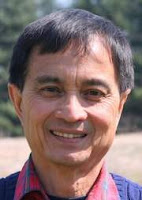
By A. Gaffar Peang-Meth
Pacific Daily News (Guam)
Ironically, it was one of my elementary school teachers, a "progressive" chap, who told us in one of his lectures in the early 1950s to "awaken" our "sleeping" national consciences, that whether one is black, brown, yellow, or white, every person has "one kilo of brain" -- that one brain is as good as another; that it can learn anything as long as the person with the brain is willing and ready to learn; and that with a brain, man can do anything.
Whoa! I was skeptical of that. If all brains are equal and good, why were our grandparents and great grandparents, products of a great civilization, ruled by white men for more than 100 years?
But, hey, maybe the "progressive" teacher was that political activist seeking to upset the authority, the French rulers and his majesty the king, under whose sacred feet subjects resided (kraowm l'aorng thuli preah bat). Weren't we taught to "korub, kaowd, khlach, smoh trang" (respect, admire, fear, be loyal)?
So, young rote learners learned well the tradition of blind obedience and unquestioned loyalty, and have practiced them faithfully until the present day.
Years later, I read a Chinese proverb that goes, "A teacher opens the door, but you must enter by yourself."
And my teacher came to mind: "You can lead a horse to water, but you can't make him drink."
How many of us, kids, really believed one brain is as good as another?
In 1980, I received my Ph.D. degree from the University of Michigan in Ann Arbor.
21st century learning
To learn is to gain knowledge or information, to receive instruction and acquire understanding of something. One learns from one's family, friends, teachers, books, the media; one learns through political socialization and experiences.
Yet all that unanalyzed information is like rocks in a box. In this world where nothing stands still and everything changes, we need to be armed with tools to compete and advance. To stand still, to leave our rocks in a box, is tantamount to walking backward. "Learning is like rowing upstream: not to advance is to drop back," the Chinese teach their children.
Futurist Alvin Toffler advised: "The illiterate of the 21st century will not be those who cannot read and write, but those who cannot learn, unlearn and relearn."
Specialists encourage us to learn to imagine, to ask essential questions that are necessary, relevant and indispensable to drive our thinking forward. An unquestioning mind is a mind that's intellectually dead and does not know how to proceed. They advise us to stay away from the trap of "reproductive thinking" that repeats the past, and to break out of patterned thoughts that prevent our creativity.
We are responsible
My regular readers know I am a quotation buff and I find some quotes move the earth underneath my feet. Former British Prime Minister Winston Churchill advised that it's a good thing to read books of quotations.
French playwright Moliere posited, "It is not only what we do, but also what we do not do, for which we are accountable."
A most quoted statement by Irish statesman and philosophical founder of conservatism, Edmund Burke, says, "All that is needed for the triumph of evil is for good men to do nothing." When good men are idle, the path is free for evil to enter and take over. Many, however, are free-riders who sit on the sidelines while others do the heavy lifting to improve the quality of life for others.
Heed the words of Nobel laureate Elie Wiesel, a Romanian-born survivor of the Holocaust: "There may be times when we are powerless to prevent injustice, but there must never be a time when we fail to protest." Wiesel "swore never to be silent whenever and wherever human beings endure suffering and humiliation. ... Silence encourages the tormentor, never the tormented."
And remember the words of a victim of the Nazis, Pastor Niemoeler: "First they came for the Jews and I did not speak out -- because I was not a Jew. Then they came for the communists and I did not speak out -- because I was not a communist. Then they came for the trade unionists and I did not speak out -- because I was not a trade unionist. Then they came for me -- and there was no one left to speak for me."
"The ultimate measure of a man is not where he stands in moments of comfort and convenience, but where he stands at times of challenge and controversy," said American civil rights leader Martin Luther King Jr., a student of India's great political and spiritual leader, Mahatma Gandhi, master of civil disobedience and nonviolence.
"Our lives begin to end the day we become silent about things that matter," King said.
A. Gaffar Peang-Meth, Ph.D., is retired from the University of Guam, where he taught political science for 13 years. Write him at peangmeth@yahoo.com.








