Showing posts with label Cambodian immigrants in the US. Show all posts

Wednesday, May 25, 2011

Congressional hearing after FOX Undercover report on illegal immigrants


Congress Trying To Close Immigration Loophole

Tuesday, 24 May 2011

BOSTON (FOX 25 / MyFoxBoston.com) - A loophole exposed by FOX Undercover is in the national spotlight today as lawmakers in Washington, DC hold a congressional hearing.

It comes after our investigative team discovered the federal government releasing illegal immigrants with violent criminal records, even though it wants to deport them.

Fox Undercover’s local example of the national problem was front and center at the hearing before the Immigration Subcommittee of the Judiciary Committee.

The subcommittee’s chairman, Rep. Elton Gallegly, cited the example in the Fox Undercover report as he kicked off the hearing.

“Mrs. Hutchinson's son was attacked while walking home from a football game in Suffolk County just outside of Boston,” said Rep. Gallegly.

Gallegly is referring to the murder of 16 year old Ashton Cline-McMurray who was killed by four teenagers in Revere 11 years ago.

Loeun Heng, an illegal immigrant who pleaded guilty to manslaughter, received a 10 to 12 year sentence.

Sunday, November 07, 2010

Neighborhood Watch [-A novel about Cambodian immigrants]

WORLD AND TOWN
By Gish Jen
386 pp. Alfred A. Knopf. $26.95
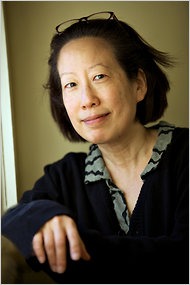
Gish Jen (Romana Vysatova)
November 5, 2010
By DONNA RIFKIND
The New York Times

In three previous novels and a book of short fiction, Gish Jen draped her characters’ troubles in a mood of antic good humor, then gradually allowed those troubles to reveal themselves. In “Typical American,” readers came to understand, through Jen’s adroit storytelling, the disappointments beneath the resilience of the Chinese immigrants Ralph and Helen Chang; in “Mona in the Promised Land,” Jen gave us the identity struggles of the couple’s American-born daughter. Still more complex were the varieties of emotional experience among the Wong family in “The Love Wife,” whose chorus of voices began with an exuberant clamor and ended up somber, reflective and hushed.

This expansiveness helped lend authority to Jen’s tales about the search for a true home in multiethnic America. Her genial family comedies were intimate but never small, and were never only comedies. In an interesting reversal, “World and Town” begins in an entirely different mood. Grief is all over, with a jittery under­tone of suspicion; and the novel’s humor, while plentiful, is most often edged in black.

In the spring of 2001, at age 68, Hattie Kong is mired in “a loneliness almost beyond words” after losing both her husband and her best friend to cancer. A retired high school biology teacher, she’s living alone in an apple-cheeked New England mountain town with the dopey name of Riverlake; her journalist son, Josh, checks in by phone every now and then, their conversations drifting into a mournful silence.

Busying herself with a few hobbies, her three dogs and regular walks with a group of local women, Hattie steels herself to endure mostly empty days. Then comes an inescapable disruption: the arrival of a Cambodian family, newly installed in a double-wide trailer on church-owned property just down the hill from Hattie’s house.


“It’s the world come to town,” she imagines her dead husband saying. “As it will, you know, as it will.” How Hattie and the other townspeople wrestle with their responsibility toward this strange, distressed family determines the course of the novel and dramatizes ideas about identity and acceptance that Jen explored in her earlier books. “It’s always been a question, hasn’t it,” one of Hattie’s walking-­group friends notes. “Whom America can be America for. And who keeps America, America.”

Wanting to help, Hattie finds herself drawn especially to the 15-year-old daughter, Sophy, who gradually discloses some details about her family’s situation. Years ago, her parents, Chhung and Mum, each witnessed the death of a spouse at the hands of the Khmer Rouge. After uniting in a refugee camp, they adopted an orphan boy whom they named Sarun. Sophy and her two sisters were born in America a few years later, though the sisters now live in foster homes, having been banished because of some shameful sin Sophy recently committed, the girl hints darkly. Sarun has grown into a foul-mouthed teenager with ties to an Asian gang. And now there’s a baby boy as well, named Gift because he has arrived, or so Mum believes, as compensation for three sons who died of starvation in Cambodia.

More unsettling to Hattie than this terrible history are what she perceives as its damaging effects. Sophy and Sarun don’t seem to be going to school. Mum works sometimes as a house cleaner, but her intermittent pay is negligible. Chhung, often drunk, argues constantly and sometimes violently with Sarun. Sophy finds a refuge — or is it, Hattie wonders, an indoctrination? — at a fundamentalist Christian church, drawn more toward its promises of instant rewards than to Mum’s passive Buddhist hopes for reincarnation. “She wanted to be reborn into the right life, her real life,” Jen writes of Sophy. “Her old life was just so wrong.”

Even as Hattie cautions Sophy against the hard sell of the church, she’s forced to examine her own motives. Raised in the Chinese port city of Qingdao, she’s the daughter of an American missionary mother and a father descended from Confucius. Shipped off to her mother’s relatives in Iowa at age 17 to escape the threat of the People’s Liberation Army, Hattie has felt ever since like “a person away from herself,” a permanent exchange student, a stranger. Maybe she’s identifying too strongly with Sophy’s yearning for acceptance to counsel her effectively. How is she to balance the Confucian ideal of guan — detachment — with its counterweight, ren, human-heartedness?

Other Riverlake residents view Sophy’s family with less compassion and more suspicion, imagining the newcomers as one more hostile disturbance to their once pristine landscape (similar to the town hall proposals for a new cellphone tower and a sprawling Value-Mart). Yet how pristine was it, exactly? Who’s to blame for the vanishing family farms, the rash of recent thefts, the decline of religious values, the general malaise? By the time the world comes to town with news of the Sept. 11 terrorist attacks, fear is already a longtime resident.

One of Jen’s greatest strengths is her fluid point of view, which she employs beautifully here, alternating perspectives among Hattie, Sophy and a local man named Everett, whose wife is Sophy’s sponsor at the Heritage Bible Church. Nothing is fixed for these unsettled characters, who keep trying to build new lives in a bewildering world, and whose victories, when they come, bring not rapture but “a defining grace, bittersweet and hard-won.”

Donna Rifkind has written for The Washington Post, The Wall Street Journal and other publications.

Monday, November 24, 2008

Cambodian family reunited after 8 years

Sunday, November 23, 2008
Times News-MagicValley.com (Twin Falls, Idaho, USA)

It was Sokry who first came to Twin Falls from Cambodia in 2000 to be with her new husband from an arranged marriage. Her two younger sisters followed: Davy in 2004 and Dany in 2006.

Earlier this year, her parents left Cambodia for good to be with their daughters.

It took eight years, but the Heng family is finally together again.

On this Wednesday evening, they gather around a hot pot dinner. The family dips rich pieces of raw beef into a boiling broth filled with vegetables and noodles. When the beef is cooked to their liking, they skillfully extract it with chopsticks.

It's a slow-paced, luxurious dinner - one that the family would have been hard to come by in Cambodia.

"Over there, they don't have a lot of variety,"Sokry says. Food is plentiful, but beef is eaten only in stew. Most people depend on fish and pork for their main meat intake.

Thirty years ago, the situation in Cambodia was much worse.

Dictator Pol Pot took over the country in 1975. Tens of thousands of victims of the regime were systematically tortured and executed. Peasants starved by the millions. Sokry's parents, Heng Ly and Houng Sok, survived on scant bowls of rice porridge and boiled banana leaves.

Houng gave birth to Sokry right after Pol Pot's regime ended in 1979, and the family's life stabilized. Houng and Heng opened a kitchenware store in Tbaung Khmum, an industrial city of 10,000. They sold chopsticks, spoons, bowls and cups during the day and lived on the second floor of the store at night.

"We lived well,"Sokry said.

In Twin Falls, the family is maintaining the good life. Sokry's husband, Yip Tse, works at Pak N Ship. The couple also owns Asian Food Market in TwinFalls, where Sokry and Dany work. Sokry and Yip share a duplex with their parents and Dany, while Davy lives with her husband (and Yip's older brother),Ken.

The sisters followed tradition in taking their father's first name as their family name, and the two young wives kept it after marrying.

Tonight, the whole family comes to the duplex to share the meal. They pile the food on two folding tables in the living room. A Buddhist shrine sits on the floor next to the entertainment center.

Yip is the last to arrive, to his wife's playful admonishment.

"Some of us have to work for a living!"Yip teases.

Their son, also named Yip but called "little Ken," runs around, pretending to shoot his family with a plastic Nerf gun. Unlike his grandparents, it's the closest the 5-year-old has come to violence.

Twenty years ago in Cambodia, armed bandits came to their city, robbing, beating and killing the family's neighbors. They came as close as the house next door but spared the Hengs' home. Sokry was 10 years old.

"They were probably too young to remember," she said of her sisters.

Now, the country is safer and provides a higher standard of living. Electricity is available 24 hours a day instead of being shut off at 11 p.m. nightly.

"It's great now,"Sokry said.

But memories of political unrest and civil violence are still fresh. When asked what she likes about Twin Falls, the first thing Dany says is: "It's safe."

Brothers Yip and Ken Tse were born in Cambodia, but moved to Idaho when they were children. Yip's cousin in Cambodia knew Sokry and suggested the two marry. They agreed, and the husband and wife didn't meet until Yip came to Cambodia for their wedding.

"It's just Cambodian tradition,"Sokry said. "It worked out well."

At the wedding, Davy met Ken. Four years later they wed, and Ken whisked her away to TwinFalls, too.

Over dinner, Dany, the youngest at 24, talks about Cambodia between bites of beef and rice.

"Imiss my grandma and all my cousins," she says. "Even though sometimes here looks better than Cambodia, it's my motherland."

Twin Falls is too cold, she adds. Before coming here, she had never seen snow. It rarely dips below 70 degrees in her home country.

"I love the weather in Cambodia a lot," she says, smiling wistfully.

Unlike her older sisters, Dany didn't have a husband waiting for her in Twin Falls. She came to be with Sokry and Davy in 2006, but immediately regretted the move.

Every day, she cried. She missed her parents and grandparents. She didn't speak English and couldn't understand the customers at work.

"She cried for months,"Sokry said.

Slowly, she started feeling more at home. She took English classes at College of Southern Idaho and practiced with customers and co-workers. Soon, she wouldn't shut up, Yip teased.

With Dany gone, Heng and Houng had little reason to stay in Cambodia. Sokry, family friend Bert Cobb and Yip's mother, Lan Tse, helped the couple apply to move to Twin Falls, a process that took two years. When they arrived in March, the two didn't speak a word of English and felt bad about leaving their siblings and elderly parents in Cambodia. But in the end, what mattered most was being with their daughters.

Although Cambodia is a world away, the Heng family is comfortable here.

They can buy most of their favorite foods, like noodles and lychee fruit drinks, through Asian Food Market. Houng accompanies her daughters at work, where she silently helps around the store. At home, the two young married couples flirt in both Cambodian and English. Dany posts handwritten signs around the house in an attempt to teach her parents English vocabulary. They watch the news in English and listen to Cambodian music.

And at the end of the day, they're rewarded with family dinners together in their comfortable, crowded living room.

Melissa Davlin may be reached at 208-735-3234 or melissa.davlin@lee.net.

Monday, March 24, 2008

Culture gap

In other countries, symptoms of mental illness vary, with treatments that American doctors are just beginning to appreciate

March 24, 2008
By Patricia Wen
Boston Globe Staff (Massachusetts, USA)


LOWELL - Heap You's doctors thought she was crazy. The Cambodian immigrant kept saying her neck was going to explode, though an examination showed nothing physically wrong. One hospital put her on antipsychotic medication.But eventually, the mother of five was referred to Dr. Devon Hinton, a psychiatrist with a clinic in this city's struggling downtown. She arrived in his office one spring day 10 years ago with her neck upright and rigid, even as she sobbed about her troubled family life. She told Hinton that she didn't want to move her neck because excessive "wind," bottled up in her body, might surge through her neck, break blood vessels, and kill her.

Hinton realized the patient was not out of her mind. The Harvard assistant professor, who specializes in treating Southeast Asian patients, knew that some Cambodians believe that the circulation of wind throughout their bodies maintains their health, and poor circulation from an ill body can cause a dangerous strokelike explosion of wind.

Hinton, speaking in You's native Khmer language, told her to taper off her antipsychotic medications, according to his records, and handed her prescriptions for two other drugs - one to help her sleep, another to control her anxiety attacks. He urged her to continue her traditional Cambodian practices to help "wind" flow.

After regular therapy sessions with Hinton, You's emotions stabilized. And she trusted these words from him: You're not going to die from your neck vessels bursting.

Hinton was one of the first foot soldiers in a national push to offer more culturally sensitive mental health care to immigrant groups, often in small clinics in urban areas. These clinicians are part cultural anthropologists, part psychiatric professionals, part medical detectives. A key part of their work is properly diagnosing mental illness that patients often first articulate as body pain, headaches, or stomach ailments.

"You often see emotions expressed as a bodily symptom," said Dr. Glenn Saxe, a psychiatrist at Children's Hospital Boston who has helped develop a new mental health clinic for Somalian refugees.

Among newcomers to this nation - one in eight Americans is now foreign-born - mental illness can be an alien, stigmatizing term, and many immigrants from Latin America, Africa, and Asia are far more likely to talk initially about physical ailments than seek psychiatric services.

Over the past several years, top mental health specialists have begun a number of new initiatives to improve psychiatric care for immigrants. The Massachusetts Department of Mental Health, along with a team of researchers, are educating primary care doctors around the state about what physical symptoms might be signs of mental disorders.

Primary care clinics in Somerville and Cambridge, run by the Cambridge Health Alliance, are going a step further, installing computerized educational programs in Portuguese, Spanish, and Creole, aimed at teaching immigrants how fatigue, intestinal complaints, and other physical ailments, as well as intense homesickness or loneliness, can be signs of depression.

Researchers say cross-cultural psychology was once relegated to the margins of mental health practice, viewed as a kind of exotic sideshow to mainstream medicine. But ever since a 1999 surgeon general's report on mental health found the impact of culture has been "historically underestimated," a growing number of clinics focused on immigrants' needs have opened. Many have blended traditional practices from patients' homelands with conventional Western treatments, and have hired translators and staff who share the patients' immigrant roots.

Like many other clinicians, Hinton, who practices at Arbour Counseling Services, in Lowell, is careful not to overgeneralize about any ethnic group. Not every Cambodian with anxiety disorders, for instance, will focus on neck pain. And some neck pain is just that - and needs an X-ray follow-up. But after working with Southeast Asian refugees for more than two decades, Hinton has identified more than 400 Cambodian patients who complained about neck ailments while being diagnosed with panic and anxiety disorders. In research papers he has published, he calls the phenomenon "sore-neck syndrome."

Hinton said each immigrant group has a particular "ethnophysiology," or the way in which they perceive their body's inner workings. He said English and German culture often raise "heart-focused" complaints when conveying anxiety, while Latin American cultures refer to attacks of "nerves."

Hinton said many Cambodians believe in the importance of wind, and that this wind must exit regularly through their feet and hands. But when their extremities become cold, perhaps because of an involuntary physical response to stress, they worry that the wind is becoming trapped in their torso.

As a result, Hinton said, they develop culturally rooted fears about the trapped wind suddenly bursting through the neck. He sees it as his job to reverse this type of snowballing, disastrous thinking - which can lead some doctors, unfamiliar with Cambodian culture, to mistakenly think the patient is psychotic.

During Hinton's sessions with You, he asked her to rotate her neck repeatedly while he was present, a way of convincing her that she would not die from such movement. He encouraged her to use native treatments to help alleviate her stress, such as "cupping," in which a person places a suction cup on the forehead for several minutes to help the wind flow. When the cup is removed, it leaves a red circular mark that looks like a raised welt, which can remain for days.

"It helps me suck my headache out," the 50-year-old You said in an interview in her Lawrence home. Her therapy with Hinton has convinced her she will not die of "wind overload," she said, and she no longer has the overwhelming worries that she once did.

But, at home now and then, she still uses the "cupping" technique, which she learned from her grandparents in Cambodia, and has since encouraged her children to use it as well. She also continues to take what she calls "Dr. Hinton's medicine," including a sleep medication and an antidepressant.

Hinton believes that his encouragement of "cupping" practice helped build You's trust in him, and explains in part why she continues to confide in him about her family and financial struggles.

Ultimately, Hinton diagnosed Heap with depression and a panic disorder common among Cambodian refugees, particularly those who lived through the brutal Khmer Rouge regime, responsible for killing more than 1 million Cambodians in the late 1970s.

Dr. Francis Lu, a specialist in cultural diversity with the American Psychiatric Association, who is familiar with Hinton's work, said the typical American clinician may find it a daunting task to understand the nuances of all the culturally diverse groups in this country.

"We don't know all the intricacies of hundreds of cultures, but that doesn't mean we throw up our hands," Lu said. "There's a certain body of knowledge that we're collecting. And at least we should know what we don't know."

Patricia Wen can be reached at wen@globe.com.



