KI-Media loves to hear from you, and we're giving you a bullhorn. We just ask that you keep things civil. Please leave out personal attacks, do not use profanity, ethnic or racial slurs, or take shots at anyone's sexual orientation or religion. We thank you for your cooperation!
January 24, 2012 By KEITH BRADSHER and RICK GLADSTONE The New York Times
HONG KONG — Deadly showdowns between Chinese security forces and Tibetans in a restive region of western China spread to a second town on Tuesday, outside advocacy groups reported. At least two and perhaps as many as five Tibetans were killed by gunfire and many more wounded, the groups said, in what appeared to be the most violent outbreak in the region in nearly four years.
The new confrontation, in the town of Seda, known in Tibetan as Serthar, was reported by Free Tibet, a London-based organization that advocates Tibetan autonomy, and by Phayul.com, a Tibetan exile web portal. Their accounts said that Chinese security forces opened fire on a crowd of Tibetan protesters in Serthar. Free Tibet said it had confirmed two deaths and an unspecified number with “serious wounds,” and said the town was under curfew.
“This is the second consecutive day that Chinese forces have opened fire and killed unarmed Tibetan protesters,” said Stephanie Brigden, director of Free Tibet.
DHARAMSHALA: A group of parliamentarians of Cambodia has made a strong call for an end to the human rights violations in Tibet, urging China to engage in sincere dialogue with the Tibetan side to resolve the issue of Tibet.
“It is with a strong sense of unity that we Cambodian parliamentarians support the recent move by British Parliamentarians to halt the continuing injustice in Tibet,” noted a press release issued by three MPs, Son Chhay , Cheam Channy and Yont Tharo from the opposition Sam Rainsy party.
Expressing serious concern over the recent spate of self-immolations in Tibet, the MPs said, “these acts of self-immolation make sense when one considers the decades of repression, intimidation, fear, and violence that Tibetans have endured daily under China’s rule which only appears to be worsening.”
SRP MP Son Chhay visiting the Dalai Lama on September 2010
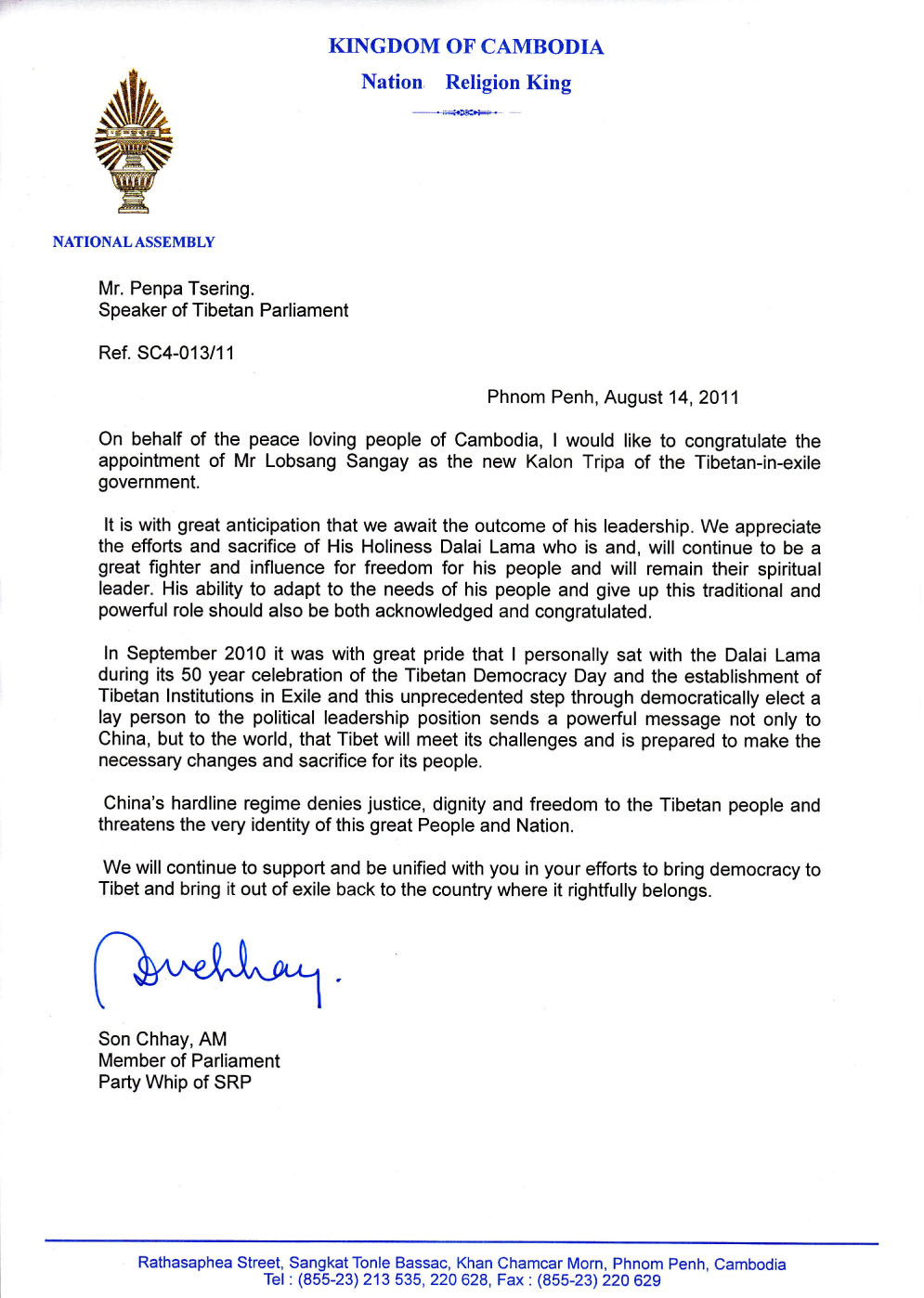
Mr. Penpa Tsering.
Speaker of Tibetan Parliament
Ref. SC4-013/11
Phnom Penh, August 14, 2011
On behalf of the peace loving people of Cambodia, I would like to congratulate the appointment of Mr Lobsang Sangay as the new Kalon Tripa of the Tibetan-in-exile government.
It is with great anticipation that we await the outcome of his leadership. We appreciate the efforts and sacrifice of His Holiness Dalai Lama who is and, will continue to be a great fighter and influence for freedom for his people and will remain their spiritual leader. His ability to adapt to the needs of his people and give up this traditional and powerful role should also be both acknowledged and congratulated.
In September 2010 it was with great pride that I personally sat with the Dalai Lama during its 50 year celebration of the Tibetan Democracy Day and the establishment of Tibetan Institutions in Exile and this unprecedented step through democratically elect a lay person to the political leadership position sends a powerful message not only to China, but to the world, that Tibet will meet its challenges and is prepared to make the necessary changes and sacrifice for its people.
China’s hardline regime denies justice, dignity and freedom to the Tibetan people and threatens the very identity of this great People and Nation.
We will continue to support and be unified with you in your efforts to bring democracy to Tibet and bring it out of exile back to the country where it rightfully belongs.
Son Chhay, AM
Member of Parliament
Party Whip of SRP
The Dalai Lama walks outside the White House after his meeting with U.S. President Barack Obama on Thursday.
February 19, 2010
Beijing, China (CNN) -- China summoned the U.S. ambassador on Friday to express its "strong dissatisfaction" over the Dalai Lama's meeting with U.S. President Barack Obama a day earlier.
China didn't disclose what was discussed during the session with Ambassador Jon Huntsman at the Foreign Ministry. But Beijing had warned that a meeting between the president and the exiled Tibetan spiritual leader would damage its ties with Washington.
"The Chinese side expresses strong dissatisfaction and resolute opposition to this meeting," a spokesman for China's Foreign Ministry said in a statement after Thursday's meeting at the White House.
"China demands the U.S. seriously consider China's stance, immediately adopt measures to wipe out the adverse impact, [and] stop conniving and supporting anti-China separatist forces."
The U.S. Embassy didn't characterize Friday's meeting, but it provided the message Huntsman delivered to Deputy Foreign Minister Cui Tiankai.
"Now is the time to move forward and cooperate in ways that benefit our two counties, the region and the world," Huntsman said, according to the U.S. Embassy.
The meeting has the potential to further complicate Sino-U.S. tensions, which have been rising in recent months.
The Dalai Lama has said he favors genuine autonomy for Tibetans, not independence for Tibet. Beijing regards the Nobel Peace Prize laureate as a separatist who wishes to sever Tibet from China.
Obama's meeting with the Dalai Lama "runs against the repeated commitments by the U.S. government that the U.S. recognizes Tibet as part of China and gives no support to 'Tibet independence'," Chinese Foreign Ministry spokesman Ma Zhaoxu said.
During the meeting, Obama stressed his "strong support for the preservation of Tibet's unique religious, cultural and linguistic identity, and the protection of human rights for Tibetans," according to a White House statement.
The president praised the Dalai Lama's "commitment to nonviolence and his pursuit of dialogue with the Chinese government," the statement added. He also stressed the importance of having both sides "engage in direct dialogue to resolve differences, and was pleased to hear about the recent resumption of talks," it noted.
The Dalai Lama, while acknowledging that he raised concerns about Tibet during the meeting, did not provide further specifics about his home region's political situation while addressing reporters.
He said he admired America as a "champion of democracy and ... freedom," and cited the need to promote "religious harmony" and "human value."
He also met with Secretary of State Hillary Clinton.
The meeting between the Dalai Lama and Obama could "seriously undermine the Sino-U.S. political relations," Zhu Weiqun, a senior Communist Party leader in charge of ethnic and religious affairs, warned recently.
"We will take corresponding action to make relevant countries see their mistakes."
On Thursday, China's Foreign Ministry spokesman said the meeting "grossly violated the norms governing ... international relations."
Obama did not meet with the Dalai Lama when the spiritual leader visited Washington last fall, making it the first time since 1991 that such a meeting did not occur. Ahead of a summit with Chinese President Hu Jintao, Obama persuaded Tibetan representatives back then to postpone the meeting with the Dalai Lama.
Thursday's encounter took place against the backdrop of several contentious issues already threatening to sour the relationship between America and China, including trade disputes, a recent U.S. arm sales deal for Taiwan -- which China considers an illegitimate breakaway province -- and a censorship row over Internet search engine Google Inc.
The meeting is "another event in the recent, one has to say, downward spiral in U.S.-China relations," said China scholar David Shambaugh.
It's also troublesome for the Chinese for one other important reason, Shambaugh said.
"He could have met him as a spiritual leader in a neutral place like a church," he said. But receiving him in the White House "is a political act. And that is going to irritate China very much."
The meeting did not take place in the formal, official setting of the Oval Office. It was instead held in the White House Map Room, which is considered part of the presidential residence. The choice of settings was considered by many observers to be a sign of Washington's acknowledgment of Beijing's political sensitivities.
Some analysts said the Chinese government could retaliate by cutting off political exchanges as they did after the Dalai Lama met with the heads of state of France and Germany. And Hu could turn down an invitation to visit Washington in April.
Neither China nor the United States can afford strained relations, said Douglas Paal, a diplomat and investment banker who has served as a presidential adviser on China.
"We both need each other," he said. "We need each other for a number of international security issues -- to deal with the global climate crisis, to deal with the global financial crisis."
China is the largest growing export market for U.S. companies, Paal said, expanding by 65 percent last year alone.
Nearly three-quarters of all Americans think that Tibet should be an independent country, according to a new national CNN/Opinion Research Corp. poll.
But the survey, released Thursday, also indicates that most Americans think it is more important to maintain good relations with China than to take a stand on Tibet.