Showing posts with label Human rights activist. Show all posts

Monday, March 19, 2012

Activists pull out of meeting with Asean leaders

18/03/2012
Achara Ashayagachat
Bangkok Post

Independent Asean activists will boycott a traditional meeting with regional leaders in a sideline session of the Asean Summit in Phnom Penh next month after the Cambodian government set conditions for nominating their representatives.

Asean non-profit organisation representatives were to meet Asean leaders on April 3 in a related session of the summit in Phnom Penh on April 3-4 under the so-called interface dialogue.

Phnom Penh has sidestepped the nomination of representatives by telling its Asean colleagues to nominate their own people instead of the Asean Civil Society Conference and the Asean People's Forum (ACSC/APF) as normal.

NGOs said Cambodia's action has undermined the process of independent groups galvanising local support and coordinating functions with other Asean counterparts.

Tuesday, October 12, 2010

A Profile of Theary Seng, Cambodian Human Rights Activist


Sunday, October 10, 2010
Originally posted at http://blog.nominetwork.org

Theary C. Seng is an American-Cambodian attorney and activist now living in Phnom Penh, Cambodia. She was born in Phnom Penh in 1971 and lived under the Khmer Rouge regime from 1975-1979. In 1980, she and her family immigrated to the United States. In 2004, she chose to return to Cambodia permanently.

In Cambodia, Theary founded the Center for Justice and Reconciliation, a non-profit organization that seeks justice for the victims of the Khmer Rouge. She is also a founding director of CIVICUS: Center for Cambodian Civic Education, an organization designed to teach Cambodian citizens about civil rights, law, and government. She lobbies and speaks often about the major social issues in Cambodia which include human rights, poverty, education, land grabbing, government corruption, and human trafficking.

The Khmer Rouge regime was responsible for the deaths of 1.7 million Cambodians, almost twenty percent of the population of the country at the time. The Khmer Rouge army gained control of Cambodia in 1975. The Khmer Rouge forced all of the residents of the cities to evacuate to the countryside, to become slave labor in collectivist villages. The Khmer Rouge arbitrarily killed anyone they didn’t like, including the systemic executing of everyone who was educated or had foreign influences.

Theary Seng and her family witnessed the full extent of the horror. While she and her family were evacuating Phnom Penh, Theary’s father decided to make a trip back in to the city to get more food. He was never seen again. Sometime later, Theary, her mother and a brother were imprisoned for several months, where, one morning, brother and sister woke-up to discover that while they were sleeping, their mother had been taken away to be killed. Throughout the entire period, in both the collectives and the prison, families and individuals were being taken away and killed on a regular basis. Food, clothing, housing, and medical care were scarce. Everywhere, people were tortured, worked, and starved to death. The extended family of grandmother, aunts, uncles, cousins, and brothers became refugees in their own country. At first they tried to seek refuge in Vietnam, but that proved too risky. They along with groups of other refugees decided to escape into Thailand. But Thai soldiers forced them at gunpoint to march back into Cambodia on a narrow path through a valley that was heavily mined. If anyone refused, was too tired, or lagged behind, the Thai soldiers simply shot them on the spot.

In 1979, Theary and her surviving extended family members were able to successfully cross the Thai border at another location and arrive at a refugee camp. After a year, they were accepted as refugees in the United States. Theary went on to graduate from Georgetown University in 1995, from the University of Michigan Law School in 2000, and is a member of the bar in New York State.

In 2005, Theary published a memoir titled, Daughter of the Killing Fields, incorporating historical sources, her own childhood memories and feelings, as well as the recollections of her family and others. As a young refugee in the United States, Theary became a Christian, and she attributes her sense of social obligation--of a need to give back--to her Cambodian past, combined with her Christian faith. As a law student and a lawyer Theary had gone back to Cambodia several times as a volunteer to assist with various human rights projects. In 2004, she moved to Cambodia permanently, with the initial intention of working on labor issues. But eventually the scope of her attention shifted and expanded to seeking justice for the survivors of the Khmer Rouge. She has been an influential public figure in the efforts to bring the former leaders of the Khmer Rouge to trial. Moreover, Theary frequently writes and speaks about what is needed for the Cambodian nation to recover from that evil regime. She has published articles regularly in Cambodia Daily, the Phnom Penh Post, and Ki-Media, She is also the co-host of a Cambodian T.V. show called, Youth Leadership Challenge.

After the Khmer Rouge had killed her parents her parents, Theary became the beneficiary of the unconditional love of her extended family of grandmother, aunts, uncles, cousins, and her four brothers. After many years of healing of healing in the U.S., she was able to emerge from the experience with her humanity and her emotional health intact. Unfortunately that has not been the case for numerous other survivors. The Khmer Rouge years have scarred the psyche of millions of Cambodians and left them with a legacy of domestic violence, post-traumatic stress disorder, hyper-vigilance, and social dysfunction that permeates their society.

In an interview, Theary said, "My work here is not to do anything big but to be a common citizen back in my homeland where I suffered a lot, and now I'm taking that suffering and shaping it into hope, and trying to work with individuals who have not had the time and space to heal that I've had.”

Besides the killings and abuse, the Khmer Rouge destroyed all of the commercial and education institutions in the country, leaving it as the poorest country in the world. In Daughter of the Killing Fields, she said: “I continue to mourn the loss of lives due to the Khmer Rouge. Today, I also mourn the loss of human potential. How many Khmer Mozarts, Einsteins and da Vincis will never be realized because there are no infrastructures to encourage and absorb a Khmer child’s potential? I mourn when I meet a little girl on the street begging. I see my face in her face. The only difference between us is in our opportunities. At one point in my life, an opportunity existed which led to other opportunities that nurtured and encouraged my budding potential. In this little girl’s situation, in light of the current infrastructure and framework, the odds are stacked against her.”

Theary Seng's own childhood story was a victory of hope over persecution, suffering and evil. Theary could have chosen to remain in the United States and to pursue a career as an attorney, while living a life of comfort and affluence. Instead, she has chosen to work to inspire hope in her fellow Cambodians, to lead them to a shared vision of justice, human dignity, and triumph over adversity.

Also see Nomi Network's, An Interview with Theary Seng, on Sex-Trafficking in Cambodia

Saturday, October 02, 2010

Nobel Peace Prize 1984: Desmond Tutu

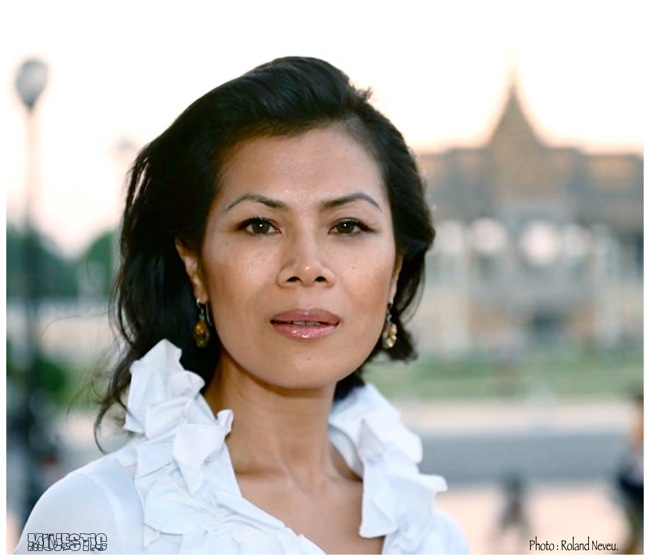
Theary Seng (Photo: Roland Neveu)
Recently, I decided that I want to know more about the Nobel Peace Laureates through the Award Ceremony Speeches. And it’s good to have company in the learning process, so I am taking you along. Here’s one to a man I have read a lot about, but it’s never enough, as his life imparts endless inspirations. Moreover, he comes from a country I love from readings (especially, Cry, the Beloved Country, a novel I have read at least three times and every time, it’s impossible to keep dry eyes) and my magical 6-month stay in Pietmaritzburg during my last year of law school in 1999 as well as the recent visit for a workshop in Stellenbosch this December 2009. In reading this, my thoughts continue to turn to our Cambodian sisters and daughters who are trafficked in modern sexual slavery. Here, the emphasis is mine.

– Theary C. Seng, Phnom Penh, 3 Oct. 2010
. . . . .
Archbishop Desmond Tutu (Photo: Veterans Today)
Award Ceremony Speech (Presentation Speech by Egil Aarvik, Chairman of the Norwegian Nobel Committee)

Your Majesty, Your Royal Highnesses, Your Excellencies, Ladies and Gentlemen:

The Norwegian Nobel Committee wishes, through the presentation of this year's Nobel Peace Prize, to direct attention to a unifying leader figure in the campaign to solve South Africa's apartheid problem by peaceful means. The situation as it is today is such that a peaceful solution is by no means inevitable - the repression is so brutal that a violent rebellion would be an understandable reaction. The South African has more reason now than ever before to exclaim "Cry, the beloved country".

Given this situation it is all the more remarkable that human beings are able to choose a peaceful way to freedom.


It is the Nobel Committee's opinion that the means by which the South African liberation process is conducted will have wide-ranging consequences for the whole of the African continent, and therefore also for the cause of peace in the world. This is an opinion which is also expressed in a number of United Nations resolutions - most recently that passed by the Security Council in October this year. Racial discrimination in South Africa is rightly regarded as a threat to peace and as an outrageous violation of basic human rights.

Fortunately, a peaceful alternative exists. On a broad front a campaign is being fought with the weapons of the spirit and reason - a campaign for truth, freedom and justice. In recognition of the fact that it is this alternative which must succeed, the South African bishop, Desmond Tutu, has been selected as this year's Peace Prize laureate.

The contribution he has made, and is still making, represents a hope for the future, for the country's white minority as well as the black majority. Desmond Tutu is an exponent of the only form for conflict solving which is worthy of civilized nations.

It is today 23 years since the Nobel Peace Prize was last awarded to a South African. On that occasion it was Albert Lutuli, then president of the African National Congress, who was presented with the prize. It is the Committee's wish that this year's award should be seen as a renewed recognition of the courage and heroic patience shown by black South Africans in their use of peaceful means to oppose the apartheid system. This recognition is also extended to all who, throughout the world, stand in the forefront of the campaign for racial equality as a human right.

It is unfortunately not only in South Africa that human rights are violated. Another former prizewinner, Amnesty International, informs us that it is known to occur in 117 countries, and that prisoners of conscience are tortured in 60 countries. Too frequently, the brutal features of power and violence mar the face of our times. But if we are willing to look for it, we can also see the face of peace - even if we have to peer through prison bars and barbed wire to find it. And, in spite of everything, new hope is raised, on each occasion we see how the spirit of man refuses to be conquered by the forces of hate.

Some time ago television enabled us to see this year's laureate in a suburb of Johannesburg. A massacre of the black population had just taken place - the camera showed ruined houses, mutilated human beings and crushed children's toys. Innocent people had been murdered. Women and children mortally wounded. But, after the police vehicles had driven away with their prisoners, Desmond Tutu stood and spoke to a frightened and bitter congregation: "Do not hate", he said, "let us choose the peaceful way to freedom".

It is with admiration and humility we today present the Nobel Peace Prize to this man.

Desmond Tutu's contribution to the liberation struggle was given a special significance in 1978 when he became the first black secretary of the South African Council of Churches. This Council of Churches is both a joint forum for the churches of South Africa and the national representative for the World Council of Churches. It includes all the major churches in the country - with the exception of the Boer Church which withdrew as a result of disagreement with the Council over the question of apartheid. The Catholic Church is a so-called associate member, but is also one of the Council's strongest supporters.

As around 75 percent of all citizens of South Africa are members of a church, the body is a very representative organization. Few other organizations can make the same claim to speak for the black population.

As the dynamic leader of this Council, Desmond Tutu has formulated as his goal "a democratic and just society without racial segregation". His minimum demands are: equal civil rights for all, the abolition of the Pass Laws, a common system of education and the cessation of the forced deportation of blacks from South Africa to the so-called "homelands".

Both through these objectives and through its practical activities the South African Council of Churches has obviously exceeded the normal scope of such an organization. The Council has become a trailblazer in the campaign for human rights, a central force in a liberation struggle and an increasingly wide-ranging support organization for the many victims of the present system's racial discrimination. Consider what happens when millions of human beings are deported. Their homes are razed to the ground. Their personal possessions are taken from them. They lose their jobs, and are physically transported and deposited in the empty veld with just a tent and a sack of maize as their only hopes of survival.

3 millions have been deported in this way, while new millions await their turn.

If we ignore for a moment the personal humiliation, the question remains - who is there to help these people to survive in their new existence? Who will help them house themselves, find water, tend to the sick or educate their children?

The system also has - obviously - its political prisoners. Their crime is the necessary one of wanting a society with freedom and respect for human rights! They are imprisoned - but who is there to help their families?

There is also the so-called "migration labor" system under which underpaid laborers are obliged to live away from their families. The Pass Laws are also notorious; they burden the black population with a collective captivity and make them foreigners in their own country. Anyone breaking these laws risks group arrest and indefinite imprisonment without legal help.

It is not difficult to imagine that, as a result of this system, there are considerable social, medical and legal problems which necessitate help from the South African Council of Churches. It is a pleasure to note that over 90 percent of the Council's budget is covered by contributions from churches in the Western world, while it is with anxiety we note that new laws are being prepared which will deprive the Council of the right to administer its own funds [Cambodian draft NGO law to curb civil society??]

As already mentioned, racial discrimination is by no means limited to South Africa. Before the Second World War such discrimination was relatively common, and world opinion was not particularly concerned with it. The situation changed, however, after 1945: new ideas were expressed in the Atlantic Charter and the Declaration of Human Rights.

During the war it was possible to see signs of a more liberal policy evolving in South Africa. The ideas from the Atlantic Charter, however, had little effect there, and when the Nationalist Party won the election of 1948 the situation worsened. It was in this period that the apartheid laws were formulated and ratified, a move which has correctly been described as a counter-revolution against pre-1948 tendencies.

History is never without a certain sense for the ironic - the man who more than anyone else was responsible for the implementation of the apartheid system, the Nationalist Party's first prime minister Dr. Daniel Malan, was a churchman, an ordained priest in the Dutch Reformed Church. And now we see that the most dynamic opponent of the apartheid system is also a churchman - in fact a bishop! In this way history corrects its own mistakes.

The irony of history is even more wide-ranging. The apartheid system is the indirect reason for the fact that Desmond Tutu became a churchman with the position he has today. His first wish was to become a doctor, but this was impossible with his parents' financial situation. He became, therefore, a teacher - as his father had been. In 1957 when the government introduced the state "Bantu education" - in many ways an abolition of education for the black population - Tutu felt himself driven from the teaching profession and began to study to be a priest. He has himself said that he did not feel himself called to take this step by high ideals, "it just occurred to me that, if the Church would have me, the profession of priest could be a good way of serving my people".

Yes - it seems that the Church was willing to take him!

Obviously, Desmond Tutu was not without high ideals. And, like so many others, he had these ideals from the family home. In his childhood in Klerksdorp in the West Rand district he was taught tolerance and sympathy. He has himself said that "I never learnt to hate". The idealism of his parents was thus reflected in Tutu's upbringing.

When Tutu was twelve years old his family moved to Johannesburg, where his father was a teacher and his mother a cleaner and cook at a school for the blind. Here he learned sympathy for the weakest and most underprivileged. It was also here that he met the man who probably exercised the strongest influence over his formative years, the white priest Trevor Huddleston, who was parish priest in the black slum of Sophiatown. "One day", says Tutu, "I was standing in the street with my mother when a white man in a priest's clothing walked past. As he passed us he took off his hat to my mother. I couldn't believe my eyes - a white man who greeted a black working class woman!" When Tutu has in later years been asked why he doesn't hate whites, he usually replies that it is because he was fortunate in the whites he met when young.

But, although he has never learnt to hate, none has opposed injustice with a more burning anger. Courageous and fearless he opposes his country's authorities. He is to be found at the front of the demonstration processions, regardless of the danger to his own life. His clear standpoints and his fearless attitude have made his name a unifying symbol for all groups of freedom campaigners in Africa.

Desmond Tutu has shown that to campaign for the cause of peace is not a question of silent acceptance, but rather of arousing consciences and a sense of indignation, strengthening the will and inspiring the human spirit so that it recognizes both its own value and its power of victory. To this fight for peace we give our affirmative "yes" today.

The actress Liv Ullmann has told of a Lebanese boy who was asked if he believed in revenge. "Yes", replied the boy, he believed in revenge. "And to revenge", he was asked, "what is that?" "To revenge", replied the boy, "is to make a bad person a good person."

Thoughts of this nature are the human spirit's bulwark against barbarism. It is those who have such thoughts who are the real peacemakers and the meek, who are not only blessed, but who shall also inherit the earth - also the earth of South Africa. The 23 million coloured people shall at least have the same right of inheritance of this earth as the 4.5 million whites.

The question has been raised whether the award of the Peace Prize to Desmond Tutu is to be seen as a judgment on the South African apartheid system. The answer is that the system has judged itself. Racial discrimination can never be anything but an expression of shameful contempt for humankind. Racial discrimination used and defended as a political system is totally incompatible with human civilization. This year's Peace Prize is therefore an attempt to awaken consciences. It is, and has to be, an illusion that privileged groups can maintain their position through repression. That such things can have a place in our future is a lie which nobody should allow themselves to believe.

In his famous book Roots, the black author Alex Hailey tells of his African ancestor, the negro slave Kunta Kinte, who attained the position of coachman with his white master. One of his duties was to drive his white masters to luxurious parties held at neighboring farms. One evening, as he sat outside and waited, he began to philosophize over his experiences. According to the author, he couldn't understand that such an unbelievable luxury really existed and that the whites really lived the way they did. After a long time and many such parties, he began to realise that the whites' existence was, in a remarkable way, unreal - a sort of beautiful dream built on a lie which the whites told themselves: that good can come of evil, and that it is possible to lead a civilized existence while not acknowledging as human beings those whose sweat and blood made their privileges possible.

Kunta Kinte was right. Negro slavery was incompatible with American civilization - in the same way as the apartheid system is in reality incompatible with South African.

There are few if any recorded examples in history of privileged groups who voluntarily relinquish privileges to the advantage of the repressed. In all probability it won't happen in South Africa either. The possibility of an unbloody resolution of the conflict is nevertheless still there. It is such a solution that Desmond Tutu fights for. The presentation of the Peace Prize to him is, therefore, not a judgment, rather it is a challenge, a hand stretched out - in the same way as Desmond Tutu's hand is stretched out to conciliation and atonement. If only the dominant minority would recognize this opportunity and take the chance before history's amnesty runs out.

It will be understood that to present Desmond Tutu's Nobel Peace Prize with a white man's hands is in some ways an oppressive experience. On such an occasion it is impossible not to allow one's thoughts to consider what the white man has perpetrated against his colored cousins. It is depressing to think of the list of debts which is written with the African's suffering, tears and blood. Think of the humiliation and exploitation which human beings from this continent have had to endure - from the first slave traffic, through centuries of colonialism to today's discrimination. On a day like this our memories are indeed painful - not only on account of what the white man has done and still does, but also on account of what he, to this day, has neglected to do.

Thus, as we now present the Nobel Peace Prize to the African Desmond Tutu, our immediate feeling is that our first word to the Prize Laureate ought to be a word describing our sorrow over the wounds which injustice and racial hatred has inflicted on his people.

The dominating feeling is, however, one of thankfulness and respectful joy, and this is because we feel ourselves united with him in the belief in the creative power of love. With his warmhearted Christian faith he is a representative of the best in us all.


Additionally, there is a factor which the Nobel Committee has placed great emphasis on - that in the liberation process which Desmond Tutu leads black and white stand shoulder to shoulder in the common cause against injustice. In this we see a moving confirmation of the words in Alfred Nobel's testament on the brotherhood of mankind.

In the light of this we bring our homage to Desmond Tutu. Because his struggle is - and has to be - our struggle, we recognize him as a brother. He receives today the Peace Prize as a sign of the thankfulness of millions - perhaps also as an omen of black and white Africans' final victory over the last remnants of opposition in the campaign for freedom and peace. It is appropriate to remember the words of Martin Luther King just before his martyrdom: "I have seen the Promised Land!"

Even though the black South African's way forward to freedom's promised land can still be long and difficult, it is a way of humanity which we shall traverse together in the sound knowledge that "we shall overcome". Therefore our first word to the Peace Prize laureate will be a word of hope and victory: "oh yes, deep in my heart I do believe that we shall overcome - some day!"

Thursday, June 26, 2008

Congratulation Sopheap Chak for your scholarship award to pursue Master Degree in Int'l Relations at Int'l University of Japan! We're proud of you!

Sopheap Chak, with the computer notebook on her lap, at Cambodia's first Blogger Summit at Pannasastra University (Photo courtesy of David Sasaki)

Cambodia: Riding the Wave of Change

Thursday, June 26th, 2008

By Tharum Bun
Global Voices Online


In a country where men tend to have more privileges in family and society, a new wave of change is about to begin.

Sopheap Chak is another urban woman with initiatives and ambitions. The 23-year-old, originally from Kampong Cham province, is a prominent human rights activist. When she talks about changes she believes in it's as if she's a new hopeful inspirational leader.

In a country where men tend to have more privileges in family and society, a new wave of change is about to begin.

Sopheap holds two Bachelor degrees; one in International Relations from University of Cambodia; and the other one in Economics from Pannasastra University of Cambodia.

In just a few days Sopheap is leaving Cambodia to continue her study in Japan. The blogger is awarded to pursue Master Degree in International Relations at International University of Japan, where she will focus on International Peace Studies. Japanese Grant Aid Scholarship—JDS has made it possible for a number of Cambodian students to have academic research opportunities at Japanese higher educational institutions.

I communicated with gentle Sopheap via email, asking her some questions about her study, work, and blogging.

You are leaving Cambodia for Japan very soon, how do you feel at the moment?

Honestly, since I was a child, I wish to continue my higher education abroad, through scholarship program; and two countries that I want to visit most is the U.S. and Japan. Regardless this commitment and uncertainty of how to achieve this dream, I set plans by working hard on my study to get high grade point average (GPA) plus English language skills to be able to apply for any scholarships. It is very fortunate and excited as it is my first scholarship application and it seemed that my dream have come true. Also, I set plan B if I would had not passed. Finally, I got it and I will be leaving Cambodia for Japan on June the 30th, 2008. Yet, I feel that I mixed up with both exciting and challenging emotion for leaving my family, friends, and be ready to live in new environment.

Could you describe what have you done so far (both education and work)?

I started my first job as soon as I completed high school in 2002 to self-finance and to gain work experience in civil society. I worked for Cambodian Institute for Cooperation and Peace (CICP), a non profit organization working to conduct a series of conferences on social issues, such as democracy, election, poverty reduction, and in pursuit of research and publication. Two years later, I worked for University of Cambodia. I was also an Advocacy Officer at Cambodian Center for Human Rights (CCHR), a non-profit public benefit organization devoted to human rights and democracy. In my perspective, I strongly believe that peaceful civil society movement is a powerful instrument to advocate policy changes for social development. With regard to my educational background, I have a bachelor's degree in International Relations at the University of Cambodia, which I earned since 2006. At the same time, I hold another bachelor's degree from Pannasastra University of Cambodia, where I majored in Economics. Beside that, I initiated a voluntary youth network called Youth Network for Change, which has a mission to work closely with people in rural communities; the network hopes to equip disadvantaged Cambodian children and youth with practical knowledge, skills, and goals to empower their life decisions. I believe in a concept of “We all can make a change”.

How did you prepare yourself for this to be awarded?

Set a goal and seek how to achieve is my secret. As mentioned, I dream of continuing my master's degree study in abroad; Either Japan or the U.S. is my hopeful country. Therefore, I had set my own destination by paving the way to reach that goal at the same time. To study hard, to have English language skills improved, and to graduate my bachelor's degree with high GPA, so that I can be a prospect candidate for scholarship applications.

To access to scholarship information or any programs available to get familiar with the them, and to grab such opportunities is very crucial. We have to get opportunity instead of waiting for opportunity coming to us. Last but not least, confidence and commitment are the key to success.

Any thoughts and advices for younger Cambodians to prepare for such a significant advancement?

Put your desire into action. Simply put, everyone does have his/her own life destination, yet to what extend they want to achieve it or not is a question. Thus, keep up our desire and plan to achieve it.
Access to information and opportunity. We should catch up with latest news and updates so that we can be aware of social trends and we will be always ready for any upcoming opportunities. Like a slogan goes saying that “Before everything else, getting ready is a secret of success”.
Be socialized. No person can be isolated. It is not just getting to know each others, but we may need other’s help, in some case, or they can indirectly or directly impact our life.
Be confident and positive toward yourself and others.

Let's talk about blogging in Cambodia. When did you start blogging? Why?

I began to blog in May 2007. A friend of mine, Chantra Be, gave me a quick introduction to blogging when he promoted how to create and maintain blog during my youth network camping program. I was enthusiastically interested in the tool and found it useful as I like dialogue and debate on social topics, mainly to focus on politics and good governance. Of course, I have attempted to learn more from others, and through self-searching to have create my own blog; it is now online under title “Three Dimension of Life”.

What do you like most about blogging?

From a perspective of a Cambodian, Cambodia's democracy is still young with restricted freedom of expression and media control; I do feel that blog is one of the most exciting and innovative technological tools to exercise the right to expression as well as other fundamental rights. We can share news, express our opinions, communicate with other fellow bloggers for any campaign purposes through blog. It's a great tool in use even in a situation that other means of communications are restricted.

What do you blog about mostly?

My blog is “Three Dimensions of LIfe”, focuses on politics, economy, and social arena, topics crucial in every people everyday life. Mostly I post my opinion analysis on politics, economics, and social-cultural issues in order to express my idea as well as to get other comments on those issues.

What is your most memorable blogging experience?

The first comment from my friend on my blog post makes me to understand that people are communicating with me. Also, other people have written something related to or about me on their blogs, and I feel I got introduced to people to the outside world. In Cambodia Blogger Summit in September 2007, I was invited to be moderator to discuss “Gender and Blogging”. It sounded a little funny for me to be invited at that time since I have just created my personal blog, and that I possess little technical knowledge of blogging, and that I was asked to join with other skillful bloggers.

What do you think about blogging/bloggers in Cambodia?

There is an increasing number of people, both men and women, blogging and creating more networks for bloggers to get to know each others through blog or online community. It is a remarkably positive trend for gender equity since men are considered to dominate in many aspects of life, especially in Information Technology works. Also, the more they interact and keep informed about world events, the higher self-esteem and development they obtain.

Through technology and blogging I think Cambodia has integrated with the world, or the world can now be seen, at least virtually, as a global village. Let me raise a Burma case as an example. I think there would be impossible for a global mobilization for freeing Burma from rights abuse earlier without new technologies such as blog, the Internet, or cellphone. Then, we could see people from different nations had a mutual commitment wearing red color shirt and standing silently in front of Burmese Embassy in their respective countries. Another interesting case is a recent Pakistan political situation that I have learned the news of Mrs. Buddho’s killing from radio, TV, and commentaries on blogs. Thanks to the new technology inventors.

What are your favorite blogs?

http://www.vuthasurf.com/
http://ki-media.blogspot.com/
http://beth.typepad.com/

As a blogger, what's your dream?

I do hope that there will be no restriction on blog or online communication as it plays influential roles in advocating for change in attitudes and sharing information as well as to build more networks. Bloggers will use blog in useful ways, not for only her/himself, but her/his communities as a whole. Let's use blog for change and development!