Showing posts with label Killing. Show all posts

Wednesday, May 14, 2008

Former CPP Activist Killed: Rights Group [-As usual, the police claims it is not political]

By Heng Reaksmey, VOA Khmer
Phnom Penh
13 May 2008


A former activist who defected from the Cambodian People’s Party this year was killed in Takeo province on Thursday, a rights group said, while six suspects were out on bail Tuesday.

Chhoung Soam, who had joined the Human Rights Party ahead of the elections, was found dead 2 kilometers from his home Ta O village, said In Kong Chhit, an investigator for the Cambodian Center for Human Rights.

Commune police official Hing Sovannarith confirmed there had been a killing, but he denied it was politically charged. Police had arrested six men, but they were currently out on bail, he said.

Soam Horn, son of the victim, said his father had had a heated exchange with a former provincial police chief the day before his death. He appealed to authorities to investigate further.

Human Rights Party President Kem Sokha said he was suspicious of the murder because police seemed to be hiding information.

Chhoung Soam’s death brings to three the total number of party activists murdered in the past two months, In Kong Chhit said.

Thursday, April 24, 2008

Cambodian son slays "sorcerer" father

Apr 24, 2008
DPA

Phnom Penh - A Cambodian man has been charged with murdering his own father after becoming 'embarrassed' by village gossip that the man was a sorcerer, police said Thursday.

Penal police chief in the central province of Kampong Chhnang, Chim Bunthueon, said Tong Syleina, 20, attacked his father, Khat Tongly, 56, on Monday, hacking him to death with a machete.

He was charged late Tuesday evening.

'He admitted that he did the murder because he felt ashamed and embarrassed about village gossip that his father was a sorcerer. The villagers insulted his family with this talk and called him son of sorcerer and witch boy,' Bunthueon said.

Executions of accused sorcerers remain common in rural Cambodia, where people are often deeply superstitious and many lack even basic education.

If convicted, Syleina faces up to 20 years in prison.

Monday, November 26, 2007

Preah Vihear Eviction - Action Needed Over Killings and Looting

The day after the eviction,authorities were still in heavy force throughout the area. In the background is a vehicle laden with bicycles and other property looted from the eviction families' homes. (Photo: Licadho)

November 22, 2007
Media Statement
Licadho


The government and courts must take strong action to investigate and punish police and military personnel responsible for serious abuses - including the alleged execution of a woman in front of her children - during the November 15 land eviction in Preah Vihear province.

According to eyewitnesses, the two people shot dead during the eviction, Mr Oeun Eng, 31, and Mrs Toeun Chheng, 29, were unarmed and posing no threat to the authorities at the time of their shootings.

Mr Oeun Eng was shot in the chest, reportedly by a uniformed man hidden in bushes some distance away, and died almost immediately. Another man standing next to him was shot in the shoulder but survived. The two men were standing amidst a group of people, most of whom leapt to the ground by the authorities began shooting; they may have been shot simply because they were too slow to get to the ground. The fact that both men were shot in the upper body indicates the bullets were fired directly at them.

The death of Mrs Toeun Chheng is even more disturbing. According to further investigation by LICADHO, initial reports that she was shot while protesting the arrest of her husband were incorrect. In fact, according to multiple witnesses, she was shot in cold blood by police while she was alone with her four children at her house.

Witnesses say that police officers went to the Toeun Chheng’s house during the eviction, apparently looking for her husband, a community representative named Moeun Chanthon, who was not at home. Toeun Chheng was in front of her house, attempting to shield her four children from the police, when one of the officers moved forward, raised his AK47 rifle and shot her in the chest. The officer then stepped up to her, as she lay bleeding on the ground, and ripped a necklace from her neck to steal it. He also took a motorcycle from the house. Toeun Chheng‘s four children, the youngest a baby and the oldest aged 11, were present during the shooting. Toeun Chheng was taken to a local medical clinic but later died.

Soon after his wife's shooting, Moeun Chanthon was arrested. Police found him at a roadblock which the community had erected to protest the arrests of two people - including Moeun Chanthon's brother, Moeun Chantha - a day earlier. After the arrest, a policeman named Sun Vannak allegedly beat Moeun Chanthon severely, including by hitting him repeatedly on the head with a baton, according to witnesses.

On the orders of police, the body of Oeun Eng was hurriedly cremated and Toeun Chheng’s body was quickly buried after she died.

At least six other people were injured, five of them shot, during the eviction.

In addition to the excessive violence, the police and military officers also looted property of the 317 families who were evicted. During the eviction, hundreds of people were rounded up by police and other authorities and taken away to be detained, while others fled into nearby forest. The authorities then burned down the houses of all of the families, stealing their property - including motorcycles, household items and clothing – beforehand. Most of the detained villagers were later released and, without any possessions except for what they were wearing, told to leave the area permanently.

After the looting and burning of houses, the authorities celebrated by killing a cow, cooking its body to eat and burying its head.

As many as 280 personnel, comprising soldiers, police, military police and Forestry Administration officers, reportedly participated in the eviction, which was carried out on the orders of the provincial governor. According to information received by LICADHO, the eviction was led by deputy provincial governor Sar Sam Ol, Forestry Administration official Pol Kham Narei, Choam Ksan district chief Kao Loung.

The eviction occurred near Sra Em village, Kantuot commune in Choam Ksan district, where the 317 families had recently settled on vacant land after coming to the area in search of land.

At least 15 arrested people remain detained and have been sent to Phnom Penh’s Prey Sar prison, including the Funcinpec-affiliated provincial deputy governor Preah Vihear, Meas Savoeun. Two injured persons, both shot in the leg, are among those still detained.

LICADHO welcomes the reported comment of Ministry of Interior spokesman Lieutenant General Khieu Sopheak (in The Cambodia Daily, Nov 21) that the level of violence used by authorities in the eviction was "unacceptable". LICADHO urges that appropriately strong action be taken by the government, judicial and National Assembly officials, including:
  • The suspension of deputy provincial governor Sar Sam Ol, Forestry Administration officer Pol Kham Narei, and Choam Ksan district chief Kao Loung from their positions, until proper investigations into the eviction are completed.
  • A high-level judicial investigation into alleged crimes committed during the eviction. This should be led by the Prosecutor-General of the Court of Appeal, who has authority over prosecutors and judicial police nationwide.
  • Prosecution of members of the authorities responsible for murder, manslaughter, theft or other crimes during the eviction. Because of provincial government officials' involvement in the eviction, prosecutions should occur in a court other than the Preah Vihear Provincial Court.
  • A simultaneous investigation by the National Assembly's Commission on Human Rights into the events, including the actions of local and provincial authorities, before, during and after the eviction.
  • The Ministry of Interior should grant immediate access by human rights workers and independent doctors to all of the arrested villagers who are still detained.
  • The Phnom Penh Municipal Court should promptly investigate the cases of the detained villagers to establish if there is convincing evidence of crimes committed by them and, if not, they should be immediately released.
The Preah Vihear eviction was the most deadly in Cambodia since the killing of five people in a March 2005 violent eviction by police and military police in Kbal Spean, Banteay Meanchey province. No officers were convicted of committing any crime in that eviction; murder, attempted murder and manslaughter charges initially filed against some officers were later dropped.

LICADHO reiterates its call for the Cambodian government to order a moratorium on all forced mass evictions in the country.

For further information, please contact:
Kek Galabru, LICADHO president, 012-940-645
Am Sam Ath, Monitoring Technical Supervisor, 012-327-770

Thursday, November 15, 2007

Former Khmer Rouge officers arrested over killing of British mine clearance expert

Wednesday, November 14, 2007
The Associated Press

PHNOM PENH, Cambodia: Two former Khmer Rouge officers have been arrested over their alleged role in the killing of a British mine clearance expert and his Cambodian interpreter 11 years ago, officials said Wednesday.

Ke Sakhan, a Phnom Penh Municipal Court investigating judge, said he charged Khem Ngun and Loch Mao on Tuesday with premeditated murder and illegal confinement of persons.

The judge said the men were charged in the death of Christopher Howes, a British mine clearance expert, and Huon Huot, his Cambodian interpreter, in 1996.

Khem Ngun defected to the government in 1998 and was awarded the rank of major general in the Cambodian army. Loch Mao became a local government official after leaving the Khmer Rouge, which collapsed in 1998.

Howes' 80-year-old father, Roy Howes, said he was pleased by the arrests, not only for himself and the interpreter's family, but also "for the people of Cambodia."

"These people have wrecked my family," he told The Associated Press from his home in Backwell, England. "We have never, ever recovered from this. The pain is permanently with us. "

Ke Sakhan said he ordered both suspects held in pretrial detention, which can last up to six months.

The maximum punishment for premeditated murder is 20 years in prison and for illegal confinement is 10 years.

Howes, of Bristol, England, and a group of his Cambodian co-workers were abducted in March 1996 by Khmer Rouge guerrillas while clearing mines in an isolated area about 17 kilometers (10 miles) north of the Angkor Wat temple, the country's most popular tourist destination.

Howes, who was 37 years old at the time, persuaded the guerrillas to free his colleagues while he and Huon Huot remained hostages for ransom.

Their fate was unknown until a team of detectives from Scotland Yard said about two years later that they had firm evidence the two had been taken to the Khmer Rouge stronghold of Anlong Veng and killed soon after their abduction.

Witnesses said Khem Ngun had given the order to kill Howes.

However, the Cambodian government was unwilling to arrest him, apparently for fear of losing the trust of Khmer Rouge guerrillas who were then in the process of defecting.

Khem Ngun was taken from his home in Siem Reap province Monday, said Col. Prak Chanthoeun, the deputy commander of military police in the province.

He said police arrested Loch Mao at his home in Anlong Veng, where he has been serving as a deputy district chief.

The British Embassy in Phnom Penh welcomed the arrests and the progress made in "this long-standing case," spokesman Chantha Kim said in an e-mail.

Former Khmer Rouge soldiers charged with British deminer's killing

Wed, 14 Nov 2007
DPA

Phnom Penh - A Cambodian judge said Wednesday two former Khmer Rouge soldiers had been charged with murder and remanded in custody over the 1996 murders of British de-miner Christopher Howes and his Cambodian translator Huon Huot. Howes and Huot were abducted in March 1996 while working for the British aid organization Mines Advisory Group in the northern province of Siem Reap.

Although it was always suspected that Khmer Rouge guerrillas were behind the abduction, it was not until years later that defectors confirmed the murders, which caused an outcry in Britain. A street in Phnom Penh was named after Howes in 1999.

Phnom Penh Municipal Court vice president Ke Sakhan said by telephone that Khim Un, a former deputy of the Khmer Rouge's deceased military commander Ta Mok, and his follower Luch Mao had been formally charged with murder.

They were remanded in Phnom Penh after being transferred from the remote Thai border Khmer Rouge stronghold of Anlong Veng, more than 100 kilometres north of Siem Reap.

If convicted of murder, the pair face 15 years to life imprisonment. Sakhan did not rule out further arrests.

"They told the court they killed him. We cannot give more details until the case is investigated and heard," Sakhan said.

The pair were remanded in the capital's Prey Sar prison. Under Cambodian law they can be held for up to six months while police build a case.

Thursday, September 27, 2007

Cambodian-American gang member convicted of killing girlfriend

Oakland Gang Member Convicted Of Murdering 16-Year-Old Girlfriend

September 26, 2007
KTVU (Oakland, California, USA)

OAKLAND -- An Oakland gang member and drug dealer has been convicted of first-degree murder for shooting his 16-year-old girlfriend in the head at point-blank range two years ago after she said she wanted to break up with him.

Loeun Sa, 22, faces a state prison term of 50 years to life when Alameda County Superior Court Judge Joan Cartwright sentences him Nov. 6 in connection with the Aug. 27, 2005, death of Nancy Nguyen at 52nd Avenue and East 10th St. in Oakland.

Nguyen was just beginning her senior year at the Life Academy High School of Health and Biosciences in Oakland and would have celebrated her 17th birthday the next week.

In their verdict late Tuesday, jurors also convicted Sa, who told Oakland police that he belongs to the Asian Street Walkers gang, of using a firearm and of being an ex-felon in possession of a gun. He has a prior conviction for possessing marijuana for sale.

Deputy District Attorney Stacie Pettigrew said Sa shot Nguyen after she told him to calm down following an incident in which he fired a gun into the air during a confrontation that involved 10 to 20 people and then told him that their relationship was over.

In his opening statement in Sa's trial, his lawyer, Spencer Strellis, admitted that Sa killed Nguyen but said the key issue in the trial was Sa's state of mind at the time and whether his actions constituted murder or a lesser charge, such as manslaughter.

"It's clear that there was a lover's quarrel and emotions ran high," Strellis said.

Pettigrew said Nguyen and Sa got into a "really loud" argument after Sa fired two shots into the air but their friends tried to ignore it because they figured it was just "a girlfriend-boyfriend spat."

But the prosecutor said Sa then turned toward a group of onlookers and said in Cambodian, "Do you want to see her die?"

Pettigrew said, "Tragically for Nancy, no one took him seriously" and tried to stop him.

The prosecutor said Nguyen, who was Vietnamese-American, probably didn't understand what Sa was saying so "she didn't know what was coming."

Pettigrew said the area where the shooting occurred is heavily Cambodian-American and there's a Cambodian temple nearby.

Pettigrew said Sa dragged Nguyen around the corner to a deserted cul-de-sac and a few moments later, witnesses heard Nguyen say to Sa, "Why are you hitting me? It's over."

Pettigrew said the witnesses then heard Sa tell Nguyen, "You can't run from me. You can't get away."

After that, the witnesses heard the gunshot that took Nguyen's life, Pettigrew said.

The prosecutor said Nguyen and Sa had dated for about seven months and there had been no prior indication that they'd had problems or that she had wanted to break up with him.

Strellis couldn't be reached for comment on the jury's verdict.

Wednesday, September 26, 2007

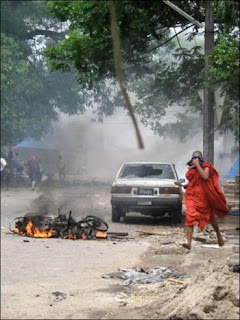
Four killed in Myanmar protest crackdown

This picture received by The Irrawaddy, an Internet publication, shows a monk running as tear gas fills the air in downtown Yangon. Myanmar security forces used batons, tear gas and live rounds in a violent crackdown on mass protests against the military junta, killing at least four people including three Buddhist monks.

YANGON (AFP) — Myanmar security forces used batons, tear gas and live rounds Wednesday in a violent crackdown on mass protests against the military junta, killing at least four people including three Buddhist monks.

Up to 100,000 people defied heavy security to take to the streets of the main city Yangon, marching and shouting abuse at police despite blunt warnings from the ruling generals who are facing the most serious challenge to their rule in nearly two decades.

Two of the monks were beaten to death while another was shot when he tried to wrestle a gun away from a soldier and the weapon discharged, two senior Myanmar officials told AFP.

They said the monks were killed near Yangon's Shwedagon Pagoda, Myanmar's holiest site and a key rallying point for the clergy leading the nine days of protests which have spread across the Southeast Asian nation.

A fourth man, who was not a monk, was shot dead, a hospital source said.

The UN Security Council was to meet in an emergency session in New York later Wednesday to discuss the spiralling crisis, French Foreign Minister Bernard Kouchner said.

British Prime Minister Gordon Brown, whose country is the former colonial power, said "the whole world is now watching Burma" and called for a UN envoy to be sent there to talk to the "illegitimate and repressive regime."

After tolerating more than a week of protests, police opened fire and baton-charged protesters who had begun to gather at the Shwedagon Pagoda in the blazing noon sunshine.

Undeterred by the show of force, some 1,000 monks soon regrouped and paraded through the streets, to the delight of thousands of onlookers.

They roared approval for the monks and shouted at security forces: "You are fools! You are fools!"

Police and troops then fired a volley of warning shots and tear gas to try to break up the march.

In a sign of the resilience and determination of the protest movement, tens of thousands of monks massed once again, marching through the main market in a protest that lasted until the early evening.

At least 100 people were injured during the day and some 200 people were arrested, as many as half of them Buddhist monks, according to witnesses and diplomats.

State television news said that one 30-year-old protester had been killed, and another two men and one woman were injured, along with 10 police.

The report said security forces had used loudspeakers to ask the crowd to disperse but that the protesters had hurled stones and sticks at them, tried to steal their weapons, and set fire to two military motorcycles.

"Because of the difficult situation, the security forces opened fire to disperse the crowd, using just a little force against the violent protesters. Because they opened fire, the protesters dispersed," it said.

The party of pro-democracy leader Aung San Suu Kyi branded the assaults on the monks -- highly revered in the devoutly Buddhist nation -- "the greatest wrong in history."

Protesters ignored a ban on public gatherings issued Tuesday along with a dusk-to-dawn curfew, as the generals who have turned Myanmar into one of the world's poorest and most isolated nations tried to keep a lid on the unrest.

Wednesday was the first time violence has been used against the recent protests, and analysts said it could be a preview for an even more severe crackdown in coming days.

There are fears of a repeat of 1988, the last time demonstrators rallied in such numbers in the streets of Myanmar, formerly known as Burma. Then, around 3,000 people were killed by the security forces.

There were sketchy reports Wednesday of huge turnouts and further clashes with police in the central city of Mandalay and in Sittwe on the western coast where 15,000 people marched.

Pro-democracy politician Win Naing and the country's most famous comedian Zaganar were also arrested earlier for helping the monks.

The unrest began last month when the junta dramatically raised the price of fuel overnight, deepening the misery in this already impoverished country.

The initial protests -- rare in a nation where the military quickly crushes any show of dissent -- began with only a handful of marching demonstrators.

But after the monks joined, the movement swelled, and around 100,000 people marched in Yangon on Monday and Tuesday.

Friday, September 21, 2007

Cambodian-Austalian man accused of killing another man for unpaid gambling debt

Son gunned down 'in front of parents'

21st September 2007
AAP (Australia)

A man's parents watched as their son was shot dead over an unpaid gambling debt, an Adelaide court has heard.

George Siahamis, 33, was shot at least six times in the groin, leg and stomach on April 16 this year when two men confronted him on the front lawn of his father's house in the Adelaide suburb of Black Forest.

He died in hospital from organ failure.

Crown prosecutor Emily Telfer on Friday told the Adelaide Magistrates Court Pheap Chea was one of the men who shot at Mr Siahamis because he had failed to pay a debt to a loan business named City Cash.

The court was told Chea, 29, who is yet to plead to a murder charge, drove to the house and confronted Mr Siahamis and his father who were waiting outside.

Chea handed Mr Siahamis a piece of paper that detailed a list of debts he owed before a scuffle broke out between the men.

Ms Telfer said at that point a second man, Andrew Fry, emerged from the car, armed with a pistol and fired shots into the air before shooting Mr Siahamis in the legs.

When he fell, Chea produced a gun and "shot the deceased while he was on the ground", she said.

Ms Telfer said Mr Siahamis's father and mother, who ran from the house upon hearing the initial shots, witnessed the attack.

Days later, Fry was found dead by police in an apparent drug overdose while Chea was discovered in a car with a hose running from the exhaust pipe to the interior, the court was told.

In applying for bail on Friday, lawyer Michael Abbott QC, for Chea, said the case was circumstantial as the gun used had not been found and there was no evidence his client was the shooter.

Mr Abbott said Chea, whose family moved to Australia 20 years ago as refugees from Cambodia, was of good character and had no history of violent behaviour.

He said the death was not a "hit".

"It is not as though he was shot in the head, it wasn't an execution-style alleged murder," Mr Abbott told the court.

But in opposing bail Ms Telfer said mobile phone records tendered to the court revealed that two hours before the incident Chea and Mr Siahamis traded text messages.

The court was told Chea wrote "Hurry Up" to Mr Siahamis before the reply "Yeah, will be there in a minute". Then Chea again: "I'm waiting".

Magistrate William Ackland refused bail on the grounds of the seriousness of the charge and remanded Chea in custody to reappear in court in November.

Friday, March 16, 2007

Human rights: killings in Cambodia

Human rights: killings in Guatemala and Cambodia, abuses in Nigeria

Human rights - 15-03-2007
EU Parliament


Parliament adopted its customary three human rights resolutions at the end of the plenary session on Thursday. The first is a response to the assassinations in Guatemala of three Members of the Central American Parliament. The second looks at the murder of trade unionists in Cambodia. In the third, the Nigerian government is pressed to deal with a range of issues ahead of the elections next month.

Murder of trade unionists in Cambodia condemned

The background to the resolution on Cambodia - which was adopted by 59 votes to 0 with 0 abstentions - is the murder of several trade unionists in recent years, the unreliable conviction of two people for one of the murders and the general lack of respect for the rule of law and basic rights in the country.

Trade unionists not safe

The murders of Hy Vuthy, Chea Vichea and Ros Sovannarith are the most prominent cases cited by the resolution, although other trade unionists in Cambodia "have been victims of serious harassment, intimidation and physical attacks in the past year".

Two individuals, Born Sammang and Sok Sam Oeun, were arrested for the murder of Chea Vichea and sentenced to 20 years’ imprisonment "despite the lack of any credible evidence against them", says the resolution.

The EP is "seriously concerned that these cases demonstrate that there is still no guarantee of the independence and impartiality of the judiciary".

Khmer Rouge trials

Nor is there any guarantee of the judiciary's ability to conduct the trials of the Khmer Rouge leaders in the specially created court (the ECCC) without political interference, say MEPs. This court has not started work, because of disagreements between Cambodian and international judicial officers on the court's draft internal rules.

Cambodian authorities must tackle judicial and other problems

Parliament's resolution therefore "condemns the killing of Hy Vuthy and all other acts of violence against trade unionists; urges the Cambodian authorities to launch an urgent, impartial and effective investigation into the murders of Hu Vuthy, Chea Vichea, Ros Sovannarith and Yim Ry" and "calls on the authorities to give Born Sammang and Sok Sam Oeum a prompt retrial which complies with international standards".

It also "insists that the Cambodian Government must put an end to the prevailing climate of impunity and effectively apply the law to violators of human rights and civil liberties".

More broadly, the authorities are urged "to engage in political and institutional reforms with a view to building a democratic State" and "to ensure in all circumstances respect for human rights and fundamental freedoms, in accordance with international human rights standards and international conventions ratified by Cambodia".

The Cambodian Government must also "allow the Khmer Rouge Tribunal to start operating without further delay, in accordance with international standards of judicial independence, fair trial and due legal process, as agreed with the UN in June 2003".

Human rights and democracy: a cornerstone of Cambodia's agreement with EU

Lastly, MEPs remind the Cambodian Government that "it must meet its obligations and commitments with regard to the democratic principles and fundamental human rights" under its Cooperation Agreement with the EU. The Council and the Commission of the EU are asked "to address the concerns over human rights and the rule of law in Cambodia in their contacts with the Cambodian Government".

Wednesday, March 14, 2007

Death of a Khmer Krom monk: Some associations denounce the lack of investigation

Wednesday, March 14, 2007

By Ung Chansophea
Cambodge Soir

Translated from French by Luc Sâr

Click here to read Cambodge Soir's original article in French

Several associations have denounced the slowness of the justice following the mysterious death of a Khmer Krom monk in a Kandal province pagoda.

The death of a monk from Kampuchea Krom, who was found with a slit throat in his room on 28 Feb, in the Boeng Thom commune, Ang Snuol district, Kandal province, still remains shrouded with mystery. Local authorities maintain the suicide under the influence of drug motive, whereas the associations suspect an assassination.

On March 5, six NGOs, including Licadho and Adhoc, sent a letter to the Kandal provincial court asking for an investigation into the case. Ang Chanrith, the executive director of the Khmer Kampuchea Krom Human Rights Organization (KKHRO), denounced the lack of reaction from the Kandal court which did not respond to a request for an autopsy of the monk who was buried at night on the same day of his death.

Monk Yoeun Sin, President of the Association of Khmer Krom Monks based in Phnom Penh, also demanded up to now, in vain, for an investigation and an autopsy.

Huot Vuthy, the prosecutor in charge of this affair, answered that an investigation was opened, but that it must be conducted step by step, according to the legal procedure.