Showing posts with label Low education. Show all posts

Saturday, January 14, 2012

Cambodian Youth Ill-Equipped for Asean Integration: Advocates

Him Sothearoth, (far left) is a 4th year student of International Studies at Royal University of Phnom Penh with Cheang Sokha, executive director of Youth Resource Development Program, on "Hello VOA" program on Monday. (Photo: By Heng Reaksmey)

Friday, 13 January 2012
Say Mony, VOA Khmer | Phnom Penh
“In terms of know-how, the abilities of Cambodian students are the lowest of Asean countries.”
Cambodian youth need better knowledge and skills to compete within the Asean marketplace, as the region becomes more closely integrated, youth advocates say.

“It is difficult for individual young people, especially those in the countryside, to know what the job market demands, because their understanding of Asean is still limited,” Cheang Sokha, executive director of the Youth Resource Development Program, told “Hello VOA” Monday.

So, the government must do research to find out where we are now, what our strong and weak points are and what the regional market demands will be, so that we can start focusing on the skills required,” he said. “And then it must make its findings widely known to youth so that they are better prepared.

Friday, November 04, 2011

Cambodia spent a lower percentage of its GDP on education than any of its three neighbouring countries in 2011 and was ranked last among them in key related indicators

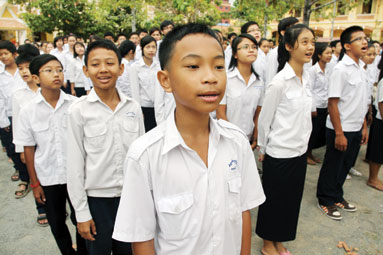
Students participate in a group activity at a Phnom Penh-area high school. (Photo by: Sovan Philong)

Struggling to keep pace

Friday, 04 November 2011
David Boyle and Phak Seangly
The Phnom Penh Post

Cambodia spent a lower percentage of its GDP on education than any of its three neighbouring countries in 2011 and was ranked last among them in key related indicators, statistics from the latest United Nations Development Program Human Development Index show.

The Kingdom spent just 2.1 percent of GDP on education, less than half that of Vietnam, and only 58.1 percent of Cambodian’s school-aged children were enrolled in some form of education, the report stated.

It also found that the number of men who had completed secondary school compared to women was just under double, at a ratio of 1 to 0.563 - last behind Lao at 0.622.

Monday, May 25, 2009

Cambodian workforce needs overhaul [... Cambodian leadership also needs an overhaul]

May 25, 2009
AFP

PHNOM PENH - CAMBODIA has an 'urgent' need to invest in education and health to further grow its economy and reduce poverty, a United Nations economist said at the launch of a report on Monday.

'Cambodia has a serious lack of qualified workers and this is something that needs urgent priority,' UN Development Programme (UNDP) economist Brooks Evans told reporters.

Mr Evans made his comments during the launch of a UNDP study on Cambodia's competitiveness in the global economy, which ranked it near the bottom among southeast Asian countries.

Cambodia also finished last in regional higher education training scores while 40 per cent of its population does not even finish primary school, Mr Evans said.

He added that lax rules and regulations have caused investors from the United States, Europe and Japan to shy away from setting up operations in the country, one of the world's poorest.

'Cambodia is potentially losing out on huge amounts of foreign direct investment,' Mr Evans said.

Cambodia enjoyed several years of double-digit economic growth until last year, but has seen sharp declines in garment exports and tourism - its two key industries - because of the global financial crisis.

Despite the recent economic expansion, under-employment, where someone's work earns only a meagre return, remains high in Cambodia.

Some 30 per cent of the country's 14 million people live on less than 50 US cents a day.

Thursday, December 13, 2007

Extortion Continues to Haunt Poor Students

By Suon Kanika, VOA Khmer
Original report from Phnom Penh
12 December 2007


With increasing development in Cambodia, many people realize the value of education, but a persistent lack of funds for teachers and their tendency to extort money from students remain obstacles for the poor.

The need to bribe teachers for regular classes and "extra" sessions encourage the poor to drop out of school, continuing a cycle of poverty, rights workers say.

"I know that taking money from children truly affects parents who don't have enough money to pay for their private classes," said one teacher, who asked not to be named. "When they don't have money to pay their teachers, they simply disappear; that is true to my knowledge as a teacher. So, if educators are to be moral, ethical and professional, the government has to appropriately increase the salary for the teachers."

The problem is so pervasive now that it has become a common understanding between students, parents, teachers and administrators.

"Nowadays, I am working as a cleaner for Santhormok school," said a Phnom Penh resident named Konthy, who has three children in school. "When there is no class, I go collect waste."

Teachers don't take money from her children every day, "but sometimes they take it," Konthy said. Teachers can take between 300 riel to 500 riel per day, depending on extra classes in the afternoon, which are often necessary for a student to pass a class, she said.

"I am not upset, because the teachers have little salary from the government," she said.

Chey Sothea, the principal of a Phnom Penh primary school, said the fees did not amount to corruption.

"Instead, it is a kind of mutual understanding between kids and their teachers," he said. "When the teachers need extra income to survive, the children cannot just watch that, so they support their teachers."

Poor children are not affected, he said, because "teachers are warm hearted."

But that was not the experience of Piseth, a 10-year-old who dropped out of the second grade because he couldn't afford the 500 riel daily surcharge. "I didn't have money to pay for private class, so I dropped out from school," he said.

Instead, he said, he began scavenging for trash "to buy rice for my mom."