Showing posts sorted by relevance for query islam. Sort by date Show all posts

Sunday, November 20, 2011

Seif al-Islam Gadhafi captured in southern Libya

http://www.youtube.com/watch?v=ktoKw3prZY8

Seif al-Islam Gadhafi, second right, is pictured standing in a plane in Zintan on Saturday. Ismail Zitouni / Reuters
Saif al-Islam, son of late former Libyan leader Moammar Gadhafi, sits after his capture, with his fingers wrapped in bandages and his legs covered with a blanket, at an undisclosed location, in this photograph aired on Free Libya TV on Saturday. Reuters TV / Reuters

Sunday, November 20, 2011
By HADEEL AL-SHALCHI, Associated Press

ZINTAN, Libya (AP) — Moammar Gadhafi's former heir apparent Seif al-Islam was captured by revolutionary fighters in the southern desert Saturday just over a month after his father was killed, setting off joyous celebrations and closing the door on the possibility that the fugitive son could stoke further insurrection.

Seif al-Islam, once seen as a voice of reform in an eccentric and reviled regime, now faces the prospect of trial before an international or Libyan court to answer for the alleged crimes of his late father's four-decade rule.

Thunderous celebratory gunfire shook the Libyan capital of Tripoli and other cities after Libyan officials said Seif al-Islam, who has been charged by the International Criminal Court for crimes against humanity, had been detained deep in the southern desert, about 30 miles (50 kilometers) west of the town of Obari in an area that borders Niger, Mali and Algeria.

Thursday, November 18, 2010

History of Islam in Indonesia

18 November 2010
Musalman Times

In the year of 30 Hijriyah or 651 Christian, just around 20 years after Rasulullah SAW passed away, the khalifah Uthman ibn Affan RA sent the delegation to China introducing Islam’s Daulah.

On the way of 4 years, the messangers of Uthman apparently stopped in Indonesian archipelago. This was the first time Indonesian people introduced Islam. Since, the moslem seaman and merchants kept coming for centuries. They bought agricultural produce from this green country while religious proselytizing.

Gradually, the indigene started to embrace Islam even though not an a large scale. Aceh, the most west region in Indonesia archipelago was the first region receiving Islam. Moreover, in Aceh, the first Islam kingdom was standing, Pasai. Marcopolo said that on the time his stop in Pasai in 692 H/1292 C, many Arabic people had disseminated Islam. So Ibnu Battutha, moslem wanderer from Marocco which when he was stopping in Aceh in 746 H/1345 C, wrote that in Aceh had disseminated Syafi’i mazhab. Now the oldest inheritance from the moslem was found in Gresik, East Java, that was the Islam funeral complex. One of them was a muslimah grave, called Fathima binti Maimun. In her grave was written numeral of year 475 H/1082 C, meant long ago before Majapahit, greatest Hindu’s Empire in Indonesia.


Read glimpses of World history by Jawaharlal Nehru—for a listing of Brahman imperialism in Southeast Asia.

Sri Vijaya, based at Palembang in southern Sumatra, reached through Java to the east and to the area of Bangkok (before it existed) in Thailand to the north. It was a Buddhist empire born in 670 A.D. and lasting until 1365. During this period, Buddhist culture and thought spread throughout the archipelagic region, influencing social order, commerce, and art.

Irregardless of what they teach some temples–Indonesia was Buddhist–and marauding hordes of Brahmans invaded, Laos, Cambodia, Vietnam and Indonesia and tried to exterminate Buddhism in the lands. the brutal Madjapahit Hindu empire with a capital in eastern Java originated about 1100 with help from the colonialists from South Bharat. It continued its brutalities ’till 1500. Hinduism was reversed in all the countries, and it kept its hold in Bali–the last island which is a reminder of Hindu imperialism in Southeast Asia.

Malacca was the first major Islamic state in the region–located in what is Malaysia today–originating in 1400 and remaining powerful until defeated by a major Portuguese naval force in 1511. In the period of Pasisir culture authors were very active in writing books on all subjects belonging to the sphere of Muslim Javanese civilization.

The three centres of Pasisir literature in Java were Surabaya (with Gresik), Demak (with Japara) and Cérbon (with Banten). East Javanese Pasisir texts came first, for in East Java Muslim religious influence first became an important element in civilization. Starting from Java, Islamic Pasisir culture spread to some other islands of which the coasts are washed by the Java sea. The most important outlying cultural provinces were Lombok and Palémbang. In the island of Lombok a remarkable Islamic Javano-Balinese literature came into existence. The texts contain reminiscences of indigenous Sasak culture. The native Sasak language developed into a medium of literary activity side by side with the Javano-Balinese idiom.

The important oversea expansions of Javanese Pasisir literature, both eastwards and westwards, started from East Java. Minor expansions, of Javanese Pasisir culture took their course from Banten and from Central Javanese maritime towns. The districts affected by them, Lampung in South Sumatra by Banten, and Bañjar Masin in Borneo by Central Java, did not produce Javanese literary texts of any importance, however.

In, Javanese Pasisir literature, the influence of Islamic culture was strong. Islam first reached Java by the intermediary of Malay literature, Malay being the medium of the interinsular commerce which brought Muslim traders from India to the Archipelago. Asa result, Pasisir literature contains borrowings, from Malay and from Arabic, the sacred language of Islam, but also, from other continental languages, in the first place Persian, which was the universal Islamic medium in India in the fifteenth and sixteenth centuries.

A number of significant early mosques survive, particularly along the north coast of Java. These include the Mesjid Agung in Demak, built in 1474, and the Menara Kudus Mosque in Kudus (1549) whose minaret is thought to be the watch tower of an earlier Hindu temple. Javanese mosque styles in turn influenced the architectural styles of mosques among its neighbors, among other the mosques in Kalimantan, Sumatra, Maluku, and also neighboring Malaysia, Brunei and the southern Philippines. Sultan Suriansyah Mosque in Banjarmasin and Kampung Hulu Mosque in Malacca for example displaying Javanese influence.

In 19th century, the sultanates of Indonesian archipelago began to merge Islamic architecture with Javanese style already popular in the archipelago. The Indo-Islamic and Moorish style are particularly favoured by Aceh Sultanate and Deli Sultanate, as displayed in Banda Aceh Baiturrahman Grand Mosque built in 1881, and Medan Grand Mosque built in 1906. Particularly during the decades since Indonesian independence, mosques have tended to be built in styles more consistent with global Islamic styles, which mirrors the practice of Islam.

Thursday, October 27, 2011

Gaddafi's son want to avoid meeting the same greesly fate as his father

Saif Al-Islam, son of Muammar Gaddafi, greets supporters in Tripoli August 23, 2011. Credit: Reuters/Paul Hackett


Gaddafi son wants to surrender to ICC, says NTC

Wed Oct 26, 2011
By Barry Malone and Maria Golovnina

TRIPOLI (Reuters) - Saif al-Islam Gaddafi, who once vowed to die fighting on Libyan soil, now wants to face international justice instead and avoid any chance of meeting the same grisly end as his father, Libyan officials said.

An official of the ruling National Transitional Council (NTC) said on Wednesday that Saif al-Islam, the only one of Muammar Gaddafi's eight children still on the run, had proposed surrendering to the International Criminal Court (ICC), which has indicted him for war crimes.

Surrender by 39-year-old Saif al-Islam would close another chapter in the four-decade history of Gaddafi family rule, as the United Nations discusses an end to its Libyan mandate that allowed NATO to bomb the country and help rebels to take power.

Monday, September 17, 2012

The long tragedy of Cham history

by Jean-Michel Filippi

Many chams or 'Khmer Islam' had traditionally lived on mobile house-boats like this one along many of the country's waterways deriving their livelihoods from fishing. However, since 1979 they along with ethnic Khmers have had to face fierce competition from ethnic Vietnamese fishermen for fisheries as sources of income and protein supplement. At least in this economic context of struggle for physical survival the Vietnamese, ancient exterminators of the Champa people and nation, are still persecuting and harassing the chams even in their exile from their 'native Champa' in central Vietnam - School of Vice [google image]
“Let’s get back to the first centuries of the Common Era. Knowing that Chinese, Burmese, Lao and Thai are relatively new in the Southeast Asian landscape, the biggest part of the peninsula was peopled by Austro-Asiatic (or Mon Khmer) ethnic groups. This means that Khmer and related groups (Mon, Kui, Bahnar) were certainly the oldest inhabitants of the peninsula.”
“The process [‘Nam Tien’ or Vietnamese southward expansion] was well defined by Léopold Cadière in 1911: “As soon as they feel themselves able, they drive off the first inhabitants, whether in a peaceful manner, by taking over the land, clearing it and “planting the bamboo” – the hedges that to this day still surround Annamese gardens and villages – or by violence, then they fight with the Chams, destroying their temples and mutilating their statues.” In short, there was no room left for the Chams.”

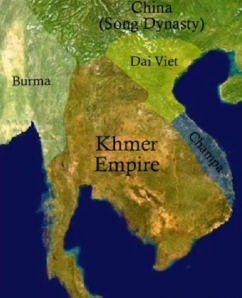
The Khmer empire, from the ninth to the 15th century, obviously didn’t develop in isolation. But, looking at the map of Southeast Asia from a historical point of view, it’s nevertheless clear that this political construction benefited from an unprecedented geopolitical quietness, at least until the 13th century. The Vietnamese hadn’t even begun their march to the south, and the Thai state was made up of embryonic chieftainships.

Yet the exception that proved the rule occurred. In the year 1177, guided by a Chinese deserter, the Cham fleet sailed the Mekong river upstream and from Phnom Penh, the Tonle Sap. They took Angkor by surprise, plundering and destroying the town. They quickly withdrew and, from 1181, under the leadership of the future Jayavarman VII, the Khmers won the war against the kingdom of Champa, which was soon reduced to a vassal state of the Khmer empire.

For the Khmer empire, military recovery was one thing; spiritual recovery was something else. If the very heart of the empire could be so easily struck, there were spiritual causes that couldn’t be ignored. Under the rule of Jayavarman VII, the Khmer empire was the theater of the most dramatic religious shift in Khmer history as the new religion became Mahayana Buddhism. It replaced the Hindu religion, which had proved unable to protect the empire.  Hindu gods still existed, but were submitted to the Mahayana Buddha. The temple of Angkor Wat was still there, but was no longer the axis of the world; that was now the Bayon. Who were those Cham who were able to disrupt a mighty empire?

The beginning of a long history
If we look at a current map of peninsular and insular Southeast Asia, we notice no fewer than nine countries. But the borders between these countries don’t tell us anything about the region’s ethno-linguistic components. The situation has become more and more complicated over the centuries.

Let’s get back to the first centuries of the Common Era. Knowing that Chinese, Burmese, Lao and Thai are relatively new in the Southeast Asian landscape, the biggest part of the peninsula was peopled by Austro-Asiatic (or Mon Khmer) ethnic groups. This means that Khmer and related groups (Mon, Kui, Bahnar) were certainly the oldest inhabitants of the peninsula.

Thursday, October 29, 2009

In Cambodia, a threatened tribe of Islam

Oct 30, 2009
By Brendan B Brady
Asia Times Online (Hong Kong)

"We love God just the same as others ... But we don't tell others how to practice and they should show us the same respect" - 19-year-old Keu Sarath
UDONG - Imam San was perhaps once Cambodia's most privileged Muslim. Legend has it that in the 19th century, former King Ang Duong encountered him meditating in the forest and was so captivated by the stranger's spirituality that he offered him land in the royal capital. A more cynical account relates that the Khmer royal family, at a time when its power was dwindling, found a ready and willing ally in the Muslim leader.

On the occasion of Imam San's birthday each October, the sect that emerged from his early followers gathers in the former royal city of Udong, about 30 kilometers outside of the present capital of Phnom Penh, to honor his memory through prayer and offerings. The colorful mawlut ceremony reaffirms the sect's privileged heritage and its continued isolation from the rest of the country's Islamic community, which is dominated by a group known as the Cham.

The Imam San followers are the only group to remain outside the domain of the Mufti, the government-sanctioned leader of Islam in Cambodia - a status that was renewed by the government in 1988. Successive Imam San leaders, or Ong Khnuur, have held the prestigious title of Okhna, originally bestowed by the palace.

Cambodia's estimated 37,000 Imam San followers live in only a few dozen villages spread throughout the country. Geography has reinforced the sect's isolation, and the mawlut has become an increasingly important opportunity to forge friendships and - more essential to the survival of the community - marriages.

At the annual ceremony, parents search for eligible suitors for their children, who otherwise would not come in contact with teenagers and young adults from other Imam San communities. The day's use for matchmaking may have new importance as the sect's long-standing isolation is challenged by pressures from Cambodia's larger Islamic community as well as from abroad.

Many Imam San followers see their sect's relationship with other Muslims as the biggest threat to their way of life, as their most vehement critics come from within their faith. For Ek Bourt, an elder member of the Imam San community, it is discrimination from other Muslims that he fears most.

"Other Muslims look down on us since we practice our religion in a different way," he said. "I'm afraid the next generation might lose our unique culture and customs."

The pilgrimage to Udong's Phnom Katera - a site of great importance for Khmers' Buddhist and royal traditions - highlights what some other Muslims see as the Imam San community's unholy cultural proximity to mainstream Khmer society. Conspicuously, the mosque on Phnom Katera is adjacent to the tombs of former Khmer kings and its name, "The Islam Cham Temple of Imam San", is written in Khmer, Cham and English, but not Arabic.

Purity perceptions
Descendants of the Cham Bani from Vietnam, who converted to Islam in the 17th century, Imam San followers view themselves as devoted adherents of the Muslim faith even as they maintain religious and cultural practices that are viewed by some as at odds with Islamic teachings. Because they blend faith in the Koran with other religious customs, including animist-like ceremonies, the Imam San followers are seen by many other Muslims as impure.

Perhaps no tradition of the Imam San community is more offensive to critics than praying only once a week, while praying five times a day is standard practice for most Muslims. And none is more bizarre than the chai ceremony, in which they dance in a possessed state, sometimes carrying prop weapons.

In fact, about 85% of Muslims consider the Imam San followers to be so heterodox as not to qualify as Muslims, according to a study by Norwegian Bjorn Blengsli, who has studied Muslims in Cambodia for nearly a decade.

"They're not true followers of Mohammed," said Hussein Bin Ibrahim, a Salafi Muslim who lives in Phnom Penh. "They don't really count as Muslims. For Muslims like us in Cambodia, our Islam is now becoming more like the Islam in Arab countries. We have grown closer to Mecca." Hussein prays in the outskirts of Phnom Penh at the Norul Ehsan mosque, which was recently renovated with funds from Kuwait.

Most of Cambodia's Muslims are ethnically Cham, whose practices have traditionally been moderate. But the last several years have seen a rise of fundamentalism in the Cham community, most notably of Wahhabism, an austere form of Islam originating from Saudi Arabia.

Growing economic ties between Cambodia and Arab countries suggest the trend will only strengthen.

Last year, after making high-level state visits, Kuwait and Qatar pledged hundreds of millions of dollars in soft loans to Cambodia for agricultural development. The aid sparked concerns among some Western officials that the money could be used not just to invigorate Cambodia's farming, but also to radicalize its Muslims.

"There are some organizations here from the Middle East that are very radical and that are very intolerant, and they are trying very hard to change the attitude and the atmosphere of the Muslim population here in Cambodia," said then-outgoing American Ambassador Joseph Mussomeli in his farewell speech to reporters in August 2008.

The primary focus of the most recent state visits has been trade. Yet cultural ties are also at stake: Kuwait pledged some $5 million for Cambodian Islamic institutions, including renovating the dilapidated International Dubai Mosque in Phnom Penh.

Economic ties with Arab countries will reverberate in Islamic practices in Cambodia, according to Blengsli. "Economic ties between Cambodia and Arab countries will lead to more funding for Islamic organisations in Cambodia and, since they are often unhappy with the purity of Islam as its practiced here, there will be increasing Arab influence on local Muslim practices," he said.

Islamic revivalism
The penetration of Islamic missionaries, as well as development and educational organizations into Cambodia, is problematic because of the separation from other cultures these groups encourage, according to Alberto Perez, a Spanish anthropologist who is writing his PhD dissertation on the Cham.

The Imam San community has been further estranged amid a wave of Islamic revivalism embraced by the majority of Cambodia's nearly 350,000 Muslims. In the past, Imam San followers have rejected donations from wealthy Middle East-based Islamic groups and resisted pressure from foreign preachers, whose requests that they convert to orthodox Islam are frequently backed by offers to finance the construction of new mosques.

But this long-maintained separation is weakening under the same foreign influences that, according to Blengsli, have made Cambodia's mainstream Muslims one of the fastest-changing Islamic communities in the world.

The Imam San community is losing numbers to other Muslim sects, including the Salafi, Jamaat Tabligh and Ahmadiyya, which have international standing and deeper pockets, he said. In particular, young Imam San followers who are sent to Phnom Penh to continue their studies face pressure from other Muslim communities to convert to orthodox Islam.

"We're especially afraid that the young will be tempted to join other groups that are well-funded," said Kai Tam, the Imam San's current Ong Khnuur. But such concerns would not have him change his group's practices.

"Our people are strong because we believe in our ancestors and we believe in their culture and the way they practiced Islam - to change would be an insult to our ancestors. We have the same goal as other Muslims, but we get there a different way."

Ahmad Yahya, president of the Cambodian Islamic Development Association and an advisor to the government on Cham issues, has said that Imam San followers should break their isolation and reform their observance. Yahya has aggressively solicited foreign funding for Cambodian Muslims to continue their studies locally and abroad, and he believes Iman San followers should make the changes necessary to avail themselves of such opportunities.

Indeed, some Imam San villages have begun praying five times a day as a compromise to foreign donors who have financed new mosques for them. But for 19-year-old Keu Sarath, whose home is in the same village as the Ong Khnuur's, her faith in the way of her ancestors has not wavered.

"We love God just the same as others," she said. "But we don't tell others how to practice and they should show us the same respect."

Brendan B Brady is a freelance journalist based in Phnom Penh, Cambodia.

Saturday, August 04, 2007

The International Federation of Champa

Sat, 2007-08-04
By Antonio Graceffo
Asian Tribune


The formation of an international organization, based in Cambodia, hopes to preserve the language and culture of Cambodia’s ethnic Muslim minority.

The Kingdom of Champa, originating in the second century AD was one of the most powerful empires in Indochina, covering much of what is today, Vietnam, and parts of Cambodia. At the peak of its power, Champa toppled the Khmer capital, but was later defeated by King Jayavarman VII, in 1181. Although originally Hindu, the Cham converted to Islam, making them one of the only Islamic Kingdoms in the region. The kingdom eventually broke up, and the survivors were scattered throughout Asia. Today, Cham can be found in Vietnam, Cambodia, Thailand, the Philippines, Malaysia, the United States and Australia.

“It is a long time that the Cham have lost their culture.” Laments Mat Mot, a principle officer of the International Federation of Champa. “Nearly everything disappeared 480 years ago. The language, education, and most of the religion were lost.”

Mat Mot, a Phnom Penh based Cham, has been working to organize the Cham in Vietnam, Cambodia, and the USA to form a single organization, dedicated to the revival of their cultural legacy. “Eighty percent of Cham in Phnom Penh don’t speak our language.” Complains Mat Mot. He goes on to say that in Phnom Penh there is not a single school dedicated to teaching the Cham language.
The Cham are a unique racial group, of Indic/Malayic stock. The Cham language is of Malay origin. Centuries ago, the Cham had their own writing system, a Pali based alphabet, similar to modern Khmer, Thai, Burmese, and Shan.

The destruction and scattering of the kingdom was just the first major blow in a long series of struggles which would threaten the continued existence of the Cham culture. The first encroachments on the language came after the conversion to Islam, as devout Cham worshipers had to adopt Arabic script, in order to read the Koran. Later, religious teachers from Malaysia introduced their own alphabet and language as a mode of instruction. The separation of Kampuchea Krom combined with the bad political blood between Vietnam and Cambodia, created barriers, separating Cambodian Cham from their brethren. The Khmer Rouge years were particularly hard on the Cham community, as Cham were often singled out and killed, and many mosques were burned. After the war, Cham refugees of the Pol Pot regime were resettled in the USA and Australia, thousands of miles away from their community.

According to Mat Mot, 80% of the Cham population lives in poverty. A large percentage of those living on the river boats have never attended school. Lack of education and nutrition are further obstacles which may stand in the way reviving the Cham culture.

More of the Cham identity was lost in 1985, when the Cambodian government decided the politically correct name for Cham people would be Khmer Islam.

“Cham is a race. Our religion is Islam, but we are not Arabs and we are not the same as the Khmer. We have our own culture which we are losing.” aid Mat Mot, in reaction to the new name for his people.
Today, it is estimated that there are between 500 thousand and one million Cham in Cambodia. They are centered in: Kompong Chhnang, Battambamg, and in Phnom Penh. They are divided into two distinct groups, Cham Chweia and Cham Champa. The Cham Champa are the city dwellers, who are in the greatest danger of losing their language and culture. They have regular access to Khmer schools and Khmer society and consequently find themselves becoming “Khmerized.”

The Cham Chweia typically live on house boats, making a living from fishing the Tonle Sap and the Mekong. They speak the Cham language fluently and have less opportunity to integrate into larger Khmer society. Although most are illiterate, and cannot read the Koran, they follow a more traditional form of Islam, in which they pray five times a day. According to Mat Mot, most of the Cham Champa only pray on Fridays.

The culture of the Cham Champa seems to differ dramatically from village to village. “Some write Arabic, some write Malay, some write ancient Cham script.” Said Mat Mot, with a gesture of resignation.

Mat Mot hopes that through his organization, the Cham in the various regions of the world can communicate with each other and work to standardize their religion and language.

“We held a three country conference in 2006 (USA, Cambodia, and Vietnam). We are planning the next conference.”

One of the most concrete steps taken toward the goal of preserving Cham culture was the formation of the Cham Ethno Cultural Center, located in Kampong Chhnang Province. The center was funded by UNESCO, through the work of Dr. Thanh Dai.

“UNESCO gave us the money. Now we have a school to teach Cham language and culture to Cham as well as non-Cham people.”

Antonio Graceffo is an adventure travel and martial arts author, living in Asia. His specialties include ethnic minorities, languages, and martial arts. He has studied Kung Fu at the Shaolin Temple and lived in the last Muay Thai monastery in Thailand. He has published four books on amazon.com

Wednesday, March 02, 2011

A short course on Islam in Cambodia

Mawlid ceremony at Kampong Tralach, Kampong Chhnang, February 2011. Photo by: DC CAM
Wednesday, 02 March 2011
The Phnom Penh Post Staff

Islam is changing in Cambodia. Muslims are financially benefiting from aide from global Islamic institutions, often at the expense of traditional practices, which are quickly changing according to the preferences of international donors.

Cambodian Islam is composed of three main groups: the orthodox Islam, who make up a 80% of Cambodian Muslims, the Chvea Muslims of coastal regions and the Imam Sann group. The first group has the closest connection to Muslims around the world, and their practices most closely resemble those seen in other the majority of Muslim populations. Most orthodox followers, for example, forbid keeping dogs as pets as it is considered unsanitary.

Tuesday, September 06, 2011

Libyan army convoy in Niger may be Gaddafi deal [-Nowhere to hide for dictators!]

Tue Sep 6, 2011
By Christian Lowe

TRIPOLI/AGADEZ, Niger (Reuters) - Scores of Libyan army vehicles have crossed the desert frontier into Niger in what may be a dramatic, secretly negotiated bid by Muammar Gaddafi to seek refuge in a friendly African state, military sources from France and Niger told Reuters on Tuesday.

Several hours later, Al Jazeera television reported that rebels had struck a deal with delegates from the Gaddafi holdout town of Bani Walid, 150 km (90 miles) south of Tripoli, to enter it without fighting later on Tuesday.

The pan-Arab news channel, citing the anti-Gaddafi forces, said the fighters were expected to enter the town after the deal is formalized, which would likely be around midday.

Bani Walid has been one of the main remaining pockets of Gaddafi resistance in the country.

Saturday, January 07, 2012

Closing Order of Case 002 against Senior KR Leaders Nuon Chea, Khieu Samphan, Ieng Sary, Ieng Thirith

In light of the HISTORIC (!) start of MOST COMPLEX (sic!) trial hearings beginning on 27 June 2011 and again ANOTHER HISTORIC (!) START of this same MOST COMPLEX (sic!) on 21 Nov. 2011 of Case 002 against the surviving Khmer Rouge senior leaders Nuon Chea, Khieu Samphan, Ieng Sary and Ieng Thirith, KI Media is posting installations of the public document of the Closing Order of Case 002.  The Closing Order of the Co-Investigating Judges forms the basic document from which all the parties (Co-Prosecutors, Co-Lead Lawyers for all civil parties, Defense Lawyers) will be making their arguments before the Trial Chamber judges (one Cambodian President, 2 Cambodian Judges, 2 UN judges).  Up until now, the hearings involving these four surviving senior Khmer Rouge leaders have been in the Pre-Trial Chamber over issues of pre-trial detention and jurisdictional issues.  Beginning in June 2011, the Trial Chamber will hear the substantive (sic!) arguments over the criminal charges (e.g. genocide, crimes against humanity, penal code of 1956 - sic!).  Available in Khmer and French. Contact the ECCC for a free copy. 


CLOSING ORDER
of Co-Investigating Judges You Bunleng and Marcel Lemonde
15 September 2010
 
D. TREATMENT OF SPECIFIC GROUPS


744.            The Cham are an ethnic minority within Cambodia who share a common language, a common culture and Islam as a common religion.3203 The Cham people self-identify as Cham and are identified as such by others outside the group.3204
745.            Prior to 1975, many Cham lived along the Mekong River in Kampong Cham Province. Large communities of Cham lived in Kroch Chhmar District and Kang Meas District.3205
746.            The Demographic Expert Report: CPK Victims in Cambodia, April 1975 - January 1979, A Critical Assessment of Major Estimates concludes that 36% of the Cham population in Cambodia perished during the regime (compared to a death rate of 18.7% for Khmers).3206
Pre-1975 Policy Towards Cham
747.            From around 1970, the CPK exerted control over increasingly large parts of Kampong Cham Province, including many areas inhabited by Cham.3207
748.            At first the CPK appeared to support Islam.3208 Before 1975, some Cham joined the CPK, for example, [REDACTED], a Cham man, was a member of the Tboung Khmum District Committee in Kampong Cham3209 and a Member of the Standing Committee of the People's Representative Assembly of Kampuchea3210 (he fled Cambodia and crossed the border into Vietnam in May 1978).3211 Some other Cham people were cadre at S-21 (though all were killed in 1977 and 1978).3212
750.            The CPK began to indoctrinate the Cham against the values of religious practice in general and curtail their freedom to practice Islam in particular.3213 One witness states that in 1974, the Cham were announced by the CPK to be "enemy number one".3214
751.            The CPK appears to have begun targeted expulsions of Cham villages in approximately 1973. Sometimes only the religious leaders and those well-educated in Islam were expelled,3215 on other occasions the majority of the village was evacuated, leaving only a few Cham families in each village.3216 The Cham were expelled to various provinces in Cambodia.3217
752.            Prior to 1975, some Cham were arrested, detained, tortured and killed.3218 In 1970 or 1971, a security centre was established in Kroch Chhmar, which had a particular role with respect to Cham as set out below. The CPK targeted Cham religious leaders for arrest as well as Cham who protested about the curtailment of their religious freedom.3221 Witnesses from Kroch Chhmar District, Kampong Cham stated that between 1003222 and 2003223 Cham people were arrested and had disappeared from their villages by around 1975 and that the decision to arrest them was made at provincial level or higher.3224


Saturday, January 02, 2010

Small Muslim Sect Worries Over New Influences

By Pich Samnang, VOA Khmer
Original report from Phnom Penh
01 January 2010


Toothless and balding, Bhann Tes sat on a wooden bed, writing Cham script in a handheld notebook outside a mosque on Udong mountain, some 30 kilometers from Phnom Penh.

The mosque, which looks more like a Buddhist temple, might not be recognizable to more orthodox Muslims. Nor would the practices of Bhann Tes, who belongs to a rare sect of Islam whose members say is in decline.

Bhann Tes, who is 76, travels to the mosque from his home, 20 kilometers away in Kampong Chhnang province, just once a week to pray. This was required by Allah to maintain a good mind, he said. To pray five times a day, as other Muslims do, was not necessary, he said.

“Allah did not tell us to physically pray five times a day, but only to keep our minds clean of bad thoughts, like wanting to steal others’ property, telling lies, or cheating others,” he said.

Bhann Tes belongs to the Imam San sect of Islam, better known as Jahed, who comprise an estimated 37,000 Cham Muslims and whose beliefs merge the teachings of the Quran with older traditions and customs like ancestor worship.

The small group is now facing a new threat, as money and influence from other Islamic groups, including those in Arab states, have begun drawing the Jahed under their influence.

“They consider us out of their group, but we follow the same holy book,” said Kai Tam, a revered Jahed elder. “They pray with body movement, and we just pray without it.” (Women, he said, are not required to pray at all.)

“I am worried that we may lose our customs and identity in the future, as some of our members have already lost their self-identity to join with the other groups for money,” Kai Tam said in an interview at his home in Kampong Chhnang’s Kampong Tralach district.

However, Sos Kamry, who leads the majority of Cambodia’s Muslims as a mufti, denied Jaheds were being lured by material gain or money.

“Those who have joined our group did it on a voluntary basis, especially after they returned from overseas studies or pilgrimages in some Arab states, where they witnessed the true practices of Islam,” Sos Kamry said. “They call themselves Muslims, but they worship our Lord a bit differently. They may not yet know how to do it fully, but when they understand it better they follow [us] because their practices exist nowhere else in the world.”

Emiko Stock, a French anthropologist who has studied the Cham for nearly a decade, said leaders of the Imam San community often refuse aid from other Islamic sects for fear they might lose their identity.

“For instance, if they accept aid from Arab states or other countries, they said they are worried that the way of practicing their religion would be changed, such as the observance of Mawlut ceremony and the prayers for their ancestor.”

Although Cambodia’s two sects of Islam practice the same religion quite differently, no clashes or mishaps have been reported in the Buddhist-dominated country.

Min Khin, the Minister of Cults and Religion, and Senate President Chea Sim each said separately at a Buddhist conference this week that Cambodia would maintain freedom of religion.

For worshippers like Bhann Tes, the differences make no difference.

“We are all walking toward the same light,” he said. “It’s just that the way we are taking is different. Who will reach the light first, let’s just wait and see.”

Tuesday, April 21, 2009

U.S. ambassador condemns terrorism at Muslim seminar in Cambodia

April 21, 2009
Source: Xinhua

U.S. Ambassador Carol A. Rodley had condemned terrorism at a Muslim seminar opened here on Monday, the official Agence Kampuchea Presse (AKP) said on Tuesday.

"The leaders of Islam in Cambodia condemn terrorism, saying that Islam is a peaceful religion," she told the seminar of "Understanding of Islam in Cambodia."

The embassy has worked closely with Cambodia in the security and law enforcement such as drug trafficking investigation, national police and Royal Cambodian Armed Forces (RCAF) capacity building and training, and cooperation in the investigation of terrorists, she added.

Meanwhile, Cambodian Deputy Prime Minister and Interior Minister Sar Kheng told the seminar that the Royal Government of Cambodia has carried out the policy of "non-racial and religious discrimination," and the Muslim-Khmers have actively participated in the law implementation, as well as peace and security establishment, especially in combating all terrorism acts.

He also highly appreciated the good cooperation between Cambodia and the U.S. in raising public awareness about Islam in Cambodia, which has provided better understanding and harmony among the religions and peoples in the kingdom.

According to official figures, there are about 200,000 Muslims in Cambodia, accounting for around two percent of its total population.

Friday, April 04, 2008

Hun Sen accuses media of linking Islam with terrorism

Cambodian PM accuses media of linking Islam with terrorism

Friday, April 4, 2008
ABC Radio Australia

Cambodian Prime Minister Hun Sen has accused major media organisations like CNN and the BBC of unfairly linking terrorism to Islam.

He made the comments in an opening speech at a two-day international conference on interfaith cooperation for peace, being held in Phnom Penh.

Hun Sen said it is inaccurate to link the world's 1 billion Muslim population to acts committed by small numbers of people.

He said when terrorism occurs in one place, a politician or the media will link it to Muslims as a whole.

''Terrorism is terrorism. It has nothing related to religion,'' he said.

''Therefore, all politicians and media should change their attitudes in using any words relating to Islam.''

He said the "biggest mistakes" had been made by major television networks such as America's CNN, Britain's BBC and TV5 of France.

Representatives from the 10 ASEAN member states are taking part in the conference, as well as Australia, New Zealand, Fiji and Papua New Guinea.

Thursday, December 30, 2010

Life of Muhammad (founder of Islam)

By Khmer Democrat, Phnom Penh
Expanding our Mind Series

During this time of reflection, family and religious festivities, it's good to be reminded of the fundamental principles, beliefs, philosophies underpinning our times. Here's a biographical sketch of the life of the Prophet Muhammad, founder of the Islam (Cham) religion.

Biographical Sketch:

Life of Muhammad

Muhammad was born in 570 A.D in Mecca, a city in Western Saudi Arabia. He was an orphan, having lost both parents by the age of 6. After age 8 the young Muhammad was raised by his uncle, Abu Talib. In time he joined the trading caravans as a merchant.

At age 25 Muhammad married a wealthy widow by the name of Khadijah, 15 years his senior. The couple had four daughters and two sons who died in infancy. During Muhammad’s life he had a total of eleven wives. He was described as gentle and humble by nature. He loved children and animals.

At age 40, Muhammad fell into a trance in a cave on Mount Hira near Mecca where he claimed to have heard the angel Gabriel speak to him. Muhammad reportedly ran home crying out, “O, Kadijah! I have either become a soothsayer or else I am possessed of the Djin [demon] and gone mad.”

Khadijah and her Christian cousin Waraqah consoled Muhammad, assuring him his vision must be real, and that he was truly God’s prophet. Muhammad had additional revelations of Gabriel speaking to him, but he still had agonizing doubts about their reality. He was even more troubled when the revelations ceased, becoming dejected and entertaining suicide.

It wasn’t until later when his revelations resumed, that Muhammad finally began proclaiming himself as a prophet, and preaching “in the one sovereign God, resurrection, and the last judgment, and the practicing of charity to the poor and the orphans.”

Muhammad was illiterate and recited his revelations orally. It wasn’t until after his death that they were compiled and written down in the Qur’an. Muslims accept the Qur’an as a miracle, believing it is 100% inspired with no human error. Much of what we know as Islam — the lives and sayings of the Prophet — is based on texts from between 130 and 300 years after Muhammad's death.

In the face of rampant idolatry, Muhammad became zealous for Allah. It was his zeal that led Muhammad to take up the sword for Allah. He would spread Islam by conquering the “infidel” (unbelieving) peoples, including Christians and Jews.

Prior to taking up the sword, Muhammad had co-existed peacefully with the many Jewish inhabitants of Medina. But when he realized the Jews rejected his prophetic calling and radical ideas, he became angry, and began treating them cruelly. As a result, some Jews were driven into exile by his militia, while others were executed with their widows and children being sold as slaves.

Prior to his death, Muhammad led several military campaigns. He proved to be a courageous and capable military leader. By the time of his death in 632, Muslims ruled only in Arabia. But within ten years the Arab Muslims conquered Palestine, Syria, Egypt, Iraq, and then Persia (Iran). In one generation Muhammad and his followers had changed the political landscape of the Eastern world. Today Muslims around the world honor Muhammad as Allah’s one “True Prophet.”


Tuesday, August 02, 2011

Hindu Influence and Southeast Asia

Bali Hindu festival

Tuesday, 02 August 2011
Written by Alexandra R. Kapur-Fic
Asia Sentinel

Did the Hindus get there first?

The flow of Indian cultural values and institutions into Southeast Asia is one of the most remarkable aspects of the region’s history and an intriguing counterpoint to China’s claims that the South China Sea is a Chinese lake because the diplomat and seafarer, Admiral Zheng He, sailed it sometime in the late 14th or early 15th Century.

In fact, an exhaustive study of the cultural values of the region makes it impossible to say that any one ethnic group or civilization has dominated. Hinduism has been a force in mixing distinctly disparate religions together for thousands of years in Southeast Asia to the point that often Buddhism, Islam, Hinduism, Taoism and animism simply fuse so that one resembles the other despite their vastly divergent roots.

Buddhism is practiced in Hindu temples in Cambodia, Muslim wedding rituals and wedding dress in Malaysia are based on Hindu rites. The Garuda is the name of Indonesia’s airline; a likeness of the mythical bird sits proudly on the front of the Bank of Thailand headquarters in Bangkok. The Naga, the sacred Hindu serpent, is prevalent in both Buddhist and Hindi cultures. There are Mount Merus-- the sacred golden mountain in Hindu text--in many countries all the way to Tanganyika.

Tuesday, April 17, 2012

Hearts, minds and tongues in Cambodia

Apr 18, 2012
By Julie Masis
Asia Times

PHNOM PENH - The United States Embassy in Cambodia is financing the publication of new textbooks for minority Cham Muslims, a public diplomacy initiative that will revive a forgotten traditional writing system and attempt to discourage the use of Arabic as a language of instruction in this predominantly Buddhist Southeast Asian nation.

The textbooks, the first to be printed in the Cham script since the Khmer Rouge's 1975-1979 reign of terror, will initially teach more than 200 Cham Muslim children to read and write in a script derived from Sanskrit, according to the US Embassy, which is also financing the production and publication of the first Cham language dictionary.

Some here have suggested the initiative aims to cut lingual links with foreign radical Islamic groups known to have made inroads to the Cham community in recent years. While Cambodia has not suffered any terrorist attacks, there have been reported upended plots.

In 2004, a Cambodian court convicted Jemaah Islamiyah (JI) operative and Indonesian national Riduan Isamuddin, or Hambali, and three other people for planning to bomb the US and United Kingdom embassies in Phnom Penh. Hambali, the mastermind behind the 2002 Bali bombing attack, is known to have traveled freely through Cambodia before his capture.

Thursday, October 09, 2008

Cambodia's Muslims as geopolitical pawns

Oct 9, 2008
By Geoffrey Cain
Asia Times Online (Hong Kong)

PHNOM PENH - Competition for influence in Cambodia, recently seen as a two-country race between the United States and China, has now seen another deep-pocketed suitor emerge: petrodollar-rich Gulf states.

While Washington has required counter-terrorism cooperation for its assistance, and Beijing has sought greater access to markets, Middle Eastern countries seem keen to build religious ties with Cambodia's Muslim Cham minority.

Kuwait and Qatar promised as much as US$700 million in August, packaged as soft loans and investment deals to help develop Cambodia's relatively primitive infrastructure. The massive aid packages include agriculture and energy-development initiatives, and a new open skies agreement granting Kuwait Airlines direct flights to Cambodia.

Beyond the economics, was a geopolitical twist to the aid package. Prime Minister Hun Sen agreed in principle to a Kuwaiti request not to support military or economic interventions against Iran, a target of US criticism for allegedly developing a secret nuclear weapons program. Hun Sen also plans a tour in January to strengthen political and economic links with Middle Eastern countries.

The financial aid package made big business headlines, but what went relatively unnoticed were the millions of dollars earmarked for building Muslim institutions. The impoverished and marginalized Cham, estimated to number about 400,000, have long sought and received funds from Middle Eastern patrons in Saudi Arabia, Kuwait and regional neighbor Malaysia to build mosques and religious schools, travel on the haj and study overseas.

With that assistance, an increasing number of Middle Eastern imams have taken up residence in Cambodia's traditionally moderate Cham communities and often promoted Wahabbi and Da'Wah Tabligh fundamentalist interpretations of Islam.

Concerns that foreign influence was stoking local terror risks first arose when four Muslim teachers from southern Thailand, Egypt and Cambodia were arrested at Phnom Penh's Cham-run Om-al-Qora school in 2003 for allegedly being members of the Jemaah Islamiyah regional terror group and using the school as a terrorist training center.

The arrests came days before the Association of Southeast Asian Nations' regional form opened in Phnom Penh, where then-US secretary of state Colin Powell was scheduled to attend. One Cham religious leader said the arrests were a political tactic to "woo the Americans", while Cham opposition parliamentarian Ahmad Yahya lashed out at Hun Sen, referring to him as a "second Pol Pot" because "he used to close schools as well".

Terrorism concerns intensified when authorities discovered that alleged top al-Qaeda operative Riduan Isamuddin, alias Hambali, took refuge in the same school in the months leading up to his August 2003 capture in Thailand. The US has since reiterated its concerns that radical Islamic organizations operating in Cambodia were winning more influence over the Cham.

In an August farewell speech this year, US ambassador to Cambodia Joseph Mussomeli told reporters that "there are some organizations here that are very radical and that are very intolerant, and they are trying very hard to change the attitude and the atmosphere of the Muslim population here in Cambodia".

Last year, the US helped to establish a National Counter-terrorism Committee and this year opened a Federal Bureau of Investigation (FBI) office in a massive new US Embassy. Robert Mueller, director of the FBI, said at the office's opening ceremony that Cambodia was important "because of the potential for persons transiting Cambodia or utilizing Cambodia as a spot for terrorism", according to news reports. Mueller was the first FBI director to ever visit Cambodia.

The minority Cham, the antecessors of the region's once-dominant Champa kingdom, have long been open to foreign influences. They are also no stranger to official oppression and prosecution, both in Cambodia and Vietnam. Ben Kiernan, who heads the Cambodian genocide project at Yale University, estimates that 90,000 of a total 250,000 Cham population were killed during the genocidal Khmer Rouge regime which ruled between 1975 and 1979.

Only 21 of a total 113 imams, or Islamic teachers, survived the radical Maoist regime, along with only 15% of Cham-built mosques, says Kiernan. That tragic history, academics and analysts say, have made the Cham more susceptible to outside religious influences. Islamic charities from Gulf states first entered Cambodia in 1991, when a ceasefire was declared among warring militias, according to academic Agnes De Feo, author of the upcoming book, Muslims of Cambodia and Vietnam.

Foreign identity

Faith-based charitable organizations, which Cham often refer to generically as "Kuwait", came mainly from the United Arab Emirates (UAE), Saudi Arabia and Kuwait, and gained significant clout over the ethnic minority's traditional Malay Muslim culture. Indian and Pakistani Islamic organizations, mostly promoters of the Tablighi Jamaat, or dawah, an apolitical movement aimed at revitalizing Muslim communities considered to be in danger of losing their Muslim identities, arrived later in the 1990s.

The result was a schism in the Cham community between the Tabligh Jamaat and Wahhabists, which have generally sought to fit Cham Islam into a more universal framework of Wahhabism, according to De Feo. However, scholars credit foreign Islamic groups for revitalizing the Cham's once-vibrant culture and sense of Muslim identity after its decline in the 1970s. Cambodia had 280 imams in 2007, a marked increase from the 21 that survived the atheist Khmer Rouge era.

With charities from the UAE funding much of their construction, it is customary for Cham to name newly built mosques "Dubai", followed by the Cambodian city or village in which they reside. De Feo and other scholars note the new mosques do not resemble Khmer Buddhist pagodas as they did pre-1975, but rather have taken the form of standard mosques in Gulf states.

Other mosques have taken on Indian and Pakistani forms, implying, some say, a shift from the Cham's traditional Malay Muslim-influenced practices. Cham formal dress has also recently changed to resemble more dawah and Middle Eastern styles, says De Feo.

Cham leaders have used foreign funds to start at least 19 cultural organizations that promote Cham heritage, most notably the Cambodian Muslim Development Foundation, run by Osman Hassan, secretary of state at the Ministry of Labor, and the Cambodian Islamic Development Association, led by opposition parliamentarian Ahmad Yahya, which develops and promotes local Muslim institutions. Few such groups existed before 1975, and their establishment post-1991 signifies a cultural resurgence among the Cham.

Sith Ibrahim, an ethnic Cham who is a secretary of state in the Ministry of Cults and Religions, recently told the Phnom Penh Post that "Cham Muslims have received direct benefit from the government's political and economic links with countries such as Malaysia, Indonesia, Saudi Arabia, Egypt and Kuwait."

At the same time, scholars cite mainstream Khmer concerns that the foreign-backed Cham cultural reawakening has caused them to resist Cambodia's new drive to speed up economic development and integrate with the global economy.

Influenced by fundamentalist Gulf charities and increasingly assertive local Cham organizations, the group's religious leaders often now say they don't want to cede their unique ethnic identity for a sense of Buddhist Khmer universalism. Critics say the Cham are instead conforming to foreign interpretations of Islam, which emphasize loyalty to faith before loyalty to the state.

Some argue a similar mindset has entrenched in Southern Thailand, where foreign-influenced ethnic Malay Muslim insurgents are have been fighting a bloody battle against the predominantly Buddhist Thai state for decades. The Thai daily The Nation reported in 2004 that hundreds of Cham attempted to cross into the southern Thai province of Pattani after the deaths of nearly 100 Thai Muslims at the hands of the military.

Despite those incidents, De Feo argues that despite deep-rooted historical connections Cambodia's Cham and southern Thailand's Malay Muslims operate in completely different geopolitical contexts. Unlike Thailand's Muslim secessionist insurgents, the Cham have no claim to independence and therefore little reason to embrace militant ideologies. Many Cham still view themselves as immigrants to Cambodia and they are an ethnic minority elsewhere in the region, including Vietnam and Malaysia, De Feo claims.

Other analysts say the Cham pose little threat, even with the growing presence of cash-rich Wahhabist charities in their areas. Some point to a January 2008 report by the US Congressional Research Service which advocated developing "a foreign aid approach that addresses the attractiveness of China's policy of non-interference with domestic affairs" and engaging "regional Muslim states and populations in a way that both supports moderate Islam in its struggle against radical Islam and brings the United States closer to regional Muslim states".

Instead, the US's current focus on developing counter-terrorism initiatives in Cambodia is pointed directly at Cambodia's ethnic Cham. Whether the US believes that threat is real, or is rather using it to strategically position itself vis-a-vis China's growing economic clout, is still an open question. But with the big, new Middle Eastern investments earmarked for Cambodia, and with the Hun Sen government's and the local Cham's warm response, the US may now find it has two major cash-rich competitors for influence rather than one.

Geoffrey Cain is based in Phnom Penh and a contributor to the Far Eastern Economic Review and Integrated Regional Information Networks (IRIN), a United Nations-run news wire service. He may be reached at geoffrey.cain@gmail.com.