


 Thursday, May 13, 2010
Op-Ed by NEAY KRUD’TH
The black and white photographs below have been taken out of a book titled “Cambodia: Land of Contrasts” by Ruth Tooze, an American Education Specialist working as US Advisor to the Cambodian Ministry of Education in 1960. The book was first published in 1962 by Viking Press, Inc. N.Y. The author was very fortunate to have found this book among a pile of thrown-away materials at the door step of a public library, and is very happy to share precious moments in time 50 years ago when most of us were still innocent children.
Many events have occurred, we witnessed powers change hands many times over, but up-close everything appears to be the same ― our nation and people are still bogged down and sunk deeper in misery, the tragic journey in circle continues. Some of these photos may evoke nostalgia as well as anger and pain, after all we are human; what makes us different from animals is that we have the capacity to reason for the greater good of humanity instead of negative thought.
A Glimpse into the Chinese Community of the Recent Past:
 The wealthy elites: Students of an exclusive Chinese school in Chinatown southeast of Phsar Chas, Phnom Penh. These students generally speak very little Khmer and receive their education entirely in traditional Chinese. They were famous for their basketball and ping-pong team. Graduates of the school normally run family business or pursue higher education abroad.
 A calligrapher in action making and selling “good fortune” paper banners.
 Our “Instant Noodle Soup” a local version of a neighborhood “roach-coach” which is very familiar to most of us who liked Chinese noodle soup right up our alley.
 Our town’s caterer: He and his crew can set up a temporary kitchen near our house and fix a very fancy feast for our wedding party and big social gathering in no time. Oh what a familiar face!
A Glimpse into the Vietnamese Community of the Recent Past:
 Vietnamese children all dressed up ready for Tet big fun (Chinese/Vietnamese New Year). This neighborhood is behind the National Bank building and south of Phsar Chas where wealthy Vietnamese and Chinese families settled. There was a private Vietnamese school and a catholic church in this neighborhood. Note a French Peugeot 403, and a cyclo-pousse in the background.
 “Neak Ta Youn, or Neak Ta Chen” as people called this personage on the palanquin, who while in a trance spills his own blood to make “good fortune” paper banners, which are then given to the crowd to hang on their front doors or altars so to scare away evil spirits. It was a part of the old Chinese/Vietnamese tradition during the yearly Dragon Parade in downtown Phnom Penh.
 A Vietnamese folklore marching band during the Dragon Parade in Phnom Penh: The author cannot help wondering why with all the freedom enjoyed by these immigrants in Cambodia, the Vietnamese authority (past and present) are so persistent on clamping down the freedom of expression of our Khmer Kampuchea Krom in Vietnam?
 A one-woman restaurant: This is where most of us spent our daily allowance going to and from school tired and hungry.
 A Vietnamese fishing boat: These fishermen made their daily catch up and down the Bassac and the Mekong River. They also had a heavy presence along the river bank from Phnom Penh to Tonlé Sap. Note the net is a bit “oversized” relative to the boat.
 Daily fresh catch from the country’s rivers: Fish market was generally the domain of Vietnamese women.
A Glimpse into the Cham Community of the Recent Past:
 Cham fishermen: The Cham generally settled along the country’s river banks in communities congregated around mosques led by Imams. They did not usually own tracks of land nor practice farming. The majority were merchants, craftsmen and artisans. They participated in all aspects of Khmer social and professional life including serving in the armed force. Most young Chams made conscious choice to be Khmer of Cham heritage. As a minority group they were deliberately targeted and brought down to near total annihilation by the KR regime. The poorest among them were the “river nomads” as seen in the photo above. They were subsistent fishermen, living on their covered boat with the entire family and all their possession. The author personally witnessed these fishermen taking their daily prayer facing Mecca at the bow of their little boat. They traveled up and down the country’s rivers almost year round to wherever there is good catch, and sell their catch at the kampongs along the rivers. They and their family were prone to danger of boat breaking up, sinking and drowning if their small vessel get caught in big rivers’ seasonal flash flood, rising water, and swift current.
The author is compelled to look at this particular photograph with special interest and a sobering thought because of its underlying message. In the words of the author’s elders: “THI IS WHAT THE ONCE FLOURISHING CIVILIZATION OF CHAMPA HAD ULTIMATELY BEEN REDUCED INTO, IN THE HANDS OF DAI VIET”.
A Glimpse into the Khmer Leu Community of the Recent Past:
 Khmer Leu Highland Tribes: The Khmer Leu tribesmen settled across the northeastern plateau along the Khmer/Vietnam border area from Kratié, to Mondulkiri, Rattanakiri, to Stung Treng. They were still very much hunters-gatherers, and to some extent taking up subsistent rice-farming, and small trades of rain forest commodities such as rare species of wood for bows, cross-bows and arrows, exotic medicinal plants, and wild animal products such as hides and ivories. Some may own elephants which they used as means of transport to travel to market towns.
 Young women performing family chores: pounding rice.
 A Mnong boy: Perhaps we are looking at the image of our pre-Khmer predecessors who settled this region a few centuries before the Christian era. We left them behind in the forest for bigger settlement with rice-farmlands and irrigation system, multi-season harvests, market towns and trading ports, last but not least burdensome government. Ancient Khmer Kings made it a tradition to exchange gifts and tributes with various highland and hill tribes to keep them pacified. In recent time they found themselves dodging bullets and bombs between Vietminh/NVA/VC and French/Viet/US. More recently they are being robbed and evicted from their ancestral land and habitat by Cousin Xen and his allies.
The Life of Khmer Mchas Srok in recent past:
 Our People and our Rivers are inseparable!
 Phnom Penh Central Market: If there were such a place called “THE MELTING POT” this place is IT. The women under the cone hats are Vietnamese, the ones under the umbrella hats are Chinese, and the one with their head wrapped in kramar or bare-headed are undeniably Khmer.
 Phsar Thmey (Le Marché Central or Central Market): If the Colonial French has ever deserved any credit for giving what we truly needed it was the design and construction of this magnificent structure which stood the test of time, and served its purpose so well through our City’s ups and downs for the last ¾ of a century.
 Many of us had a humble beginning from an honest-to-goodness classroom (Sala Wat) like this one. This is a bit of a gender-biased photo ― our girl classmates on the right rows ought to be in the picture frame as well. Our men teachers always looked dignified like a ship captain.
 We were hardly wealthy by any standard, but we invested heavily in our wat and our Sangha. We have always preserved the tradition of our ancestors in providing and maintaining mutual duty and support between the Sangha and laity community, because we only have each other to rely on in the absence of a compassionate and dependable central government leadership.
 Women co-op during rice-transplant: Without the benefit of technology and mechanical power, we combined force and took turns to work our land collectively from plowing to harvest, with the blessing of the monsoon rain. We should never forget that without the community (our village, us, the Sangha, and the wat) which has traditionally held us together for centuries, and without the bond and the unity between us we would be like “FISH OUT OF THE WATER”; our enemies are well-aware of this. That is why they have never ceased mounting flagrant assault and encroachments to isolate us and steal our land since antiquity. Note the Vietnamese cone hats were the preferred choice of head and face protection by Khmer peasants against the merciless sunray and heat.
The Outlook:
While most of the earlier immigrants came to Cambodia either to fill the voids in our country’s economic food chain, or were brought-in by the French to serve their colonial interests, or to escape war and repression in their homeland, and to find a peaceful place to raise and feed their family, the current wave of migration across our eastern border have been frightfully outside any recognizable norm ― it looks more like an invasion. We are being forced to make rooms for these new comers by a deliberate and wicked strategy of “swarming-evicting-land grabbing” contrived by a threatening neighbor with the consent of a mindless, spineless local puppet administration, under the pretext of “economic cooperation”. This sketchy and criminal act has been executed at the expense of our own citizens who hardly have been given free and fair access to opportunities which enable them to work and live with dignity. Currently most Khmers have to scrape the bottom of the barrel to secure food and basic necessities to sustain their family and themselves while the threat of eviction and land-grab are never far from real. This out-of-control, one-way, free-flow immigration policy is intensifying while the land, water, forest, and food resources are dwindling. The environmental health of the land is rapidly deteriorating with no serious and meaningful restoration effort in the work. The future outlook of our ordinary citizens is getting grimmer by the day. All things have a tipping point ― the era of “live and let’s live” may soon come to a screeching halt and begin to kick into reverse-gear rather violently.
To the Powerful Ruling Elites:
We, Khmer Mchas Srok, who have inherited and worked this land to finance, build, and defend the once an Empire, and now a tiny Kingdom, with our own blood, sweat, and tears, are asking you to examine closely the bas-reliefs along the gallery walls of Angkor Wat and Angkor Thom. Pay particular attention to the magnificent war elephants which carried kings and generals across enemy line to secure victories for the people and the land ― we are those elephants which you are riding on today. If you are so hell-bent on riding us to the ground until we are done taken our last fateful step, and collapsed under your abusive “ridership”, there will be a dire consequence ― YOU WILL BITE THE DUST!
If you anticipate your bloody allies would give you a free ride just like we did, you are only fooling yourselves….
 ……… HEAR OUR VOICES!
Many events have occurred, we witnessed powers change hands many times over, but up-close everything appears to be the same ― our nation and people are still bogged down and sunk deeper in misery, the tragic journey in circle continues. Some of these photos may evoke nostalgia as well as anger and pain, after all we are human; what makes us different from animals is that we have the capacity to reason for the greater good of humanity instead of negative thought.
A Glimpse into the Chinese Community of the Recent Past:
 The wealthy elites: Students of an exclusive Chinese school in Chinatown southeast of Phsar Chas, Phnom Penh. These students generally speak very little Khmer and receive their education entirely in traditional Chinese. They were famous for their basketball and ping-pong team. Graduates of the school normally run family business or pursue higher education abroad.
 A calligrapher in action making and selling “good fortune” paper banners.
 Our “Instant Noodle Soup” a local version of a neighborhood “roach-coach” which is very familiar to most of us who liked Chinese noodle soup right up our alley.
 Our town’s caterer: He and his crew can set up a temporary kitchen near our house and fix a very fancy feast for our wedding party and big social gathering in no time. Oh what a familiar face!
A Glimpse into the Vietnamese Community of the Recent Past:
 Vietnamese children all dressed up ready for Tet big fun (Chinese/Vietnamese New Year). This neighborhood is behind the National Bank building and south of Phsar Chas where wealthy Vietnamese and Chinese families settled. There was a private Vietnamese school and a catholic church in this neighborhood. Note a French Peugeot 403, and a cyclo-pousse in the background.
 “Neak Ta Youn, or Neak Ta Chen” as people called this personage on the palanquin, who while in a trance spills his own blood to make “good fortune” paper banners, which are then given to the crowd to hang on their front doors or altars so to scare away evil spirits. It was a part of the old Chinese/Vietnamese tradition during the yearly Dragon Parade in downtown Phnom Penh.
 A Vietnamese folklore marching band during the Dragon Parade in Phnom Penh: The author cannot help wondering why with all the freedom enjoyed by these immigrants in Cambodia, the Vietnamese authority (past and present) are so persistent on clamping down the freedom of expression of our Khmer Kampuchea Krom in Vietnam?
 A one-woman restaurant: This is where most of us spent our daily allowance going to and from school tired and hungry.
 A Vietnamese fishing boat: These fishermen made their daily catch up and down the Bassac and the Mekong River. They also had a heavy presence along the river bank from Phnom Penh to Tonlé Sap. Note the net is a bit “oversized” relative to the boat.
 Daily fresh catch from the country’s rivers: Fish market was generally the domain of Vietnamese women.
A Glimpse into the Cham Community of the Recent Past:
 Cham fishermen: The Cham generally settled along the country’s river banks in communities congregated around mosques led by Imams. They did not usually own tracks of land nor practice farming. The majority were merchants, craftsmen and artisans. They participated in all aspects of Khmer social and professional life including serving in the armed force. Most young Chams made conscious choice to be Khmer of Cham heritage. As a minority group they were deliberately targeted and brought down to near total annihilation by the KR regime. The poorest among them were the “river nomads” as seen in the photo above. They were subsistent fishermen, living on their covered boat with the entire family and all their possession. The author personally witnessed these fishermen taking their daily prayer facing Mecca at the bow of their little boat. They traveled up and down the country’s rivers almost year round to wherever there is good catch, and sell their catch at the kampongs along the rivers. They and their family were prone to danger of boat breaking up, sinking and drowning if their small vessel get caught in big rivers’ seasonal flash flood, rising water, and swift current.
The author is compelled to look at this particular photograph with special interest and a sobering thought because of its underlying message. In the words of the author’s elders: “THI IS WHAT THE ONCE FLOURISHING CIVILIZATION OF CHAMPA HAD ULTIMATELY BEEN REDUCED INTO, IN THE HANDS OF DAI VIET”.
A Glimpse into the Khmer Leu Community of the Recent Past:
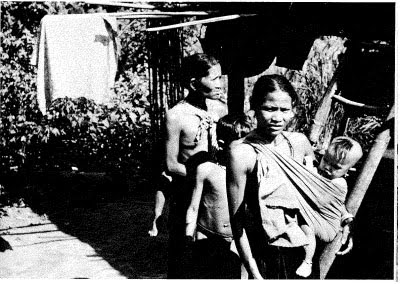 Khmer Leu Highland Tribes: The Khmer Leu tribesmen settled across the northeastern plateau along the Khmer/Vietnam border area from Kratié, to Mondulkiri, Rattanakiri, to Stung Treng. They were still very much hunters-gatherers, and to some extent taking up subsistent rice-farming, and small trades of rain forest commodities such as rare species of wood for bows, cross-bows and arrows, exotic medicinal plants, and wild animal products such as hides and ivories. Some may own elephants which they used as means of transport to travel to market towns.
 Young women performing family chores: pounding rice.
 A Mnong boy: Perhaps we are looking at the image of our pre-Khmer predecessors who settled this region a few centuries before the Christian era. We left them behind in the forest for bigger settlement with rice-farmlands and irrigation system, multi-season harvests, market towns and trading ports, last but not least burdensome government. Ancient Khmer Kings made it a tradition to exchange gifts and tributes with various highland and hill tribes to keep them pacified. In recent time they found themselves dodging bullets and bombs between Vietminh/NVA/VC and French/Viet/US. More recently they are being robbed and evicted from their ancestral land and habitat by Cousin Xen and his allies.
The Life of Khmer Mchas Srok in recent past:
 Our People and our Rivers are inseparable!
 Phnom Penh Central Market: If there were such a place called “THE MELTING POT” this place is IT. The women under the cone hats are Vietnamese, the ones under the umbrella hats are Chinese, and the one with their head wrapped in kramar or bare-headed are undeniably Khmer.
 Phsar Thmey (Le Marché Central or Central Market): If the Colonial French has ever deserved any credit for giving what we truly needed it was the design and construction of this magnificent structure which stood the test of time, and served its purpose so well through our City’s ups and downs for the last ¾ of a century.
 Many of us had a humble beginning from an honest-to-goodness classroom (Sala Wat) like this one. This is a bit of a gender-biased photo ― our girl classmates on the right rows ought to be in the picture frame as well. Our men teachers always looked dignified like a ship captain.
 We were hardly wealthy by any standard, but we invested heavily in our wat and our Sangha. We have always preserved the tradition of our ancestors in providing and maintaining mutual duty and support between the Sangha and laity community, because we only have each other to rely on in the absence of a compassionate and dependable central government leadership.
 Women co-op during rice-transplant: Without the benefit of technology and mechanical power, we combined force and took turns to work our land collectively from plowing to harvest, with the blessing of the monsoon rain. We should never forget that without the community (our village, us, the Sangha, and the wat) which has traditionally held us together for centuries, and without the bond and the unity between us we would be like “FISH OUT OF THE WATER”; our enemies are well-aware of this. That is why they have never ceased mounting flagrant assault and encroachments to isolate us and steal our land since antiquity. Note the Vietnamese cone hats were the preferred choice of head and face protection by Khmer peasants against the merciless sunray and heat.
The Outlook:
While most of the earlier immigrants came to Cambodia either to fill the voids in our country’s economic food chain, or were brought-in by the French to serve their colonial interests, or to escape war and repression in their homeland, and to find a peaceful place to raise and feed their family, the current wave of migration across our eastern border have been frightfully outside any recognizable norm ― it looks more like an invasion. We are being forced to make rooms for these new comers by a deliberate and wicked strategy of “swarming-evicting-land grabbing” contrived by a threatening neighbor with the consent of a mindless, spineless local puppet administration, under the pretext of “economic cooperation”. This sketchy and criminal act has been executed at the expense of our own citizens who hardly have been given free and fair access to opportunities which enable them to work and live with dignity. Currently most Khmers have to scrape the bottom of the barrel to secure food and basic necessities to sustain their family and themselves while the threat of eviction and land-grab are never far from real. This out-of-control, one-way, free-flow immigration policy is intensifying while the land, water, forest, and food resources are dwindling. The environmental health of the land is rapidly deteriorating with no serious and meaningful restoration effort in the work. The future outlook of our ordinary citizens is getting grimmer by the day. All things have a tipping point ― the era of “live and let’s live” may soon come to a screeching halt and begin to kick into reverse-gear rather violently.
To the Powerful Ruling Elites:
We, Khmer Mchas Srok, who have inherited and worked this land to finance, build, and defend the once an Empire, and now a tiny Kingdom, with our own blood, sweat, and tears, are asking you to examine closely the bas-reliefs along the gallery walls of Angkor Wat and Angkor Thom. Pay particular attention to the magnificent war elephants which carried kings and generals across enemy line to secure victories for the people and the land ― we are those elephants which you are riding on today. If you are so hell-bent on riding us to the ground until we are done taken our last fateful step, and collapsed under your abusive “ridership”, there will be a dire consequence ― YOU WILL BITE THE DUST!
If you anticipate your bloody allies would give you a free ride just like we did, you are only fooling yourselves….
 ……… HEAR OUR VOICES!








