


Showing posts with label Donors. Show all posts
Showing posts with label Donors. Show all posts
Wednesday, June 20, 2007


Monday, June 18, 2007
CPP sings its yearly sad song to fool donors: No aid to the CPP gov't then the "already-suffering" Cambodian people will suffer more
 CPP official’s reaction to human rights organization
16 June 2007
By Phan Sophat
Radio Free Asia
Translated from Khmer by Heng Soy
A high-ranking official of the ruling CPP, reacted today to the accusations made by Human Rights Watch (HRW) which called on donor countries to apply pressure on Cambodia, by saying that this is a bad idea with the intention of inflicting pain on the Cambodian people.
In a phone interview with RFA on Saturday afternoon, Chiem Yeap, a CPP MP and a member of the permanent committee of the CPP central committee, said that HRW’s declaration was made only to create problem ahead of the donor countries meeting.
Chiem Yeap said: “I see that a number of organizations are creating all these issues ahead of the general election, and ahead of the aid provided by the International community. These actions do not help the well-being of the Cambodian people.”
On 15 June, HRW issued a statement calling for all donor countries to apply pressure on the Cambodian government in order to push for a fight against corruption, illegal logging, and land-grabbing from the people perpetrated by the rich and powerful.
HRW’s declaration stressed that donor countries should not accept any more delay in the empty promises of reform made by Hun Sen in the past, when he was looking for $600 million in aid annually.
The HRW declaration also stated that the Cambodian government has made virtually no progress in the past decade on key pledges to donors on the rule of law or judicial independence. Impunity for human rights violations remains the rule. Corruption is rampant. Natural resources are still being plundered. Those who report on such abuses are threatened or harassed and sometimes subject to violence.
HRW declaration came at a time when officials from the International community and officials from the Cambodian government plan to meet to discuss the request for aid for the development of Cambodia, to be held on 19-20 June.
Brad Adams, HRW director for Asia, said in this declaration: “The $5 billion in aid plowed into Cambodia in the past decade has yielded little in return for the donors or the Cambodian people.”
Brad Adams said that donor countries all know about this problem, and there will be more promises made this year, but without serious donor pressure they, too, will be broken.
In a phone interview with RFA on Saturday afternoon, Chiem Yeap, a CPP MP and a member of the permanent committee of the CPP central committee, said that HRW’s declaration was made only to create problem ahead of the donor countries meeting.
Chiem Yeap said: “I see that a number of organizations are creating all these issues ahead of the general election, and ahead of the aid provided by the International community. These actions do not help the well-being of the Cambodian people.”
On 15 June, HRW issued a statement calling for all donor countries to apply pressure on the Cambodian government in order to push for a fight against corruption, illegal logging, and land-grabbing from the people perpetrated by the rich and powerful.
HRW’s declaration stressed that donor countries should not accept any more delay in the empty promises of reform made by Hun Sen in the past, when he was looking for $600 million in aid annually.
The HRW declaration also stated that the Cambodian government has made virtually no progress in the past decade on key pledges to donors on the rule of law or judicial independence. Impunity for human rights violations remains the rule. Corruption is rampant. Natural resources are still being plundered. Those who report on such abuses are threatened or harassed and sometimes subject to violence.
HRW declaration came at a time when officials from the International community and officials from the Cambodian government plan to meet to discuss the request for aid for the development of Cambodia, to be held on 19-20 June.
Brad Adams, HRW director for Asia, said in this declaration: “The $5 billion in aid plowed into Cambodia in the past decade has yielded little in return for the donors or the Cambodian people.”
Brad Adams said that donor countries all know about this problem, and there will be more promises made this year, but without serious donor pressure they, too, will be broken.
Sunday, June 17, 2007
CITA asks Donors to pressure the government
16 June 2007
By Mayarith
Radio Free Asia
Translated from Khmer by Heng Soy
By Mayarith
Radio Free Asia
Translated from Khmer by Heng Soy
The Cambodian Independent Teachers’ Association (CITA) issued an open letter calling for the International community which provides aid to Cambodia to apply pressure on the government to respect the promises it made, in order to lead the country towards development.
The letter was issued on Friday 15 June by CITA – which claims to represent several hundreds of thousands of civil servants – just ahead of the Consultative Group (CG) meeting to be held in Phnom Penh city.
Leng Bun Hong, a CITA representative said: “CITA calls on donor countries to please pay attention and apply pressure on the government leader so that the anti-corruption law is adopted. This government promised to ratify the anti-corruption law since the CG meeting in 2004. Then, the government promised to have the law ready by the end of 2005. Now, we can see that corruption is growing in all (government) institutions.”
There was no immediate reaction from government officials on this issue.
The letter was issued on Friday 15 June by CITA – which claims to represent several hundreds of thousands of civil servants – just ahead of the Consultative Group (CG) meeting to be held in Phnom Penh city.
Leng Bun Hong, a CITA representative said: “CITA calls on donor countries to please pay attention and apply pressure on the government leader so that the anti-corruption law is adopted. This government promised to ratify the anti-corruption law since the CG meeting in 2004. Then, the government promised to have the law ready by the end of 2005. Now, we can see that corruption is growing in all (government) institutions.”
There was no immediate reaction from government officials on this issue.
Saturday, June 16, 2007
Human Rights Watch urges donors to pressure Cambodian government
Saturday June 16, 2007
The New York-based group said donors should no longer accept unfulfilled promises of reform that Cambodian Prime Minister Hun Sen's government has previously made in exchange for about US$600 million (euro450 million) in aid a year.
"Hun Sen continues to run circles around the donors, making the same empty promises every year and laughing all the way to the bank,'' Brad Adams, Human Rights Watch's Asia director, was quoted saying in a statement received Saturday.
Adams said donors must send the government an unambiguous signal that it has to make good on pledges to fight rampant corruption, land-grabbing and illegal logging, which Adams said have enriched only the rich and the powerful.
Long Visalo, a deputy foreign minister, said the government needs more time to tackle those issues, "but in saying this, it does not mean that Cambodia is not advancing at all.''
Foreign donors and government officials are scheduled to meet June 19-20 to discuss proposals for development aid for Cambodia, one of the world's poorest countries. About 35 percent of Cambodia's 14 million people live on less than US$0.50 (euro0.38) a day.
At last year's meeting, donors pledged US$601 million (euro451 million) for Cambodia, despite criticisms from human rights groups about the government's poor human rights record and its failure to fight corruption.
Since then, general progress on government commitments to pursue good governance "is slow while some promised reforms have been stalled,'' the NGO Forum, an umbrella of non-governmental groups in Cambodia, said in a statement Friday.
NGO is an acronym for nongovernment organization.
The forum said Cambodia's government has also missed its promised June deadline of last year for introducing a draft anti-corruption law.
It said the NGOs are also "extremely concerned about the escalating number of poor and vulnerable people being alienated from their land and natural resources, both in urban and rural areas.''
U.S. Ambassador Joseph Mussomeli countered that Cambodia continues to make "solid progress,'' noting its work on fighting bird flu and AIDS, passing an anti-domestic violence law and a penal procedures code.
But he said "the fight against corruption remains the number one concern of the donor community as it underpins our efforts in every other sector,'' he said in an e-mail Saturday.
"Other important areas of discussion will be the environment, land grabbing and good governance, but again, progress in all of these areas is hampered by the systemic corruption we see in Cambodian today,'' he said.
Adams said the meeting has become an empty annual ritual, with the government making and breaking promises every year. The donors "know all about this,'' he said, adding "instead, they are being taken for a ride.''
"There will be more promises made this year, but without serious donor pressure they, too, will be broken,'' Adams said.
"There will be more promises made this year, but without serious donor pressure they, too, will be broken" - Brad Adams, Human Rights Watch's Asia directorPHNOM PENH, Cambodia (AP): Foreign donors must pressure Cambodia's government to fight corruption, illegal logging and land-grabbing by the impoverished country's rich and powerful, Human Rights Watch said Saturday.
The New York-based group said donors should no longer accept unfulfilled promises of reform that Cambodian Prime Minister Hun Sen's government has previously made in exchange for about US$600 million (euro450 million) in aid a year.
"Hun Sen continues to run circles around the donors, making the same empty promises every year and laughing all the way to the bank,'' Brad Adams, Human Rights Watch's Asia director, was quoted saying in a statement received Saturday.
Adams said donors must send the government an unambiguous signal that it has to make good on pledges to fight rampant corruption, land-grabbing and illegal logging, which Adams said have enriched only the rich and the powerful.
Long Visalo, a deputy foreign minister, said the government needs more time to tackle those issues, "but in saying this, it does not mean that Cambodia is not advancing at all.''
Foreign donors and government officials are scheduled to meet June 19-20 to discuss proposals for development aid for Cambodia, one of the world's poorest countries. About 35 percent of Cambodia's 14 million people live on less than US$0.50 (euro0.38) a day.
At last year's meeting, donors pledged US$601 million (euro451 million) for Cambodia, despite criticisms from human rights groups about the government's poor human rights record and its failure to fight corruption.
Since then, general progress on government commitments to pursue good governance "is slow while some promised reforms have been stalled,'' the NGO Forum, an umbrella of non-governmental groups in Cambodia, said in a statement Friday.
NGO is an acronym for nongovernment organization.
The forum said Cambodia's government has also missed its promised June deadline of last year for introducing a draft anti-corruption law.
It said the NGOs are also "extremely concerned about the escalating number of poor and vulnerable people being alienated from their land and natural resources, both in urban and rural areas.''
U.S. Ambassador Joseph Mussomeli countered that Cambodia continues to make "solid progress,'' noting its work on fighting bird flu and AIDS, passing an anti-domestic violence law and a penal procedures code.
But he said "the fight against corruption remains the number one concern of the donor community as it underpins our efforts in every other sector,'' he said in an e-mail Saturday.
"Other important areas of discussion will be the environment, land grabbing and good governance, but again, progress in all of these areas is hampered by the systemic corruption we see in Cambodian today,'' he said.
Adams said the meeting has become an empty annual ritual, with the government making and breaking promises every year. The donors "know all about this,'' he said, adding "instead, they are being taken for a ride.''
"There will be more promises made this year, but without serious donor pressure they, too, will be broken,'' Adams said.
Cambodia: Donors Must Hold Government Accountable
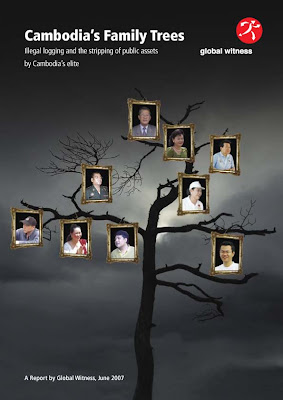 Global Witness report banned by Hun Sen's regime
Human Rights Watch
Banning of Forest Report Mocks Commitments to Human Rights
(New York, June 15, 2007) – Cambodia’s international donors should not accept any more empty promises from the Cambodian government on human rights, the rule of law and good governance, Human Rights Watch said today. The annual Consultative Group meeting of donors is scheduled to take place in Phnom Penh on June 19-20, and donors are expected to pledge more than US$600 million in additional aid for the next year.
Human Rights Watch said that the Cambodian government has made virtually no progress in the past decade on key pledges to donors on the rule of law or judicial independence. Impunity for human rights violations remains the rule. Corruption is rampant. Natural resources are still being plundered. Those who report on such abuses are threatened or harassed and sometimes subject to violence.
“The $5 billion in aid plowed into Cambodia in the past decade has yielded little in return for the donors or the Cambodian people,” said Brad Adams, Asia director at Human Rights Watch. “The meeting has become an empty annual ritual, with the government making and breaking promises every year. There will be more promises made this year, but without serious donor pressure they, too, will be broken.”
Human Rights Watch called on the Cambodian government to rescind its June 3 order to “ban and collect” the recent report by Global Witness. The report, “Cambodia’s Family Trees,” alleges illegal logging by individuals close to Prime Minister Hun Sen. It also claims that the government’s promises to end illegal logging have been broken, that the army, military police and police are deeply involved in illegal logging, and that funds from illegal logging support Hun Sen’s personal bodyguard unit, which has been responsible for human rights abuses.
The government should officially repudiate reported statements by Kompong Cham provincial governor Hun Neng, Hun Sen’s brother. Hun Neng reportedly said on June 11 that “If they [Global Witness] come to Cambodia, I will hit them until their heads are broken.”
“The government’s reaction to the Global Witness report shows its lack of commitment to freedom of expression and public debate, and its continued thuggish behavior,” said Adams. “Donors should insist that the government undertake a credible judicial investigation into the criminal activities detailed in the report, rather than resort to violent threats against its authors. Donors often complain about a lack of political will from the government, but this will be a test of their political will, too.”
Human Rights Watch said that donors have a major role to play in determining Cambodia’s future by continuing their assistance to civil society and insisting that the government fully comply with commitments made at successive donor meetings dating back to 1993. After billions of dollars of donor support over the past 14 years, it is time for a clear and unambiguous signal to be sent to the government. Donors should make it clear that they can no longer accept previously unmet promises.
For more than a decade, donors have been providing aid equivalent to roughly half Cambodia’s national budget. As donors have noted, good governance is directly linked to a country’s pace of development. There is little doubt that Cambodia’s development continues to be slowed by the country’s poor governance.
“If donors are serious about development in Cambodia, they should start generating momentum for real reform,” said Adams. “They need to emphasize, not marginalize, the links between human rights and development.”
Development assistance and budgetary support should be contingent on the government meeting agreed benchmarks on human rights, the rule of law, and good governance, such as:
“The donors’ list of conditions hardly changes over time, and the government simply ignores them year after year,” said Adams. “Hun Sen continues to run circles around the donors, making the same empty promises every year and laughing all the way to the bank.”
(New York, June 15, 2007) – Cambodia’s international donors should not accept any more empty promises from the Cambodian government on human rights, the rule of law and good governance, Human Rights Watch said today. The annual Consultative Group meeting of donors is scheduled to take place in Phnom Penh on June 19-20, and donors are expected to pledge more than US$600 million in additional aid for the next year.
Human Rights Watch said that the Cambodian government has made virtually no progress in the past decade on key pledges to donors on the rule of law or judicial independence. Impunity for human rights violations remains the rule. Corruption is rampant. Natural resources are still being plundered. Those who report on such abuses are threatened or harassed and sometimes subject to violence.
“The $5 billion in aid plowed into Cambodia in the past decade has yielded little in return for the donors or the Cambodian people,” said Brad Adams, Asia director at Human Rights Watch. “The meeting has become an empty annual ritual, with the government making and breaking promises every year. There will be more promises made this year, but without serious donor pressure they, too, will be broken.”
Human Rights Watch called on the Cambodian government to rescind its June 3 order to “ban and collect” the recent report by Global Witness. The report, “Cambodia’s Family Trees,” alleges illegal logging by individuals close to Prime Minister Hun Sen. It also claims that the government’s promises to end illegal logging have been broken, that the army, military police and police are deeply involved in illegal logging, and that funds from illegal logging support Hun Sen’s personal bodyguard unit, which has been responsible for human rights abuses.
The government should officially repudiate reported statements by Kompong Cham provincial governor Hun Neng, Hun Sen’s brother. Hun Neng reportedly said on June 11 that “If they [Global Witness] come to Cambodia, I will hit them until their heads are broken.”
“The government’s reaction to the Global Witness report shows its lack of commitment to freedom of expression and public debate, and its continued thuggish behavior,” said Adams. “Donors should insist that the government undertake a credible judicial investigation into the criminal activities detailed in the report, rather than resort to violent threats against its authors. Donors often complain about a lack of political will from the government, but this will be a test of their political will, too.”
Human Rights Watch said that donors have a major role to play in determining Cambodia’s future by continuing their assistance to civil society and insisting that the government fully comply with commitments made at successive donor meetings dating back to 1993. After billions of dollars of donor support over the past 14 years, it is time for a clear and unambiguous signal to be sent to the government. Donors should make it clear that they can no longer accept previously unmet promises.
For more than a decade, donors have been providing aid equivalent to roughly half Cambodia’s national budget. As donors have noted, good governance is directly linked to a country’s pace of development. There is little doubt that Cambodia’s development continues to be slowed by the country’s poor governance.
“If donors are serious about development in Cambodia, they should start generating momentum for real reform,” said Adams. “They need to emphasize, not marginalize, the links between human rights and development.”
Development assistance and budgetary support should be contingent on the government meeting agreed benchmarks on human rights, the rule of law, and good governance, such as:
- Tackling impunity for human rights abuses, including the many extrajudicial killings carried out during and after the July 1997 coup by Hun Sen’s government;
- Ceasing to harass and threaten civil society activists and opposition party members;
- Ensuring that the rights of individuals and organizations to defend and promote human rights are protected, including the right to peacefully criticize and protest government policies, in accordance with the International Covenant on Civil and Political Rights and the 1998 United Nations General Assembly Declaration on Human Rights Defenders;
- Creating an independent and restructured National Election Committee;
- Liberalizing electronic media ownership rules, including allowing transmitters of private, critical media to be as strong as those of pro-government private stations;
- Complying fully with previous Consultative Group commitments to address corruption and misuse of natural resources and other state assets; these include public disclosure of information concerning management of land, forests, mineral deposits and fisheries, as well as the location of military development zones; and,
- Passing legislation on asset disclosure and anti-corruption that meets international standards, and appointing an independent, international external auditor for government finances.
“The donors’ list of conditions hardly changes over time, and the government simply ignores them year after year,” said Adams. “Hun Sen continues to run circles around the donors, making the same empty promises every year and laughing all the way to the bank.”
Wednesday, June 13, 2007
Begging festival celebration in preparation: CPP hopes that aid will still pour in
Tuesday, June 12, 2007
Everyday.com.kh
Translated from Khmer by Heng Soy
Everyday.com.kh
Translated from Khmer by Heng Soy
Even though it is facing with a barrage of criticisms from NGOs and Global Witness just before the Consultative Group (CG) meeting next week, high-ranking CPP officials expressed their belief that these criticisms will not lead to aid cut for Cambodia. Nguon Nhel, CPP first Vice-president of the National Assembly, said on Monday that he is confident that donor countries will continue to provide aid to Cambodia, because they know that the (Cambodian) government is doing a good job, and it deserves the aid. Nguon Nhel told The Cambodia Daily that donor countries would not provide sacks and sacks of dollars in aid to a corrupt government. He added: “I think that the donor countries and international institutions won’t believe the NGO’s report.” CPP MP Cheam Yiep said that he believed the donor countries will listen to the comments made by Samdach Hun Sen and Mr. Keat Chhon, the minister of economy and finance.
Wednesday, June 06, 2007
Cambodia: Can't See the Forest for the Thieves
 The author, with Global Witness in November 2005, investigating a truck transporting
 logs to Phnom Penh. The driver of this truck claimed he was carrying "mango trees"
(Global Witness photo).
06 Jun 2007
Liam Cochrane
World Politics Review Exclusive
"... the profits from transporting illegally cut logs fund a small army, which in turn props up Cambodia's authoritarian rulers"The latest report by illegal logging watchdog Global Witness has received the highest accolade an investigative NGO's work can receive from the Cambodian Government: It has been banned.
The reason?
It exposes the country's largest illegal logging syndicate and its links to senior government officials, including the prime minister. Plus, it details the way the army has been used as a log courier service for the secret trade with Vietnam and China.
Now, as Cambodia's annual pledge-a-thon approaches, international donors are scrambling to react to accusations they haven't done enough to protect Cambodia's forests.
Global Witness, the U.K.-based logging and blood diamond watchdog, cheekily titled its 95-page report "Cambodia's Family Trees" and printed a cover with framed pictures of Prime Minister Hun Sen -- and the logging kingpins related to him by marriage or political ties -- hanging from a barren tree.
The study took Global Witness three years of surveillance and interviews to complete and is perhaps the most extensive exposé of institutionalized corruption and natural resources pillaging to date. Among the main targets are Hun Sen's first cousin, Hun Chouch, Minister of Agriculture, Forestry and Fisheries Chan Sarun, and Forestry Administration boss Ty Sokhun.
So it was little surprise the report ruffled some feathers.
"If they [Global Witness] come to Cambodia, I will hit them until their heads are broken," was how the prime minister's brother and provincial governor, Hun Neng, responded to accusations that he and his wife were involved in the illicit trade.
Cambodia's Ministry of Information released a statement describing the report as "a personal accusation . . . to cause political conflicts in the country" and ordered the confiscation of any copies already in the Southeast Asian nation.
But the fallout adheres to a long-running pattern of government behavior that is accurately predicted within the report.
"Hun Sen responds to even muted criticism by declaring that attempts to remove him will cause the country to fall back into conflict and instability," Global Witness wrote about the leader of a country still traumatized by the killing frenzy of the Khmer Rouge in the 1970s and the bitter civil war that followed.
It's not the first time Global Witness has raised the ire of Cambodia's government.
Global Witness was appointed by the government as the official monitor of illegal logging, but was fired from the job after its reports uncovered the involvement of military and political figures. In 2004, copies of the group's report "Taking a Cut" were confiscated at the airport and several international staff were refused entry.
Global Witness says the issues of illegal logging and political power are intertwined, with logging bankrolling Hun Sen's private armies, which in turn assure political supremacy for the one-eyed former Khmer Rouge leader, nicknamed the "Strongman."
Log Laundering
Cambodia's ruling powers have long used timber to fund their wars and, in more recent times, their political dominance. In the late 1990s, there was pressure from international donors to crack down on the plunder; the transport of logs was banned and illegal cutting slowed.
But lucrative profits and lax laws meant that the chainsaws never really stopped.
Over the years there have many creative schemes invented to bypass logging regulations. The funniest involved logging permits given ostensibly for the purpose of building a platform so the country's parachute regiment could practice jumping off. The most shameless would have to be the tricking of monks into signing documents requesting valuable koki logs for building dragon boats to represent their temples in the annual boat racing festival.
The latest Global Witness report focuses on the use of economic land concessions -- usually plantations -- as a cover for illegal logging. In 2001, Hun Sen inaugurated the Tumring Rubber Plantation and the country's biggest logging cartel went to work.
The Seng Keang Import Export company was owned by Hun Sen's Rolex-wearing cousin Hun Chouch, his ex-wife Seng Keang and Khun Thong, brother-in-law of the minister of forestry, the official ultimately responsible for protecting Cambodia's trees.
Their "plantation" area was located inside the Prey Long forest -- the largest lowland evergreen forest still standing in Southeast Asia. It is home to elephants, tigers and the Asiatic black bear, as well as burial grounds and resin trees tapped by locals for a modest income.
But Prey Long's natural blessings are also its curse: The rich flora includes large amounts of commercial-grade and luxury timber.
"It is unlikely they could have selected a more suitable location for their activities and Tumring duly became the center of the largest illegal logging operation in Cambodia," said Global Witness.
The strategy was simple: harvest the most valuable trees within reach, move the timber inside the plantation's borders and claim it was felled in clearing. This neatly avoided various laws and a ban on the transport of freshly cut logs.
The operation was big. In 2005, community forestry activists counted 131 chainsaws and 12 mobile sawmills in the district. Timber was processed at an illegal sawmill at the appropriately named village of Khaos, or trucked out at night to another factory in the capital of Phnom Penh, most of it eventually heading for China.
Between 2003 and 2005, China says it bought $16.2 million worth of plywood from Cambodia, with Seng Keang being the principle manufacturer of ply. Strangely, Cambodia's registered exports, and thus taxes, for that period were zero.
In November 2005, I accompanied Global Witness to Tumring and saw work gangs with chainsaws kilometers outside the plantation boundaries. They told us their boss, a notorious local thug known by his radio call sign "Mr. 95", paid $100 a month to the Forestry Administration in Khaos for each chainsaw in use; just the tip of the corruption iceberg.
After dark we followed convoys of trucks heading to Phnom Penh. We reached some that had stopped by the side of the road and we got out to inspect. The owner of the truck told Global Witness the trucks contained "mango trees." I peeked inside and saw neatly cut logs a foot in diameter.
As we talked with the nervous driver, a pickup truck full of armed soldiers escorting the convoy tried to photograph us as they sped past, a dangerous prospect considering the death threats and beatings given out to Global Witness staff in the past.
As Global Witness explains in their report, the complicity of corrupt police makes this racket possible, but for the military it's much more -- the profits from transporting illegally cut logs fund a small army, which in turn props up Cambodia's authoritarian rulers.
How to Fund a Private Army
Since an attempted coup against Hun Sen in 1994, Southeast Asia's longest serving premier has maintained an elite Bodyguard Unit of 4,000 well-equipped troops loyal solely to him.
In addition, Hun Sen has a backup force of 2,000 soldiers, known as Brigade 70. Global Witness says that under the leadership of business-turned-soldier Brigadier General Hak Mao, Brigade 70 has developed a lucrative business transporting logs and other contraband across the country.
Hak Mao personally owns 16 trucks and has two depots in the capital -- one for commercial grade timber, one for luxury wood, according to Global Witness.
"According to one timber dealer in Phnom Penh, Hak Mao is able to deliver logs of all types according to order," says the report.
The U.K. watchdog estimates that fees from transporting logs and other smuggled goods such as liquor, cigarettes and even ice cream -- amounts to somewhere between $2 million and $2.75 million a year.
A cut of this money -- at least $30,000 a month, says Global Witness -- is used to fund Brigade 70 and the Bodyguard Unit.
"The Brigade 70 case highlights the direct linkage between Hun Sen's build up of loyalist military units and large-scale organized crime," says the Global Witness report, which was released from the safety of Bangkok on June 1.
Where's the Outrage?
The reaction from the international community has been muted.
The U.S. and British embassies have said they share some of the concerns Global Witness has raised, but have not been drawn into the detail of the report.
Some of Global Witness' strongest criticisms are directed towards the international donors who last year spent $601 million underwriting half the Cambodian budget, yet apply little real pressure for change.
"The donors have failed. They are basically spineless," Simon Taylor, director of Global Witness, told the Associated Press. "The message that Hun Sen gets from the donors is that they don't really give a damn."
Hun Sen, however, does give a damn.
Despite receiving "no-strings-attached" aid money from the Chinese equal to all other donor contributions combined, Cambodia continues to seek the legitimacy that can only come from the support of developed nations.
And despite well-documented corruption and an increasingly one-party state, the international community -- much to the frustration of many NGOs on the ground -- continues to give the Cambodian Government that support.
Cambodia's army -- the same force that transports illegal logs -- is receiving military assistance from Australia, China, Vietnam, and the United States.
The U.S. suspended military assistance after the 1997 coup, in which Hun Sen violently unseated his co-Prime Minister Prince Ranariddh. But after Cambodia recently signed the "Article 19" agreement, which promises not to send any U.S. citizens to the International Criminal Court, and began helping out with the "War on Terror" by some dubious arrests of Muslims, the United States is once again providing aid for Cambodia's soldiers.
Ironically, the U.S. embassy says a third of the $1 million military assistance that was earmarked for 2006 went towards trucks, spare parts and training.
What makes Global Witness' report on forestry all the more compelling is Cambodia's burgeoning oil industry. Several companies -- including Chevron -- are currently exploring oil fields of considerable size just off the southern coastline.
But many see the sad fate of the forestry industry as a likely precedent for what will happen to the oil bonanza: The ruling elite and their cronies will get richer, the environment will be devastated and the people of Cambodia will receive next to nothing.
It's the so called "oil curse" that has afflicted Angola, Chad and Nigeria, among others.
To sound a warning to Cambodia's "kleptocracy," Global Witness has recommended international donors link non-humanitarian aid money to reforms and "test cases" to make an example of the powerful.
"There can be little doubt that a handful of competently investigated and prosecuted cases against senior officials, their relatives and associates would have a far greater impact on abuse of power and corruption than new legislation, as important as it is," said the report.
The donor community will have to think fast. The annual meeting at which bilateral donors and the World Bank will pledge next year's aid and discuss the development of the nation is scheduled for June 19-20.
No doubt, the issues of illegal logging, corruption and misuse of the military will be somewhere on the agenda. The question is where do they go from there?
Liam Cochrane is a freelance journalist based in Katmandu, Nepal. He was formerly the managing editor of the Phnom Penh Post newspaper in Cambodia.
Monday, February 12, 2007
Aid donors blast Cambodia corruption
Phnom Penh (dpa) - Donors voiced increasing frustration at the Cambodian government's continued failure to pass an anti-corruption law or act on land grabbing and other related issues at a tense meeting in the capital Monday.
Speaking at the ninth meeting of the Government-Donor Coordination Committee (GDCC), Finance Minister Keat Chhon tried to placate visibly impatient donors by promising a long-promised meeting between them and Deputy Prime Minister Sok An would take place soon.
In-depth discussion of other related topics of major concern to donors and rights groups including land grabbing, land concessions and transparency were also postponed until that promised meeting.
But donors, who said they have heard it all before, told the government in the strongest diplomatic language possible that the time for waiting was over.
The subject was first scheduled for discussion after last October's quarterly GDCC, and the government promised an anti-corruption bill before the National Assembly by the end of the year, but also failed to meet that deadline.
"I have now been asked to inform you about Sok An's intention to schedule this meeting as early as possible... The meeting with Sok An will provide an opportunity for a full discussion on the anti-corruption law," Keat Chhon said, and in doing so removed the subject from the day's discussion.
Donors were not about to let the opportunity drop, however, and in speeches by a number of ambassadors and the UN representative, donor demands for action were clear and to the point.
Douglas Gardner, UN resident coordinator, said Cambodia's economic growth for 2006 was "commendable" at 9.6 per cent, but that this was offset by the "increased inequalities for marginalized groups and the rural poor."
US Ambassador Joseph Mussomeli said donors demanded answers and firm deadlines on the law.
"On behalf of all development partners, we ask you when will this law be enacted? We affirm our commitment to aggressively support your efforts to fight corruption and improve the lives of all Cambodians," he said.
Canadian Ambassador Donica Pottie said land issues remained of serious concern despite the fact that that law had been enacted, in doing so again echoing donor concerns that the proposed anti-corruption law must have teeth and be seen to work in practice.
"Six years have now passed since the adoption of that law and still not a single indigenous group has been issued with a land title," she said.
The government blamed changes to the penal law for the last delay in the anti-corruption law, which would require an independent body with executive powers be set up to investigate corruption allegations.
Last November, Berlin-based Transparency International (TI) positioned Cambodia at 151 out of 163 countries in its "corruption perceptions index" survey.
The TI study defined corruption as "the abuse of public office for private gain," and Cambodia scored just 2.1 points out of a possible 10. Corruption has been seen as a major stumbling block in the path of the heavily aid-dependant nation's development.
Sunday, ahead of the GDCC meeting, a coalition of non-government organizations issued a statement calling on donors to push the government to act on reform and make it show the political will to honour its promises.
Donors have threatened to withhold aid if the government fails to implement an acceptable anti-corruption law imminently.
Speaking at the ninth meeting of the Government-Donor Coordination Committee (GDCC), Finance Minister Keat Chhon tried to placate visibly impatient donors by promising a long-promised meeting between them and Deputy Prime Minister Sok An would take place soon.
In-depth discussion of other related topics of major concern to donors and rights groups including land grabbing, land concessions and transparency were also postponed until that promised meeting.
But donors, who said they have heard it all before, told the government in the strongest diplomatic language possible that the time for waiting was over.
The subject was first scheduled for discussion after last October's quarterly GDCC, and the government promised an anti-corruption bill before the National Assembly by the end of the year, but also failed to meet that deadline.
"I have now been asked to inform you about Sok An's intention to schedule this meeting as early as possible... The meeting with Sok An will provide an opportunity for a full discussion on the anti-corruption law," Keat Chhon said, and in doing so removed the subject from the day's discussion.
Donors were not about to let the opportunity drop, however, and in speeches by a number of ambassadors and the UN representative, donor demands for action were clear and to the point.
Douglas Gardner, UN resident coordinator, said Cambodia's economic growth for 2006 was "commendable" at 9.6 per cent, but that this was offset by the "increased inequalities for marginalized groups and the rural poor."
US Ambassador Joseph Mussomeli said donors demanded answers and firm deadlines on the law.
"On behalf of all development partners, we ask you when will this law be enacted? We affirm our commitment to aggressively support your efforts to fight corruption and improve the lives of all Cambodians," he said.
Canadian Ambassador Donica Pottie said land issues remained of serious concern despite the fact that that law had been enacted, in doing so again echoing donor concerns that the proposed anti-corruption law must have teeth and be seen to work in practice.
"Six years have now passed since the adoption of that law and still not a single indigenous group has been issued with a land title," she said.
The government blamed changes to the penal law for the last delay in the anti-corruption law, which would require an independent body with executive powers be set up to investigate corruption allegations.
Last November, Berlin-based Transparency International (TI) positioned Cambodia at 151 out of 163 countries in its "corruption perceptions index" survey.
The TI study defined corruption as "the abuse of public office for private gain," and Cambodia scored just 2.1 points out of a possible 10. Corruption has been seen as a major stumbling block in the path of the heavily aid-dependant nation's development.
Sunday, ahead of the GDCC meeting, a coalition of non-government organizations issued a statement calling on donors to push the government to act on reform and make it show the political will to honour its promises.
Donors have threatened to withhold aid if the government fails to implement an acceptable anti-corruption law imminently.
Cambodia donors 'disappointed' over promised anti-graft law
12-Feb-2007
AFP
 Speaking on behalf of international donors, US ambassador in Cambodia Joseph Mussomeli expressed disappointment over the impoverished kingdom's failure to enact a long-delayed anti-corruption law (AFP/File/Tang Chhin Sothy)
AFP
 Speaking on behalf of international donors, US ambassador in Cambodia Joseph Mussomeli expressed disappointment over the impoverished kingdom's failure to enact a long-delayed anti-corruption law (AFP/File/Tang Chhin Sothy)
 International donors to Cambodia have expressed disappointment over the impoverished kingdom's failure to enact a long-delayed anti-corruption law.
Cambodia promised donors last year that it would enact the law by the end of 2006 as part of a raft of anti-corruption measures.
But during a meeting between the government and donors, US ambassador Joseph Mussomeli said little progress had been made.
"It is time -- indeed, past time -- to immediately enact an international standard anti-corruption law, and it is also time to do it right," Mussomeli said, speaking on behalf of Cambodia's donors.
"This law, which stands to benefit all Cambodians, by contrast has experienced delay after delay," he added.
The law has been in the works for more than a decade but is still under review by the government's top legal experts, the Council of Ministers, the ambassador said.
"On behalf of all development partners, we ask you when will this law be enacted?" Mussomeli said.
Cambodia's donors have made tackling corruption the focus of their reform efforts, tying hundreds of millions of dollars to the government's willingness to clean up graft.
Cambodian Finance Minister Keat Chhon said the slow passage of the law was due to "much contradiction" within Cambodia's complicated legal system, but denied intentionally delaying the process.
"We are not using difficult issues as an excuse to slow the draft of our law," he said.
The government has repeatedly blamed delays in the anti-corruption law on Cambodia's slow progress in drafting a new penal code.
Donors led by Japan, France and the United States gave 600 million dollars in aid to Cambodia last year, accounting for about half of the country's annual budget.
Rights groups regularly push the donors, which also include Australia, Canada and several European countries, to demand reform rather than simply hand over cash.
International graft watchdog Transparency International (TI), said in December that corruption pervaded almost every sector of Cambodia, making it one of the most graft-ridden countries in the world.
The Economic Institute of Cambodia think-tank estimates that Cambodian businesses lost about 330 million dollars to graft last year.
Cambodia promised donors last year that it would enact the law by the end of 2006 as part of a raft of anti-corruption measures.
But during a meeting between the government and donors, US ambassador Joseph Mussomeli said little progress had been made.
"It is time -- indeed, past time -- to immediately enact an international standard anti-corruption law, and it is also time to do it right," Mussomeli said, speaking on behalf of Cambodia's donors.
"This law, which stands to benefit all Cambodians, by contrast has experienced delay after delay," he added.
The law has been in the works for more than a decade but is still under review by the government's top legal experts, the Council of Ministers, the ambassador said.
"On behalf of all development partners, we ask you when will this law be enacted?" Mussomeli said.
Cambodia's donors have made tackling corruption the focus of their reform efforts, tying hundreds of millions of dollars to the government's willingness to clean up graft.
Cambodian Finance Minister Keat Chhon said the slow passage of the law was due to "much contradiction" within Cambodia's complicated legal system, but denied intentionally delaying the process.
"We are not using difficult issues as an excuse to slow the draft of our law," he said.
The government has repeatedly blamed delays in the anti-corruption law on Cambodia's slow progress in drafting a new penal code.
Donors led by Japan, France and the United States gave 600 million dollars in aid to Cambodia last year, accounting for about half of the country's annual budget.
Rights groups regularly push the donors, which also include Australia, Canada and several European countries, to demand reform rather than simply hand over cash.
International graft watchdog Transparency International (TI), said in December that corruption pervaded almost every sector of Cambodia, making it one of the most graft-ridden countries in the world.
The Economic Institute of Cambodia think-tank estimates that Cambodian businesses lost about 330 million dollars to graft last year.
Subscribe to:
Posts (Atom)








