Showing posts with label Ethnic minority. Show all posts

Friday, December 16, 2011

Indigenous families’ 6-year title wait ends

Friday, 16 December 2011
Bridget Di Certo and May Titthara
The Phnom Penh Post

After nearly six years of fighting bureaucratic red tape, three indigenous communities on Wednesday became the first to receive communal land titles, more than a decade after the passage of laws making such ownership possible.

Three indigenous villages, comprising 329 families, in Ratanakkiri and Mondulkiri province are the first communities in the Kingdom to receive communal land title under the much-applauded, but poorly implemented, 2001 Land Law.

“Indigenous representatives attended a ceremony chaired by the minister of land management in Ratanakkiri on Wednesday,” the ILO’s Sek Sophorn said.

“They are so happy the title grant will enable them to maintain their land and culture.”

Tuesday, August 09, 2011

SRP MP and councilor met with Kachak indigenous people in Ratanakiri who were evicted from their lands by Vietnamese companies

08 August 2011
By Son Chhay

On August 8, 2011, SRP MP Son Chhay met with indigenous Kachak community in Kanard village of Taleav district, Ratanakiri to listen to their complaint over land lost and the destruction of the forest by Vietnamese companies.

There has been at least three Vietnamese companies operating under the name of Heng Development, Veasna Investment and Heng Brothers. All these companies received forest land concessions from Hun Sen government in Andong Meas district where many indigenous communities such as Jarai, Tompun and Kachak have been forced out off their ancestor land and forest.

SRP MP Son Chhay took note on a complaint from Kachak man on how the Viet company took away his land.

Son Chhay listen to another Kachak man on Viet intrusion on his land

SRP provincial councilor Seng Mardi was showing photos he took to Kachak women in Kanad village, in Ratanakiri.
Seng Mardi has been working tirelessly  as Party technical official to help MP Son Chhay on Agriculture and Health projects to enable SRP party to draw up policy in these areas.

SRP provincial councilor and a senator candidate Seng Mardi showing the photos to Kachak women at a remote village of Kanard in Taleav district.

RFA's Ratha Visal (second from left) was interviewing Kachak people over their loss land.
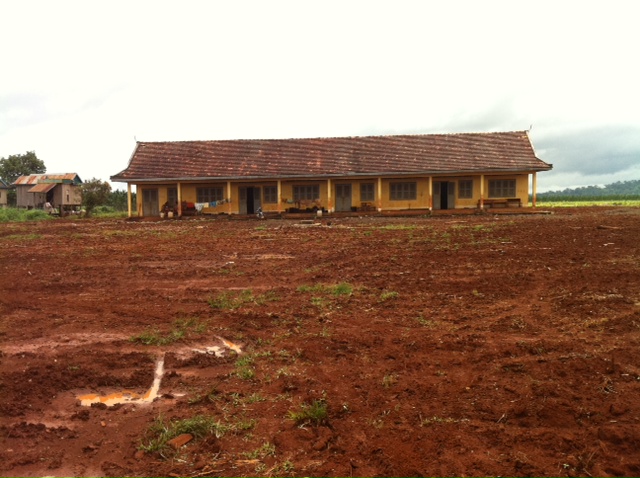
A school which was built by an international organization to provide education to Jarai people was abandoned after all the villagers were removed by a Viet company. The land around the school is now ready for plantation. Without land and a village to go to,  indigenous Tompuon now have to hide themselves in the forest a few kilometers away which will be cleared by the companies also.

Friday, January 22, 2010

Cambodia's Minority Languages Face Bleak Future

Two S'aoch children in their village in Cambodia. Neither of them speaks S'aoch, 19 Jan 2010 (Photo: VOA's R.Carmichael)

The United Nations' cultural agency UNESCO warns that 19 Cambodian languages are at risk of extinction

Phnom Penh 21 January 2010
Robert Carmichael, VOA

More than 20 languages are spoken in Cambodia, but most are minority languages and face extinction in the coming decades. Robert Carmichael has this report from Phnom Penh.

Jean-Michel Filippi is in a race. As the foremost scholar of S'aoch, the language of one of Cambodia's minority tribes, he has only a few years to record the language before it may be lost forever. To date he has recorded 4,000 words in S'aoch. His next step is to write a grammar book on the language.

Filippi says just 10 people are fluent in S'aoch and none uses the language in their daily life. That makes S'aoch the most endangered language in Cambodia. In a decade it will likely be extinct.

For him, recording the language is one way to preserve a cultural view of the world.

"Culturally speaking a language is a unique vision of the world," Filippi said. "You can take two languages which may appear to be - if not similar then very close to each other, like French for instance and English - in fact the vision of the world which implies in French language and English language are totally, totally different. If a language disappears, a whole vision of the world disappears as well at the same time."

Cambodia's dominant language is Khmer but small ethnic groups have other languages.

The United Nations' cultural agency UNESCO warns that 19 Cambodian languages are at risk of extinction. It is not a rare problem: half of the world's 6,700 languages will likely die out by the end of the century. Most are spoken by small ethnic communities in developing nations or by groups such as Native American tribes in North America.

Blaise Kilian is UNESCO's joint program coordinator in Phnom Penh. He says there are many reasons languages die.

"When you have only a very few people speaking a language of course it is in danger of being extinct," Kilian said. "But besides this you have the environment. You have the way people, themselves, and especially the new generation, react to the changing environment. How much they are interested themselves in preserving and transmitting their own languages. So I would say it is a number of internal and external factors which play an important role besides the number of speakers."

Filippi says the S'aoch people have rejected their own language because they are extremely poor. They have decided their best bet is to adopt the Khmer language.

"In the case of the S'aoch they apparently want to get rid of their language and their cultural institution because it is linked to their poverty, to I would say their economic situation, which compared to the Khmers is a very poor one, and so on and so on," Filippi said.

The imminent extinction of S'aoch raises the question of what can be done about Cambodia's other endangered languages. With S'aoch, the only option is to write down and record as much as possible while the speakers are alive.

The situation is less dire for some languages spoken in other parts of the country. In the northeastern provinces of Ratanakkiri, Mondolkiri and Stung Treng a number of organizations are involved with youth and adult education for minority people.

One of those is Care International, which for seven years has worked with the Ministry of Education on a program teaching schoolchildren in two languages.

Care's education adviser, Ron Watt, says almost 2,000 primary school children in the three provinces last year received instruction both in their ethnic community's language and in Khmer. The program is now in 25 schools.

"Bilingual education is really spreading - people are very enthusiastic about it," Watt said.

Watt says that before the program started, the government and aid organizations had misconceptions about education for minority people. One of those misconceptions was that minority groups did not want to send their children to school.

"What we have found that that is just not the case at all - that the moment you start providing relevant education that kids can access and that kids can learn, parents are more than enthusiastic to send their kids, and kids are enthusiastic to go," Watt said.

The positive response from minority communities toward language learning programs highlights something Jean-Michel Filippi insists is essential to keeping languages alive.

"If a community wants its language to be saved and is strong enough to express the will to have its language saved, it may very well work. But you will never save a language if the community doesn't want to," Filippi said.

Cambodia's poverty does not augur well for the language survival chances of its minority peoples, many of whom are struggling to keep hold of their community land.

Language and development experts say that unless Cambodia's economic situation improves, it seems likely that it will lose far more than the S'aoch language by the end of this century.

Tuesday, December 02, 2008

Adhoc: Two activists arrested by Ratanakiri cops

Adhoc's Thun Saray (Photo: DR, Cambodge Soir Hebdo)

01 Dec 2008

By Ung Chamroeun
Cambodge Soir Hebdo
Translated from French by Luc Sâr
Click here to read the article in French


The Adhoc human rights NGO denounced the arrest of two of its activists in the province of Ratanakiri. The reason for the arrest: Land disputes.

A communiqué was made public on 01 December by Adhoc, a human rights NGO in Cambodia, to protest against the arrest of two of its activists from Ratanakiri province’s Lumphat district. 36-year-old Svin Vev and 43-year-old Yang Than were summoned by the provincial court for questioning on 27 November. The two men were defending the interest of 136 ethnic minority families from the Tapang village.

“In spite of the intervention from 40 villagers, the cops sent the two men to jail in handcuff. They were tortured,” the Adhoc communiqué indicated. According to Adhoc, the arrest of these two activists is unfair, cruel and inhumane, and it constitutes a serious threat against human rights defenders.

Since 2003, the Tapang village is embroiled in a conflict with the DM Group Company. According to the villagers, the local authority granted to this company 2,000 hectares of land. The villagers were summoned on several occasions by the provincial authority and by the tribunal, but they did not budge. “No intervention, no investigation on the spot were conducted regarding the illegal deforestation which is currently taking place. On the other hand, these two human rights representatives were arrested without any precise proof, following a complaint brought up by DM Group which accused them of destroying someone else’s properties,” Adhoc denounced in its communiqué while indicating that a demonstration will be held to obtain the release of the two men arrested.

An anonymous villager indicated that several villagers have fled because they fear they could be arrested.

Neither Ros Saram, the Ratanakiri prosecutor, nor other provincial representatives could be reached on Monday.

Friday, July 11, 2008

Locals, Lawyers Prepare for Battle Over Land

Jarai children (Photo Credit: Andrew Nette/IPS)

By Andrew Nette - Newsmekong*

RATANAKIRI, Cambodia, Jul 10 (IPS) - In thick forest in the north-east Cambodian province of Ratanakiri, a team of lawyers uses a global positioning satellite handset to mark the location of traditional spirit forests and gravesites belonging to local Jarai villagers.

The stark contrast between old and new, the latest technology and ancient beliefs, illustrates the changes sweeping this remote part of the Cambodia, mainly populated by Indigenous people.

It also marks the latest round in an ongoing dispute many believe typifies the epidemic of land grabbing sweeping the country and its impact on indigenous people.

The lawyers are from the Phnom Penh-based Community Legal Education Centre (CLEC). Their ethnic Jarai clients are from Kong Yu village, about 42 kilometres out of Ban Lung, Ratanakiri’s capital.

The air is hot and alive with dragonflies as Roman Phil, a Kong Yu elder, directs the lawyers towards a traditional Jarai burial site, a dense patch of forest strewn with ceramic urns. The lawyers mark the spot on their GPS handset.

The location of the burial site and other areas of spiritual significance will be used as evidence in a case lodged by Kong Yu villagers in the provincial court against the company that they say has cheated them out of land.

The company, the Progressive Farmers Association, has already cleared much of the land, including graveyards and spirit forests, and planted it with rubber trees, a popular cash crop in Cambodia.

"We would never destroy spirit forest. It is too important for our ancestors and for us," says Phil. "They destroyed some of these and did not even give us a chance to remove the remains."

Now the Kong Yu people are alarmed at recent suggestions by local authorities that the company wants even more of their land. "If the company comes to clear more land we will protest," maintains Phil. "We are determined to protect our land."

According to a memorandum from Legal Aid of Cambodia, the dispute originated in March 2004, when the then village chief and other local officials asked Kong Yu villagers to sell a portion of their land to high-ranking official in Phnom Penh.

The villagers rejected the offer, saying that it was their ancestral land essential to the preservation of their culture.

The officials returned about a month later, according to the January 2007 memorandum, and informed the villagers they needed the land for Prime Minister Hun Sen’s disabled soldiers. They threatened to simply take it without compensation as it belonged to the government, the document says.

Believing they had little choice, villagers agreed to donate 50 hectares.

The authorities returned several more times and asked families to put their thumbprints on documents -- most of the Kong Yu people do not speak or read Khmer -- which they said were needed to facilitate the deal.

In one instance, they brought alcohol to celebrate the land donation. Once the villagers were drunk, they asked them to affix their thumbprints to additional documents and also to do the same on behalf of villagers absent from the party, according to the Legal Aid of Cambodia document.

The buyer turned out to be Keat Kolney, wife of a prominent official in the Ministry of Land Management, Urban Planning and Construction, and sister of Keat Chhon, Cambodia’s finance minister.

Kolney only visited the village once, in August 2007, together with officials from Phnom Penh and local commune government, when she distributed gifts and envelopes of cash.

The villagers were asked once again to thumbprint documents in Khmer before they could receive the gifts. Those who did so were allowed to keep gifts, but the village chief immediately collected the envelopes after distribution.

The next day the chief distributed 400 US dollars to villages and a further sum to widowed families and children. Media reports at the time claimed the chief and members of the local government received payments for facilitating the deal.

Approximately one month later, the company informed the villagers they were taking 500 hectares of land.

Amid village protests, bulldozers belonging to the Progressive Farmers’ Association, which Kolney chairs, started clearing the area soon after.

"They have already destroyed a lot of our crops when they cleared, including cashew, cassava and banana trees," says Phil.

The villagers’ traditional shifting cultivation practice is also now under pressure, explains Phil. "As the land becomes smaller, it becomes more difficult to do this practice."

Lawyers representing the Kong Yu people filed a lawsuit with the Ratanakiri provincial court in January 2007, saying the sale is illegal.

"I feel very confident we have a strong case," states Am Sokha, coordinator of CLEC’s Public Interest Legal Advocacy Project. "We have the legal arguments and a lot of evidence the people did not voluntarily sell their land, but were cheated."

There are only 46 families residing in Kong Yu, though the final contract in the disputed sale bears 101 thumbprints.

Lawyers representing the villagers maintain that many of the thumbprints on document can only belong to people who do not live in Kong Yu, including local officials with no legal entitlement to the land.

In response to the court action, Kong Yu elders say the local government has engaged in of a campaign of intimidation.

Roman Phil says he has been threatened with arrest and jail. Lawyers representing the villagers have been prevented on several occasions from accessing their clients.

A document presented to the Ratanakiri court by Kolney’s lawyer in October 2007 says the land was bought legally through a broker who told her that the Kong Yu people had wanted to sell their land since 2001. The document states the villagers decided to sell their land because "they are facing livelihood difficulties (and) they are in debt". It also said they feared people from a neighbouring village would grab their land.

It also says Kolney knew nothing about the claims made by officials that villagers needed to give up 50 hectares of their land for Hun Sen’s disabled soldiers.

In response to doubts about the validity of the thumbprints on the purported sale document, Kolney’s lawyer recently told the English-language ‘Cambodia Daily’ that some of the villagers had thumbprinted the document twice to get more money.

The Konh Yu case is merely one of many ongoing and emerging land disputes taking place across the province, according to NGOs and local indigenous groups.

In Chrung, another Jarai community 30 minutes’ drive from Kong Yu, local elders tell how they were nearly cheated out of their land.

Although some of the details get confused in the translation from Jarai to Khmer to English, it was probably 2001 when speculators connected to business figures in Phnom Penh came to Chrung and told the local people they wanted to develop their village.

The local people were told they would be hired as part of the deal to work on the land. They were asked to put their thumbprints on documents in return for a kilo of salt per thumbprint, although some were also reportedly given money.

"We only gave our thumbprint because we thought the deal was to develop our village," says one elder. "Then we were told we had signed a contract to sell our land." After several years of legal proceedings, Cambodia’s then monarch King Norodom Sihanouk intervened and the villagers got their land back.

As they speak, Chrung elders clutch official documents wrapped in plastic and pass around old colour photographs showing them during an audience with King Sihanouk at his Phnom Penh palace.

Despite their victory, many Chrung villagers have subsequently sold their land, say NGOs familiar with the case.

Cambodian law specifies no time frame within which the Kong Yu court case must be tried. Some doubt the case will ever get to a courtroom.

Meanwhile, the Kong Yu villagers say they have plans to go to Phnom Penh and perhaps petition King Sihanouk for a resolution to the case.

(*This story was written for the Imaging Our Mekong Programme coordinated by IPS Asia-Pacific.)

Wednesday, August 08, 2007

Living conditions of Cambodian Ethnic Minority in Mondulkiri province

Motorbikes loaded with goods are seen next to a Cambodian ethnic minority house at a village in Mondul Kiri province some 265 kilometers (165 miles) northeast Phnom Penh, Cambodia, on April 6, 2007. The United Nations criticized the Cambodian government Wednesday, Aug. 8, 2007 for doing little to protect land of the indigenous people, whose livelihood has increasingly come under threat from land grabbing by the rich and powerful. (AP Photo/Heng Sinith)

An ethnic minority Cambodian woman smokes hand-rolled cigarette at her village in Rattanakiri province, 325 kilometers (202 miles) northeast Phnom Penh, Cambodia, on March 18, 2005. The United Nations criticized the Cambodian government Wednesday, Aug. 8, 2007 for doing little to protect land of the indigenous people, whose livelihood has increasingly come under threat from land grabbing by the rich and powerful. (AP Photo/Heng Sinith)

An ethnic minority Cambodian boy, left, stands next to his mother at a village in Mondul Kiri province some 265 kilometers (165 miles) northeast Phnom Penh, Cambodia, on April 6, 2007. The United Nations criticized the Cambodian government Wednesday, Aug. 8, 2007 for doing little to protect land of the indigenous people, whose livelihood has increasingly come under threat from land grabbing by the rich and powerful. (AP Photo/Heng Sinith)

Tuesday, July 17, 2007

A Tale of Three Tribes

16 July 2007
Antonio Graceffo
Asia Sentinel (Hong Kong)

The dilemma of ethnic minorities lies in the choice between preserving cultures and integrating individuals into a broader society.

The Chinese chase the Khmer. The Khmer chase the tribal people. The tribal people chase the spirits. And the spirits live in the mountains.” -- Old Cambodian Tampuan saying

In Cambodia’s Ratanakiri province, Chinese and Khmer businessmen get a village headman drunk enough and happy enough to sign a document allowing them to buy the land of a Tampuan family. Strictly speaking, the transaction is illegal, but with the signature of the village headman, no questions will be asked. With the money they get from the land sale, the Tampuan family will buy a used motorcycle, and then starve.

Missionaries convert half of an Akha village in northern Thailand. Now the Christians don’t talk to their animist neighbors. But in the Akha communal system, every member of the tribe must do his traditional job. The healer is called when people are ill. She is paid in food. The shaman, the keeper of traditions and ceremonies, is called when a new house is built or the village is transplanted. He preserves the culture and teaches it to the young. Gaining his permission before making any major changes in the village serves the dual purpose of supporting the shaman and his family, but it also preserves the forest, as the shaman is the one who knows when the resources have been depleted and the village needs to move.

Now the shaman and the healer have no customers, because the Christian villagers won’t patronize them. The villagers don’t know when the village is supposed to move, and the children aren’t being taught their sacred ceremonies.

In the Philippine province of Palawan, a far western archipelago, a remote tribal village lacks both running water and electricity. It is five kilometers from the nearest road and a three- hour drive from the nearest city. Here, a Tagbanua family survives, barely. In the corner of their filthy hut, a family member lies dripping sweat. She has been suffering from malaria for weeks. Edward Hagedorn, the well known mayor of the nearest city, Puerto Princessa, has made a satellite hospital available to the tribal people, but for reasons that are unclear they won’t go there until they are near death. Hagedorn also made free seeds available so that they could diversify their diet and increase their food yield. Once again, no one knows quite why the tribe refuses to take advantage of the program.

The plight of these three ethnic groups mirrors the problems of tribal people in developing countries the world over. Often referred to as living in the Fourth World, they are the marginalized minorities of developing nations. Although each country deals with its ethnic minorities in different ways, none seems to have found a solution. In most cases, if they remain within their shrinking cultures, they are condemned to lives that are nasty, brutish and short, in Thomas Hobbes’ phrase , faced with poverty, ill health, and a bare minimum of education that leaves them functionally illiterate. If they leave to seek education and opportunity away from the village, they contribute to the death of their culture.

Graham Brown, a representative of a non-governmental organization in Cambodia’s Ratanakiri province, believes that the key to tribal survival is land ownership. His group, Community Forestry International, helps tribal people obtain rights to both their traditional forest and farmland.

“In collective cultures, everything is an all-or-nothing proposition. When one goes, they all go. Once people give up hope they will all sell their land.” Once the land is gone, Brown says, the tribes will die out.

While many of the hill tribes in Thailand have traditionally been denied citizenship because of their links to Burma or Laos and their inability to “prove” they are Thai, the indigenous tribes of Cambodia were given full citizenship and land rights by then-Prime Minister Prince Norodom Sihanouk more than 30 years ago. The problem is that many don’t understand the concept of landownership or its importance.

“They were always here,” Graham says. But national boundaries are an unnatural occurrence which hill tribes are barely aware of.

According to Dr. Carlos Fernandez, a Filipino anthropologist and tribal expert, “To call tribal people horticulturists is wrong. They are craftsmen. Agriculture is just one of the many tools available to them in their plan for survival. They also use hunting, fishing, gathering, and farming, transplanting jungle products closer to the tribal villages for use when needed. And with this combination of skills, plus weaving and making handicrafts to sell, the tribal people could exist.”

In the transition to modern society, lowlanders generally force tribal people off the best land, with a typical defense in the face of conflict being to simply push deeper into the forest. Very few tribes in the 21st century are living on the land they once inhabited. With commercial farms and others taking the choice land closest to rivers and oceans, the immediate impact on the tribal diet is they can no longer supplement it through the fishing or river trading.

As their land is squeezed, they also lose their semi-nomadic ways and are forced to remain in one place, where they deplete the soil.

Back in the Philippines, the Tagbanua faced similar difficulty. The land they have inhabited for years, and which provided them with a livelihood, no longer belongs to them. Each year, lowland Filipinos and commercial farming concerns encroach further on their land. Now, under a government program called Ancestral Domain, they can get title to the land they live on, but this means remaining in one place. It also means they are no longer able to forage in the jungle and that they have been cut off from the river.

Migrants originally from southern China like many Southeast Asians, the Akha have long been in the border regions of Laos, Burma and Thailand. Some of those now settled in Thailand were driven off land in Burma by military conflict and forced relocations. Once farmers and hunter- gatherers, many are being forced off the land in Thailand and even their high mountain fields are drying up because the water is being diverted to large-scale commercial farms. The Akha are also easy victims for drug traffickers, who use them as mules, making them convenient targets for police who need to shore up their arrest numbers toward the end of the month.

In Cambodia, most Tampuan are now sedentary farmers, but lowlanders want their land and each year convince them to sell off some of it. Their domain has shrunk until now even their ancestral burial grounds in some cases have been sold. For the Tampuan, this is a great sin. They believe deeply in the spirits and could never imagine being cut off from the spirits of their ancestors.

“It is actually the village which owns the land, but the individual families are given rights by the village headman to farm the land. They do not, however, have the right to sell the land. This respects their traditional concept of communal ownership. The commune chief and village headman, however, are not supposed to approve the sale of the land. But they do. It is all corruption,” Graham explained.

The villagers who sell their land are referred to as nyat colcot (scoundrels),” Graham added.

“After the first sales the people lose faith in the government and in the system. They lose faith in the law and believe that they have no rights. So they sell their land. They buy a second-hand motorcycle, and the others in the village get jealous. So, they sell also.”

According to Graham, the buyers are mostly those who have made money from illegal logging, much of which is carried out by the Cambodian armed forces. They are generally politically powerful enough to exert pressure on the tribes.

“They are told they are stupid if they don’t sell, and that they are backward if they keep to ancient ways. People with no land have to move out of the village and then the structure begins to deteriorate. When they move, they have to clear new forest which is both backbreaking and illegal. And, the government will just take the land away from them.”

“Using the knowledge acquired by the tribe over centuries, they were able to work out a survival strategy that was fairly accurate,” says Fernandez of traditional life. “The upland people without irrigation may appear poor because they don’t have good houses, but they eat better than the lowland poor, who eat a mono-crop of rice. The uplanders, without irrigation, grow a variety of foods. The poor lowlanders grow only rice and sell the surplus to diversify their diet. If they don’t grow enough rice, they fall into an endless spiral of debt. Eventually, to pay off the debt, they sell land.”

The tribes “started down the slope to financial ruin was because the land wasn’t producing enough to begin with. Now, they are selling the land, and of course, losing part of their future harvest. This will create more debt and lead to selling more land,” Feranandez says.

War and political upheaval also impact the tribes, but they often have no control over those events and no defense. This is certainly true of those Akha who were displaced by the civil war in Burma and now find themselves as unwanted guests in Thailand, with no rights. Other ethnic minorities in Burma have been engaged in combat with the Burmese government for decades, but the Akha are completely passive. In Thailand they are ill-equipped to understand the political events which affect their everyday lives.

In Palawan, the Tagbanua were always conflict avoiders. When Muslim pirates raided coastal villages, the Tagbanua gave up the coast and pushed into the forest. When the Spanish invaded the Philippines, they pushed deeper into the forest. Finally, during their occupation of the Philippines from 1899 to 1945, the Americans built the first college for the Tagbanua and included them in national education programs. But more than 60 years later, the Tagbanua find it difficult to participate in education.

Tribal people everywhere are often faced with having to send their children great distances to attend school. Rainy seasons may make it impossible. During planting and harvest seasons they are also absent, as they are needed to work at home.

For Tampuan parents, like the Tagbanua, the minuscule school fees and the cost of notebooks and pencils are insurmountable hurdles. Since most Akha refugees are not Thai citizens, their children are not permitted to attend school. However, Thailand’s royal family interceded and under a royal foundation has been building schools in refugee villages where non-citizen tribal children can study. In some instances, Akha children have been given permission to attend school but the parents cannot afford the tuition. In others, the distance to the school makes it impossible for the children to attend.

Governments in all three countries have introduced elementary schools into the tribal areas but high schools always seem far away. Parents often can’t afford or don’t want to send the children away. NGOs may come in and pay for kids to leave the village and go to school in the cities, but this introduces yet another dilemma. In order to improve their lives, it children need education, but once educated many do not want to go back to the hardships of village life and this drains the village of its brightest youth.

Marifi Nitor-Pablico, the director of the Tagbalay Tribal Foundation in the Philippines, has spent years trying to understand the tribal people.

“All of the culture is lost,” she said in an interview in her office in Puerto Princesa. “All we can do is go back to the documents recorded by foreign and Filipino researchers. And there is no way to validate any of it. There is no one who can tell us if the customs or beliefs, which appear in the books still exist.

“Among tribal people, there is a memory loss about culture and a failure to find something to replace what they have lost. They are made to feel ashamed of what they are as tribal people, and made to feel they are inadequate to adopt lowland ways. That is the situation that needs to be explored. But, how do we do it? We must flesh out, what did I lose? And what did I fail to gain?”

It won’t be long until the Akha have lost their cultural memory. Although some villages struggle to maintain the culture, it is clearly on a path to destruction as long as children are shipped off to schools, missionaries invade villages, and the villagers are denied land rights. For the Tampuan, as young people move to cities like Phnom Penh in search of work, the tribe will eventually die.

If children are taken away and educated, the culture may be destroyed, but, as Pablico noted, the march of the modern world has already rendered the culture almost extinct.

For policymakers, the question is whether it is more important to preserve the culture or save and improve individual lives. In Thailand tribal people are marginalized by the state and lack citizenship or recourse to the law. In Cambodia, they have citizenship but still fall victim to predators who want to steal their land. And in Puerto Princesa, where local government is willing to help, even the experts aren’t certain what form the help should take.

Graham paints a bleak picture of Cambodia’s Tampuan situation, but it is true of tribal people everywhere.

“Many Tampuan children go to a government school whose focus is to teach Khmer values and ideas. They teach the children values which differ from their tribal beliefs. They become Khmer. And suddenly, they need things that they never needed before. They need cell phones and motorcycles. And the informal education that they get is much more powerful than the formal one. The informal education comes at the hands of officials who push the development paradigm. They are told that their tribal culture is stupid, and that what they have is backward and without value.”