


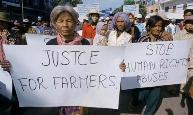
 Cambodian villagers march through the capital Phnom Penh to protest against land-grabbing in this file photo taken in February 2000. REUTERS/Stringer
08 Jul 2010
By Thin Lei Win
BANGKOK (TrustLaw) - When more than 200 Cambodians representing tens of thousands of land grab victims marched to Prime Minister Hun Sen's house last month to petition for help, they were turned away by riot police.
Critics say the incident is just one example of the authorities' disregard for communities who have been forcefully evicted over the years from farmland and prime urban real estate later sold or leased to foreign and local companies.
In December, parliament passed a controversial law allowing the government to expropriate land for development, raising worries of a surge in forced displacement in the Southeast Asian country.
The move came three months after Cambodia pulled out of a World Bank-sponsored project aimed at settling land disputes. The Bank and other donors have criticised the evictions as hampering efforts to tackle poverty in a country where 35 percent of the population live on less than $1 a day.
"Land security and a fair, transparent approach to resolving land disputes and resettlement are among the greatest challenges facing Cambodia today," Bou Saroeun, spokesman for World Bank in Cambodia said. "People without land or secure title to land are much more likely to be poor and to remain poor."
Land ownership is especially problematic in Cambodia where legal documents were destroyed under the Khmer Rouge regime of the 1970s when private property was abolished as part of its drive for a communist agrarian utopia.
An estimated 85 percent of households in Cambodia today do not have land titles, leaving them vulnerable to land grabbing, rights activists say.
Three out of five families in rural Cambodia are either landless or or do not own enough land to meet their food needs, a precarious situation that, combined with widespread corruption, feeds into a cycle of poverty, activists and aid agencies say.
In urban areas, communities are routinely forced to make way for shopping malls and apartment blocks.
"LAND RIGHTS CRISIS"
"Land disputes are one of the most frequent conflicts," said Yeng Virak, executive director of the Community Legal Education Centre (CLEC), which provides legal support to communities faced with forced evictions.
"The absence of security of tenure in the context of endemic corruption and a rapid influx of foreign investment and economic development has resulted in a land rights crisis in Cambodia," he told TrustLaw.
Local non-governmental organisation (NGO) Sahmakum Teang Tnaut says between 1990 and 2009, more than one in 10 people were evicted or displaced from their homes in Phnom Penh alone. The eviction rate has accelerated as unprecedented economic growth since 2004 pushes land prices ever higher.
One of the biggest sources of contention are economic land concessions (ELCs) -- massive tracts of land the government has granted to private companies since the early 1990s for large-scale agriculture and infrastructure projects.
Activists say there is little consultation with evicted communities, and accuse armed police and soldiers of intimidation and harassment.
"International human rights law requirements, including consultation with affected persons, are rarely respected," David Pred, executive director of aid group Bridges Across Borders Cambodia (BABC), said.
Rights groups say evicted communities receive little or no compensation and usually no support from the Cadastral Commission, the government body mandated to rule on land ownership disputes, or the courts.
"In the first four or five months of this year, more than 100 people were prosecuted over land rights. Officials said they arrested them because the people committed criminal acts," Thun Saray, president of human rights group Adhoc, told TrustLaw.
However, Finance Minister Keat Chhon has said foreign companies were not taking villagers' land. Companies were only given leases to land, and people who claimed they were evicted were often not the real owners.
These villagers were not badly treated, he said. People who refused to leave land leased to companies were allowed to carry on living there, leaving pockets of homes amid the industrial development.
RECORD AID INCREASE DESPITE CONCERNS
The process of allocating ELCs has itself raised concerns over governance. "In general, the process of granting ELC is accompanied by a lack of accountability and transparency, an increase in rent-seeking behaviour, a lack of local consultation and weak law enforcement," the German Technical Cooperation agency GTZ said in a December 2009 report.
Official figures show almost a million hectares -- 5.5 percent of Cambodia's territory -- has been allocated as ELCs. Rights groups, however, say the real figure is closer to 3 million hectares.
Recognising the problem of land rights, donors set up the Land Management and Administration Project (LMAP), a multi-donor programme primarily funded by the World Bank, in 2002. Among its goals were to issue land titles to ordinary Cambodians under the Land Law, which recognises possession of land made before August 2001, and settle land disputes.
Despite issuing 1.1 million land titles, the project stalled in September 2009 when the the Cambodian government cancelled World Bank's funding -- $24.3 million over 7 years -- saying the Bank's administrative procedures were too complicated.
LMAP had also run into criticism from a group of NGOs led by Geneva-based Centre on Housing Rights and Evictions (COHRE), which said thousands of families living around Phnom Penh's Boeung Kak lake were denied titles when the area was adjudicated by LMAP in January 2007.
The same month, the government signed a 99-year lease agreement with a private developer for the area -- prompting the NGOs to lodge a formal complaint to the World Bank which its Inspection Panel is investigating.
Despite donor criticism over forced evictions and the lack of land rights in Cambodia, an increase in aid commitments to $1.1 billion for 2010 was announced this month -- a record amount for the country.
That has left many rights activists despairing.
"With their ever-increasing pledges of aid and their silence in the face of the land rights crisis that is unfolding in Cambodia today, the donors have become complicit in the plunder of this country," BABC's Pred said.
(Editing by Katie Nguyen)
Critics say the incident is just one example of the authorities' disregard for communities who have been forcefully evicted over the years from farmland and prime urban real estate later sold or leased to foreign and local companies.
In December, parliament passed a controversial law allowing the government to expropriate land for development, raising worries of a surge in forced displacement in the Southeast Asian country.
The move came three months after Cambodia pulled out of a World Bank-sponsored project aimed at settling land disputes. The Bank and other donors have criticised the evictions as hampering efforts to tackle poverty in a country where 35 percent of the population live on less than $1 a day.
"Land security and a fair, transparent approach to resolving land disputes and resettlement are among the greatest challenges facing Cambodia today," Bou Saroeun, spokesman for World Bank in Cambodia said. "People without land or secure title to land are much more likely to be poor and to remain poor."
Land ownership is especially problematic in Cambodia where legal documents were destroyed under the Khmer Rouge regime of the 1970s when private property was abolished as part of its drive for a communist agrarian utopia.
An estimated 85 percent of households in Cambodia today do not have land titles, leaving them vulnerable to land grabbing, rights activists say.
Three out of five families in rural Cambodia are either landless or or do not own enough land to meet their food needs, a precarious situation that, combined with widespread corruption, feeds into a cycle of poverty, activists and aid agencies say.
In urban areas, communities are routinely forced to make way for shopping malls and apartment blocks.
"LAND RIGHTS CRISIS"
"Land disputes are one of the most frequent conflicts," said Yeng Virak, executive director of the Community Legal Education Centre (CLEC), which provides legal support to communities faced with forced evictions.
"The absence of security of tenure in the context of endemic corruption and a rapid influx of foreign investment and economic development has resulted in a land rights crisis in Cambodia," he told TrustLaw.
Local non-governmental organisation (NGO) Sahmakum Teang Tnaut says between 1990 and 2009, more than one in 10 people were evicted or displaced from their homes in Phnom Penh alone. The eviction rate has accelerated as unprecedented economic growth since 2004 pushes land prices ever higher.
One of the biggest sources of contention are economic land concessions (ELCs) -- massive tracts of land the government has granted to private companies since the early 1990s for large-scale agriculture and infrastructure projects.
Activists say there is little consultation with evicted communities, and accuse armed police and soldiers of intimidation and harassment.
"International human rights law requirements, including consultation with affected persons, are rarely respected," David Pred, executive director of aid group Bridges Across Borders Cambodia (BABC), said.
Rights groups say evicted communities receive little or no compensation and usually no support from the Cadastral Commission, the government body mandated to rule on land ownership disputes, or the courts.
"In the first four or five months of this year, more than 100 people were prosecuted over land rights. Officials said they arrested them because the people committed criminal acts," Thun Saray, president of human rights group Adhoc, told TrustLaw.
However, Finance Minister Keat Chhon has said foreign companies were not taking villagers' land. Companies were only given leases to land, and people who claimed they were evicted were often not the real owners.
These villagers were not badly treated, he said. People who refused to leave land leased to companies were allowed to carry on living there, leaving pockets of homes amid the industrial development.
RECORD AID INCREASE DESPITE CONCERNS
The process of allocating ELCs has itself raised concerns over governance. "In general, the process of granting ELC is accompanied by a lack of accountability and transparency, an increase in rent-seeking behaviour, a lack of local consultation and weak law enforcement," the German Technical Cooperation agency GTZ said in a December 2009 report.
Official figures show almost a million hectares -- 5.5 percent of Cambodia's territory -- has been allocated as ELCs. Rights groups, however, say the real figure is closer to 3 million hectares.
Recognising the problem of land rights, donors set up the Land Management and Administration Project (LMAP), a multi-donor programme primarily funded by the World Bank, in 2002. Among its goals were to issue land titles to ordinary Cambodians under the Land Law, which recognises possession of land made before August 2001, and settle land disputes.
Despite issuing 1.1 million land titles, the project stalled in September 2009 when the the Cambodian government cancelled World Bank's funding -- $24.3 million over 7 years -- saying the Bank's administrative procedures were too complicated.
LMAP had also run into criticism from a group of NGOs led by Geneva-based Centre on Housing Rights and Evictions (COHRE), which said thousands of families living around Phnom Penh's Boeung Kak lake were denied titles when the area was adjudicated by LMAP in January 2007.
The same month, the government signed a 99-year lease agreement with a private developer for the area -- prompting the NGOs to lodge a formal complaint to the World Bank which its Inspection Panel is investigating.
Despite donor criticism over forced evictions and the lack of land rights in Cambodia, an increase in aid commitments to $1.1 billion for 2010 was announced this month -- a record amount for the country.
That has left many rights activists despairing.
"With their ever-increasing pledges of aid and their silence in the face of the land rights crisis that is unfolding in Cambodia today, the donors have become complicit in the plunder of this country," BABC's Pred said.
(Editing by Katie Nguyen)








