Showing posts with label Phnom Penh skyscrapers. Show all posts

Tuesday, August 16, 2011

The glorious 555-meter buidling

Cartoon by Sacrava (on the web at http://sacrava.blogspot.com)
Tuesday, August 16, 2011
Op-Ed by A bewildered citizen in the Kingdom of Wonder(?)

When I saw the news on the Phnom Penh Post this morning again about the official plan for the construction of a 555-meter on Diamond Island, I was thinking to myself “Thank Lucifer, we haven’t given up that idea yet!”

I must say I admire the wisdom of those geniuses who have come up with this construction plan. Really! Because now I feel like I can yell out to the World that:
“Stop telling us that Cambodia is among the poorest countries! Stop telling us one-third of the country’s population lives below poverty line! And that 80% of the country’s population don’t have access to electricity! And that our public health care and educational services suck! And that our industries are underdeveloped compared to the rest of the region! And basically anything you’ve accused us of: deforestation, land grabbing, human rights abuses, corrupt judicial system etc. – please just stop! Because now, unlike you losers, we will have the tallest building in Southeast Asia, and the second tallest in the world!”
Who cares if many of the tall buildings in Phnom Penh are still unoccupied, or whether the “555” building would generate economic development? The important thing is, we will live up to Pol Pot’s famous saying, “If the Khmers could build Angkor, they could do anything!” – Only this time, we’ll probably just give the contracts to Chinese companies… but who haven’t ?

~ A bewildered citizen in the Kingdom of Wonder(?) ~

Monday, April 25, 2011

Phnom Penh Tower construction to be completed by end of April

Phnom Penh Tower

Apr 25, 2011
Property-Report.com

The construction of the 22-storey, US$60 million Phnom Penh Tower is scheduled to be finished by the end of April, The Phnom Penh Post has reported.

“We already completed 95 percent [of the tower],” said Hong Youvoin, Marketing Manager of the South Korean company behind the tower, Hyundai Amco Co. “We’re preparing the grand opening ceremony for the end of this month or beginning next month.”

The office skyscraper on Monivong Boulevard is one of many new towers recently completed or under construction in Cambodia’s capital including OCIC Tower and Gold Tower 41.

Hong Youvoin said that since the beginning of 2011, demand for new office space has jumped along with new investments from Vietnam, France, and South Korea.

Tuesday, February 08, 2011

Cambodia struggles to realise skyscraper dreams

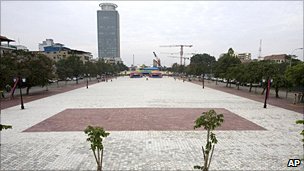
The Diamond Island Exhibition Centre can be glimpsed beyond the bridge

Canadia tower has struggled to find tenants

Work on Tower 42 has resumed, after a pause at the 30th floor
7 February 2011
By Guy De Launey
BBC News, Phnom Penh


Not so long ago there were only a handful of families living there. It had only the most basic facilities, and was accessible only by boat. But as the name Diamond Island suggests, the government saw a glittering future ahead.

The authorities removed the families - some of them forcibly - and brought in well-connected private developers to transform the place.

They built a convention centre and wedding hall, a small park and a housing development called Elite Town.

More was to come. Prime Minister Hun Sen held up Diamond Island as a symbol of the country's development. And he announced plans to build the world's second-largest structure there. It would be more than half-a-kilometre high - and show that Cambodia could do things to make the rest of the world take notice.

Wednesday, September 08, 2010

A Skyscraper Too Far

Sep 08, 2010
O.J. Fall
Property Report


Cambodia’s plans announced in August to build South East Asia’s tallest tower at 555m continues to generate substantial discussion across the region and wider property industry.

The announcement comes at a time when the region seems to be engaged in a rather cold war-esque skyscraper battle, such as that which Stalin undertook against the US leaving great monoliths dotted across the Moscow cityscape.

Across South East Asia, led by Malaysia’s Petronas Towers, which were the world’s tallest building until 2004, each country has sought to redefine the region’s cityscape.

Thailand’s innovative 310m MahaNakhorn development, announced in 2009 and standing just 10m shy of the Eiffel Tower’s spire actually exceeds Singapore’s skyscraper collective that are limited to 280m by the proximity of the airport to the city centre.

As such Vietnam had, until Cambodia’s announcement, been at the van guard of this region’s ‘skyscraper race’. Parallels between Soviet Russia and Vietnam’s communist government aside, it seems that Vietnam is closer to grasping the nettle than any other party in the region. Call it a communist obstinacy or perhaps more realistically a further testament to Vietnam’s endurance and meteoric rise over the lat twenty years, projects announced in both Hanoi and Ho Chi Minh City are looking strong.

Hanoi’s proposed 528m tower to be built by the PetroVietnam Construction Joint Stock Corporation (PVC) at a cost of US$1.2 billion by 2014 follows on from the Bitexco Financial Tower that will open in October this year, standing at 262.5m.

It is however a substantial jump from the 250 – 310m range to over 500m.

Vietnam obviously feels the need to make a statement, announcing its presence on the regional and world stage. Deeper motives behind Cambodia’s announcement than making a bold statement are somewhat elusive.

As an economy that still relies on substantial donor funding to operate (accounting for half of the central government’s budget) and though its garment industry has taken off, with the promise of some future oil and gas returns too, the population lacks education and productive skills, particularly in the poverty-ridden countryside, which suffers from an almost total lack of basic infrastructure.

By its effort to stride out of its dark past, could Cambodia’s new tower yet become an icon of delusional grandeur? Well, the project is not impossible, but challenges await and there is no doubt the US$200 million price tag could be put to better uses across the country. Cambodia’s developing construction industry will require foreign assistance, that is a given, but even the proposed location of the tower will poses its own issues.

Diamond Island has only existed for 100 years and with the constant flux of the great Mekong River there is no guarantee that the island will remain in years to come without substantial and expensive engineering works. All of which will be dictated by the market’s demand for such a property.

On top of that Cambodia’s property market is still developing and though skyscrapers continue to arise from the city built on banks of the Mekong, there is no guarantee that the market will be able to accommodate, nor fill such a development. To date, Phnom Penh’s towers have hovered around the 25 storey, 170m mark.

Such a development can re-define cities and countries on the global stage. But the same applies whether these developments are succeed or fail.

Friday, September 03, 2010

Cambodia’s Blind-Eye

"Didn't anybody tell you guys that in the kingdoom of blinds, the one-eye blind like me is the king?"

September 3, 2010
By Ulara Nakagawa
The Diplomat

"One can only hope that the government of this vibrant and resilient nation will come to put its people’s long-term well-being first when making such major decisions that for now seem entirely about short-term gains for its economy"

KI-Media Note: Oh, come on, Ms. Nakagawa, did you already forget that you wrote at the beginning of your article: "the impoverished nation, which has lately also been garnering international criticism on human rights issues"? Do you believe such regime would heed your hope?
It isn’t the likeliest place to house Asia’s tallest building, but Cambodia has officially made known that it plans to build a skyscraper that stands 1,820-feet (555-metres) high in its capital city of Phnom Penh. The slightly ‘off’ nature of this news hasn’t gone unnoticed by many. The Associated Press for instance states (with a hint of irony?) that the new structure will stand in ‘a dusty city of colonial villas (and) slums,’ while Reuters points out that ‘real estate companies questioned whether there was much demand for a building half a kilometre high in the capital of one of Asia's poorest countries.’

Indeed, it seems ironic that the impoverished nation, which has lately also been garnering international criticism on human rights issues, would be investing such a large sum of public funds into a building that seems to be no more than a status symbol for the government and the few well-to-do. Construction of the proposed tower, as publicly announced this week by Cambodian Prime Minister Hun Sen, doesn’t have a scheduled starting date yet, but will cost about $200 million to build.

Meanwhile, there is also talk of another large infrastructural change brewing in the small country—the construction of a titanium mine in Koh Kong province that is slated to begin next year. This project, which would be the largest mine ever built in Cambodia, has drawn protests locally and from around the world, as it threatens to destroy ‘144,000 hectares of protected forest in the district, as well as ecotourism projects that support 150 families in Chi Pat commune.’

I visited the unforgettable Chi Pat village last year, and spoke to members of the Wildlife Alliance conservation organization there, who mentioned to me that this area is also an important elephant corridor (the Southwest Elephant Corridor), and that ecotourism (not titanium mines) offers hope for the majestic creatures’ future survival.

Non-profit organization Care2 lays the facts out eloquently on their website, describing the area threatened by the proposed mine, the Cardamom Mountains, as a home also to species like Malayan sun bears, pileated gibbons, Siamese crocodiles and half of Cambodia's bird species—on top of being inhabited by the 100 wild Asian elephants, the country's largest population.

Care 2 also reminds us that the project will likely damage to rivers key to fisheries, agriculture and drinking water for local populations and wildlife and spoil ecotourism programs in the region that ‘bring revenues and jobs to poor rural people while preserving the natural environment.’

Furthermore, it seems that the Cardamom Mountains are very close to being recognized globally as being a prime example of the conservation movement and an ideal model for community-based and sustainable economic development. But, according to the organization, ‘if the government allows mining, for the sake of a few years of mineral extraction, Southwestern Cambodia would lose forever the forest, the elephant corridor, and the chance for a sustainable future for local communities. All that would be left would be a massive hole in the ground and surrounding ecological devastation.’

One can only hope that the government of this vibrant and resilient nation will come to put its people’s long-term well-being first when making such major decisions that for now seem entirely about short-term gains for its economy.
-----------
Ulara Nakagawa

Ulara Nakagawa is associate editor of The Diplomat. Now based in Tokyo, she has worked in related fields for organizations including the The Ministry of Education, The Economist Group and has written for publications including The Japan Times. In addition to her current line of work, she is interested in finding pathways to contribute positively to the world community, the Internet, photography, cross-cultural topics, oral tradition, nature programs, sustainable food and more
.

Sacrava's Political Cartoon: The Tallest Building


Cartoon by Sacrava (on the web at http://sacrava.blogspot.com)

Wednesday, September 01, 2010

Cambodia aims high with record-breaking skyscraper

Wed Sep 1, 2010

PHNOM PENH (Reuters) - Cambodia is aiming for the record books with an ambitious plan to construct Asia's tallest building, a 555-metre skyscraper worth $200 million (£130 million), Prime Minister Hun Sen said on Wednesday.

The building would be five times taller than the country's present highest structure, the new, 32-storey Canadia Bank Tower, which dominates the Phnom Penh skyline, where buildings of more than five floors stand out.

If the project goes ahead, it would top the Taipei 101 Tower, the Shanghai World Financial Centre and Kuala Lumpur's Petronas Towers -- the world's three tallest buildings after the 828-metre Burj Khalifa in Dubai.

"It will be shorter than the one in Dubai and taller than any buildings in Asia, and I think we can do it," Hun Sen announced during a university graduation ceremony on Wednesday.

"We don't have to be too conservative and we also don't need to be too outdated," Hun Sen added, brushing off criticism from cultural groups concerned that a construction boom was threatening the city's French colonial architecture.

Hun Sen said the proposal had been made to the country's Land Management Ministry and local lender Canadia Bank would be involved in the project.

However, real estate companies questioned whether there was much demand for a building half a kilometre high in the capital of one of Asia's poorest countries.

"Where would the investors come from?" said Sung Bonna, CEO of Bonna Real Estate Group in Phnom Penh.

"We are concerned about the shortage of demand and occupancy rates so we need time, but we hope this dream comes true."

(Reporting by Prak Chan Thul; Editing by Martin Petty)

Cambodia boasts plans for Asia's tallest building [-We may not have anything to eat, but we'll have the tallest building in Asia!]

Wednesday, September 01, 2010
By SOPHENG CHEANG (AP)

PHNOM PENH, Cambodia — Impoverished Cambodia plans to build a 1,820-foot (555-meter) skyscraper, its prime minister said Wednesday, a feat that would give one of the region's least-developed capitals the tallest building in Asia.

Prime Minister Hun Sen said he had approved a master plan for the skyscraper, which would be located about half a mile (one kilometer) from the Royal Palace in Phnom Penh — a dusty city of colonial villas, slums and one standout skyscraper, the recently completed Canadia Tower that is about 377 feet (115 meters) high.

Hun Sen did not say when construction would start, how much it would cost or give any other details, except that it would be built by a Cambodian company, Overseas Cambodia Investment Corp., owned by tycoon Pung Khiav Se.

The company's project manager, Touch Samnang, said preliminary estimates suggest the building would cost $200 million, but the project was being studied by experts and government ministries. He said it would include a shopping mall, hotel, apartments and an entertainment center.

That figure is dwarfed by the sum for what is currently Asia's tallest building, the Taipei 101 in Taiwan. Rising 1,667 feet (508 meters), it cost about $1.6 billion. It had been the world's tallest since 2004 but was overtaken in January when Dubai unveiled the Burj Khalifa, which rises 2,717 feet (828 meters) from the desert.

Cambodia, whose commerce is tiny by international standards, has been experiencing a real estate bubble for the past few years, but several ambitious construction projects have been delayed or suspended.

Monday, August 30, 2010

Phnom Penh skyscrapers arise

Aug 30, 2010
PropertyReport

Phnom Penh Tower, a US$60 million 22 storey ‘skyscraper’ billed as Cambodia’s first intelligent office building is set to top-off September 2, this week.

One of several towers that are simultaneously under construction across the capital, developers are hailing these as a sign of Cambodia’s strong and resurgent property market.

Host to commercial office space, officials at Hyundai Amco Company, the firm that is building the tower, say that they have already contacted the 250 potential clients and expect 50 per cent of these to sign contracts soon.

“ I can see that foreign direct investment, tourism, import-export is increasing together with the number of companies registered to do business here,” Sung Soo Kim, Hyundai Amco Company Director, was reported as saying by the Phnom Penh Post.

“Cambodia’s real estate sector is not in a downturn anymore.”

With Cambodia’s new towers offering a mix of commercial, office and residential space, the targeted rent for the Phnom Penh Tower runs from about $20 to $40 per square metre. Its topping off also comes at a time when a larger 27 storey Canadia Tower looks to welcome businesses into its lower floors in September, with some speculating that it will be host to the Cambodia Stock Exchange, which is awaiting the completions of its own building next year.

Friday, June 13, 2008

South Korean investor to build 52-story skyscraper in Phnom Penh

PHNOM PENH, Jun 12, 2008 (Xinhua) -- South Korean investors will hold ground-breaking ceremony here next week for its 52-story skyscraper, the tallest building currently designed for Cambodia, said English-Khmer language newspaper the Mekong Times Friday.

GS Engineering and Construction, the largest real estate developer in South Korea, will take four years to complete the project near the Tonle Bassac River, the paper quoted Mu Hion Woo, its chief of business division in Cambodia, as saying.

The project will include a 52-story office block, a 32-story residential block, an international school and a shopping mall, he said.

"Which country has the most experience in developing satellite cities? The answer is South Korea. There are probably four or five such cities near Seoul," he told the paper.

"But for us, it is business on one hand and a contribution to the development of Cambodia on the other. If you want to see the potential of Cambodia, you can see it in this project," he added.

Currently, a second South Korean real estate developer is constructing a 42-story skyscraper of comprehensive functions in downtown Phnom Penh and a third one developing a satellite city in the suburb.

When all South Korean projects were accomplished, the skyline of the capital would be totally renewed, as it is now dominated by buildings only four- or five-storey high.

Friday, January 25, 2008

Skyscraper to change city skyline

By Vong Sokheng
Phnom Penh Post, Issue 17 / 02, January 24 - February 7, 2008

Another South Korean company announced plans to build a city skyscraper, this one to begin construction next week at the heavily trafficked corner of Sihanouk and Monivong Blvds.

The South Korean Yon Woo Co., Ltd developer said it is investing $240 million in a glitzy high tech 42-story building Gold Tower, which will have apartments and office and commercial space.

The building is expected to be completed by 2011.

The company received its approvals from the government in May 2007.

The news comes on top of the announcement by Korea's GS Engineering and Construction Company, that it will start construction in June on a 53-story building near the Russian Embassy in the Tonle Bassac riverfront area. It is supposed to be finished in 2012.

"We see that the skyscraper market is getting interest from Cambodian people because the price of the land is very expensive now," said Sry Thamarong, personal advisor to Prime Minister Hun Sen.

He said the prime minister is encouraging more skyscrapers.

"The 53-story is the tallest, but in the future there will be taller ones." The Yon Woo Co. Ltd. held a ceremony to launch construction January 24.

The architectural drawings for Gold Tower were done in Korea.
Yon Woo is the developer and was in charge of searching for the right site. It has hired a separate contractor.

Company officials said the contractor will employ about 300 Cambodian workers and Korean engineers during the construction period.

Yon Woo official Kim Tea Yon said the company is committed to contributing to the success of the Cambodian economy as well as to its stakeholders, who expect profits.

Collaborators in the project are DaeHan Real Estate Trust, a fund management firm, and Hanil Engineering & Construction Co Ltd, which initiated the construction of the first phase of the large Camko City planned development on the outskirts of Phnom Penh, the officials said. Korean investment is involved there also.

In a statement, the company said: "The Yon Woo Co.,Ltd will become the project for the image of the international capital by making a new skyline in the city of Phnom Penh ."

Investment from Korea in the past year has been picking up fast, according to Sangkwang Lee, Commercial Attache of the Embassy of Republic of Korea in Phnom Penh.

He told the Post that Korean total investment in Cambodia since 1992 totaled $897 million, but in just nine months of 2007, it had already reached $502 million.

He said that Korea's total foreign investment worldwide last year was $15.3 billion.

The investment went to: China $4.9 billion; US $2 billion; Vietnam $1.1 billion; Hong Kong $752 million. Cambodia was its fifth largest investment target. He said Korean businessmen are beginning to see Cambodia as an alternative to the higher prices in Vietnam.

"They have many possibilities in Vietnam, but they have been looking for another destination for investment," Lee said.

Im Chhun Lim, Minister of Land Management, Urban Planing and Construction, said in his speech at the launch that the government received more than 1,500 requests for construction projects worth $1.5 billion in the first nine months of 2007.

Thursday, January 24, 2008

Cambodia to get first skyscraper [-Hun Sen's Twin Gold Towers to overshadow the royal palaces?]

Officials linked the building to Cambodia's economic success

Cambodian officials have attended the official sales launch of the first-ever skyscraper in the capital, Phnom Penh.

The twin towers are to be 42 storeys high - almost three times higher than the current tallest building.

It is the first of three skyscrapers planned in the capital, where the skyline has been kept low - in part to avoid overshadowing royal palaces.

But the government has encouraged the new buildings as symbols of Cambodia's development after decades of conflict.

Although Gold Tower 42 is some way from completion, the launch of its show apartment and sales office attracted government ministers and overseas ambassadors.

The BBC's Guy De Launey, in Phnom Penh, said the launch gave a taste of the shape of things to come.

He said the solid, imposing, gold-faced structure would stand out from its neighbours on Norodom Boulevard - an area of yellow-washed, wooden-shuttered French colonial-era buildings.

But Phnom Penh is in the middle of a real-estate boom - and some residents hope that building up will bring the price of homes down.

"It's more affordable for people wanting to stay in town, and I think it's good. It's secure and they have all the facilities," one resident said.

But other locals worry about the effect tall buildings will have on the city's character

"The original Phnom Penh city [was developed to] be horizontal, not vertical," one resident said.

South Korean companies are building Gold Tower 42 and another even taller skyscraper near the Mekong River.