Showing posts with label American Assistance for Cambodia. Show all posts

Thursday, October 01, 2009

Efficient Computers in Cambodian Schools

Children working on a low-power computer at a school in Phnom Penh run by American Assistance for Cambodia, a not-for-profit group. (American Assistance for Cambodia)

September 30, 2009

By James Kanter
The New York Times


What is the best computer for schools in developing countries?

The answer is one that is rugged and sips electricity, according to Javier Sola, one of the founders of the Open Institute, a not-for-profit group providing computers and training in Cambodia.

Mr. Sola’s organization is building desktop computers that consume about a quarter of the electricity normally used by desktop and laptop computers, and that cost just over $200. Mr. Sola said he had so far installed 400 of the “low-power-consumption” computers in schools and teacher-training centers in Cambodia.

Another not-for-profit group, American Assistance for Cambodia, said that it was assembling and marketing additional computers under the brand name “Compodia,” and using the profits for projects to build schools, fund scholarships and support an orphanage.

The biggest energy savings for the desktop machines come from an Atom processor, made by Intel, Mr. Sola said. But in some cases the computers are directly connected to a battery that is fed with electricity from subsidized solar panels, which he said was a highly efficient way to transmit power.

The batteries cost about $85 each. But using solar power in combination with the battery means students do not have to pay the usual fee to the local grid of about 4 cents a day, or buy diesel to run a nearby generator, Mr. Sola said.

Even more energy savings would possible if costs come down for monitors using LED technology, which is far more efficient than other monitors, the experts suggest.

Mr. Sola said that a popular misconception was that reconditioned desktop and laptop computers are appropriate for developing countries because they are free. But those computers are often unsuited to rural environments, where cables get eaten or short-circuited by ants, roaches and mice, and where dust ends up clogging the fans.

Reconditioned computers also have relatively short life spans, so that “Cambodia produces computer waste at a much faster speed that any of the developing countries that donate them,” said Mr. Sola.

Tuesday, December 25, 2007

Inspired upstate NY group finds generosity in campaign to help build Cambodian school

December 24, 2007
By WILLIAM KATES
Associated Press Writer


CLINTON, N.Y.

Chris Willemsen and a group of friends are giving an unusual holiday gift this year - a new school to a village in the Cambodian province of Kompong Thom.

And as satisfying as it feels to help, the way they raised the funds has been equally illuminating:

They sold a handful of cookies here and a pile of lost-and-found clothing there. They organized a ride along the Erie Canal. They relied on friends, family and strangers to kick in a few bucks at a time. Kids at a parochial school paid for the right to dress down one day and turned over the proceeds.

"It's taken off in a way I could not have anticipated. I thought we would be raising funds for the school for at least a year. I didn't realize just how generous people are," said Willemsen, a part-time instructor at Hamilton College, a 195-year-old liberal arts college in upstate New York.

A weekend holiday concert at the community arts center pushed Willemsen's group over the goal of $13,000 they need to pay for a school through American Assistance for Cambodia, a nonprofit organization that has built nearly 400 schools in rural Cambodia since 1999. Ultimately, they'd like to raise $30,000 for more improvements, including a computer teacher, Internet connection for two years and solar panels to power a computer.

"Having this happen over the holidays gives it extra meaning, in part because this project, like the holidays, reinforces the themes of family, friends, and community; as well as generosity, gratitude, and hope," Willemsen said.

It was one of life's unassuming moments that inspired the 43-year-old Willemsen. A newspaper editorial she read last Christmas Eve detailed the plight of poor children in Cambodia and ways people could help. The story mentioned a Washington State school that raised money to build a school.

"I had one of those moments where you wonder, `I can do something like this,"' Willemsen said. "I let it go for a little while. I was busy teaching."

Last spring, Willemsen was co-teaching a course with philosophy professor Rick Werner on "Democracy, Ethics, and Globalization" when the class took up the subject of human trafficking in Cambodia. Student presentations were graphic and startling, and moved Willemsen and Werner to act.

At first, there were just six people: Willemsen and her husband, Werner and his wife, and two other faculty members. The group now totals 19.

After several months researching AAfC's Rural Schools Project and making plans, the group held its first event in late August _ a rummage sale, furnished partly from the clothes students left behind in their dorms. They netted about $750.

"We kept things low-key at first. None of us are big organizers. We've just been doing this by the seat of our pants," Willemsen said.

Then they planned a bike ride along the historic Erie Canal. The bike ride raised an eye-popping $5,000.

Word spread quickly through the village of about 1,800 _ about the same population as the college. In the dental hygienist's chair, the conversation turned to biking. And the rally.

"She immediately pulled out her checkbook and writes us a donation," Willemsen said. "Then she said she was on the social concerns committee of her church. The next week, I get a call from her. She's all excited. Her church had decided to donate $500."

Amy James was a friend inspired to help. The students at St. Mary's Elementary School, where two of her children go, hold a "dress down day" each month, paying a small contribution to not wear their uniforms to class. The 100 or so students came up with $425 for the group's cause, said James.

"Chris came in and talked to the students," said James, an administrator at Hamilton College. "She told them where Cambodia was on the map. She told them about the issue of children not being able to go to school and how fortunate they were to be able to go to St. Mary's."

"I think the kids were very inspired. It's good for them to have an understanding of what they're doing it for," said James, who would like to see students start a pen pal project with the Cambodian students next year.

The student congregation at the college heard about the campaign and donated a Sunday collection worth about $120, said Chaplain Jeff McArn.

"It shows that an ordinary person can make a difference if they try," McArn said.

Decades of war and oppression have left hundreds of villages in rural Cambodia without functioning schools. Using private contributions from individuals, groups and businesses in America and Japan and matching funds from the World Bank and Asian Development Bank, AAfC has raised enough money to open 355 schools with another 40 under construction.

Construction on the Kirkland-Kompong Thom Academy and several other schools should begin in January and take three to four months to complete. The name is a tribute to Hamilton College founder Samuel Kirkland. Willemsen hopes to attend the opening ceremony and meet the students and the teachers.

Each school, built on land donated by a village or added to an existing school, contains three to six classrooms furnished with desks and chairs. The school is then given to the village and recognized by the Cambodian government as a state school. It is staffed with official government teachers who follow the Ministry of Education curriculum.

Uneducated, Borin Chea fled Cambodia in 1979 near the end of the Khmer Rouge's bloody rule, settling first in Canada and then New Hartford, near Utica. Now 49, Chea owns a small chemical plating company in nearby Rome. He has used his success to support four dozen family members who remain in Cambodia.

Chea and his wife were invited to a dinner to hear about the school project. He immediately enlisted in the cause, offering to help bring a Cambodian dance troupe to town for a spring fundraiser. He also said he would seek support from the 80 to 90 Cambodian refugee families who live in the Utica area.

"Education in Cambodia is still much needed," Chea said. "When I found out (what) Chris was doing, I have all my heart for her, and all my respect for her. Even though she is an American and lives well, she is reaching out to help those who are not as fortunate."

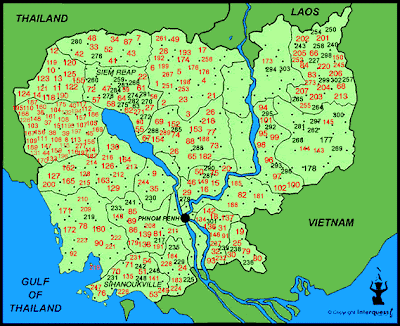
A brief look at Cambodian schools program

Click on the map to find out the names of all the schools funded

December 24, 2007
Newsday (Long Island, New York, USA)

NAME: American Assistance for Cambodia

WHAT: An independent, nonprofit organization dedicated to improving opportunities for youth in rural Cambodia; operates programs across Cambodia in the areas of education, health, rural development and technology. Has helped build nearly 400 primary and lower secondary schools in rural Cambodia since 1999.

START: Founded in 1993 by American journalist Bernie Krisher, former head of the Newsweek and Fortune Tokyo bureaus. He also started The Cambodia Daily, Cambodia's first English language daily.

PROGRAM: Donors raise $13,000 to sponsor the construction of a school in a village that currently lacks one. Matching funds are provided by the World Bank and Asian Development Bank.

After the school is built, donors are encouraged _ but not obligated _ to fund improvements for their school, such as providing English and computer teachers, computers powered through solar panels, Internet access, a well or water filter, a school nurse or a vegetable garden.

ON THE NET: http://www.cambodiaschools.com

Thursday, November 15, 2007

Milton teacher spurs Cambodia project

Wednesday, November 14, 2007
By Jeff Shaffer Staff writer
Standard Journal (Milton, Pennsylvania, USA)

The need for understanding, tolerance and education is glaringly important” - Mike Conn, Milton high school teacher
MILTON — Soon enough there may be another school with Milton’s name on it; this one will be nearly 9,000 miles away.

The Milton Area School Board gave its blessing to Mike Conn, a high school social studies teacher, to start a club and raise $30,000 to build a school in poverty-stricken Cambodia Tuesday night.

As some readers may remember, Conn, his daughter from New York and other educators visited southeast Asia — Thailand, Vietnam and Cambodia — this past summer. The trip was featured in Standard Journal.

The poor children of Cambodia weighed particularly heavy on Conn’s heart.

“I thought I knew what I was in store for,” Conn, a seasoned world traveler, told the board. “But, I didn’t.

“It was the most amazing travel experience of my life. I won’t forget those children.”

The teacher went on to show a short video of the day-to-day of life for many Cambodians. The average monthly salary is $20; they dig through trash for food and recyclable materials to sell. The country is full of landmines and leads the world in amputations because of the destructive devices.

A former French colony, Cambodia has yet to recover from a ruthless regime that assumed power about 30 years ago. Conservative estimates suggest that 2 million people were killed by Pol Pot and his followers.

Conn believes educating the next generation is the first step in turning the country around.

The need for understanding, tolerance and education is glaringly important,” he said.

Conn, who has high hopes of reaching the goal by the end of this school year, will be working with American Assistance for Cambodia (AAfC), which has already built hundreds of schools in Cambodia. But still, many more are needed.

If all goes according to plan, Milton may be the first public school in the country to construct a learning facility in Cambodia, Conn said. The school will be named after Milton.

The money will pay for a five- to seven-room school, large enough to hold 500 children. A well will also be dug to provide fresh water. Students will receive text books and other supplies, and even a satellite dish for Internet capabilities on new computers. The school will also be provided with teachers through AAfC.

“We could be their window to the world,” Conn said.

He added Milton students are very excited about taking on this project, and raising the money should be “very doable.”

In addition to the board, superintendent Dr. William Clark said he’ll be looking forward to the project.

“It struck a chord with me, as a parent of a child from a Third World country,” he said.

Clark also mentioned Milton has taken on some other great projects, such as building homes for Habitat for Humanity.

Jeff Shaffer: 570-742-9671
jeff@standard-journal.com

Saturday, October 20, 2007

Boerne High reaching out to Cambodia

10/19/2007
Zeke MacCormack
Express-News (San Antonio, Texas, USA)


BOERNE — Looking beyond their own wants to others' needs, Boerne High School students poured pennies out Friday to kick off an initiative aimed at building a school in Cambodia.

The pep rally penny drive generated $680 toward the goal of raising $13,000 by next spring.

That's the amount needed to build a simple rural school in the underdeveloped Asian country, according to American Assistance for Cambodia.

"We like creative, innovative projects that help bring our community together and promote good will," Boerne High Principal Betty Butler said.

Since 1999, the independent nonprofit organization has overseen construction of more than 300 schools in rural areas of Cambodia, according to its Web site, cambodiaschools.com.

The schools are among aid initiatives by the organization, founded in 1993 by American Bernie Krisher, former head of the Newsweek and Fortune Tokyo bureaus.

Local students joined the effort after seeing news accounts of a drive by Overlake School in Redmond, Wash.

"It's made us aware of the great need there is in the world, the importance of education in developing countries, and it's given us an opportunity to learn about Cambodia and the genocide there," said Francisco Grijalva, headmaster at Overlake.

Overlake students last spring visited the school they funded in Pailin, he said, and a teacher from there is soon coming to visit.

Boerne High School's National Honor Society chapter got the local ball rolling, donating $2,000 it had banked from a car wash.

"It's a really unique and amazing opportunity to be able to bring Boerne High School and the Boerne community together," said Jacob Knettel, a senior who leads a committee created in August to lead the fundraising drive dubbed "Purple Out Cambodia" — referring to the school colors.

Beside soliciting funds from local businesses, the project will get proceeds from the Nov. 2 Fall Fest, an annual lunch-hour event with games and food sales that normally benefits clubs.

"A lot of the clubs used the funds to go on trips and make T-shirts and to pay for their activities," Knettel said. "Now instead, all of Boerne High School is joining together to help others."

The curriculum at Boerne High also is being shifted to focus more on Cambodia to give students a better understanding of the beneficiaries of the aid.

Students plan to continue raising funds next year for accessories such as a water well and Internet access at the campus that they will name and may someday visit.

Boerne teacher Catherine Davis said her students' faces "went blank" upon hearing that diverting cash from their clubs may provide Cambodian kids with their only real shot at a formal education.

"We hope they realize that not everyone is as blessed as (the students) are, and that they can use their blessings to help others," said Davis, one of three faculty advisers on the project. "It's not just them in the world, and the world needs help."

zeke@express-news.

Monday, October 15, 2007

Cambodian schoolchildren offer a hero’s welcome to two Kaimuki businesswomen who funded school

Professional voice coaches Neva Rego, front, and Betty Grierson, left, posed with their student, Dr. Kathleen Kozak, at the Bel Canto School of Singing in Kaimuki. Kozak, who built a school with the American Assistance for Cambodia program in 2006, inspired the two business owners to work extra hours to raise $20,000 to fund a secondary school for underprivileged Cambodian children. (CINDY ELLEN RUSSELL / CRUSSELL@STARBULLETIN.COM)

Singing the praises: Cambodian schoolchildren offer a hero’s welcome to two Kaimuki businesswomen who funded school

STORY SUMMARY:
Two Kaimuki small-business owners worked an extra hour a day for a year to save money to fund a school for Cambodian children who were still living in the shadow of the Killing Fields.

Though Neva Rego and Betty Grierson, owners of the Bel Canto School of Singing, don't fit the stereotypical profile of Hawaii's well-heeled philanthropist, they were so inspired by the unfortunate children of Cambodia that they used hard work to overcome their lack of resources.

The women, along with other Hawaii donors, were recently honored by King Father Norodom Sihanouk, who threw a palace lunch in their honor and sent them home with silver.

However, the small-business owners said that the greatest rewards came when the children who inspired their gift gave them a hero's welcome.

Neighborhood children and students from schools surrounding the Bright Future Kids School in the rural countryside outside of Phnom Penh sat patiently during the grand opening of their sister school. Kathleen Kozak, a doctor for Straub in Hawaii, was one of the major donors for the project. (ALLISON SCHAEFERS / ASCHAEFERS@STARBULLETIN.COM)

Sunday, October 14, 2007
By Allison Schaefers
aschaefers@starbulletin.com
Honolulu Star Bulletin (Hawaii, USA)


PHNOM PENH, Cambodia - Two Kaimuki small-business owners showed Cambodia the meaning of aloha on a recent trip to open a secondary school that they funded for more than 300 underprivileged children in Kandal province.

Neva Rego and Betty Grierson, owners of the Bel Canto School of Singing, worked an extra hour a day for a year to raise $20,000 to build a school in a remote Cambodian village where the children did not have access to an education. The women were moved to build a school for Cambodian children when their voice student, Dr. Kathleen Kozak, began singing the praises of American Assistance for Cambodia program. Kozak invited the business owners to the opening of the school that she funded last year for the nonprofit, founded by retired journalist and Holocaust survivor Bernie Krisher.

Workers continued to build the facility minutes after the grand-opening ceremony for the school. (ALLISON SCHAEFERS / ASCHAEFERS@STARBULLETIN.COM)

It's ironic that music is the stuff Rego and Grierson are using to help rebuild Cambodia and lead the country's children out of the shadow of the Killing Fields. In the years after infamous communist leader Pol Pot killed 2 million Khmer people in the 1975-79 genocide, Cambodia has struggled to rebuild without the aid of all of the trainers, educators, artists and entertainers who were among the first to be executed. Last year, only one out of every two Cambodia children completed primary school, but Krisher hopes to change that with Khmer schools that he has built largely with U.S. and Japanese aid.

"We've got 382 schools and more coming in every day," Krisher said from Phnom Penh on a recent trip to open several high-profile development projects in Cambodia, including a secondary school for the brightest Khmer children and an orphanage for children who have lost either one or both parents to HIV or AIDS.

Rego and Grierson said they were touched by the children they met in Cambodia during the opening of the Kozak Ohana School in 2006 and wanted to find a way to make their own difference.

"We didn't think that we had enough money to open a school, but when we met the children, we decided that we had to make it happen," Rego said, while surrounded by the bright, brown-eyed students at her simple Kandal province school and from the nearby village.

Many other Hawaii people have opened their hearts and their checkbooks to Krisher's cause, shoring up the health, education and, eventually, economic prospects of Khmer children so that the emerging country can meet its development goals. On Krisher's most recent fundraising trip to Hawaii, donors pledged more than $78,000 to bring the total of Hawaii-funded schools in Cambodia to 16. However, Rego and Grierson don't fit the stereotypical profile of the wealthy philanthropists that often fund such projects.

A Cambodian government official handed out gifts to children of the New Life Orphanage during the establishment's grand opening. All children at the orphanage, which was funded through Bernie Krisher's foundation, have lost at least one parent to HIV/AIDS. (ALLISON SCHAEFERS / ASCHAEFERS@STARBULLETIN.COM)

Still, Rego and Grierson said that they figured if the children of Cambodia could find a way to survive each day in a land short on money, resources and access to the basics like adequate food, shelter and even clean water, than they could manage to find a way to fund a school.
"These children are so poor that all they know about is staying alive from one day to the next," Grierson said. "We are so concerned about things like paying insurance on our cars, but these kids just want to stay alive."

While they were short of dollars, the two business owners were determined. By working harder and saving more, they were able to make a project happen that at first seemed impossible.

"We just worked longer hours," Grierson said, adding that the pair named the school Bel Canto after the Hawaii business that made it possible.

Retired journalist and Holocaust survivor Bernie Krisher, left, who founded the American Assistance for Cambodia and the Japan Relief for Cambodia school-building programs, received a hug greeting from King Father Norodom Sihanouk of Cambodia. Ties between the unlikely friends served as the inspiration for Krisher's school-building program. (COURTESY ROYAL PALACE OF CAMBODIA)

The businesswomen said they also were inspired by Kozak's example from the year earlier. The young doctor funded the opening of the school with faith, dogged determination and lots of work hours.

"I didn't have the funds when I committed to building a school, but I found a way to do it," Kozak said.

A fortuitously timed tax refund helped bolster Kozak's savings so that she could open her school last year. She returned to Cambodia recently to celebrate the opening of the Bel Canto School, as well as the opening of the Bright Future Kids School, another project that she helped fund.

"It was amazing to be at the opening of the Bright Future Kids School," Kozak said. "One year ago, we held a groundbreaking. Now, there are several buildings that will be there for perpetuity."

The Bel Canto School and others like it will serve as feeder schools for the Bright Future Kids School.

"The sky is the limit at the Bright Future Kids School," Krisher said. "It will provide secondary education and a chance for a bright future for the smartest children from Cambodia's most remote villages. Without this school, these children would have had to go back to farming after they finished elementary school."

Building the Bel Canto School was just another adventure in a lifetime of many for the two business partners and longtime friends.

Professional voice coach Neva Rego, front, signed the welcoming book at the opening ceremony for the Bright Future Kids School. Betty Grierson, left, who works with Rego, and their student, Dr. Kathleen Kozak, observed the signing. (ALLISON SCHAEFERS / ASCHAEFERS@STARBULLETIN.COM)

Rego, a native of Kaimuki, and Grierson, formerly of Canada, met in Italy while studying opera. Rego returned home to Hawaii in the early 1980s and soon after opened the Bel Canto School of Singing so that she could share her love of music and expertise with others. Over the years, Rego has coached many stars, including the Brothers Cazimero, Makaha Sons, Shari Lynn, Jimmy Borges and Danny Couch. She also was recognized by the Hawaii Legislature last year for her contributions to the state, which have included voice coaching for 16 Miss Hawaiis and two Miss Americas.
Gov. Linda Lingle herself honored Rego last week with a commendation letter acknowledging the opening of the Bel Canto School in Cambodia and thanking her for her work as a goodwill ambassador on behalf of Hawaii.

Grierson, who went home to Canada for a time before joining Rego, helped Rego expand her school and her dreams.

"In our own small remote way, we are helping Cambodia to rise up," Grierson said.

While the Bel Canto School in Kandal will be most concerned about teaching the students basic subjects like speaking English, eventually the Hawaii philanthropists might try to teach them to sing, too.

"If it goes well, eventually we'd like to hire a music teacher," said Rego, who has been honored with an "excellence in education" award from the National Society of Arts.

While the two business owners have earned many accolades in Hawaii, the most touching praise that they received has come from King Father Norodom Sihanouk of Cambodia.

King Father hosted a lunch for the American and Japanese school donors. The women also were royally greeted from the students of the school they funded.

"They gave us so much love," Rego said, with tears in her eyes as she recalled the way that she felt to see all of the children at their school lined up to greet her on opening day.

Even Grierson, the least sentimental of the pair, said she cried at the event.

"There was plenty of waterworks," Rego said.

But there was also much joy, she said. While career choices kept the women from marrying and having families, they said that they now count hundreds of Cambodian schoolchildren among their ohana.

"Ever since we made the decision to fund this school, I've felt so much joy. These children have become our kids," Rego said. "I've learned that doing well for others is what true happiness is all about."