Showing posts with label Cambodia-Americans. Show all posts

Sunday, May 20, 2012

One in 10 Cambodians have hepatitis B

By Bunthay Cheam/Khmerican

Originally published at http://khmr.cn/L44LRB

NOTE: May 19, 2012 is the first-ever National Hepatitis Testing Day

SEATTLE, WA -- Every 30 to 45 seconds, someone in the world dies from complications related to the hepatitis B virus (HBV). In fact, 60 to 80 percent of liver cancer in the world is caused by hepatitis B. However, HBV is highly preventable through proper screening and vaccination, and even when contracted, it is very manageable through lifestyle adjustments and medication. Despite the Obama administration deeming viral hepatitis a “silent epidemic” in an official action plan for 2011, there is only a fraction of awareness compared to other diseases such as HIV.

According to the Stanford School of Medicine’s Asian Liver Center, over 2 million Americans have hepatitis B, two-thirds of them infected chronically (lifelong). Each year, 60,000 people become infected, and 6,000 die from complications related to the effects of hepatitis B.

Two-thirds of carriers display no symptoms, making it difficult to become alert to and diagnose. It can be years before symptoms appear, and at that point, it may be too late for treatment. If symptoms do appear, they are commonly mistaken for influenza: loss of appetite, fever, headaches. Jaundice, which causes yellowing of the skin, may also be a sign of liver cancer.

Friday, September 24, 2010

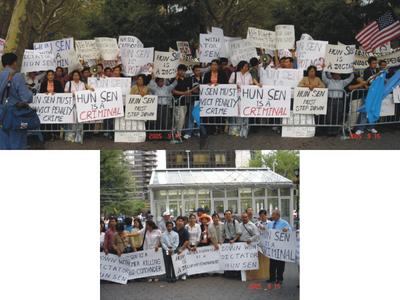
Cambodian-Americans plan to demonstrate during Hun Xen’s arrival in New York


24 Sept 2010
By Moeung Tum
Radio Free Asia

Translated from Khmer by Soch


Numerous US citizens of Cambodian origin from all over the US plan to hold a peaceful demonstration in front of the UN headquarters building in New York, USA, on 24 September 2010 during PM Hun Xen’s meeting with the US President.

Tuesday, May 04, 2010

Cab driver killed on birthday

Ty Tang

Tuesday, May 4, 2010

By Dan Nakaso
Advertiser Staff Writer (Honolulu, Hawaii)


Cambodian immigrant Ty Tang was hard worker with 2 young children
WANT TO HELP?
Donations in the form of checks can be sent to:
University Avenue Baptist Church
2305 University Ave.
Honolulu, HI 96822
In the memo line, write: For Ty Tang's Family
Cambodian immigrant Ty Tang was driving a taxi out of Waikīkī to help raise his two young children when he was found beaten and dying in the middle of the night Saturday in the parking lot of the Waipahu Times Super Market.

It was Tang's 41st birthday.

His family had been planning a celebration for Tang at Magic Island on Saturday to coincide with a gathering of other struggling, but hardworking immigrants from Cambodia.

Instead, Tang's children — a 12-year-old boy and 10-year-old girl — were told they could not deliver a birthday cake to their father's hospital bed at The Queen's Medical Center on Saturday "so he could blow out the candles," said Tang's best friend, Richard Ung, who also emigrated from Cambodia and also drove a cab out of Waikīkī.

Since Honolulu police called Ung around 2:15 a.m. Saturday with the news that Tang was found dying with head and facial injuries, "I cry all the time," Ung said. "He's a nice person, a good man, a good father, a good friend."

Detectives yesterday continued to search for two men who were seen fleeing from the direction of Tang's white, 2004 Ford Crown Victoria after he was found beaten at 1:50 in the morning. He died later on Saturday.

Tang had picked up two men around 1:15 a.m. on Kūhiō Avenue near Seaside Avenue then drove them to the Times Super Market, police said.

Police asked anyone with information to call CrimeStoppers at 955-8300, or *CRIME on their cellular phones.

Worried Honolulu cab drivers — most of them immigrants themselves — and their even more frightened wives and children were wondering aloud yesterday about the safety of hustling for fares in hard times during yet another Hawai'i slow tourism season.

At a waiting area for 200 to 300 cab drivers outside Honolulu International Airport yesterday, one immigrant cab driver after another said they have to wait eight to 12 hours per day for their turns to pick up what averages out to two fares per day.

On a typical shift this time of year, drivers said, they can generate about $100 per day, which means they take home about $65 every day after paying for gas and maintenance on their cars, which they own.

"It's slow, really slow," said Tony Nguyen, 36, who was raised in Ho Chi Minh City in Vietnam. "Every day worse."

Jimmy Lieu, 44, who is from Vietnam's Mekong Delta area, only drives his cab during the day "because it's dangerous. My wife always tell me to be safe. My wife, she keep checking on me, checking on me."

Lieu considers "night time" to be after midnight.

Many of the drivers waiting around for fares yesterday said they have been ripped off by passengers who bolt from their cabs — or have worried about sketchy, fearsome passengers.

"When people get in your cab and say, 'You got change for $100?' that's a sign," Nguyen said. "But there's not much else we can do when English is second language. No career jobs."

Waneka Davis refuses to pick up passengers after 9 p.m. and won't ever make what she calls "the long trip" to the Windward and Leeward Coasts, giving up the chance for a lucrative trip.

Davis, a mother and grandmother of two, is constantly being warned by her family to be safe.

"They say, 'Mom, be careful.'"

The Honolulu medical examiner's office yesterday identified the victim in Saturday's taxi cab beating as Charlys Ty Tang.

But everyone called him Ty, (pronounced Tee).

Like his friend, Ung, Tang lived in Waikīkī and occasionally worshipped with Vietnamese and Cambodian parishioners at University Avenue Baptist Church.

Pastor Hong Ly Khuy yesterday was collecting donations for Tang's family, which includes an ex-wife Tang remained friendly with and Tang's new wife.

Before he turned to driving a cab, Tang had worked as a cook at several restaurants that closed because of slow business, Khuy said.

Then about four years ago, Khuy said, Tang turned to driving a cab, one of the primary sources of income for struggling immigrants.

"It's a job for when you're new and don't speak English that well," Khuy said. "But all the time, people talk about how dangerous it is."

Reach Dan Nakaso at dnakaso@honoluluadvertiser.com.
-------
Two men sought by police

Police yesterday released sketches and descriptions of two men wanted for questioning in Sunday's fatal beating of cab driver Ty Tang in the parking lot of the Waipahu Times Super Market.

Suspect 1 is described as 17 to 23 years old, 5 feet 4 to 5-7, and 140 to 155 pounds. He has black hair and brown eyes.

Suspect 2 is described as 17 to 23 years old, 5-8 to 5-11, and 155 to 180 pounds. He has black hair and brown eyes.

Anyone with information of this incident may call CrimeStoppers at 955-8300 or *CRIME on a cell phone.

Wednesday, April 28, 2010

NUTS for doughnuts

The 1,500 to 2,000 doughnuts made fresh each day at K-May Donuts & Coffee House on Sixth Avenue Southeast include those dipped in chocolate, caramel, vanilla or maple and some topped with nuts or sprinkles. (Daily photos by John Godbey)

Cambodian native opens shop in Decatur, continuing hardworking family tradition

4/28/10

By Patrice Stewart
Staff Writer
Decatur Daily (Alabama, USA)

The early riser gets the biggest selection when K-May Donuts & Coffee House opens at 4:30 a.m.

Cambodian native Chy Khoun comes to work at 2 a.m. to start making the glazed, cream-filled, cake and many other types of doughnuts for the month-old business at 1815 Sixth Ave. S.E., across from Gateway Shopping Center.

“I’ve done doughnuts most of my life,” said Khoun, 53, who starts with a mix and adds water and yeast. He has lived in the United States for about 20 years and previously ran doughnut shops in California, Arizona, Arkansas and Mississippi.

“There are about 4,000 doughnut stores in California owned by Cambodians,” he said. “We don’t have other skills, so we do this — and I’m used to working 14 to 18 hours a day.”

He was in high school in the late 1970s when the Communists came and closed the schools and banks, and he was sent to work in the fields and on road construction. They worked hard, with little food, medicine or money, he recalled.

“I still think about that two or three times a week and wonder why they did that,” Khoun said.

“Things were bad, and when I left Cambodia, I had to walk 150 miles to Thailand. After I escaped, I stayed in a refugee camp in Thailand for five or six years. But I am a lucky one.”

About 2 million Cambodians were executed for political reasons or died from starvation or forced labor during a four-year period.

When someone wanted to purchase Khoun’s shop in Batesville, Miss., he drove around to look for his next location and discovered Decatur, where he didn’t know anyone.

He named his shop K-May for Khmer, or the nationality of the Cambodian people.

His wife helps him make doughnuts, and his brother Chhanarith, who moved from Massachusetts, assists with customers.

“I like the river here, because I like to fish,” Khoun said. “I like this town, and the weather is about like Cambodia. I’m tired of big towns now.”

He is also planning to open a doughnut shop in Cullman in May.

The 1,500 to 2,000 doughnuts he estimates he makes every day includes those made with yeast and then glazed or dipped in chocolate, caramel, vanilla or maple. The doughnut holes, an offshoot, often sell out quickly, as do the Long Johns and styles filled with vanilla, chocolate and various fruity creams.

Customers have a hard time choosing from the wide assortment, which also includes pineapple fritters and apple fritters, bear claws, cinnamon twists and cake doughnuts made with sour cream, buttermilk, blueberries or chocolate.

Along with doughnuts and various coffee beverages, they prepare breakfast any time.

“Mornings are busy, and a lot of people are getting omelets, two eggs over easy or breakfast burritos,” he said.

They finish preparing trays of doughnuts at 10 a.m. and then until 2 p.m., they make sandwiches such as Chicken Montana with grilled chicken, onion, bell pepper, mushrooms and melted cheese.

“A lot of people like our sandwiches, because they are different,” Khoun said.

The doughnut shop is open from 4:30 a.m. to 6 p.m. Monday through Friday and from 6 a.m. to 2 p.m. Saturdays and Sundays.

Tuesday, November 04, 2008

US-Cambodians Say They Lack a Voice

By Sok Khemara, VOA Khmer
Original report from Washington
03 November 2008


A leading advocate of Khmer Kampuchea Krom rights in the US insists that members of his organization and other Cambodians must act as a group in elections, such as the Nov. 4 national race.

Other groups have proven a strong voting block in elections, said Prak Sereyvuth, vice chairman of the Kamuchea Krom Federation, which has branches in nearly 20 states.

Presidential hopefuls Barack Obama, for the Democracts, and John McCain, for Republicans, have run a tight race, leading to increased interest in politics by many Americans. But when it comes to having a voice heard, Cambodian-Americans can learn from many different groups, he said.

“Sometimes we hate Vietnamese nationals, because of their country’s politics,” Prak Sereyvuth said. “But sometimes we have to learn from them. Why have their communities in California, Texas and Virginia made tremendous progress and our communities progress too slowly?

Vietnamese communities “gather all their forces for elections,” he said. “And just close to the election, the businessmen all do party fundraising, to help any congressman who has succeeded in helping their society.”

“For our nationals, we have only by heart, but obviously no implementation,” he said. “Sometimes we don’t think the election is important, but it’s most necessary.”

An estimated 10 million Khmer Krom, who have cultural ties to Cambodia, live in the Mekong Delta of Vietnam, where advocacy groups claim their basic rights are abused, a claim Vietnamdenies.

Prak Sreyvuth said he encourages members of his organization, which lobbies for greater rights of the Khmer Krom, not only to vote for presidents, but congressmen and senators, across party lines, as well.

Thach Berong, a Khmer Krom monk in San Jose, Calif., who became a citizen in 2003, said he had already voted in early balloting.

“We vote because we are thankful to the US for allowing us to live and giving us equal rights,” he said. “So when the USneeds to pick a great leader, we participate.”

As a member of the Kamuchea Krom Federation, he helps organize groups of voters and get messages to other members, he said.

Thach Thong, another member of the group in San Jose, said about 50 percent of the local Cambodian community did not vote. The community lacked media and leaders to explain the important issues, he said.

“It’s not like the Vietnamese community,” he said. “They have their own media to tell the community, and leader as binding. So if they want to help their country, it’s better, as they have a strong voice.”

As for the candidates, Thach Thong said either man as president would push for human rights, “so whoever wins, it doesn’t matter.”

Saturday, August 04, 2007

Report refines image of Asians [in the US]

(Center) Jeaneille Vinas (13), soon to be an 8th grader at JW Fair Middle School, takes a practice high school exit exam put together by her math teacher Rudy Duran during summer school at San Jose State University on July 30, 2007. (Joanne Ho-Young Lee / Mercury News)

A LOOK AT SUBGROUPS BELIES STEREOTYPE OF BRAINY OVER-ACHIEVER

08/03/2007
By Lisa M. Krieger
San Jose Mercury News (San Jose, California, USA)


Asian-American students are often viewed as brainy, affluent and over-achieving. But a new government report concludes that several Asian groups are not well-prepared - academically or financially - to succeed in college.

Chinese, Japanese, Korean and Indian students typically do well in school, fulfilling the "model minority" stereotype, according to the report by the Government Accountability Office, Congress' research arm.

Many of their families have saved money for college and do not depend on their children's help at home.

But others - Pacific Islanders and Southeast Asians of Vietnamese, Laotian, Cambodian, Thai and Burmese descent - do not enroll in the rigorous math and reading classes needed to climb the ladder of collegiate success, the report found.

Moreover, Southeast Asian and Pacific Islander youths who make it to college are more likely to need outside financial support, often living at home and working to help their families, the report said.

For instance, 68 percent of Chinese students reported that they could afford college without working, compared with only 36 percent of Vietnamese. Almost half of all Vietnamese college students said they helped their families with tutoring, translating and household chores.

While 42 percent of Korean families saved $20,000 or more for college, only 8 percent of Southeast Asian families had.

"The report confirms the need to avoid making national generalizations about Asian-American achievements in education and conflating all Asian-American subgroups as if all Asian-Americans are homogeneous," said L. Ling-chi Wang, chairman of the University of California-Berkeley's ethnic studies department.

Deborah Reed of the San Francisco-based Public Policy Institute of California agreed with the findings, saying that when taken as a whole "Asians and Pacific Islanders tend to have relatively high levels of education and income and relatively low poverty rates."

But, she said, "when we look at Southeast Asians from Vietnam, Cambodia and Laos - the refugee-sending countries - we find lower family income, lower education and higher poverty."

To be sure, Asian-American and Pacific Islanders are, on average, better educated than the average American. Almost half have a four-year college degree, compared with one-third of whites, 17 percent of African-Americans and 12 percent of Latinos.

And the academic strength of even the most disadvantaged groups grows over time, Reed said. "When we look at the second generation, we see increasing progress."

The study, conducted from July 2006 through July 2007, used data from the U.S. Census Bureau and two large national education databases. Researchers also visited eight colleges with high numbers of Asian students, including Cupertino's DeAnza College.

Many of the differences were attributed to the number of years that an ethnic group had been in the United States - or whether immigrants had arrived to escape war and persecution or seek high-tech jobs.

The report, released July 27 before the education committee of the U.S. House of Representatives, found wide differences in:

Adult education. A high percentage of adult Asian Indians (68 percent) and Chinese (53 percent) had at least a college degree. In contrast, only 25 percent of Vietnamese, 17 percent of Pacific Islanders and 13 percent of other Indochinese - Cambodians, Laotians and Hmong - had a college degree.

English fluency. More than 90 percent of Filipinos, Indians and Japanese identified themselves as fluent in English. Only 70 percent of Koreans, 62 percent of Vietnamese and 60 percent of the other Indochinese groups identified themselves as fluent.

Funding. About 80 percent of Vietnamese students reported that their parents paid none of their tuition. And large percentages of Southeast Asian and Pacific Islander groups lived at home.

In contrast, many Chinese, Indian and Korean undergraduates reported that they worked to gain job experience or earn spending money.

Simply put, poverty creates barriers to education, whether one is Asian-American, Latino or African-American, said Paul Fong, a political science professor at Evergreen Valley College in San Jose.

"There's an achievement gap among Filipino-Americans, Cambodian-Americans and Vietnamese-Americans - the haves and have-nots," said Fong, noting that it can be difficult to dream about higher education when one is worried about earning money to pay the bills.

IF YOU'RE INTERESTED

For a copy of the report, see
www.gao.gov/new.items/d07925.pdf.

Mercury News Staff Writer Kim Vo contributed to this report.
Contact Lisa M. Krieger at lkrieger@mercurynews.com or (408) 920-5565.