 |
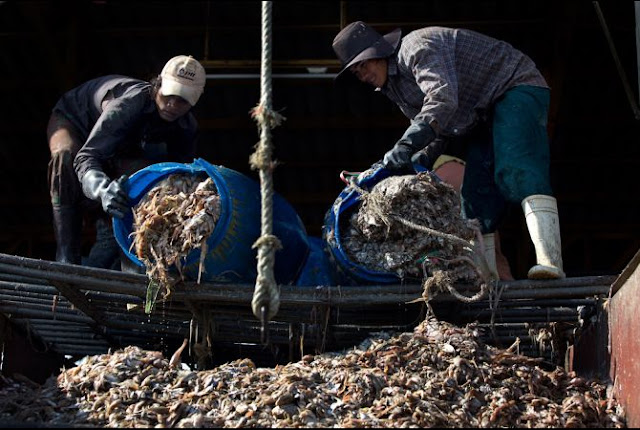
| Migrants from Cambodia and Myanmar unload fish off a boat Feb. 25, 2010, in Mahachai, Thailand. (Paula Bronstein/Getty Images) |
In the wild-caught seafood industry, forced labor persists because the first crucial supply-chain steps take place in a lawless, saltwater abyss.
May 21, 2012
Patrick Winn
Global Post
SAMUT SAKHON, Thailand, and PREY VENG, Cambodia — The laundering begins in a sub-zero chamber floating far from civilization. It is filled with heaps of fish, and men dressed like eskimos.
This is the fridge room on a vessel known as a “mothership.” These hulking vessels serve as deep-sea resupply stations for trawlers seeking fuel, meat, medicine, spare parts and even laborers to replace men lost at sea.
The ship’s most important function, however, is receiving wild catch into its icy bowels and ferrying it to onshore fishmongers. Some motherships and fishing boats operate under the same syndicate. Motherships that don't collect a fee for transporting catch to the buyer, typically a fishmonger stationed at a specific dock. Once a squid or sardine comes aboard the mothership, there is almost no way to know whether it was netted by paid fishermen or sea slaves.
“Motherships have freezing capacity to hold high-value fish for long periods of time,” said Lisa Rende Taylor, chief technical specialist with the United Nations Inter-Agency Project on Human Trafficking. “The fish is taken back to Thai ports for sale and, most likely, export if the fish is of high value.”
“The boat that caught it may or may not have used slave labor,” she said. “There’s just no way to know who actually caught these fish because of the way unregistered boats work with motherships many kilometers away from the shore.”
Most of the fisheries supply chain between the US and Thailand, America’s second-largest supplier of foreign seafood, can be traced. These are the links that can’t.
Slavery in Thailand’s deep-sea fishing trade is an open secret, acknowledged by the US, the UN and some within the Thai government. It is not all-pervasive. Thailand's biggest seafood export, shrimp, is sourced from coastal farms subject to spot checks. Most "Thai" tuna, the nation's second-largest seafood export, is actually imported from abroad and processed for re-export.








