


Showing posts with label Chapei Dong Veng. Show all posts
Showing posts with label Chapei Dong Veng. Show all posts
Tuesday, March 15, 2011
Kong Nay and Ouch Savy tour documentary
http://www.youtube.com/watch?v=nrIpJDcisVc&feature=related
http://www.youtube.com/watch?v=N95gjSKfZqw&NR=1
http://www.youtube.com/watch?v=yMhx6_2WZZw&feature=related


Sounds from the past suggest a bright future

Traditional instruments create a modern sensibility in this Khmer master's work
15/03/2011
Bangkok Post
In 2003, I wrote about the Cambodian Master Performers' Program, which was set up by a young trdo ui (upright fiddle) player Arn Chorn to document and preserve traditional Khmer music.
Chorn had escaped the killing fields of the murderous Khmer Rouge regime to the refugee camps on the Thai border and eventually made his way to Lowell, Massachusetts, in the USA.
Many of his peers and teachers, however, were not so lucky: Some 90% of the country's traditional and popular musicians were either killed or left for exile in a new country.
The master chappei dong vang (long-neck, two-string lute) player and singer Kong Nay was one of the few to survive. There were many times he thought he and his family would perish but perhaps because of his musical ability he survived. The programme, now renamed Cambodian Living Arts and based in the US, England and Phnom Penh, brought Nay and nineteen other surviving traditional musicians in to teach young students, thereby passing on their skills and experience to a new generation. A studio, sponsored by Peter Gabriel's hugely successful global Womad festival circuit and the related Real World record label, was set up to record the master teachers and their students.
Thursday, June 03, 2010
Blindness and the blues: Cambodia's 'chapei'
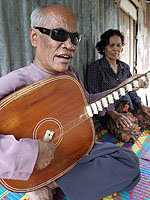 Kong Nay (Photo: AP)
June 3, 2010
ABC Radio Australia
Cambodia's traditional music scene has gone through something of a revival in recent years. Almost all of the kingdom's musicians were killed during the Khmer Rouge years in the Seventies and the few masters who escaped have been busy passing on their knowledge to young Cambodians. One of the most famous masters is Kong Nai, a player of the two-string guitar-like instrument known as a chapei. Radio Australia's Liam Cochrane has been in Cambodia and went on a search for the authentic sounds of the chapei.
Presenter: Liam Cochrane
Speakers: Guitar shop owner; Chieng Ry, traditional instrument maker; Nou Narin, Chieng Ry's wife
COCHRANE: That's the sound of the old master Kong Nai, playing the chapei - a kind of two-stringed guitar found in Cambodia. The music is often described as the delta blues of Southeast Asia and often used for storytelling. Kong Nai, blind and wearing dark sunglasses, is the Ray Charles of the Cambodian chapei.
I've always loved the sound of this music and I've decided to go in search of an authentic chapei. But where to start looking? Well, taking a cue from a Cambodian pop song of the 60's, I head to Phnom Penh's Central Market, Psar Thmey.
Eventually I find a shop selling all kinds of guitars and mandolins, but do they have a chapei?
The owner of the shop says he doesn't stock any traditional instruments and if I want a chapei, I'll need to get one specially made. So I call a friend who works with Cambodian musicians. It just so happens that the master instrument builder Chieng Ree has recently finished a handmade traditional chapei and is willing to sell it to me.
COCHRANE: That's it that's the chapei. Wow so let's hear what it sounds like. While he tunes it up, maybe I'll just describe what this chapei looks like. It's a blonde ash coloured wood. Sort of looks like a guitar, with a very thin body to it and a long neck. And at the end of the neck, past where the strings stop, there's a long curved piece of wood. Now the strings are set about 3cms above the neck with pieces of black and white frets protruding up to fret the strings.
COCHRANE: So tell me about the making of this particular chapei. How long did it take him to build this? It took me 15 days to make it.
I asked Chieng Ree about a third string that ran through each fret but seemed to play no part it making music.
RY: In fact we use only two strings but the third one is for those who get blind because most chapei players get blind. Does that mean I'm going to go blind?
Chieng Ree assured me that blindness wasn't didn't come from playing the chapei but instead from not making good on our promises. He tells a story that echoes the legend of American bluesman Robert Johnson selling his soul to the devil at the crossroads in exchange for his amazing guitar-playing.
RY: Some people who get blind, because they do not keep their promise. For example in the case of Ne Prey, he give promise to the spirit that he would give offering if he could play in other countries. Then when he came back from Australia, he did not keep his promise and he got blind.
COCHRANE: Chieng Ree and his wife told me another story about promises not kept. They were one of several families of musicians that used to live on a central Phnom Penh block called Dey Krahom, or Red Earth. Their community had simple houses and had lived there for years, but it was prime real estate and a company bought the land from under them, offering paltry compensation. A local government official promised to help them.
RY: He told us not to worry because we are artists, he said he will solve the problem, like giving us compensation, like other artists get. But finally they were evicted.
COCHRANE: Chieng Ree's wife, Nou Narin, told me what happened next.
NOU: Before I got evicted, we had 30-thousand US dollars worth of instrument-making equipment, but after the evictions there was have nothing left, the only thing we rescued was this sofa we are sitting on.
COCHRANE: It was a sad story and one fitting of the blues tradition that the chapei invokes in Western musicians. But it was time to turn back to the chapei and get a few tips from Chieng Ry about how to play the thing.
I'm going to have to practice that. I think I'll stop now because that's absolutely awful and we'll leave it to the experts.
Presenter: Liam Cochrane
Speakers: Guitar shop owner; Chieng Ry, traditional instrument maker; Nou Narin, Chieng Ry's wife
COCHRANE: That's the sound of the old master Kong Nai, playing the chapei - a kind of two-stringed guitar found in Cambodia. The music is often described as the delta blues of Southeast Asia and often used for storytelling. Kong Nai, blind and wearing dark sunglasses, is the Ray Charles of the Cambodian chapei.
I've always loved the sound of this music and I've decided to go in search of an authentic chapei. But where to start looking? Well, taking a cue from a Cambodian pop song of the 60's, I head to Phnom Penh's Central Market, Psar Thmey.
Eventually I find a shop selling all kinds of guitars and mandolins, but do they have a chapei?
The owner of the shop says he doesn't stock any traditional instruments and if I want a chapei, I'll need to get one specially made. So I call a friend who works with Cambodian musicians. It just so happens that the master instrument builder Chieng Ree has recently finished a handmade traditional chapei and is willing to sell it to me.
COCHRANE: That's it that's the chapei. Wow so let's hear what it sounds like. While he tunes it up, maybe I'll just describe what this chapei looks like. It's a blonde ash coloured wood. Sort of looks like a guitar, with a very thin body to it and a long neck. And at the end of the neck, past where the strings stop, there's a long curved piece of wood. Now the strings are set about 3cms above the neck with pieces of black and white frets protruding up to fret the strings.
COCHRANE: So tell me about the making of this particular chapei. How long did it take him to build this? It took me 15 days to make it.
I asked Chieng Ree about a third string that ran through each fret but seemed to play no part it making music.
RY: In fact we use only two strings but the third one is for those who get blind because most chapei players get blind. Does that mean I'm going to go blind?
Chieng Ree assured me that blindness wasn't didn't come from playing the chapei but instead from not making good on our promises. He tells a story that echoes the legend of American bluesman Robert Johnson selling his soul to the devil at the crossroads in exchange for his amazing guitar-playing.
RY: Some people who get blind, because they do not keep their promise. For example in the case of Ne Prey, he give promise to the spirit that he would give offering if he could play in other countries. Then when he came back from Australia, he did not keep his promise and he got blind.
COCHRANE: Chieng Ree and his wife told me another story about promises not kept. They were one of several families of musicians that used to live on a central Phnom Penh block called Dey Krahom, or Red Earth. Their community had simple houses and had lived there for years, but it was prime real estate and a company bought the land from under them, offering paltry compensation. A local government official promised to help them.
RY: He told us not to worry because we are artists, he said he will solve the problem, like giving us compensation, like other artists get. But finally they were evicted.
COCHRANE: Chieng Ree's wife, Nou Narin, told me what happened next.
NOU: Before I got evicted, we had 30-thousand US dollars worth of instrument-making equipment, but after the evictions there was have nothing left, the only thing we rescued was this sofa we are sitting on.
COCHRANE: It was a sad story and one fitting of the blues tradition that the chapei invokes in Western musicians. But it was time to turn back to the chapei and get a few tips from Chieng Ry about how to play the thing.
I'm going to have to practice that. I think I'll stop now because that's absolutely awful and we'll leave it to the experts.
Tuesday, July 24, 2007
Rare visit by 'Cambodian Ray Charles' [in the UK]
 By Charley Morgan
This is Wiltshire (UK)
A CAMBODIAN artist whose music was banned under the brutal Khmer Rouge regime is making a rare visit to Wiltshire to perform songs that have been saved from extinction.
Kong Nay, the 'Ray Charles of Cambodia', will be performing the Chapei in Bradford on Avon on August 2 as part of a tour to mark his first ever visit to the UK.
A film called The Flute Player is being shown before the concert about fellow Cambodian, Arn Chorn-Pond, who survived Pol Pot's genocide in the 1970s to set up the charity Cambodian Living Arts, which supports traditional artists like Kong Nay in teaching future generations so the music lives on.
The tour is thanks to former Genesis front man and WOMAD organiser, Peter Gabriel, who saw the film and sent his sound engineer out to Cambodia to find Kong Nay and bring him back to play in the UK.
Speaking at his Real World Recording Studios in Box, Gabriel said: "At the end of the Khmer Rouge one of the things Arn Chorn-Pond did was to try and save some of the great arts that Cambodia had had.
"Artists had been targeted by the Khmer Rouge and Pol Pot - 90 per cent of them were eliminated.
advertisement
"For us, to be a rock musician we get rewarded handsomely in many ways, but to be a rock musician in Cambodia may well have cost you your life."
Although Kong Nay's music seems very different and is thousands of years old, Gabriel believes it has many similarities to the Delta Blues, hence the nickname the 'Ray Charles of Cambodia'.
Nay is a master of the Chapei Dang Weng, a long-necked two-stringed guitar, which he plays while singing with his young student, Ouch Savy.
Speaking through a translator, Nay, whose instrument was confiscated during the regime, said: "During the Khmer Rouge time it was completely banned but in my heart the art was always there and I would try to remember the notes, the tones and the music by humming to myself.
"I have been waiting for this day for so long and have always been excited by it.
"The Chapei is uniquely Cambodian and it is very important that our young people know about these forms of art. If it dies we are going to lose it forever."
Gabriel added: "I think it's a wonderful thing to have a visit from Kong Nay to this country for the very first time and to be able to sample some of this extraordinary music."
Kong Nay with Ouch Savy and The Flute Player film is on at Bristol's Arnolfini on Wednesday, the WOMAD festival on July 26-29 and Wiltshire Music Centre in Bradford on Avon on August 2.
For Bradford tickets call (01225) 860100.
Kong Nay, the 'Ray Charles of Cambodia', will be performing the Chapei in Bradford on Avon on August 2 as part of a tour to mark his first ever visit to the UK.
A film called The Flute Player is being shown before the concert about fellow Cambodian, Arn Chorn-Pond, who survived Pol Pot's genocide in the 1970s to set up the charity Cambodian Living Arts, which supports traditional artists like Kong Nay in teaching future generations so the music lives on.
The tour is thanks to former Genesis front man and WOMAD organiser, Peter Gabriel, who saw the film and sent his sound engineer out to Cambodia to find Kong Nay and bring him back to play in the UK.
Speaking at his Real World Recording Studios in Box, Gabriel said: "At the end of the Khmer Rouge one of the things Arn Chorn-Pond did was to try and save some of the great arts that Cambodia had had.
"Artists had been targeted by the Khmer Rouge and Pol Pot - 90 per cent of them were eliminated.
advertisement
"For us, to be a rock musician we get rewarded handsomely in many ways, but to be a rock musician in Cambodia may well have cost you your life."
Although Kong Nay's music seems very different and is thousands of years old, Gabriel believes it has many similarities to the Delta Blues, hence the nickname the 'Ray Charles of Cambodia'.
Nay is a master of the Chapei Dang Weng, a long-necked two-stringed guitar, which he plays while singing with his young student, Ouch Savy.
Speaking through a translator, Nay, whose instrument was confiscated during the regime, said: "During the Khmer Rouge time it was completely banned but in my heart the art was always there and I would try to remember the notes, the tones and the music by humming to myself.
"I have been waiting for this day for so long and have always been excited by it.
"The Chapei is uniquely Cambodian and it is very important that our young people know about these forms of art. If it dies we are going to lose it forever."
Gabriel added: "I think it's a wonderful thing to have a visit from Kong Nay to this country for the very first time and to be able to sample some of this extraordinary music."
Kong Nay with Ouch Savy and The Flute Player film is on at Bristol's Arnolfini on Wednesday, the WOMAD festival on July 26-29 and Wiltshire Music Centre in Bradford on Avon on August 2.
For Bradford tickets call (01225) 860100.
Tuesday, July 03, 2007
Kong Nay on Hello VOA program
 Renowned Chapei Dong Veng musician Kong Nay performs for an audience at the National Mall in Washington Friday. (Photo: VOA)
Cambodian Blues Man Guest on 'Hello VOA'
Neou Sarem, VOA Khmer
Washington
02/07/2007
Click here to listen Neou Sarem hosts 'Hello VOA' in Khmer
Click here to listen Nuch Sarita reports from the Smithsonian Festival
(Real Media Player required)
Click here to listen Nuch Sarita reports from the Smithsonian Festival
(Real Media Player required)
Kong Nay, the nearest thing Cambodia has to a Blues man, stopped by "Hello VOA" Monday, answering questions about his art and improvising several Chapei Dong Vey songs.
Kong Nay, a blind singer who plays the long-necked, two-string guitar while singing heartwarming love songs or comedic improves, is in Washington as part of the Smithsonian's Folklife Festival.
The festival is an international exhibition of "living cultural heritage" that takes place each year in July on the National Mall in Washington.
This year's festival saw a special dedication to the cultures of the Mekong River.
"The Mekong region has been a cradle and crossroads of cultures for many centuries and more recently has become closely connected to the United States through the more than two million Americans who trace their ancestry to Vietnam, Thailand, Cambodia, Laos, and the Chinese province of Yunnan," Folklife festival organizers said.
"Visitors will experience the region's diversity firsthand through the presentations of artists, performers, craftspeople, cooks, ritual specialists and presenters," organizers said.
"The Mekong has many different meanings to the peoples of the region as well as to Americans who may know little of its complexity," organizers said.
The Mekong program of the festival included Vietnamese opera, Thai shadow puppetry, Cambodian classical dance, and Chinese gourd flute music. Lao textiles, Naxi calligraphy and mural paintings were also on display.
The festival also showcases the musical stylings of Kong Nay.
Kong Nay's Chapei Dong Veng music, which includes ballads, stories and comedic improvisation, is dying as a tradition thanks to the invasion of karaoke into rural Cambodia.
One "Hello VOA" listener noted that many of the practitioners of the art were blind like Kong Nay, and wondered aloud if the art made a person so.
Kong Nay said he'd been blind before he started to play.
Kong Nay, a blind singer who plays the long-necked, two-string guitar while singing heartwarming love songs or comedic improves, is in Washington as part of the Smithsonian's Folklife Festival.
The festival is an international exhibition of "living cultural heritage" that takes place each year in July on the National Mall in Washington.
This year's festival saw a special dedication to the cultures of the Mekong River.
"The Mekong region has been a cradle and crossroads of cultures for many centuries and more recently has become closely connected to the United States through the more than two million Americans who trace their ancestry to Vietnam, Thailand, Cambodia, Laos, and the Chinese province of Yunnan," Folklife festival organizers said.
"Visitors will experience the region's diversity firsthand through the presentations of artists, performers, craftspeople, cooks, ritual specialists and presenters," organizers said.
"The Mekong has many different meanings to the peoples of the region as well as to Americans who may know little of its complexity," organizers said.
The Mekong program of the festival included Vietnamese opera, Thai shadow puppetry, Cambodian classical dance, and Chinese gourd flute music. Lao textiles, Naxi calligraphy and mural paintings were also on display.
The festival also showcases the musical stylings of Kong Nay.
Kong Nay's Chapei Dong Veng music, which includes ballads, stories and comedic improvisation, is dying as a tradition thanks to the invasion of karaoke into rural Cambodia.
One "Hello VOA" listener noted that many of the practitioners of the art were blind like Kong Nay, and wondered aloud if the art made a person so.
Kong Nay said he'd been blind before he started to play.
Thursday, June 21, 2007
Monday, May 14, 2007
In Cambodia, Preserving a Musical Tradition
 Kong Nai is one the last living masters of the traditional Cambodian guitar, known as the chapei dong veng. (Photo: Matt Ozug, NPR)
 Kong was forced to play only Khmer Rouge anthems during that regime's reign. (Photo: Matt Ozug, NPR)
Morning Edition, May 14, 2007
by Matt Ozug
National Public Radio, Morning Edition (USA)
Officials in Cambodia's capital city of Phnom Penh are preparing for the long-awaited trial of the surviving leaders of the Khmer Rouge, the regime that carried out the genocide of nearly 2 million Cambodians in the late 1970s.
In addition to destroying lives, the Khmer Rouge nearly obliterated Cambodian arts and culture. But at least one man is helping to keep those traditions alive.
Kong Nai is one of only two or three living masters of the Cambodian guitar, known as the chapei dong veng, to have survived the Khmer Rouge.
A childhood illness left Kong blind at the age of 4, around the time he began asking his mother to take him to hear the chapei.
He learned to play the chapei from his uncle.
"Well, it'll be difficult for me to teach you because you're blind," his uncle told him.
But Kong persisted. Whenever one of the old chapei masters was playing, Kong would beg his mother to take him to listen. And when Kong went home, he would practice humming the melodies over and over.
Chapei music is an oral tradition. The melodies are passed down from one generation to the next, while the lyrics are often composed or improvised on the spot.
When the Khmer Rouge took over his country in 1975, Kong was spared hard labor and was even allowed to keep his instrument. But he was forced to play only Khmer Rouge anthems, extolling the greatness of the regime.
Without warning, Kong's instrument was taken away. He was separated from his family and sent to work making palm rope.
"[I've] never been fit enough," he says. "They beat us up and we had to eat the potato leaves, and we had to eat the cassava leaves in order to survive. This is so painful, but we had to live through the regime."
Then one day, Kong was taken to the woods, and left there overnight. He still doesn't know why he wasn't killed. But the next day, when the Vietnamese army overtook the camp, Kong was freed. He was reunited with his wife, his children and his music.
"I didn't really expect I'd have this day," he says. "Because before the liberation day I thought everything turned black. I can tell you after the liberation day I feel totally changed that I had freedom to play the chapei again …"
When asked if he had a favorite song, or one he is proudest of, Kong plays one about liberation from the Khmer Rouge.
"Liberation Song" (listen) says in part:
Matt Ozug traveled to Cambodia as part of the International Reporting Project.
In addition to destroying lives, the Khmer Rouge nearly obliterated Cambodian arts and culture. But at least one man is helping to keep those traditions alive.
Kong Nai is one of only two or three living masters of the Cambodian guitar, known as the chapei dong veng, to have survived the Khmer Rouge.
A childhood illness left Kong blind at the age of 4, around the time he began asking his mother to take him to hear the chapei.
He learned to play the chapei from his uncle.
"Well, it'll be difficult for me to teach you because you're blind," his uncle told him.
But Kong persisted. Whenever one of the old chapei masters was playing, Kong would beg his mother to take him to listen. And when Kong went home, he would practice humming the melodies over and over.
Chapei music is an oral tradition. The melodies are passed down from one generation to the next, while the lyrics are often composed or improvised on the spot.
When the Khmer Rouge took over his country in 1975, Kong was spared hard labor and was even allowed to keep his instrument. But he was forced to play only Khmer Rouge anthems, extolling the greatness of the regime.
Without warning, Kong's instrument was taken away. He was separated from his family and sent to work making palm rope.
"[I've] never been fit enough," he says. "They beat us up and we had to eat the potato leaves, and we had to eat the cassava leaves in order to survive. This is so painful, but we had to live through the regime."
Then one day, Kong was taken to the woods, and left there overnight. He still doesn't know why he wasn't killed. But the next day, when the Vietnamese army overtook the camp, Kong was freed. He was reunited with his wife, his children and his music.
"I didn't really expect I'd have this day," he says. "Because before the liberation day I thought everything turned black. I can tell you after the liberation day I feel totally changed that I had freedom to play the chapei again …"
When asked if he had a favorite song, or one he is proudest of, Kong plays one about liberation from the Khmer Rouge.
"Liberation Song" (listen) says in part:
For 3 years we suffered unforgettable hardship; everything was destroyed."I am the oldest one now and when I pass away I hope that the music will carry on to the young generation," Kong says.
Blood was spilled and children orphaned.
Cambodia became a place of killing.
They forced the people to dig and plow the fields.
Exhausted they fell down to the ground;
bodies swollen, tired, hopeless.
Husbands and Wives, brothers and sisters, were separated.
We were forced to forget each other.
Until January 7th, when the Cambodian people were freed of the sorrow.
Kong still performs regularly and also teaches chapei to a new generation. He hopes that one of his sons who plays the instrument can "take over from me."
Matt Ozug traveled to Cambodia as part of the International Reporting Project.
Subscribe to:
Posts (Atom)








