http://www.youtube.com/watch?v=iqHsA4P8nws
Showing posts with label Khmer food promotion. Show all posts
Showing posts with label Khmer food promotion. Show all posts
Monday, September 03, 2012


Tuesday, July 31, 2012
Friday, July 27, 2012
Food Fridays: Cuisine Wat Damnak in Siem Reap
 |
| A refined version of a street eat–nom banh chok–is an example of Chef Riviere’s aim to serve modernized and creative Cambodian cuisine. Kaylene Hong/The Wall Street Journal |
July 27, 2012
By Kaylene Hong
The Wall Street Journal
Be prepared to be surprised at Cuisine Wat Damnak, a contemporary Cambodian restaurant in Siem Reap that has entirely transformed native dishes seen on the streets into haute cuisine.
Having earlier eaten nom banh chok—a Cambodian dish of rice noodles with a thin curry gravy ladled onto it—at a local market after trooping through muddy walkways displaying squirming, bloody fish, the nom banh chok at Cuisine Wat Damnak was almost unrecognizable.
It had a different and rather elaborate description on the menu: “Mekong langoustine in light curry and coconut broth, fresh rice vermicelli and local crudités.” Essentially it was a sophisticated version of nom banh chok—with the broth tasting richly of shrimps, and the dish topped with expertly-seared mini lobsters and a borrowed French element, crudités, or sliced raw vegetables. Decadent, but delicious.
Sunday, February 05, 2012
In Lowell, true Cambodian fare
February 05, 2012
By Kathleen Pierce
Boston Globe Correspondent
By Kathleen Pierce
Boston Globe Correspondent
Simply Khmer
26 Lincoln St., Lowell
978-454-6700
Open daily, 8 a.m. to 9 p.m.
All major credit cards accepted
Handicapped accessible
Living in Lowell, the question often arises: “Where should I go for Cambodian food?’’ Until now I’ve not had a surefire answer. The city is awash in Southeast Asian restaurants that lump Cambodian cuisine with Vietnamese, Thai, and Laotian. A true Cambodian restaurant that doesn’t serve pad Thai or pho takes some sleuthing.
On a tip from a gallery owner, I visited Simply Khmer and found my answer. Flavorful soup, perfectly wrapped nam chow, endless pots of jasmine tea, and the savory, sweet and sour essence of this faraway land come into play with each freshly prepared dish. It’s been a while since a meal was this invigorating.
Tucked away on Lincoln Street, between downtown and the Highlands neighborhood, Simply Khmer is not suffering from its off-the-grid location.
Monday, September 26, 2011
10 Cambodian dishes you've got to try
Khmer cuisine has long been overshadowed by its Thai and Vietnamese cousins: But times (and menus) to change that
26 September, 2011
By Lina Goldberg
CNN Go
Squished between culinary heavyweights Thailand and Vietnam, Cambodia is often overlooked when it comes to food. But once you've sampled Khmer cuisine, you won't turn back.
Here are 10 dishes to start you off.
 |
| No two bai sach chrouks are ever exactly the same |
1. Bai sach chrouk -- pork and rice
Served on street corners all over Cambodia early every morning, bai sach chrouk, or pork and rice, is one of the simplest and most delicious dishes that the country has to offer.
Thinly sliced pork is slowly grilled over warm coals to bring out its natural sweetness. Sometimes the pork will be marinated in coconut milk or garlic -- no two bai sach chrouks are ever exactly the same.
The grilled pork is served over a hearty portion of broken rice, with a helping of freshly pickled cucumbers and daikon radish with plenty of ginger. On the side, you'll often be given a bowl of chicken broth topped with scallions and fried onions.
Try it at: 786 St. 474, Phnom Penh

Where else can you get fish whipped into a mousse?
2. Fish amok
Fish amok is one of the most well-known Cambodian dishes, but you'll find similar meals in neighboring countries.
You won't find the same enthusiasm for the dish outside of Cambodia, though, or the addition of slok ngor, a local herb that imparts a subtly bitter flavor.
Fish amok is a fish mousse with fresh coconut milk and kroeung, a type of Khmer curry paste made from lemongrass, turmeric root, garlic, shallots, galangal and fingerroot, or Chinese ginger.
At upscale restaurants fish amok is steamed in a banana leaf, while more local places serve a boiled version that is more like a soupy fish curry than a mousse.
Try it at: K'nyay, Suramarit Boulevard between Sothearos Blvd. and St. 19, Phnom Penh; +855 23 225 225
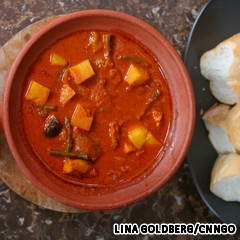 |
| A red curry that doesn't result in flames bursting from your mouth. |
Thursday, April 21, 2011

Wednesday, June 23, 2010
Bringing the tastes of Cambodia to Fairfax

 Annandale resident and author of the book "A Taste of Cambodian Cuisine," Demaz Baker is teaching cooking classes each month on how to prepare traditional Cambodian meals. (Shamus Ian Fatzinger/Fairfax County Times)
Cooking teacher, author shares her passion for exotic cuisine
Wednesday June 23, 2010
by Alexandra Greeley | Special to the Times
Fairfax County Times (Virginia, USA)
Perhaps the least known of Asian cuisines, Cambodian food has been a rarity in the Washington, D.C., metro area. But cooking teacher Demaz Baker of Annandale hopes to change that.
According to Baker, no Cambodian restaurants exist in the District or its surrounding suburbs, making it a challenge for interested foodies to go out and taste the culture's traditional flavors. That doesn't make it impossible, though, says Baker, who is also an amateur chef and author of two Cambodian cookbooks -- such as "A Taste of Cambodian Cuisine," which is available on Amazon.com. With monthly classes at the Arlington County Adult Education Center and a little patience, anyone can learn how to master the culture's sweet and savory flavors.
Although it shares many similarities with Thai cuisine, Baker says Cambodian cooking is "lighter and less spicy in taste," with less reliance on coconut milk and chilis.
A U.S. resident since the mid-1970s, Baker has held daytime jobs with the Department of Defense. But in her spare time, she has indulged her passion for Cambodian food by learning the traditional recipes from her homeland and then cataloging them in her two self-published cookbooks. This has certainly been a labor of love, for Baker admits she never learned how to cook as a child in her parents' home.
"I have always liked cooking, but I never learned it in Cambodia," she said. "My aunts are really the experts in Cambodian food. I even registered in cooking school when I was a student in Australia, but I only studied there for two months."
As a newcomer to the area, Baker longed for the sweet and savory delicacies from her native country. Finding no restaurant that offered the food she craved, Baker set about learning the basics of the cuisine by calling friends and relatives all over the world.
"I gathered recipes from whomever had the expertise," she said.
Top on her phone list were two friends in Los Angeles and others in France and Canada, but because Cambodians usually never write down measurements, reconstructing the recipes required experimentation and tasting.
After gathering stacks of recipes, Baker turned to trying them all, tasting what worked and discarding the rejects.
"This was a labor of several years," she said. "But now I know how to cook properly."
As a result, Baker wrote her first cookbook, "Cambodian Cuisine," in 1999 and issued her second, "A Taste of Cambodian Cuisine," in 2009. A full-color volume, the book is available online at Amazon.com and also at Barnes & Noble.
As a complement to her culinary hobby, Baker started teaching Cambodian cooking at the Arlington County Adult Education Center, offering a month's worth of classes each semester.
"I would teach once a week for the month," she said. After eight years of offering adult education classes, Baker decided to simply teach cooking in her own home. This switch has worked out well, she says, noting that many of her former students signed up and have now formed an informal cooking club, though all newcomers are welcome to join in.
Held one night each month, the classes require student participation supervised by Baker. Afterward, all sit down to a feast.
"A typical menu includes a main-course soup and two side dishes, one with vegetables and often one with fish," she said, adding that the usual Cambodian meal includes fish, since the Mekong River running through the country is a rich source of freshwater fish. There may also be a chicken or beef curry, which is a norm here in the U.S. but is a luxurious meal back home in Cambodia, where chicken and beef are expensive for the average household.
Participants learn three dishes per class, and classes cost $55 each.
Her students are so enthusiastic about Baker's food that they have been urging her to open a restaurant. After all, she notes, all her siblings own a restaurant in Quebec. But Baker's response is simple: No way, she says.
"In my opinion, for a small restaurant to be successful, it has to be run by family members," she says. "Besides, you have no other life if you own one."
For more information, contact Demaz Baker at www.CambodianCooking.webng.com.
Recipe: Saraman Chicken
Serves four
Demaz Baker explains that Cambodian cooking is very similar to Thai cooking, which is evident in this rich chicken curry. To simplify the long and arduous process of pounding ingredients for a curry paste, the basis of all Thai and Cambodian curries, Baker uses commercial curry paste, making the preparation of such dishes relatively fast. All ingredients are available in Asian markets.
- 2 tablespoons vegetable oil
- 3 tablespoons Masaman curry paste
- one (13.5- ounce) can coconut milk
- 2 pounds boneless chicken thighs, cut into bite-sized pieces
- 3 tablespoons fish sauce
- 2 tablespoons sugar or palm sugar
- ½ teaspoon salt
- 2 cups pearl onions, peeled
- 4 to 5 medium-sized potatoes, peeled and quartered
Wednesday, April 28, 2010
When Khmers were sent to teach all things Khmer to the Chinese...
 According to the Cambodian tale "Thon-Chey", the Chinese learned to make noodle from the clever Khmer Thon-Chey (albeit it could be a "tall" tale also)
Researchers discovered a group of ancient ethnic Khmers living in southern China
Tuesday, 27 April 2010
By Khmerization Source: RFA
Dr. Soum Chhum Bun, Secretary General of the Cambodian Royal Academy who is a researcher of cultural heritage and civilisation of the Asian region, has told RFA's reporter, Mr. Orm Oudom, on 26th April that researchers have discovered a group of more than 1,000 ancient ethnic Khmers living in Sisorng Phana region in southern China. He said this group of ethnic Khmers were descendants of Khmer mahouts and Khmer cooks sent by Khmer kings to help train elephants and cook Khmer food for the Chinese emperor in the 13th century which was at the end of the Angkorian era. "The Khmer king sent two Khmer families to help keep and care for the (Chinese emperor's) elephants. Later, when the Khmer king found out that emperor Ching Hong likes Khmer food, he sent another two families to cook for Emperor Ching Hong. That's why they (those ethnic Khmers) said that the four families of their ancestors came to China from Cambodia. Presently, there were about 1,000 ethnic Khmers living in their village and they can speak some ancient Khmer language which they still can remember", he said.
Dr. Soum Chhum Bun said the reason the Khmer kings sent Khmer mahouts and Khmer cooks to the Chinese imperial court in Sisorng Phana region was because at that time Cambodia had formed a very close tie with the Chinese imperial court in Sisorng Phana region due to Cambodia's long wars with the T'ai people, which presently known as Thais. Dr. Soum said the Cambodian Royal Academy will send its researchers to conduct study on this group of ancient Khmers in Sisorng Phana region very soon.
Tuesday, 27 April 2010
By Khmerization Source: RFA
KI-Media note: In the Cambodian tale of “Thon-Chey”, Thon-Chey’s cleverness earned him the ire of the Khmer king who exiled him to China. Upon arriving there, Thon-Chey made “num banh-chok”, the Cambodian noodle, to sell to make a living. His food was the rave among the Chinese who never ate noodle before (most likely a mockery of the Chinese by Thon-Chey’s author). One day, the Chinese emperor ordered that Thon-Chey be brought to the palace along with his “num banh-chok” so that the emperor may have a taste of it. Prior to entering the palace, Thon-Chey was told that he is not allowed to look at the face of the emperor. This order made Thon-Chey even more curious. As the Chinese emperor was eating the noodle, he had to pick it up with chopsticks, tilt his head backward to gulp the long string noodle. Thon-Chey then took the opportunity to sneak a peek at the emperor’s face, after which he spoke to himself: “Muk sdach chen doch kdet chhker, muk sdach khmer to kher penh boramey” (The face of the Chinese emperor looks like the dog’s derriere, whereas the face of the Khmer king looks like a full moon). As it turned out, the Chinese emperor overheard Thon-Chey’s comment and ordered him to be thrown in jail. The tale went on to tell Thon-Chey making Khmer kites (khleng ek) while he was in jail, and how the noise made by the kite bothered the Chinese emperor enough that he ordered Thon-Chey be released and sent back to Cambodia. It appears that the tale of Khmer people teaching the Chinese is not a tale at all, but rather a fact.A group of Khmer cultural heritage and civilisation researchers have just discovered a group of ancient Khmers living in one region of southern China, reports Radio Free Asia.
Dr. Soum Chhum Bun, Secretary General of the Cambodian Royal Academy who is a researcher of cultural heritage and civilisation of the Asian region, has told RFA's reporter, Mr. Orm Oudom, on 26th April that researchers have discovered a group of more than 1,000 ancient ethnic Khmers living in Sisorng Phana region in southern China. He said this group of ethnic Khmers were descendants of Khmer mahouts and Khmer cooks sent by Khmer kings to help train elephants and cook Khmer food for the Chinese emperor in the 13th century which was at the end of the Angkorian era. "The Khmer king sent two Khmer families to help keep and care for the (Chinese emperor's) elephants. Later, when the Khmer king found out that emperor Ching Hong likes Khmer food, he sent another two families to cook for Emperor Ching Hong. That's why they (those ethnic Khmers) said that the four families of their ancestors came to China from Cambodia. Presently, there were about 1,000 ethnic Khmers living in their village and they can speak some ancient Khmer language which they still can remember", he said.
Dr. Soum Chhum Bun said the reason the Khmer kings sent Khmer mahouts and Khmer cooks to the Chinese imperial court in Sisorng Phana region was because at that time Cambodia had formed a very close tie with the Chinese imperial court in Sisorng Phana region due to Cambodia's long wars with the T'ai people, which presently known as Thais. Dr. Soum said the Cambodian Royal Academy will send its researchers to conduct study on this group of ancient Khmers in Sisorng Phana region very soon.
Monday, March 15, 2010
The Trouble with Prahok: Why are Khmers Turning Against Their Fish Paste Heritage?

 (Photos by Jerry Redfern)
March 15, 2010
Karen Coates
The Faster Times
The soul of Khmer cuisine resides in a murky barrel of a potent, fishy paste that graces every meal—prahok . It’s the odiferous spice of Cambodia, the protein-packed punch of grandma’s soup and auntie’s curry. Just a little dab will do, thanks to the olfactory power of fermentation. It takes the country’s blazing sun, it’s muddy waters and the sweat of its people to lug and crush, salt and dry, heaps and piles of tiny fish, which then rot into potent distinction. Prahok is indeed the heart of a nation; its juices, the blood that keeps Cambodia running.
Why, then, are some Khmers shunning this heritage?
“Now I don’t like prahok anymore,” says Keo Touch, who goes by the name of “Toot” and runs a Battambang cooking school with his wife, Nuon Nary.
His statement catches me off guard, so I start asking questions. The answers, I realize, I have heard many times before.
“Now I am a towner, I am no longer a farmer,” he says. “Some people look down on you if you eat prahok , because if you eat prahok , you are a farmer, you are poor.”
I understand his concern. Poverty is a pestilence that Cambodians everywhere aim to escape. This is a countrified state, with 13.3 million people scattered among some 14,000 villages housing more than 80 percent of the population. Read the other way: only 20 percent of Cambodians live in a city. Of those, many have ended up on the urban scene because they lost land, got sick, needed money or suffered some heinous tragedy that left them no recourse. The average Cambodian earns less than $2 a day. Marginally few are the people like Toot, who built a thriving business after years of destitution.
Toot says the scent of prahok reminds them of the farm. And the farm is a place that offers no easy life. Plus, it comes with the added baggage of memory—every Cambodian spent 1975-1979 as a farmer under the genocidal Khmer Rouge. And every survivor harbors stories of slave-like labor, death and starvation. No surprise, people want to forget.
It’s as though Toot internalizes the acrid smell of prahok as a blemish on his character—untrue as that might be. “I am very ashamed if I tell about prahok to my students,” he says. “Because if I tell, and they smell, they run away.” Only if they ask do his recipes and market tours include prahok , that most fundamental of Cambodian ingredients. “Now I use shrimp paste. Shrimp paste is not very strong.”
Still, it’s Nary’s kitchen (she cooks while Toot peruses the market and chats up the students), so I ask her about prahok as she minces an almond butter-colored pad of the stuff. “Yeah,” she smiles, “I like.” No problem for her.
When I get to Phnom Penh—the throbbing capital of hustle, bustle and noise—I ask my longtime friend, Ke Monin, whether he can vouch for Toot’s ideas. “Yeah, sure,” he agrees. He is “100 percent sure,” if people have money, “they don’t want to eat prahok .” He says rich Khmers eat fish paste only once every few months. “When they don’t have money, they eat a lot.”
I ask one more source, the notable photographer Heng Sinith, a longtime friend and confidante. Sinith is the most knowledgeable Cambodian I know. He has Access with a capital A. He makes friends with everyone, singing karaoke with cops and shmoozing with bodyguards while taking his liver to the outer limits. Meanwhile, secrets emerge in the blur of inebriation.
Sinith doesn’t think Khmers willingly forgo the fish of their identity—least of all, he. “I really like real Khmer food,” he says. Nonetheless, he insists prahok will disappear as quickly as the fish in Cambodia’s ailing lakes and rivers (diminished fish stocks are a growing worry). “The people will never deny prahok ,” Sinith says, but “prahok will be finished because there are no more fish.”
And that is a story for another time.
-----
About Karen Coates
When she’s not crashing her bike or running up mountains in New Mexico, Karen Coates covers food, environment, science, health and social issues. She splits her time between the American Southwest and any other place in the world that interests her (particularly Southeast Asia). She’s Southeast Asia correspondent for Archaeology magazine and for five years was Asia correspondent for Gourmet until the magazine imploded in 2009. Her first book, Cambodia Now: Life in the Wake of War, won the August Derleth award for nonfiction. She’s also co-authored the memoirs of Sharon Sites Adams in Pacific Lady: The First Woman to Sail Solo across the World’s Largest Ocean. Karen and her husband, photojournalist Jerry Redfern, are at work on two forthcoming books: Eternal Harvest: The Legacy of American Bombs in Laos and This Way More Better, is a collection of travel essays from the back roads of Asia. Karen writes the award-winning food blog, Rambling Spoon.
Wednesday, January 16, 2008
Cambodian street kids spearhead Khmer food revival
Tue Jan 15, 2008
By Gillian Murdoch
Phnom Penh (Reuters Life!) - First kill your tarantulas by pressing hard on their bodies then remove the fangs and wash the spiders thoroughly, advises the glossy in-house recipe book from Phnom Penh's Romdeng restaurant.
Served with a lime and pepper sauce, the crispy arachnids, fried to remove their venom, became a delicacy during Khmer Rouge reign over Cambodia when Pol Pot's plan to create an agrarian utopia forced millions from cities to the country.
The spiders are part of the restaurant's mission to champion Khmer food from the present and dating back to the Khmer Kingdom of over 1,000 years ago while also helping provide work and a new life for street kids.
Virtually annihilated during the Khmer Rouge's reign that ended in 1979, Cambodia's traditional specialties are less well-known than Western-friendly pad thais and rice-paper rolls from bigger neighbors Thailand and Vietnam although many regional dishes have their roots in Khmer cooking.
But with Cambodia rapidly developing, restaurants such as Romdeng are helping spearhead a comeback, said founder Sebastien Marot and top chef Sok Chhong who put together the cookbook "From Spiders to Water Lillies."
While the spiders may seem like a gimmick, the restaurant also has a serious social mission -- getting young people off the streets and into employment and education.
Run by Cambodian non-profit Mit Samlanh or Friends, Romdeng and its sister restaurant Friends are staffed by former street kids who design the menus, cook the dishes, wait tables, and even sew the silk cushions for the chairs.
So what will Cambodia's breakthrough dish be if tarantulas are not to everyone's taste?
The country is considering submitting its "prahok" fish paste and peppercorns from the southeastern town of Kampot for trademarking as distinctive national products but it is "amok" curry that probably has the widest crossover appeal.
Milder than other curries, as Cambodia's traditional dishes were first cooked up in the days before traders introduced chili to the region, it is named after the dark green amok leaf that's shredded into the dish as a seasoning.
Not surprisingly in a country crisscrossed by the Mekong and two other mighty rivers, the Tonle Sap and the Bassac, fish and shrimps feature heavily on Cambodian menus.
A range of local vegetable dishes also get a creative spin, in dishes like morning glory and water spinach salad, and sautéed rice and chive flower cakes on green papaya salad.
As there are no starters or mains in Khmer culture, all the food comes at once, and there are also no knives so don't wait for anything more than your fork and spoon.
Washed down the meal with a bottle of local Anchor beer, a shot of honey-flavored Khmer rice wine, or fancy combination juices such as sweet tamarind, guava and honey.
True converts to Khmer cooking can end the meal with a commitment by buying the cookbook that feeds its profits back into the endeavor.
Romdeng:#21, Street 278 Phnom Penh (Tel:+ 855 92 219 565)
http://www.streetfriends.org/CONTENT/BUSINESS/romdeng.swf-
Friends: #215, Street 13, Phnom Penh (Tel:+855 12 802 072)
http://www.streetfriends.org/CONTENT/BUSINESS/restaurant_final.
(Editing by Belinda Goldsmith)
Subscribe to:
Posts (Atom)