Showing posts with label Robert Zoellick. Show all posts

Monday, October 13, 2008

Cambodia is “fiscally vulnerable”, according to the World Bank

11-10-2008
Cambodge Soir Hebdo in English
Click here to read the article in French


Twenty eight Third World countries will have to be “rescued”, according to Robert Zoellick

The financial crisis risks having an impact of the Cambodian economy, states a report of the World Bank, published on Thursday 9 October and designating 28 countries which are “vulnerable” to the inflation of food and oil products and to the repercussions of the financial crisis.

Amongst those 28 countries are Cambodia, Jordan, Lebanon, Jamaica, Eritrea, Sri Lanka and Nepal.

According to this report, most of these countries only have limited possibilities when it comes to requesting new loans allowing them to face a price increase of the food and oil products.

These countries, of which many are trying to improve the use of their natural resources as the prices are escalating, also face the risk of being affected by the “Dutch syndrome”: a strengthening of the national currency which is detrimental to the country’s productivity and to its local manufacturing industry.

According to the director of the World Bank, Robert Zoellick, the growth of developing countries could decrease to 4%, far from the average 6% observed in April 2008.

These countries often reacted to the price increase by subsidising oil products and organising free food distribution, putting their budgetary balance at risk.

According to the World Bank, a drop in the exports towards rich countries in recession could lead to the closure of companies and to a possible crisis within the bank sector.

Monday, April 14, 2008

World Bank urges aid over food prices

April 14, 2008
Washington Times (USA)

From combined dispatches - The president of the World Bank, calling for a "New Deal" in global food policy, yesterday urged immediate action to deal with mounting food prices that have caused hunger and deadly violence in several countries.

Robert Zoellick said the international community has "to put our money where our mouth is" and act now to help hungry people. "It is as stark as that."

He called on governments to rapidly carry out commitments to provide the U.N. World Food Program (WFP) with $500 million in emergency aid it needs by May 1.

"It is critical that governments confirm their commitments as soon as possible and others begin to commit," Mr. Zoellick said. Prices have only risen further since the WFP issued that appeal, so it is urgent that governments step up, he said.

Rising prosperity and demand for grain in countries such as China and India, as well as the diversion of crops to make biofuels, are stoking dramatic increases in most agricultural commodities and analysts see no end in sight. Rice prices hit a record last week, and have doubled over the past year and risen fivefold since 2001.

China, Egypt, Vietnam, Cambodia and India, accounting for more than a third of global rice exports, curbed exports in order to tamp local prices this year. Indonesia said Friday it soon will ban rice exports except through a government agency. Global rice stockpiles have been cut nearly in half. Australia's rice crop was withered by drought this year.

China and India are the world's largest producers of rice, but because of strong internal demand, only India is among the top five rice exporters. India ranks fourth behind Thailand, Vietnam and the United States.

Unrest has spread from Asia to South America.

After a meeting of the bank's policy-setting committee, Mr. Zoellick said that the fall of the government in Haiti after a wave of deadly rioting and looting underscores the importance of quick international action. A U.N. police officer was killed Saturday in Haiti's capital.

Mr. Zoellick said that international finance meetings are "often about talk," but he has noted a "greater sense of intensity and focus" among ministers. Now, he said, they have to "translate it into greater action."

He said the bank is granting an additional $10 million to Haiti for feeding programs, "and I understand others are looking to help."

Mr. Zoellick said the bank was responding to needs in a number of other countries with conditional cash transfer programs, providing food in workplaces and seeds for planting in the new season.

He said by a rough analysis the bank estimates that a doubling of food prices over the past three years could potentially push people in low-income countries deeper into poverty.

Mr. Zoellick spoke as the bank and its sister institution, the International Monetary Fund, wound up two days of meetings that dealt with the financial crises roiling global markets and rising food and energy prices.

The head of the IMF also sounded the alarm on food prices, warning that if they remain high there will be dire consequences for people in many developing countries, especially in Africa.

IMF Managing Director Dominique Strauss-Kahn said progress in recent years on development can be destroyed by rising food prices, which can lead to starvation and shake the stability of governments, even if they have nothing to do with the increase in food costs.

"We are facing a huge problem," he said.

Wednesday, August 15, 2007

WB's Zoellick: Cambodia is one of the fragile states ... the development community has struggled with how to deal with these countries

Open your gates to Pacific migrants: World Bank chief

New Zealand acted on the report to create a scheme that allows guest workers from the Pacific stays of between seven and nine months.

Aug 15, 2007
Peter Hartcher Political Editor
Sydney Morning Herald


(PRLog.Org) – THE new president of the World Bank, Bob Zoellick, has said it is "absolutely critical" that South Pacific nations be able to send guest workers to Australia.

New Zealand has adopted such a scheme and the ALP is prepared to explore the idea, but the Prime Minister, John Howard, has ruled it out.

In Sydney yesterday, Mr Zoellick told the Herald in an interview: "Labour mobility is absolutely critical to the long-term development of the South Pacific.

"I don't know about Australia's visa and immigration rules but labour mobility will be important for remittances and skills" for South Pacific countries.

The World Bank, whose charter is the eradication of poverty, lends about $US24 billion ($28 billion) in concessional finance to poor countries each year.

Mr Zoellick, formerly the US trade representative and also a former deputy secretary of state in the Bush Administration, is in Australia for a meeting today of the finance ministers of Asia-Pacific Economic Co-operation forum countries.

He said that he also wanted to explore with Australia the options for working co-operatively in helping the development of the South Pacific states.

The subject of failing and fragile states was a key area of concern for the bank, he said, and "a strong interest for Australia".

Mr Zoellick said that failing states "are dangerous to their neighbours". He nominated Papua New Guinea, East Timor and Cambodia as fragile states: "And frankly the development community has struggled with how to deal with these countries," he said.

Australia has extended a de facto security guarantee to the South Pacific, sending police and troops to the Solomon Islands and East Timor, but the economic prospects for the region are grim.

In a report published in August last year, the World Bank recommended guest worker schemes as an important way of creating economic futures for the South Pacific states.

New Zealand acted on the report to create a scheme that allows guest workers from the Pacific stays of between seven and nine months.

The author of the report, Dr Manjula Luthria, said last night that "it's early days, but so far it's working reasonably well".

She said guest worker programs sent vital streams of money to the Pacific states as workers sent remittances home, constituting about 30 per cent of GDP in Tonga and Samoa, according to official figures, and perhaps double this proportion in reality.

She said that the programs were also critical in creating a skills base and a better-informed citizenry. "The best and the brightest were leaving already, and the rest were trapped there."

She said the Government had valid concerns, including the possibilities of overstaying and of exploitation of Pacific workers, but that a scheme could be designed to minimise these.

Much of rural Australia is clamouring for casual labour.

Labor's foreign affairs spokesman, Robert McClelland, said last night: "I think it is inequitable that there are lots of backpacker visas - mainly for middle-class kids from Europe - to do fruit picking and other work, but there are not opportunities for people from Pacific islands."

Tuesday, August 14, 2007

Row Between Global Witness and Government Continues

Cartoon by Sacrava (on the web at http://sacrava.blogspot.com)


Heng Reaksmey, VOA Khmer
Original report from Phnom Penh
13 August 2007


The London-based forestry monitor Global Witness and the Cambodian government traded a fresh round of barbs over the weekend, following Global Witness's calls on World Bank chief Robert Zoellick to investigate corruption in Cambodia's logging sector.

"The Cambodian government, increasingly desperate to defend their already tarnished public image, has issued a press release demanding a change in Global Witness' leadership and a call to the organisation's donors to cut funding," Global Witness said in a statement Friday.

A Cambodian Embassy statement earlier this month called the group's recommendations to the World Bank "amusing and disturbing."

Global Witness issued a lengthy report earlier this year linking illegal logging to Prime Minister Hun Sen, his family and an extended "kleptocratic elite."

Friday, August 10, 2007

World Bank President: the Kingdom needs branding

By Cat Barton
Phnom Penh Post, Issue 16 / 16, August 10 - 23, 2007

One embarrassing faux pas aside - mispronounciating microfinance bank ACLEDA as something sounding a lot like al Qaeda - new World Bank president, Robert Zoellick, did his best to distance himself from his beleaguered predecessor, Paul Wolfowitz.

His gaffe corrected, Zoellick went on to outline a new image of Cambodia and its future. His remarks were a departure from his predecessor's approach to issues of corruption, resource management, and governance in the Kingdom.

"Cambodia can develop an international brand for socially responsible production, resource development and tourism," Zoellick said. "That reputation would help Cambodia to sustain high growth and overcome poverty in the face of tough global competition."

The last Bank president to visit Cambodia, James Wolfenson in 2005, spoke forcefully of the importance of governmental reform and the fight against corruption.

He concluded with an announcement that the Bank would reduce its funding to the Kingdom in response to "poor performance on governance indicators." Wolfowitz did not visit Cambodia.

Zoellick, who addressed foreign and domestic press on August 5 at the end of a two-day visit, spoke briefly of the importance of combating corruption and strengthening the rule of law. In his remarks, the importance of governmental reform was strongly linked to positioning Cambodia as a player in a competitive global market.

"Cambodia is a small country so it needs to be distinctive to get on the map," he said.

Establishing high standards - be it in the garment industry, the banking sector, or the management of natural resources - could be one way to achieve this, he said.

"Investors have a choice, and what Mr. Zoellick was saying is that Cambodia can brand itself, for example by setting high labor standards, so that it can compete," said Sin Foong Wong, country manager for Cambodia, Vietnam and Laos, of the International Finance Corporation (IFC), the World Bank's private sector wing.

A New Beginning?

The Bank has a chequered history in Cambodia.

On at least three separate occasions in the last decade, major scandals have erupted which have resulted in the withholding of funds, the cancellation of contacts and the suspension of projects. In all cases, once some disciplinary action had been taken, it has been back to business.

Experts say Zoellick's move from criticism to muted praise, and emphasis on the private sector, is a positive sign. It may indicate a more pragmatic Bank stance towards Cambodia's ongoing development.

"Recently, we have touted Cambodia's double digit economic growth," said Tioulong Saumura, SRP parliamentarian and economist. "It makes sense that the president of the World Bank has been struck by this, and thinks there may be an avenue for reform by using this high growth."

Bullish economic growth has not stopped the emergence of a gaping income disparity. Saumura said it was possible Zoellick feels this problem could be more easily addressed through the private sector.

"The idea of a Cambodian 'brand' is a good one," she said. "More and more buyers have a social conscience; they don't want garments from sweatshops. Cambodia cannot possibly compete with the vast reservoirs of cheap labor in China or Bangladesh so don't go for cheapness, go for high standards. It may not make Cambodia more competitive from a strict economic point of view, but it will make us more appealing."

By emphasizing governmental reform aimed at business development, the World Bank may be introducing a non-combative way of facilitating a proper institutional framework and the rule of law, said Saumura.

"It is very savvy and wise advice," she said. "Under the guise of making Cambodia more competitive, the World Bank will push our leaders along a path that is actually very good for Cambodia itself."

Skepticism remains

Still, some analysts question the legacy of the world financial body who's mission is to help the poor.

"I don't think this - or indeed any - international body has been efficient in Cambodia," said Ou Virak, president of the Cambodian Center for Human Rights (CCHR). "They need to look at themselves and be more efficient and principled in their approach."

Nearly 15 years after the international donor community joined the UN-initiated process of rebuilding Cambodia, the majority of the Kingdom's citizens continue to have no access to minimum standards of education, health care, justice or income security, said Basil Fernando, executive director of the Asian Human Rights Commission (AHRC).

"How can anyone claim that they have done something for this country?" he asked. "The proof of the pudding is in the eating. If there is a new realistic vision from the World Bank's leadership it would be a welcome shift."

Complete control of all economic activity, by a group of people who also totally control political activity, has not been of benefit to either the economic or the political systems of the country, said Fernando.

"The only way the legal institutional framework will be strengthened in Cambodia in the current circumstances is via the intervention of international agencies," he said. "If the World Bank and others pursue this new initiative strongly, then those who have political power have no way to resist."

Cambodia is considered to be a "challenging" business environment. At the moment in Cambodia there is not true and fair competition in the private sector, said Virak.

"It is only those with the backing of high ranking officials who can do business, all others struggle," he said. "But it is hard for even the Prime Minister to fight corruption. He needs to keep those around them happy, and so he has to allow corruption to continue."

As a result, both governmental and private sector reform will have to start at an individual level, said Virak.

"It could start with one politician declaring their assets to the public," he said. "I call on any politician to do this. The challenge is for one person to come clean - say 'yes, some of my income may be questionable, but I am prepared to answer to the public, from today on this is what I stand by,' that would be a catalyst for broader change."

Empty Threats

Experts say that years of demands for governmental reform from the Bank now seem like empty threats as a result of their continued engagement. Zoellick's emphasis on private sector development could be a more effective means of achieving the improved governance the Bank has long been demanding, said Fernando.

"The Cambodian government controls people who confront the system directly, who want to take the place of the current bureaucracy," he said. "But, in reality, the government will be undermined by their own backwardness."

Real commitment from the Bank to improving leadership in industry, and sufficient investment of energy and resources to improve the education levels of Cambodian citizens, is only way the current political leadership will ever be replaced, said Fernando.

"It is a very deep internal process," he said. "And it will work - Hun Sen will not bother about changes that will only appear in 15 years time."

Zoellick has replaced criticism with encouragement, indicating that the Bank will not rely on its ability to pressure the government to develop the institutions central to the rule of law.

"If the strategy is genuine and deep it may work; it makes sense," said Fernando. "It depends on whether they have worked out the details, not just the general statement of policy. The time for compromise will come in Cambodia; they can't go on, including the government, in this obsolete fashion forever."

Thursday, August 09, 2007

World Bank chief: stealing aid money is unacceptable [-A warning to the family of the thieves of the Khmer Nation]

TOKYO, Aug 9 (Reuters) - World Bank President Robert Zoellick on Thursday spoke out against corruption in poor countries that receive the bank's loans, echoing the anti-graft stance of his controversial predecessor, Paul Wolfowitz.

"If people are trying to steal the World Bank's money, we can't accept that," Zoellick told reporters.

"We are responsible to our contributors and the contributors have their taxpayers. Nobody wants their money stolen," he said at a news conference wrapping up his visit to Japan, the bank's second-largest shareholder.

Zoellick, visiting Asia for the first time as World Bank chief, said while countries have different views on how to tackle corruption, they do agree on the need to deal with the problem.

He added that some developing countries would need the bank's support in building social infrastructure, such as a solid judiciary system, to fight corruption.

Wolfowitz, who resigned earlier this year over a scandal involving the promotion of his companion, alarmed some African nations and even those within the bank with his strict anti-corruption drive, which critics feared would slow the flow of aid to the poor.

Zoellick himself has said little about whether he will stick with that strategy or change the way the bank approaches corruption in borrowing countries.

His five-year tenure begins in the middle of the bank's critical year-long fund-raising for its lending programs to its poorest borrowers, which will set the course of the bank for the next three years starting mid-2008.

Zoellick, a former U.S. chief trade negotiator and deputy secretary of state, stopped in Australia, Cambodia and Vietnam before arriving in Japan, a major donor of international development aid.

Zoellick said one of the key purposes of his visit was to urge Japan to maintain or even increase aid despite tight budgetary conditions. He added that the government officials he met expressed support and understanding for his request.

Prime Minister Shinzo Abe and Finance Minister Koji Omi were among the policymakers Zoellick met during his visit.

Cambodia in the Spotlight

08 August 2007
By Suzy Khimm
Asia Sentinel (Hong Kong)

Note: Updated article

Beleaguered by endemic corruption and victimized by one of the most brutal genocides in modern history, long-impoverished Cambodia has begun to come around, and a host of international institutions are paying close attention.

The country was in the spotlight last week when World Bank President Robert Zoellick showed up for a visit, in the wake of a separate appearance by International Monetary Fund Managing Director Rodrigo de Rato.

In a press conference Sunday, Zoellick called on the country to transform itself into a transparent, clean, and socially responsible place to do business, which could give it a fighting chance to compete in the regional and international economy.

“Cambodia is a small country. It needs to be distinctive to get on the map,” Zoellick said at the end of his two-day visit to the country. “It can be distinctive by emphasizing its heritage, better labor practices, better transparency, fighting corruption, which is important if Cambodia is going to draw the foreign investment and create jobs.”

Both the World Bank and IMF, along with the United Nations, have lavished special attention on the country since the early 1990s. The Bank, for its part, has funneled its aid through its Country Assistance Strategy in education, environment, health and other programs, as well as loans through the International Finance Corporation. Under the authority of the UN Resident Coordinator, some 23 agencies, funds and programs have worked to support the reconstruction of the tiny nation, which has a current population of only 14.2 million. Aid of various kinds totals US $690 million this year alone.

Certainly, the country’s economic profile has changed drastically since the UN-led occupation began in 1992. Decades after civil war decimated its population and infrastructure, Cambodia’s newfound stability has opened the country to a flood of capital and financial sector reforms—though corruption remains a nagging problem.

Driven by its garment and tourism industries, Cambodia has posted double-digit gross domestic product growth for the past three years, with GDP growth expected to cool slightly to 9.1 percent in 2007, according to the IMF. Other signs of change are steadily accruing. Foreign direct investment, while still anemic, rose from US $121 million in 2004 to US $475 million in 2006, according to IMF figures. The banking sector is also expanding rapidly, and the country received its first credit ratings from Standard and Poor’s and Moody’s last spring.

The country’s remarkable turnaround has caught the attention of development leaders and investors alike. Zoellick’s own visit to Cambodia was his first to a developing country since he replaced Paul Wolfowitz last month. De Rato arrived to Phnom Penh only days earlier. And business delegations from more cautious, deep-pocketed investors—Japan, France, and the US—have toured Cambodia in recent months, with US giant General Electric setting up its first country office in July.

While upbeat in their assessment of the country’s prospects, both Zoellick and de Rato underscored Cambodia’s need to broaden its revenue base and expand its economic profile, which remains largely limited to garments, tourism, and agriculture. Garments alone make up 80 percent of the country’s exports. Though Cambodia’s industry has carved out a niche by marketing its pro-worker stance to Western companies, notoriously fickle garment manufacturers can and do flee countries in days if they turn up better tax or investment deals or lower wages elsewhere.

De Rato also urged Cambodian officials to negotiate for debt forgiveness with Russia and the US to liberate further government revenue. But Zoellick went beyond the usual fiscal prescriptions in suggesting that Cambodia recast its global image to make the most of its economic ascent.

“Cambodia has a particular opportunity and need to develop a global brand—the need to build on this as a country with distinctive standards,” Zoellick said, singling out the garment industry’s success in capitalizing on its International Labor Organization standards for workers. “This is not just a question of pleasing the external world. It’s a question of being fair to the Cambodia people…making sure that whether it be foreign aid or government revenue, that it’s spent appropriately.”

Cambodia’s reputation for corruption, poor governance, and weak judiciary has doubtlessly continued to affect its international profile. Last year, the country was ranked 151st of 163 countries in Transparency International’s corruption perceptions index. The World Bank itself suspended funds from three projects in Cambodia last year after discovering that millions of dollars had been siphoned by officials.

“The leverage of the donor community is decreasing—the government is much happier with money from China, which comes without the same conditions,” said Sam Rainsy, leader of Cambodia’s opposition Sam Rainsy Party. China has become Cambodia’s second-largest donor country and foreign investor, pledging US $91 million in aid this year, mostly in soft loans, and investing US $1.58 billion between 1994 and 2006, according to the Council for the Development of Cambodia.

Zoellick’s remarks seem to suggest an alternate strategy of persuasion. By linking reforms with private sector gains, groups like the World Bank may be able to convince more Cambodian officials to bend an ear, said Tim Smyth, managing director of Indochina Research in Phnom Penh.

Cambodia’s inconsistent judiciary and inadequate legal framework have made it difficult to enforce contract law, for example, Smyth said. “The end result is that people are making it up as they go along, and in business, a waste of time is a waste of money.”

Ultimately, the business incentives for fighting corruption and improving governance could help tip the balance toward change, Smyth said. But first, he added, groups like the World Bank need to provide clear evidence that anti-corruption, governance, and labor reforms would be economically beneficial, beyond the specialized Western market for ILO-standard textiles.

Hang Chuon Naron, secretary-general for Cambodia’s Ministry of Finance, acknowledged that better legal mechanisms and infrastructure could help improve Cambodia’s investment climate.

“It’s not just anti-corruption, but service delivery…having transparent and efficient management [to] streamline procedures,” Hang said. He added, however, that implementing any broad-based changes would necessarily be a gradual process.

Whatever the current impetus for reform, Cambodian officials will soon be put to the test with the arrival of oil revenues, which are expected to generate over US $500 million a year for the government by 2009.

Whether or not Cambodia falls victim to the “oil curse”—squandering its income through corruption and mismanagement—will speak volumes to the world about the country’s maturity and investment climate, Zoellick noted.

“It’s part of the challenge for the brand of Cambodia,” Zoellick said. “Rather than see it as a concern, I see it as an opportunity where people can look at Cambodia as a model for development.”

Tuesday, August 07, 2007

World Bank Faces Kleptocracy Test [... and the Kleptocratic regime comes out unscathed ... as usual]

By Marwaan Macan-Markar

BANGKOK, Aug 7 (IPS) - For all its talk of good governance, the World Bank continues to choose its words carefully when reprimanding errant states it has big stakes in. What is happening in Cambodia is typical.

Over the weekend, the Bank’s new president, Robert Zoellick, uttered the customary warnings that his predecessors have done regarding rampant graft in the South-east Asian country. Phnom Penh should ‘’counter the challenge of corruption,’’ Zoellick told reporters Sunday at the end of his two-day visit.

His talks with Cambodian Prime Minister Hun Sen had touched on the widespread illegal logging networks that have come to symbolise the web of corruption across the impoverished nation. Hun Sen had admitted that there was ‘’a need to stop the logging operations,’’ Zoellick said at the press conference.

This visit was the first to a developing country since Zoellick, a former U.S. deputy secretary of state and a former U.S. trade representative, became the chief of the Washington D.C.-based international financial institution (IFI). He replaced Paul Wolfowitz, who stepped down on Jun. 30.

That mild tone against corruption in Cambodia was also mirrored in the formal press statement issued by the Bank at the end of Zoellick’s visit. The need to fight corruption received passing mention in a three-page Phnom Penh-datelined statement that touched, for the most part, on the other major interests of the Bank. The list includes the Bank’s role in supporting microfinance schemes, help in issuing land titles, coordinating aid and shaping the country’s development agenda.

‘’The World Bank wants to assist the (Cambodian) Government to enact reforms to reduce rural poverty, encourage social development, improve the business and investment climate, and strengthen the rule of law,’’ Zoellick said. ‘’These next, essential steps would help the Government earn the respect of entrepreneurs and investors and, more importantly, the appreciation of Cambodians, who have suffered much and seek the full benefits of peace, growth and opportunity.’’

These words help to gloss over a prospect looming in the distance that could be damaging to senior government officials with hands soiled by corrupt deals. In early July, the U.S. Senate urged the administration of President George W. Bush in a draft bill to impose travel bans on Cambodian officials named in a recent report on the country’s illegal logging network.

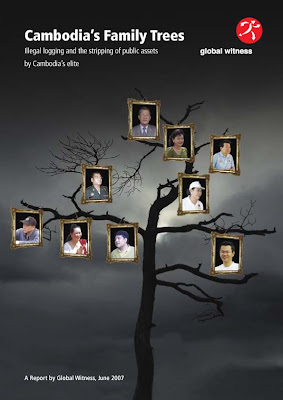
‘’If implemented, the proposed U.S. ban would (prohibit) senior Cambodian ministers, top-ranking generals and others’’ from entering the US, states Global Witness, the London-based environmental lobby, which produced the report, ‘Cambodia’s Family Trees -- Illegal logging and the stripping of public assets by Cambodia’s elite’. ‘’It also wants other western and Asian countries to impose similar restrictions.’’

The Senate is acting on the 2006 Kleptocracy Initiative that was launched by Bush to combat high-level corruption, says Simon Taylor, a director at Global Witness. ‘’The initiative aims to shut out high-level corrupt officials from the global financial system, deny them a safe haven and recover and return proceeds of their crimes.’’

‘’Our report presents strong evidence that corruption and nepotism by high-ranking officials in the Cambodian government has facilitated extensive illegal logging in Cambodia; and that their involvement has undermined the rule of law, democracy and sustainable development,’’ Taylor revealed in an e-mail interview. ‘’The activities of these officials fall within the remit of the Kleptocracy Initiative, and they can be denied safe haven in the United States.’’

On the eve of Zoellick’s visit to Cambodia, Global Witness urged the Bank’s new chief to use his days in Phnom Penh to ‘’set the tone for his presidency and lay the foundations for the Bank’s approach to kleptocratic governments.’’ That would be a shift from ‘’the Bank and most other international donors (having) so far made little effort to call the (Cambodian) government to account on the issue (of illegal logging).

‘’(The) inaction by the donor community is symptomatic of its long-standing failure to ensure that aid strengthens governance,’ says Taylor. ‘’The donor-Cambodian government relationship has descended into a farcical exchange of money for empty promises, which confers legitimacy on those same officials who are looting the country.’’

It is a view echoed by Transparency International. In its 2006 corruption survey for the Asia-Pacific region, the Berlin-based global anti-graft watchdog described Cambodia as being among those with ‘’the highest perception of corruption.’’ The country stands out for ‘’the lack of political will to strengthen anti-corruption institutions,’’ consequently perpetuating ‘’rampant corruption’’ and ‘’undermining improvements in quality of life for the poorest citizens.’’

That year, the non-governmental Transparency ranked Cambodia 151 among 163 countries surveyed for corruption, where the country that topped the list was the least corrupt.

The Global Witness report, released in early June, revealed that the dominant logging syndicates in Cambodia were ‘’controlled by individuals related to Prime Minister Hun Sen, Minister for Agriculture Forestry and Fisheries Chan Sarun and Director General of the Forest Administration Ty Sokhun.’’

The annual timber haul from illegal logging was estimated to be over 13 million US dollars, the report, ‘Cambodia’s Family Tree,’ noted. Consequently, 30 percent of the country’s forest cover has been wiped off over a five-year period, it added. ‘’Illegal logging in Cambodia not only fills the pockets of the political elite; it also funds the activities of a 6,000-strong private army controlled by Hun Sen.’’

Over 35 percent of Cambodia’s 13.3 million people live in poverty, on less than one dollar a day. The World Bank is among a group of aid donors who help the country, pumping in financial assistance that accounts for close to half of the country’s national budget. In June, the donors pledges 689 million dollars.

It was only last year that the Bank responded to corruption, freezing 7.6 million dollars for three projects it was funding, including a water supply and sanitation scheme.

But that was a departure from the norm since the Bank stepped in to shape Cambodia’s development agenda following a peace accord in the early 1990s, bringing to an end decades a bloody conflict. ‘’The World Bank cannot afford to crack the whip on corruption in Cambodia, because it has too much to lose,’’ says Shalmali Guttal, a senior researcher at Focus on the Global South, a Bangkok-based regional think tank.

‘’Corruption is deeply entrenched in Cambodia and so is it within the development system and the aid industry,’’ she told IPS. ‘’The World Bank has been in charge of this development model. It has held it up as a post-conflict reconstruction country.’’

World Bank To Assist Vietnam Become A Middle Income Country By 2010 [but it remains silent in Cambodia's case]

August 6, 2007
Windsor Genova

Hanoi, Vietnam (AHN) - The World Bank said on Monday it will put in place an assistance package to help Vietnam achieve its goal of becoming a middle income country by 2010.

"We will try to help the government achieve that goal," World Bank President Robert Zoellick told the Vietnam News Agency (VNA) during his two-day visit to the Southeast Asian country on Monday.

"The way to do that is to help all of Vietnam grow. The rural areas, so farmers can add more to the production of the country, some of the financial sector, energy sector, infrastructure," Zoellick was quoted as saying by VNA.

Vietnam is targeting a $2,000 annual per capita income by 2010.

Vietnam Prime Minister Nguyen Tan Dung told the visiting World Bank president that his country is thankful for the development assistance provided by the bank to fight poverty.

However he added that even though Vietnam has halved poverty in a decade, the country remains poor with an annual income per capita of just $720.

The prime minister told Zoellick that there are still a lot of challenges facing Vietnam. Zoellick said he was "very impressed" with what he had seen on his tour and congratulated Vietnam on its poverty reduction program.

World Bank Chief: Corruption Costing Cambodia [-More sweet and empty promises from Hun Sen]

Mean Veasna, VOA Khmer
Original report from Phnom Penh
06 August 2007


The new president of the World Bank ended a visit to Cambodia this week identifying corruption as a top problem as the country's economy scrambles forward.

Robert Zoellick, whose brief stay in Cambodia was part of an Asia-Pacific tour, his first in his new position, said corruption cost the country hundreds of millions of dollars each year.

"I talked briefly with Prime Minister Hun Sen on strengthening governance, building institutional infrastructure so resources are used well and [so] the huge annual international support of $690 million can be maintained, and countering the challenges of corruption that cost Cambodia between $300 million and $500 million per year," Zoellick said after his meetings.

Eang Sophaleth, a spokesman for Prime Minister Hun Sen, said the prime minister had assured the World Bank chief his government was committed to reforms under the Bank's recommendations.

Zoellick also said Hun Sen had stressed the government's commitment to curbing illegal logging, a longstanding issue between Cambodia and donors, including the World Bank.

Critics charge that illegal logging is perpetrated by a Cambodian elite who have ties themselves to the prime minister.

Cambodia unduly suffers thanks to corruption and the lack of law, said Seng Theary, executive director of the Center for Social Development.

"We need to have laws that govern all standards, high standards," she said.

Monday, August 06, 2007

Political Cartoon: A lesson from World Bank

Cartoon by Sacrava (on the web at http://sacrava.blogspot.com)

Cambodia's narrow economic focus [: World Bank Robert Zoellick]

06-Aug-07
AFP
PHNOM PENH


CAMBODIA'S economy is too narrowly focused on its garment sector, World Bank chief Robert Zoellick said yesterday, suggesting it needs to build on its successes to draw investors to other industries.

"Cambodia has a particular opportunity and need to develop a global brand," Zoellick said at the end of a two-day visit to the country, which has carved out a lucrative niche by selling itself to buyers as a labour-friendly textile producer.

"It's been able to stay in the game and grow, in part because for some buyers there is special value to the social responsibility that it's included in that industry," he said.

Cambodia's garment sector continues to expand, employing some 330,000 people in more than 200 factories and accounting for 80 per cent of the country's export earnings.

But Zoellick said that this is "too narrow a base on which to develop" and that to attract other businesses, it was essential for Cambodia to create the right investment climate.

"Cambodia is a small country. It needs to be distinctive to get on the map and I believe it can be distinctive by emphasising its heritage, better labour practices, better transparency, fighting corruption," he added. "This is all important if Cambodia is going to draw foreign investment and create jobs."

Economic growth has been projected at nine per cent this year by the International Monetary Fund.

While it continues to expand at a healthy rate, the economy has shrunk from a growth high of 13.5 per cent two years ago and relies almost solely on garments and tourism to drive it.

Zoellick, who during his visit met Prime Minister Hun Sen and held lengthy discussions with other top officials, was making his first visit to the region after taking over the World Bank last month.

His talks here were focused largely on the bank's continued role in Cambodia, a relationship that has not always been easy.

The government is still paying back millions of dollars that were found to have been stolen from three bank-supported projects last year, forcing their temporary suspension.

"As we tried to make clear from the recent past, we can't be in a position where the money that we are ... devoting to Cambodia gets stolen," he said.

Cambodia, which also fell foul of the World Bank in 2003, when graft was uncovered in a project to demobilise soldiers, remains one of the world's poorest countries and last year was ranked 151 out of 163 in Transparency International's Corruption Perceptions Index.

Zoellick said the government acknowledged its problems with corruption, saying "governance and corruption issues are at the front and centre of people's agendas."

WB president: Land titling is key to overcome poverty in Cambodia

2007-08-05

PHNOM PENH, Aug. 5 (Xinhua) -- World Bank (WB) President Robert Zoellick said here on Sunday the land titling progress is at the heart of a strategy to overcome poverty in Cambodia and spread the benefits of a growing economy.

The land titling progress enables poor Cambodians to own a stake in both their own future and that of their country, Zoellick said at a press conference, adding that having property rights would also enable people to invest in their farms, small business and household to improve their finance security and their lives.

With support from the WB-financed land management and administration project, the Cambodian government is issuing more than 20,000 titles a month, mostly in rural areas, with 80 percent of the titles registered jointly by wife and husband or female-headed households, he said.

However, many poor people remain landless in Cambodia, Zoellick said, adding that some powerful people are seeking to dominate large tract. He said that Cambodia still faces a huge task of reclaiming productive land and clearing millions of landmines laid during decades of conflicts.

Zoellick presided over a ceremony to hand over land titles to nearly 800 owners in Cambodia after arriving in this country on Saturday.

During the two-day visit, Zoellick met on Sunday with Prime Minister Hun Sen, a number of high-ranking officials, representatives of the private sector and civil society, and locals who have benefited from WB projects, according to a government press release.

Sunday, August 05, 2007

World Bank head urges Cambodia to tackle corruption

Sunday, August 5, 2007
The Associated Press

PHNOM PENH, Cambodia: World Bank President Robert Zoellick said Sunday Cambodia needs to make a greater effort to tackle rampant corruption if it wants the continued support of international donors.

"As many of you know, Cambodia draws about US$690 million (€504 million) of assistance a year from international donors, which is no small sum in a world of competitive aid," Zoellick said at a press conference ending his visit to Cambodia Sunday.

"And to be able to continue and strengthen that support, it will need to build a positive record and counter the challenge of corruption," he said.

Cambodia has been blessed by a double-digit economic growth for the past three years but it remains plagued by chronic corruption.

It was ranked 151 among 163 countries in Transparency International's 2006 "corruption perceptions index," where the number one country is the least corrupt. Transparency International is an international non-governmental agency.

Some 35 percent of its 14 million people live with less than 50 US cents (36 euro cents) a day.

The World Bank is among donors who in June pledged US$689 million (€502 million) in aid for Cambodia, where recent discovery of offshore oil has raised both hope for the country's future and fear that it could make corruption even worse.

Fraud and corruption in the procurement process forced the World Bank in June 2006 to freeze US$7.6 million (€5.5 million) in funding for several projects in Cambodia.

Prime Minister Hun Sen angrily denied the allegations and said there was no proof of wrongdoing.

Early this year, the bank lifted the suspensions on the projects after it had reached agreement with the government on frameworks for improving the project's implementation.

Zoellick said combating corruption also comes down to an issue of "fairness to the Cambodian people."

"For people who've suffered enormously, they need the share and the benefit of the growth and development," he said.

A government spokesman could not be immediately reached for comment.

Zoellick said he met with Hun Sen and other government officials behind the push of economic development.

He said he discussed with them recent economic achievements of the country and the challenges it is still facing in trying to move "to the next level of development."

He said revenue from recently discovered oil will be a fresh opportunity for Cambodia to advance its development and provide the basis for spreading rural electrification and eradicating poverty.

"This will also be a key question for Cambodia with natural resource development. Will it apply high standard whether it be the energy sector or the forestry sector?" he asked.

World Bank Chief Urges Cambodia to Fight Graft

World Bank President Robert Zoellick gestures as he speaks during a news conference in Phnom Penh August 5, 2007. Zoellick is on a two-day visit to Cambodia. REUTERS/Chor Sokunthea

Robert Zoellick urged Cambodia to fight graft, better manage its resources and improve education and healthcare.

August 05, 2007
Reuters

World Bank President Robert Zoellick urged impoverished Cambodia on Sunday to fight graft, better manage its resources and improve education and healthcare.

Cambodia received $690 million in foreign donor aid in June and "to continue and strengthen support, it will need to build a positive record and counter the challenges of corruption", he told reporters at the end of a 2-day visit.

Zoellick, on his first official visit to Asia as World Bank chief, toured development projects and met senior Cambodian officials, including Prime Minister Hun Sen.

They discussed the impact of illegal logging, which the British environmental group Global Witness says involves elite families, including Hun Sen's relatives, a charge denied by the prime minister.

"The prime minister actually emphasised himself the need to stop the logging operations because it had become too significant a source of corruption," Zoellick said.

Hun Sen, a former Khmer Rouge soldier who has been in charge for more than two decades, has previously acknowledged the concerns about rampant graft in a country rated by Transparency International as one of the most corrupt in the world.

Last year the World Bank suspended three development projects in Cambodia plagued by corruption and demanded misused funds be repaid.

After years of civil war and political unrest, Cambodia's economy has finally started to take off, although Hun Sen's critics say the stability he has brought has been at the expense of human rights and probity.

Zoellick said the bank would work with Cambodia to speed up passage of an anti-corruption law, which has been delayed by a decade.

"I urge Cambodia to help me help them. It is not only to pass the law but implement it," he said.

Zoellick said he was impressed by Cambodia's economic performance and its double-digit growth in recent years, but it needed to reduce its heavy reliance on garment exports.

Garment exports accounted for about $2.5 billion of Cambodia's total exports of $3.7 billion in 2006.

Cambodia's economy grew 10.8 percent last year and it is expected to expand 9.1 percent in 2007.

"To draw other businesses, it is important to create the climate for investment such as improving the legal system and judiciary," he said.

World Bank chief says Cambodia needs broader-based economy

08.05.07
"Governance and corruption issues are at the front and center of people's agendas .... To be able to continue and strengthen that support it will need to build a positive record and counter the challenge of corruption" - Robert Zoellick
PHNOM PENH (Thomson Financial) - Cambodia's economy is too narrowly focussed on its garment sector, World Bank chief Robert Zoellick said Sunday, suggesting it needs to build on its successes to draw investors to other industries.

'Cambodia has a particular opportunity and need to develop a global brand,' Zoellick said at the end of a two-day visit to the country, which has carved out a lucrative niche by selling itself to buyers as a labor-friendly textile producer.

'It's been able to stay in the game and grow, in part because for some buyers there is special value to the social responsibility that it's included in that industry,' he said.

Cambodia's garment sector continues to expand, employing some 330,000 people in more than 200 factories and accounting for 80 percent of the country's export earnings.

But Zoellick said that this is 'too narrow a base on which to develop' and that to attract other businesses, it was essential for Cambodia to create the right investment climate.

'Cambodia is a small country. It needs to be distinctive to get on the map and I believe it can be distinctive by emphasising its heritage, better labor practices, better transparency, fighting corruption,' he said.

'This is all important if Cambodia is going to draw foreign investment and create jobs.'

Economic growth has been projected at 9.0 percent this year by the International Monetary Fund.

While it continues to expand at a healthy rate, the economy has shrunk from a growth high of 13.5 percent two years ago and relies almost solely on garments and tourism to drive it.

During his visit Zoellick met Prime Minister Hun Sen and held lengthy discussions with other top officials.

His talks here were focussed largely on the bank's continued role in Cambodia, a relationship that has not always been easy.

The government is still paying back millions of dollars that were found to have been stolen from three bank-supported projects last year, forcing their temporary suspension.

'As we tried to make clear from the recent past, we can't be in a position where the money that we are ... devoting to Cambodia gets stolen,' he said.

Cambodia, which also fell foul of the World Bank in 2003, when graft was uncovered in a project to demobilize soldiers, remains one of the world's poorest countries, and last year was ranked 151 out of 163 in Transparency International's corruption perceptions Index.

Zoellick said the government acknowledged its problems with corruption.

'Governance and corruption issues are at the front and center of people's agendas,' Zoellick said.

'Cambodia draws about 690 million dollars a year from international donors, which is no small sum in the world of competitive aid,' he said.

'To be able to continue and strengthen that support it will need to build a positive record and counter the challenge of corruption,' he said.

'This is not just a question of pleasing the external world. It's a question of being fair to the Cambodian people ... and that means making sure that, whether it be foreign aid or government revenue, [money] is spent appropriately.'

Cambodia Facing Key Choices to Build Domestic Opportunity, Manage International Challenges: World Bank President

World Bank

PHNOM PENH, August 5, 2007 — “Cambodia is at a pivotal moment in its recent history, facing key choices as it marks its first decade of peace and stability after many years of shattering conflict and suffering,” according to Mr. Robert B. Zoellick, President of the World Bank Group, at the end of a two-day visit – his first to a developing country since becoming President in July. Mr. Zoellick’s involvement with the country goes back to working on the 1991 Paris Peace Accords, under which the United Nations was authorized to oversee a ceasefire and prepare for elections, and assisting Cambodia’s accession to the World Trade Organization in 2004.

Mr. Zoellick said today that “Cambodia has the opportunity to build on its recent strong economic performance to broaden and deepen the foundation for sustainable economic growth. The World Bank wants to assist the Government to enact reforms to reduce rural poverty, encourage social development, improve the business and investment climate, and strengthen the rule of law. These next, essential steps would help the Government earn the respect of entrepreneurs and investors and, more importantly, the appreciation of Cambodians, who have suffered much and seek the full benefits of peace, growth and opportunity.”

Mr. Zoellick spoke with a cross-section of people to learn first-hand about the challenges and opportunities facing the country. He met senior government officials, including Prime Minister Hun Sen, Minister of Economy and Finance Keat Chhon, Minister of Education Kol Pheng, Minister of Land Management, Urban Planning and Construction Im Chun Lim, and Minister of Women’s Affairs Dr. Ing Kantha Phavi. Mr. Zoellick also met with garment workers, a small manufacturer, a community that received new titles to land, a fast-expanding local bank, members of the private sector, members of the donor community, and a leader of the civil society forum.

Impact of Microfinance

In the past decade, microfinance has transformed Cambodia’s young and undeveloped finance sector and, in the process, provided important financial services to small businesses, reaching almost a fifth of all Cambodian households. Mr. Zoellick visited a small business client of one such institution, ACLEDA Bank, whose borrowers include artisans, service providers, shopkeepers and market traders. The private sector arm of the Bank Group, the International Finance Corporation, has supported ACLEDA since 1999, and seen it grow into the country’s second-largest bank, reaching 181,000 people through 166 branches in all 24 provinces. Mr. Zoellick said that “the success of the microfinance industry in Cambodia is remarkable given the challenging business environment and the difficulty of reaching rural and remote areas. I am delighted that the Bank Group has been able to help ACLEDA grow from an NGO to a licensed financial institution that now provides working capital to small business owners, more that two-thirds of them women. We hope to help ACLEDA expand its successful service to other areas, too.”

Garment Sector, and Beyond

Mr. Zoellick visited a garment factory, and met with private sector representatives. The garment sector is Cambodia’s largest industry, worth $2.5 billion in 2006, and accounting for 80 percent of exports. Mr. Zoellick’s association with the garment sector goes back to 2001 when, as United States Trade Representative, he extended a program of support to Cambodian manufacturers which provided incentives for compliance with labor standards established by the International Labor Organization (ILO). Cambodia’s garment sector has grown steadily, even after the end of the Multi-Fiber Arrangement in 2005 which had afforded some protection from bigger producers. Mr. Zoellick said it was heartening to see the strength of the sector, and that its success contained lessons about the important role of adhering to internationally acceptable standards in building confidence with foreign buyers and investors. “These lessons apply more broadly,” he said. “They can be put into action so that not only the garment sector thrives, but other sectors do as well, and Cambodia can develop an international brand for socially responsible production, resource development and tourism. That reputation would help Cambodia to sustain high growth and overcome poverty in the face of tough global competition.”

Land Titling

Another highlight of the visit was a ceremony for land titling certificates, where Mr. Zoellick assisted in handing out new land titles to the people of Prey Speu village, outside Phnom Penh. With support from the World Bank-financed Land Management and Administration Project, the Government is issuing more than 20,000 titles a month, mostly in rural areas, with 80 percent of the titles registered jointly by wife and husband or by female-headed households. “The land titling progress enables poorer Cambodians to own a stake in both their own future and that of their country. Yet too many poor people remain landless. Some of the powerful are seeking to dominate large tracts.” he said. “We want to work to accelerate this titling of land and to ensure that efforts are being made to reach the poorest and those most likely to be dispossessed of their lands, such as ethnic minorities. Also that Cambodia still faces a huge task of reclaiming productive land and clearing the millions of mines laid during the decades of conflict – mines which still kill and maim today.” He said that having property rights would also enable people to invest in their farms, small businesses, and houses, to improve their financial security and their lives. “Land titling is at the heart of a strategy to overcome poverty and spread the benefits of a growing economy,” he said.

Aid Coordination

Tackling another key issue – aid harmonization and effectiveness – Mr. Zoellick met with a number of donors to discuss how to build on the Government’s efforts to increase the effectiveness of the nearly $690 million the country receives in aid each year. Mr. Zoellick noted the leadership role played by H.E. Keat Chhon, Minister of Economy and Finance, in harmonizing aid, with donors increasingly cooperating and aligning their programs with the Government’s priorities. As in other areas, Minister Keat Chhon is trying to build a better foundation for the future. Partnership, better alignment, and strengthened country systems would help to ensure that aid reaches the people it is intended to help. “I am pleased the development partners have come a long way in the last few years and have worked hard to coordinate their policy messages. But on the program delivery side, unfortunately, there is still too much fragmentation and waste, and more needs to be done to deliver aid through common programs rather than seeing it dissipated through small, unconnected projects. The World Bank is committed to providing support through sector-wide programs led by the Government and delivered through the Government’s own systems. We are also committed to doing all we can to ensure the money we provide is used only for the intended purposes.”

Public Finances

Mr. Zoellick attended a lunch hosted by members of the Supreme National Economic Council (SNEC), a group of economic policy advisers to the Prime Minister. Mr. Zoellick noted Cambodia’s strong growth and reduction of poverty over the past decade, and its improved approach to managing public finances. “We want to work with the Government to do more in this area. Better management of government revenues and spending makes it more likely the people will receive better public services. Central to this will be redoubling efforts to improve governance, fight corruption, and improve the quality of the legal system.”

Future Choices, Major Challenges

Mr. Zoellick also met with Prime Minister Hun Sen and discussed their common interest in a high quality relationship between the Bank and Cambodia, to better serve the Cambodian people. Speaking after the meeting, Mr. Zoellick said “The World Bank has worked with Cambodia since the early 1990s, and together we have come a long way. Cambodia has done well economically, with double-digit growth for the past three years, a sharp increase in tourism and reductions in overall poverty levels. Now Cambodia faces the challenge of moving to the next level of development. We wish to help it achieve the Millennium Development Goals, address rural poverty and keep students in schools. Cambodia would benefit by improving the ease of doing business. The World Bank can also help manage natural resources – especially forests and energy -- in a way that supports sustainable development. It is definitely possible to make progress in all these areas, and donors, civil society, business and government need to press one another to achieve greater effectiveness and accountability so that the poor of Cambodia enjoy the benefits and build hope.”

Oil and Gas Revenue

In his meetings, Mr. Zoellick underscored the vital need to improve governance and overcome corruption, especially following the recent discovery of oil and gas. “The revenue from oil and gas could provide the basis for spreading rural electrification and eradicating poverty in Cambodia. In too many countries, resource income has fueled corruption and been squandered, often making the country worse off and its people more destitute. We discussed ways the Government could manage these and other natural resources transparently – for example, by adhering to the Extractive Industries Transparency Initiative --for the common good of all Cambodians. The Bank Group wants to assist and help reduce the costs of compliance.”

-####-

For more information on Mr. Zoellick's visit, see:
http://www.worldbank.org/zoellick

Zoellick arrives for talks expected to focus on corruption and graft scandals

Zoellick arrives for talks in Cambodia

Sunday, 5 August, 2007
AFP
“This visit is an opportunity for Robert Zoellick to set the tone for his presidency and lay the foundations for the Bank’s approach to kleptocratic governments everywhere” - Global Witness
PHNOM PENH: World Bank president Robert Zoellick arrived in Cambodia yesterday for talks expected to focus on corruption in the impoverished kingdom and bank-supported projects hit by graft scandals.

Zoellick, who took office in July, is to meet with Cambodian Prime Minister Hun Sen today on his first visit to the kingdom. He is also supposed to travel to rural areas to see the bank’s development projects.

But his visit comes as Cambodia continues paying back millions of dollars siphoned off in a massive corruption scandal that forced the World Bank to suspend three key aid projects last year.

The projects have since been reinstated, but the bank has demanded Cambodia repay some $2.9mn after contractual irregularities involving agricultural and flood prevention funds were uncovered.

The issue sparked a row with the Hun Sen government, which initially refused to repay, saying the World Bank must provide more evidence of financial irregularities.

A major environmental group, which published a damning report in June accusing Cambodia’s political elite of illegally plundering the country’s forests, on Friday urged Zoellick to address corruption during his two-day visit.

“This visit is an opportunity for Robert Zoellick to set the tone for his presidency and lay the foundations for the Bank’s approach to kleptocratic governments everywhere,” Global Witness said in a statement.

Officials said Zoellick was also expected to visit the Khmer Rouge’s notorious Tuol Sleng prison, a former high school that was converted into a torture centre during the 1975-79 communist regime.

Cambodia, which is plagued by corruption at almost every level of government, also fell foul of the World Bank in 2003, when graft was uncovered in a project to demobilise some 30,000 soldiers.

Saturday, August 04, 2007

New World Bank chief in Cambodia

2007/08/04
By Guy De Launey
BBC News, Phnom Penh


The new president of the World Bank, Robert Zoellick, has arrived in Cambodia, part of his first official visit since replacing Paul Wolfowitz.

Mr Zoellick has praised the rapid economic development of Cambodia and its neighbour Vietnam.

But pressure groups have called on him to use the Bank's influence to reduce corruption and push forward reforms.

The World Bank has had to suspend some of its operations in Cambodia, after allegations of corruption.

Mr Zoellick arrived in Cambodia fresh from meeting Asia-Pacific finance ministers in Australia.

He endorsed calls for more intensive efforts to help poor countries and said the Bank would play a leading role in cutting poverty in half by 2015.

Corruption allegations

Cambodia is a prime candidate for assistance. Four fifths of its people are without access to electricity or running water and more than a third live below the "basic needs" poverty line.

But World Bank operations in the country have not always run smoothly. Last year, the Bank suspended three projects after the discovery of large-scale corruption.

The Cambodian government had to repay millions of dollars. Pressure groups have called on Mr Zoellick to do more than his predecessors in reducing corruption and pressing for reform.

The forestry monitor Global Witness said he should "lay the foundations for the Bank's approach to [corrupt] governments everywhere".

During his visit, Mr Zoellick will meet prime minister Hun Sen and various civil society groups.

He has praised Cambodia's "vibrant economy", but has acknowledged the country faces challenges in building institutions and improving governance.

Mr. Zoellick, the World Bank should push the Hun Sen's regime to fight corruption and deforestation!

World Bank President Robert Zoellick (L) walks with Senior Minister and Minister of Economy and Finance, Keat Chhon, upon his arrival at Phnom Penh international airport on August 4, 2007. Zoellick is on a two-day visit to Cambodia. REUTERS/Chor Sokunthea

World Bank President Robert Zoellick (L) walks with Senior Minister and Minister of Economy and Finance, Keat Chhon (C), and Nisha Agrawal, Country Manager for Cambodia Phnom Penh, upon his arrival at Phnom Penh international airport on August 4, 2007. Zoellick is on a two-day visit to Cambodia. REUTERS/Chor Sokunthea