Showing posts with label Sean Visoth. Show all posts

Friday, April 03, 2009

The court on trial [-Cash allegedly collected for Sok An]

Sok An (L) and Sean Visoth (R)

The Khmers Rouges and justice

Apr 2nd 2009 | PHNOM PENH
The Economist


Accusations of corruption threaten to discredit the trial of the Khmers Rouges

THE tribunal to try former Khmers Rouges began its real proceedings this week. The first in the dock is Kaing Guek Eav, alias Duch, who ran the former regime’s notorious S-21 torture prison and who is charged with crimes against humanity, torture and murder. In court, he admitted responsibility, expressing “heartfelt sorrow”. But the long-overdue hearing is being overshadowed by accusations of a lesser sort: corruption and political interference. These threaten to discredit proceedings on the far greater crimes.

Three of the court’s staff, who spoke on condition of anonymity, accuse Sean Visoth, the court’s chief of administration, of collecting money from every Cambodian in his department, including court employees and Cambodian legal assistants in the office of the co-investigating judges and co-prosecutors (the court has dual officials because it is was set up under Cambodian and United Nations auspices and is run under national and UN rules). Some of the cash, they were told, was intended for Sok An, a deputy prime minister.

There is no indication that the minister took the money and neither man has commented on the accusations, which are unproven. But in November Sean Visoth went on sick leave because, according to the government’s spokesman Khieu Kanharith, a UN corruption review had named him and requested his removal. “Sick leave is a political excuse,” he says.

These accusations are only the latest in a series to have plagued the court. The UN says that last year it received complaints from several Cambodians about kickbacks. This action brought the UN and Cambodian sides into conflict and, according to one staffer at the court, resulted in several people being fired by the government in murky circumstances.

The court’s rules oblige Cambodians to report complaints to their own government. So when the Cambodian whistle-blowers took their complaints to the UN, it organised a confidential review of the allegations and recommended that the Cambodian side should investigate them. The Cambodian side responded by saying that the review was outside the UN’s jurisdiction and therefore invalid. Last August Sok An appointed two officials to hear the complaints and in December he met officials of the UN Office of Legal Affairs to draw up an anti-corruption plan. But the whistle-blowers are not reassured. “If the UN does an investigation, I will come out,” says one. “But if the government does an investigation, I will not...I would not feel safe for myself and my family.”

Lawyers for the defence are demanding a full investigation. On March 27th the defence team for Nuon Chea, another of the accused, backed by two other defence teams, asked to see the confidential UN review. “At some point,” says Richard Rogers, the co-ordinator for the defence lawyers, the UN “is going to have to choose between either looking like it’s complicit in a cover-up or hand over the documents to the defence teams so they can help ensure international standards.”

There are also allegations of political interference, not just corruption. The international prosecutor, Robert Petit, says he has enough evidence to charge more suspects than the five in detention. Yash Ghai, a former special representative of the UN secretary general to Cambodia, adds that if prosecutors have enough evidence to prosecute “they have a duty to do so.” But the Cambodian prosecutor disagrees. Pursuing more suspects would cause instability and exhaust funding, she argues.

Such disputes may be inevitable in a process that is designed to please both Cambodia, which is concerned about maintaining political support for the trial, and the UN, which must keep up international legal standards. “It’s very easy to be a pure international judge in a pure international tribunal very far away from Cambodia, far away from this corrupt atmosphere,” says Marcel Lemonde, the court’s international co-investigating judge and a framer of its internal rules. “But if we have the court operating in Cambodia, applying Cambodian law, with participation of Cambodian judges, and the possibilities for victims and witnesses to attend the hearings and participate, then it becomes interesting.”

The rumble of allegations makes it increasingly difficult for the court to satisfy both sides. The UN Development Programme, which manages a trust fund of donations to the court, has refused to pay the Cambodian side, pending the result of the corruption investigation. Other donors are likely to continue their support—unless the UN itself pulls out or the international judges rule to stay proceedings.

Even then, says the Cambodian government, the trial would go ahead. “Why don’t all the lawyers pull out?” asks its spokesman. “If you say that the court is corrupt, get out. At least we can save some money.” But not, if that were to happen, the tribunal’s judicial reputation.

Tribunal Administrator Answers Allegations

Sean Visoth, the chief administrator of ECCC, is now on medical leave. (Photo: AP)

By Sok Khemara, VOA Khmer
Original report from Phnom Penh
02 April 2009


With corruption allegations continuing to hound the Khmer Rouge tribunal and with the Cambodian side of the courts continually cash-strapped, the chief administrator said in a rare interview Wednesday the allegations leveled against his office were products of ulterior motives, politics, and even “destructors.”

The man at the center of the court’s corruption woes is Sean Visoth, the director of administration for the tribunal. He has not been to work in four months, even though the tribunal has begun its first trial, of prison chief Duch. He spoke to VOA Khmer by phone from Phnom Penh.

“I can say that this is a power struggle,” he said of allegations his office had mismanaged the tribunal and that Cambodian staff have been forced to pay kickbacks in order to work at the tribunal. “Who controls this court? This issue is what is causing this problem. All these elements are politically motivated.”

By way of explaining, he quoted a Cambodian proverb: “If you want to get a dog killed, say the dog is mad.”

Corruption allegations have followed the tribunal from the get-go, just after the court stood up in 2006. By February 2007, the Open Society Justice Initiative had issued a statement saying its monitors were hearing about kickbacks. And in 2008, several Cambodian whistleblowers reported to the UN they were forced to pay senior officials to keep their jobs. The UN investigated but has not made those findings public.

Sean Visoth said Wednesday he had been to the United Nations in New York twice at the end of 2008, “for discussions,” but he would not elaborate. He denied any allegations of corruption in his office, and said seven different auditing teams had been unable to find evidence to support the claims.

These investigations made a clean bill of health, he said, and the so-called whistleblowers were in fact disgruntled Cambodian staff members who had moved over to the UN side of the court. He declined to say whether he could take legal action against them for their allegations, but said instead the former staff members could “only cheat children” and were “tribunal destructors.”

Meanwhile, he said, the UN’s Office of Internal Oversight Service did no t have jurisdiction over his office, which is on the Cambodian side of the UN-backed tribunal.

Still, the allegations have been enough for some donors to freeze funding, and the Cambodian side of the court was only able to pay its staff for March with the help of an emergency $200,000 from Japan.

Sean Visoth said the Cambodian side has always had difficulties with funding, so it would make no difference whether he stepped down amid the allegations. He has been on medical leave since November 2008, but his doctors have not yet cleared him to return to work.

“Since the start-up, this court has not received a big budget package,” he said. The donors “drop [funds] just like they’ve hung up an IV, drop by drop, and wait and see.”

Even in these conditions, he said, the court was able to pass its internal rules more quickly than expected, arrested five suspects in just four months, and had a lower cost and wider public participation than other war crimes tribunals.

Tuesday, January 27, 2009

Investigation of Tribunal Officers Underway


By Kong Sothanarith, VOA Khmer
Original report from Phnom Penh
26 January 2009


Phnom Penh Municipal Court has begun investigating alleged corruption by administrators of the Khmer Rouge tribunal, officials confirmed Monday.

“We’ve started investigating,” deputy prosecutor Sok Kallyan said. “One person has been summoned for questioning. We will summon more persons soon.”

The investigation comes at the behest of tribunal defense lawyers for Nuon Chea, who filed a complaint earlier this month alleging Sean Visoth, the top administrator of the tribunal, and Keo Thyvuth, its former chief of personnel, had engaged in or abetted institutional corruption.

Sean Visoth, who has been on medical leave since November, declined to comment Monday and did not say when he would return to his duties.

Keo Thyvuth was removed from his position at the tribunal in August 2008 and is now on staff at the Council of Ministers.

The Khmer Rouge tribunal, which is preparing for its first trial of five jailed leaders of the regime, for prison chief Duch, has been plagued by reports from Cambodian employees and independent monitors who claim staff members paid kickbacks in order to work at the courts.

Saturday, January 10, 2009

Sacrava's Political Cartoon: Cambodian Workers' Agency

Cartoon by Sacrava (on the web at http://sacrava.blogspot.com)

Top Cambodian KRouge trial officials to be investigated for graft [-Will it be a real investigation or just a show-investigation?]

Sean Visoth, Director of the Khmer Rouge tribunal's Office of Aministration

Saturday, January 10, 2009

PHNOM PENH (AFP) — A Phnom Penh court will hear a corruption complaint against top officials at the UN-backed Khmer Rouge war crimes tribunal, a judge told AFP Friday.

Chief judge of Phnom Penh Municipal Court Chev Keng said he would accept the complaint against Sean Visoth, the top government official at the court, and Keo Thyvuth, its former chief of personnel, lodged Thursday by defence lawyers.

The lawyers allege the pair have received kickbacks from court workers, but on Friday the tribunal's Cambodian judges released a statement denying any involvement.

The judges added the complaint "was causing confusion and seriously affecting the honour and dignity of all individual judges and this (Khmer Rouge tribunal) institution as a whole."

Thursday's complaint was lodged by international lawyers for Khmer Rouge "Brother Number Two" Nuon Chea, one of five former leaders due to stand trial.

They said the failure to address corruption allegations undermined Nuon Chea's right to a fair trial on charges of war crimes and crimes against humanity.

Last year the UN launched an investigation into allegations that Cambodian workers had been forced to pay for their jobs, and withheld at least 300,000 dollars in July funding and court salaries.

The investigation's findings were never made public but Keo Thyvuth was later transferred from the court and Sean Visoth put on leave.

The tribunal opened in 2006 after nearly a decade of wrangling between the United Nations and Cambodia.

It is expected to hear its first case within the next few months, against former Khmer Rouge prison chief Duch, whose real name is Kaing Guek Eav.

Up to two million people were executed or died of starvation and overwork as the communist Khmer Rouge dismantled modern Cambodian society during its 1975-1979 rule in a bid to forge an agrarian utopia.

Friday, August 29, 2008

Tribunal Official To Resign if Graft Is Found [-Another all talk no action?]

By Sok Khemara, VOA Khmer
Original report from Washington
28 August 2008


The director of the Khmer Rouge tribunal's administration office has said he will resign if any corruption is found in his department, following allegations made by Cambodian staff in June, a spokesman said Wednesday.

The director, Sean Visoth, is dedicated to tackling the corruption issue, tribunal spokesman Reach Sambath said.

Allegations of kickbacks from the Cambodian side of the hybrid tribunal have led to a freeze in funding, as donors consider whether to continue, and the Cambodian side has established an investigation task force.

Long Panhavuth, a tribunal observer for the Open Society Justice Initiative, welcomed the determination of the administration chief but added that investigations into the allegations should ensure confidentiality.

Tuesday, June 24, 2008

Cambodia's "Killing Fields" court trims budget

PHNOM PENH, June 24 (Reuters) - Cambodia's Khmer Rouge tribunal has cut its proposed budget to $143 million instead of $170 million sought from donors, and brought its expected end date forward by a year to 2010, officials said on Tuesday.

The joint Cambodian-U.N. court set up to try Pol Pot's top surviving henchmen for the deaths of an estimated 1.7 million people under the Khmer Rouge had an initial budget of $56 million, and was expected to run for three years.

But after delays in getting it off the ground, followed by seemingly endless bail hearings, appeals and pre-trial machinations, it quickly became apparent the court would be broke before any of the ageing cadres faced justice.

Presenting the revised budget extension, Cambodia's top official to the court, Sean Visoth, said he was "quite optimistic" foreign donors would come up with the cash.

He also said the court's first full trial, that of Duch, the ultra-Maoist guerrilla movement's chief jailer and executioner, would start in September.

Five top Khmer Rouge officials have been charged with war crimes or crimes against humanity and placed under detention, including Duch and Pol Pot's right-hand man, Nuon Chea, also known as "Brother Number Two".

(Reporting by Ek Madra, Editing by Ed Cropley and Sanjeev Miglani)

Tuesday, May 13, 2008

Tribunal Seeks Budget for Five Trials Soon

By Mean Veasna, VOA Khmer
Original report from Phnom Penh
12 May 2008


Khmer Rouge tribunal administration chief Sean Visoth said Monday a revised budget must bring five leaders to trial soon.

“The budget presently under review should be as definite as possible,” he said in a speech addressing donors last week and posted on the tribunal Web site Monday.

The budget should also project the time requirements in dealing with the trials of the five leaders in custody: Kaing Khek Iev, Nuon Chea, Khieu Samphan, Ieng Sary and Ieng Thirith.

Tribunal officials have asked for as much as $114 million in additional funds over the $56 million originally proposed. Donors need a smaller sum.

“We are still in the final stages of developing a precise budget because the budget presumed in early January was not welcome by jurists, because it was too big and it went for too long period,” tribunal spokeswoman Helen Jarvis said. “So now we are seeing how it can be cut back.”

Youk Chhang, director of the Documentation Center of Cambodia, said he agreed that the five leaders must be tried soon, but he said the use of the first $56 million was still unclear.

The tribunal “must use this money to try the first case, to show the donors,” he said.

Friday, April 25, 2008

Cambodian Genocide Tribunal Denies Financial Mismanagement

04-25-08

PHNOM PENH (AFP)--UN officials Friday denied allegations of financial mismanagement at Cambodia's genocide tribunal after ordering a review of the cash-strapped court in an effort to restore the confidence of foreign donors.

International backers have appeared hesitant to pledge more money to the UN- backed court, which was set up to try former Khmer Rouge leaders, amid allegations of mismanagement and political interference.

"Through the various audits that have been conducted to date, there has never been any issue with regard to the management of the (tribunal's) financial resources," said Jo Scheuer, country director of the UN development program, which now oversees the financial management of the Cambodian side of the court.

"All of their financial transactions have passed audit scrutiny," said Scheuer, who is also a member of the tribunal's project board.

Last year, the New York-based Open Justice Society Initiative alleged that Cambodian tribunal staff, including judges, had bought their jobs.

Tribunal administrative director Sean Visoth said the allegations were " unspecific, unsourced and unsubstantiated."

"There is no government policy to take kickbacks from staff," he said, but added no one could guarantee a system was 100% corruption-free.

"With the results of the special review we are sharing with you today we can finally close this chapter and move on to continue the very positive achievement the (court) has made in discharging its historic mandate," Visoth said.

The officials made the comments during a press conference to release an independent special human resources management review of the tribunal.

The review stated "there were no recent allegations of mismanagement" in the tribunal and found staff on the Cambodian side were "robust and ready to take on the challenges of the next phase of operation." Scheuer said the review was important "to restore donors' confidence" and address all the allegations.

Originally budgeted at $56.3 million over three years, the tribunal, which opened in 2006 after nearly a decade of wrangling between the UN and Cambodia, has significantly raised its cost estimates to $170 million.

Up to two million people died of starvation and overwork, or were executed as the communist Khmer Rouge dismantled modern Cambodian society in a bid to forge an agrarian utopia during its 1975-1979 rule.

Five former regime leaders have been detained by the tribunal for their alleged role in one of the 20th century's worst atrocities.

Saturday, March 29, 2008

Tribunal Official Says Meeting in New York was “Fruitful” [-Jarvis: Money may last longer than April after all]

By Poch Reasey, VOA Khmer
Washington
28 March 2008


Speaking by telephone with VOA Khmer from New York, tribunal spokeswoman Helen Jarvis said the meeting at the United Nations headquarters in New York Thursday was “fruitful.”

Jarvis said because it was a “closed door meeting”, she could not go into the details. However, she said what she could say was that it was attended by 20 different countries, the legal council, the UN comptroller, and the Cambodian permanent representatives to the UN and the Cambodian delegation led by chief of the Office of Administration Sean Visoth.

“Mr. Visoth was able to give a briefing to the meeting on the recent developments at the ECCC, and forward planning and there was a very fruitful discussion,” said ECCC spokeswoman Helen Jarvis.

Jarvis said that she wanted to make it clear that Thursday’s meeting was not a pledging conference.

“It was a discussion of where we are and where we are going and giving them some information, in particular, also providing the summary of the result of the special review of all the human resources management improvements in the ECCC,” Jarvis said, referring to the tribunal by its official name, the Extraordinary Chambers in the Courts of Cambodia.

The hybrid, UN-backed tribunal was expected to last 3 years and cost $56.3 million. But now court officials say they need an additional $114 million and expect the trial to last until 2011.

There is a concern that the money to pay the Cambodia staff would run out at the end of April.

However, Jarvis said the latest figures show that the money will last longer than the end of April.

“We are confident because we have been making strong progress. We are not panicking at all,” said Jarvis. “We are confident that the court will continue to attract the support both morally and financial support and we will be able to keep going with this important work.”

Jarvis said she can not say when donor countries will pledge more money for the tribunal except to say that there are a lot of discussions going on about what ECCC is doing right now.

Sunday, March 23, 2008

ECCC officials to travel to New York; Ieng Thirith’s hearing delayed

23 March 2008
Koh Santepheap
Translated from Khmer by Socheata

Phnom Penh City – Three ECCC officials led by Sean Visoth, director of the ECCC office of administration, plan to leave for New York to discuss with donor countries on aid for the KR Tribunal. The ECCC delegation plans to leave Cambodia on 24 March. The departure of the delegation appears to be linked to the ECCC funding crisis. Meanwhile, Ieng Thirith’s lawyer asked to delay her hearing to 21 May instead. Reach Sambath, ECCC spokesman, declared that Sean Visoth plans to provide clarification (to the donor countries) about the past progress of the tribunal, as well as to provide progress to “Friends of the court.” Nevertheless, Reach Sambath declined to answer when he was asked whether the ECCC delegation will leave to New York to ask for more funding or not.

It has been claimed that the KR Tribunal will deplete its $56.3 million budget for 3-year spending in April, and recently, the plan is to extend the tribunal until 2011, whereas the required budget has increased to $170 million. The OSJI is involved with the auditing of the ECCC expense also.

Reach Sambath indicated: “We do not plan to ask for more budget, but we are going to report to friends of the court, which, in the past, was done once every two months in Phnom Penh city.”

Reach Sambath added that only the UN side can evaluate and ask for additional funding, Cambodia does not make any request up to now.

Reach Sambath added that, at the same time, Ieng Thirith’s lawyer sent in a petition to delay her bail appeal hearing to 21 May 2008 instead of the 21 March 2008 date set by the tribunal.

Saturday, March 15, 2008

ECCC optimistic funding crisis can be averted

Friday-Sunday, March 14-16, 2008
By Craig Guthrie
The Mekong Times


Looming fund shortages at the Khmer Rouge Tribunal have raised the twin spectres of Cambodian staff losing their jobs and the court’s judicial process facing further delay. The Mekong Times has interviewed the court’s Public Affairs Officer Helen Jarvis to gauge the seriousness of the crisis.

During a meeting held Mar 12, Extraordinary Chambers in the Courts of Cambodia (ECCC) Director of Administrative Sean Visoth told 200 Cambodian staff members that their jobs were in doubt as the court’s founds for the Cambodian side would dwindle to nothing by April. Nothing could be guaranteed in terms of salary after March, he said, putting pressure on international donors to pony up the sizeable funds that have been requested of them. The ECCC’s Public Affairs Officer Helen Jarvis explained the depth of crisis to The Mekong Times’ Craig Guthrie.

If the Cambodian side run out of funds, will the ECCC need to make Cambodian staff redundant?
We are not considering such an eventuality at this time. The historic importance of and necessity for the ECCC are well known; the achievements made by the court are also there for all to see. The donors are currently considering budget projections, and we are confident that funds will be forthcoming.

If the Cambodian side has no funds, will the UN side continue working alone? Would this disturb the judicial process?
Our director of Administration, His Excellency Sean Visoth, has often said “a bird can not fly with one wing.” The name of the ECCC is the Extraordinary Chambers in the Courts of Cambodia – it is impossible to imagine that it could function without Cambodian administrative and judicial officers and staff.

When will the tribunal receive final word on whether or not it will receive funding from donors? What is the latest news that the tribunal has on this matter - are you optimistic that the court will get the funds it needs?
We expect that the donors and potential donors convened in the Group of Interested States will meet in New York in the coming weeks to discuss the projected budget that they were given in January, together with our responses to a number of points of clarification that they have raised with us.

If the ECCC does not receive the funds it needs before April, will it postpone all activities or close? If necessary will the government step in and provide stopgap funds?
We do not think that anyone would be seriously contemplating postponing or ceasing the activities of the court. The Royal Government of Cambodia has provided US$1.5 million in cash ( earmarked for utilities), and in addition, it has contributed an estimated US$5.2 million in extra-budgetary support (including provision of the premises, general security in support of the activities of the court, costs of detention, visa and customs processing). This US$6.7 million amounts to some 15 percent of the total costs of the court and, as such, represents a significant and ongoing commitment. I refer you also to recent statements to this effect by the Prime Minister, by Deputy Prime Minister Sok An, and by the Government spokesperson, His Excellency Khieu Kanharith. We are optimistic for continuing support for the ECCC to carry out its mandate, and once again express our appreciation to those who have generously provided funds for the court to date. These include the Cambodian government and more than 30 other countries (ranging from US$21.6 million from Japan to US$ 1,000 from Armenia and US$ 500 from Namibia).

Monday, December 31, 2007

Corruption at the KRT: Just because there was no authorization for it that corruption did not take place

Sean Visoth (R) talking with UN Michelle Lee (Photo: VOA)

Sean Visoth denies ECCC corruption

Monday, December 31, 2007
Everyday.com.kh
Translated from Khmer by Socheata

Sean Visoth, the ECCC (KR Tribunal or KRT) director of office administration, rejected the accusation claiming that this tribunal takes a cut out of the employees working there, and that it selected incapable employees. Sean Visoth said, in a letter sent to the KRT employees, for the New Year, that there is no such corruption or such authorized threat to cut the employees salary in this tribunal. Sean Visoth stressed that he will take strong measures if he were to know that such actions take place. He said that the office of administration asked all employees to sign the KRT integrity rule, and there is no authorization to allow such corruption action to take place. At the beginning of this year, the KRT was criticized because newspapers accused the KRT of being corrupt. However, these accusations seem to die down after rejections of this information were issued.

Wednesday, February 21, 2007

Cambodia's Khmer Rouge tribunal administration divided over corruption allegations [-Sean Visoth shows his true calling?]

Who's who? Nicholas Michel (C), a representative of U.N. Secretary-General Kofi Annan , and Michelle Lee (R), deputy director of the administration office of the Khmer Rouge tribunal watch as Sean Visoth (L), Director of the Khmer Rouge tribunal kneels down and prays, during the swearing in ceremony inside the royal palace in Phnom Penh July 3, 2006. Top Buddhist priests swore in Cambodian and foreign judges on Monday for the trials of surviving Khmer Rouge leaders accused of responsibility for the deaths of 1.7 million people. REUTERS/Chor Sokunthea

Wednesday, February 21, 2007
The Associated Press

PHNOM PENH, Cambodia: Cambodian and foreign officials in the Khmer Rouge genocide tribunal were divided Wednesday over recent corruption allegations against the organization.

The Open Society Justice Initiative, a New York-based law group, alleged in a statement last week that Cambodian judges and other court personnel had kicked back some of their wages to Cambodian government officials in exchange for their positions on the court.

The OSJI has helped organize legal training for the tribunal's Cambodian staff in the past, according to the tribunal's Cambodian spokesman, Reach Sambath. The tribunal is being jointly run by Cambodian and U.N.-appointed staff.

Cambodian officials at the tribunal's administration office have strongly denied the OSJI's accusations.

Reach Sambath said Wednesday that Sean Visoth, the administration's Cambodian director, has decided to sever all dealings with the OSJI.

The spokesman said Sean Visoth has also sent a letter to OSJI Executive Director James A. Goldston accusing the group of being irresponsible in making the allegations.

"They released the statement without responsibility. Cooperation with an organization that shows such bad faith and bias is impossible," Reach Sambath said.

The tribunal was created by a 2003 agreement between Cambodia and the U.N. after years of difficult negotiations to bring those behind the genocidal Khmer Rouge regime to justice.

The radical policies of the now-defunct communist group, which held power in 1975-79, led to the deaths of about 1.7 million people from execution, overwork, disease and malnutrition.

Peter Foster, a U.N.-appointed tribunal spokesman, said Sean Visoth's decision was unilateral and does not keep the OSJI from having full access to the tribunal's premises and to other officials involved in the tribunal.

Foster said Michelle Lee, the U.N.-appointed deputy director of administration, has not issued any ban on OSJI.

"We still consider them a valuable partner in the process," he said.

If the OSJI's allegations turn out to have merit, "we believe they should be fully investigated," Foster said.

The corruption accusations could deal another blow to the already troubled tribunal, which is set to convene later this year after long delays.

However, there are concerns that further postponements could result from continuing disagreements between Cambodian and foreign judges on draft rules for the proceedings.

The tribunal has been set up to operate under Cambodia's judicial system, which is widely regarded as corrupt and susceptible to political influence.

Monday, February 19, 2007

Jarvis blames Sean Visoth's office for the banning of OSJI from ECCC admin office

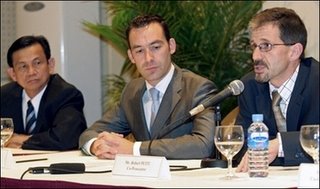
Sean Visoth (L) Director of the Khmer Rouge tribunal's Office of Aministration, Ruper Skilbeck (C) principal defender, and Robert Petit (R). (AFP/Tang Chhin Sothy)

Monday, February 19, 2007
ECCC Cools to NGO After Kickback Charge

By Erika Kinetz and Pin Sisovann
THE CAMBODIA DAILY

"You can't ban OSJI or anyone else from the building ... We still consider them valuable partners" - ECCC Peter Foster
Although staff from the Open Society Justice Initiative are no longer welcome at the administration office of the Extraordinary Chambers in the Courts of Cambodia, the rest of the court's facilities remain open to them, court officials said Sunday.

"The court is a public place," said Helen Jarvis, ECCC public affairs chief, in an interview.

Cabinet Minister Sok An announced Friday that the tribunal's administration office had informed him that it would no longer allow entry to OSJI, after the legal NGO called for a speedy and thorough investigation into allegations of corruption and kickbacks at the ECCC. Several ECCC officials have denied the allegations.

ECCC public affairs officer Peter Foster said Sunday that he would meet Tuesday with Heather Ryan, OSJI's trial monitor in Phnom Penh, as previously planned.

"You can't ban OSJI or anyone else from the building," he said. "We still consider them valuable partners."

Jarvis emphasized that restricting the NGO entry had come from the administration office and not from Sok An. The tribunals administration director Sean Visoth, she said, "does not wish to cooperate with them [OSJI] anymore due to the bad faith and bias on their part." On Sunday Sean Visoth declined to speak to a reporter and Ryan, who was traveling, could not be reached for comment.

Several Cambodian staffers at the court—including Co-Prosecutor Chea Leang and Trial Chamber Judge Nil Non—said Sunday they were not aware of the restriction placed on OSJI. Several added that in general, they advocate open lines of communication. Nil Non said that in his experience, "a judge needs all sides of information."