Showing posts with label Wildlife Preservation. Show all posts

Tuesday, July 17, 2012

Egg-Eating Snake Species Discovered in Cambodia

Cambodian kukri. Photo credit: Neang Thy/FFI.

The Cambodian kukri (Oligodon kampucheaensis) snake has curved rear teeth to hold and help swallow eggs.

July 16, 2012
ReptileChannel.com

A new species of egg-eating snake has been discovered in the Cardamom Mountains in south west Cambodia. The snake, named the Cambodian kukri (Oligodon kampucheaensis) was named after the country in which it was found. Neang Thy, a Cambodia Ministry of Environment officer who works with Fauna & Flora International (FFI) discovered the snake with Dr. Lee Grismer and Dr. Jenny Daltry.

“Cambodian science was smashed under the Pol Pot regime, and only now are we picking up the pieces. It gave me a great sense of pride to both discover and describe this species, and to name it in honor of my country,” Thy said in a statement released by FFI. “Most kukri snakes are dull-colored, but this one is dark red with black and white rings, making it a beautiful snake.”

The kukri snake is a rainforest species that eats eggs as its principle food source. It has rear curved teeth that apparently are similar in shape to a Nepalese knife known as the kukri, hence the name. According to FFI, the snake is under threat due to habitat loss and land conversion, and is the second reptile FFI has described in Cambodia in 2012.

Thursday, March 01, 2012

Cambodia to restrict fishing in Mekong River to save endangered dolphins

March 1, 2012

PHNOM PENH (Kyodo) -- Cambodia has decided in principle to regulate fishing in a large stretch of the Mekong River in order to conserve endangered dolphins, a government official said Wednesday.

Touch Seang Tana, chairman of Cambodia's Commission for Conservation and Development of the Mekong River Dolphin Ecotourism Zone, told reporters a new sub-decree on protection of the dolphins has just been finalized and is expected to soon be approved by the Cabinet meeting.

He said the sub-decree covers a 180-kilometer stretch of the Mekong River -- from the border with Laos through Cambodia's two northeastern provinces of Stung Treng and Kratie -- considered to be a key dolphin habitat in need of protection.

Monday, December 12, 2011

Species in Mekong region rich and at risk, WWF warns

The self-cloning lizard was found in a Vietnamese resturant. Picture: La Sierra University
Dec 12, 2011
DPA

Hanoi - The six-country Mekong River region is so biologically rich that an average of one new species is discovered there every other day, the World Wide Fund for Nature (WWF) said Monday.

A snub-nosed, Elvis-coiffed monkey; a self-cloning, all-female lizard and five carnivorous plants are among the 208 new species discovered by scientists last year, the WWF said.

The conservation group called the region along South-East Asia's longest waterway as 'one of the last frontiers for new species discoveries on our planet' while also warning of its fragility and calling on Cambodia, Laos, Myanmar, Thailand, Vietnam and China to protect their biodiversity.

Sunday, November 06, 2011

Wounded elephant walks again, thanks to jumbo-sized false foot


A baby elephant gets a new leg: Conservationists didn't think that Chhouk would survive after having a foot ripped apart by a trap in Cambodia, but thanks to a prosthetic limb, the pachyderm is thriving.
The elephant Chhouk lefts his prosthetic leg at the conservation camp in Cambodia. (Ian Williams/ NBC News)


November 04, 2011
By Ian Williams, NBC News Correspondent

PHNOM TAMAO, Cambodia – "I really thought he would never make it," said Nick Marx, stroking Chhouk's trunk with a sense of pride and affection.

"He was seriously injured. He was extremely young, emaciated and very, very sick."

Chhouk, a bull elephant now 5 years old, was found in the Cambodian jungle in 2007, alone and close to death, his left front foot mangled by a poacher's trap.

Marx, the Director of Wildlife Rescue and Care at the Wildlife Alliance, a conservation group, was one of the first to the scene, nursing Chhouk in the jungle for a week.

"I stayed with him, slept beside him, hand-fed him everything he ate.”

Wednesday, September 21, 2011

Rare tiger prey at risk from land concessions

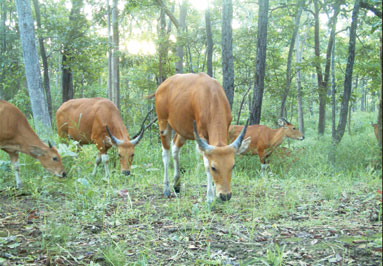
A herd of banteng, an endangered species of wild cattle, in Mondulkiri province in this 2009 photo that was captured with a camera trap. The world’s largest population of banteng is at risk due to continued land concessions and poaching. Photo by: World Wildlife Fund
Tuesday, 20 September 2011
Derek Stout
The Phnom Penh Post

Surveys conducted by the World Wildlife Foundation have revealed that the world’s largest population of banteng, an endangered species of cattle that once thrived in the Kingdom, remains at risk due to economic land concessions and poaching inside protected areas.

An estimated 2,700 to 5,700 banteng live on the eastern plains of Cambodia, primarily in the Mondulkiri province’s Protected Forest and the Phnom Prich Wildlife Sanctuary. The total global population is estimated to be between 5,900 to 11,000.

The number of banteng in Cambodia has decreased by more than 50 percent in the last 30 years causing them to be officially listed by International Union for Conservation of Nature as globally endangered in 1996, said the statement released yesterday by the WWF.

Monday, September 19, 2011

Conservationists: Hunters, habitat loss threaten endangered wild cattle in Cambodia

September 18, 2011
Associated Press

BANGKOK — The world’s largest population of banteng, a type of cattle native to Southeast Asia, is at risk from hunters and agricultural concessions granted inside protected areas of Cambodia, a conservation group said Monday.

Numbers of banteng, graceful wild cattle that once roamed in vast herds, in Cambodia have plummeted by 90 percent since the 1960s and the species is listed as globally endangered by the International Union for Conservation of Nature, which monitors wildlife populations.

A three-year study by the World Wide Fund for Nature and the Cambodian government showed that between 2,700 and 5,700 banteng have survived on the plains of northeastern Cambodia from a global population of 5,900 to 11,000. Areas of Thailand and Indonesia shelter only several hundred.

Wednesday, August 17, 2011

Mekong dolphins on brink of extinction - WWF

Tue, Jul 26 2011

TOKYO (Reuters) - The Irrawaddy dolphin population in the Mekong River numbers roughly 85, with the survival of new calves very low, suggesting they are at high risk of extinction, environmental group WWF said Wednesday.

The Irrawaddy dolphins live in a 190 km (118 mile) section of the Mekong between Kratie, Cambodia and the Khone Falls, which are on the border with Laos.

Fishing gear, especially gill nets, and illegal fishing methods involving explosions, poison and electricity all appear to be taking a toll, with surveys conducted from 2007 to 2010 showing the dolphin population slowly declining, the WWF added.

"Evidence is strong that very few young animals survive to adulthood, as older dolphins die off and are not replaced," said Li Lifeng, director of WWR's Freshwater Program, in a statement.

Thursday, April 14, 2011

Crocodiles rescued from Cambodia dam destruction

Workers from Fauna and Flora International take a blood sample from crocodile at Phnom Tamao wildlife centre (Reuters)

Thu, 14 Apr 2011
APTN

Lurking in the still waters by the banks of a Cambodian lake is a silent killer.

However, the Siamese crocodile is itself in grave danger.

Less than 100 years ago, this large reptile was abundant in much of Southeast Asia.

But today Siamese crocodiles are listed by the IUCN as Critically Endangered with fewer than 250 adults left in the wild, almost all of which are in remote parts of southwest and northeast Cambodia.

Sam Han is the Cambodian Forestry Administration Project Officer of the Cambodian Crocodile Conservation Project set up in 2000 to help save the Siamese crocodile from extinction.

Thursday, March 31, 2011

Photo: new vipers discovered in Asia's rainforests

Hard to miss the bright red ruby eyes of the world's newest pitviper: Cryptelytrops rubeus. Photo: Peter Paul van Dijk.

March 30, 2011
Jeremy Hance
mongabay.com

Researchers have discovered two new species of pitviper in Southeast Asia. After collecting snakes throughout the Asian tropics—Thailand, Laos, Vietnam, and Cambodia—researchers were able to parse out a more complex set of species than had been recognized. One of the new vipers has been dubbed Cryptelytrops rubeus for its ruby-colored eyes.

Over 12 years of work researchers conducted genetic tests, looked at physical differences, and then geographical separations of various viper populations that were all considered big-eyed pitviper (Cryptelytrops macrops). Out of the various population two new distinct species have been described: Cryptelytrops rubeus and Cryptelytrops cardamomensis.

"They are genetically distinct at mitochondrial and multiple nuclear genetic markers, and are geographically separated, occupying different mountainous areas […] There are some superficial differences involving the color of the eye, the presence and width of lateral stripes on the head and body and so on, but they are quite subtle," co-author Anita Malhotra, a molecular ecologist at Bangor University, explained to mongabay.com.

Wednesday, February 16, 2011

Cambodia's Elephants Lose Fight Against Mine -- For Now


February 15, 2011
By Andrea Kaufmann
Wildlife Alliance

Our fight against the titanium mine began in June.

Villagers stumbled upon construction workers and bulldozers in a remote part of the forest and started to ask questions.

They found out a private mining group, United Khmer Group (UKG), was involved. The development threatened more than 50,000 acres of land that was vital to the elephant corridor, to more than 70 endangered and vulnerable species as well as one of the last untouched rainforests in all of Asia.

Quickly, Wildlife Alliance worked with communities to mobilize. Thousands living in the surrounding communities -- many currently making their living through innovative ecotourism initiatives or reforestation activities -- signed a petition protesting the mine.

Suwanna Gauntlett, CEO at Wildlife Aliiance, led ministry officials from across the Cambodian government through tours of Chi Phat so they could experience firsthand the vitality of the communities, they celebrated the economic successes families were experiencing, recognized the value in preserving forests and the vital elephant corridor, and heard the strong case for protection.

The mining company made its case as well, promising high levels of immediate revenue from the titanium mine. They showcased charts and graphs that promised returns never before seen and certainly not taking into account the economies of existing communities dependent on the region’s forests or long-term impacts on the forests and wildlife.

Tuesday, February 15, 2011

Cambodian Government Approves Controversial Titanium Mine

Monday, 14 February 2011
Source: Wildlife Alliance

Prime Minister Hun Sen has approved a land concession to United Khmer Group, a private mining company. The prime minister's approval came ahead of a meeting on Friday, February 11 at the Council for the Development of Cambodia that was meant to discuss the proposed mining project. United Khmer Group had exploration rights to search for titanium in 20,400 hectares of densely forested land in the Southern Cardamom Mountains.

The decision to approve the mine threatens to devastate one of the last remaining elephant corridors on the continent, put more than 70 endangered and vulnerable species at risk, and degrade one of the world's largest remaining carbon sink reserves. Months after local villagers initially discovered construction workers bulldozing access roads in June 2010, the Cambodian government's decision will allow the mining company to exploit the land.

Suwanna Gauntlett, Wildlife Alliance CEO, led the fight against the mine, representing the views of local communities and other environmental groups. Local villagers recognized the mine as a threat to the growing ecotourism industry, agricultural initiatives, forests, and a habitat for one of Cambodia's largest wild elephant populations.

Sunday, January 23, 2011

Sarus crane reserve finally created in Cambodia

23/01/2011
WildlifeExtra.com

Anlung Pring Management and Conservation Area for Sarus Crane and Other Birds

January 2011. Kampong Trach Important Bird Area (IBA) has finally been designated as Cambodia's second Sarus Crane reserve. On 6 January 2011, Prime Minister Hun Sen signed a sub decree to establish the Anlung Pring Management and Conservation Area for Sarus Crane and Other Birds located in Kampong Trach District, Kampot Province. This signing represented the culmination of consultative and bureaucratic process that began in 2006.

"Almost the entire process has been driven by the vision and dedication of Seng Kim Hout and the credit is his", said Jonathan Eames, Programme Manager for BirdLife International in Indochina. "At times it felt like the process would never end, but Kim Hout never lost focus or commitment to completing the task", continued Eames.

Tuesday, October 12, 2010

Wildlife in Cambodia Survived War but Still Under Threat


During recent years of peace, wildlife in Cambodia continues to face threats from poaching and trafficking. The Cambodian government and its non-governmental organization partners have tried to preserve vulnerable wildlife facing extinction. They some were rescued from poachers and kept in Phnom Tamao Zoo.

Nick Marx, wildlife rescue director of Wildlife Alliance in Cambodia, met supporters and made a presentation Sept 24 to potential donors at the Smithsonian National Zoological Park, in Washington DC.

Monday, September 20, 2010

Scientists warn little known gibbons face immediate extinction

A cao vit gibbon, a subspecies of the eastern black crested gibbon, in the new Bangliang Cao Vit Gibbon Nature Reserve. Photo by: Zhao Chao, FFI.
Hainan gibbon with infant. Photo by: Bill Bleisch, FFI.

September 19, 2010
Jeremy Hance
mongabay.com


It's not easy to be a gibbon: although one of the most acrobatic, fast, and marvelously loud of the world's primates, the gibbon remains largely unknown to the global public and far less studied than the world's more 'popular' apes. This lack of public awareness, scientific knowledge, and, thereby, conservation funding combined with threats from habitat loss to hunting to the pet trade have pushed seven gibbon species, known as 'crested', to the edge of extinction according to scientists attending the 23rd Congress of the International Primatological Society.

"The crested gibbons are the most threatened group of primates and all species require urgent attention to save them from extinction", Thomas Geissmann, gibbon expert from Zurich University and advisor with Flora and Fauna International (FFI), said in a statement

Gibbons, who spend their lives in trees, have been dubbed the 'lesser apes', for while gibbons do not have a tail like other ape species—gorillas, chimps, and orangutans—they share some other characteristics with monkeys. The seven gibbon species of concern inhabit regions east of the Mekong, including Laos, Cambodia, Vietnam, and China.

The situation is bleakest for the eastern black crested gibbon. This species is not only the world's most endangered gibbon, but likely the most endangered primate. Split into two subspecies—the cao vit and the Hainan—the eastern black crested gibbon has in total just over 100 individuals surviving. Only 20 or so Hainan gibbons survive in China, while the cao vit gibbon is faring just a little better.

"Current efforts by FFI appear to be turning round the fortune of the cao vit gibbon at the eleventh hour," said Paul Insua-Cao, FFI China-Indochina Primate program manager, in a statement. "FFI has been championing conservation of several of the world’s rarest gibbon species for more than a decade. The organization is working with local communities and government authorities across the range states of these gibbons to protect them and their habitat".

Of the seven species of crested gibbon, three are listed by the IUCN Red List as Critically Endangered, four are Endangered, and one is Vulnerable to extinction. One would be hard pressed to find another mammalian group so imperiled. In fact, two of the species—the eastern black crested gibbon and the western hoolock gibbon—appear on the world's top 25 most endangered primates list.

New surveys in largely unexplored regions have found unknown populations of some gibbon species, yet the situation remains dire for many. Gibbon experts say more action is needed if these apes are to saved from extinction.

Thursday, September 09, 2010

Cambodian monk received UNDP award for forest protection

Ven. Bun Saluth, recipient of the Equator Initiative Prize 2010 for his forest protection work (Photo: Leang Delux, RFI)

07 Sept 2010
By Leang Delux
Radio France Internationale

Translated from Khmer by Soch
Click here to read the article in Khmer


Venerable Bun Saluth was selected by the UNDP to receive a prize for forest protection. He was one of the 25 people in the world who received the award from the UNDP. Ven. Bun Saluth is the administrator of the Monks Community Forestry (MCF) in Oddar Meanchey province. He will leave to New York to receive his award dubbed the Equator Initiative prize.

Ven. Bun Saluth will leave to New York, US, at the beginning of next week based on an invitation from the organizing committee of the Equator Initiative prize. Ven. Bun Saluth, who led the protection of forest and the conservation of wild animals since 2001, was selected by the UNDP to receive the Equator Prize 2010. The forest protection and wildlife conservation, which later renamed the Monks Community Forestry, occupy an area of 18,216-hectare extending from Samrong district to Anlong Veng district in Oddar Meanchey province.

39-year-old Ven. Bun Saluth indicated that he is very thrilled and happy for the international recognition of his community’s achievement. He said that this is also a pride for Cambodia on the international scene as well. He explained that forest communities are very important for the livelihood of the 3,500 families living in the community as they depend on the forest resources. Furthermore, forest communities will provide benefit to the country in the form of carbon bank also.

Long Ratanak Komar, the deputy director of the forestry department and forest communities of the forestry administration, indicated his happiness over the recognition awarded to Ven. Bun Saluth. He said that the prize will not only encourage local communities to continue their forest protection work, but it also encourages the government to plan and provide support to the various forest communities in Cambodia as well. He also indicated that the MCF administers the largest area among the 12 forest communities recognized by the government and that the government left these communities to the management of the local community leaders.

Friday, September 03, 2010

Cambodia’s Blind-Eye

"Didn't anybody tell you guys that in the kingdoom of blinds, the one-eye blind like me is the king?"

September 3, 2010
By Ulara Nakagawa
The Diplomat

"One can only hope that the government of this vibrant and resilient nation will come to put its people’s long-term well-being first when making such major decisions that for now seem entirely about short-term gains for its economy"

KI-Media Note: Oh, come on, Ms. Nakagawa, did you already forget that you wrote at the beginning of your article: "the impoverished nation, which has lately also been garnering international criticism on human rights issues"? Do you believe such regime would heed your hope?
It isn’t the likeliest place to house Asia’s tallest building, but Cambodia has officially made known that it plans to build a skyscraper that stands 1,820-feet (555-metres) high in its capital city of Phnom Penh. The slightly ‘off’ nature of this news hasn’t gone unnoticed by many. The Associated Press for instance states (with a hint of irony?) that the new structure will stand in ‘a dusty city of colonial villas (and) slums,’ while Reuters points out that ‘real estate companies questioned whether there was much demand for a building half a kilometre high in the capital of one of Asia's poorest countries.’

Indeed, it seems ironic that the impoverished nation, which has lately also been garnering international criticism on human rights issues, would be investing such a large sum of public funds into a building that seems to be no more than a status symbol for the government and the few well-to-do. Construction of the proposed tower, as publicly announced this week by Cambodian Prime Minister Hun Sen, doesn’t have a scheduled starting date yet, but will cost about $200 million to build.

Meanwhile, there is also talk of another large infrastructural change brewing in the small country—the construction of a titanium mine in Koh Kong province that is slated to begin next year. This project, which would be the largest mine ever built in Cambodia, has drawn protests locally and from around the world, as it threatens to destroy ‘144,000 hectares of protected forest in the district, as well as ecotourism projects that support 150 families in Chi Pat commune.’

I visited the unforgettable Chi Pat village last year, and spoke to members of the Wildlife Alliance conservation organization there, who mentioned to me that this area is also an important elephant corridor (the Southwest Elephant Corridor), and that ecotourism (not titanium mines) offers hope for the majestic creatures’ future survival.

Non-profit organization Care2 lays the facts out eloquently on their website, describing the area threatened by the proposed mine, the Cardamom Mountains, as a home also to species like Malayan sun bears, pileated gibbons, Siamese crocodiles and half of Cambodia's bird species—on top of being inhabited by the 100 wild Asian elephants, the country's largest population.

Care 2 also reminds us that the project will likely damage to rivers key to fisheries, agriculture and drinking water for local populations and wildlife and spoil ecotourism programs in the region that ‘bring revenues and jobs to poor rural people while preserving the natural environment.’

Furthermore, it seems that the Cardamom Mountains are very close to being recognized globally as being a prime example of the conservation movement and an ideal model for community-based and sustainable economic development. But, according to the organization, ‘if the government allows mining, for the sake of a few years of mineral extraction, Southwestern Cambodia would lose forever the forest, the elephant corridor, and the chance for a sustainable future for local communities. All that would be left would be a massive hole in the ground and surrounding ecological devastation.’

One can only hope that the government of this vibrant and resilient nation will come to put its people’s long-term well-being first when making such major decisions that for now seem entirely about short-term gains for its economy.
-----------
Ulara Nakagawa

Ulara Nakagawa is associate editor of The Diplomat. Now based in Tokyo, she has worked in related fields for organizations including the The Ministry of Education, The Economist Group and has written for publications including The Japan Times. In addition to her current line of work, she is interested in finding pathways to contribute positively to the world community, the Internet, photography, cross-cultural topics, oral tradition, nature programs, sustainable food and more
.

Wednesday, July 14, 2010

Siamese Crocodile Conservation in Cambodia


2010-07-13
New Tang Dynasty TV

Conservationists are trying to protect thirteen endangered baby Siamese crocodiles in Cambodia.

They will care for the crocodiles for about a year then release them into the wild.

Conservation group Fauna and Flora International, or FFI, says uncontrolled hunting and habitat loss has reduced the number of Siamese crocodiles to less than 250 in the wild.

Cambodia will flood most of the Areng River Valley, a critical breeding habitat for the crocodile, in order to build a hydroelectric dam.

FFI and the Cambodian government are working to develop a long-term survival strategy for the crocodiles.

[Adam Star, Fauna and Flora International]:
"They are an important species and Cambodia has what is believed to be the largest population left in the world. And the amount of care that has been given to this shows that the government is interested. I'm hoping though that we can make the right decisions in the future, that we can be able to move these crocodiles safely and others like them to safe areas where they will not be harmed by hydro dams."

It's a concern shared by others who work closely with the animals.

[Lon Deth, Conservationist]:
"I'm worried that when they build the hydro dam, the water level in this area will not be stable."

The FFI works to train locals to protect crocodiles from poachers and improve management of natural resources, for the benefit of future generations.

Siamese crocodiles are among the smaller species of freshwater crocodile, with males averaging almost 10 feet in length.