Showing posts sorted by date for query christianity. Sort by relevance Show all posts

Tuesday, December 24, 2013

Mere Christianity - Chapter 2 SOME OBJECTIONS. chapter 3 THE REALITY OF THE LAW

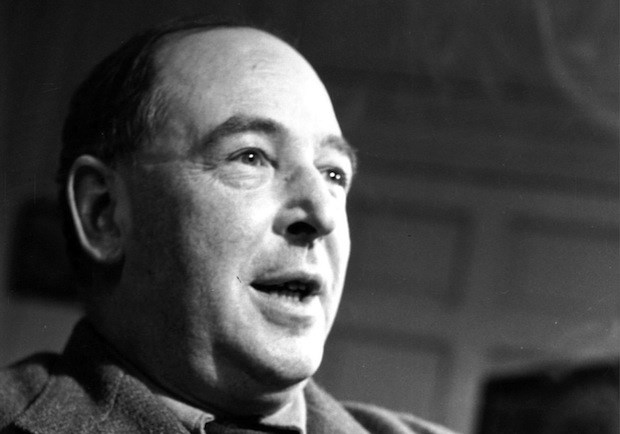
TIME Magazine Cover: C.S. Lewis -- Sep. 8, 1947

 Synopsis:
This hugely popular international bestseller is being repackaged and rebranded as the leading title in the C.S. Lewis Signature Classics range. One of the most popular and beloved introductions to the concept of faith ever written, Mere Christianity has sold millions of copies worldwide. The timeless questions of spirituality which Lewis raises will have resonance with a new generation of readers. Mere Christianity brings together Lewis's legendary broadcast talks of the war years, talks in which he set out simply to 'explain and defend the belief that has been common to nearly all Christians at all times.' Rejecting the boundaries that divide Christianity's many denominations, C.S. Lewis provides an unequaled opportunity for believers and nonbelievers alike to hear a powerful, rational case for the Christian faith. This scintillating collection confirms C.S. Lewis's reputation as one of the leading writers and thinkers of our age.


BOOK I: RIGHT AND WRONG AS A CLUE TO MEANING OF UNIVERSE

Chapter 2: SOME OBJECTIONS

You might think love of humanity in general was safe, but it is not. If you leave out justice you will find yourself breaking agreements and faking evidence in trials 'for the sake of humanity,' and become in the end a cruel and treacherous man.

Other people wrote to me saying, 'Isn't what you call the Moral Law just a social convention, something that is put into us by education?' I think there is a misunderstanding here. The people who ask that question are usually taking it for granted that if we have learned a thing from parents and teachers, then that thing must be merely a human invention. But, of course, that is not so. We all learned the multiplication table at school. A child who grew up alone on a desert island would not know it. But surely it does not follow that the multiplication table is simply a human convention, something human beings have made up for themselves and might have made different if they had liked? I fully agree that we learn the Rule of Decent Behaviour from parents and teachers, and friends and books, as we learn everything else. But some of the things we learn are mere conventions which might have been different�Cwe learn to keep to the left of the road, but it might just as well have been the rule to keep to the right�Cand others of them, like mathematics, are real truths. The question is to which class the Law of Human Nature belongs.

Sunday, December 22, 2013

Mere Christianity - PREFACE and Book I: Right and Wrong as a Clue to the Meaning of Universe, Chapter 1: LAW OF HUMAN NATURE

TIME Magazine Cover: C.S. Lewis -- Sep. 8, 1947

 Synopsis:
This hugely popular international bestseller is being repackaged and rebranded as the leading title in the C.S. Lewis Signature Classics range. One of the most popular and beloved introductions to the concept of faith ever written, Mere Christianity has sold millions of copies worldwide. The timeless questions of spirituality which Lewis raises will have resonance with a new generation of readers. Mere Christianity brings together Lewis's legendary broadcast talks of the war years, talks in which he set out simply to 'explain and defend the belief that has been common to nearly all Christians at all times.' Rejecting the boundaries that divide Christianity's many denominations, C.S. Lewis provides an unequaled opportunity for believers and nonbelievers alike to hear a powerful, rational case for the Christian faith. This scintillating collection confirms C.S. Lewis's reputation as one of the leading writers and thinkers of our age.


PREFACE (cont'd)

Far deeper objections may be felt - and have been expressed - against my use of the word Christian to mean one who accepts the common doctrines of Christianity. People ask: 'Who are you, to lay down who is, and who is not a Christian?': or 'May not many a man who cannot believe these doctrines be far more truly a Christian, far closer to the spirit of Christ, than some who do?' Now this objection is in one sense very right, very charitable, very spiritual, very sensitive. It has every available quality except that of being useful. We simply cannot, without disaster, use language as these objectors want us to use it. I will try to make this clear by the history of another, and very much less important, word.

The word gentleman 'originally meant something recognisable; one who had a coat of arms and some landed property. When you called someone 'a gentleman' you were not paying him a compliment, but merely stating a fact. If you said he was not 'a gentleman' you were not insulting him, but giving information. There was no contradiction in saying that John was a liar and a gentleman; any more than there now is in saying that James is a fool and an M.A. But then there came people who said - so rightly, charitably, spiritually, sensitively, so anything but usefully - 'Ah but surely the important thing about a gentleman is not the coat of arms and the land, but the behaviour? Surely he is the true gentleman who behaves as a gentleman should? Surely in that sense Edward is far more truly a gentleman than John?' They meant well. To be honourable and courteous and brave is of course a far better thing than to have a coat of arms. But it is not the same thing. Worse still, it is not a thing everyone will agree about. To call a man 'a gentleman' in this new, refined sense, becomes, in fact, not a way of giving information about him, but a way of praising him: to deny that he is 'a gentleman' becomes simply a way of insulting him. When a word ceases to be a term of description and becomes merely a term of praise, it no longer tells you facts about the object: it only tells you about the speaker's attitude to that object. (A 'nice' meal only means a meal the speaker likes. (A gentleman, once it has been spiritualised and refined out of its old coarse, objective sense, means hardly more than a man whom the speaker likes. As a result, gentleman is now a useless word. We had lots of terms of approval already, so it was not needed for that use; on the other hand if anyone (say, in a historical work) wants to use it in its old sense, he cannot do so without explanations. It has been spoiled for that purpose.


Saturday, December 21, 2013

Mere Christianity - PREFACE ( 1 of 2) - follow audiobook with printed text


TIME Magazine Cover: C.S. Lewis -- Sep. 8, 1947

 Synopsis:
This hugely popular international bestseller is being repackaged and rebranded as the leading title in the C.S. Lewis Signature Classics range. One of the most popular and beloved introductions to the concept of faith ever written, Mere Christianity has sold millions of copies worldwide. The timeless questions of spirituality which Lewis raises will have resonance with a new generation of readers. Mere Christianity brings together Lewis's legendary broadcast talks of the war years, talks in which he set out simply to 'explain and defend the belief that has been common to nearly all Christians at all times.' Rejecting the boundaries that divide Christianity's many denominations, C.S. Lewis provides an unequaled opportunity for believers and nonbelievers alike to hear a powerful, rational case for the Christian faith. This scintillating collection confirms C.S. Lewis's reputation as one of the leading writers and thinkers of our age.


PREFACE

THE CONTENTS of this book were first given on the air, and then published in three separate parts as Broadcast Talks (1942), Christian Behaviour (1943), and Beyond Personality (1944). In the printed versions I made a few additions to what I had said at the microphone, but otherwise left the text much as it had been. A 'talk' on the radio should, I think, be as like real talk as possible, and should not sound like an essay being read aloud. In my talks I had therefore used all the contractions and colloquialisms I ordinarily use in conversation. In the printed version I reproduced this, putting don't and we've for do not and we have. And whereever, in the talks, I had made the importance of a word clear by the emphasis of my voice, I printed it in italics. I am now inclined to think that this was a mistake - an undesirable hybrid between the art of speaking and the art of writing. A talker ought to use variations of voice for emphasis because his medium naturally lends itself to that method: but a writer ought not to use italics for the same purpose. He has his own, different, means of bringing out the key words and ought to use them. In this edition I have expanded the contractions and replaced most of the italics by a recasting of the sentences in which they occurred: but without altering, I hope, the 'popular' or 'familiar' tone which I had all along intended. I have also added and deleted where I thought I understood any part of my subject better now than ten years ago or where I knew that the original version had been misunderstood by others.

Sunday, December 15, 2013

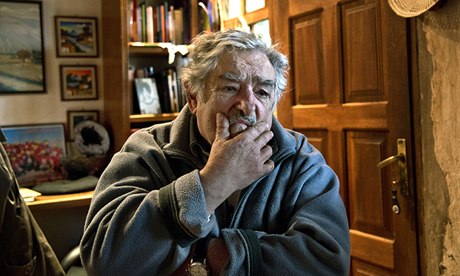
Uruguay's president José Mujica: no palace, no motorcade, no frills

Uruguay's president José Mujica: no palace, no motorcade, no frills

In the week that Uruguay legalises cannabis, the 78-year-old explains why he rejects the 'world's poorest president' label

How does your leader compare to José Mujica? Have your say
José Mujica
José Mujica, the Uruguayan president, at his house in Montevideo. Photograph: Mario Goldman/AFP/Getty Images
"The world will always need revolution. That doesn't mean shooting and violence. A revolution is when you change your thinking. Confucianism and Christianity were both revolutionary," he said.
If anyone could claim to be leading by example in an age of austerity, it is José Mujica, Uruguay's president, who has forsworn a state palace in favour of a farmhouse, donates the vast bulk of his salary to social projects, flies economy class and drives an old Volkswagen Beetle.

But the former guerrilla fighter is clearly disgruntled by those who tag him "the world's poorest president" and – much as he would like others to adopt a more sober lifestyle – the 78-year-old has been in politics long enough to recognise the folly of claiming to be a model for anyone.

"If I asked people to live as I live, they would kill me," Mujica said during an interview in his small but cosy one-bedroom home set amid chrysanthemum fields outside Montevideo.

Sunday, December 08, 2013

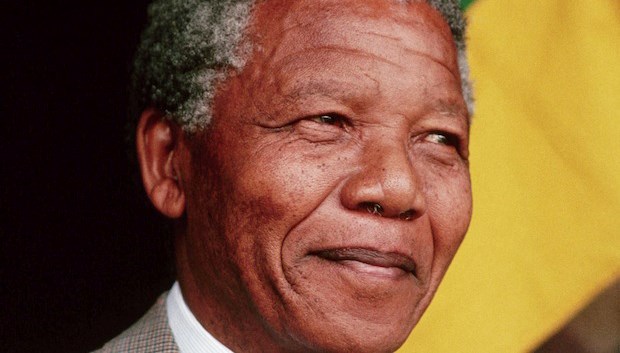
Nelson Mandela Has Died: Some history, thoughts, and reaction from South African pastors

In Memoriam

Nelson Mandela Has Died: Some history, thoughts, and reaction from South African pastors

What to Know and How to Pray
 
Ed Stetzer| Christianity Today | 5 Dec. 2013

Nelson Mandela Has Died: Some history, thoughts, and reaction from South African pastors
Nelson Mandela

Nelson Mandela has died.
His life was a remarkable journey.

Who is Mandela?

Part Abraham Lincoln, part Rosa Parks, part Frederick Douglas, and part Martin Luther King, Jr., Mandela was the face of the anti-Apartheid movement in South Africa and deeply connected to the African National Congress, the political party that (still today) holds the power in the country.

In his youth, he was involved in numerous protests and even some more subversive conspiracies against the Afrikaner establishment. After serving 27 years of a life imprisonment sentence following a conviction for sabotage and attempting to overthrow the government in 1962, Mandela worked with then-President F. W. de Klerk in the early 90s to abolish apartheid and bring forth the first multi-racial elections ever in South Africa. That 1994 election saw Mandela become the first black president of South Africa, a position he held until 1999.

Even though Mandela led his revolution through political maneuvers, in his autobiography, Long Walk to Freedom, he reflected on the work of the church in South Africa regarding the overthrow of apartheid: "The Church was as concerned with this world as the next: I saw that virtually all of the achievements of Africans seemed to have come about through the missionary work of the Church."

Because Nelson Mandela showed forgiveness and was the leading force to unify his country.
 
But, more than that, Mandela held back what many saw as an inevitable retribution after a half-century of racial tension, segregation, and institutionalized racism. As one friend in South Africa told me, "There is much respect for Nelson regarding the fact that he literally stopped a civil war. I have seen racist men honor him at rugby games." It's impossible to underestimate Mandela's influence and reputation, among people of all races in South Africa.

Will the Past Hold for the Future?

Yet the fear remains that his death may release some of that rage he helped to address.

As The Guardian explains, there are many wild rumors, and most such rumors prove to be false. However, my Christian friends in South Africa agree with the Guardian that "[s]ome believe the anti-apartheid hero and paragon of racial reconciliation is the glue that holds this diverse, sometimes discordant nation together."

It does not take much to remember the bad days of South African apartheid. Many wondered if the nation would spin out of control after the fall of apartheid.

But it did not.

Because Nelson Mandela showed forgiveness and was the leading force to unify his country.

Many non-South Africans learned about this era—and Mandela's role—through the movie Invictus. The book would be more profitable as its title tells the story: Playing the Enemy: Nelson Mandela and the Game that Made a Nation. Also, you might consider this ESPN video to get a picture of the era. No, it's not all about sports, but it helps give the picture.

Saturday, December 07, 2013

Punctuated Khmer Bible hosted by CCEL

Seen and heard on Ms. Theary C. Seng's Facebook accounts: 
 
Photo: Visit with staff of Christian Classics Ethereal Library who will be hosting the punctuated version of the Khmer Bible that I've edited on the Calvin College campus. CCEL ranks in the top ten for online traffic (secular and Christian!) only after Christianity Today, according to Google.
Visit with staff of Christian Classics Ethereal Library who will be hosting the punctuated version of the Khmer Bible that I've edited on the Calvin College campus. CCEL ranks in the top ten for online traffic (secular and Christian!) only after Christianity Today, according to Google.

Thursday, December 05, 2013

The BROTHERS KARAMAZOV -- Book IV: Lacerations, (chapter 1) Father Ferapont


Other great pieces of literature at the Christian Classics Ethereal Library: 

The Brothers Karamazov and Crime and Punishment
by Fyodor Dostoyevsky, my two all-time favorite novels

"Since its publication, it has been acclaimed all over the world by intellectuals as one of the supreme achievements in literature."

https://app.box.com/s/xx0llgjz176r2dcg32bz

 The Complete Book online

ALYOSHA was roused early, before daybreak. Father Zossima woke up feeling very weak, though he wanted to get out of bed and sit up in a chair. His mind was quite clear; his face looked very tired, yet bright and almost joyful. It wore an expression of gaiety, kindness and cordiality. "Maybe I shall not live through the coming day," he said to Alyosha. Then he desired to confess and take the sacrament at once. He always confessed to Father Paissy. After taking the communion, the service of extreme unction followed. The monks assembled and the cell was gradually filled up by the inmates of the hermitage. Meantime it was daylight. People began coming from the monastery. After the service was over the elder desired to kiss and take leave of everyone. As the cell was so small the earlier visitors withdrew to make room for others. Alyosha stood beside the elder, who was seated again in his arm-chair. He talked as much as he could. Though his voice was weak, it was fairly steady. 

"I've been teaching you so many years, and therefore I've been talking aloud so many years, that I've got into the habit of talking, and so much so that it's almost more difficult for me to hold my tongue than to talk, even now, in spite of my weakness, dear Fathers and brothers," he jested, looking with emotion at the group round him. 

Saturday, November 30, 2013

The BROTHERS KARAMAZOV -- Book III: The Sensualists, (chapter 7) The Controversy


Other great pieces of literature at the Christian Classics Ethereal Library: 

The Brothers Karamazov and Crime and Punishment
by Fyodor Dostoyevsky, my two all-time favorite novels

"Since its publication, it has been acclaimed all over the world by intellectuals as one of the supreme achievements in literature."

https://app.box.com/s/xx0llgjz176r2dcg32bz

 The Complete Book online

BUT Balaam's ass had suddenly spoken. The subject was a strange one. Grigory had gone in the morning to make purchases, and had heard from the shopkeeper Lukyanov the story of a Russian soldier which had appeared in the newspaper of that day. This soldier had been taken prisoner in some remote part of Asia, and was threatened with an immediate agonising death if he did not renounce Christianity and follow Islam. He refused to deny his faith, and was tortured, flayed alive, and died, praising and glorifying Christ. Grigory had related the story at table. Fyodor Pavlovitch always liked, over the dessert after dinner, to laugh and talk, if only with Grigory. This afternoon he was in a particularly good-humoured and expansive mood. Sipping his brandy and listening to the story, he observed that they ought to make a saint of a soldier like that, and to take his skin to some monastery. "That would make the people flock, and bring the money in." 

Grigory frowned, seeing that Fyodor Pavlovitch was by no means touched, but, as usual, was beginning to scoff. At that moment Smerdyakov, who was standing by the door, smiled. Smerdyakov often waited at table towards the end of dinner, and since Ivan's arrival in our town he had done so every day.
"What are you grinning at?" asked Fyodor Pavlovitch, catching the smile instantly, and knowing that it referred to Grigory. 

"Well, my opinion is," Smerdyakov began suddenly and unexpectedly in a loud voice, "that if that laudable soldier's exploit was so very great there would have been, to my thinking, no sin in it if he had on such an emergency renounced, so to speak, the name of Christ and his own christening, to save by that same his life, for good deeds, by which, in the course of years to expiate his cowardice." 

"How could it not be a sin? You're talking nonsense. For that you'll go straight to hell and be roasted there like mutton," put in Fyodor Pavlovitch. 

Thursday, November 28, 2013

This Thanksgiving, Stop Idolizing the Pilgrims

This Thanksgiving, Stop Idolizing the Pilgrims
An evangelical historian teaches us how to think critically about the heroes of our past.
The First Thanksgiving: What the Real Story Tells Us About Loving God and Learning from History

In 1623, Plymouth Colony Governor William Bradford proclaimed the first Thanksgiving. "The great Father," he declared, "has given us this year an abundant harvest...and granted us freedom to worship God according to the dictates of our own conscience." He directed the Pilgrims to gather that November, "the third year since ye Pilgrims landed on ye Plymouth Rock, there to listen to ye Pastor and render Thanksgiving to ye Almighty God for all his blessings."


Sunday, November 24, 2013

Narnia and Camelot: A Tribute to C.S. Lewis

Narnia and Camelot: A Tribute to C.S. Lewis

Dying on the same day, JFK and C.S. Lewis exemplify two contrasting reasons for hope. |
Narnia and Camelot: A Tribute to C.S. Lewis Courtesy of The Wade Center
 
4,694 miles—that's what separates Dallas, Texas from Oxford, England.

But on November 22, 1963, they were brought together in the deaths of two influential men called "Jack" – John F. Kennedy and C.S. Lewis.

I don't remember that day—my parents had not yet married, let alone had any children. Yet, that day would be significant for many reasons and to many people—including me.

The president of the United States had been assassinated and the eyes of the world turned to Dallas, Texas. Meanwhile, across the Atlantic Ocean, an Oxford professor collapsed in his bedroom, succumbing to an illness that had ravaged his body for more than two years.

Seeing the president shot dead as he rode through the streets will dominate the news and grab the attention of everyone. Lewis' death in his home due to a kidney illness he had been living with since 1961 doesn't jar the senses and beg for headlines quite as much. But, the latter had much more influence on me than the former.

Over the next decade of upheaval, Lewis' works remained almost dormant. Disillusionment following the assassination of JFK and Bobby Kennedy, Vietnam, the civil rights movement and the sexual revolution pushed aside his place in the culture.

But turmoil and revolution can only last so long. People needed something solid. There was Lewis, ready to be rediscovered by a generation of Christians looking to engage culture and move beyond the isolationist mindset of fundamentalism.

Thursday, November 21, 2013

EDUCATIONAL materials in both KHMER and English freely available for your reading / listening / viewing pleasure

Complete Books Freely Accessible at:
KI Media
The Brothers Karamazov by Fyodor Dostoyevsky

Audio Online
Mere Christianity by C. S. Lewis

ANCIENT ROME:
The Rise and Fall of an Empire


The BROTHERS KARAMAZOV -- Book II: An Unfortunate Gathering, (chapter 6) Why Is Such a Man Alive?


Other great pieces of literature at the Christian Classics Ethereal Library: 

The Brothers Karamazov and Crime and Punishment
by Fyodor Dostoyevsky, my two all-time favorite novels

"Since its publication, it has been acclaimed all over the world by intellectuals as one of the supreme achievements in literature."

https://app.box.com/s/xx0llgjz176r2dcg32bz

 The Complete Book online

DMITRI FYODOROVITCH, a young man of eight and twenty, of medium height and agreeable countenance, looked older than his years. He was muscular, and showed signs of considerable physical strength. Yet there was something not healthy in his face. It was rather thin, his cheeks were hollow, and there was an unhealthy sallowness in their colour. His rather large, prominent, dark eyes had an expression of firm determination, and yet there was a vague look in them, too. Even when he was excited and talking irritably, his eyes somehow did not follow his mood, but betrayed something else, sometimes quite incongruous with what was passing. "It's hard to tell what he's thinking," those who talked to him sometimes declared. People who saw something pensive and sullen in his eyes were startled by his sudden laugh, which bore witness to mirthful and light-hearted thoughts at the very time when his eyes were so gloomy. A certain strained look in his face was easy to understand at this moment. Everyone knew, or had heard of, the extremely restless and dissipated life which he had been leading of late, as well as of the violent anger to which he had been roused in his quarrels with his father. There were several stories current in the town about it. It is true that he was irascible by nature, "of an unstable and unbalanced mind," as our justice of the peace, Katchalnikov, happily described him. 

He was stylishly and irreproachably dressed in a carefully buttoned frock-coat. He wore black gloves and carried a top hat. Having only lately left the army, he still had moustaches and no beard. His dark brown hair was cropped short, and combed forward on his temples. He had the long, determined stride of a military man. He stood still for a moment on the threshold, and glancing at the whole party went straight up to the elder, guessing him to be their host. He made him a low bow, and asked his blessing. Father Zossima, rising in his chair, blessed him. Dmitri kissed his hand respectfully, and with intense feeling, almost anger, he said: 

"Be so generous as to forgive me for having kept you waiting so long, but Smerdyakov, the valet sent me by my father, in reply to my inquiries, told me twice over that the appointment was for one. Now I suddenly learn- " 

"Don't disturb yourself," interposed the elder. "No matter. You are a little late. It's of no consequence... " 


The Chronicles of C. S. Lewis Lead to Poets’ Corner

The Chronicles of C. S. Lewis Lead to Poets’ Corner

The Narnia chronicles are published by HarperCollins Children’s Books. “They are the jewel in the crown for us,” said Susan Katz, the publisher. Schoolchildren continue to read the series, especially those 8 to 12. 

Toni Markiet, the Narnia editor, said: “The books are over 60 years old, but they still work because they’re still about the struggle between good and evil. Children understand that concept very well. And the books are about friendship, loyalty and compassion. They have humor. Lewis would say if a book is good for you to read at 5, it’s good at 50.”
LONDON — C. S. Lewis was a noted polymath: philosopher, theologian, professor, novelist, children’s writer, literary critic, lecturer. But he was not much of a poet. 

Still, 50 years to the day after his death, Clive Staples Lewis, known to his friends and family as Jack, will be among the more than 100 people commemorated in some fashion in Westminster Abbey’s Poets’ Corner, alongside figures like Geoffrey Chaucer, Ben Jonson, Samuel Johnson, Shakespeare, the Brontë sisters, Gerard Manley Hopkins, John Keats, John Milton and Ted Hughes. 

Lewis, who died at a week before his 65th birthday, on Nov. 22, 1963 — the day John F. Kennedy was assassinated — will receive the honor of a memorial stone in the floor in the Poets’ Corner, a portion of the abbey’s south transept that contains graves, memorial stones and a memorial window. 

His stepson Douglas Gresham sees the amusing side of this. “Jack has been revered in the Christian world for some time now, so the abbey is good,” he said. “The ironic part, though he mastered several genres, is that he’ll be memorialized in Poets’ Corner, but that’s one field in which he didn’t succeed very well.” 

Lewis remains read and profitably published in various worlds, most prominently in religious texts and in his children’s fantasy novels about Narnia. 

Over 100 million copies of the Narnia books have been sold in more than 40 languages, said Mr. Gresham, 68, and the three films based on the books have grossed $1.6 billion, with a fourth commissioned. “Not too shabby,” he said. 

Wednesday, November 20, 2013

The BROTHERS KARAMAZOV -- Book II: An Unfortunate Gathering, (chapter 5) So Be It! So Be It!


Other great pieces of literature at the Christian Classics Ethereal Library: 

The Brothers Karamazov and Crime and Punishment
by Fyodor Dostoyevsky, my two all-time favorite novels

"Since its publication, it has been acclaimed all over the world by intellectuals as one of the supreme achievements in literature."

https://app.box.com/s/xx0llgjz176r2dcg32bz

 The Complete Book online

The elder's absence from his cell had lasted for about twenty-five minutes. It was more than half-past twelve, but Dmitri, on whose account they had all met there, had still not appeared. But he seemed almost to be forgotten, and when the elder entered the cell again, he found his guests engaged in eager conversation. Ivan and the two monks took the leading share in it. Miusov, too, was trying to take a part, and apparently very eagerly, in the conversation. But he was unsuccessful in this also. He was evidently in the background, and his remarks were treated with neglect, which increased his irritability. He had had intellectual encounters with Ivan before and he could not endure a certain carelessness Ivan showed him. 

"Hitherto at least I have stood in the front ranks of all that is progressive in Europe, and here the new generation positively ignores us," he thought. 

Fyodor Pavlovitch, who had given his word to sit still and be quiet, had actually been quiet for some time, but he watched his neighbour Miusov with an ironical little smile, obviously enjoying his discomfiture. He had been waiting for some time to pay off old scores, and now he could not let the opportunity slip. Bending over his shoulder he began teasing him again in a whisper. 

"Why didn't you go away just now, after the 'courteously kissing'? Why did you consent to remain in such unseemly company? It was because you felt insulted and aggrieved, and you remained to vindicate yourself by showing off your intelligence. Now you won't go till you've displayed your intellect to them." 

"You again?... On the contrary, I'm just going." 


Sunday, November 17, 2013

The KHMER BIBLE -- Theary Seng Version

This is from the Khmer Standard Version of the Holy Bible of the Bible Society of Cambodia (1997, 2005) which I have edited mainly with regards to spacing and punctuation for easier comprehension. Similar to the English Bible, I have put the words of the LORD Jesus in red ink (read its history).

(Click here for the highest authority to use and understanding rules of punctuation.)

On occasions, I have corrected translation inaccuracy vis-a-vis the English New International Version.

And always, whenever វា (it) is used for a person, in particular for a child, it is replaced with គេ or គាត់ (s/he, him/her or they/them). The use of អញ (the derogatory "I" or "me", used inappropriately to connote authority, e.g. as by the father in the Parable of the Prodigal Son) is also replaced to ​ខ្ញុំ, unless the context calls for it (e.g. angry Old Testament king screaming at a servant).

* * *
The Holy Bible--the best-selling book in history with 25 MILLION Bibles sold annually, totaling between 2.5 to 6 BILLION--is a library or consolidation of 66 books, divided into the Old Testament (39 books, shared by both Judaism and Christianity) and the New Testament (27 books).  Both the OT and the NT form one single history, with the OT pointing to the coming Messiah of the NT.  The NT has the 4 Gospels recounting the "good news" and life of Jesus, the book of Acts recounting the spread of Christianity in the first century, letters by Jesus' disciples to believers spread across what is now the Mediterranean, Eastern Europe and Asia Minor -- new converts and old ones from the time of Jesus, persecuted for their faith in the Roman Empire, and the book of Revelation with vision of the end time (or, the time between Jesus Christ's 1st coming and His return--the time of our salvation--or, now!). 


Thursday, November 14, 2013

The BROTHERS KARAMAZOV -- Book I: The History of a Family: (chapter 5) Elders


Other great pieces of literature at the Christian Classics Ethereal Library: 

The Brothers Karamazov and Crime and Punishment
by Fyodor Dostoyevsky, my two all-time favorite novels

"Since its publication, it has been acclaimed all over the world by intellectuals as one of the supreme achievements in literature."

Book I: The History of a Family, (chapter 4) The Third Son, Alyosha

 The Complete Book online

Some of my readers may imagine that my young man was a sickly, ecstatic, poorly developed creature, a pale, consumptive dreamer. On the contrary, Alyosha was at this time a well-grown, red-cheeked, clear-eyed lad of nineteen, radiant with health. He was very handsome, too, graceful, moderately tall, with hair of a dark brown, with a regular, rather long, oval-shaped face, and wide-set dark grey, shining eyes; he was very thoughtful, and apparently very serene. I shall be told, perhaps, that red cheeks are not incompatible with fanaticism and mysticism; but I fancy that Alyosha was more of a realist than anyone. Oh! no doubt, in the monastery he fully believed in miracles, but, to my thinking, miracles are never a stumbling-block to the realist. It is not miracles that dispose realists to belief. The genuine realist, if he is an unbeliever, will always find strength and ability to disbelieve in the miraculous, and if he is confronted with a miracle as an irrefutable fact he would rather disbelieve his own senses than admit the fact. Even if he admits it, he admits it as a fact of nature till then unrecognised by him. Faith does not, in the realist, spring from the miracle but the miracle from faith. If the realist once believes, then he is bound by his very realism to admit the miraculous also. The Apostle Thomas said that he would not believe till he saw, but when he did see he said, "My Lord and my God!" Was it the miracle forced him to believe? Most likely not, but he believed solely because he desired to believe and possibly he fully believed in his secret heart even when he said, "I do not believe till I see." 

I shall be told, perhaps, that Alyosha was stupid, undeveloped, had not finished his studies, and so on. That he did not finish his studies is true, but to say that he was stupid or dull would be a great injustice. I'll simply repeat what I have said above. He entered upon this path only because, at that time, it alone struck his imagination and presented itself to him as offering an ideal means of escape for his soul from darkness to light. Add to that that he was to some extent a youth of our last epoch- that is, honest in nature, desiring the truth, seeking for it and believing in it, and seeking to serve it at once with all the strength of his soul, seeking for immediate action, and ready to sacrifice everything, life itself, for it. Though these young men unhappily fail to understand that the sacrifice of life is, in many cases, the easiest of all sacrifices, and that to sacrifice, for instance, five or six years of their seething youth to hard and tedious study, if only to multiply tenfold their powers of serving the truth and the cause they have set before them as their goal such a sacrifice is utterly beyond the strength of many of them. The path Alyosha chose was a path going in the opposite direction, but he chose it with the same thirst for swift achievement. As soon as he reflected seriously he was convinced of the existence of God and immortality, and at once he instinctively said to himself: "I want to live for immortality, and I will accept no compromise." In the same way, if he had decided that God and immortality did not exist, he would at once have become an atheist and a socialist. For socialism is not merely the labour question, it is before all things the atheistic question, the question of the form taken by atheism to-day, the question of the tower of Babel built without God, not to mount to heaven from earth but to set up heaven on earth. Alyosha would have found it strange and impossible to go on living as before. It is written: "Give all that thou hast to the poor and follow Me, if thou wouldst be perfect.