Showing posts with label CG meeting. Show all posts

Wednesday, June 20, 2007

Hun Sen's latest concession land seizure "show" always work like a charm with aid donors

Jun 20, 2007
DPA
"Cambodia had taken pleasing steps to combat the problem, seizing five land concessions deemed illegal and suspending or disciplining more than 50 officials for corrupt practices in the past year" - Pius Fischer, German Ambassador to Cambodia
Phnom Penh - Despite heavy political pressure from human rights groups, donors significantly increased total aid pledges to Cambodia Wednesday to nearly 690 million dollars at an annual meeting in a move the government said recognized its ongoing efforts at reform.

Donors at the two-day Cambodia Development Cooperation Forum largely kept their pledges in line with previous years, granting 689.21 million dollars in grants and loans. The total included both direct government funding and indirect funding to non-government organizations, according to Finance Minister Keat Chhon.

The overall increase on the 601 million dollars pledged by donors in 2006 came despite demands from rights groups for donors to demand more for their money. They said widespread rights abuses and endemic corruption continue virtually unchecked in Cambodia.

It was bumped up by a contribution of 91 million dollars by China, which has previously refused to be involved with the meeting. Although it did not send a delegation, Chhon said it had made the pledge via official diplomatic channels. Japan remained the most generous donor, pledging 112 million dollars for 2007.

The German ambassador to Cambodia, Pius Fischer, said that although corruption remained a 'cancer of this society,' Cambodia had taken pleasing steps to combat the problem, seizing five land concessions deemed illegal and suspending or disciplining more than 50 officials for corrupt practices in the past year.

Germany, which is also the chair of the European Union (EU) this year, pledged 21 million dollars for 2007, although Fischer said total disbursment may actually be even higher. EU countries pledged a total of 170.2 million dollars for the year and nearly half a billion over three years.

No breakdown of the total into what constituted loans and what constituted grants was made available. Chhon said the total included direct funding for the government and indirect funding through non-government organisations.

Last week, the UN human rights envoy to Cambodia, Yash Ghai, delivered a stinging report in Geneva, and the government recently came under harsh criticism for banning a critical report on illegal logging by London-based Global Witness, but Fischer said donor funding was a complex process which 'should be interpreted more long term than short term,' and donors had seen overall progress as positive.

The forum meeting involved key donors to Cambodia, including the United States, Germany, Japan, South Korea, the Asian Development Bank, the European Commission, the International Monetary Fund, the United Nations Development Programme and the World Bank.

Government officials said the funds are primarily earmarked for the development of infrastructure, such as rural development and irrigation projects, as well as improving the fledgling health system, which remains in disarray after 30 years of civil war.

The World Bank estimates 70 per cent of Cambodians remained dependent on agriculture but the country also has one of the fastest rates of urbanization in the region. According to the IMF, its economy also grew 10.4 per cent last year and was expected to continue to grow at a rate of about 9 per cent in 2007.

Eight foreigners were briefly detained but later released during the meeting after a protest urging the release of two men who rights groups said have been falsely jailed for 20 years for the murder of unionist Chea Vichea.

Donors Criticize Cambodia over Widespread Corruption

June 20, 2007
By Ker Munthit/AP Writer/Phnom Penh

Foreign donors castigated Cambodian Prime Minister Hun Sen's government for failing to tackle chronic corruption, but were still expected Wednesday to pledge new aid to the impoverished country.

Cambodia, o­ne of the world's poorest countries, is seeking US $689 million in development aid for 2008, according to a government document.

It is not clear yet exactly how much it will get. Government officials and donor representatives were set to end a two-day meeting Wednesday with an announcement of hundreds of millions of dollars in new aid.

Donors pledged $601 million to the government last year.

The meeting came after a barrage of criticism that the government has endlessly reneged o­n promises to control corruption, illegal logging and land grabbing by well-connected businessmen.

Ian Porter, World Bank country director for Cambodia, noted in a speech Tuesday that the country's troubled past has resulted in weak governance and "high levels of corruption."

Although there has been notable progress in the economic and social arenas over the past year, he said "other areas remain stagnant" and "remaining problems, particularly in the area of governance, become even more serious impediments."

The passage of anti-corruption laws, which was supposed to happen a year ago according to the government's original indications, still remains the "highest priority" for the donors, US Ambassador Joseph Mussomeli said in a speech Tuesday.

"The delays in its enactment do not well serve the interests of the Cambodian people," he said.

The government should remove any obstacles for passing the law, said a statement from the NGO Forum, an umbrella of private organizations in Cambodia. It also urged the government to conduct systematic reporting of corruption cases, especially those involving public officials.

Human rights and environmental groups have repeatedly alleged that Hun Sen has ignored the concerns of donors, who have repeatedly criticized government abuse but have so far refrained from punishing the government by cutting off funds.

Cambodia was ranked No 151 among the 163 countries in Transparency International's 2006 "corruption perceptions index." Transparency International is an international non-governmental agency.

In asking for more aid Tuesday, Hun Sen took aim at the donors for casting doubt o­n his government's ability to manage prospective windfall revenues from oil and gas. If oil production starts, Hun Sen said his government will use the revenues "efficiently, transparently and accountably."

A recent offshore oil discovery by US energy giant Chevron Corp has prompted concerns that corruption could worsen in Cambodia if oil money starts pouring in, even though it is still unclear if the find would be commercially viable.

Hun Sen also said his administration remains firmly committed to enacting an anti-corruption law, an often-repeated promise he has yet to fulfill.

Please tell us ...


Aid to Hun Sen's regime

With the upcoming Consultative Group meeting in Phnom Penh on 19-20 June 2007, do you think there will be any changes in the aid package provided to Hun Sen's regime?

No, donor countries will provide aid as usual in spite of human rights violations, broken promises

Most likely not, donor countries will make some tough statement, but will provide aid as usual

Yes, donor countries will drastically cut its aid to Hun Sen


Tuesday, June 19, 2007

Hun Sen's siren begging song is music to donors ears ... and it always work like a charm every year

Jun 19, 2007
Cambodia asks for more aid as donor meeting opens

DPA

Phnom Penh - Cambodia conceded that land grabs and corruption were issues that needed to be tackled as an annual international donor meeting opened Tuesday, and asked the donors for more aid to tackle the problems.

Addressing the Cambodia Development Cooperation Forum (CDCF), Prime Minister Hun Sen said the government was continuing efforts to weed out some 'bad politicians behind some bad Cambodians' and solve growing inequalities between the rich and poor, especially in rural areas.

'I appeal to Cambodian government partners ... please join with us, especially the World Bank,' Hun Sen told the meeting, previously known as the Consultative Group meeting.

Last year donors pledged 601 million dollars to the heavily aid-dependent nation, at least half the annual budget of which is estimated to rely on international donors after a 30-year civil war.

The meeting comes with the government under a barrage of criticism from non-government groups which have used the banning of a negative forestry report from London-based Global Witness as a focus, and follows a highly critical report from UN human rights envoy Yash Ghai in Geneva last week.

Critics, including New York-based Human Rights Watch, have charged that donors have done little to make the Cambodian government accountable for the vast sums of aid which have poured into the country over the past decade, maintaining that land grabs, human rights abuses and corruption remain rife. They have called on donors to get tough.

World Bank country director Ian Porter was more circumspect in his opening speech, congratulating the government for progress in a number of areas, but noting that other areas were significantly lagging.

'Looking back at what has been achieved since we last met, there has been notable progress in the economic and social arenas, and some progress in government reforms,' Porter, who is the lead development partner coordinator for the meeting, said.

'However, there remain important, and in some cases growing, challenges in each of these areas.'

Although economic development continued to be impressive, in turn driving poverty reduction, 'the government will need to carefully monitor inequality, which increased in the last decade, due mainly to widening inequality within rural areas,' Porter said.

Legal and judicial reform and public administration reform would receive particular attention from donors at the meeting, he said, calling for speedy enactment of a long-promised anti-corruption law.

Minister of Economy and Finance Keat Chhon also acknowledged dialogue would need to focus on some key issues, and said the government had placed a high importance on equitable distribution of economic growth and the development of the agricultural sector, on which 70 per cent of the population depend.

'Although the poverty rate has declined from 47 to 35 per cent over the past 10 years, further improving the living standard of the people, in particular in rural areas, and ensuring an equitable distribution of economic growth among all remains a concern for the Royal Government, and continues to be of high priority,' the minister said.

The meeting comprises key bilateral donors to Cambodia including the US, Germany, Japan and South Korea, and the Asian Development Bank, the European Commission, the International Monetary Fund, the United Nations Development Program and the World Bank. It does not include China. It concludes Wednesday with a press conference.

Donors push Cambodia to pass anti-corruption law

PHNOM PENH, June 19 (Reuters) - Cambodia has made progress in improving its healthcare and education but needs to do more to reform a decrepit judiciary, especially when it comes to fighting corruption, international donors said on Tuesday.

"There remain important and in some cases growing challenges in each of these areas," World Bank country director Ian Porter told an annual meeting at which donors thrash out how much aid they will give Phnom Penh for next year.

Prime Minister Hun Sen, a former Khmer Rouge soldier who has been in charge for more than two decades, acknowledged the concerns about rampant graft in a country rated by Transparency International as one of the most corrupt in the world.

"The royal government is aware that corruption is a dangerous cancer that needs to be tackled all the time and in all cases without exception," Hun Sen said, adding that he was committed to introducing a special anti-corruption law.

He gave no indication of when parliament would hear the long-awaited bill, which donors say is vital before Cambodia starts pumping oil from reserves discovered recently in its waters in the Gulf of Thailand.

After years of civil war and political unrest, Cambodia's economy has finally started to take off, although Hun Sen's critics say the stability he has brought has been at the expense of human rights and probity.

The economy grew 10.8 percent last year, according to the International Monetary Fund, and is expected to expand by around 9 percent this year, due to booms in the tourism, clothing, construction and agriculture sectors.

Foreign reserves have risen to more than $1 billion, compared to $100 million in 1994, although donors are not expected to trim the annual $600 million in aid they have given in recent years. Japan is the biggest donor, accounting for around $100 million.

Cambodia's donors open aid talks focused on corruption

Tuesday • June 19, 2007
AFP

Cambodia's donors opened their annual aid talks Tuesday concerned that rampant corruption remains a huge problem as they decide how much to pledge this year to the impoverished country.

International aid makes up about half of the country's national budget, and donors last year offered just over 600 million dollars, but said they remained deeply frustrated at the government's failure to enact key reforms.

"The fight against corruption remains the number one concern of the donor community, as it underpins our efforts in every other sector," US Ambassador Joseph Mussomeli told AFP in an interview before this week's meeting.

At the core of these concerns is the government's repeated failure to pass anti-corruption legislation that is hoped to tackle graft that plagues every level of governance.

Cambodia was ranked 151 out of 163 countries in the governance watchdog Transparency International's 2006 corruption index, which compares graft levels in governments around the world.

While progress was made on the law over the past year, some points remain unresolved, including whether government officials would have to declare their assets and guarantees that Cambodia's anti-corruption body would be independent.

"I am confident that we can pursue, provided there is sufficient political will and good will on both sides, a dialogue to resolve the two remaining sticking points," Mussomeli said.

Other diplomats say they are encouraged by a more conciliatory Cambodian government, which has turned past donor meetings into sometimes antagonistic showdowns over the country's right to run itself free of foreign influence.

"The climate has changed on both sides -- there's more open dialogue," said one western diplomat who did not want to be named.

"We're not at the end of the road yet, but (the government) is moving forward," he added.

Finance Minister Keat Chhon said the government was "resolutely fighting against corruption" as he opened the meeting.

But opposition politicians say Prime Minister Hun Sen's administration has been "unreasonably slow" to act on donor demands for reform.

"Non-transparent land reforms and the creeping pace of judicial reforms lead us to believe that what is lacking is not a plan, but rather political will," the Sam Rainsy Party said in a statement.

International rights groups have also come down hard on both the government and donors, who were taken to task this year for allowing Cambodia to slide along with little progress on reform.

"The five billion (dollars) in aid ploughed into Cambodia in the past decade has yielded little in return for the donors or the Cambodian people," said Brad Adams, Asia director for the group Human Rights Watch.

"It is time for a clear and unambiguous signal to be sent to the government ... Hun Sen continues to run circles around the donors, making the same empty promises every year and laughing all the way to the bank," he added.

Cambodia remains one of the world's poorest countries after decades of civil war and government mismanagement.

Some 35 percent of the county's 14 million people live on less than 50 US cents a day, while inadequate infrastructure, healthcare and schools only add to the misery of poverty.

The British Government pays £13 million a year to support a "mafiosi" regime in Cambodia accused of plundering the country

Regime in Cambodia funded by Britain

19/06/2007
By Thomas Bell, South East Asia Correspondent
The Telegraph (UK)


The British Government pays £13 million a year to support a "mafiosi" regime in Cambodia accused of plundering the country, a meeting of donors will be told today.

Relatives of the prime minister, Hun Sen, have been involved in illegal logging, kidnapping and attempted murder, claims the British organisation Global Witness.

This year, the Department for International Development plans to spend £13 million in the country of 14 million people where 35 per cent live on less than 25p a day.

But many Cambodians say the foreign aid has made little difference to their lives. Large-scale deforestation robs local people of the resources they have relied on for years.

Simon Taylor, the director of Global Witness, said: "Whenever they protest they tend to get murdered or shunted off."

His report said: "Illegal logging in Cambodia not only fills the pockets of the political elite; it also funds the activities of a 6,000-strong private army controlled by Hun Sen."

The report said the prime minister's bodyguard unit, known as Brigade 70, "runs a nationwide timber trafficking and smuggling service, catering to prominent tycoons."

Hun Neng, the prime minister's brother, said yesterday: "If they [Global Witness] come to Cambodia, I will hit them until their heads are broken." The Cambodian embassy in London said the report was "unacceptable rubbish".

Khieu Kanharith's confidence: "We think that we will get the amount of aid that we have asked for"

Gov't Optimistic on This Year's Aid Disbursement

Chun Sakada, VOA Khmer
Original report from Phnom Penh
18/06/2007

Government officials said Monday ahead of this week's donor meeting they were optimistic aid would continue to flow, despite recent criticism from human rights and advocacy groups.

The Cambodian government will be looking for $600 million from countries including the US and Japan, to support its national budget in two days of meetings that begin Tuesday.

Government spokesman Khieu Kanharith told VOA Khmer that donor countries will give the amount that the government has asked.

"We think that we will get the amount of aid that we have asked for," he said.

The government's confidence comes in the wake of serious accusations of abuse and corruption, including a forestry report by Global Witness that links illegal logging to Prime Minsiter Hun Sen, his cabinet and a powerful "kleptocratic elite." The report, whose findings the government denies, also reprimanded donors for failing to use aid as proper leverage for governmental responsibility.

Other critics say the aid given Cambodia each year does not reach its intended agencies, but instead slips into the coffers of corrupt officials.

Opposition legislator Yim Sovan said donor countries should push harder to abolish corruption and reduce poverty, while pressuring the government to solve a land-grab problem that has grown worse as Cambodia develops. Meanwhile, the government has continually failed to pass an anti-corruption law.

"Up to now, all the promises have no meaning, because up to now, the anti-corruption law has not been in place, so the international community should be aware of this issue," he said. "It should do something to help the government make an anti-corruption law."

Since 1993, the annual donors meeting has elicited promises from Cambodia's leaders that are rarely kept, said Kek Galabru, founder of the rights group Adhoc.

"So I think that this year, I still think there is no change from last year," she said.

Monday, June 18, 2007

CPP sings its yearly sad song to fool donors: No aid to the CPP gov't then the "already-suffering" Cambodian people will suffer more

CPP official’s reaction to human rights organization

16 June 2007
By Phan Sophat
Radio Free Asia

Translated from Khmer by Heng Soy

A high-ranking official of the ruling CPP, reacted today to the accusations made by Human Rights Watch (HRW) which called on donor countries to apply pressure on Cambodia, by saying that this is a bad idea with the intention of inflicting pain on the Cambodian people.

In a phone interview with RFA on Saturday afternoon, Chiem Yeap, a CPP MP and a member of the permanent committee of the CPP central committee, said that HRW’s declaration was made only to create problem ahead of the donor countries meeting.

Chiem Yeap said: “I see that a number of organizations are creating all these issues ahead of the general election, and ahead of the aid provided by the International community. These actions do not help the well-being of the Cambodian people.”

On 15 June, HRW issued a statement calling for all donor countries to apply pressure on the Cambodian government in order to push for a fight against corruption, illegal logging, and land-grabbing from the people perpetrated by the rich and powerful.

HRW’s declaration stressed that donor countries should not accept any more delay in the empty promises of reform made by Hun Sen in the past, when he was looking for $600 million in aid annually.

The HRW declaration also stated that the Cambodian government has made virtually no progress in the past decade on key pledges to donors on the rule of law or judicial independence. Impunity for human rights violations remains the rule. Corruption is rampant. Natural resources are still being plundered. Those who report on such abuses are threatened or harassed and sometimes subject to violence.

HRW declaration came at a time when officials from the International community and officials from the Cambodian government plan to meet to discuss the request for aid for the development of Cambodia, to be held on 19-20 June.

Brad Adams, HRW director for Asia, said in this declaration: “The $5 billion in aid plowed into Cambodia in the past decade has yielded little in return for the donors or the Cambodian people.”

Brad Adams said that donor countries all know about this problem, and there will be more promises made this year, but without serious donor pressure they, too, will be broken.

Sunday, June 17, 2007

Global Witness asks Donor Countries to hold discussions with Cambodia

16 June 2007
By Mayarith
Radio Free Asia

Translated from Khmer by Socheata

An official of Global Witness, which published a report accusing illegal logging corruption in Kompong Thom province, has raised a number of issues for the donor countries to discuss with the representatives of the government of Cambodia at next week’s (CG meeting).

Simon Taylor, Global Witness director, said that donor countries, which provide aid to help in the development and to establish the base for democracy in Cambodia, should raised the issues that Cambodia is currently facing with to discuss with the Cambodian government to come up with a resolution.

Simon Taylor said: “We strongly request that donor countries raised the issues shown in Global Witness report about corruption, not only about illegal logging, we want to see a resolution from high-ranking government officials in the fight against corruption, in the bad management of natural resources, and in the management of other public assets, as well in the smuggling perpetrated by powerful military officers, in the kidnappings, and in the threats against people. And we also want to see the government perform a detailed investigation into all these issues. I want to clearly state that if they (donor countries) still refuse to raise the issues (with the government) as we requested, then future aid and the relationship between the government of Cambodia and the donor countries will be affected.”

The Consultative Group meeting between donor countries and Cambodia will take place on Tuesday 12 June to Wednesday 20 June. It will be participated by representatives from Australia, Canada, Denmark, France, Germany, India, Japan, South Korea, Sweden, the UK and the USA.

CITA asks Donors to pressure the government

16 June 2007
By Mayarith
Radio Free Asia

Translated from Khmer by Heng Soy

The Cambodian Independent Teachers’ Association (CITA) issued an open letter calling for the International community which provides aid to Cambodia to apply pressure on the government to respect the promises it made, in order to lead the country towards development.

The letter was issued on Friday 15 June by CITA – which claims to represent several hundreds of thousands of civil servants – just ahead of the Consultative Group (CG) meeting to be held in Phnom Penh city.

Leng Bun Hong, a CITA representative said: “CITA calls on donor countries to please pay attention and apply pressure on the government leader so that the anti-corruption law is adopted. This government promised to ratify the anti-corruption law since the CG meeting in 2004. Then, the government promised to have the law ready by the end of 2005. Now, we can see that corruption is growing in all (government) institutions.”

There was no immediate reaction from government officials on this issue.

Human Rights group concerned about the demand made by the Cambodian representative at the UN

15 June 2007
By Mayarith
Radio Free Asia

Translated from Khmer by Heng Soy

The Cambodian Human Rights Action Committee (CHRAC) which regroups 22 organizations, expressed its concern about the demand made by the Cambodian representative at the UN.

CHRAC issued a joint statement where it expressed its concerns that the government may cancel its cooperation on human rights issue with the UN.

The human rights group stated that if the government does not cooperate with the UN Special Envoy on Human Rights in Cambodia, then the respect of human rights in Cambodia will be affected.

CHRAC calls on the International community, and the donor countries which plan to hold a meeting in Cambodia between 19-20 June, to pay attention on this issue by ensuring that the Cambodian government will continue and increase its cooperation with the UN Special Envoy on Human Rights, and that the government will start resolving all the human rights violation issues in Cambodia.

Saturday, June 16, 2007

Human Rights Watch urges donors to pressure Cambodian government

Saturday June 16, 2007
"There will be more promises made this year, but without serious donor pressure they, too, will be broken" - Brad Adams, Human Rights Watch's Asia director
PHNOM PENH, Cambodia (AP): Foreign donors must pressure Cambodia's government to fight corruption, illegal logging and land-grabbing by the impoverished country's rich and powerful, Human Rights Watch said Saturday.

The New York-based group said donors should no longer accept unfulfilled promises of reform that Cambodian Prime Minister Hun Sen's government has previously made in exchange for about US$600 million (euro450 million) in aid a year.

"Hun Sen continues to run circles around the donors, making the same empty promises every year and laughing all the way to the bank,'' Brad Adams, Human Rights Watch's Asia director, was quoted saying in a statement received Saturday.

Adams said donors must send the government an unambiguous signal that it has to make good on pledges to fight rampant corruption, land-grabbing and illegal logging, which Adams said have enriched only the rich and the powerful.

Long Visalo, a deputy foreign minister, said the government needs more time to tackle those issues, "but in saying this, it does not mean that Cambodia is not advancing at all.''

Foreign donors and government officials are scheduled to meet June 19-20 to discuss proposals for development aid for Cambodia, one of the world's poorest countries. About 35 percent of Cambodia's 14 million people live on less than US$0.50 (euro0.38) a day.

At last year's meeting, donors pledged US$601 million (euro451 million) for Cambodia, despite criticisms from human rights groups about the government's poor human rights record and its failure to fight corruption.

Since then, general progress on government commitments to pursue good governance "is slow while some promised reforms have been stalled,'' the NGO Forum, an umbrella of non-governmental groups in Cambodia, said in a statement Friday.

NGO is an acronym for nongovernment organization.

The forum said Cambodia's government has also missed its promised June deadline of last year for introducing a draft anti-corruption law.

It said the NGOs are also "extremely concerned about the escalating number of poor and vulnerable people being alienated from their land and natural resources, both in urban and rural areas.''

U.S. Ambassador Joseph Mussomeli countered that Cambodia continues to make "solid progress,'' noting its work on fighting bird flu and AIDS, passing an anti-domestic violence law and a penal procedures code.

But he said "the fight against corruption remains the number one concern of the donor community as it underpins our efforts in every other sector,'' he said in an e-mail Saturday.

"Other important areas of discussion will be the environment, land grabbing and good governance, but again, progress in all of these areas is hampered by the systemic corruption we see in Cambodian today,'' he said.

Adams said the meeting has become an empty annual ritual, with the government making and breaking promises every year. The donors "know all about this,'' he said, adding "instead, they are being taken for a ride.''

"There will be more promises made this year, but without serious donor pressure they, too, will be broken,'' Adams said.

Cambodia: Donors Must Hold Government Accountable

Global Witness report banned by Hun Sen's regime

Human Rights Watch


Banning of Forest Report Mocks Commitments to Human Rights

(New York, June 15, 2007) – Cambodia’s international donors should not accept any more empty promises from the Cambodian government on human rights, the rule of law and good governance, Human Rights Watch said today. The annual Consultative Group meeting of donors is scheduled to take place in Phnom Penh on June 19-20, and donors are expected to pledge more than US$600 million in additional aid for the next year.

Human Rights Watch said that the Cambodian government has made virtually no progress in the past decade on key pledges to donors on the rule of law or judicial independence. Impunity for human rights violations remains the rule. Corruption is rampant. Natural resources are still being plundered. Those who report on such abuses are threatened or harassed and sometimes subject to violence.

“The $5 billion in aid plowed into Cambodia in the past decade has yielded little in return for the donors or the Cambodian people,” said Brad Adams, Asia director at Human Rights Watch. “The meeting has become an empty annual ritual, with the government making and breaking promises every year. There will be more promises made this year, but without serious donor pressure they, too, will be broken.”

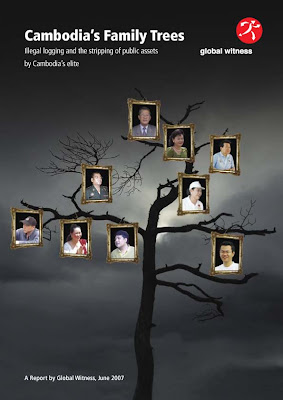
Human Rights Watch called on the Cambodian government to rescind its June 3 order to “ban and collect” the recent report by Global Witness. The report, “Cambodia’s Family Trees,” alleges illegal logging by individuals close to Prime Minister Hun Sen. It also claims that the government’s promises to end illegal logging have been broken, that the army, military police and police are deeply involved in illegal logging, and that funds from illegal logging support Hun Sen’s personal bodyguard unit, which has been responsible for human rights abuses.

The government should officially repudiate reported statements by Kompong Cham provincial governor Hun Neng, Hun Sen’s brother. Hun Neng reportedly said on June 11 that “If they [Global Witness] come to Cambodia, I will hit them until their heads are broken.”

“The government’s reaction to the Global Witness report shows its lack of commitment to freedom of expression and public debate, and its continued thuggish behavior,” said Adams. “Donors should insist that the government undertake a credible judicial investigation into the criminal activities detailed in the report, rather than resort to violent threats against its authors. Donors often complain about a lack of political will from the government, but this will be a test of their political will, too.”

Human Rights Watch said that donors have a major role to play in determining Cambodia’s future by continuing their assistance to civil society and insisting that the government fully comply with commitments made at successive donor meetings dating back to 1993. After billions of dollars of donor support over the past 14 years, it is time for a clear and unambiguous signal to be sent to the government. Donors should make it clear that they can no longer accept previously unmet promises.

For more than a decade, donors have been providing aid equivalent to roughly half Cambodia’s national budget. As donors have noted, good governance is directly linked to a country’s pace of development. There is little doubt that Cambodia’s development continues to be slowed by the country’s poor governance.

“If donors are serious about development in Cambodia, they should start generating momentum for real reform,” said Adams. “They need to emphasize, not marginalize, the links between human rights and development.”

Development assistance and budgetary support should be contingent on the government meeting agreed benchmarks on human rights, the rule of law, and good governance, such as:
  • Tackling impunity for human rights abuses, including the many extrajudicial killings carried out during and after the July 1997 coup by Hun Sen’s government;
  • Ceasing to harass and threaten civil society activists and opposition party members;
  • Ensuring that the rights of individuals and organizations to defend and promote human rights are protected, including the right to peacefully criticize and protest government policies, in accordance with the International Covenant on Civil and Political Rights and the 1998 United Nations General Assembly Declaration on Human Rights Defenders;
  • Creating an independent and restructured National Election Committee;
  • Liberalizing electronic media ownership rules, including allowing transmitters of private, critical media to be as strong as those of pro-government private stations;
  • Complying fully with previous Consultative Group commitments to address corruption and misuse of natural resources and other state assets; these include public disclosure of information concerning management of land, forests, mineral deposits and fisheries, as well as the location of military development zones; and,
  • Passing legislation on asset disclosure and anti-corruption that meets international standards, and appointing an independent, international external auditor for government finances.
Past meetings of the Consultative Group have been attended by 18 countries and five intergovernmental organizations: Australia, Belgium, Canada, Denmark, Finland, France, Germany, Ireland, Japan, Korea, New Zealand, Norway, Poland, Russia, Singapore, Sweden, the United Kingdom and the United States, plus the Asian Development Bank, the European Commission, the International Monetary Fund, the United Nations Development Program, and the World Bank.

“The donors’ list of conditions hardly changes over time, and the government simply ignores them year after year,” said Adams. “Hun Sen continues to run circles around the donors, making the same empty promises every year and laughing all the way to the bank.”

Rights group urges donors to get tough with Cambodia

Jun 16, 2007
DPA
"The five billion dollars in aid ploughed into Cambodia in the past decade has yielded little in return for the donors or the Cambodian people" - Brad Adams, Human Rights Watch Asia director
Phnom Penh - A New York-based human rights group Saturday urged international donors to make the Cambodian government more accountable for the way it uses aid, citing the recent banning of a logging report in the lead-up to a vital donor meeting next week.

Human Rights Watch (HRW) released the statement ahead of a Consultative Group (CG) meeting of international donors scheduled for Tuesday and Wednesday, during which it said donors are expected to pledge more than 600 million dollars to the aid-dependent country.

HRW said the banning of a recent report on illegal logging by London-based environmental watchdog Global Witness which claimed to link high ranking government officials and their families to the illegal trade had made a mockery of the Cambodian government's claims of commitment to human rights.

Cambodia sacked Global Witness as its independent forestry watchdog in 2003 and later banned it from the country. It has strongly denied the allegations made against it in the report, claiming the document is revenge in retaliation for the group's sacking.

Some individuals named in the report have threatened legal action and Cambodia has asked the group's donors to curb its funding.

Human Rights Watch urged Cambodia's international donors to 'not accept any more empty promises' from the Cambodian government on human rights, the rule of law and good governance. It said human rights violations went unpunished, corruption was rampant and 'natural resources are still being plundered.'

'The five billion dollars in aid ploughed into Cambodia in the past decade has yielded little in return for the donors or the Cambodian people,' HRW Asia director Brad Adams said in the statement.

'The meeting has become an empty annual ritual, with the government making and breaking promises every year. There will be more promises made this year, but without serious donor pressure they, too, will be broken.

'The government's reaction to the Global Witness report shows its lack of commitment to freedom of expression and public debate,' Adams said.

The consultative group comprises 18 key donors to Cambodia including Germany, Japan and South Korea, and the Asian Development Bank, the European Commission, the International Monetary Fund, the United Nations Development Program and the World Bank.

Adams charged that Prime Minister Hun Sen 'continues to run circles around the donors, making the same empty promises every year and laughing all the way to the bank.'

The Cambodian government has been scathing of HRW allegations and demands in the past, accusing the group of harbouring a political agenda and of refusing to acknowledge its efforts at ongoing reforms.

Friday, June 15, 2007

US Amb ambiguous position regarding GW report: Mussomeli supports GW report but not the fact that GW is accusing individuals


Friday, June 15, 2007
Rasmei Kampuchea newspaper
Translated from Khmer by Socheata
“Cambodia can be considered as one of the countries that has a good human rights record when compared to a number of other countries” - Joseph Mussomeli, US Ambassador to Cambodia
Joseph Mussomeli, US Ambassador to Cambodia, said that he supports the Global Witness report regarding illegal logging and corruption which cause several problems (in Cambodia), however, he does not support the political attitude taken to accuse each individual without sufficient evidence.

During a visit to Peace Corps volunteers who are currently teaching English at the Hun Sen Svay Chrum high school on 13 June, Amb Mussomeli declared in an interview with reporters that he shares the concerns expressed by Global Witness regarding illegal logging and corruption which cause a lot of problems, however, he criticizes the entire Global Witness report for accusing each individual without providing sufficient evidence to back up the accusations made against these individuals.

Mussomeli said: “We do not support the accusations made by Global Witness against each individual because it does not contain sufficient evidence.”

“In the future, I am confident that Global Witness and the Royal Government of Cambodia will hold a constructive dialogue because Global Witness has a lot of issues to raise to the government, and the government also has a lot of explaining to do on the issues raised by Global Witness,” Mussomeli added.

Regarding Mr Yash Ghai, the UN Special Envoy for Human Rights in Cambodia, Amb Mussomeli said: “It’s a fact that Mr Yash Ghai and human rights organizations has an important role in advancing human rights issues, and I hope that the relationship between Mr Yash Ghai and the Royal Government of Cambodia will improve in the future, and that they both will hold a dialogue to discuss on a number of issues that they need to accomplish.”

Nevertheless, Amb Mussomeli said that “Cambodia can be considered as one of the countries that has a good human rights record when compared to a number of other countries.”

When questioned about the impact of Yash Ghai’s human rights report and the Global Witness report on the upcoming Consultative Group (CG) aid forum to Cambodia, to be held between the Cambodian government and the aid providers, Amb Mussomeli provided his opinion by saying: “At the upcoming CG meeting, donor countries will not have major problems (that will force them) to cut aid to Cambodia, even though Global Witness asked for donor countries to apply pressures on Cambodia regarding illegal logging.”

He provides this opinion based on two factors: (1) government officials and other officials are actively working to fight against illegal logging, and (2) donor countries are coming to Cambodia to provide aid to the Cambodian people on AIDS issue, on healthcare issue, on lack of food for children issue, therefore, what can Global Witness do to reduce this kind of aid? I believe that it (GW) cannot do it.”

Wednesday, June 13, 2007

Begging festival celebration in preparation: CPP hopes that aid will still pour in

Tuesday, June 12, 2007
Everyday.com.kh
Translated from Khmer by Heng Soy

Even though it is facing with a barrage of criticisms from NGOs and Global Witness just before the Consultative Group (CG) meeting next week, high-ranking CPP officials expressed their belief that these criticisms will not lead to aid cut for Cambodia. Nguon Nhel, CPP first Vice-president of the National Assembly, said on Monday that he is confident that donor countries will continue to provide aid to Cambodia, because they know that the (Cambodian) government is doing a good job, and it deserves the aid. Nguon Nhel told The Cambodia Daily that donor countries would not provide sacks and sacks of dollars in aid to a corrupt government. He added: “I think that the donor countries and international institutions won’t believe the NGO’s report.” CPP MP Cheam Yiep said that he believed the donor countries will listen to the comments made by Samdach Hun Sen and Mr. Keat Chhon, the minister of economy and finance.

Tuesday, June 12, 2007

Time for begging again: Phnom Penh put up a show by cancelling land concession projects with 5 private companies

June 12, 2007
Cambodia cancels land concession projects with 5 private companies

The Cambodian government has canceled the land concession projects with five private companies because they didn't respect the contracts, said Prime Minister Hun Sen on Tuesday.

"Yesterday, I decided to sign a government degree for stopping economic land concession projects with five private companies according to the requests from Ministry of Agriculture, Forestry and Fisheries," he said while launching the World Bank's report on "Sharing Growth: Equity and Development in Cambodia."

He didn't elaborate on decision.

"From now on, if any private company receives economic land concession from the government but doesn't respect the agreement, I will order to stop it immediately and withdraw the land," he said.

"We can't prolong the land development project agreements anymore. And we observe other companies one by one and check subsequently," he added.

In the past years, the Cambodian government handed over land concession projects to private companies in order to develop the economy, provide jobs for the people and help reduce poverty.

However, some companies are just unable to finish the projects and leave their lands deserted, thus triggering off wide-spread criticism against the government's decision.

Source: Xinhua

NGOs To Ask Donors To Press Cambodian Government To Tackle 'Major' Problems

NGOs meeting (Photo: Sralanh Khmer)

Nongovernmental organizations Meet To Ask Donors To Put Pressure on Cambodian Government

09 Jun 07
by Veha
Sralanh Khmer

Translated from Khmer and posted online

Before donor countries meet with the Cambodian Government on 18-19 June, "some 200 officials from more than 10 important nongovernmental organizations [NGOs] in provinces and cities have held a meeting to look for key recommendations on major problems which will be reported to the donors' representatives so they will put pressure on the Hun Sen government."

The report quoted Sok Sam-oeun, executive director of the Cambodian Defender's Project and representative of the NGOs who would take part in the consultative meeting with the donors, as stating that the NGOs "had presented many important points to persuade the donor representatives to put pressure on the government." Sok Sam-oeun made the statement at a meeting to disseminate the document about the NGOs' position on the development of Cambodia in 2006 and their statement about the forum on cooperation to develop Cambodia in 2007 held at the [Phnom Penh] World Vision office [date not published].

Sok Sam-oeun added the NGOs viewed that the "present judicial system has not yet been independent, and we request that the government enforce two important basic laws: 1) the law on the structure and functions of the Supreme Council of Magistracy and 2) the judges' statute. They have already been prepared, but have been blocked. They have not yet been passed. Therefore, the government is requested to state in that law that judges are independent. The judges and prosecutors should not be forced to join any political parties at all."

The report said Chhit Sam-at, executive director of the NGO Forum, had compiled key documents about the NGOs' statement on the forum on cooperation to develop Cambodia in 2007. He said there were three priority problems that should be presented to the government: "1) farmlands and natural resources management; 2) good governance, and 3) human resource development. "

Chhit Sam-at added that what was "more important was the need of the weak and poor people who were victims of speedy economic development and who had been evicted from their homes, affecting their livelihood." The NGOs, he further said, were "concerned about the rights of the people, who have lost their land, houses and who have not been provided with health services, clean water, various public services, and so forth."

Chhit Sam-at also said that the NGOs requested the government to "put off granting temporary land concessions to businessmen or private companies until after state land was delimited and registered in accordance with the subdecree on state land management and after the granting of collective land titles to ethnic minority groups had been complete."

Chhit Sam-at further said the "eviction of people was possible only if other options were enforced but still unproductive. " Anyway, a policy should be established to support the reselection of "distributed land" in development regions. Moreover, compensations to victims should be "reasonable and fair" and offered, before the implementation of projects, according to market prices evaluated by independent observers and monitors.

As for Sin Somuni, executive director of MEDICAM, the report said, he stated that those problems "are not just raised by the NGOs this year. We have defended our views for many years already. The government must look at major problems." He added "scorching problems" that should be dealt with were "corruption, the reform of public services, including raising salaries for the public servant, and so forth." Additionally, pressure should be brought to bear on the government to ensure that "natural resources" were also used to "serve the people's need."

To conclude, the report said Sin Somuni also demanded that donor countries "achieve results" at the consultative meeting to take place on 18-19 June, with a view to "developing Cambodia, making it better."