


Showing posts with label Global Witness report ban. Show all posts
Showing posts with label Global Witness report ban. Show all posts
Friday, January 25, 2008


Thursday, August 16, 2007
Cambodia standards of justice: You talk, you die
Arson attack follows anonymous threat against journalist reporting on illegal logging
Country/Topic: Cambodia
Date: 15 August 2007
Source: Committee to Protect Journalists (CPJ)
Person(s): Phan Phat
Target(s): journalist(s)
Type(s) of violation(s): attacked , threatened
Urgency: Flash
(CPJ/IFEX) - The following is a CPJ press release:
NEW YORK, August 15, 2007 - The Committee to Protect Journalists calls on the Cambodian government to launch an independent investigation into the recent arson attack on the home of Phan Phat, a journalist with the local Khmer language newspaper Chbas Kar.
According to local press freedom groups and news reports, Phat's wooden house was set ablaze by unknown assailants at around 4 a.m. on August 10 in the Boeng Khnar commune of Porsat province. The small blaze was quickly extinguished and Phat and his family escaped without injury. Phat was quoted by local media as saying that he had received an anonymous phone call threatening to give him a "gift" the day before the attack, according to the same reports.
Commune Police Chief Sann Ly was quoted in a local publication as saying that the attack was likely in "revenge" for Phat's recent reporting on illegal logging activities in the province's Bakan district. District Police Chief Youk Yoen told reporters that judging by the small amount of gasoline used in the arson attack, the assailants likely did not mean to kill the reporter and his family. The police official said his office was approaching the case as "an attack on the free press."
"There is strong reason to believe that the attack on Phan Phat was motivated by his work as a journalist," said Joel Simon, CPJ's executive director. "Cambodian authorities must act quickly and decisively to uncover who is responsible."
Illegal logging is rampant in Cambodia's provincial areas. Reporters who dare to publish on the activities often face threats, physical attacks, and sometimes death. An investigative report released in May by UK-based environmental watchdog Global Witness accused several high ranking Cambodian officials of complicity in illegal logging, including a senior official inside Prime Minister Hun Sen's personal bodyguard unit. Government officials denied any involvement in illegal logging.
The government ordered a ban on the report's distribution and the Ministry of Information issued a blanket order to local media outlets not to publish on the report's findings. Lem Pichpisey, a radio reporter with Radio Free Asia, nonetheless aired several news stories on the report's allegations. He later received an anonymous death threat by telephone. The radio reporter was forced to flee Cambodia for neighboring Thailand on June 17 due to his editors' concerns about his personal security.
CPJ is a New York-based, independent, nonprofit organization that works to safeguard press freedom worldwide. For more information, visit http://www.cpj.org
Country/Topic: Cambodia
Date: 15 August 2007
Source: Committee to Protect Journalists (CPJ)
Person(s): Phan Phat
Target(s): journalist(s)
Type(s) of violation(s): attacked , threatened
Urgency: Flash
(CPJ/IFEX) - The following is a CPJ press release:
Arson attack follows anonymous threat against Cambodian journalist
NEW YORK, August 15, 2007 - The Committee to Protect Journalists calls on the Cambodian government to launch an independent investigation into the recent arson attack on the home of Phan Phat, a journalist with the local Khmer language newspaper Chbas Kar.
According to local press freedom groups and news reports, Phat's wooden house was set ablaze by unknown assailants at around 4 a.m. on August 10 in the Boeng Khnar commune of Porsat province. The small blaze was quickly extinguished and Phat and his family escaped without injury. Phat was quoted by local media as saying that he had received an anonymous phone call threatening to give him a "gift" the day before the attack, according to the same reports.
Commune Police Chief Sann Ly was quoted in a local publication as saying that the attack was likely in "revenge" for Phat's recent reporting on illegal logging activities in the province's Bakan district. District Police Chief Youk Yoen told reporters that judging by the small amount of gasoline used in the arson attack, the assailants likely did not mean to kill the reporter and his family. The police official said his office was approaching the case as "an attack on the free press."
"There is strong reason to believe that the attack on Phan Phat was motivated by his work as a journalist," said Joel Simon, CPJ's executive director. "Cambodian authorities must act quickly and decisively to uncover who is responsible."
Illegal logging is rampant in Cambodia's provincial areas. Reporters who dare to publish on the activities often face threats, physical attacks, and sometimes death. An investigative report released in May by UK-based environmental watchdog Global Witness accused several high ranking Cambodian officials of complicity in illegal logging, including a senior official inside Prime Minister Hun Sen's personal bodyguard unit. Government officials denied any involvement in illegal logging.
The government ordered a ban on the report's distribution and the Ministry of Information issued a blanket order to local media outlets not to publish on the report's findings. Lem Pichpisey, a radio reporter with Radio Free Asia, nonetheless aired several news stories on the report's allegations. He later received an anonymous death threat by telephone. The radio reporter was forced to flee Cambodia for neighboring Thailand on June 17 due to his editors' concerns about his personal security.
CPJ is a New York-based, independent, nonprofit organization that works to safeguard press freedom worldwide. For more information, visit http://www.cpj.org
Wednesday, July 04, 2007
Khieu Kanharith: Global Witness report affects Cambodia's national security -sic!-
 Khieu Kanharith provides clarifications to the NA committee on the Global Witness case
02 July 2007
By Sok Serei Radio Free Asia
Translated from Khmer by Heng Soy
On Monday, the National Assembly (NA) committee on foreign affairs and international cooperation, and information, summoned Khieu Kanharith, the Minister of Information (MoInf), to provide clarifications on the reason why the MoInf banned the publication of the Global Witness report in Cambodia. The report accused relatives of Cambodian government leaders, and high ranking government officials, of involvement in illegal logging in Kompong Thom province.
SRP MP Son Chhay, chairman of the above NA committee, told RFA on Monday that the MoInf ban of the report in unacceptable.
Son Chhay said: “The MoInf banned the publication of the Global Witness (report) about illegal logging in Tumring and at other national parks, involving government officials, this is a problem which we want to have more information about.”
Regarding this issue, Khieu Kanharith said: “In summary, this is an explanation to the NA question, they must understand a lot about what the MoInf must perform, and what else must be planned (by the MoInf) to be performed in the future.”
After direct clarification from Khieu Kanharith, Son Chhay said that he agreed with some of the points in the publication reviews, but he does not agree on the ban of research documents, including the Global Witness report which (the government tries to) link to national security matters.
Son Chhay added: “There must be some reviews of published information, but in the past activities, we did not see that it (Global Witness report) affects the national security.”
Dr Pung Chiv Kek, President of Licadho human rights organization, said that Cambodian people have the rights to freely receive information. “In order for our country to have democracy, there should not be any ban in the publication of information.”
On 8 June, the MoInf sent a declaration to all newspaper and magazine publishers to stop all publications of the Global Witness report. In this banned report, the London-based Global Witness leveled serious accusations on the relatives of the prime minister of Cambodia, on the relatives of Chan Sarun, the minister of agriculture, and on the relatives of Ty Sokhun, the director of the Cambodian forestry department, saying that they are involved in illegal logging in Cambodia.
These accusations were met by rebuttal claims from the accused government officials who said that the accusations were baseless.
SRP MP Son Chhay, chairman of the above NA committee, told RFA on Monday that the MoInf ban of the report in unacceptable.
Son Chhay said: “The MoInf banned the publication of the Global Witness (report) about illegal logging in Tumring and at other national parks, involving government officials, this is a problem which we want to have more information about.”
Regarding this issue, Khieu Kanharith said: “In summary, this is an explanation to the NA question, they must understand a lot about what the MoInf must perform, and what else must be planned (by the MoInf) to be performed in the future.”
After direct clarification from Khieu Kanharith, Son Chhay said that he agreed with some of the points in the publication reviews, but he does not agree on the ban of research documents, including the Global Witness report which (the government tries to) link to national security matters.
Son Chhay added: “There must be some reviews of published information, but in the past activities, we did not see that it (Global Witness report) affects the national security.”
Dr Pung Chiv Kek, President of Licadho human rights organization, said that Cambodian people have the rights to freely receive information. “In order for our country to have democracy, there should not be any ban in the publication of information.”
On 8 June, the MoInf sent a declaration to all newspaper and magazine publishers to stop all publications of the Global Witness report. In this banned report, the London-based Global Witness leveled serious accusations on the relatives of the prime minister of Cambodia, on the relatives of Chan Sarun, the minister of agriculture, and on the relatives of Ty Sokhun, the director of the Cambodian forestry department, saying that they are involved in illegal logging in Cambodia.
These accusations were met by rebuttal claims from the accused government officials who said that the accusations were baseless.
Friday, June 29, 2007
Cambodia: Logging abuse
Activists and journalists who exposed eco-scandal under threat.
29.06.2007
By Andrew Wasley
Index on Censorship for free expression
29.06.2007
By Andrew Wasley
Index on Censorship for free expression
Journalists and campaigners working to expose an environmental scandal in Cambodia are under threat from the political and business interests with most to lose from their investigations. Andrew Wasley reports.
Journalists and environmental activists investigating deforestation in Cambodia are facing harassment, death threats and censorship after a report accused senior officials within the country's government of involvement in illegal logging, kidnapping and attempted murder.
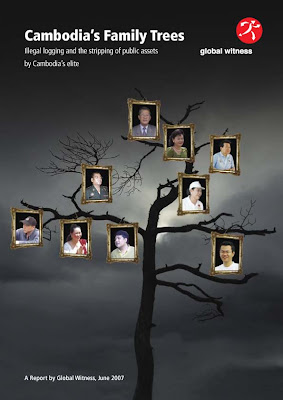
In Cambodia's Family Trees UK-based campaign group Global Witness claims that leading figures in Cambodia's government - including relatives of Prime Minster Hun Sen - are complicit in destroying large swathes of the country's remaining forests and is calling for international donors to conduct a thorough inquiry into the activities of this 'forest mafiosi' before pledging future development money.
The Cambodian authorities responded to the report's allegations by banning its publication inside the country, threatening Global Witness campaigners and harassing journalists reporting on the story.
The prime minister's brother directly threatened Global Witness earlier this month, stating, ‘if they … come to Cambodia I will hit them until their heads are broken’. Copies of the investigative report have subsequently been confiscated in Phnom Penh and several journalists targeted for covering the story.
Lem Piseth, a reporter with Radio Free Asia, received an anonymous death threat by mobile telephone after producing a piece looking at deforestation in the Kompong Thom province in central Cambodia. The caller accused Piseth of being insolent and asked if he ‘wanted to die’ before stating that there ‘will not be enough land to bury you in’.
The journalist also claimed that whilst researching the story, he was followed by police and the military and was unexpectedly forced to leave a hotel by its owners, who provided no explanation. Piseth, fearing for his life following the death threat, has now fled to Thailand.
Soren Seelow, news editor with the French language daily Cambodge Soir, also suffered after publishing extracts of the Global Witness report in an article highlighting the pressure group's findings. Seelow was summarily dismissed by the paper's owners who claimed the article would upset the authorities and put them in a difficult position.
Employees on the newspaper subsequently went on strike in protest at Seelow's removal, and have now been told the newspaper faces closure.
The worldwide press freedom organisation Reporters sans Frontières commented: ‘It is obvious that the Global Witness report on the over-exploitation of the Cambodian forests is upsetting some people. Since this report was released, all media have been subjected to unjustified state censorship... and we urge the authorities to identify those who made threats (to Lem Piseth) so he can safely resume his work.’
The report alleges that one of the most powerful logging syndicates in the country is the Seng Keang Company, allegedly controlled by the prime minister’s cousin Dy Chouch; his ex-wife Seng Keang; her brother Seng Kok Keang; the Minister of Agriculture, Forestry and Fisheries, Chan Sarun; and, director-general of the Forest Administration, Ty Sokhun.
Under the guise of a rubber plantation scheme, the syndicate is accused of logging timber from the Prey Long forest. The targeting of resin trees has also destroyed the livelihoods of hundreds, if not thousands, of families living in the area, states the report .
Global Witness also claims that the company attempted to kill two community forest activists who had protested against illegal logging in Prey Long. It is alleged that the elite army unit, known as the Brigade 70, which reportedly has close connections to senior politicians, including the prime minister, has transported illegally logged timber and other smuggled goods.
Environmentalists and human rights pressure groups are now calling on a ‘complacent’ international donor community to launch their own inquiry into the allegations - and support the prosecution of those involved. Failure to do so, argue campaigners, will effectively mean that international money will continue to be fed into a corrupt regime and ultimately offer little benefit to Cambodia's impoverished people.
It is not the first time the Cambodian authorities have attempted to stifle the findings of Global Witness. In 2005, copies of a previous report Taking A Cut were confiscated by customs officials at Pochentong Airport; in 2002 a senior Global Witness campaigner was beaten by a gang of masked men armed with sticks in Phnom Penh. Prior to this, activists had received threats by email from forest concession security staff.
Illegal logging, in Cambodia and across the world, is big business and frequently linked to organised crime and corrupt government officials.
Index on Censorship previously revealed the dangers facing journalists and activists reporting on environmental abuses (‘Dangers lurking in the forests’, 2002) following a brutal attack on an Indonesian reporter, Arbi Kusno, investigating logging issues. Kusno was attacked by thugs armed with machetes and was so badly injured he was presumed dead, only waking up en-route to the morgue.
Journalists and environmental activists investigating deforestation in Cambodia are facing harassment, death threats and censorship after a report accused senior officials within the country's government of involvement in illegal logging, kidnapping and attempted murder.
In Cambodia's Family Trees UK-based campaign group Global Witness claims that leading figures in Cambodia's government - including relatives of Prime Minster Hun Sen - are complicit in destroying large swathes of the country's remaining forests and is calling for international donors to conduct a thorough inquiry into the activities of this 'forest mafiosi' before pledging future development money.
The Cambodian authorities responded to the report's allegations by banning its publication inside the country, threatening Global Witness campaigners and harassing journalists reporting on the story.
The prime minister's brother directly threatened Global Witness earlier this month, stating, ‘if they … come to Cambodia I will hit them until their heads are broken’. Copies of the investigative report have subsequently been confiscated in Phnom Penh and several journalists targeted for covering the story.
Lem Piseth, a reporter with Radio Free Asia, received an anonymous death threat by mobile telephone after producing a piece looking at deforestation in the Kompong Thom province in central Cambodia. The caller accused Piseth of being insolent and asked if he ‘wanted to die’ before stating that there ‘will not be enough land to bury you in’.
The journalist also claimed that whilst researching the story, he was followed by police and the military and was unexpectedly forced to leave a hotel by its owners, who provided no explanation. Piseth, fearing for his life following the death threat, has now fled to Thailand.
Soren Seelow, news editor with the French language daily Cambodge Soir, also suffered after publishing extracts of the Global Witness report in an article highlighting the pressure group's findings. Seelow was summarily dismissed by the paper's owners who claimed the article would upset the authorities and put them in a difficult position.
Employees on the newspaper subsequently went on strike in protest at Seelow's removal, and have now been told the newspaper faces closure.
The worldwide press freedom organisation Reporters sans Frontières commented: ‘It is obvious that the Global Witness report on the over-exploitation of the Cambodian forests is upsetting some people. Since this report was released, all media have been subjected to unjustified state censorship... and we urge the authorities to identify those who made threats (to Lem Piseth) so he can safely resume his work.’
The report alleges that one of the most powerful logging syndicates in the country is the Seng Keang Company, allegedly controlled by the prime minister’s cousin Dy Chouch; his ex-wife Seng Keang; her brother Seng Kok Keang; the Minister of Agriculture, Forestry and Fisheries, Chan Sarun; and, director-general of the Forest Administration, Ty Sokhun.
Under the guise of a rubber plantation scheme, the syndicate is accused of logging timber from the Prey Long forest. The targeting of resin trees has also destroyed the livelihoods of hundreds, if not thousands, of families living in the area, states the report .
Global Witness also claims that the company attempted to kill two community forest activists who had protested against illegal logging in Prey Long. It is alleged that the elite army unit, known as the Brigade 70, which reportedly has close connections to senior politicians, including the prime minister, has transported illegally logged timber and other smuggled goods.
Environmentalists and human rights pressure groups are now calling on a ‘complacent’ international donor community to launch their own inquiry into the allegations - and support the prosecution of those involved. Failure to do so, argue campaigners, will effectively mean that international money will continue to be fed into a corrupt regime and ultimately offer little benefit to Cambodia's impoverished people.
It is not the first time the Cambodian authorities have attempted to stifle the findings of Global Witness. In 2005, copies of a previous report Taking A Cut were confiscated by customs officials at Pochentong Airport; in 2002 a senior Global Witness campaigner was beaten by a gang of masked men armed with sticks in Phnom Penh. Prior to this, activists had received threats by email from forest concession security staff.
Illegal logging, in Cambodia and across the world, is big business and frequently linked to organised crime and corrupt government officials.
Index on Censorship previously revealed the dangers facing journalists and activists reporting on environmental abuses (‘Dangers lurking in the forests’, 2002) following a brutal attack on an Indonesian reporter, Arbi Kusno, investigating logging issues. Kusno was attacked by thugs armed with machetes and was so badly injured he was presumed dead, only waking up en-route to the morgue.
Tuesday, June 19, 2007
AHRC censures Hun Sen's regime ban of Global Witness report
Rights Commission Censures Gov't Over Banned Report
Mony, VOA Khmer
Original report from Phnom Penh
18/06/2007
Mony, VOA Khmer
Original report from Phnom Penh
18/06/2007
The Hong-Kong based Human Rights Commission criticized the government's recent banning of a forestry report as an infringement on free speech.
Hard copies and serialization of a Global Witness report—linking illegal logging to the prime minister and other high-ranking officials—have both been banned by the Ministry of Information.
"The ban infringes upon the right of the media to freedom of expression," the Rights Commission said. "In Cambodia, the freedom of expression is often quashed by government officials to protect their own agendas, under the guise of alleging defamation or otherwise."
Government spokesman Khieu Kanharith, who is also the Minister of Information, dismissed the criticism, saying the government allowed newspapers to report on the document for at least a week before banning it.
The Rights Commission said such a dictate made a "mockery" of free speech.
"For the Information Minister to try and dictate how much of the report is permitted to be published, and for how many days, is a mockery to the meaning of freedom of expression," the group said.
The Global Witness report links Prime Minister Hun Sen and Minister of Agriculture Chan Sarun to illegal logging, along with the director-general of the government's Forest Administration, Ty Sokhun, and a laundry list of other government and military officials.
All have denied any connection to the crime, and Khieu Kanharith said the ban was for the good of the nation's newspapers and journalists.
The Ministry of Information "feels sorry for the journalists," he said. "Because, be careful, the ministry in [the report] might sue [and] our newspapers will lose money."
Hard copies and serialization of a Global Witness report—linking illegal logging to the prime minister and other high-ranking officials—have both been banned by the Ministry of Information.
"The ban infringes upon the right of the media to freedom of expression," the Rights Commission said. "In Cambodia, the freedom of expression is often quashed by government officials to protect their own agendas, under the guise of alleging defamation or otherwise."
Government spokesman Khieu Kanharith, who is also the Minister of Information, dismissed the criticism, saying the government allowed newspapers to report on the document for at least a week before banning it.
The Rights Commission said such a dictate made a "mockery" of free speech.
"For the Information Minister to try and dictate how much of the report is permitted to be published, and for how many days, is a mockery to the meaning of freedom of expression," the group said.
The Global Witness report links Prime Minister Hun Sen and Minister of Agriculture Chan Sarun to illegal logging, along with the director-general of the government's Forest Administration, Ty Sokhun, and a laundry list of other government and military officials.
All have denied any connection to the crime, and Khieu Kanharith said the ban was for the good of the nation's newspapers and journalists.
The Ministry of Information "feels sorry for the journalists," he said. "Because, be careful, the ministry in [the report] might sue [and] our newspapers will lose money."
Saturday, June 16, 2007
Cambodia: Donors Must Hold Government Accountable
 Global Witness report banned by Hun Sen's regime
Human Rights Watch
Banning of Forest Report Mocks Commitments to Human Rights
(New York, June 15, 2007) – Cambodia’s international donors should not accept any more empty promises from the Cambodian government on human rights, the rule of law and good governance, Human Rights Watch said today. The annual Consultative Group meeting of donors is scheduled to take place in Phnom Penh on June 19-20, and donors are expected to pledge more than US$600 million in additional aid for the next year.
Human Rights Watch said that the Cambodian government has made virtually no progress in the past decade on key pledges to donors on the rule of law or judicial independence. Impunity for human rights violations remains the rule. Corruption is rampant. Natural resources are still being plundered. Those who report on such abuses are threatened or harassed and sometimes subject to violence.
“The $5 billion in aid plowed into Cambodia in the past decade has yielded little in return for the donors or the Cambodian people,” said Brad Adams, Asia director at Human Rights Watch. “The meeting has become an empty annual ritual, with the government making and breaking promises every year. There will be more promises made this year, but without serious donor pressure they, too, will be broken.”
Human Rights Watch called on the Cambodian government to rescind its June 3 order to “ban and collect” the recent report by Global Witness. The report, “Cambodia’s Family Trees,” alleges illegal logging by individuals close to Prime Minister Hun Sen. It also claims that the government’s promises to end illegal logging have been broken, that the army, military police and police are deeply involved in illegal logging, and that funds from illegal logging support Hun Sen’s personal bodyguard unit, which has been responsible for human rights abuses.
The government should officially repudiate reported statements by Kompong Cham provincial governor Hun Neng, Hun Sen’s brother. Hun Neng reportedly said on June 11 that “If they [Global Witness] come to Cambodia, I will hit them until their heads are broken.”
“The government’s reaction to the Global Witness report shows its lack of commitment to freedom of expression and public debate, and its continued thuggish behavior,” said Adams. “Donors should insist that the government undertake a credible judicial investigation into the criminal activities detailed in the report, rather than resort to violent threats against its authors. Donors often complain about a lack of political will from the government, but this will be a test of their political will, too.”
Human Rights Watch said that donors have a major role to play in determining Cambodia’s future by continuing their assistance to civil society and insisting that the government fully comply with commitments made at successive donor meetings dating back to 1993. After billions of dollars of donor support over the past 14 years, it is time for a clear and unambiguous signal to be sent to the government. Donors should make it clear that they can no longer accept previously unmet promises.
For more than a decade, donors have been providing aid equivalent to roughly half Cambodia’s national budget. As donors have noted, good governance is directly linked to a country’s pace of development. There is little doubt that Cambodia’s development continues to be slowed by the country’s poor governance.
“If donors are serious about development in Cambodia, they should start generating momentum for real reform,” said Adams. “They need to emphasize, not marginalize, the links between human rights and development.”
Development assistance and budgetary support should be contingent on the government meeting agreed benchmarks on human rights, the rule of law, and good governance, such as:
“The donors’ list of conditions hardly changes over time, and the government simply ignores them year after year,” said Adams. “Hun Sen continues to run circles around the donors, making the same empty promises every year and laughing all the way to the bank.”
(New York, June 15, 2007) – Cambodia’s international donors should not accept any more empty promises from the Cambodian government on human rights, the rule of law and good governance, Human Rights Watch said today. The annual Consultative Group meeting of donors is scheduled to take place in Phnom Penh on June 19-20, and donors are expected to pledge more than US$600 million in additional aid for the next year.
Human Rights Watch said that the Cambodian government has made virtually no progress in the past decade on key pledges to donors on the rule of law or judicial independence. Impunity for human rights violations remains the rule. Corruption is rampant. Natural resources are still being plundered. Those who report on such abuses are threatened or harassed and sometimes subject to violence.
“The $5 billion in aid plowed into Cambodia in the past decade has yielded little in return for the donors or the Cambodian people,” said Brad Adams, Asia director at Human Rights Watch. “The meeting has become an empty annual ritual, with the government making and breaking promises every year. There will be more promises made this year, but without serious donor pressure they, too, will be broken.”
Human Rights Watch called on the Cambodian government to rescind its June 3 order to “ban and collect” the recent report by Global Witness. The report, “Cambodia’s Family Trees,” alleges illegal logging by individuals close to Prime Minister Hun Sen. It also claims that the government’s promises to end illegal logging have been broken, that the army, military police and police are deeply involved in illegal logging, and that funds from illegal logging support Hun Sen’s personal bodyguard unit, which has been responsible for human rights abuses.
The government should officially repudiate reported statements by Kompong Cham provincial governor Hun Neng, Hun Sen’s brother. Hun Neng reportedly said on June 11 that “If they [Global Witness] come to Cambodia, I will hit them until their heads are broken.”
“The government’s reaction to the Global Witness report shows its lack of commitment to freedom of expression and public debate, and its continued thuggish behavior,” said Adams. “Donors should insist that the government undertake a credible judicial investigation into the criminal activities detailed in the report, rather than resort to violent threats against its authors. Donors often complain about a lack of political will from the government, but this will be a test of their political will, too.”
Human Rights Watch said that donors have a major role to play in determining Cambodia’s future by continuing their assistance to civil society and insisting that the government fully comply with commitments made at successive donor meetings dating back to 1993. After billions of dollars of donor support over the past 14 years, it is time for a clear and unambiguous signal to be sent to the government. Donors should make it clear that they can no longer accept previously unmet promises.
For more than a decade, donors have been providing aid equivalent to roughly half Cambodia’s national budget. As donors have noted, good governance is directly linked to a country’s pace of development. There is little doubt that Cambodia’s development continues to be slowed by the country’s poor governance.
“If donors are serious about development in Cambodia, they should start generating momentum for real reform,” said Adams. “They need to emphasize, not marginalize, the links between human rights and development.”
Development assistance and budgetary support should be contingent on the government meeting agreed benchmarks on human rights, the rule of law, and good governance, such as:
- Tackling impunity for human rights abuses, including the many extrajudicial killings carried out during and after the July 1997 coup by Hun Sen’s government;
- Ceasing to harass and threaten civil society activists and opposition party members;
- Ensuring that the rights of individuals and organizations to defend and promote human rights are protected, including the right to peacefully criticize and protest government policies, in accordance with the International Covenant on Civil and Political Rights and the 1998 United Nations General Assembly Declaration on Human Rights Defenders;
- Creating an independent and restructured National Election Committee;
- Liberalizing electronic media ownership rules, including allowing transmitters of private, critical media to be as strong as those of pro-government private stations;
- Complying fully with previous Consultative Group commitments to address corruption and misuse of natural resources and other state assets; these include public disclosure of information concerning management of land, forests, mineral deposits and fisheries, as well as the location of military development zones; and,
- Passing legislation on asset disclosure and anti-corruption that meets international standards, and appointing an independent, international external auditor for government finances.
“The donors’ list of conditions hardly changes over time, and the government simply ignores them year after year,” said Adams. “Hun Sen continues to run circles around the donors, making the same empty promises every year and laughing all the way to the bank.”
Rights group urges donors to get tough with Cambodia
Jun 16, 2007
DPA
Human Rights Watch (HRW) released the statement ahead of a Consultative Group (CG) meeting of international donors scheduled for Tuesday and Wednesday, during which it said donors are expected to pledge more than 600 million dollars to the aid-dependent country.
HRW said the banning of a recent report on illegal logging by London-based environmental watchdog Global Witness which claimed to link high ranking government officials and their families to the illegal trade had made a mockery of the Cambodian government's claims of commitment to human rights.
Cambodia sacked Global Witness as its independent forestry watchdog in 2003 and later banned it from the country. It has strongly denied the allegations made against it in the report, claiming the document is revenge in retaliation for the group's sacking.
Some individuals named in the report have threatened legal action and Cambodia has asked the group's donors to curb its funding.
Human Rights Watch urged Cambodia's international donors to 'not accept any more empty promises' from the Cambodian government on human rights, the rule of law and good governance. It said human rights violations went unpunished, corruption was rampant and 'natural resources are still being plundered.'
'The five billion dollars in aid ploughed into Cambodia in the past decade has yielded little in return for the donors or the Cambodian people,' HRW Asia director Brad Adams said in the statement.
'The meeting has become an empty annual ritual, with the government making and breaking promises every year. There will be more promises made this year, but without serious donor pressure they, too, will be broken.
'The government's reaction to the Global Witness report shows its lack of commitment to freedom of expression and public debate,' Adams said.
The consultative group comprises 18 key donors to Cambodia including Germany, Japan and South Korea, and the Asian Development Bank, the European Commission, the International Monetary Fund, the United Nations Development Program and the World Bank.
Adams charged that Prime Minister Hun Sen 'continues to run circles around the donors, making the same empty promises every year and laughing all the way to the bank.'
The Cambodian government has been scathing of HRW allegations and demands in the past, accusing the group of harbouring a political agenda and of refusing to acknowledge its efforts at ongoing reforms.
DPA
"The five billion dollars in aid ploughed into Cambodia in the past decade has yielded little in return for the donors or the Cambodian people" - Brad Adams, Human Rights Watch Asia directorPhnom Penh - A New York-based human rights group Saturday urged international donors to make the Cambodian government more accountable for the way it uses aid, citing the recent banning of a logging report in the lead-up to a vital donor meeting next week.
Human Rights Watch (HRW) released the statement ahead of a Consultative Group (CG) meeting of international donors scheduled for Tuesday and Wednesday, during which it said donors are expected to pledge more than 600 million dollars to the aid-dependent country.
HRW said the banning of a recent report on illegal logging by London-based environmental watchdog Global Witness which claimed to link high ranking government officials and their families to the illegal trade had made a mockery of the Cambodian government's claims of commitment to human rights.
Cambodia sacked Global Witness as its independent forestry watchdog in 2003 and later banned it from the country. It has strongly denied the allegations made against it in the report, claiming the document is revenge in retaliation for the group's sacking.
Some individuals named in the report have threatened legal action and Cambodia has asked the group's donors to curb its funding.
Human Rights Watch urged Cambodia's international donors to 'not accept any more empty promises' from the Cambodian government on human rights, the rule of law and good governance. It said human rights violations went unpunished, corruption was rampant and 'natural resources are still being plundered.'
'The five billion dollars in aid ploughed into Cambodia in the past decade has yielded little in return for the donors or the Cambodian people,' HRW Asia director Brad Adams said in the statement.
'The meeting has become an empty annual ritual, with the government making and breaking promises every year. There will be more promises made this year, but without serious donor pressure they, too, will be broken.
'The government's reaction to the Global Witness report shows its lack of commitment to freedom of expression and public debate,' Adams said.
The consultative group comprises 18 key donors to Cambodia including Germany, Japan and South Korea, and the Asian Development Bank, the European Commission, the International Monetary Fund, the United Nations Development Program and the World Bank.
Adams charged that Prime Minister Hun Sen 'continues to run circles around the donors, making the same empty promises every year and laughing all the way to the bank.'
The Cambodian government has been scathing of HRW allegations and demands in the past, accusing the group of harbouring a political agenda and of refusing to acknowledge its efforts at ongoing reforms.
Thursday, June 14, 2007
In Wake of Banned Report, Illegal Loggers Saw On
 Illegal logging in Prey Lang, Sandan district, Kompong Thom province (Photo: RFA)
Suon Kanika, VOA Khmer
Original report from Kampong Thom
13/06/2007
Rampant illegal logging continued this week, in Kampong Thom province at least, regardless of a blistering report issued by the forest monitor Global Witness that has been banned in the country.
Witnesses say timber from Kampong Thom forests continue to be moved out of the countryside, at night, by cart, bicycle and truck. Many people moving the logs belong to the military.
Global Witness, which was fired as the country's official monitor in 2003, issued a report earlier this month that linked the country's illegal logging to the prime minister and his family, as well as the Minister of Agriculture and the director of the Forestry Department. Global Witness blamed a "kleptocratic elite" and an indifferent group of donor countries for the depletion of Cambodia's forest cover.
Those named in the report denied the charges, and hard copies of the report were subsequently banned, while serialization of the report in newspapers was also forbidden.
This week criminal logging continued unabated in some of the country's richest—dwindling—forests.
Sam Rainsy Party activist Duong Chanty told VOA Khmer he had witnessed numerous carts of felled logs in transport.
"During the past three days, I saw 25 to 26 carts at 8 [pm], and all of the people [were from] the armed forces, and not civilians," he said. "When the [everyday] people carry logs to build their houses, they are arrested and have to pay fines."
Witnesses say timber from Kampong Thom forests continue to be moved out of the countryside, at night, by cart, bicycle and truck. Many people moving the logs belong to the military.
Global Witness, which was fired as the country's official monitor in 2003, issued a report earlier this month that linked the country's illegal logging to the prime minister and his family, as well as the Minister of Agriculture and the director of the Forestry Department. Global Witness blamed a "kleptocratic elite" and an indifferent group of donor countries for the depletion of Cambodia's forest cover.
Those named in the report denied the charges, and hard copies of the report were subsequently banned, while serialization of the report in newspapers was also forbidden.
This week criminal logging continued unabated in some of the country's richest—dwindling—forests.
Sam Rainsy Party activist Duong Chanty told VOA Khmer he had witnessed numerous carts of felled logs in transport.
"During the past three days, I saw 25 to 26 carts at 8 [pm], and all of the people [were from] the armed forces, and not civilians," he said. "When the [everyday] people carry logs to build their houses, they are arrested and have to pay fines."
Wednesday, June 13, 2007
How Cambodian Minister of Information is Duped
By Chanda Chhay
OpEd posted online
OpEd posted online
The cats are already out of the bag. it is foolish to try to herd them back into it. There is a much better means to conduct damage control. But I'm not going to tell!
What Global Witness did on its Cambodia's Family Trees report, which implicated many well-connected individuals in the plundering of Cambodian natural resources, was a classic text-book report, or, shall I say, a perfect execution of a very challenging task.
By moving to ban Global Witness's report, whether on his own initiative, or on order from the government, Mr. Khieu Kanharith has played right into Global Witness's hands.
As minister of information whose unforunate jurisdiction was to handle this hot potato (GW report), Mr. Khieu Kanharith should know better that every report (regardless of what kind of a report it is) has one thing in common: A target audience!!!
Without going into the details of what Global Witness mission is (know yourself, know your enemy; a hundred battles, a hundred victories: Chinese saying), Global Witness's target audiences could be prioritized as follow: Donor nations, Cambodian government officials and the well-educated, and Cambodian population in general.
As producer of the report, GW could have predicted with certainty that the Cambodian government will react negatively upon seeing the report. Thus, what GW does, if my hypothesis is correct, is to bank on such negative reactions to maximize the distribution of its report. Thanks, in part, to the Cambodian Ministry of Information's move to ban the report, the desired effect has been achieved.
Through the magic power of the Internet and the ever vigilant news media, those, esp. the prioritized target audiences, who would otherwise not give much weight to the report, would undoubtedly pay a much greater attention to scutinize it. And those, who would not care about, or otherwise be reluctant to possess such report, would certainly be compelled to make discretionary efforts to obtain one (the desire to know is greater than compliance with political line). Lesson learned: In this Information Age, it is impossible to control the flow of information; the best one can do is to manage it.
In a sense, despite their antagonistic relationship, Global Witness and the Cambodian Ministry of Information seem to work well together in tackling tough issues. If society's prevailing concerns were to find flaws or ailments within its organs so that people could repair and/or rebuild it to keep it healthy, then Global Witness and the Cambodian Ministry of Information have done a superb job. They have exposed what ailments our society has. And it is up to us to decide whether to find remedies to cure it, or leave it alone until death comes to claim its soul.
Chanda Chhay
Washington, D.C. (USA)
What Global Witness did on its Cambodia's Family Trees report, which implicated many well-connected individuals in the plundering of Cambodian natural resources, was a classic text-book report, or, shall I say, a perfect execution of a very challenging task.
By moving to ban Global Witness's report, whether on his own initiative, or on order from the government, Mr. Khieu Kanharith has played right into Global Witness's hands.
As minister of information whose unforunate jurisdiction was to handle this hot potato (GW report), Mr. Khieu Kanharith should know better that every report (regardless of what kind of a report it is) has one thing in common: A target audience!!!
Without going into the details of what Global Witness mission is (know yourself, know your enemy; a hundred battles, a hundred victories: Chinese saying), Global Witness's target audiences could be prioritized as follow: Donor nations, Cambodian government officials and the well-educated, and Cambodian population in general.
As producer of the report, GW could have predicted with certainty that the Cambodian government will react negatively upon seeing the report. Thus, what GW does, if my hypothesis is correct, is to bank on such negative reactions to maximize the distribution of its report. Thanks, in part, to the Cambodian Ministry of Information's move to ban the report, the desired effect has been achieved.
Through the magic power of the Internet and the ever vigilant news media, those, esp. the prioritized target audiences, who would otherwise not give much weight to the report, would undoubtedly pay a much greater attention to scutinize it. And those, who would not care about, or otherwise be reluctant to possess such report, would certainly be compelled to make discretionary efforts to obtain one (the desire to know is greater than compliance with political line). Lesson learned: In this Information Age, it is impossible to control the flow of information; the best one can do is to manage it.
In a sense, despite their antagonistic relationship, Global Witness and the Cambodian Ministry of Information seem to work well together in tackling tough issues. If society's prevailing concerns were to find flaws or ailments within its organs so that people could repair and/or rebuild it to keep it healthy, then Global Witness and the Cambodian Ministry of Information have done a superb job. They have exposed what ailments our society has. And it is up to us to decide whether to find remedies to cure it, or leave it alone until death comes to claim its soul.
Chanda Chhay
Washington, D.C. (USA)
Tuesday, June 12, 2007
Cambodia : deforestation report censored
12 June 2007
Reporters Without Borders
Reporters Without Borders
Reporters Without Borders today expressed dismay at ban slapped on all national media preventing them from carrying extracts from a report on deforestation published by the environmental organisation Global Witness The report, released on 30 May 2007 and entitled “Cambodia’s Family Trees”, accuses officials, including those close to Prime Minister Hun Sen, of forming a corrupt and “kleptocratic elite” which was responsible for the destruction of the natural landscape. The Ministry of Information on 8 June banned any reproduction of the report after denying the allegations and dismissing it as a “political attack” against the government. Information Minister, Khieu Kanharith, said, “The media have had one week to put out their news and that is more than enough. Newspapers can refer to it but not reproduce it. If they break the ban, we will take the necessary legal steps”.
Monday, June 11, 2007
Hun Sen regime against Global Witness charges: If we can't deny them, we'll silence them
Khieu Kanharith bans integral republishing of Global Witness documents
Monday, June 11, 2007
Everyday.com.kh
Translated from Khmer by Socheata
Monday, June 11, 2007
Everyday.com.kh
Translated from Khmer by Socheata
Last Friday, the Ministry of Information (MoInf) issued an order to all newspapers to stop the publication of the Global Witness report which accuses government officials and their relatives of illegal logging in Cambodia. Khieu Kanharith, government spokesman and Minister of Information, wrote in his statement sent to all newspaper editors to stop the integral publication of the Global Witness report. He said that if the publication continues, he will take legal action. On Sunday, Khieu Kanharith told The Cambodia Daily by phone that newspapers can publish reference to the report, but that they cannot publish the entire report. He said that stories of the (Global Witness) report has been published for one week already and that should be enough. He added that since the report came out on 01 June, only the Sralanh Khmer newspaper published the entire document. Nevertheless, he said that the government would not take action against newspapers that continue to publish the entire content of the report.
-----------
KI-Media note: The Cambodia Daily reported that Khieu Kanharith also said that newspapers and magazines that will print Global Witness report will be legally responsible if the people mentioned by the GW report file lawsuits against these newspapers and magazines.
-----------
KI-Media note: The Cambodia Daily reported that Khieu Kanharith also said that newspapers and magazines that will print Global Witness report will be legally responsible if the people mentioned by the GW report file lawsuits against these newspapers and magazines.
Sunday, June 10, 2007
Sralanh Khmer Management disappointed by warning
 Khieu Kangarith's letter to Sralanh Khmer newspaper (Source: Sralanh Khmer newspaper)
9 June 2007
By Mayarith
Radio Free Asia
Translated from Khmer by Heng Soy
Boy Reuy, Manager of the Sralanh Khmer newspaper, said that he was very disappointed when he saw the warning letter (issued by the Ministry of Information (MoInf) for Sralanh Khmer to stop publishing Global Witness report), however, he said that his newspaper will look for other means to publish the essence of the banned report.
Boy Reuy said that this means will consist of publishing the essence of the report through quoting words from the report in combination with other writings. “I will not stop, I will use other means, I will quote the salient points from the report so that people know. But we will not publish it in its entirety like what we just did. I am very disappointed because the government owns radio stations, TV stations to clarify the information published by the Global Witness report, and my newspaper only publishes (the report) for people to judge (this report) what the government claims to be not true. Our newspaper’s view is that the people must judge by themselves about the truth (or not of the Global Witness report),” Boy Reuy said.
There is no reaction yet from the MoInf on (Saralanh Khmer’s) plan to use new means to publish (the essence of Global Witness report). In the UK, Simon Taylor, Global Witness director, said that he will also be disappointed if the government plans to prevent these publications.
Simon Taylor said: “We are very disappointed by this decision. The issues raised by the report were to provide an opportunity for the government to resolve by itself the problem of corruption, and to resolve the illegal logging activities, because on many occasions, the government raised the issue about its willingness to resolve (problems) in order to provide transparency. This is an opportunity because we provided the evidence showing the corruption involving those who use their family's political power to perpetrate these acts.”
The management of the Sralanh Khmer newspaper said that the publications of the Global Witness report increased the sale of the newspaper.
Boy Reuy said that normally the newspaper print 1,500 copies per edition, but this number had to be increased to more than 2,000 due to people’s interest in the Global Witness report publication.
Boy Reuy said that this means will consist of publishing the essence of the report through quoting words from the report in combination with other writings. “I will not stop, I will use other means, I will quote the salient points from the report so that people know. But we will not publish it in its entirety like what we just did. I am very disappointed because the government owns radio stations, TV stations to clarify the information published by the Global Witness report, and my newspaper only publishes (the report) for people to judge (this report) what the government claims to be not true. Our newspaper’s view is that the people must judge by themselves about the truth (or not of the Global Witness report),” Boy Reuy said.
There is no reaction yet from the MoInf on (Saralanh Khmer’s) plan to use new means to publish (the essence of Global Witness report). In the UK, Simon Taylor, Global Witness director, said that he will also be disappointed if the government plans to prevent these publications.
Simon Taylor said: “We are very disappointed by this decision. The issues raised by the report were to provide an opportunity for the government to resolve by itself the problem of corruption, and to resolve the illegal logging activities, because on many occasions, the government raised the issue about its willingness to resolve (problems) in order to provide transparency. This is an opportunity because we provided the evidence showing the corruption involving those who use their family's political power to perpetrate these acts.”
The management of the Sralanh Khmer newspaper said that the publications of the Global Witness report increased the sale of the newspaper.
Boy Reuy said that normally the newspaper print 1,500 copies per edition, but this number had to be increased to more than 2,000 due to people’s interest in the Global Witness report publication.
Saturday, June 09, 2007
Freedom of the Press redux: Sralanh Khmer newspaper told not to publish “Family of the thieves of the Nation” (Global Witness report in Khmer)

Ministry of Information warns Sralanh Khmer newspaper
08 June 2007
By Mayarith
Radio Free Asia
Translated from Khmer by Socheata
The Ministry of Informatiom (MoInf) issued a letter today to warn the Sralanh Khmer newspaper which has been publishing the Global Witness report in its daily edition.
On 03 June, the MoInf issued a letter banning the publication of the report “Family of the thieves of the Nation” (Global Witness report “Cambodia’s Family Trees” in Khmer) issued by Global Witness.
This week, Sralanh Khmer said that it will print portion of the report daily, from the beginning until the end. However, currently, the newspaper had published a few portions of the report only.
In today’s warning letter signed by Khieu Kanharith, Minister of Information, the MoInf said that it requested the editor of Sralanh Khmer newspaper to immediately stop this publication, and if the publication still goes on, the MoInf will take legal action against the newspaper.
As of Friday, there is no reaction from the editor of Sralanh Khmer yet about this warning.
On 03 June, the MoInf issued a letter banning the publication of the report “Family of the thieves of the Nation” (Global Witness report “Cambodia’s Family Trees” in Khmer) issued by Global Witness.
This week, Sralanh Khmer said that it will print portion of the report daily, from the beginning until the end. However, currently, the newspaper had published a few portions of the report only.
In today’s warning letter signed by Khieu Kanharith, Minister of Information, the MoInf said that it requested the editor of Sralanh Khmer newspaper to immediately stop this publication, and if the publication still goes on, the MoInf will take legal action against the newspaper.
As of Friday, there is no reaction from the editor of Sralanh Khmer yet about this warning.
Friday, June 08, 2007
German Ambassador criticizes confiscation of Global Witness reports
07 June 2007
Everyday.com.kh
Translated from Khmer by Socheata
Everyday.com.kh
Translated from Khmer by Socheata
Pius Fischer, German Ambassador to Cambodia, criticized the action taken by the government in confiscating Global Witness reports discussing about illegal logging in Cambodia. Pius Fischer said that this action is unreasonable. In a roundtable talk held in Phnom Penh on Thursday, Pius Fischer said that the confiscation of the reports is unreasonable, and to the contrary, the government ought to study this report to find out about the truth. Pius Fischer said that the government strategy should consist of studying the issues raised by the Global Witness in order to find out about the perpetrators of the illegal logging. Pius Fischer added that the confiscation of the reports would have a negative impact on the Cambodian government image.
Thursday, June 07, 2007
Cambodian officials respond to Global Witness report with ban and threat of violence
Press release 6 June
Global Witness
UK-based NGO Global Witness today condemned the Cambodian government’s decision to ban its latest report, as well as the violent threat against Global Witness staff made by the prime minister’s brother.
Released on June 1st, ‘Cambodia’s Family Trees’ reveals how the illegal destruction of Cambodia’s forests is carried out with impunity by family members and business associates of Prime Minister Hun Sen, his wife, and other senior officials.
On Sunday Minister of Information Khieu Kanharith issued a statement saying that the government was banning the report and would confiscate any copies it found in Cambodia. On Tuesday Hun Neng, the governor of Kompong Cham province and brother of Hun Sen, was quoted in a Cambodian newspaper as saying that "If (Global Witness staff) come to Cambodia, I will hit them until their heads are broken."
“This is senseless censorship,” said Global Witness Director, Simon Taylor. “Attempts to suppress this report will not make the facts that it presents disappear. We would very much like to know the legal basis for this decision.”
“The threat against our staff is entirely unacceptable,” added Taylor. “Such crude intimidation by a senior public official says little for the government’s commitment to upholding human rights and freedom of expression.”
Cambodians’ right to freedom of expression is guaranteed by Article 41 of the country’s constitution, and by Article 19 of the International Covenant on Civil and Political Rights, which Cambodia ratified in 1992.
Global Witness is calling on the government to ensure full and credible investigations and prosecutions of all those responsible for the cases of illegal logging, corruption, smuggling, attempted murder and kidnapping detailed in the ‘Cambodia’s Family Trees’ report.
The report’s findings include the following:
‘Cambodia’s Family Trees’ can be downloaded from www.globalwitness.org.
For more information and interviews, please contact Global Witness on + 44 (0)207 561 6396.
Global Witness
UK-based NGO Global Witness today condemned the Cambodian government’s decision to ban its latest report, as well as the violent threat against Global Witness staff made by the prime minister’s brother.
Released on June 1st, ‘Cambodia’s Family Trees’ reveals how the illegal destruction of Cambodia’s forests is carried out with impunity by family members and business associates of Prime Minister Hun Sen, his wife, and other senior officials.
On Sunday Minister of Information Khieu Kanharith issued a statement saying that the government was banning the report and would confiscate any copies it found in Cambodia. On Tuesday Hun Neng, the governor of Kompong Cham province and brother of Hun Sen, was quoted in a Cambodian newspaper as saying that "If (Global Witness staff) come to Cambodia, I will hit them until their heads are broken."
“This is senseless censorship,” said Global Witness Director, Simon Taylor. “Attempts to suppress this report will not make the facts that it presents disappear. We would very much like to know the legal basis for this decision.”
“The threat against our staff is entirely unacceptable,” added Taylor. “Such crude intimidation by a senior public official says little for the government’s commitment to upholding human rights and freedom of expression.”
Cambodians’ right to freedom of expression is guaranteed by Article 41 of the country’s constitution, and by Article 19 of the International Covenant on Civil and Political Rights, which Cambodia ratified in 1992.
Global Witness is calling on the government to ensure full and credible investigations and prosecutions of all those responsible for the cases of illegal logging, corruption, smuggling, attempted murder and kidnapping detailed in the ‘Cambodia’s Family Trees’ report.
The report’s findings include the following:
- Cambodia’s most powerful illegal logging syndicate – known as the Seng Keang Company – is controlled by individuals related to Prime Minister Hun Sen, Minister for Agriculture, Forestry and Fisheries Chan Sarun and Director General of the Forest Administration Ty Sokhun.
- The Seng Keang Company has illegally logged vast tracts of Prey Long Forest, yielding a timber haul worth more than US$13 million annually. Its targeting of resin trees has damaged the livelihoods of hundreds, if not thousands of families living in the area.
- Leading members of the syndicate are heavily implicated not only in illegal logging, but also tax evasion, kidnapping, bribery and attempted murder. There is substantial evidence that the Minister of Agriculture, Forestry and Fisheries, Chan Sarun, and Director General of the Forest Administration, Ty Sokhun, have illegally sold at least 500 jobs in the Forest Administration.
- The elite Royal Cambodian Armed Forces Brigade 70 unit makes between US$2 million and US$2.5 million per year through transporting illegally-logged timber and smuggled goods. A large slice of the profits generated through these activities goes to Lieutenant General Hing Bun Heang, Commander of the Prime Minister’s Bodyguard Unit.
‘Cambodia’s Family Trees’ can be downloaded from www.globalwitness.org.
For more information and interviews, please contact Global Witness on + 44 (0)207 561 6396.
Forest Monitor Head Calls Official Threats 'Unacceptable'
 Simon Taylor, Global Witness co-founder
Brian Calvert, VOA Khmer
Original report from Washington
06/06/2007
The head of the forest monitor group Global Witness called physical threats to his staff by the prime minister's brother unacceptable Wednesday and appealed to donors and officials to investigate the crimes and high-level corruption stripping Cambodia's forests.
"I can only take that as a direct threat, which I think is completely unacceptable," Simon Taylor, director of Global Witness, said, referring to a comment by Hun Sen's brother, Hun Neng, who is governor of Kampong Cham province.
Hun Neng told the Cambodia Daily on Tuesday that if Global Witness staff came to Cambodia again he would "hit them until their heads are broken," in response to a report the group issued last week.
The report links illegal logging to Hun Sen, his wife, a cousin, the Minister of Agriculture and the director of the Forestry Administration. Government members have denied wrongdoing, and on Sunday the Cambodian government banned the report.
Taylor said Hun Neng's threats were typical, but they highlighted the kind of danger Cambodians near valuable forests continually face.
"These kinds of threats illustrate to my mind very clearly what most Cambodians have to deal with, if they are on the ground and face a situation that is very threatening to their livelihoods," he said. "So I think it's something the donors should wake up and take note and deal with."
The report, "Cambodia's Family Trees," was highly critical of donor countries, which, the group said, contribute more than $600 million in aid each year without using the money's political leverage to stop forest crimes or corruption.
Taylor said the lack of progress made over the years pointed to donor "spinelessness" and fear of tough stances.
"I can only take that as a direct threat, which I think is completely unacceptable," Simon Taylor, director of Global Witness, said, referring to a comment by Hun Sen's brother, Hun Neng, who is governor of Kampong Cham province.
Hun Neng told the Cambodia Daily on Tuesday that if Global Witness staff came to Cambodia again he would "hit them until their heads are broken," in response to a report the group issued last week.
The report links illegal logging to Hun Sen, his wife, a cousin, the Minister of Agriculture and the director of the Forestry Administration. Government members have denied wrongdoing, and on Sunday the Cambodian government banned the report.
Taylor said Hun Neng's threats were typical, but they highlighted the kind of danger Cambodians near valuable forests continually face.
"These kinds of threats illustrate to my mind very clearly what most Cambodians have to deal with, if they are on the ground and face a situation that is very threatening to their livelihoods," he said. "So I think it's something the donors should wake up and take note and deal with."
The report, "Cambodia's Family Trees," was highly critical of donor countries, which, the group said, contribute more than $600 million in aid each year without using the money's political leverage to stop forest crimes or corruption.
Taylor said the lack of progress made over the years pointed to donor "spinelessness" and fear of tough stances.
"It gets difficult, what happens? They collectively duck," he said. "And so to my mind this document is a real wake-up call. We want to see some serious collective action."
Taylor said Global Witness will next push the donor governments at home to investigate the use of aid money and scrutinize their development goals for Cambodia.
Wednesday, June 06, 2007
Global Witness deplores Hun Sen's "senseless censorship"
 Cambodian Prime Minister Hun Sen waves to wellwishers in Phnom Penh, May 2007. A report released by London based watchdog Global Witness, a damning indictment of corruption in Cambodia, alleged that the country's most powerful illegal logging syndicate, the Seng Keang Company, is controlled by people related to Hun Sen.(AFP/File/Tang Chhin Sothy)
Environment group slams Cambodia ban on logging report
"Is the government sincere in its pledges to strengthen governance and the rule of law, or is it simply paying lip service to these ideals to secure aid and international respectability?" - Simon Taylor. Global Witness DirectorPHNOM PENH (AFP) - Cambodia's ban on a report accusing the country's political elite of illegally plundering the kingdom's forests was denounced as "senseless censorship" Wednesday by the study's authors.
The London-based watchdog Global Witness, which released the report June 1, also condemned threats of violence against its staff that were made by Prime Minister Hun Sen's brother.
The report, a damning indictment of corruption in Cambodia, alleged that the country's most powerful illegal logging syndicate, the Seng Keang Company, is controlled by people related to Hun Sen.
Agriculture, Forestry and Fisheries Minister Chan Sarun and Forest Administration director Ty Sokhun were also fingered for their alleged role in robbing the country of tens of millions of dollars in natural resources.
The report enraged government officials, who called it "fiction," and prompted the information ministry to ban it from the country Sunday.
"This is senseless censorship," said Global Witness Director Simon Taylor in a statement.
"Attempts to suppress this report will not make the facts that it presents disappear. We would very much like to know the legal basis for this decision," he added.
While the government has ordered its own forest monitoring unit to investigate the Global Witness allegations, some officials continue to react angrily.
The premier's brother, provincial governor Hun Neng, is reportedly annoyed by allegations against his wife and son and was quoted in local press Tuesday as saying: "If they (Global Witness staff) come to Cambodia, I will hit them until their heads are broken."
Taylor called the threat against his staff "entirely unacceptable."
"Such crude intimidation by a senior public official says little for the government's commitment to upholding human rights and freedom of expression," he said.
The row comes just days before the June 19-20 annual meeting of Cambodia's foreign donors, whose pledges make up at least half of the impoverished country's national budget.
Donors have repeatedly said they are frustrated over Cambodia's lack of reform, particularly the government's apparent unwillingness to tackle rampant corruption.
Global Witness has urged more action from the international community to force Cambodia's government towards accountability.
"The reaction to this report raises a serious question for Cambodia's international donors," Taylor said.
"Is the government sincere in its pledges to strengthen governance and the rule of law, or is it simply paying lip service to these ideals to secure aid and international respectability?" he added.
Son Chhay discusses (Global Witness) illegal logging report
 04 June 2007
By Chivita
Radio Free Asia
Translated from Khmer by Heng Soy
The Chairman of the National Assembly committee in charge of information said today that Global Witness’ revelation of severe illegal logging by a group of powerful people is nothing new.
MP Son Chhay said that, in the past, his committee had requested clarifications from government ministers and the ministries involved, about the illegal logging activities conducted in the province of Kompong Thom also, but in general, no response was ever provided to his committee.
Based on his three terms experience as MP, Son Chhay said that the reason the government did not provide any clarification was because: “Most likely, (on illegal logging), that is why there was no response on the activities involving all these perpetrators. Now, we see the publication of Global Witness (report), this is not different from (what our committee raised in the past), this is an admission of the truthbut Global Witness shows more proofs, and they also showed the intricate business operation of this network group which is difficult to counter against. The reaction of the government is not appropriate, the government should reply back to Global Witness, rather than ordering a ban like this, simply because when the information is already on the net, anybody can download it anytime they want.”
Son Chhay also said that the confiscation of Global Witness reports is an illegal act.
Son Chhay added: “The ban order issued by the Ministry of Information is an illegal ban, because, as we already know, our constitution discusses about the right to receive information, and neither the information distribution law, nor any other legal documents stipulate any such ban on the distribution (of information). In the name of our committee, we are puzzled and, maybe, today, we will discuss among members of our committee to decide whether to invite the minister (of information) to come and clarify this ban issue.”
MP Son Chhay said that, in the past, his committee had requested clarifications from government ministers and the ministries involved, about the illegal logging activities conducted in the province of Kompong Thom also, but in general, no response was ever provided to his committee.
Based on his three terms experience as MP, Son Chhay said that the reason the government did not provide any clarification was because: “Most likely, (on illegal logging), that is why there was no response on the activities involving all these perpetrators. Now, we see the publication of Global Witness (report), this is not different from (what our committee raised in the past), this is an admission of the truthbut Global Witness shows more proofs, and they also showed the intricate business operation of this network group which is difficult to counter against. The reaction of the government is not appropriate, the government should reply back to Global Witness, rather than ordering a ban like this, simply because when the information is already on the net, anybody can download it anytime they want.”
Son Chhay also said that the confiscation of Global Witness reports is an illegal act.
Son Chhay added: “The ban order issued by the Ministry of Information is an illegal ban, because, as we already know, our constitution discusses about the right to receive information, and neither the information distribution law, nor any other legal documents stipulate any such ban on the distribution (of information). In the name of our committee, we are puzzled and, maybe, today, we will discuss among members of our committee to decide whether to invite the minister (of information) to come and clarify this ban issue.”
Son Chhay: Confiscation and Ban of Global Witness reports are illegal
Tuesday, June 5, 2007
Everyday.com.kh
Translated from Khmer by Heng Soy
Everyday.com.kh
Translated from Khmer by Heng Soy
SRP MP Son Chhay said that the order issued by the Ministry of Information to confiscate reports distributed by Global Witness on illegal logging in Cambodia as an illegal act (by the government). Son Chhay told RFA in an interview that the ban imposed by the Ministry of Information on the distribution of this report is illegal because the Constitution of Cambodia states that there should not be any ban in the distribution of information. Son Chhay said that in his position as the Chairman of the National Assembly Committee in charge of information, he is puzzled about this act, he said that he will discuss this issue with members of his committee and will invite Khieu Kanharith, the Minister of Information, to the floor of the National Assembly to clarify this ban.
Tuesday, June 05, 2007
Group Denounces Government's Ban on Forestry Report
 The 3-S gang implicated by Global Witness: Prime Minister Hun Sen (L), Ministry of Agriculture Chan Sarun (M), Director General of the Forestry Administration Ty Sokhun (R) (Photo: Cambodia's Family Trees, Global Witness)
Heng Reaksmey, VOA Khmer
04/06/2007
"The fact of the matter is that in the current climate in Cambodia, those who are involved in illegal logging are those who are loyal to the CPP or to the prime minister, and it is those political networks that this report exposes" - Global Witness spokeswomanThe government this weekend ordered the seizure of a scathing report by the forest monitor Global Witness that implicates Prime Minister Hun Sen, and the Minister of Agriculturethe head of the Forestry Administration in illegal logging and the corruption that follows it. A spokeswoman for the group said Monday she wasn't surprised by the ban, given the laundry list of officials and business partners the report entails.
The report, which is available on the group's Web site in Khmer and English, points to the highest levels of government as complicit in illegal logging and the wholesale stripping of Cambodia's forest cover. The government banned copies of the report on Sunday, claiming it was politically motivated and the work of a spiteful organization.
The Global Witness spokeswoman, who asked not to be named due to the sensitivity of the group's work, said the ban was more evidence of government failure to face corruption.
"We do deplore the government's decision to ban and confiscate this report and would like to raise the question as to what legal basis this decision has been made," she said. "We see their attempts at censorship as indicative of their reluctance to address the core issues of corruption that we have raised here and also of complete denial of freedom of speech."
The report, "Cambodia's Family Trees," is an extensive look into how illegal logging works in the country: where the logs are felled, how they are transported, processed, shipped and sold. It includes charts and graphs and photographs.
The spokeswoman denied any political motivation by the group, pointing out that Global Witness had reported on the Khmer Rouge and Funcinpec in 12 years investigating the sector in Cambodia.
"The fact of the matter is that in the current climate in Cambodia, those who are involved in illegal logging are those who are loyal to the CPP or to the prime minister, and it is those political networks that this report exposes," she said.
Government spokesman Khieu Kanharith said Sunday the report was without evidence and the authors had not given the accused a chance to respond.
Center for Social Development Director Seng Theary called the government ban a violation of free expression and "against the line of thought of democracy."
"In democracy we give freedom in writing reports, doing research, having all kinds of opinions in society," she said. "We believe that, when we have an opinion, an idea, they are not wide open. Therefore we want to have competition in expressing ideas and opinions, so there would be all kinds of information in society, so that the people can decide and choose, to see if those ideas are correct."
US Embassy spokesman Jeff Daigle said Sunday the US supported the Global Witness report and encouraged the government to find solutions to corruption in logging.
Khieu Kanharith told the Cambodia Daily on Sunday the report was meant to incite political problems and was the work of a group disgruntled by its broken relationship with the government. Global Witness was fired as the official forestry monitor of the government in 2003, and closed its office in 2005, when some international staff were banned from the country, the spokeswoman said. The group continued investigating without announcing its presence, she said.
"The report is a rigorous piece of research, which Global Witness has done over a number of years, into illegal logging in the forest sector," the spokeswoman said. "We have attempted to report in an impartial manner on those who are involved in the industry. It just so happens that those who are closely involved in illegal logging in Cambodia at this present moment in time are closely linked to the prime minister, the minister of Agriculture, Forestry and Fisheries, and the director of the Forestry Administration."
The report came from numerous interviews with people closely involved in the illegal trade, she said, and the group gave each individual in the report a chance to respond.
"We have written letters to all those people named in the report, giving them the opportunity to answer questions and put across their point of view in regards to the content of the report," she said.
The report names Prime Minister Hun Sen, wife Bun Rany, and cousin Hun Chouch as complicit in forest crimes, as well as Hun Chouch's ex-wife, Seng Keang, and business partner Khun Thong.
The report also indicts Minister of Agriculture Chan Sarun and Forest Administration Director Ty Sokhun, among other high-ranking officials and powerful businessmen. The report also blamed international donors for failing to use the leverage their foreign aid gives them to help preserve Cambodia's fast-dwindling forests.
Subscribe to:
Posts (Atom)








