Showing posts with label Hun Sen cronies. Show all posts

Tuesday, November 18, 2008

Hun Sen forced gasoline price reduction on crony companies, while foreign companies ignore his appeal

Gasoline price: Hun Sen obtained a price reduction from local companies while thrashing foreign oil companies

By Ros Dina
Ka-set
Unofficial translation from French by Luc Sâr
Click here to read the article in French
Click here to read the article in Khmer


On Monday 17 November, prime minister Hun Sen appealed to gasoline companies to reflect the lowering of international oil price on the retail price of gasoline at pump stations across Cambodia. His appeal was immediately followed by actions taken by two local companies: Sokimex and Tela [both of which belong to Hun Sen’s cronies] which announced a lowering of 200 riels ($0.05) and 150 riels ($0.0375), respectively, on the price of all their gasoline, before Hun Sen even finished his speech …

The lack of drop in gasoline price to reflect the price reduction of crude oil was denounced for the past several weeks, and up to now, nothing has changed. Such inaction led to criticisms on the government by both the consumers and the opposition parties.

“I ask that Sokimex and Tela to provide a gift to the prime minister [by lowering gasoline price]. And if they don’t want to give me this gift, they should at least do that for the people,” Hun Sen declared during the inauguration of a South Korean bio-fuel factory in the province of Kandal.

Hun Sen directly addressed his speech to representatives from the two local gasoline companies who were present, asking them to contact their respective management to obtain a quick response.

The Sokimex representative first announced a lowering price of 150 riels, then increased it to 200 riels, before Hun Sen even finished his speech… The Tela company maintained its price reduction to 150 riels per liter.

Hun Sen also thrashed the attitude of foreign gasoline companies which did not play by his rule. He then turned to the local companies, asking them not to wait for the price lowering from their foreign competitors, but instead for them to initiate the price reduction movement without fearing for their image. During a previous meeting held at the ministry of Finance, the Sokimex management justified maintaining a higher price for fear that consumers would associate lower price to lower quality. “Price can be lower, but the quality of gasoline is the same everywhere,” Hun Sen said.

“When the price of crude oil climbed pass $140 per barrel, the retail price of gasoline rose to 5,700 riels ($1.425 per liter). But now, while the price of a barrel drops to $54, the price [of retail gasoline] does not drop in Cambodia! We can understand that you have an old surplus stock, but why did it take so much time to get rid of it? […] I don’t understand,” Hun Sen pummeled. “If Caltex and Total do not lower their price, we will leave them alone, but nobody will buy from them.”

Next, Hun Sen justified the government inaction to obtain gasoline price reduction because of the need to respect “the free market and the WTO rules.”

On Monday morning, the retail price of one liter of super gasoline in Phnom Penh was at 3,900 riels ($0.975) at the Sokimex station, 3,800 riels ($0.95) for the regular gasoline and 3,700 riels ($0.925) for gasoil.

Wednesday, May 07, 2008

Government vows to reduce inflation by end of 2008

Economist Sok Hach (Photo: EIC)
Wednesday, 07 May 2008
By Chun Sophal
The Mekong Times


Soaring inflation is a painful thorn in the side of Cambodia’s burgeoning economy, but government officials are trying to soothe concerns with assurances that inflation wil be under control by the end of 2008.

“We will reduce the inflation rate to single digits starting from the end of 2008 and into next year,” said Hang Chuon Narun, secretary general of the Ministry of Economy and Finance. He cited the government’s recent efforts to encourage agriculture sector investment, subsidize oil prices, and increase banks’ reserve capital as reasons why inflation would decrease.

Sok Hach, director of the Economic Institute of Cambodia, said that Cambodia would be unable to reduce inflation if open competition with products produced by various dominant Okhna groups is not allowed.

“The government has to decrease taxes on all goods in general and lift barriers to competition in trade,” he said. “I believe we can help reduce inflation to some extent if we have a competition law and implement it well.”

Cambodia, which currently has an inflation rate of over 10 percent, has yet to introduce a trade competition law even though it is a requirement for the Kingdom’s continued membership of the the World Trade Organization.

Economists say that the soaring inflation in Cambodia is partially due to the rising global oil prices, the devaluation of the US dollar and increasing international food prices. Internal factors such as high goods taxes and the lack of open product competition exacerbate the situation.

John Nelmes, International Monetary Fund resident representative for Cambodia, said increased cash flow in Cambodia is linked with the country’s inflation rate. “I think that increasing obligatory reserve funds to reduce growth is a positive step,” he said.

Early this year, the government paid out US$300 million in oil subsidies, US$41 million in electricity subsidies and cut taxes on imported agricultural materials in order to curb increasing prices.

Chhit Sam Ath, director of the NGO Forum on Cambodia, said inflation is a major problem severely affecting the nation’s poor.

“I believe government subsidies can help people,” he said. “I think the government should try its best to lower and stabilize inflation by dealing with the impact from both internal and international factors.”

Thursday, January 24, 2008

US Could Ban ‘Kleptocrats’ From Entry


By Brian Calvert, VOA Khmer
Original report from Washington
23 January 2008


Top Cambodian officials implicated in illegal logging could face a ban from US entry, according to a new US law.

Under a recently inacted 2008 spending law, the State Department must compile a list of foreign government officials and their immediate family members suspected of involvement in corruption in natural resources depletion.

Any name the on the “anti-kleptocracy” list will not be granted entry into the US, with exceptions for UN meetings or law enforcement requirements, according to the law.

“If it now it becomes hard to, you know, go and stay in your nice house in Manhattan or wherever you happen to have it, then too bad,” said Simon Taylor, director of the resource monitor Global Witness.

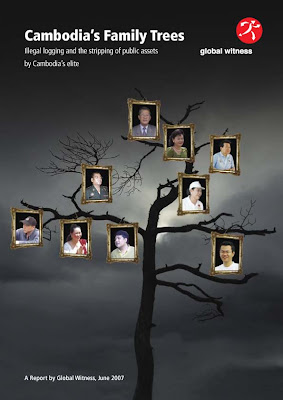
A 2007 Global Witness report, “Cambodia’s Family Trees,” names a number of high-level officials and family members as part of countrywide illegal logging rackets.

Congress has urged the State Department to consider the report when making its list of Cambodian officials.

A State Department spokesman said Wednesday the US “takes all allegations of corruption seriously.”

The US “shares many of the concerns” raised by the Global Witness report and is “reviewing all relevant information” to compile its list, the spokesman said.

Government spokesman Khieu Kanharith said Congress was seeking to ban Cambodian officials as a way to attract votes ahead of a presidential election and said the move to ban corrupt officials was not a “presidential decree.”

In fact, Congressional elections are not held this year, and the US does not run on a decree system.

The potential ban was welcomed by some conservationists in Cambodia.

“It is right for the United States to deny entry visas for those violating international law, because logging is an important issue,” said Hieng Rith, director of the Cambodia National Research Organization. “When all the trees are logged, there will be no rain. By definition it’s just like destruction against humanity, as humans will die if there is no rain.”

The Global Witness report, issued in June 2007, angered Cambodian officials and was immediately banned across the country.

It said Cambodia’s forests were being stripped clean by a network of Cambodian elite that generated its wealth from the seizure of public assets, including wide swaths of forests.

Officially ejected from the country in 2006, Global Witness spent years investigating the networks of illegal logging.

The report implicates more than a dozen officials, including Forestry Minister Chan Sarun, Forestry Administration Director Ty Sokhun and military officers of the elite military Brigade 70, which Global Witness called a “private army” of Prime Minister Hun Sen.

The officials have denied wrongdoing in the past, and were unavailable for further comment Wednesday.

All of them are part of a circle of kleptocrats and cronies surrounding Hun Sen, Taylor said.

“Either he’s looking the other way, because they’re too close, which doesn’t say much for his authority, or he’s part of the problem,” Taylor said.

Global Witness was “disappointed” that language in the bill was removed that would have banned US companies from doing business with listed kleptocrats, but Taylor said the group would continue to push for stronger language in the future.

“Here we are in Cambodia ten years down, we’ve had a decade worth of billions of dollars of delivery, and very little delivery, I think, beyond personal wealth expansion in Phnom Penh and a few other centers," he said. "And meanwhile, the average lot of the average Cambodian hasn’t gone up that much, and the assets of the state have been stolen and parked offshore.”

For more information, see the Global Witness report, and the 2008 Consolidated Appropriations Act.

Thursday, December 06, 2007

Thief robbing from Hun Sen-crony-thief?

Ranariddh Party Official Arrested on Land Theft Charges

By Chiep Mony, VOA Khmer
Original report from Phnom Penh
05 December 2007


A Norodom Ranariddh Party commune official in Kandal province was arrested Wednesday on charges of land theft, a party representative said.

Soth Say, second clerk of Viel S'bou commune, in Kien Svay district, for allegedly taking land from Phanimex Co., Ltd., and selling it to an organization for orphans, Sovan Komar, said NRP spokesman Muth Chantha.

The arrest comes after several back-and-forth public exchanges between Hun Sen and Prince Ranariddh, his traditional political rival.

Muth Chantha said the arrest was undertaken without a warrant, "in violation of the law."

The party planned to file a complaint with the police chief of Kandal, Muth Chantha said.

Monday, October 08, 2007

Oknha Dy Chouch says that he is not involved in illegal logging in Kampong Thom

06 October 2007
By Mayarith
Radio Free Asia

Translated from Khmer by Socheata

The defense lawyer of Hun Sen’s younger cousin declared for the first time, following the accusation of his involvement in an (illegal logging) scandal about 4 months ago, that he is not involved that the illegal logging in Kampong Thom province.

Oknha Dy Chouch issued a clarification letter yesterday, saying that there is a number of people who used his name to conduct their private business.

Dy Chouch’s name was included in Global Witness’ list of Cambodian officials reported in Global Witness’ Cambodia’s Family Trees (Relatives of the thieves of the Nation in Khmer) which was distributed at the beginning of June, stemming from his involvement in the destruction of natural resources, and pocketing the revenue for himself. Dy Chouch’s former wife is Seng Keang whose name also features in the Global Witness report.

Okhna Dy Chouch declared in the clarification letter that he is divorced from Lok Chumteav Seang Keang for several years already and he said that before the divorce, the activities of Seng Keang did not involve him.

Oknha Dy Chouch asked the authority to take legal action against anyone who uses his name to do business.

Wednesday, September 26, 2007

Hun Sen: "If 1.3 billion Chinese were all to urinate at the same time, it would unleash a major flood...When China gives...no strings attached"

Lao Meng Khin and Choeung Sopheap (also known as Yeay Phu) together run Pheapimex, arguably Cambodia’s most powerful company. Through its logging and economic land concessions, Pheapimex controls 7.4% of Cambodia’s total land area (Photo and data: Global Witness, Cambodia's Family Trees)

China's 'long shadow' on Cambodia

September 25, 2007
By Tim Johnson, Beijing bureau chief
McClatchy Newspapers

"Pheapimex and Wuzishan, two companies run by the best friend of Hun Sen's wife, were given rights to develop and exploit more than 1.26 million acres of forest with logistical support from Chinese firms"
The New York Review of Books has a long article this week on China’s support of Cambodia, written by a longtime foreign correspondent for the French newspaper Le Figaro. The article by Francois Hauter is behind this pay wall, but here is the opening paragraph, an excerpt and the surprising ending:

In Phnom Penh, the capital of Cambodia, the economy is going strong, but the prime minister, Hun Sen, has organized the plunder of the nation's resources for the benefit of its powerful neighbor, China, in exchange for Beijing's protection.
….
Cambodia was on its last legs when the Vietnamese invaded in December 1978, and they installed the new government dominated by Hun Sen, who became prime minister in 1985. A consummate survivor, he is still prime minister twenty-two years later. He did everything he could to prevent the public trial of Khmer Rouge leaders demanded by the United Nations. Why? Because although he had been placed in power by the Vietnamese, he had long since transferred his allegiance to the Chinese government, which had been the chief patron of the Khmer Rouge regime, supplying it with arms, food, training, and international backing. To put the Khmer Rouge leaders on trial would have been to denounce Chinese collaboration in the Khmer genocide. It would also have compromised certain tangible interests. "China is a very great country," Hun Sen declared recently. “If 1.3 billion Chinese were all to urinate at the same time, it would unleash a major flood. But China's leaders are doing good things with their partners.... When China gives, there are no strings attached. You can do what you want with the money.”

The Cambodian leaders did not fail to take advantage of the opportunity. State assets were sold off to the highest bidder. One scholar, François Mangin, has estimated that between 1993 and 1999, the Cambodian government sold concessions to more than a third of Cambodia's most productive land, mainly to foreign companies engaged in commercial exploitation of forests, mineral resources, agriculture, fisheries, and tourism.

To cite just one example: Pheapimex and Wuzishan, two companies run by the best friend of Hun Sen's wife, were given rights to develop and exploit more than 1.26 million acres of forest with logistical support from Chinese firms.

The proceeds from land confiscation which primarily involves the pillage of Cambodian forests for Chinese exploitation have been used to finance the prime minister's party and his security force, which is the only well-equipped military unit in the country (other brigades are employed in the transport of timber). Money acquired dishonestly is laundered in nine casinos now operating in Poipet, a town near the Thai border. Western governments and international aid organizations, including the World Bank and Asian Development Bank, are well aware of this phenomenal corruption.
…..

What seems to me more singular about Beijing's attitude toward Cambodia, however, is that Chinese officials have shown themselves unable to support "good" practices rather than "bad" ones. Hun Sen and his collaborators have long held Cambodia in their grip, and that has suited the Chinese Communists just fine. Beijing has also backed the despicable military government in Burma and the paranoid North Korean dictator. Whatever mad regime might serve China's interests, regardless of the suffering inflicted on the victims of those regimes, has been accepted, tolerated, and supported by the Chinese. Western diplomats have taken much satisfaction in denouncing their "cynicism."

But is it really cynicism? It is in the name of pragmatism that the Chinese do not allow moral considerations to weigh on their minds. Without any qualms, they adapt instantly to whatever situation they find, good and bad. This absolute pragmatism is the rule in the private sphere as well as for public affairs. I am reminded of what a Chinese friend told me when I expressed my exasperation at this failure to distinguish between good and evil. She answered: "My father told me, 'Be good, but not too good, or else you will die, for your place will be in Heaven, not on earth. And don't be too bad, either, or you won't deserve your place on earth." Had the balloon seller said the same thing, it might have mitigated my rage against Hun Sen's clique.

Hun Sen orders to stop land swapping ... but it's way too late, most of them have been swapped already

Hun Sen asks Education and Health Ministers to stop swapping state lands

25 September 2007
Rasmei Kampuchea Newspaper
Translated from Khmer by Heng Soy

Prime minister Hun Sen issued a letter on 21 September to the education minister and the health minister, telling them not to swap any schools or hospitals, and telling them to prreserve these facilities “in order to respond to the increasing needs of our population.”

Hun Sen’s letter indicated: “In the past, middle men have asked to swap school buildings, heath care facilities, and hospitals in Phnom Penh city and in a number of provinces and municipalities also. It’s true that in the past effort of the royal government of Cambodia to develop education and heath, our state needed to build many additional schools and hospitals, in order to respond to the increasing daily needs of our population.

The current locations of school and hospital facilities were selected based on the living condition of our people, to ease the school traveling for young children, as well as for the ease in the rescue (operation) and health care.”

The letter stressed: “Therefore, I ask that Your Excellencies, the senior minister and ministers, protect and preserve the current school and hospital locations, including all elementary schools, middle schools, high schools, and universities, as well as all heath care facilities and hospitals in the city of Phnom Penh, and in all the provinces and municipalities, and there should absolutely be no swapping of these locations.”

Hun Sen added: “I am confident that Your Excellency will take appropriate and firm measures to put into application the goal specified above, in order to provide advantages to the development and the good health of young children and of our people in the entire country.”

Friday, July 20, 2007

Reactions on the US Senate plan to ban Cambodian officials from entering the USA

19 July 2007
By Mom Sophon
Radio Free Asia

Translated from Khmer by Socheata

NGO and opposition party officials expressed their support to the report saying that the US Senate appropriations committee is pushing for a ban from entering the US to those officials who are involved in illegal logging in Cambodia and whose names appear in the Global Witness report.

Ou Virak, CCHR President, told RFA on 19 July that the push by the US Senate appropriations committee is a very good thing for Cambodia.

Ou Virak said: “First, it’s the right thing to do, I say that those who are accused of deforestations … should not be authorized to enter the US in order to show that the US support the protection of the environment, and more importantly, it shows that the US defends the free expression of opinion, and it respects human rights. The action taken by the US is the right thing to do, and it is a declaration that the US does not condone such action anymore.”

Opposition leader Sam Rainsy told RFA that the plan by the US Senate appropriations committee is to display its opposition to corrupt officials, and it also strongly pushes Cambodia to get rid of corruption.

Sam Rainsy said: “This is a very good idea, because the USA should not welcome the criminals involved in illegal logging in Cambodia which forces Cambodian people to live in dire poverty due to this theft of national treasury, and the theft of state revenue, just as Global Witness revealed. Therefore, I am applauding the US plan to ban corrupt officials from entering the USA.”

Sam Rainsy also said that the ban of corrupt officials from entering the US does not interfere with diplomatic relations between the two countries because such ban only affect only those who are conducting criminal activities against their country and their own people.

Sam Rainsy also indicated that such action would serve as a warning to those involved in corruption.

Nevertheless, Khieu Kanharith, government spokesman, told a local newspaper that the reason the US Senate appropriations committee undertook this ban plan is for political reason only.

On 01 June 2007, Global Witness issued a 120-page document titled “Relatives of the thieves of the Nation” (Cambodia’s Family Trees, in English). This report named several high ranking officials and business tycoons, such as Chan Sarun, Ty Sokhun, Hing Bun Heang, Hak Mao, Dy Phen, Seng Kieng, etc…

Friday, July 13, 2007

Cambodia's cowboy capitalism

Jul 13, 2007
By Shawn W Crispin
Asia Times (Hong Kong)


BANGKOK - Despite his rough and ready reputation, Cambodian Prime Minister Hun Sen has presided over an extraordinary transformation of the country's once war-torn, now booming local economy, marking Southeast Asia's latest successful transition from a centrally planned to market-driven economy.

But as Cambodia's capitalist reforms enter a crucial new phase - one where multilateral organization economists say that to sustain fast growth, economic benefits must be more equitably distributed - it's altogether unclear whether Hun Sen and his Cambodian People's Party-led government are up to the egalitarian task.

Over the past three years, Cambodia's gross domestic product has expanded at double-digit growth rates, averaging a breakneck 11.4% per annum. Garment exports, the economy's top foreign-currency earner, accounting for nearly 14% of total GDP, grew by 20% last year, despite predictions that Cambodian producers would start to lose a substantial market share to China and Vietnam.

Foreign direct investment touched a record high US$475 million last year and, in a show of fiscal confidence last weekend, the government unveiled a new $26 million parliament building, which is about 10 times the size of the previous complex. Meanwhile, hopes are running high that recent discoveries of big new oil and gas deposits will translate into a multibillion-dollar boon and by as early as 2010 transform the country into a net fuel exporter - potentially one of Asia's largest.

Monetary authorities have successfully reined in inflation, which on average galloped well over 50% per annum throughout the 1990s, to less than 3% last year, and policymakers are now feeling emboldened enough to talk about "de-dollarizing" the economy in a nationalistic bid to shore up the local currency, the riel. International credit-rating agencies, including Standard & Poor's and Moody's, recently issued their first sovereign ratings for the country, in anticipation of new stock- and bond-market launches in 2009.

Hun Sen, a former communist guerrilla and currently Southeast Asia's longest-serving elected leader, deserves a fair measure of credit for the progress. In the state-sanctioned press, he's frequently seen presiding over the opening of new roads, bridges and schools, putting his personal populist mark on public-funded investments.

His deputies have recently taken to portraying him as one of the region's vanguard economic reformers, who began dumping communism for capitalism through limited land-ownership reforms in the mid-1980s. In advance of the 1991 Paris Peace Agreement, which ushered in United Nations-sponsored elections and a new power-sharing government, Hun Sen introduced full-scale land reforms, slashed price controls, privatized state enterprises and, to a degree, liberalized foreign investments.

More recently, Hun Sen has in the main stayed the course of a World Bank-designed market-reform strategy, which aims to boost the private sector and move the economy away from its age-old reliance on subsistence agriculture. That has included substantial policy reforms aimed at improving the investment climate and trade facilitation, including recent automation of traditionally corruption-prone customs-related services.

Rich man, poor man

Still, there are contrary indicators that Cambodia's emerging brand of wild and wooly capitalism is unevenly - and in instances perhaps illegally - benefiting the politically connected few at the great expense of the indigent masses.

A recent World Bank research report shows that robust economic growth over the past decade has helped to reduce the national poverty rate from 47% to 35% over the 10-year period spanning 1994-2004. Over that same period, however, average consumption per capita rose a mere 8% for the bottom fifth of the wage-earning population, while rising a whopping 45% for the top tier.

Where land ownership was seen as equitable after the 1989 land reforms, now levels of inequality in landholding and landlessness are among the highest in Asia, due to recent government policies in favor of large-scale land concessions - not to mention increasing state-backed land grabs from the poor. Lightly populated Cambodia, remarkably, now ranks worse than Malthusian dread-ridden India in this category.

The World Bank report also warned that, in general, high levels of inequality contribute to market failures and reduced investment, give rise to institutions that favor the rich over the poor and, over prolonged periods, often result in social and political instability. Those dire predictions are arguably already coming due, seen in the recent rash of land grabbling, where international rights groups such as Human Rights Watch estimate that tens of thousands of people have been forcibly evicted to make way for state projects and big plantation agriculture.

More damaging, however, were the allegations in a recent investigative report titled "Cambodia's Family Trees" issued by UK-based environmental watchdog Global Witness. The globally respected outfit alleged that senior army, police and government officials, many close to Hun Sen, including the head of his personal bodyguard unit, had profited hugely from illegal logging activities.

The report also claimed that a "kleptocratic elite" - including members of Hun Sen's direct family - were complicit in exploiting large swaths of officially protected forest lands. The report notably mentioned by name Hun Sen's wife as benefiting from the alleged illicit trade. For its part, the government banned the publication, issued a blanket denial, and threatened journalists who followed up the allegations.

One Radio Free Asia reporter was forced to flee the country after he received an anonymous death threat related to his reports, which corroborated some of Global Witness' findings. He was the second RFA reporter to flee the country this year because of concerns about possible government reprisals over critical news coverage. Further, Hun Sen refused in May to meet with the UN special representative on human rights for Cambodia, Yash Ghai, who had conducted investigations into allegations of state-backed land grabs.

Such statistical and investigative findings explain why - despite Hun Sen's recent consolidation of political power and his pivotal role in accelerating economic growth - foreign and local observers still have big doubts about his style of governance. For instance, last year international corruption monitoring group Transparency International rated Cambodia 151 out of 163 nations it ranked in its global government corruption index.

A more recent Indochina Research Limited public-opinion poll found that 88% of Cambodians feel that growing inequality in wealth is a pressing issue, while a World Bank survey released this week found that perceptions of Cambodia's government effectiveness, regulatory quality and control of corruption all declined from 2005 to 2006. Cambodia is no doubt growing, and growing fast, but increasingly the perception is that the benefits are only gushing up and not trickling down.

Shawn W Crispin is Asia Times Online's Southeast Asia editor. He may be reached at swcrispin@atimes.com.

Sunday, July 08, 2007

Phnom Penh: scrapheap of the poor

10 years on from historic coup, success story is blighted by corruption

From Nick Meo in Phnom Penh
Sunday Herald (Scotland, UK)


THE MUNICIPAL dump on the outskirts of Phnom Penh is where Cambodia's luckless poor go when they become truly desperate.

As the monsoon rains pour down scavengers hunt through piles of stinking refuse for bits of saleable scrap or even edible food. At this time of year, with the rain and mud at their worst, they have been known to disappear into water-filled holes or slip under the tracks of the dump's bulldozers.

This is the Cambodia that the tourists don't see. On the surface the nation appears to have become a success story, with its years of mass murder and war behind it; now there is political stability, more than 10% annual economic growth and a thriving textile sector.

But the scavengers at the dump are evidence of the downside - the victims of the corruption and greed which has thrived since the current prime minister, Hun Sen, grabbed power in a coup 10 years ago this week. Since then, behind a veneer of democracy, the corrupt elite around him has become richer and a gaping chasm has opened between rich and poor.

The corruption problem is one of the worst in Asia. Last year, Transparency International rated Cambodia at 151 out of 163 nations in its government corruption index. Yet fears are growing that a dysfunctional political system will soon become much worse.

In three years' time, massive offshore oil wealth will start to be pumped - perhaps as much as 500 million barrels.

It should produce a bonanza which could fund the schools, roads and hospitals that Cambodia desperately needs, but instead it will almost certainly flow into the pockets of the corrupt. The poor could then become even worse off because prices will be forced up as the economy grows.

Aid workers speak of the example of Nigeria, where years of oil revenues have been stolen by the corrupt and life has hardly changed for the poor. The resulting anger there has caused crime and instability - spectres which are beginning to concern diplomats in Phnom Penh.

So far, the poor have had to accept their fate, but with so many dispossessed existing alongside a class of wealthy who enjoy flaunting it there are concerns that political unrest could grow.

The ugliest form of exploitation has been an epidemic of land-grabbing in which businessmen pay thugs or corrupt police to drive the poor from their homes so they can build on sites which are rocketing up in value.

Many of those victims end up struggling to survive in the dump. Some were evicted from urban shanty towns which are bulldozed for development; others were tribal people tricked out of their forest lands or peasants with a few paddy fields which a sharp-eyed developer realised could turn a quick profit.

In the dump most of them live on the edge of the sprawling refuse heaps in a shanty town which they have built from scrap, afflicted by disease and preyed on by toughs. Other victims of land-grabbing live in refugee camps, waiting for help promised by the authorities which never seems to arrive.

The problem is so serious that the UN's Special Rapporteur on Human Rights in Cambodia last month issued a report on land-grabbing, accusing the corrupt rich of having a devastating effect on the poor and driving tens of thousands from their homes into destitution.

It is easy to drive the poor off because few Cambodians have land titles. After the chaos of Khmer Rouge rule between 1975 to 1979, when more than a quarter of the population was murdered and property was abolished, the survivors often settled where they could without documents to prove ownership. Following the fall of the regime the most ruthless thrived. Now they are rich.

Illegal logging of the once-beautiful and extensive forests has been another way for the rich to turn a fast buck. Last month watchdog group Global Witness castigated a clique around Hun Sen for making tens of millions of dollars out of logging. The prime minister was furious - with Global Witness.

He also attacked international aid donors when they ticked him off for corruption last month at an annual meeting to fork out millions of dollars in taxpayers' money, much of which will be stolen. Hun Sen pledged to clean up the corruption, as he does every year, and the donors pretended to believe him, as they do every year. The donors don't press too hard. Most are worried that Cambodia is getting too close to China, which is eyeing the offshore oil and making aid pledges without complaining about human rights abuses.

Meanwhile, as the rich build mansions and work out how to make money out of the forthcoming oil boom, the poor are left to survive as best they can.

Friday, June 22, 2007

SGS and Global Witness, along with the various reactions

18 June 2007
By Lim Pisith
Radio Free Asia

Translated from Khmer by Socheata and Heng Soy

KI-media Note: The following report filed by Lim Pisith earned him a death threat. He is currently in hiding somewhere in Cambodia.

A number of forest observers and villagers’ communities in the Tumring area called the report issued by the Swiss company SGS a lie. The SGS report stated that the activities taking place in the Tumring area are not illegal logging activities.

Por Lay Hin, the representative of the Development Organization for Poor Rural Families – an organization which closely observes the forest activities in Tumring, reacted on Friday by saying: “I don’t know how they look at it to make them (SGS) say that there is no illegal logging, just look at the roads, you can see how worn out they are. If these roads were used by normal cars, it wouldn’t be in this (bad) shape. The activities taken by rubber plantation companies can be considered as development, it’s OK for them to cut off the trees and plant rubber trees instead. However, the other forest areas outside of the areas belonging to the rubber plantation companies, they are located in the Tumring commune, and these outside areas are covered by forest which are under assault by anarchic logging.”

Sao Kim, the former Tumring commune chief who retired a few months ago, said that the Tumring area is covered by 34,400-hectare of forest area, and the rubber plantations occupy 6,200-hectare only. He recognized that under his mandate as commune chief, logging activities did actually take place outside the rubber plantation (concession) area to harvest precious wood. But, Sao Kim said that the commune authority did not have the ability to prevent (these illegal loggings). Sao Kim said: “All the forest has been destroyed … the chief of the forestry administration is there already, we only heard (about the activities) and the top of (the logging activities) … is Seng Keang [Hun Chouch’s ex-wife and business partner].”

Mao Him, the president of the Tumring forest community, said, at the end of May, that illegal logging activities outside of the rubber plantation lands, are taking place daily starting since 2000 on. He also said that the Tumring forest located near villages have been anarchically logged for sale to businessmen and companies which received the government authorization to saw woods (for commercial sale) between 2003 and 2006. “Up to now, I heard the 60% (of the forest) has already been logged,” Mao Him said.

Suos Ven, a Tum Or villager, said that several thousands of resin trees, passed down between several generations in each family so that their offspring could collect tree resins for sale, have been logged and transported out between 2002 and 2006, and that the trees have almost all been logged already, and even wild animals such as deers, elephants, boars have fled from the area.

Lim Pisith (RFA): Your family is still collecting wood resin?
Suos Ven (SV): Before, we collected resin, but now there are no more resin trees. I am angry, but whatever I do, I cannot win over them, so there is no point of being angry, I just shut up.
RFA: During the logging, you did not go to tell them to stop?
SV: Before, we prevented them, but now they have the power, we cannot prevent them anymore.
RFA: Who did you say have the power?
SV: The people at the top are those who operate sawmills, they said that whatever they do, they paid the fees to Hun Sen already.

An anonymous forestry official in Tumring also recognized that logging activity outside of the rubber plantation does actually take place. “The activity still goes on, it does exist, but the activity is done in secret, this to tell you the truth because if I tell you that there is no (illegal logging) then you wouldn’t believe me.”

The Swiss company SGS published a report in the Koh Santepheap newspaper, a few days after Robert Thinin, the SGS company representative, gave his comments on TV about the Global Witness report titled “the family of the thieves of the nation” (Cambodia’s Family Ties in English). In its 3-1/2-page report bearing no clear date and published in the Cambodian newspaper Koh Santepheap on Friday morning, George Bottomlay, the deputy director of SGS in charge of service and institution, gave a clarification on the Global Witness report issued at the beginning of June 2007, titled Cambodia’s Family Trees (or Family of the thieves of the Nation in Khmer), based on SGS’ work between 2003 and 2005.

In this SGS report, it stated that the Tumring zone is not a protected forest, but it is a rubber plantation (concession area), and the activities taking place there cannot be construed as illegal logging. Furthermore, SGS discussed about the illegal logging involvements of a number of people reported by Global Witness, by saying that SGS does not have the mandate to investigate on the spot these illegal logging activities, and that it has to rely on evidence provided by the forestry department of the Ministry of Agriculture, reports provided to them (SGS) by the Ministry of Environment, and other reports from physical persons or various organizations. Furthermore, SGS said that it never received evidence from any organization bearing the names of the people named in Global Witness report.

In its 120-page report, Global Witness detailed about illegal logging, and the transport of woods by relatives and cronies of Prime Minister Hun Sen who are involved in the logging business in the Tumring area and the Prey Long forest, and that this group of people received millions of dollars in income each year from this illegal operation. One such company involved in the illegal logging is the Seng Kean company who is owned by Seng Keang – who is herself a friend of Bun Rany Hun Sen, Hun Sen’s wife – her ex-husband Dy Chouch – who is Hun Sen’s cousin – Dy Phen, the Military Police chief in Kompong Thom province – who is also a cousin of Hun Sen from his mother side – and Hing Bun Heang, the chief of Hun Sen’s bodyguards.

Global Witness also reported that bribe monies earned by army officers involved in the transportation of illegally logged woods were used to provide for Hun Sen’s 4,000 bodyguards brigade. Brigadier General Hak Mao, the commander of brigade 70 unit, is named by Global Witness for using his troop to transport wood out of the Tumring area to Phnom Penh. Agriculture minister Chan Sarun, and the forestry department director Ty Sokhun are accused of corruption for the sale of 555 forestry department positions, each position costing between $10,000 to $30,000, and Khun Thong, the brother-in-law of Chan Sarun and father-in-law of Ty Sokhun, was also colluding by using his family ties to obtain the privilege for the Seng Keang company – which he is also one of the partners – to perform logging in the Tumring rubber plantation.

Global Witness called for the sending of 9 individuals to face justice as stipulated in the laws dating from the UNTAC era, regarding jail and fine sentences that could be handed down to the criminals involved.

Thursday, June 21, 2007

Global Witness Report To Help Open Hun Sen's Eye to 'Festering' Corruption

02 Jun 07
Sralanh Khmer
Translated from Khmer and posted online

Hun Sen's Cambodian Government has been deeply bogged down in all sorts of corruption pointed out by national and international circles after the prime minister arrogantly asked on Wednesday, "How this corruption looks like? Can anyone tell me where it is?" From now on, the prime minister surely will have a splitting headache reading a mountain of reports on corruption, documents that have piled up as high as Mount Everest because the corruption monitors have prepared them to open the prime minister's eye and make him see what really happens around him.

The forest crime report Global Witness released yesterday shows only the minister of agriculture and the head of the Forest Administration [FA], together with seven generations of the prime minister's relatives, as ringleaders behind the current waves of forest crimes in Cambodia. Although Agriculture Minister Chan Sarun and FA Chairman Ti Sokun softly denied the charges yesterday, this kind of rebuttal is not enough. The government must investigate, for this is an example of corruption that the prime minister has never seen and never thought possible, since he used to observe that corrupt persons never wear collars or bear tattoos on their foreheads for him to recognize them.

For the past few years, the prime minister who used to boast that he could see through everybody has been totally blind to corruption. For instance, he was blind to the recent corruption case in four ministries that caused the World Bank to suspend aid worth several dozen million dollars. Later, we do not know why the prime minister quietly took over $10 million from the national budget with which he paid back to the donors on behalf of the corrupt officials.

The general public has heard the prime minister roar like a Cyclops that if he could not suppress the forest crimes he would cut his own head. There was one time when the prime minister claimed as if he meant it that he would step down if he could not stop illegal logging. The prime minister has made this kind of vociferation for years and on many occasions. But forests continue to be decimated under the blows of the criminals' chainsaws. Just as exposed by Global Witness in its report yesterday, these logging criminals include a maternal cousin of the prime minister, a close friend of Mrs. Bun Rany Hun Sen, Agriculture Minister Chan Sarun, FA chief Ti Sokun, and their father-in-law and many relatives who have operated in a close network to devastate the forests and make money from the timber trade for their own syndicates and families. General Hing Bun-hieng, commander of the prime minister's bodyguard unit, also has his name on the logging criminals' list.

In years past as well as this year economic experts and governance specialists have shown the figures of the loss in national incomes caused by the people close to the prime minister. They have estimated that each year some $400 to $500 million has been lost to illegal logging alone. Last year and this year, the share from corruption and land-grab activities by the powerful people in the group around the prime minister and the Mafia-like money-laundering tycoons has spread far and wide all over Cambodia. Unfortunately, the prime minister has been left in the dark. He cannot see even if he is looking at it.

Those who are monitoring the prime minister's government stewardship say that crimes, murders, and all kinds of corrupt practice of large and medium scales usually are the works of the prime minister's own blood relatives. Several of his cousins have been accused of involvement in land grab. One of his nephews shot and killed people. Close relatives of the prime minister are implicated in logging and oil smuggling, and so on. In other words, the prime minister has become very notorious on the national and international stages since the outset thanks to the exploits of the members of his extended family.

The Cambodian prime minister claims himself to be strong and smart in all departments. Whenever he gets hold of a microphone, he rambles on and on for hours. Most of the time, his speeches include threats and useless nonsense, especially excessive laudatory mentions of his own children and relatives. The incitement, menace, and temperamental outbursts of the prime minister in his frequent speeches give listeners the impression that he really means business. Over the past decade, however, the prime minister has made nothing but empty promises, meaning that whatever he has said is just part of his misleading oratory skill. The prime minister has proved to be politically incompetent and unwilling. Frankly speaking, he does not have a shred of national conscience in him. Such incompetence and obvious ignorance have driven the prime minister deeper into darkness to the point that he can no longer see or understand the widespread corruption tentacles that are constricting the Cambodian society, plunging it into growing darkness.

Nevertheless, the latest Global Witness report, which identifies the criminals behind the destruction of the national forests as being part of the prime minister's family tree, will help to open the prime minister's eye to reality. On the contrary, if the prime minister is not blind but pretends to be so, he will not escape retribution because in the future the parliamentarians will summon the ministers or even the prime minister to answer in person (not in writing) to their questioning at the National Assembly concerning all cases involving corruption that the current prime minister cannot see or grasp.

Anyway, one sentence uttered by the prime minister who pretends to be ignorant goes like this: "There is corruption in every country." This means that the prime minister is not completely unaware of the festering corruption in his government. In making this remark, the prime minister wanted to cover up and protect the corrupt people and criminals of all sorts and in all places who are members of his group or of his family.

Tuesday, June 19, 2007

All that the Hun Sen regime can do is: Beg, beg, beg ... for more aid

Cambodia asks foreign donors for more aid

Tuesday, June 19, 2007
The Associated Press
"If their mission is to help Cambodia's long-suffering population, rather than just cozying up to its kleptocratic government, donors must start insisting on tangible actions to combat corruption and impunity" - Simon Taylor, Global Witness Director
PHNOM PENH, Cambodia: The Cambodian government opened a meeting with foreign donors Tuesday to ask for more aid, amid a barrage of criticism that it has reneged on promises to control rampant corruption.

Despite economic growth averaging 11.4 percent for the last three years, Cambodia remains one of the world's poorest countries and heavily reliant on foreign aid. Donors pledged US$601 million (€448 million) to the government last year.

It is not yet clear how much Cambodia will ask for during the two-day meeting that started Tuesday.

Human rights and environmental groups said the government keeps breaking its promises of reform, and that donors must get tougher with the government to ensure it meets its pledges.

"If their mission is to help Cambodia's long-suffering population, rather than just cozying up to its kleptocratic government, donors must start insisting on tangible actions to combat corruption and impunity," Simon Taylor, director of the Britain-based environmental group Global Witness, said in a statement Monday.

Early this month, his group issued a stinging report alleging tycoons, some senior officials and relatives of Prime Minister Hun Sen were running illegal logging businesses. The government denied the allegations.

Yash Ghai, the U.N. secretary-general's special representative for human rights in Cambodia, in a report this month, also blasted the government's land concessions.

He said many rural Cambodians were losing out on land which was being given to those with government connections, including for logging purposes.

U.S. Ambassador Joseph Mussomeli has praised the government for realizing strong economic growth and "solid progress" in some health and legal areas.

But progress in other important areas, such as land-grabbing, the environment and good governance "is hampered by the systemic corruption we see in Cambodia today," he said Saturday.

Yet, the donors "are being taken for a ride" by the government, Brad Adams, Human Rights Watch's Asia director, said Saturday.

"Hun Sen continues to run circles around the donors, making the same empty promises every year and laughing all the way to the bank," he said.

Tuesday, June 12, 2007

Cambodia : deforestation report censored

12 June 2007
Reporters Without Borders

Reporters Without Borders today expressed dismay at ban slapped on all national media preventing them from carrying extracts from a report on deforestation published by the environmental organisation Global Witness The report, released on 30 May 2007 and entitled “Cambodia’s Family Trees”, accuses officials, including those close to Prime Minister Hun Sen, of forming a corrupt and “kleptocratic elite” which was responsible for the destruction of the natural landscape. The Ministry of Information on 8 June banned any reproduction of the report after denying the allegations and dismissing it as a “political attack” against the government. Information Minister, Khieu Kanharith, said, “The media have had one week to put out their news and that is more than enough. Newspapers can refer to it but not reproduce it. If they break the ban, we will take the necessary legal steps”.