Showing posts with label Election fraud. Show all posts

Wednesday, February 29, 2012

Inaccurate voting lists give watchdog pause

Wednesday, 29 February 2012
Meas Sokchea
The Phnom Penh Post

An election monitoring group yesterday claimed that people were failing to vote because their names were not included on voter lists at polling stations.

Speaking at a Phnom Penh forum held by civil society groups and political parties, Koul Panha, executive director of election monitoring group Comfrel, said that the National Election Committee must ensure that voters’ names were not left off the list for upcoming commune elections in June.

They arrive at the polling station and cannot find their name, so they return home,” he said.

The loss of voters’ names is because of technical mistakes or the changing of someone’s name.”

Koul Panha said the Ministry of Interior must issue permanent identification cards and send that information to the NEC, and the NEC must guarantee that someone with an ID card is able to vote.

Thursday, December 15, 2011

U.S. Officials Cite 'Nationwide Awakening' In Russia

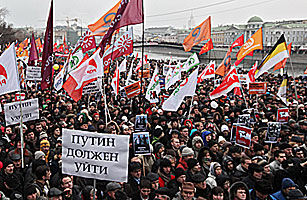
Protesters at a Moscow rally on December 10 to protest alleged violations in the parliamentary elections nearly a week earlier.

Thursday, December 15, 2011
By RFE/RL

WASHINGTON -- A U.S. State Department official says recent mass protests in Russia could represent a "nationwide awakening" among Russians who want more accountability from their government.

Protesters across Russia have staged a series of demonstrations accusing Prime Minister Vladimir Putin and his ruling United Russia party of rigging votes in the party's favor during the December 4 parliamentary elections, which United Russia narrowly won. More major protest rallies are being organized for December 24.

At a hearing in the U.S. Senate on December 14 focusing on rule of law and corruption in Russia, Thomas Melia, the U.S. deputy assistant secretary for democracy and human rights, said "the curtain has gone up on a new act" in Russia, though he said Russia's future direction remains unclear.

Monday, December 12, 2011

Crackdown or Negotiation? Russian Protests Pose a Dilemma for Putin

Russians stage a protest against alleged vote rigging in parliamentary elections, holding signs including one that reads "Putin Must Go Away," on Dec. 10, 2011 in Moscow (Konstantin Zavrazhin / Getty Images)
A protester stands during a rally in downtown St. Petersburg, Russia, Dec. 10, 2011. The sign reads "No vote." (Dmitry Lovetsky / AP)

Sunday, Dec. 11, 2011
By Simon Shuster / Moscow
Times Magazine (USA)

Mercenaries, goateed liberals, jackals who scavenge for money at foreign embassies in Moscow — those are some of the things Vladimir Putin has called Russia's opposition. But he's never before had to reckon with them as a significant threat to his rule. That may now have to change. On Saturday, in the biggest act of popular resistance ever to Putin's government, tens of thousands of protesters rallied across the country to challenge the results of parliamentary elections held a week ago. This time, the once and future President can't ignore his challengers or simply dismiss them with colorful epithets.

"We realize these aren't Chinese people sent here to protest," an official from Putin's United Russia party told TIME after the demonstrations. "These are regular citizens, and we have to respond to their demands." (The official asked to remain anonymous because these are "nervous times" and "no one wants to talk out of turn.") Since the wave of protests began last Monday, party officials and Putin's circle of advisers have held emergency meetings to try to hammer out a response, the official added, but have so far come up with little.

Sunday, December 11, 2011

Russian vote protests spread across nation

Up to 50,000 people turned out in Moscow on Saturday for a protest against disputed polls that have sparked a rare national show of defiance against Vladimir Putin’s 12-year rule.
Saturday, December 10, 2011
By Agence France-Presse
But analysts say rapid social changes and the Internet’s first significant gains in Russia may have caught Kremlin strategists off guard amid signs that Putin’s likely return to head of state is less welcome than originally thought.
Hundreds of security trucks blocked off central squares while helicopters patrolled the skies as Moscow authorities deployed more than 50,000 riot police and troops on the biggest day of protest to hit Russia since the turbulent 1990s.

Protesters braved a whipping snow storm to snake their way through tight police cordons and across the Moscow River to a secluded square not far from the Kremlin, assigned by the authorities for the “For Fair Elections” protest.

“The current regime does not know how to behave with dignity,” former cabinet member turned Kremlin critic Boris Nemtsov said as the crowd gathered for the biggest Moscow opposition rally of the Putin era.

Thursday, December 08, 2011

Gorbachev urges Russia poll re-run amid protests

Mikhail Gorbachev says Russia's election results "Do not reflect the will of the people." (AFP/File, Pascal Guyot)
December 8, 2011

MOSCOW (AFP) - Former Soviet leader Mikhail Gorbachev on Wednesday called for Russia's elections to be re-run due to fraud, as the opposition vowed new rallies contesting the results despite mass arrests.

Police threw a huge security cordon around the square in central Moscow which saw the latest protest on Tuesday night to prevent a new rally, as the opposition called for a mass gathering near the Kremlin on Saturday.

The protests and a loss of support in the parliamentary elections have provided Russian Prime Minister Vladimir Putin with an unexpected challenge as he prepares to return to the Kremlin in 2012 presidential polls.

Saturday, November 26, 2011

Fighting Corruption is About Political Will

Corruption and greed will bring shame to world leaders. It may take years but it needs change of regime. Will catch you. Will shame you. Remember there is justice at the end of the long tunnel.

Salute to President Aquino for his high political commitment to crash corruption in the Philippines.

Mu Sochua

A senior police official announced details of the arrest warrant outside the hospital near Manila where Mrs. Arroyo will remain.(Pat Roque/Associated Press)
Gloria Macapagal Arroyo  (Dennis M. Sabangan/European Pressphoto Agency)
Philippines’ Ex-President Is Arrested on Fraud Charges

November 18, 2011
By FLOYD WHALEY
The New York Times

MANILA — The former president of the Philippines, Gloria Macapagal Arroyo, was arrested in her hospital room on Friday on charges of election fraud, her lawyer said, after days of dramatic struggle with the government over whether she would be allowed to leave the country for medical treatment.

Police officers at the hospital said that Mrs. Arroyo would not be taken to the police station and would be held in custody in her hospital room, one of her lawyers said.

Mrs. Arroyo, 64, says she suffers from a bone ailment that requires medical treatment unavailable in the Philippines.

Monday, October 31, 2011

Escaping Arrest by The Hun Sen Police, Mr. Kong Kiet is Now in The U.S.

October 30, 2011

ESCAPING ARREST BY THE HUN SEN POLICE, MR. KONG KIET IS NOW IN THE U.S.

After three years in hiding in a neighboring country to escape arrest by the Cambodian police, Mr. Kong Kiet, 51, his wife and their three children finally landed this week in the USA where they will be resettled as political refugees.

Three years ago, a few days after the July 27, 2008 national election that gave a “landslide victory” to the ruling CPP, I met for the first time with Mr. Kong Kiet who was a resident of Boeung Tumpun commune in Phnom Penh’s Meanchey district.

Mr. Kong Kiet was not registered as a voter in his commune of residence. However, he was able to cast a ballot for the CPP. His story is not an isolated case but reflects the pattern of a massive election trick that contributed nationwide to the CPP victory.

The pattern is the following: A few days before, and sometimes on, voting day, the CPP-controlled local authorities (commune chief, village chief) come to meet with people like Mr. Kong Kiet who look like any legitimate voters but are actually not registered on the voter list in the commune in question. They give them money and a fake ID document and push them to go to vote at a nearby polling station by casting a ballot for the CPP.

The trick is based on two irregularities:
  1. The voter list is inflated with ghost names (the large number of ghost voters has been decried by independent observers and human rights NGOs).
  2. A fake ID document (the controversial “1018 Form”) showing the name of a ghost voter is delivered to an illegitimate voter such as Mr. Kong Kiet (illegitimate voters could also include other unregistered citizens, foreigners, person below 18-year-old, passers-by paid to vote for the CPP).
In the “1018 Form” he received in 2008, Mr. Kong Kiet was given a stranger’s name: Yov Phet, and another year of birth: 1955 instead of 1960 associated with his real age.

Because he dared to publicly expose the truth and to accept to testify in the complaint that the SRP lodged against the CPP authorities (see documents attached herewith), the police came to arrest Mr. Kong Kiet, who luckily managed to escape just in time.

One can see why the National Election Committee (NEC) controlled by the CPP persistently refuses to provide the opposition SRP with the voter lists for all Cambodia’s communes: They don’t want us to check and to delete the names of ghost voters (dead persons, persons registered twice or more, persons who have permanently left the commune in question, persons who have never existed, etc). Only the SRP, with its over 3,000 locally elected officials in virtually all communes, can confront the CPP by systematically checking on the spot the names of ghost voters and asking for their deletion.

One can see why the NEC persistently wants the CPP-controlled local authorities to continue to issue controversial ID documents, such as the “1018 Form” or a new version of it in 2012 and 2013, rather than ensuring that every citizen be delivered the same standardized national ID card. Ghost voters combined with fake IDs given to illegitimate voters allow the NEC to boast a high voter turnout and to claim a strong citizen participation reflecting a democratic election!

One can see why a courageous man like Mr. Kong Kiet who exposed the CPP election tricks as a witness and a victim, can be a danger for the Hun Sen regime which has managed to "win" a long series of elections over many decades, using probably the same tricks as the Hosni Mubarak regime in Egypt that was toppled earlier this year after 30 years of dictatorship.

Sam Rainsy
Elected Member of Parliament

SRP's complaint against Suos Sarin for issuing the illegal 1018 form

Illegal form 1018

Kong Kiet's actual ID card

Friday, November 12, 2010

[Burmese] Junta’s Asian Friends Close Ranks, Endorse Poll

By Marwaan Macan-Markar

BANGKOK, Nov 11, 2010 (IPS) - A political fault line has emerged just days after Burma’s junta held the country’s first election in two decades, one that was held on Nov. 7 with near military precision to ensure a sweeping victory for the military regime’s allies.

This divide playing out on the international stage reflects foreign governments’ contrasting views of the poll, which is part of the junta’s seven- step roadmap to install a discipline-flourishing democracy in the South-east Asian nation.

The junta’s political proxy, the Union Solidarity and Development Party (USDP), claims to have won over 80 percent of seats in Parliament, as was predicted by critics of the regime. Also expected were the litany of charges of fraud, vote rigging and the abuse of power by pro-regime factions.

Coming to the defence of the regime in Burma, or Myanmar, are the country’s Asian neighbours, some of which had shown signs of encouragement before the poll. In this chorus is the Association of South- east Asian Nations (ASEAN), a 10-member regional bloc that includes Brunei, Cambodia, Indonesia, Laos, Malaysia, Philippines, Singapore, Thailand and Vietnam, in addition to Burma.


"ASEAN welcomes the General Election held on 7th November 2010 in Myanmar as a significant step forward in the implementation of the 7-point Roadmap for Democracy," declared Vietnam, the current chair of the regional bloc that has a history of throwing a protective cloak around Burma when it comes to international criticism.

"ASEAN encourages Myanmar to continue to accelerate the process of national reconciliation and democratisation, for stability and development in the country," added the foreign ministry of Vietnam, a country under the iron grip of its own communist party that brooks no opposition and has been hostile toward any hint of democracy within its borders.

Asia’s communist giant China has been as unequivocal about its support for Burma, where it has invested millions of dollars to exploit the country’s rich natural resources. "This is a critical step for Myanmar in implementing the seven-step road map in the transition to an elected government and is thus welcome," a foreign ministry spokesman in Beijing told the media.

But in sharp contrast against China and the majority of ASEAN members -- which have limited to non-existent democratic cultures -- are the industrialised nations in the west that have condemned the poll as a sham. "It is unacceptable to steal an election, as the regime in Burma has done again for all the world to see," said U.S. President Barack Obama in a speech to the Indian parliament, echoing the sentiments expressed in London and some European capitals.

This East-West divide reflects just how open to interpretation a contentious election is. "The governments in the region were looking at what existed before and they see the poll as paving the way for something different," said Thant Myint-U, a respected Burmese historian and author. "The western governments judged the election by the high democratic standards they are familiar with."

Yet he cautions against expecting more from what some see as the military’s loosening of some of its grip on power for this election, only the second multi-party poll to be held since the military grabbed power in a 1962 coup. "It is difficult to say, because any political opening is going to be tenuous," Thant told IPS. "One cannot say how long the political space will last."

The guarded sense of optimism about more openness under the oppressive junta has been shaped by a noticeable opening – however small – for Burmese to converse openly about democracy on the streets and in teashops following an order in August that said "democracy" is a permissible word.

Supporters of the opposition parties disillusioned by their candidates’ defeat due to the "advanced voting" mechanism, under which government employees, the military and people travelling on voting day were given the option to cast their ballots days before Nov. 7, have not gone silent since that day, says a Rangoon-based analyst. "People are frustrated, people are angry and there is a feeling of politics in the air."

But analysts familiar with Burma’s reclusive strongman, Senior Gen Than Shwe, point out that the regime has no intention of conceding even marginal ground to its political opponents.

"If the final vote in the parliament was fixed so that the USDP got 70 percent of the votes and the opposition got 30 percent, then it would have confirmed that there was a small and relevant opening for the opposition," said Win Min, a Burmese national security expert. "That 30 percent would have given the opposition enough power to at least summon the parliament for a sitting."

But the regime, which under the Constitution had been guaranteed 110 seats in the 440-seat national legislature for non-elected military offices, wanted to assert its dominance in this new political arena, revealed Win Min. "They wanted to have a symbolic yet weak opposition. It shows their true colours; they did not want to make any concessions."

The means for ensuring this dominance was advanced voting, under which an estimated two percent of the nearly 30 million registered voters were given the option to vote ahead.

The regime reportedly went "door-to-door" to get members of a pro-junta social and development association that gave rise to the USDP to vote ahead, tapping its nearly 17 million members. "This is why advance voting was the game changer," said Win Min. "Governments who are endorsing the election should take note of this rigging." (END)

Wednesday, November 10, 2010

Poll Watchdog Questions Burma Vote Fraud


Wednesday, 10 November 2010
Asia Sentinel

Stacking the polls through the electoral process apparently wasn't enough

The Thailand-based Asian Network For Free Elections has sharply criticized Nov. 7 elections in Burma, saying many advance votes were taken outside the official time frame and that "the counting of ballots has raised many questions that demand an answer." Anfrel's concerns were borne out by a team of undercover journalists inside Burma who risked prison time to report on the election for independent international media. One of those reports, by Mon Mon Myat, who managed to monitor the counting process from a single polling station, appears here. If what she saw is repeated across the country, it indicates that even despite the junta's overwhelming rigging of the election by giving a quarter of the seats to the army and disqualifying meaningful participation by supporters of democracy leader Aung San Suu Kyi, the military sought to copper its bets through fraud.

In addition to Anfrel's concerns, Burma's censorship board, the Press Scrutiny and Registration Division, banned domestic media from reporting any vote-rigging in the wake of the election. On Monday, Weekly Eleven, a private news journal in Rangoon, apologized to its readers, saying it regretted not being able to publish a 12-page special report on the election as it had planned.

ANFREL, as the organization is known, was established in 1997 to monitor elections across Asia. It has worked in Sri Lanka, Nepal, Thailand, Malaysia,, Cambodia, Pakistan, Bangladesh, East Timor and Indonesia. The NGO said it is crucial for election officials and the junta "clarify these questions raised by people from inside and outside Burma:

  • Why was there advance voting taken and counted before the designated period of the 5th & 6th of November? Shouldn't such voting be considered illegal?
  • Where were ballot papers, for both the advanced voting and for polling day, stored and was any security provided for them? Were party agents not from the USDP allowed to witness the counting at the township office?
  • Did polling station officers announce to the public on November 7th separate results from the advance voting period and those ballots that came from polling day?
  • When was the counting of official advance voting (i.e. those from the 5th-6th of Nov.) done and where was it done?
  • Did the election commission at the ward and township level store those ballots used in the advance-voting period in a safe place with neutral security to safeguard them?
  • Did the poll officer mix up the advance voting ballots with the polling day ballots and count them together without informing the public of the amount of the ballots that they received from the ward or township offices?
  • Was there an announcement of the totals of valid, invalid, spoiled, unused, legal and illegal advanced voting at the polling station in front of neutral witnesses? Were any stakeholders invited to observe this process?"

The organization called on the election commission to "heed the call of Myanmar's citizens and political parties who implore the commission to ensure a transparent counting process. Where there have been complaints about advance voting fraud or an opaque counting process, the UEC must thoroughly investigate these claims while refusing to certify any results until their investigations are complete."The censorship board in military-ruled Burma, the Press Scrutiny and Registration Division (PSRD), has said that media may not publish or air reports about nationwide vote rigging in Sunday's election, according to sources.

An editor from the PSRD reportedly said opposition candidates told domestic media about vote rigging in the election, which was dominated by the junta-backed Union Solidarity and Development Party (USDP), but the PSRD will not allow media groups to carry such reports.

"The PSRD told us that with regard to election news, we would be allowed to carry only official news issued by the Union Election Commission (EC). A PSRD editor said that even news about voters casting their ballots wouldn't be permitted, or if we said the turnout was low," said a production editor at a private news journal.

On Monday, Weekly Eleven, a private news journal in Rangoon, carried an apology to its reader saying that the journal regretted not being able to publish a 12-page special report on the election as it had planned.

The Weekly Eleven website, which has published timely information on the election, was reportedly inaccessible on Monday evening.

Reporters inside Burma said that based on unofficial election results, the USDP seems to have won the vast majority of the seats in parliament, and the domestic media will likely face more censorship challenges in the future.

"Since the USDP-led government will rule the country, it is pretty sure the PSRD will remain active. There will be no freedom of information and literature, and the journalism situation in Burma could be worse," said a reporter in Rangoon.

In areas where advance vote totals reveal irregularities or manipulation, a re-vote should be scheduled and those responsible for the manipulation, whether they are officials of the local government office, a party, or the local Election Commission, should be held accountable.

ANFREL respectfully but firmly requests that the UEC and the SPDC act now to save what little legitimacy the election has left by making the counting process more transparent, properly dealing with fraudulent advance votes, and, where necessary, holding a re-vote in all problematic constituencies to correct the flaws in the voting and counting process.

Monday, November 08, 2010

Burmese election 2010 ... a model for Cambodia's election in 2012 and 2013?

Fear and loathing at the polls [in Burma]

Migrant workers in Thailand boycotted, but inside Burma intimidation and indecision caused a light turnout, as voters realised that no matter who they picked, the military junta will win. (Reuters photo)
Light turnout from Burmese voters

8/11/2010
By Htet Myat U
Bangkok Post

RANGOON : Fear, indecision and confusion has marked the first parliamentary election in Burma in 20 years, amid light voter turnout and widespread allegations of fraud.

Nearly 30 million voters yesterday were eligible to take part in the military junta's carefully scripted polls for two houses of parliament and 14 regional and state legislatures.

But voter turnout appeared light in most urban areas of the country and there were no long lines like in 1990, when the last polls were held.

"I didn't vote. Whatever happens, they will win," a 23-year-old resident of Taungoo, several hours north of Rangoon, said of the military's proxy, the well-financed Union Solidarity and Development Party.

Others were indecisive and afraid of repercussions from local authorities.

"If I don't vote, maybe I'll be in trouble," said Khin Moe Sway, a 35-year-old housewife, in Magwe city in central Burma, shortly after the polls opened. "Even if I vote, I'll just cast a blank ballot."

She was still undecided two hours after the polls opened at 6am.

Many others said they had voted, but had deliberately spoiled their ballots.


In one neighbourhood in Mandalay, an election official reported a 55% turnout - 994 ballots cast out of 1,818 eligible voters.

That matched reports ranging from 40% to 60% in Lashio in northern Shan state.

Some were happy to take part in a rare democratic exercise. Burma has been ruled by the military since 1962.

"I must vote. If I do not vote, my ethnic people will lose," said 76-year-old U Shein, a farmer from a village in Mon state bordering Thailand, as he leaned on his grandson outside the polling station.

Ballot-counting began immediately at the local level after 4pm, when the nation's approximately 40,000 polling stations closed. Ballots were then to be counted at the township level last night or this morning. National results were not expected until later this week.

At stake are 1,148 legislative seats - 330 for the new lower house, 168 for the upper house and 650 for state and regional parliaments.

But many Burmese already suspect the outcome.

The Union Solidarity and Development Party (USDP) fielded candidates for nearly all of the seats. In many cases, their only opposition was the National Union Party, the former party of the socialist regime up until the 1980s. The third largest party, the National Democratic Force (NDF), could only field 163 candidates.

The NDF split off from the National League for Democracy, the party that won a landslide victory in 1990. The NLD was officially dissolved when it decided not to contest these polls. Its leader, Nobel laureate Aung San Suu Kyi, has been under house arrest for 15 of the past 20 years. She is expected to be released after the election.

While there were only scattered reports of violence in the campaign period, intimidation was widespread.

"All of my villagers will vote for the USDP because they have signed a paper saying they will vote for them," said UWin Maung, a bean and sesame broker living near Magwe. "If they do not vote, they will get arrested."

Local officials pressured many people to vote ahead of the elections, and some schools and hospitals forced their employees to vote.

"The USDP said they'd give us a tractor if we vote," said a 60-year-old farmer from Lashio. "If not, they will take our house and land. Without land, how could we work?"

Confusion reigned in many polling stations and several election-related complaints have been filed.

"My name and my wife's name are not on the register," said Min Sein, 37, of Magwe. "When I talked to the local authority, he said, 'Let it be.' Although our names are not on the register, the guy on my street who already died is on the register."

In Pathein, in the Irrawaddy delta, a 19-year-old voter said he ticked his ballot on a table in front of others. He could also see how other people voted.

The first-time voter also said it was crowded and confusing, and people were shouting at each other. "Even staff at the polling station did not know the process very well," he said.

Rubber-stamp Myanmar voting? [-Sounds like Hun Xen's Cambodia]

Despite a wealth of parties, there seemed little question of anything really changing as a result of the nation's first multiparty election in 20 years.

November 7, 2010
LOS ANGELES TIMES (California, USA)

YANGON, MYANMAR - Myanmar held its first multiparty election in 20 years Sunday as citizens chose from among lions, peacocks, bamboo hats, eyeglasses and other party symbols in a carefully scripted contest unlikely to bring about significant change.

While results were not expected before Monday, the outcome was never in question. Opposition candidates were far outspent, outmanned and out-advertised by the two main parties backed by the country's military rulers. Twenty-five percent of parliamentary seats are reserved for the military, and the government-crafted constitution and skewed election rules heavily favored the regime's candidates.

In Mumbai, India, President Obama termed the vote "anything but free and fair."

British Ambassador Andrew Heyn, who toured polling places Sunday morning, reported no evidence of enthusiasm. "There is a sense that people are going through the motions of the process with a presumption that the outcome is predetermined," he said.


In Yangon, Myanmar's largest city, polling stations on 47th Street and 38th Street had only a trickle of voters in the morning and were largely empty by early afternoon, while a larger station on Sule Pagoda Road had a steady trickle but no line.

"I voted for the fighting peacock," said a Yangon money-changer, referring to the symbol of the 88 Generation party which, despite evoking a former student activist movement, favors the government. "You have to vote or the state gives you trouble. They'll figure out a way to win no matter what." He spoke on condition of anonymity.

Some saw Sunday's vote as a way to eventually chip away at the ruling generals' grip after 48 years in power.

"There may be slightly more political space if the other parties win some seats," said Donna Guest, the deputy director of Amnesty International's Asia program and a longtime watcher of Myanmar, which also is known as Burma.

Detained Nobel Peace Prize laureate Aung San Suu Kyi, whose National League for Democracy won a landslide victory in the last elections in 1990 but was barred from taking office, urged a boycott of the vote.

In response, the regime pressured its citizens to turn out and vote for "candidates correctly."

Than Nyein, chairman of the National Democratic Front, the largest opposition party running in the elections, symbolized by the bamboo hat, said the boycott "failed miserably." He estimated there was a 60 percent voter turnout, although local reports suggested that could be high.

Residents said government workers were illegally issued ballots in advance for the Union Solidarity and Development Party, a pro-regime party known by its lion image and staffed by many recently decommissioned military officials.

Six of the 37 registered parties that competed for about 1,100 national and regional seats lodged complaints alleging fraud favoring the regime.

Once elected, the national parliament will name a president, almost certain to be a former general.

The Washington Post and Associated Press contributed to this report.

Thursday, September 18, 2008

Khmer Intelligence News - 17 September 2008

17 September 2008

Internal divisions within the CPP (2)

On September 25, at the first working session of the new National Assembly, the CPP intends to proceed with the simultaneous election of the Assembly President (along with the Vice-Presidents, Committee Chairmen, etc.) and the Prime Minister (along with the Deputy Prime Ministers, Ministers, etc.) through a single ballot called a "package vote."

At a recent meeting of the CPP Permanent Committee, Nguon Nhel, a Vice-President of the outgoing Assembly, opposed Hun Sen's plan to call for a "package vote" as in 2004 when there was a serious political stalemate. Nguon Nhel said that, after having secured an overwhelming majority at the 2008 legislative election, the CPP does not need to resort to such a "package vote." He was seriously reprimanded by Hun Sen who has to manage internal divisions within the CPP and does not trust many of his colleagues in the ruling party.

The "package vote" is considered undemocratic because when the legislative and executive branches of the government have their respective leaderships elected at the same time, through a same single vote, there is definitely no separation of powers and no system of checks and balances, which is the very essence of a functioning democracy.

International press starts to realize extent of election fraud in Cambodia (2)

On September 12, the Paris-based left-wing daily newspaper "Libération" published an assessment of the July 27, 2008 election in Cambodia, calling the poll "a big mess." The article points to "grotesque" irregularities and official tallies of vote counting whose reading is "breathtaking."

Original article in French with English translation and relevant documents also with English translation at http://tinyurl.com/5agfhz

1991 Paris Accords: Most appropriate basis for resolution of conflict with Thailand (2)

In a September 17 letter, the Opposition asks the Government to call on the signatories of the 1991 Paris Peace Accords on Cambodia to fulfill their legal obligations to help find a peaceful resolution to the border conflict with Thailand. See letter in Khmer at http://tinyurl.com/64erzc
One of the Accords, the "Agreement concerning the sovereignty, independence, territorial integrity and inviolability, neutrality and national unity of Cambodia" states, in its Article 5, that:
  1. In the event of a violation or threat of violation of the sovereignty, independence, territorial integrity (…) of Cambodia (…), the parties to this Agreement undertake to consult immediately with a view to adopting all appropriate steps to ensure respect for [their] commitments [towards Cambodia] and resolving any such violations through peaceful means.
  2. Such steps may include, inter alia, reference of the matter to the Security Council of the United Nations (…).
  3. The parties to this Agreement [including Cambodia] may also call upon the assistance of the co-Chairmen of the Paris Conference on Cambodia [France and Indonesia].
All Cambodia's neighboring countries and all the world's powers signed the Paris Peace Accords in 1991. So far, bilateral talks with Thailand have produced no results and the UN Security Council has refused to deal with Cambodia's complaint.

Thaksin's business interests in Cambodia are a touchy issue (2)

As reported in the "Bangkok Post" on September 14, former Thai Prime Minister and business tycoon Thaksin Shinawatra may be involved in big businesses in Cambodia, especially in Koh Kong province. Read the article at http://tinyurl.com/5ql7z4

Actually, Thaksin may have a hidden (political) agenda when pouring money into Cambodia (see KI News, 19 August 2008: "Thaksin prepares his comeback with the support of Hun Sen").

On September 8, Opposition MP Son Chhay wrote to the Government asking for information related to a deal that Thaksin reportedly signed in Cambodia with Prime Minister Hun Sen only a few months ago. See letter in Khmer at http://tinyurl.com/5bdgnt

According to the Constitution (Article 96), the Government must provide explanations to any question from any Member of Parliament within seven days after receiving the question. Son Chhay has received no answer whatsoever as of today, nine days after the Government has received his question.
-----------------
19 August 2008

Thaksin prepares his comeback with the support of Hun Sen (2)

Former Thai Prime Minister and business tycoon Thaksin Shinawatra has recently signed an official deal with Cambodian Prime Minister Hun Sen to allegedly develop Cambodia's south-western maritime province of Koh Kong.

In fact, Thaksin wants to secure very convenient Cambodian-based facilities to prepare his political comeback in Thailand. Hun Sen is well aware of Thaksin's hidden agenda but the pair have many things in common.

The current tension between Cambodia and Thailand about Preah Vihear temple is in part due to false assurances given by Thaksin to Hun Sen in the past about border delineation. A possible additional reason for the tension is pressure exerted by Vietnam on Hun Sen to prove his loyalty toward Hanoi. From this perspective the current tension is reminiscent of the anti-Thai riots in Phnom Penh in January 2003 which were organized by the most pro-Vietnamese elements within the Cambodian government.

[End]

Tuesday, September 16, 2008

Mu Sochua: "We [will still] boycott and we are not concerned about the threat"

SRP will lose legislative seats: PM

Wednesday, 17 September 2008
Written by Cheang Sokha and Vong Sokheng The Phnom Penh Post
Hun Sen warns opposition not to boycott swearing-in of parliament

PRIME Minister Hun Sen issued a stern warning to opposition parties Monday, saying that if they go ahead with a planned boycott of the swearing-in of the National Assembly their salaries will be cut off and they will lose their positions in the legislative body.

"If they ignore the swearing in, then they will not get paid," Hun Sen told reporters at the Ministry of Foreign Affairs after a meeting with US Deputy Secretary of State John Negroponte.

"In Cambodia the winning party cannot be held hostage by the losing party. If they join the swearing-in or not it is up to them, but the ruling party will go ahead."

Hun Sen said he was unsure why the opposition had decided not to recognise the results of the July 27 polls and emphasised that he did not want them to throw their parliamentary seats away. He added that his Cambodian People's Party is actively seeking replacement candidates to take the opposition's slots in the Assembly's nine commissions.

"They cannot order the King to [hold a separate ceremony for them ... the National Assembly has never been sworn in twice," Hun Sen said.

Sam Rainsy Party Deputy Secretary General Mu Sochua said the opposition was not concerned by Hun Sen's warning.

"We [will still] boycott and we are not concerned about the threat," Mu Sochua told the Post.

"If the CPP's aim is to take our seats then, please, take control of 116 of the total 123 seats in the National Assembly [and] it will be the CPP's National Assembly," she said, referring to the number of seats the CPP would hold if it confiscated the SRP's 26.

On Friday, Sam Rainsy Party lawmakers wrote to King Norodom Sihamoni requesting a separate swearing- in ceremony.

Friday, September 12, 2008

To boycott or not... that is the question

Friday, 12 September 2008
Written by Meas Sokchea
The Phnom Penh Post


A FORMERLY united opposition now appears split on whether to boycott this month's swearing in of the new National Assembly, with some politicians saying they will abandon their plans for a walkout if the King does not agree to a separate inauguration.

King Norodom Sihamoni has sent letters to the 123 parliamentarians-elect inviting them to the September 24 swearing in. But the Sam Rainsy Party, which is disputing the poll results, is standing by its request that the King hold a special ceremony for its lawmakers the following day.

"We cannot attend the swearing-in ceremony with CPP parliamentarians because they won many seats due to electoral irregularities. I believe the Human Rights Party (HRP) will also not join in the meeting," said SRP Deputy Secretary General Mu Sochua.

But HRP Secretary General Yem Ponhearith said that if the King denied their request for a change of day, the party would follow his decision.

Koul Panha, executive director of the election monitor Comfrel, said the opposition request was unsuitable.

Wednesday, September 03, 2008

SRP: At Least Seven Irregularities In A Terribly Forged 1018 Voter Identification Form

September 1, 2008
Source: SRP

AT LEAST SEVEN IRREGULARITIES
IN A TERRIBLY FORGED 1018 VOTER IDENTIFICATION FORM

The document with relevant explanation is presented at http://tinyurl.com/57vdu8

The seven irregularities are related to:
  1. Holder's name
  2. Holder's age
  3. Holder's place of birth
  4. Stamp on the holder's photo
  5. Document's issuing date: July 27, 2008 (Voting Day). The document is backdated March 11, 2007 .
  6. Witnesses: They did not put their thumbprints on the 1018 form as required by the law, but two other persons thumbprinted in their place.
  7. Commune chief's signature: The person who signed and stamped on the 1018 form was Kheng Koeur, a CPP commune councilor who is neither the commune chief nor a deputy commune chief, and therefore is not entitled to issue any 1018 form.
Holder's real identity as known by everybody in her village:

Name: Doeung Kea
Gender: female
Age: 13 year-old (born in 1995)
Place of birth: Sraeung commune, Prasat Sambor district, Kampong Thom province.

Holder's fake identity as shown on the forged 1018 form:

Name: Dy Aun
Gender: female
Age: 18 year-old (born in 1990)
Place of birth: Sraeung commune, Santuk (sic) district, Kampong Thom province. Sraeung commune is actually located in Prasat Sambor district.

The seven irregularities show that this 1018 form was hastily issued on Voting Day to allow, at the last minute, an illegitimate voter, underage Doeung Kea, to cast a fraudulent ballot for the CPP by taking the identity of a ghost voter named Dy Aun.

We have got hold of a large number of such forged 1018 voter identification forms issued by the CPP local authorities throughout the country, which reflects a general pattern of election fraud designed to substantially inflate the CPP votes. To see a large sample of forged 1018 forms please click at http://tinyurl.com/6cmh94

SRP Cabinet

Saturday, August 30, 2008

Parties Warn World of 'Death' of Democracy

Kem Sokha, Sam Rainsy and Mu Sochua (Photo: Ung Chamroeun, Cambodge Soir Hebdo)

By Chun Sakada, VOA Khmer
Original report from Phnom Penh
29 August 2008


Two opposition leaders said Friday they would continue to push the international community to support their denial of July's election results, following a series of hearings this week that dismissed their complaints of fraud and calls for a re-vote.

The Sam Rainsy and Human Rights parties maintain the election results were fraudulent and have called for a nationwide re-vote, citing a number of irregularities during the run-up to the election and on the day of the polls.

The parties are now seeking international lawyers to complain of irregularities to the US government, the EU and the UN, and to call on them "to review their relationship with the fourth mandate of the Phnom Penh government," opposition leader Sam Rainsy said Friday. "The Phnom Penh government has come from an illegal National Assembly, which came from unfair elections."

Kem Sokha, president of the Human Rights Party, said a failure of the international community to intervene would lead to "the death of the democratic process in Cambodia."

Both the National Election Committee and the Constitutional Council maintain that the elections were legitimate, with the ruling Cambodian People's Party claiming to have won 90 or 123 National Assembly seats.

According to the NEC, the Sam Rainsy Party won 26 seats and the Human Rights Party won three.

CPP, Funcinpec and Norodom Ranariddh Party officials say they will go ahead with a swearing-in ceremony for the newly elected National Assembly on Sept. 24, but both opposition leaders said Friday their representatives would boycott the ceremony.

A boycott of the ceremony could lead to a further delay in the formation of a new government.

Friday, August 29, 2008

Failure in The Election Complaint Resolution Process Says A Lot About The Whole Election Process

August 28, 2008
Source: SRP and HRP

FAILURE IN THE ELECTION COMPLAINT RESOLUTION PROCESS
SAYS A LOT ABOUT THE WHOLE ELECTION PROCESS

The way electoral complaints are handled or mishandled is an integral part of the election process that international observers are supposed to monitor. There was only one international observer left today in Cambodia. He was from the European Union Election Observation Mission.

Today was the final day of the complaint resolution process following Voting Day of July 27. None of the opposition's numerous complaints has been properly dealt with. Over the last four weeks following Voting Day, both the National Election Committee (NEC) and the Constitutional Council (CC) have dismissed all the opposition's requests for re-vote or vote recount in spite of irrefutable evidence of massive fraud. http://tinyurl.com/4eegak

This failure in the election complaint resolution process says a lot about the whole election process…

The following is an excerpt from letters that the Sam Rainsy Party and the Human Rights Party have just written to signatories of the 1991 Paris Peace Agreements on Cambodia.

The letter to France's President of the Republic is in French http://tinyurl.com/56b3xl

The letter to Indonesia's President of the Republic is in English http://tinyurl.com/6ka6x4

France and Indonesia were co-chairs of the Paris International Conference on Cambodia which led to the signing of the Paris Peace Agreements on October 23, 1991.

"An acceptable resolution of a number of our electoral complaints should be through the holding of a re-vote or, at least, a vote recount in a limited number of constituencies (provinces or municipalities) where the opposition has come very close to winning one additional parliamentary seat according to figures provided by the NEC. However, the NEC, which is both judge and judged, has rejected practically all our complaints. Even the most important ones were only "examined" behind closed doors and very quickly dismissed as "groundless". As of today, the NEC has not allowed a single vote recount, let alone a re-vote, even when first reports of ballot counting from a given polling station conflict with each other and some of these reports seem to have been doctored. When the opposition submits a complaint with some evidence raising some doubt, why doesn't the NEC accept to jointly with the plaintiffs recount the ballots from any given ballot box from any given polling station so as to dissipate any doubt? Are they afraid that a vote recount even for a single ballot box from a single polling station – there are 15, 254 polling stations nationwide – could reveal anomalies/irregularities that are indicative of broader fraud commune-wide, province-wide and nationwide? The Constitutional Council, which is another CPP-controlled institution acting as a kind of Supreme Court, has so far upheld all the NEC's decisions to dismiss the opposition's complaints and requests. There is apparently no other reasons for the two institutions for not allowing any vote recount than the fear to see the CPP's "landslide victory" evaporate following proper verifications."

SAM RAINSY PARTY
HUMAN RIGHTS PARTY

Wednesday, August 27, 2008

Cambodian people must reject poll results

August 27, 2008
By Sourn Serey Ratha
Guest Commentary

UPI Asia Online


Cranston City, RI, United States, — The full implementation of the 1991 Paris Peace Agreement is the only alternative to lead Cambodia toward freedom and democracy.

Presently, Cambodia is a police state just as were Poland, Czechoslovakia, Hungary and Bulgaria during their occupation by the Red Army of the Soviet Union. The elections in Central Europe during the Red Army occupation were merely a masquerade for the communist control of these countries by the Soviet Union.

It was the same in the Cambodian parliamentary elections held last month. The European Union said the elections failed to meet international standards because they were biased in favor of the ruling party. Prime Minister Hun Sen's Cambodian People's Party claimed a landslide victory, ensuring that he will keep the seat he has held for 23 years.

In the same way as the police states of Central Europe, the Cambodian People’s Party has absolute control of all aspects of Cambodian life: the police, the army, the administration, education, healthcare, the economy, land, real estate, natural resources and the National Election Committee, without transparency and true representative oversight.

As in Central Europe then, elections in Cambodia are a sham.

Although less apparent, the People's Army of Vietnam's occupation of Cambodia was comparable to the Soviet Union's Red Army's occupation of the Eastern European countries. Prime Minister Hun Sen once publicly admitted in a speech broadcast on national radio, "Yes, I am a Vietnamese puppet. More than 100,000 Vietnamese soldiers still occupy Cambodia."

Hence, Vietnam had Cambodia under its thumb.

While under Vietnam's control, CPP leaders signed the 1979, 1982, 1983, 1985 and 2005 treaties with Vietnam in violation of Cambodia's territorial integrity and sovereignty, and ceded lands and territorial seas to Vietnam, Laos and Thailand.

Through these treaties, millions of Vietnamese flooded into Cambodia, and the majority of them have been authorized by the NEC to vote for the CPP, out a total of 8 million voters. Simultaneously, several hundred thousand legitimate Cambodians had their voting rights "ripped off," according to Puthea Hang, executive director of the Neutral and Impartial Committee for Free and Fair Elections in Cambodia. Without a doubt, these millions of immigrant Vietnamese voters have artificially increased the number of CPP-elected members.

How can we rectify the wrongs committed by the CPP and the Socialist Republic of Vietnam, the Kingdom of Thailand and the Lao People's Democratic Republic toward Cambodia?

The solution is the integral implementation of the Paris Peace Agreement of Oct. 23, 1991.

Under the CPP's watch, the elections have always been manipulated, rigged, unfair, and undemocratic.

To reach the full implementation of the 1991 Paris Peace Agreement, we urge the opposition parties to stick to the following strategy in two stages:

The two main opposition parties, the Sam Rainsy Party and the Human Rights Party must, as they have already done, reject the results of the July 27 election and continue to do so.

What exactly does it mean? This means that SRP and HRP must agree that they were awarded respectively 26 and three "elected members,” but they must claim that they should have obtained more than 29 seats. Therefore, they are contesting the validity of the mandate of the 90 CPP-elected members to the Parliament.

Simply put, the three opponent parties are not rejecting their own 29 "elected members" to Parliament.

Hence, Article 118 E. of the Electoral Laws did not apply to these 29 "elected members.” Therefore, the NEC cannot rip off the mandate of these 29 "elected members" of SRP and HRP to distribute these 29 seats to other parties, as Hun Sen declares.

The first line of Article 76 of the Constitution of the Kingdom of Cambodia stipulates that the National Assembly consists of at least 120 members. This article will block the Fourth National Assembly from being fully constituted if any four of the "elected members" refuse to participate in the first session of the Fourth National Assembly.

So, it needs only the non-participation in the first session of the Fourth National Assembly of any four "elected members" of SRP and HRP to block the Fourth National Assembly from being fully constituted.

Conversely, if 120 "elected members" participate in the first session of the Fourth National Assembly – which will be convened by the king or, in his absence, Senate President Chea Sim – on Sept. 24, then the Fourth National Assembly will be de facto officially constituted because the CPP has at its disposal 90 "elected members.”

"With a super majority of two-thirds, you can appoint a horse as president," a U.S. congressman once said.

Hence, a fortiori, the CPP with its 90 elected members – more than the two-thirds majority, and more than the number required for a quorum of 87 – can appoint anyone as president and the next day can strip that person of all parliamentary immunity rights, then put him on trial by a kangaroo court and execute him as a traitor to the nation. Such a kangaroo court already condemned Norodom Rannaridh in absentia as a traitor.

Hence, the 90 seats for the CPP are not acceptable because they indicate that the elections were not really free and fair. In a true democracy, no political party would get more than a two-thirds majority. Only when the elections are not free and fair, such as under communism or fascism, can one party get more than a two-thirds majority of seats.

With 90 CPP "elected members,” Cambodia will be forever under the dictatorship of the CPP.

According to NEC rules, the first session of the Fourth Assembly is to be held on Sept. 24. Therefore, according to article 78, the mandate of the Third National Assembly will terminate on Sept. 24. From that day on the Hun Sen regime will become the caretaker government, legally empowered only to conduct routine business, and will have no political and economic mandate to act on behalf of Cambodia. This already happened during 11 months of 2003-2004 until the unconstitutional package vote put an end to the stalemate.

If four "elected members" refuse to participate in the first session of the Fourth National Assembly, then Cambodia will have neither a National Assembly nor a government.

Therefore, by blocking the Fourth Assembly from being fully constituted, the king, if he has the courage to do so, can ask for new elections to be organized and supervised by the United Nations, which is the only way to bring about the full implementation of the 1991 Paris Peace Agreement.

This is the only way to cut the Gordian knot and dismantle the police state that has ruled Cambodia since the signature of the 1991 Paris Peace Agreement.
--
(Sourn Serey Ratha is chief of mission of the Action Committee for Justice and Equity for Cambodians Overseas, based in Rhode Island, United States. He was born to a farmer's family in Cambodia, earned B.A. degrees in law and sociology in Phnom Penh and an M.A. in international policy from Mara University of Technology in Malaysia. He has been a social activist for his country on the national and international levels since 1997. ©Copyright Sourn Serey Ratha.)

Opposition demands re-vote in provinces

Human Rights Party leader Kem Sokha (left) and Sam Rainsy Party’s Mu Sochua speak to reporters on Monday. (Photo: HENG CHIVOAN)
Sam Rainsy speaks to reporters at a press conference in Phnom Penh on Monday. (Photo: HENG CHIVOAN)

Tuesday, 26 August 2008
Written by Meas Sokchea
The Phnom Penh Post


Opposition parties continue attack on NEC over vote tallies

Sam Rainsy Party leader claims new proof of massive voter fraud by the NEC in three provinces and calls for a re-vote

OPPOSITION leader Sam Rainsy hurled a slew of fresh charges Monday at the Kingdom's National Election Committee, claiming that it had falsified vote tallies from polling stations in three provinces at the behest of the Cambodian People's Party and demanded a revote.

"Our election observers found that 11-04 forms from 119 polling stations had been changed," Sam Rainsy said at a press conference.

"The NEC has accused us of making these changes, but we would have no reason to do this."

The 11-04 forms are used to note the total number of votes received by each party at a particular polling station. They are NEC documents and are taken by NEC officials from individual polling stations to their central headquarters.

Sam Rainsy said his complaints focus on irregularities at polling stations in Svay Rieng province, but that observers found major discrepancies in Kampot and Pursat provinces as well, adding that a re-vote in these provinces should be held.
The CPP’s 90 seats do not belong to them. Some of them belong to us.
"We should have opened the ballot boxes and recounted the votes," he said, adding that he had asked for recounts on 16 boxes but was refused.

"I believe that if we had asked for only one box to be recounted, our request would still have been refused because even one case would show that the vote tallies had been changed."

Kem Sokha, president of Human Rights Party, which has aligned itself to the SRP in the aftermath of the polls, said it would be meaningless for both parties to join the National Assembly when it convenes in September to announce the new government. He argued that the Assembly does not represent the people or the nation, but belongs to the CPP and is a pawn of the Vietnamese government.

"It would not be right for us to sit in parliament," Kem Sokha said. "The CPP's 90 seats do not belong to them. Some of them belong to us."

Khieu Kanharith, CPP spokesman and information minister, could not be reached for comment Monday.

NEC Secretary General Tep Nytha said Monday the SRP documents were handwritten and prove nothing, while the voter tally forms submitted to the NEC show no irregularities. He added that any changes to the documents would have been done by the opposition.

"If [Sam Rainsy] has clear evidence of irregularities, a revote could take place," he said. "If he does not, that should be the end of the matter."