


Showing posts with label IPU. Show all posts
Showing posts with label IPU. Show all posts
Wednesday, November 02, 2011


Friday, October 28, 2011
IPU Resolutions on the case of Sam Rainsy (Bern, 19 October 2011)
Resolutions adopted unanimously by the IPU Governing Council [including the Cambodian delegation] at its 189th session (Bern, 19 October 2011).
The Inter-Parliamentary Union "Reaffirms that Mr. Sam Rainsy's gesture of pulling out temporary border markers was a political gesture, and that, consequently, the courts should never have been seized to resolve a political matter, which rather should have given rise to a debate within parliament."
The IPU "Deeply regrets that the Prime Minister's clear statement on the question of border post # 185, has not as yet led to any initiatives with a view to settling this case, which indisputably may impair the democratic process in Cambodia (...)."
The IPU "Calls once again on the authorities, including Parliament, to take action with a view to Mr. Sam Rainsy's rehabilitation so as to enable him to resume his rightful place as a member of the National Assembly and to stand as a candidate in the next parliamentary elections."
http://www.box.net/shared/i945vuxdn79jtfmbz8xl
http://www.box.net/shared/u74hgbpgtlmi5opx2lve
Monday, October 17, 2011
National Assembly Members Ask Prime Minister to Respond to IPU on Sam Rainsy’s Case
October 17, 2011
NATIONAL ASSEMBLY MEMBERS ASK PRIME MINISTER
TO RESPOND TO IPU ON SAM RAINSY’S CASE
A group of opposition National Assembly members wrote today to Prime Minister Hun Sen asking him to respond to the Inter-Parliamentary Union (IPU) on the case of opposition leader Sam Rainsy.
In 2009, siding with Cambodian farmers protesting the loss of their rice fields because of border encroachment, Sam Rainsy pulled out a few wooden poles considered by the authorities as the “tentative border post” # 185. He was subsequently sentenced to a total of 12 years in prison for that “crime.”
In its Resolution adopted on April 20, 2011 the IPU - “Affirms that, given the official recognition, including by the Prime Minister, that there is no such thing as a legal border post # 185 and the absence of any official map as the border demarcation is still under way, Mr. Sam Rainsy cannot possibly have committed a crime by pulling out wooden posts, which were illegally driven in, nor is the accusation of divulging false information a tenable one,” and - “Considers, therefore, that it is becoming even more urgent to review Mr. Sam Rainsy’s case and to rehabilitate him, and calls on the authorities, including Parliament, to take action to this end without delay so as to enable Mr. Sam Rainsy to resume his rightful place as a member of the National Assembly and to stand as a candidate in the next parliamentary elections.”
See full text of the IPU Resolution at http://tinyurl.com/3u7wvhv
In a November 8, 2010 letter responding to Parliamentarians through National Assembly President Heng Samrin, Prime Minister Hun Sen wrote notably, “In the area surrounding the tentative post # 185, in particular posts # 184 to 187 along the border between Cambodia and Vietnam, the joint technical group from the two countries is continuing its study on the actual ground in order to search for material evidence necessary for the determination of the real location of those border posts. Because the joint technical group from the two countries has not planted border post # 185 yet, the border demarcation work, which is the work of the joint technical group after the planting of that post, has not started either." See Hun Sen’s full letter in Khmer at http://tinyurl.com/3gy5mkk
Five questions were sent today to Prime Minister Hun Sen:
- As of today, what is the status of the “study on the actual ground in order to search for material evidence necessary for the determination of the real location” of border posts # 184 to 187? What progress has been made over the past 12 months?
- Has the joint technical group from Cambodia and Vietnam already planted the border post # 185?
- Has the border demarcation work in the concerned area already started?
- What is the present legal status of the location of the tentative border post # 185 that H.E. Sam Rainsy, with the population in Svay Rieng province’s Chantrea district, pulled out on October 25, 2009?
- What is the reaction of the Royal Cambodian Government to the April 20, 2011 IPU Resolution on “Case No. CMBD/01 – Sam Rainsy – Cambodia” as attached herewith?
See SRP Parliamentarians’ original letter in Khmer to Prime Minister Hun Sen at http://tinyurl.com/3bbnsqh
According to Article 96 of the Constitution, the Government must respond in writing to any written question from any National Assembly member within seven days.
SRP Members of Parliament


Thursday, July 28, 2011
Wednesday, May 11, 2011
Friday, April 29, 2011
April 20, 2011 IPU Resolution on Sam Rainsy's case
29 April 2011


RESOLUTION BY THE INTER-PARLIAMENTARY UNION (IPU) ON THE CASE OF SAM RAINSY

On 20 April 2011, in Panama City, the Governing Council of the Inter-Parliamentary Union (IPU) was submitted a Resolution by the Committee on the Human Rights of Parliamentarians, in which there is the following sentence:
"[The Governing Council of the Inter-Parliamentary Union] considers that it is becoming even more urgent to review Mr. Sam Rainsy’s case and to rehabilitate him, and calls on the authorities, including Parliament, to take action to this end without delay so as to enable Mr. Sam Rainsy to resume his rightful place as a member of the National Assembly and to stand as a candidate in the next parliamentary elections."
The full text of the Resolution is available in the attached file.
SRP Members of Parliament


Monday, January 31, 2011
Decision of the Inter-Parliamentary Union (IPU) on MP Sam Rainsy on 17 January 2011 Click
 |
| Click on the text to zoom in |

Friday, October 15, 2010
Parliamentary Group Seeks Solution to Sam Rainsy Cases

Washington, DC Thursday, 14 October 2010
“What they have raised as a resolution of the IPU, I cannot accept it as a parliamentarian of Cambodia.” - CPP Cheam Yeap
A group of European parliamentarians says charges brought in Cambodia against opposition leader Sam Rainsy are more political than criminal.
The Inter-Parliamentarian Union issued a resolution this month calling on Cambodian authorities to “explore ways and means of resolving the issues at hand through political dialogue.”
Sam Rainsy, who is in exile abroad, is facing a 12-year jail sentence in two cases, for uprooting markers along the Vietnamese border and for posting a map on his party's website the government says falsely alleges Vietnamese border encroachment.
The Appeals Court this week upheld a guilty verdict in Sam Rainsy's border marker case, which carries a two-year sentence for destruction of property and incitement.
The IPU called on the government to “enable Mr. Sam Rainsy to resume his parliamentary activities as rapidly as possible.”
Government officials, including Prime Minister Hun Sen, have said the cases belong to the courts and will not be discussed beyond them.
The IPU said in its Oct. 6 resolution the cases “never should have been brought before the courts, but resolved at the political level.”
As a result of the charges, Sam Rainsy has been stripped of his parliamentary immunity. Meanwhile, his party and others must now prepare for commune elections in 2012 and national elections the following year.
The IPU said it was “particularly alarmed that, if upheld, this verdict would bar Mr. Sam Rainsy from standing in the 2013 parliamentary elections.”
The verdict would also have “consequences far beyond Mr. Sam Rainsy's case, as it is bound to affect the opposition,” the IPU said, calling recent prosecutions of other opposition supporters a narrowing of the political space and detrimental to the democratic process.
Cheam Yiep, a senior Cambodian People's Party lawmaker, said Sam Rainsy had broken the law and should face the legal ramifications.
“What they have raised as a resolution of the IPU, I cannot accept it as a parliamentarian of Cambodia,” he said, and he accused the IPU of “listening to the minority.”
The Sam Rainsy Party holds 26 of 123 National Assembly seats, compared to the CPP's 90.
“So they are paying attention only to 26 seats,” he said.
The IPU resolution calls for close monitoring of the developments of Sam Rainsy's legal cases.
Wednesday, October 13, 2010
Report of the IPU's Committee on the Human Rights of Parliamentarians on Mu Sochua and Sam Rainsy's cases
123rd ASSEMBLY OF THE INTER-PARLIAMENTARY UNION
AND RELATED MEETINGS
Geneva
REPORT OF THE
COMMITTEE ON THE HUMAN RIGHTS OF PARLIAMENTARIANS
TO THE IPU GOVERNING COUNCIL
(Geneva, 6 October 2010)
Dear Mr. President,
Dear colleagues,
I would first of all like to thank the delegations that came to see us for the time they took for this exchange of views, which is always an opportunity for us not only to better understand the cases before us, but also to share our concerns with delegations. I would also like to thank the many parliaments that have provided information in writing.
During this session, the Committee examined the individual situations of 306 parliamentarians in 35 countries. It held 7 meetings with official delegations. The Committee also met with the parliamentarians concerned or their representatives in 4 of the cases. The resolutions submitted for your approval concern the cases in 21 countries around the world. One of them is presented for the first time.
In 2008, the presentation of our report was accompanied for the first time by photos of some of the parliamentarians whose cases were presented to you. This time we have managed to obtain many more and new photos which, we are sure, will help to put a human face on the numerous case files that we bring to your attention.
Let me begin with Myanmar.
[...]
I am now turning to Afghanistan and will continue to present the cases in alphabetical order.
[...]
CAMBODIA
In Bangkok, the Committee presented to you for the first time the case of Mu Sochua. At its session here in Geneva, the Committee decided to present to you also the case of Mr. Sam Rainsy, the leader of the opposition.
Let me begin with Ms. Mu Sochua. Her troubles started when she brought a defamation lawsuit against Prime Minister Hun Sen, taking the view that he had insulted her. Not only was her case quickly dismissed but the Prime Minister decided to sue her in return. He felt that she had tarnished his reputation by announcing publicly her intention to sue him and writing letters to the IPU and the Global Fund for Women. The court agreed with him and sentenced her to a fine while awarding the Prime Minister compensation. The higher courts upheld that ruling. However, the courts never looked into whether or not his reputation had indeed been tarnished, which is necessary in any defamation case. Mu Sochua stated that she would not pay the fine. The compensation and fine is now being deducted from her salary. The Committee is scandalized that her letter to the IPU was used to convict her, which means that its procedure, which is meant to protect the human rights of members of parliament, was used here to violate her fundamental right to freedom of expression.
Let me now turn to the case of Mr. Sam Rainsy, which raises similar problems, namely the use of courts for political purposes. On 23 September 2010, Mr. Rainsy was sentenced to ten years in prison, and such a sentence bars him from standing in the 2013 elections. The background to this is the following. One year ago, Sam Rainsy removed six wooden temporary border demarcation posts along the Cambodian-Vietnamese border after local peasants had complained to him that they encroached on their land. As a result, he was found guilty of the destruction of public property and sentenced to a two-year prison term. When he collected evidence to show that the border posts were on Cambodian territory, a new charge of falsifying public documents and divulging false information was brought against him. If what Mr. Rainsy says is untrue, then the authorities should be able to set the record straight by providing the correct information on the location of the disputed border posts, but they said this was a State secret. The Committee was informed that yesterday at an appeal hearing, the governmental border committee acknowledged that the border posts that Mr. Rainsy uprooted were in fact not in the right place. The Committee firmly believes that the issue in question is of a purely political nature and should therefore be resolved at the political level. We sincerely hope that the authorities will find ways to do this, so that Mr. Rainsy can resume his parliamentary activities as quickly as possible.
The Committee believes that the National Assembly can and should do much more to protect its members from encroachments by the executive authorities. As an essential part of these efforts, it should take the lead in promoting debate on strengthening the independence of the judiciary. The Special Rapporteur on the situation of human rights in Cambodia has outlined a series of recommendations which, if implemented, would provide important legal protection to all, including parliamentarians.
I invite you to adopt the draft resolutions on pages 12 and 16 of the English and French versions.
[...]


Saturday, October 09, 2010
IPU Examines Abuses of Legislators’ Rights in 35 Countries [including Cambodia]
Le texte en français se trouve en fin du texte anglais
Geneva, 6 October 2010 - No. 2
IPU EXAMINES ABUSES OF LEGISLATORS’ RIGHTS IN 35 COUNTRIES
Geneva, 6 October 2010 - No. 2
Senator Rosario Green (Mexico), President of the Inter-Parliamentary Union (IPU) Committee on the Human Rights of Parliamentarians, presented her report to the IPU Governing Council on the last day of the 123rd IPU Assembly. The Committee has examined the individual predicament of 306 parliamentarians in 35 countries. These include the public cases of 118 legislators in Afghanistan, Bangladesh, Burundi, Cambodia, Colombia, Ecuador, Eritrea, Iraq, Lebanon, Madagascar, Malaysia, Mongolia, Myanmar, Palestine/Israel, Philippines, Russian Federation, Rwanda, Sri Lanka, Turkey and Zimbabwe.
At a press conference held after the presentation of the report, the Committee President, accompanied by Canadian Senator Sharon Carstairs (a former President of the Committee), focussed on cases concerning Cambodia, Eritrea, Myanmar and Rwanda.
In her report to the IPU Council, Committee President Green referred in particular to the situation in Myanmar. “In a little over a month” she said, “the citizens of Myanmar will take part in elections, the first in twenty years. This should be a reason for joy, but it is not. In Bangkok, the IPU called on the Myanmar authorities to do everything possible to ensure inclusive, free and fair elections. There are currently 2,100 political prisoners still waiting for their release. This includes the twelve parliamentarians whose cases are being examined by the IPU and who remain imprisoned for merely having exercised their freedom of expression. They have all been sentenced on the basis of legal proceedings which blatantly disregarded their right to a fair trial. They are not the only ones, however, who are excluded from the political process. In the past, the Committee examined many other cases of parliamentarians in Myanmar who at one time or another ended up in prison for speaking their minds. None of them can stand in the elections, because all those who have been the subject of a conviction are automatically disqualified. Take a clear stance in support of the release of your detained colleagues for a credible political transition in Myanmar.” urged Ms. Green.
Some 500 parliamentarians from 119 countries, among them 23 Speakers of Parliament, are attending the 123rd Assembly. At today’s close they adopted a resolution on an emergency item to call for immediate action to support international relief efforts in response to natural disasters, in particular for flood-stricken Pakistan.
The legislators urged the both the private sector and the international community, particularly donor countries, international financial institutions and international organizations, to extend their full support and assistance to the Government of Pakistan and to mitigate the adverse impact of the floods. Actions recommended included writing off and/or rescheduling Pakistan’s debt, providing market access to revive Pakistan’s economy and investing in medium and long-term rehabilitation and reconstruction projects. They also encouraged the Government of Pakistan to continue its own efforts to introduce the financial and economic reforms required for successful reconstruction.
The parliamentarians also called upon governments to provide adequate and accessible resources to United Nations agencies involved in funding and providing disaster assistance, and upon the IPU to support the UN by developing a parliamentary programme on disaster-risk reduction that encompasses mitigation, prevention and preparedness.
The IPU Governing Council also adopted a zero growth budget for 2011, for a total amount of 18.1 million Swiss francs, taking account of budgetary constraints to which national parliaments are subject during the current period of economic difficulty.
The next IPU Assembly will be held in Panama City (Panama) from 15-20 April 2011.
Established in 1889 with Headquarters in Geneva, Switzerland, the IPU - the oldest multilateral political organization in the world - currently brings together 155 national parliaments and nine associated regional assemblies. The world organization of parliaments also has an Office in New York, which acts as its Permanent Observer to the United Nations.
Contacts:
- Mr. James Jennings, IPU Head of Communication. Mobile: 079 819 92 63; e-mail: jj@mail.ipu.org
- Ms. Luisa Ballin, IPU Information Officer. Tel. at the CICG: +41 22 791 94 42. Mobile: +41 79 649 71 45
IPU website: www.ipu.org
=====================
L’UIP EXAMINE LES ATTEINTES AUX DROITS DE PARLEMENTAIRES DANS 35 PAYS
Genève, le 6 octobre 2010 - N°2
La sénatrice Rosario Green (Mexique), Présidente du Comité des droits de l’homme des parlementaires de l’Union interparlementaire (UIP), a présenté son rapport au Conseil directeur de l’Organisation le jour de la clôture des travaux de la 123ème Assemblée de l’UIP. Le Comité a étudié la situation de 306 parlementaires, dans 35 pays. Il a examiné 118 cas publics dans les pays suivants : Afghanistan, Bangladesh, Burundi, Cambodge, Colombie, Equateur, Erythrée, Fédération de Russie, Iraq, Liban, Madagascar, Malaisie, Mongolie, Myanmar, Palestine/Israël, Philippines, Rwanda, Sri Lanka, Turquie et Zimbabwe.
Lors de la conférence de presse qui a eu lieu après la présentation de son rapport, la Présidente du Comité, accompagnée de la sénatrice canadienne Sharon Carstairs (ancienne Présidente du Comité), a mis l’accent sur les cas touchant le Cambodge, l’Erythrée, le Myanmar et le Rwanda.
Dans son rapport au Conseil directeur, Mme Green a insisté sur la situation au Myanmar. « Dans à peine plus d’un mois, a-t-elle dit, les citoyens du Myanmar prendront part aux élections, les premières depuis vingt ans. Ce devrait être une raison de nous réjouir, mais ce n’est pas le cas. A Bangkok, l’UIP a appelé les autorités du Myanmar à tout mettre en œuvre pour que les élections soient libres, régulières et sans exclusive. Deux mille cent prisonniers politiques attendent toujours d’être libérés. Parmi eux figurent les 12 parlementaires dont l’UIP examine le cas et qui sont détenus pour le simple fait d’avoir exercé leur liberté d’expression. Ils ont tous été condamnés à l’issue de procédures judiciaires constituant une atteinte caractérisée au principe de procédure équitable. Pour autant, ils ne sont pas les seuls à être exclus du processus politique. Le Comité a examiné nombre d’autres cas de parlementaires du Myanmar qui se sont retrouvés en prison, à un moment ou à un autre, pour avoir osé dire ce qu’ils pensaient. Aucun d’entre eux ne peut se présenter aux élections car quiconque a fait l’objet d’une condamnation est automatiquement frappé d’inéligibilité. » Mme Green a exhorté les membres du Conseil à prendre une position claire en faveur de leurs collègues détenus, afin de permettre une transition politique crédible au Myanmar.
Quelque 500 parlementaires de 119 pays, parmi lesquels 23 Présidents de parlement, participent à la 123ème Assemblée. Aujourd'hui, à la séance de clôture, ils ont adopté une résolution sur un point d'urgence appelant à une action immédiate de soutien aux secours internationaux face aux catastrophes naturelles, en particulier pour le Pakistan victime d'inondations.
Les parlementaires ont exhorté le secteur privé et la communauté internationale, et en particulier les pays donateurs, les institutions financières internationales et les organisations internationales, à apporter tout leur appui et toute leur assistance au Gouvernement pakistanais et à atténuer les effets dévastateurs des inondations. Parmi les mesures recommandées, on citera l'annulation ou le rééchelonnement de la dette du Pakistan, un accès au marché propre à relancer l'économie pakistanaise et l'investissement dans des projets de relèvement et de reconstruction à moyen et à long terme. Le Gouvernement pakistanais a été encouragé à poursuivre ses efforts pour adopter les réformes économiques et financières nécessaires à une reconstruction réussie.
Les parlementaires ont aussi appelé les gouvernements à fournir des moyens suffisants et accessibles aux institutions des Nations Unies s'occupant du financement et de l'assistance post-catastrophes et ont demandé à l'UIP de soutenir l'action de l'ONU en mettant au point un programme parlementaire sur l'atténuation des catastrophes naturelles qui inclue la réduction des risques, la prévention et la préparation.
Par ailleurs, compte tenu des contraintes budgétaires que connaissent les parlements nationaux en cette période de difficultés économiques, le Conseil directeur a adopté pour 2011 un budget à croissance nulle d'un montant total de 18,1 millions de francs suisses.
La prochaine Assemblée de l'UIP se tiendra à Panama (Panama) du 15 au 20 avril 2011.
Etablie en 1889 et ayant son siège à Genève(Suisse), l'UIP - l'organisation politique multilatérale la plus ancienne au monde – compte actuellement 153 Parlements membres et neuf Membres associés (Assemblées parlementaires régionales). L'organisation mondiale des parlements a également un Bureau à New York, qui exerce la fonction d’observateur permanent auprès de l’ONU.
Contacts et informations :
M. James Jennings, Chef de la Communication à l'UIP. Tél. : 079 819 92 63 courriel : jj@mail.ipu.org
MmeLuisa Ballin, Chargée de l'information à l'UIP. Tél. : +41 22 919 41 16 ou +41 79 649 71 45.
Friday, August 06, 2010
IPU's decision in Mrs. Mu Sochua's case
 Mrs. Mu Sochua (L) vs. Cambodia's Strongman Hun Xen
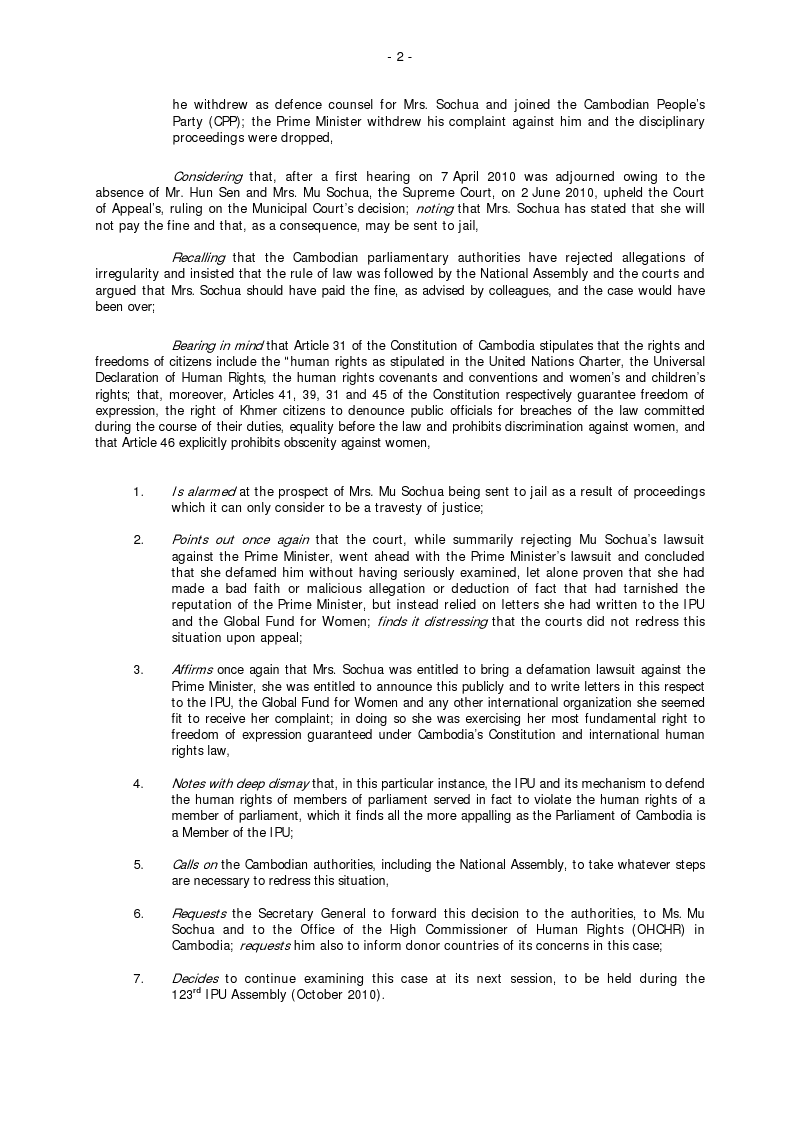 COMMITTEE ON THE HUMAN RIGHTS OF PARLIAMENTARIANS CASE No. CMBD/47 - MU SOCHUA - CAMBODIA Decision adopted by the Committee at its 130th session (Geneva, 12 - 15 July 2010)
 The Committee,
Referring to the case of Ms. Mu Sochua, a member of the National Assembly of Cambodia, and to the resolution adopted by the Governing Council at its 186th session (April 2010),
Referring also to the legal analysis of this case by the Cambodian Center for Human Rights of 30 May 2010,
Taking into account the information provided on a continuous basis by the sources,
Recalling the following:
Recalling that the Cambodian parliamentary authorities have rejected allegations of irregularity and insisted that the rule of law was followed by the National Assembly and the courts and argued that Mrs. Sochua should have paid the fine, as advised by colleagues, and the case would have been over;
Bearing in mind that Article 31 of the Constitution of Cambodia stipulates that the rights and freedoms of citizens include the “human rights as stipulated in the United Nations Charter, the Universal Declaration of Human Rights, the human rights covenants and conventions and women’s and children’s rights; that, moreover, Articles 41, 39, 31 and 45 of the Constitution respectively guarantee freedom of expression, the right of Khmer citizens to denounce public officials for breaches of the law committed during the course of their duties, equality before the law and prohibits discrimination against women, and that Article 46 explicitly prohibits obscenity against women,
Referring to the case of Ms. Mu Sochua, a member of the National Assembly of Cambodia, and to the resolution adopted by the Governing Council at its 186th session (April 2010),
Referring also to the legal analysis of this case by the Cambodian Center for Human Rights of 30 May 2010,
Taking into account the information provided on a continuous basis by the sources,
Recalling the following:
- In a widely publicized speech made by Prime Minister Hun Sen on 4 April 2009 in Kampot Province, where Mrs. Mu Sochua was elected in 2008 and which she represents in the National Assembly, reference was made to a woman who could only have been Mu Sochua in a derogatory manner with sexual innuendos;
- On 23 April 2009, Mrs. Sochua announced at a press conference that she would file a defamation lawsuit under Article 63 of the United Nations Transitional Authority in Cambodia (UNTAC) Criminal Law, stating that she respected the Prime Minister as the head of the government but wanted him to be held responsible for his insults; on 27 April 2009, Mrs. Sochua filed the lawsuit against Mr. Hun Sen who, in turn, filed a defamation lawsuit against her, stating that lifting Ms. Mu Sochua’s parliamentary immunity would be “as easy as ABC”; he also brought a defamation lawsuit against her lawyer, Mr. Kong Sam Onn, for stating during the press conference that he had defamed Ms. Sochua,
- On 10 June 2009, the Phnom Penh Municipal Court dismissed Mrs. Sochua’s case against the Prime Minister without any investigation, stating that it was groundless; however, the court moved ahead with the Prime Minister’s lawsuit, requesting that Mrs. Sochua’s parliamentary immunity be lifted;
- On 22 June 2009, the National Assembly, in a closed-door session, lifted her immunity by a show of hands without giving her the possibility to defend herself and without a debate;
- On 4 August 2009, the Phnom Penh Municipal Court found Ms. Mu Sochua guilty under Article 63 of the UNTAC law criminal provisions of defaming Prime Minister Hun Sen by: (i) holding a press conference to announce that she would file a defamation lawsuit against the Prime Minister, (ii) informing the IPU and the Global Fund for Women of the matter, (iii) affirming that the Prime Minister’s words against her “affected all Khmer women and women all over the world”, all of which showed that she had acted in bad faith with the intention of defaming the Prime Minister worldwide and sullying his reputation and dignity; she was fined 8.5 million riel and ordered to pay another 8 million riel in damages to the Prime Minister (a total of appr. US$ 4,000); on 28 October 2010, the Court of Appeal upheld the judgment; as for her lawyer, disciplinary proceedings have been brought against him by the Cambodian Bar Association, as a result of which he withdrew as defence counsel for Mrs. Sochua and joined the Cambodian People’s Party (CPP); the Prime Minister withdrew his complaint against him and the disciplinary proceedings were dropped,
Recalling that the Cambodian parliamentary authorities have rejected allegations of irregularity and insisted that the rule of law was followed by the National Assembly and the courts and argued that Mrs. Sochua should have paid the fine, as advised by colleagues, and the case would have been over;
Bearing in mind that Article 31 of the Constitution of Cambodia stipulates that the rights and freedoms of citizens include the “human rights as stipulated in the United Nations Charter, the Universal Declaration of Human Rights, the human rights covenants and conventions and women’s and children’s rights; that, moreover, Articles 41, 39, 31 and 45 of the Constitution respectively guarantee freedom of expression, the right of Khmer citizens to denounce public officials for breaches of the law committed during the course of their duties, equality before the law and prohibits discrimination against women, and that Article 46 explicitly prohibits obscenity against women,
- Is alarmed at the prospect of Mrs. Mu Sochua being sent to jail as a result of proceedings which it can only consider to be a travesty of justice;
- Points out once again that the court, while summarily rejecting Mu Sochua’s lawsuit against the Prime Minister, went ahead with the Prime Minister’s lawsuit and concluded that she defamed him without having seriously examined, let alone proven that she had made a bad faith or malicious allegation or deduction of fact that had tarnished the reputation of the Prime Minister, but instead relied on letters she had written to the IPU and the Global Fund for Women; finds it distressing that the courts did not redress this situation upon appeal;
- Affirms once again that Mrs. Sochua was entitled to bring a defamation lawsuit against the Prime Minister, she was entitled to announce this publicly and to write letters in this respect to the IPU, the Global Fund for Women and any other international organization she seemed fit to receive her complaint; in doing so she was exercising her most fundamental right to freedom of expression guaranteed under Cambodia’s Constitution and international human rights law,
- Notes with deep dismay that, in this particular instance, the IPU and its mechanism to defend the human rights of members of parliament served in fact to violate the human rights of a member of parliament, which it finds all the more appalling as the Parliament of Cambodia is a Member of the IPU;
- Calls on the Cambodian authorities, including the National Assembly, to take whatever steps are necessary to redress this situation,
- Requests the Secretary General to forward this decision to the authorities, to Ms. Mu Sochua and to the Office of the High Commissioner of Human Rights (OHCHR) in Cambodia; requests him also to inform donor countries of its concerns in this case;
- Decides to continue examining this case at its next session, to be held during the 123rd IPU Assembly (October 2010).
Friday, July 16, 2010
Group Accuses 34 Governments of Abusing Parliament Members' Rights
Lisa Schlein, Voice of America
Geneva 15 July 2010
Geneva 15 July 2010
The Inter-Parliamentary Union accuses governments in 34 countries of intimidating, illegally imprisoning and, in some cases, of being complicit in the killings of 300 members of Parliament. The group is highlighting abuses in Cambodia, Lebanon, Malaysia, Palestine/Israel, the Russian Federation and Zimbabwe.
The Inter-Parliamentary Union Human Rights Committee is calling for the Cambodian government to drop defamation charges against a female parliament member, Mu Sochua.
Mu Sochua had sued Prime Minister Hun Sen for having made derogatory remarks against her. The prime minister counter sued. The Supreme Court convicted her and ordered Mu Sochua to pay a fine by June 16.
Mexican Senator, Rosario Green, says Mu Sochua is refusing to pay the fine as a matter of principle.
"She is, therefore, on the verge of being sent to prison for merely exercising her right to freedom of expression," said Green. "But, not only that, if she goes to jail, her possibility to run for the next parliamentary election in her country will be seriously compromised."
The Inter-Parliamentary Union committee also expresses concern about the situation of three Palestinian parliament members who were elected on a ticket linked to Hamas. The three men who were imprisoned by Israel in 2006 are now free.
But the Committee says Israel has given the MPs the choice of renouncing their membership in the Palestinian Legislative Council or of facing deportation from East Jerusalem, the city of their birth. The committee says this is in violation of the fourth Geneva Convention.
The Inter-Parliamentary Union also highlights the case of Galina Starovoitova, a Russian parliament member who was assassinated in 1998. Canadian Senator Sharon Carstairs says several people were arrested in the case, but those behind this politically motivated killing have never been identified.
"We have been urging the Russian Federation for now 12 years to investigate more deeply into the mastermind of the assassination of Madame Starovoitova," said Carstairs. "Quite frankly, the communications have ceased. It is clear that they are not trying to get to the bottom of her assassination."
Carstairs also brings up the cases of three Zimbabwean opposition members of Parliament. She says Job Sikhala, Paul Madzore and Nelson Chamisa have been arrested in the past, tortured and beaten up. Yet, she says none of the perpetrators of these offenses have ever been arrested.
The Inter-Parliamentary Union Human Rights Committee is calling for the Cambodian government to drop defamation charges against a female parliament member, Mu Sochua.
Mu Sochua had sued Prime Minister Hun Sen for having made derogatory remarks against her. The prime minister counter sued. The Supreme Court convicted her and ordered Mu Sochua to pay a fine by June 16.
Mexican Senator, Rosario Green, says Mu Sochua is refusing to pay the fine as a matter of principle.
"She is, therefore, on the verge of being sent to prison for merely exercising her right to freedom of expression," said Green. "But, not only that, if she goes to jail, her possibility to run for the next parliamentary election in her country will be seriously compromised."
The Inter-Parliamentary Union committee also expresses concern about the situation of three Palestinian parliament members who were elected on a ticket linked to Hamas. The three men who were imprisoned by Israel in 2006 are now free.
But the Committee says Israel has given the MPs the choice of renouncing their membership in the Palestinian Legislative Council or of facing deportation from East Jerusalem, the city of their birth. The committee says this is in violation of the fourth Geneva Convention.
The Inter-Parliamentary Union also highlights the case of Galina Starovoitova, a Russian parliament member who was assassinated in 1998. Canadian Senator Sharon Carstairs says several people were arrested in the case, but those behind this politically motivated killing have never been identified.
"We have been urging the Russian Federation for now 12 years to investigate more deeply into the mastermind of the assassination of Madame Starovoitova," said Carstairs. "Quite frankly, the communications have ceased. It is clear that they are not trying to get to the bottom of her assassination."
Carstairs also brings up the cases of three Zimbabwean opposition members of Parliament. She says Job Sikhala, Paul Madzore and Nelson Chamisa have been arrested in the past, tortured and beaten up. Yet, she says none of the perpetrators of these offenses have ever been arrested.
World parliaments criticize Israel, Cambodia
Thursday, July 15, 2010
AP
AP
GENEVA — Representatives of world parliaments on Thursday criticized Israel, Cambodia and 19 other countries for their treatment of lawmakers.
The chair of the Inter-Parliamentary Union's human rights committee, Rosario Green, urged Israel not to deport Palestinian lawmakers Mohammed Abu Teir, Mohammed Totah and Ahmed Abu Atoun after they were recently released from prison.
The three were ordered expelled from Jerusalem for links to Hamas. But Green, a former Mexican foreign minister, said the expulsion violates the lawmakers' human rights.
Green's panel also called a Cambodian defamation case against opposition lawmaker Mu Sochua a "complete travesty of justice."
Mu Sochua faces up to six months in prison after refusing to pay a court-ordered fine for defaming Cambodia's prime minister.
Other countries scrutinized by the committee for their treatment of lawmakers included Afghanistan, Bangladesh, Belarus, Burundi, Colombia, Ecuador, Eritrea, Iraq, Lebanon, Madagascar, Malaysia, Mongolia, Myanmar, Philippines, Russia, Rwanda, Sri Lanka, Turkey and Zimbabwe.
In one of its harshest criticisms, the panel slammed Russia for failing to bring to justice the murderers of Galina Starovoitova, who was gunned down in the stairwell of her St. Petersburg apartment building in 1998.
"We have been urging the Russian Federation for now 12 years to investigate more deeply into the masterminding of the assassination," said panel member Sharon Carstairs, a Canadian senator, explaining why the previously confidential case was now being highlighted.
"It is clear that they are not trying to get to the bottom of her assassination," said Carstairs. "We believe therefore that it is necessary to make this a public case, in order for her murderers — those who are ultimately responsible for her murder — to be brought to justice."
IPU brings together lawmakers from 155 countries. The U.S. Congress isn't a member.
The chair of the Inter-Parliamentary Union's human rights committee, Rosario Green, urged Israel not to deport Palestinian lawmakers Mohammed Abu Teir, Mohammed Totah and Ahmed Abu Atoun after they were recently released from prison.
The three were ordered expelled from Jerusalem for links to Hamas. But Green, a former Mexican foreign minister, said the expulsion violates the lawmakers' human rights.
Green's panel also called a Cambodian defamation case against opposition lawmaker Mu Sochua a "complete travesty of justice."
Mu Sochua faces up to six months in prison after refusing to pay a court-ordered fine for defaming Cambodia's prime minister.
Other countries scrutinized by the committee for their treatment of lawmakers included Afghanistan, Bangladesh, Belarus, Burundi, Colombia, Ecuador, Eritrea, Iraq, Lebanon, Madagascar, Malaysia, Mongolia, Myanmar, Philippines, Russia, Rwanda, Sri Lanka, Turkey and Zimbabwe.
In one of its harshest criticisms, the panel slammed Russia for failing to bring to justice the murderers of Galina Starovoitova, who was gunned down in the stairwell of her St. Petersburg apartment building in 1998.
"We have been urging the Russian Federation for now 12 years to investigate more deeply into the masterminding of the assassination," said panel member Sharon Carstairs, a Canadian senator, explaining why the previously confidential case was now being highlighted.
"It is clear that they are not trying to get to the bottom of her assassination," said Carstairs. "We believe therefore that it is necessary to make this a public case, in order for her murderers — those who are ultimately responsible for her murder — to be brought to justice."
IPU brings together lawmakers from 155 countries. The U.S. Congress isn't a member.
Thursday, May 20, 2010
Assembly Discusses Ethnicity, Gender
Chun Sakada, VOA Khmer
Phnom Penh Wednesday, 19 May 2010
The legislative body is underrepresented by members of minorities, leading to lower education and less development, Zakarya Adam, a Muslim representative from Kandal province, told members of the union.
A low number of women representatives also make it hard for the National Assembly to address issues like domestic violence, women’s health, poverty and trafficking, Mu Sochua, Sam Rainsy Party lawmaker for Kampot province, said.
“Cambodian women parliamentarians from the ruling and opposition parties should abandon their own party policies to unite together to fight against the challenges for women,” she said.
Mu Sochua, who was once a minister of Women’s Affairs, recommended forming a joint commission to solve the gender problem.
Cambodian women lawmakers “don’t deeply understand and aren’t able to analyze the gender situation in many fields,” said Ros Sopheap, head of the Gender and Development Organization, following Wednesday’s meetings. “But they have capabilities in law.”
She urged women parliamentarians to join together to work for more solutions.
The Inter-Parliamentary Union delegation was led by Sonia Palmient, who met with Ho Naun, head of the National Assembly committee for women’s affairs, Chheang Uun, head of the body’s committee for foreign affairs, Khuon Sudary, the head of the human rights committee, Cheam Yiep, head of the finance committee, and Mu Sochua.
Phnom Penh Wednesday, 19 May 2010
“Cambodian women parliamentarians from the ruling and opposition parties should abandon their own party policies to unite together to fight against the challenges for women.”International members of the Inter-Parliamentarian Union met with lawmakers from the ruling and opposition parties on Wednesday to seek ways to better incorporate the needs of ethnic minorities and women into the National Assembly.
The legislative body is underrepresented by members of minorities, leading to lower education and less development, Zakarya Adam, a Muslim representative from Kandal province, told members of the union.
A low number of women representatives also make it hard for the National Assembly to address issues like domestic violence, women’s health, poverty and trafficking, Mu Sochua, Sam Rainsy Party lawmaker for Kampot province, said.
“Cambodian women parliamentarians from the ruling and opposition parties should abandon their own party policies to unite together to fight against the challenges for women,” she said.
Mu Sochua, who was once a minister of Women’s Affairs, recommended forming a joint commission to solve the gender problem.
Cambodian women lawmakers “don’t deeply understand and aren’t able to analyze the gender situation in many fields,” said Ros Sopheap, head of the Gender and Development Organization, following Wednesday’s meetings. “But they have capabilities in law.”
She urged women parliamentarians to join together to work for more solutions.
The Inter-Parliamentary Union delegation was led by Sonia Palmient, who met with Ho Naun, head of the National Assembly committee for women’s affairs, Chheang Uun, head of the body’s committee for foreign affairs, Khuon Sudary, the head of the human rights committee, Cheam Yiep, head of the finance committee, and Mu Sochua.
Wednesday, March 03, 2010
Sacrava's Political Cartoon: The Check Up
 Cartoon by Sacrava (on the web at http://sacrava.blogspot.com)
IPU’s mission to understand Cambodia’s parliament
02 March 2010
Everyday.com.kh
Translated from Khmer by Socheata
Four delegates of the Inter-Parliamentary Union (IPU) are currently visiting Cambodia to try to understand the role of the Cambodian parliament – which includes both the National Assembly and the Senate – in the oversight of foreign aid to Cambodia. The visit of the Geneva-based IPU will take place between 01 and 05 March 2010. The IPU delegates will meet with Cambodian senators and MPs from the CPP, the SRP, the HRP, and the royalist party (formerly known as the Norodom Ranariddh Party) on Monday 01 March at the National Assembly. A representative of the IPU delegates indicated that their mission to Cambodia is for understanding the role of the parliament in the oversight on the government, in particular in the use of development aid provided by the international community, and health-related aid.
Tuesday, March 02, 2010
IPU’s mission to understand Cambodia’s parliament
02 March 2010
Everyday.com.kh
Translated from Khmer by Socheata
Everyday.com.kh
Translated from Khmer by Socheata
Four delegates of the Inter-Parliamentary Union (IPU) are currently visiting Cambodia to try to understand the role of the Cambodian parliament – which includes both the National Assembly and the Senate – in the oversight of foreign aid to Cambodia. The visit of the Geneva-based IPU will take place between 01 and 05 March 2010. The IPU delegates will meet with Cambodian senators and MPs from the CPP, the SRP, the HRP, and the royalist party (formerly known as the Norodom Ranariddh Party) on Monday 01 March at the National Assembly. A representative of the IPU delegates indicated that their mission to Cambodia is for understanding the role of the parliament in the oversight on the government, in particular in the use of development aid provided by the international community, and health-related aid.
Wednesday, February 10, 2010
IPU “Deeply Concerned” by Lifting of Parliamentary Immunity of Cambodian Opposition MPs
February 10, 2010
Source: SRP
Source: SRP
IPU “DEEPLY CONCERNED” BY LIFTING OF PARLIAMENTARY IMMUNITY OF CAMBODIAN OPPOSITION MPs
In a late January decision of its Committee on the Human Rights of Parliamentarians, the Geneva-based Inter-Parliamentary Union (IPU) said it “is deeply concerned at the lifting of Mr. Sam Rainsy’s parliamentary immunity for the same reasons as the ones it has expressed in the cases of opposition parliamentarians Ho Vann and Mu Sochua, namely that without proper examination of the request for the lifting of immunity, without an open and public parliamentary debate, during which the parliamentarians concerned can present their arguments, without a secret vote, parliamentary immunity is reduced to a mere formality and is thus meaningless.”
The IPU also “expresses further concern at the charges laid against Mr. Sam Rainsy which, in the light of the information before it, appear highly questionable.”
Full text of the IPU decision at http://tinyurl.com/yhcb9kj
SRP Members of Parliament
The IPU also “expresses further concern at the charges laid against Mr. Sam Rainsy which, in the light of the information before it, appear highly questionable.”
Full text of the IPU decision at http://tinyurl.com/yhcb9kj
SRP Members of Parliament
Tuesday, October 27, 2009
IPU Resolution regarding Mrs. Mu Sochua's case
INTER-PARLIAMENTARY UNION
CHEMIN DU POMMIER 5
1218 LE GRAND-SACONNEX / GENEVA (SWITZERLAND)
TELEPHONE + 41 22 - 919 41 50 - FAX + 41 22 - 919 41 60 - E-MAIL postbox@mail.ipu.org
CHEMIN DU POMMIER 5
1218 LE GRAND-SACONNEX / GENEVA (SWITZERLAND)
TELEPHONE + 41 22 - 919 41 50 - FAX + 41 22 - 919 41 60 - E-MAIL postbox@mail.ipu.org
CASE No. CMBD/47 - MU SOCHUA - CAMBODIA
Resolution adopted by consensus by the IPU Governing Council at its 185th session*
(Geneva, 21 October 2009)
Resolution adopted by consensus by the IPU Governing Council at its 185th session*
(Geneva, 21 October 2009)
The Governing Council of the Inter-Parliamentary Union,
Having before it the case of Mu Sochua, a member of the National Assembly of Cambodia, which has been the subject of a study and report of the Committee on the Human Rights of Parliamentarians following the Procedure for the treatment by the Inter-Parliamentary Union of communications concerning violations of the human rights of members of parliament,
Taking note of the report of the Committee on the Human Rights of Parliamentarians, which contains a detailed outline of the case (CL/185/11(b)-R.1),
Noting that during the 121st Assembly the Committee met with the Cambodian delegation; taking into account the letter from the President of the National Assembly dated 4 September 2009,
Considering the following information on file:
- At a news conference held on 23 April 2009, Ms. Mu Sochua, a member of the opposition Sam Rainsy Party and former Minister for Women’s Affairs, announced that she would be bringing a defamation lawsuit against Prime Minister Hun Sen. This decision followed a public speech made by the Prime Minister on 4 April 2009 in Kampot province, which is Ms. Sochua’s constituency, in which he attacked the opposition and an unnamed woman member of parliament, who could only have been her. He reportedly used disparaging language, qualifying her inter alia as a women gangster or prostitute who had rushed to hug a man and unbuttoned her shirt to attract his attention. This reportedly refers to an incident that occurred during the July 2008 election campaign in Kampot province where she took a picture of a car with the licence plate of the army being used by the Cambodian People’s Party (CPP) during the campaign, which was illegal. The army officer who was driving the car assaulted her and twisted her arm in an attempt to grab her camera. During the attack, her shirt became unbuttoned;
- The day after Ms. Sochua announced that she would be bringing a lawsuit, a senior adviser to the Prime Minister told the press that he would in turn sue her and that all Cambodian People’s Party (CPP) National Assembly members would support the lifting of her parliamentary immunity. Five days later, the Prime Minister reportedly confirmed that he was suing “a lady”, whom he described as “stupid”;
- Ms. Sochua’s lawsuit and the Prime Minister’s suit against her and her lawyer were filed in Phnom Penh Municipal Court on 27 April 2009. In a speech he made on 29 April, Prime Minister Hun Sen called on the parliament to lift Ms. Sochua’s immunity and, alluding to his party’s majority, reportedly said that it would be “as easy as ABC”. Prime Minister Hun Sen’s lawyer, Ky Tech, a former president of the Cambodian Bar Association (CBA), also filed a complaint with the Bar Association against Ms. Sochua’s lawyer, Kong Sam Onn, accusing him of violating the attorneys’ code of ethics in this case. The CBA’s special team assigned to investigate his case has accused Kong Sam Onn of violating the CBA’s internal rules, which carries a penalty of disbarment for two years;
- On 10 June 2009, the Phnom Penh Municipal Court rejected Ms. Sochua’s lawsuit for lack of evidence, but accepted the Prime Minister’s case against her. She and her lawyer were summoned and appeared for questioning by the deputy prosecutor on 3 June 2009;
- On 22 June 2009, the National Assembly lifted Ms. Sochua’s immunity, after which, on 26 June, Phnom Penh Municipal Court charged her with defamation; the procedure for lifting her immunity was reportedly unlawful for the following reasons: (a) emergency rules were applied to prevent the public, the diplomatic corps, civil society and the media from attending the session; the sound system allowing television coverage was disconnected so that the session was not broadcast as usual; (b) the Speaker did not allow time for her to defend herself although she had asked to speak; the Speaker put the matter to the vote without a debate; (c) heavily-armed military police were seen outside the parliament building threatening the public with batons; however, according to the parliamentary authorities, the relevant rules of the National Assembly were fully respected and normal procedure was followed;
- In an article published on 18 June 2009 in the Phnom Penh Post, Prime Minister Hun Sen was quoted as saying that if Ms. Sochua’s immunity was lifted, that might well signal the end of her political career. “Lifting immunity is easy. Restoring it in some cases is not so easy. So Ms. Sochua will not be a parliamentarian forever; her party must replace her with a new person”, he was quoted as saying; according to the Cambodian delegation, parliamentary immunity is not automatically restored, but needs to be restored following the same procedure as that in use for the lifting of parliamentary immunity;
- The case was heard on 24 July 2009 before Phnom Penh Municipal Court. Ms. Sochua had no legal assistance as her lawyer had apologized to the Prime Minister and declined to present her defence. On 4 August 2009, the court delivered its verdict, finding Ms. Sochua guilty under Article 63 of the United Nations Transitional Authority in Cambodia (UNTAC law) Criminal Provisions of defaming Prime Minister Hun Sen on the grounds of (i) holding a press conference to announce that she would file a defamation lawsuit against the Prime Minister, (ii) informing international organizations such as IPU of the matter, (iii) affirming that the Prime Minister’s words against her “affected all Khmer women and women all over the world”, which showed that she had acted in bad faith with the intention of defaming the Prime Minister worldwide and besmirching his reputation and dignity. The Court sentenced her to payment of 8.5 million riel as a fine and 8 million riel in compensation; as to her lawyer Kong Sam Onn, the judge stated that the Prime Minister had withdrawn the complaint and that the charges against him had been dropped; Ms. Sochua has filed an appeal, which is due for hearing on 28 October. Ms. Sochua has not found a lawyer prepared to defend her,
Considering that the Committee sent an observer to the court hearing in the person of attorney at law Franklin Drilon, former member and President of the Senate of the Philippines; he observed inter alia that Ms. Sochua’s right to confront the witnesses against her had not been respected as the entire hearing was based on evidence from the prosecution only and that she was thus denied basic due process that must be accorded to an accused in a fair trial; moreover, the threat of disbarment of her lawyer, which forced him to withdraw from the case, violated her right to counsel of her choice and that, on the whole, the evidence presented was grossly inadequate to convict Mu Sochua and did not meet the universally accepted standard of proof beyond reasonable doubt; noting that the parliamentary authorities have rejected his conclusions stating that the evidence presented during the trial was not challenged and that Mu Sochua did not present any witnesses, that the Court respected its duty to find out the truth, that the alleged threat of the disbarment of her lawyer was not related to his being selected as counsel by Mu Sochua but to his violation of the Code of Ethics and that he apologized for those violations and that his withdrawal cannot be considered a denial of Mu Sochua’s right to counsel of her choice and that, generally, the court respected due process,
Bearing in mind that the Office of the United Nations High Commissioner for Human Rights in Cambodia issued a statement on 5 August 2009 in response to the guilty verdict in Mu Sochua’s case, in which it emphasized the need to uphold the constitutional right to freedom of expression in Cambodia and pointed out that under international law, freedom of expression is to be restricted only in exceptional cases, where clearly necessary and proportionate to the value that the restriction seeks to protect, and appealed to the Cambodian judiciary to take full account of constitutional and international standards when considering defamation cases; the Office also recalled that in July 2007 the Constitutional Court had directed all Cambodian courts to take into account international human rights standards, as contained in the treaties to which Cambodia was a party when considering such cases,
1. Thanks the Cambodian delegation and the President of the National Assembly for the cooperation extended to the Committee and for the documents provided;
2. Expresses deep concern at the sentencing of Mu Sochua for defamation on account of statements she made which clearly fall within the limits of her freedom of expression since she merely sought to defend her own reputation; is appalled and finds intolerable that a letter she sent to the Inter-Parliamentary Union was used as an argument in court to show her alleged intention to defame the Prime Minister; firmly states that parliamentarians are entitled to call upon the IPU and to seek its assistance, just as they are entitled to seek the assistance of any international organization; would have hoped that, as a member of the IPU, the National Assembly of Cambodia would defend this right to the best of its ability;
3. Endorses the conclusions of the Committee’s trial observer as it cannot share the arguments put forward by the authorities to prove the fairness of the trial, and notes the following in particular: the judge, who is bound to seek the truth, has to examine arguments not only in favour of the prosecution but also in favour of defendants, whether or not defendants present such evidence, which the judge did not do in this case; Ms. Sochua did not enjoy her right to legal counsel of her choice whatever may have been the reasons for Mr. Kong Sam Onn’s withdrawal from her case; considers in this respect that it is difficult to accept the argument of the authorities that no link exists between the risk of his being disbarred from the Bar Association and his having taken on Mu Sochua’s defence;
4. Expresses furthermore deep concern at the lifting of Ms. Mu Sochua’s parliamentary immunity on grounds that appear to be mere retaliation for her having dared to bring a lawsuit against the Prime Minister;
5. Is therefore all the more alarmed at the manner in which immunity was lifted, although the procedure may have formally been in keeping with rules; stresses that with no serious examination of or debate on whether or not it is appropriate to lift immunity, parliamentary immunity fails to fulfil its purpose;
6. Notes in this respect with deep concern the Prime Minister’s statements expressing a certainty that the Assembly would lift her immunity, and even threatening her with definitive expulsion from parliament; considers that such statements of the Head of Government may harm the independence and sovereignty of parliament;
7. Firmly recalls that parliamentary immunity is designed to protect parliamentarians from possibly unfounded proceedings, thus safeguarding the independence and sovereignty of parliament as an institution; and that it must therefore be lifted in strict compliance with the law and in particular with due respect for the right of the parliamentarians concerned to defend themselves; urges the Cambodian parliament to amend its rules in such a way as to ensure that a thorough and transparent examination, involving both majority and opposition parliamentarians, of requests for the lifting of immunity are carried out and that parliamentarians concerned are given the opportunity to defend themselves;
8. Observes with deep concern that the decisions such as those in question may have a dampening effect on the ability of members of parliament and, even more so, of citizens to criticize the conduct of government officials and hence may detract from democratic debate;
9. Earnestly hopes that, in conformity with the directive issued by the Cambodian Constitutional Court, the Appeal Court will decide upon Mu Sochua’s case in accordance with the international human rights obligations which Cambodia is bound to respect and hence will ensure respect for the most core of democratic values, freedom of expression; requests the Secretary General to examine the possibility of sending an observer to the appeal court hearing;
10. Requests the Secretary General to forward this resolution to the parliamentary authorities, to Ms. Sochua and to the Office of the United Nations High Commissioner for Human Rights (OHCHR) in Cambodia;
11. Requests the Committee to continue examining this case and report to it at its next session, to be held on the occasion of the 122nd IPU Assembly (March-April 2010).
* The delegation of Cambodia expressed its reservation regarding the resolution.
Having before it the case of Mu Sochua, a member of the National Assembly of Cambodia, which has been the subject of a study and report of the Committee on the Human Rights of Parliamentarians following the Procedure for the treatment by the Inter-Parliamentary Union of communications concerning violations of the human rights of members of parliament,
Taking note of the report of the Committee on the Human Rights of Parliamentarians, which contains a detailed outline of the case (CL/185/11(b)-R.1),
Noting that during the 121st Assembly the Committee met with the Cambodian delegation; taking into account the letter from the President of the National Assembly dated 4 September 2009,
Considering the following information on file:
- At a news conference held on 23 April 2009, Ms. Mu Sochua, a member of the opposition Sam Rainsy Party and former Minister for Women’s Affairs, announced that she would be bringing a defamation lawsuit against Prime Minister Hun Sen. This decision followed a public speech made by the Prime Minister on 4 April 2009 in Kampot province, which is Ms. Sochua’s constituency, in which he attacked the opposition and an unnamed woman member of parliament, who could only have been her. He reportedly used disparaging language, qualifying her inter alia as a women gangster or prostitute who had rushed to hug a man and unbuttoned her shirt to attract his attention. This reportedly refers to an incident that occurred during the July 2008 election campaign in Kampot province where she took a picture of a car with the licence plate of the army being used by the Cambodian People’s Party (CPP) during the campaign, which was illegal. The army officer who was driving the car assaulted her and twisted her arm in an attempt to grab her camera. During the attack, her shirt became unbuttoned;
- The day after Ms. Sochua announced that she would be bringing a lawsuit, a senior adviser to the Prime Minister told the press that he would in turn sue her and that all Cambodian People’s Party (CPP) National Assembly members would support the lifting of her parliamentary immunity. Five days later, the Prime Minister reportedly confirmed that he was suing “a lady”, whom he described as “stupid”;
- Ms. Sochua’s lawsuit and the Prime Minister’s suit against her and her lawyer were filed in Phnom Penh Municipal Court on 27 April 2009. In a speech he made on 29 April, Prime Minister Hun Sen called on the parliament to lift Ms. Sochua’s immunity and, alluding to his party’s majority, reportedly said that it would be “as easy as ABC”. Prime Minister Hun Sen’s lawyer, Ky Tech, a former president of the Cambodian Bar Association (CBA), also filed a complaint with the Bar Association against Ms. Sochua’s lawyer, Kong Sam Onn, accusing him of violating the attorneys’ code of ethics in this case. The CBA’s special team assigned to investigate his case has accused Kong Sam Onn of violating the CBA’s internal rules, which carries a penalty of disbarment for two years;
- On 10 June 2009, the Phnom Penh Municipal Court rejected Ms. Sochua’s lawsuit for lack of evidence, but accepted the Prime Minister’s case against her. She and her lawyer were summoned and appeared for questioning by the deputy prosecutor on 3 June 2009;
- On 22 June 2009, the National Assembly lifted Ms. Sochua’s immunity, after which, on 26 June, Phnom Penh Municipal Court charged her with defamation; the procedure for lifting her immunity was reportedly unlawful for the following reasons: (a) emergency rules were applied to prevent the public, the diplomatic corps, civil society and the media from attending the session; the sound system allowing television coverage was disconnected so that the session was not broadcast as usual; (b) the Speaker did not allow time for her to defend herself although she had asked to speak; the Speaker put the matter to the vote without a debate; (c) heavily-armed military police were seen outside the parliament building threatening the public with batons; however, according to the parliamentary authorities, the relevant rules of the National Assembly were fully respected and normal procedure was followed;
- In an article published on 18 June 2009 in the Phnom Penh Post, Prime Minister Hun Sen was quoted as saying that if Ms. Sochua’s immunity was lifted, that might well signal the end of her political career. “Lifting immunity is easy. Restoring it in some cases is not so easy. So Ms. Sochua will not be a parliamentarian forever; her party must replace her with a new person”, he was quoted as saying; according to the Cambodian delegation, parliamentary immunity is not automatically restored, but needs to be restored following the same procedure as that in use for the lifting of parliamentary immunity;
- The case was heard on 24 July 2009 before Phnom Penh Municipal Court. Ms. Sochua had no legal assistance as her lawyer had apologized to the Prime Minister and declined to present her defence. On 4 August 2009, the court delivered its verdict, finding Ms. Sochua guilty under Article 63 of the United Nations Transitional Authority in Cambodia (UNTAC law) Criminal Provisions of defaming Prime Minister Hun Sen on the grounds of (i) holding a press conference to announce that she would file a defamation lawsuit against the Prime Minister, (ii) informing international organizations such as IPU of the matter, (iii) affirming that the Prime Minister’s words against her “affected all Khmer women and women all over the world”, which showed that she had acted in bad faith with the intention of defaming the Prime Minister worldwide and besmirching his reputation and dignity. The Court sentenced her to payment of 8.5 million riel as a fine and 8 million riel in compensation; as to her lawyer Kong Sam Onn, the judge stated that the Prime Minister had withdrawn the complaint and that the charges against him had been dropped; Ms. Sochua has filed an appeal, which is due for hearing on 28 October. Ms. Sochua has not found a lawyer prepared to defend her,
Considering that the Committee sent an observer to the court hearing in the person of attorney at law Franklin Drilon, former member and President of the Senate of the Philippines; he observed inter alia that Ms. Sochua’s right to confront the witnesses against her had not been respected as the entire hearing was based on evidence from the prosecution only and that she was thus denied basic due process that must be accorded to an accused in a fair trial; moreover, the threat of disbarment of her lawyer, which forced him to withdraw from the case, violated her right to counsel of her choice and that, on the whole, the evidence presented was grossly inadequate to convict Mu Sochua and did not meet the universally accepted standard of proof beyond reasonable doubt; noting that the parliamentary authorities have rejected his conclusions stating that the evidence presented during the trial was not challenged and that Mu Sochua did not present any witnesses, that the Court respected its duty to find out the truth, that the alleged threat of the disbarment of her lawyer was not related to his being selected as counsel by Mu Sochua but to his violation of the Code of Ethics and that he apologized for those violations and that his withdrawal cannot be considered a denial of Mu Sochua’s right to counsel of her choice and that, generally, the court respected due process,
Bearing in mind that the Office of the United Nations High Commissioner for Human Rights in Cambodia issued a statement on 5 August 2009 in response to the guilty verdict in Mu Sochua’s case, in which it emphasized the need to uphold the constitutional right to freedom of expression in Cambodia and pointed out that under international law, freedom of expression is to be restricted only in exceptional cases, where clearly necessary and proportionate to the value that the restriction seeks to protect, and appealed to the Cambodian judiciary to take full account of constitutional and international standards when considering defamation cases; the Office also recalled that in July 2007 the Constitutional Court had directed all Cambodian courts to take into account international human rights standards, as contained in the treaties to which Cambodia was a party when considering such cases,
1. Thanks the Cambodian delegation and the President of the National Assembly for the cooperation extended to the Committee and for the documents provided;
2. Expresses deep concern at the sentencing of Mu Sochua for defamation on account of statements she made which clearly fall within the limits of her freedom of expression since she merely sought to defend her own reputation; is appalled and finds intolerable that a letter she sent to the Inter-Parliamentary Union was used as an argument in court to show her alleged intention to defame the Prime Minister; firmly states that parliamentarians are entitled to call upon the IPU and to seek its assistance, just as they are entitled to seek the assistance of any international organization; would have hoped that, as a member of the IPU, the National Assembly of Cambodia would defend this right to the best of its ability;
3. Endorses the conclusions of the Committee’s trial observer as it cannot share the arguments put forward by the authorities to prove the fairness of the trial, and notes the following in particular: the judge, who is bound to seek the truth, has to examine arguments not only in favour of the prosecution but also in favour of defendants, whether or not defendants present such evidence, which the judge did not do in this case; Ms. Sochua did not enjoy her right to legal counsel of her choice whatever may have been the reasons for Mr. Kong Sam Onn’s withdrawal from her case; considers in this respect that it is difficult to accept the argument of the authorities that no link exists between the risk of his being disbarred from the Bar Association and his having taken on Mu Sochua’s defence;
4. Expresses furthermore deep concern at the lifting of Ms. Mu Sochua’s parliamentary immunity on grounds that appear to be mere retaliation for her having dared to bring a lawsuit against the Prime Minister;
5. Is therefore all the more alarmed at the manner in which immunity was lifted, although the procedure may have formally been in keeping with rules; stresses that with no serious examination of or debate on whether or not it is appropriate to lift immunity, parliamentary immunity fails to fulfil its purpose;
6. Notes in this respect with deep concern the Prime Minister’s statements expressing a certainty that the Assembly would lift her immunity, and even threatening her with definitive expulsion from parliament; considers that such statements of the Head of Government may harm the independence and sovereignty of parliament;
7. Firmly recalls that parliamentary immunity is designed to protect parliamentarians from possibly unfounded proceedings, thus safeguarding the independence and sovereignty of parliament as an institution; and that it must therefore be lifted in strict compliance with the law and in particular with due respect for the right of the parliamentarians concerned to defend themselves; urges the Cambodian parliament to amend its rules in such a way as to ensure that a thorough and transparent examination, involving both majority and opposition parliamentarians, of requests for the lifting of immunity are carried out and that parliamentarians concerned are given the opportunity to defend themselves;
8. Observes with deep concern that the decisions such as those in question may have a dampening effect on the ability of members of parliament and, even more so, of citizens to criticize the conduct of government officials and hence may detract from democratic debate;
9. Earnestly hopes that, in conformity with the directive issued by the Cambodian Constitutional Court, the Appeal Court will decide upon Mu Sochua’s case in accordance with the international human rights obligations which Cambodia is bound to respect and hence will ensure respect for the most core of democratic values, freedom of expression; requests the Secretary General to examine the possibility of sending an observer to the appeal court hearing;
10. Requests the Secretary General to forward this resolution to the parliamentary authorities, to Ms. Sochua and to the Office of the United Nations High Commissioner for Human Rights (OHCHR) in Cambodia;
11. Requests the Committee to continue examining this case and report to it at its next session, to be held on the occasion of the 122nd IPU Assembly (March-April 2010).
* The delegation of Cambodia expressed its reservation regarding the resolution.
Monday, July 20, 2009
Drilon to observe Cambodia case for IPU
The IPU is monitoring the celebrated trial of Mu Soncha (Sochua), a member of the Cambodian National Assembly and a known advocate of women and children’s rights...
Phay Siphan, a Cambodian government spokesman, dismissed Mu Soncha’s claims that the courts were biased.
But the accusations have gained traction among international human rights groups, as well as donor countries, which pledged almost $1 billion in foreign aid to Cambodia in 2008.
By Jerome Aning
Philippine Daily Inquirer First Posted 07/19/2009
Filed Under: Human Rights, Treaties & International Organisations
MANILA, Philippines -- Former Senate President Franklin Drilon said he was chosen by the International Parliamentary Union (IPU) as an observer in the defamation trial of a Cambodian opposition member of the parliament.
Drilon said the IPU, a worldwide organization of parliamentarians, designated him as its representative and observer in next week's trial of Cambodian opposition MP Mu Sochua (not Soncha) for a defamation suit filed by strongman Prime Minister Hun Sen.
Drilon, in a statement sent to media outfits on Sunday afternoon, said he was informed of his designation by Anders Johnson, IPU secretary general, and Ingeborg Schwarz, secretary of the IPU Committee on Human Rights of Parliamentarians.
The IPU is monitoring the celebrated trial of Mu Soncha (Sochua), a member of the Cambodian National Assembly and a known advocate of women and children’s rights.
Mu Soncha (Sochua), a one-time Nobel Prize nominee and a former minister of women affairs, was in the forefront of the campaign against sex and human trafficking in Cambodia and was vocal against the Hun Sen government’s alleged failure to crack down on offenders.
She will stand trial on Friday in Phnom Penh on a defamation countersuit filed by Hun Sen in retaliation to an earlier suit she filed against the prime minister, according to Drilon’s press statement.
The case against Hun Sen was earlier dismissed by the courts.
Mu Soncha claimed the courts were biased and that no lawyer in Cambodia was courageous enough to represent her for fear of reprisal from government.
“I intend to put the (Cambodian) justice system on trial,” she was quoted as saying recently.
Phay Siphan, a Cambodian government spokesman, dismissed Mu Soncha’s claims that the courts were biased.
But the accusations have gained traction among international human rights groups, as well as donor countries, which pledged almost $1 billion in foreign aid to Cambodia in 2008.
Reports said the Cambodian government launched at least nine criminal cases against politicians, journalists and activists recently.
Critics such as Human Rights Watch accuse the ruling Cambodia People’s Party of using the legal system to silence opposition voices.
Johnson and Ingeborg informed Drilon that he was chosen as IPU trial observer and representative in his capacity as former chairman of the IPU Human Rights for Parliementarians Committee and as a former justice secretary in the Philippines.
In July 2006, Drilon was elected chairman of the IPU committee, a prestigious international body that investigates violations of human rights of lawmakers.
He is the first Filipino legislator to be elected to the position since the IPU was established in 1889.
The IPU, the oldest multilateral political organization, brings together 146 affiliated parliaments and seven associated regional assemblies. It is based in Geneva, Switzerland. It serves as a Permanent Observer at the United Nations.
The IPU Committee of Human Rights of Parliamentarians was established in 1976 and was created to ensure that the human rights of the world's parliamentary community - composed of more than 40,000 members - are respected.
In 2005, Drilon was elected assembly president of the 112th General Assembly which was held at the Philippine International Convention Center (PICC) in Manila and was attended by over 1,500 parliamentarians from over 45 countries.
Prior to his election as president of the IPU assembly, Drilon was also a member of the IPU Executive Committee.
Drilon is the current chairman of the Liberal Party.
.
Subscribe to:
Posts (Atom)








