KI-Media loves to hear from you, and we're giving you a bullhorn. We just ask that you keep things civil. Please leave out personal attacks, do not use profanity, ethnic or racial slurs, or take shots at anyone's sexual orientation or religion. We thank you for your cooperation!
Kong Sothanarith, VOA Khmer Phnom Penh Monday, 06 December 2010
“We wanted to share experiences with other countries in the world in terms of ending war, national reconciliation and peace-building.”
Cambodia and Nepal are each seeking support from one another in their respective bids with the UN General Assembly, top officials said Monday.
Cambodia has had a request with the General Assembly for non-permanent membership since 2005, with the international body expected to decide on it in the 67th General Assembly in New York in 2012.
Nepal, meanwhile, is seeking its own position for the presidency of the General Assembly, in competition with Qatar, in the 2011 session.
Nepali Prime Minister Madhav Kumar Nepal, who was among regional leaders in Phnom Penh last week, told reporters Friday that both Cambodia and Nepal has requested help from each other.
Cambodia has slowly begun participating in the UN system, sending “blue helmet” peacekeepers, mostly deminers, to Sudan, Chad, the Central African Republic and Lebanon over the past few years. Cambodia has been a full member of the UN since 1955.
“We wanted to share experiences with other countries in the world in terms of ending war, national reconciliation and peace-building,” Koy Kuong, a spokesman for the Ministry of Foreign Affairs, said.
Foreign Minister of Cambodia Hor Namhong at United Nations General Assembly at U.N. (Photo: ASSOCIATED PRESS)
Foreign Minister Touts Achievements at UN
Men Kimseng, VOA Khmer Washington, D.C Wednesday, 29 September 2010
[Hor 5 Hong] also lent Cambodian support to a UN resolution to end the embargo of Cuba
Cambodian Foreign Minister Hor Namhong addressed the UN General Assembly Tuesday, saying the global financial crisis had not stopped Cambodia from reaching some of its development goals.
Cambodia's “Millennium Development Goals” included targets for child mortality, HIV and AIDS, malaria and other diseases, he said. “According to the recent study made by the Overseas Development Institute (ODI) and the UN Millennium Campaigns, Cambodia was listed among 20 countries making the most absolute progress on MDGs.”
The UN development goals aim at halving the world's poverty rate, promoting education and health and protecting the environment, all by 2015.
The UN in Cambodia says child mortality has dropped from 95 per 1,000 live births in 2000 to 60 in 2005, the latest figure available. But the rate is still high compared to regional countries like Indonesia, Malaysia, Thailand and Vietnam.
Hor Namhong said that while a lack of attention on agriculture, coupled with rising fuel costs, threatened food security in some parts of the world, Cambodia had managed well.
“Food production is the top agenda of our government policy, and agriculture and irrigation are being aggressively considered as a springboard for broader economic development with the ambition to turn Cambodia into a more important rice-exporting country,” he told the Assembly.
In his 13-minute speech, Hor Namhong pushed for developed countries to pay more attention to climate change and environmental issues.
“Cambodia urges developed countries to honor their commitment to provide financial and technological aid to developing nations in the fight against climate change, and take the lead to cut their respective carbon dioxide emission,” he said.
Hor Namhong called for peaceful resolution to issues on the Korean peninsula and between Israel and Palestine. He also lent Cambodian support to a UN resolution to end the embargo of Cuba.
Cambodia, General Debate, 65th Session 28 September 2010
Address by H.E. Hor Namhong, Deputy Prime Minister and Minister for Foreign Affairs and International Cooperation of Cambodia, at the General Debate of the 65th Session of the General Assembly of the United Nations (New York, 23-25 and 27-30 September 2010)
24 Sept 2010 By Moeung Tum Radio Free Asia Translated from Khmer by Soch
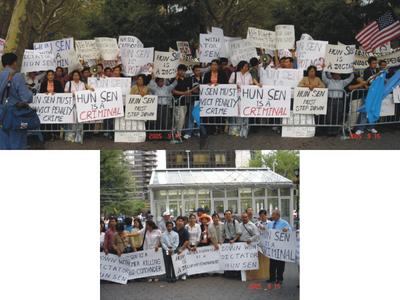
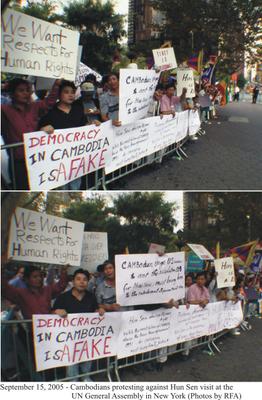
Numerous US citizens of Cambodian origin from all over the US plan to hold a peaceful demonstration in front of the UN headquarters building in New York, USA, on 24 September 2010 during PM Hun Xen’s meeting with the US President.
The Rally at the United Nations Headquarters in New York City, New York, USA against Hun Sen and his Governmental Officials on 24 September 2010 from 11:00 AM to 2:00 PM at East 47st Street & 2nd Avenue.
Maryland - Wednesday, September 22, 2010: We are, the Cambodians, and Cambodian-Americans from Virginia, Maryland, Philadelphia, New Jersey, New York, Road islands, Massachusetts, Canada, and others are proudly hosting the Rally in front of the Headquarters, United Nations against Hun Sen, and his Government Officials for these following reasons:
Illegal treaties (1979, 1982, 1983, 1985, and Supplemental Treaty of 2005 ) with Vietnam---Hun Sen’s Former Communist Boss during Vietnam’s armed occupied forces to colonize Cambodia from 1979 to present and recent borders encroachments and flooding of illegal Vietnamese Immigrants into Cambodia.
Disregarded and unimplemented the Paris Peace Agreement on 23 Oct 1991 to its fullest extent.
Land grabbing, illegal land concessions and evictions of innocence people by armed forces from their homes and their lands.
Selling of National Assets (States’ Buildings, Forest, Land, Sands, Oil and underground Minerals.
Using Judicial Systems to silence oppositions and innocence citizens.
Make Cambodia to be the one of the corrupted nations in the world from the bottom-up.
Interfering and manipulating of Extra Ordinary Chamber in the Court of Cambodia (ECCC)---Khmer Rouge Tribunal (KRT).
Did not use International Court of Justice (ICJ) ruling on 15 June 1962 on Preah Vihear issue to solve the problem with Thailand and Thais’ ambition on Preah Vihear and its vicinity.
Monopoly Media by his own family.
Hun Sen turns Cambodia into Burmese’s Junta.
Created Corruption-Law only to protect their corrupted inner-circle members.
Pocketing money for themselves from foreign donors, and foreign loans from foreign
countries.
Wasteful spending on outdated and useless military equipment & weapons where his Government is living by foreign donors and the country unemployment is skyrocketing.
And many others.
For further information, please contact the Rally Organizer, Mr. Michael Duong (202) 280-7223, jeyvarman@yahoo.com.
Cambodia not surprised by SRP party protest against Hun Xen in New York … but following the situation very closely (!!!)
23 Sept 2010
By Keh Ratana
DAP news
Translated from Khmer by Soy
Phnom Penh – Tith Sothea, the mouthpiece of the Press and Quick Reaction Unit (PQRU) of the Council of Ministers, reacted yesterday that Cambodia is not surprised about the unreasonable action (sic!) of these people.
He indicated that what the opposition is doing is their right, but he rejected all the accusations raised by the SRP against the Cambodian leaders, in particular the accusation that Hun Xen did not lead the country properly.
Tith Sothea made this comment after the SRP-USA branch plans to demonstrate against Hun Xen in New York City on 24 September from 11AM to 2PM.
Those who will join this demonstration are Cambodians living in the US, they come from various US states, from Canada, from France, as well as numerous other European countries.
On Thursday, according to SRP officials in the US, the topic of the demonstration is to condemn Hun Xen for recognizing the illegal treaties of 1979, 1982, 1983 and 1985 which were concluded with Vietnam because all the treaties prior to 2005 were concluded in the 80s, at a time when Vietnam maintained a militarily occupation of Cambodia.
Tith Sothea indicated that the opposition SRP party is taking this course in order to force Cambodia to pardon opposition leader Sam Rainsy and for its own political gain.
Prime Minister Abhisit Vejjajiva said on Wednesday he would explain Thailand's economic and political situation to world leaders during the 65th United Nations General Assembly in New York.
The assembly takes place from Sept 22 to 26. The prime minister will leave for New York Wednesday evening and will return to Bangkok Sunday morning.
"I believe there are many investors in the US planning to invest or expand their businesses here," Bangkok Post online quoted Abhisit as saying.
On the plan to meet Cambodia's Prime Minister Hun Sen, Abhisit said he and his Cambodian counterpart would likely meet many times at international meetings before the end of this year.
"I'm not sure if there will be enough time for talks on the border row around Preah Vihear temple and it is not easy to get down to the details. But I can assure that both countries want to solve the problems between them peacefully, since they are good neighbours," the premier was quoted by the Bangkok Post online as saying.
Moreover, he said he has assigned Deputy Prime Minister Suthep Thaugsuban to oversee domestic issues during his trip to New York.
Cambodia's Prime Minister Hun Sen left here for New York on Wednesday noon for ASEAN-U.S. Summit which is to be held later this week.
Sry Thammarong, minister attached to the prime minister said Prime Minister Hun Sen will attend the Second ASEAN-U.S. Leaders' Meeting on Sept. 24 in New York.
He said, as planned, the leaders will exchange views on important regional and international issues of common interest and concern, as well as cooperation between ASEAN and U.S.
The first ASEAN-U.S. Summit was held in Singapore last November.
According to Sry Thammarong, Hun Sen will likely meet with Barack Obama, president of the United States if time will be available.
And, on the sidelines of the summit, Prime Minister Hun Sen will hold bilateral talks with Thai Prime Minister Abhisit Vejjajiva on bilateral cooperation and issues of common interests, he said.
Also, while he is in New York, the prime minister will meet with the members of the ruling Cambodian People's Party from the United States and Canada.
Abhisit to clarify Thai issues while he is in the US September 21, 2010 The Nation
Prime Minister Abhisit Vejjajiva will clarify and explain issues of economics, politics and foreign policy to audiences during his visit to the United States from Wednesday to Saturday.
He will be telling investors about the Map Ta Phut problems, the souring of ties with Cambodia and the auction of 3G licences at the US-Asean Business Council on Friday, a Government House official said yesterday.
Abhisit hopes the foreign business community and investors will understand his government’s policies and justice system, the official said.
The premier will also attend the second US-Asean summit on Friday to emphasise the importance of America’s role in building up security in Southeast Asia. Leaders from both sides will look for ways to prevent protectionism and help turn the US and Asean into strategic partners.
On Thursday Abhisit will attend the opening ceremony of the 65th UN General Assembly at the UN headquarters in New York. The assembly this year will include a high-level meeting on the Millennium Development Goals in order to push member countries, notably developing countries, to achieve the goal by 2015.
The premier will also meet the media while he’s in the US, and is scheduled for interviews with CNN and CNBC. Foreign media, notably CNN, was accused of being prejudiced when reporting on Abhisit’s handling the red-shirt protest earlier this year.
Abhisit will also hold bilateral meetings with many foreign leaders, including Slovenian Prime Minister Borut Pahor, Sri Lankan President Mahinda Rajapaksa, and also attend a luncheon with UN Secretary-General Ban Ki-moon. A dinner reception hosted by US President Barack Obama, a speech at the Council of Foreign Relations and a meeting with Thais in New York is also on the PM’s itinerary.
He is scheduled to return to Thailand on Sunday morning.
We wish the Prime Minister well as he attends this Summit in New York; may he be inspired to implement this obvious ROAD MAP toward reducing poverty in Cambodia. May he also use this occasion to raise the Preah Vihear issue with more than just Abhisit but with other ASEAN and Paris Peace Agreement signatories. A great article by the amazing singer-humanitarian BONO. - Theary Seng, Phnom Penh, 19 Sept. 2010.
Theary Seng and Singer Bono at P8, Germany, 2007
September 18, 2010 By BONO The New York Times
I’ve noticed that New Yorkers, and I sometimes try to pass for one these days, tend to greet the word “summit” with an irritated roll of the eyes, a grunt, an impatient glance at the wristwatch. In Manhattan, a summit has nothing to do with crampons and ice picks, but refers instead to a large gathering of important persons, head-of-state types and their rock-star retinues in the vicinity of the United Nations building and creates, therefore, a near total immobilization of the East Side. Can world peace possibly be worth this? Never, never...Eleanor Roosevelt, look what you’ve done ... .
Recent global summit meetings, from Copenhagen to Toronto, have frankly been a bust, so the world, which may not know it yet, is overdue for a good multilateral confab — one that’s not just about the gabbing but about the doing. The subject of the summit meeting at the United Nations this week is one whose monumental importance is matched only by its minuscule brand recognition: the Millennium Development Goals, henceforth known as the M.D.G.’s (God save us from such dull shorthand).
The M.D.G.’s are possibly the most visionary deal that most people have never heard of. In the run-up to the 21st century, a grand global bargain was negotiated at a series of summit meetings and then signed in 2000. The United Nations’ “Millennium Declaration” pledged to “ensure that globalization becomes a positive force for all the world’s people,” especially the most marginalized in developing countries. It wasn’t a promise of rich nations to poor ones; it was a pact, a partnership, in which each side would meet obligations to its own citizens and to one another.
Of course, this is the sort of airy-fairy stuff that people at summit meetings tend to say and get away with because no one else can bear to pay attention. The 2000 gathering was different, though, because signatories agreed to specific goals on a specific timeline: cutting hunger and poverty in half, giving all girls and boys a basic education, reducing infant and maternal mortality by two-thirds and three-quarters respectively, and reversing the spread of AIDS, tuberculosis and malaria. All by 2015. Give it an A for Ambition.
So where are we now, 10 years on, with some “first-world” economies looking as if they could go bang, and some second- and third-level economies looking as if they could be propping us up?
Well, I’d direct you to the plenary sessions and panel discussions for a detailed answer...but if you’re, eh, busy this week...my view, based on the data and what I’ve seen on the ground, is that in many places it’s going better than you’d think.
Much better, in fact. Tens of millions more kids are in school thanks to debt cancellation. Millions of lives have been saved through the battle against preventable disease, thanks especially to the Global Fund to Fight AIDS, Tuberculosis and Malaria. Apart from fallout from the market meltdown, economic growth in Africa has been gathering pace — over 5 percent per year in the decade ending in 2009. Poverty declined by 1 percent a year from 1999 to 2005.
The gains made by countries like Ghana show the progress the Millennium Goals have helped create.
At the same time, the struggles of places like Congo remind us of the distance left to travel. There are serious headwinds: 64 million people have been thrown back into poverty as a result of the financial crises, and 150 million are hungry because of the food crisis. And extending the metaphor, there are storms on the horizon: the poor will be hit first — and worst — by climate change.
So there should be no Champagne toasts at this year’s summit meeting. The 10th birthday of our millennium is, or ought to be, a purposeful affair, a redoubling of efforts. After all, there’s only five years before 2015, only five years to make all that Second Avenue gridlock worth it. With that in mind I’d like to offer three near-term tests of our commitment to the M.D.G.’s.
1. Find what works and then expand on it. Will mechanisms like the Global Fund get the resources to do the job?
Energetic, efficient and effective, the fund saves a staggering 4,000 lives a day. Even a Wall Streeter would have to admit, that’s some return on investment. But few are aware of it, a fact that allows key countries — from the United States to Britain, France and Germany — to go unnoticed if they ease off the throttle. The unsung successes of the fund should be, well, sung, and after this summit meeting, its work needs to be fully financed. This would help end the absurdity of death by mosquito, and the preventable calamity of 1,000 babies being born every day with H.I.V., passed to them by their mothers who had no access to the effective, inexpensive medicines that exist.
2. Governance as an effect multiplier. In this column last spring, I described some Africans I’ve met who see corruption as more deadly than the deadliest of diseases, a cancer that eats at the foundation of good governance even as the foundation is being built. I don’t just mean “their” corruption; I mean ours, too. For example, multinational oil companies. They want oil, and governments of poor countries rich in just one thing, black gold, want to sell it to them. All well and good. Except the way it too often happens, as democracy campaigners in these countries point out, is not at all good. Some of these companies knowingly participate in a system of backhanders and bribery that ends up cheating the host nation and turning what should be a resource blessing into a kind of curse of black market cabals.
Well, I’m pleased to give you an update on an intervention that some of us thought of and fought for as critical: hidden somewhere in the Dodd-Frank financial reform bill (admit it...you haven’t read it all either) there is a hugely significant “transparency” amendment, added by Senators Richard Lugar and Benjamin Cardin. Now energy companies traded on American exchanges will have to reveal every payment they make to government officials. If money changes hands, it will happen in the open. This is the kind of daylight that makes the cockroaches scurry.
The British government should institute the same requirement for companies trading in Britain, as should the rest of the European Union and ultimately all the G-20 nations. According to the African entrepreneur Mo Ibrahim, who has emerged as one of the most important voices on that continent, transparency could do more to transform Africa than even debt cancellation has. Measures like this one should be central to any renewed Millennium Development Goal strategy.
And the cost to us is zero, nada. It’s a clear thought in a traffic jam.
3. Demand clarity; measure inputs and outputs.
Speaking of transparency, let’s have a little more, please, when it comes to the question of who is doing what toward which goal and to what effect. We have to know where we are to know how far we’ve left to go.
Right now it’s near impossible to keep track. Walk (if you dare) into M.D.G. World and you will encounter a dizzying array of vague financing and policy commitments on critical issues, from maternal mortality to agricultural development. You come across a load of bureau-babble that too often is used to hide double counting, or mask double standards. This is the stuff that feeds the cynics.
What we need is an independent unit — made up of people from governments, the private sector and civil society — to track pledges and progress, not just on aid but also on trade, governance, investment. It’s essential for the credibility of the United Nations, the M.D.G.’s, and all who work toward them.
And that was the deal, wasn’t it? The promise we made at the start of this century was not to perpetuate the old relationships between donors and recipients, but to create new ones, with true partners accountable to each other and above all to the citizens these systems are supposed to work for. Strikes me as the right sort of arrangement for an age of austerity as well as interdependence. (The age of interrupted affluence should sharpen our focus on future markets for our sake as well as theirs.)
No leader scheduled to speak at the summit meeting is more painfully aware of this context than President Obama, who one year ago pledged to put forth a global plan to reach the development goals. If promoting transparency and investing in what works is at the core of that strategy, he can assure Americans that their dollars are reinforcing their values, and their leadership in the world is undiminished. Action is required to make these words, these dull statistics, sing. The tune may not be pop but it won’t leave your head — this practical, achievable idea that the world, now out of kilter, can re-balance itself and offer all, not just some, a chance to exit the unfathomable deprivation that brings about the need for such global bargains.
I understand the critics who groan or snooze through the pious pronouncements we will hear from the podium in the General Assembly. But still in my heart and mind, undiminished and undaunted, is this thought planted by Nelson Mandela in his quest to tackle extreme poverty: “Sometimes it falls upon a generation to be great.”
We have a lot to prove, but if the M.D.G. agreement had not been made in 2000, much less would have happened than has happened. Already, we’ve seen transformative results for millions of people whose lives are shaped by the priorities of people they will never know or meet — the very people causing gridlock this week. For this at least, the world should thank New Yorkers for the loan of their city.
Bono, the lead singer of the band U2 and a co-founder of the advocacy group ONE and (Product)RED, is a contributing columnist for The Times.
Rong Chhun, CITA and CWC President (Photo: Cambodge Soir Hebdo)
Friday 10 Sept 2010 Everyday.com.kh Translated from Khmer by Soch
Rong Chhun, President of the Cambodia Watchdog Council (CWC) and President of the Cambodia Independent Teachers’ Association (CITA), said that the meeting between the Cambodian and Thai leaders in New York on 24 September will show an improvement in the border tension, however, he does not believe that this bilateral meeting can put an end to the border dispute between the two countries unless an intervention by the UN will take place. Rong Chhun told VOA yesterday: “Because we follow up on all the bilateral meetings, if we count their number of times, we couldn’t even remember how many times there were, and the result is ‘zero’, there was no outcome whatsoever in regards to the Thai aggression.”
Prime Minister Abhisit Vejjajiva and his Cambodian counter-part Hun Sen will meet on the sidelines of the Asean-US summit in New York late this month, government spokesman Panitan Wattanayagorn said yesterday.
All 10 leaders of Asean plus Asean secretary-general Surin Pitsuwan would meet with US President Barack Obama on September 24, he said.
Officials from the foreign ministries of the two countries were working closely to tee up a bilateral meeting between Abhisit and Hun Sen when they are in New York, Panitan said.
"It will be an informal and friendly meeting to discuss only cooperation, not issues of conflict," he said.
Thailand and Cambodia normalised diplomatic relations last month after former PM Thaksin Shinawatra stood down as an adviser to Hun Sen. However, problems remain over Preah Vihear. The Thai government has opposed moves to list the border temple as a World Heritage site due to a dispute over areas adjacent to the temple.
KI-Media Note: Hun Xen would be foolish to accept the following condition set by Thailand: "That both sides accept the fundamental fact that there is no defined border and that both sides commit to defining that border". Please voice out you opinion.
4/09/2010 Pichai Chuensuksawad Bangkok Post
The first top-level meeting on the Preah Vihear dispute between Prime Minister Abhisit Vejjajiva and his Cambodian counterpart Hun Sen is likely to take place earlier than expected in New York rather than in Brussels, diplomatic sources told the Bangkok Post yesterday.
Initially, Hun Sen had not planned to attend the United Nations General Assembly in New York this year.
He is now likely to be in New York after US President Barack Obama officially invited all Asean leaders to the second US-Asean summit set for Sept 24.
The summit is expected to last two hours - half an hour longer than the first US-Asean summit held in Singapore in November last year.
The possibility of a high-level meeting between the leaders in Brussels was first revealed by Asean Secretary-General Surin Pitsuwan after his visit to Phnom Penh where he met Hun Sen and Foreign Minister Hor Nam Hong on Aug 16.
Mr Surin spent more than two hours with Hun Sen but did not reveal details of their meeting.
Two days later the leaders confirmed their willingness to meet in Brussels.
When Phnom Penh announced on Aug 23 that former prime minister Thaksin Shinawatra had resigned as Cambodia's economic adviser, Thailand decided to send its ambassador Prasas Prasasvinitchai back to Phnom Penh.
Phnom Penh then announced its ambassador, You Aye, would return to Bangkok.
The thawing of relations is the result of discussions at various levels resulting in Hun Sen agreeing not only to meet Mr Abhisit but also agreeing to discuss a resolution to Preah Vihear based on a framework proposed by intermediaries.
Hun Sen revealed to diplomatic sources in Phnom Penh that he had been silent on the Preah Vihear dispute for quite a while but was prompted to speak out only after Mr Abhisit appeared on a national televised programme with members of the Thai Patriots network led by the People's Alliance for Democracy in August.
The sources quoted Hun Sen as saying he was confused because on the one hand the Thai prime minister said he would explain the Thai position to the international community but wanted the dispute to be resolved bilaterally.
Hun Sen reacted strongly also because Mr Abhisit said that Thailand would apply diplomatic and military measures in dealing with Cambodia's encroaching upon the disputed area surrounding the Preah Vihear temple.
Hun Sen is very familiar with all the players on the Thai side but he questions why the memorandums of understanding (MoU) which have been agreed upon by both countries on the issue have not yet moved forward.
The Cambodian leader said there was a perception that Thailand is not really committed or that it cannot deliver, and that a resolution was also difficult because Preah Vihear had become a "hostage of Thai politics".
Hun Sen understood, however, that his Thai counterpart was under considerable pressure and had to balance the various forces in Thailand over the temple dispute, the sources said.
Despite these doubts and questions, Thailand and Cambodia continue to keep the channel of communications open through their respective defence ministers.
This is to ensure that the border dispute does not get out of hand, sources in both capitals said.
In an attempt to help defuse the situation, the point was made to Hun Sen that the hundreds of kilometres of border between the two countries had not been surveyed, nor was there clear demarcation. Each attempt to resolve the boundary issue failed because of a lack of trust.
The sources said it was proposed to Hun Sen that one way forward was for both leaders to meet when it was convenient.
It was suggested there were several opportunities to meet, namely at the Asia-Europe summit in Brussels in early October, the Asean summit in Hanoi at the end of October, the Asian Games in Gaungzhao in November, or at the Ayeyarwady-Chao Phraya-Mekong Economic Cooperation Strategy (Acmecs) in Cambodia in November.
There were a number of points proposed which would form the framework of discussions between both leaders when they meet, including:
That both sides accept the fundamental fact that there is no defined border and that both sides commit to defining that border.
That both sides exercise maximum restraint with regards to troop movements and avoid any movement that could lead to miscalculations or act in any way that would increase pressure at the border.
To allow technical teams to find a process of moving forward - this should occur "when it is convenient" along the lines agreed in the MoU. By agreeing to this, a cooling down process would commence.
Both sides should agree to an exchange of ambassadors.
Given the political nature of the dispute which has heightened emotions on both sides, people-to-people exchanges should be encouraged.
Hun Sen had no difficulty in accepting the points and was willing to meet Mr Abhisit to discuss them, the sources in Phnom Penh said.
On the thorny issue of former prime minister Thaksin's role as economic adviser - an issue which prompted Thailand to withdraw its ambassador - Hun Sen said "he could not abandon Thaksin".
However it was made clear to Hun Sen that Thaksin's appointment via royal proclamation was very difficult for the Thai side to accept, especially when the former prime minister is viewed as a convicted fugitive.
Since his appointment as economic adviser, Thaksin has not visited Cambodia nor been active in his advisory role.
The sources in Phnom Penh quoted Hun Sen as saying that during the political turmoil in Thailand in May, Thaksin had asked to visit Cambodia but Hun Sen asked him not to come.
It is also widely known in Phnom Penh that Cambodian instructions were issued prohibiting troop movements along the border during the May riots as it could be misconstrued, and that Cambodians in Thailand should not be involved in the red shirt protests.
Apart from agreeing to meet Mr Abhisit and to discuss the four points, Hun Sen said he had nothing personal against the Thai leader and asked intermediaries to convey his "best wishes".
Hun Sen's agreement to meet Mr Abhisit and the possible points of discussion were conveyed to the Thai prime minister indirectly through intermediaries, the sources in both capitals said.
"He [Hun Sen] has voiced confidence that Mr Abhisit will stay in the post for a long time and that the prime minister has grown stronger and proved his leadership skills," Ong-art Klampaibul
Ong-art's visit to Phnom Penh helps boost ties
4/09/2010 Pradit Ruangdit Bangkok Post
Prime Minister Abhisit Vejjajiva and his Cambodian counterpart Hun Sen look set to hold talks later this month to build on the improving ties between the two countries.
Given the potential meeting of the two leaders, the Defence Ministry is considering postponing the Joint Boundary Commission (JBC) meeting scheduled for Sept 8-10 in Bangkok, a ministry source said.
Speaking after his return from Cambodia yesterday, Prime Minister's Office Minister Ong-art Klampaibul said the Cambodian prime minister appears keen on the prospect of catching up with Mr Abhisit when they meet at the United Nations General Assembly.
"He said we [Thailand and Cambodia] don't have to wait until the Asia-Europe Meeting (Asem) in October because we will meet in New York on Sept 24," said Mr Ong-art who visited Cambodia on Thursday shortly after the normalisation of diplomatic ties.
Mr Ong-art was only scheduled to meet with the Cambodian information minister during the visit. But he also had a one-hour meeting with Hun Sen.
Ties with Phnom Penh deteriorated over border conflicts and the appointment of ousted premier Thaksin Shinawatra as economic adviser. They went downhill after Cambodia proposed a management plan for the Preah Vihear temple to the World Heritage Committee that Bangkok opposed.
Bangkok and Phnom Penh recently reinstated their ambassadors after Thaksin resigned from his advisory post.
Mr Ong-art said the Cambodian leader is ready to hold talks on "any issue" with Mr Abhisit. "He has assured that a broker is unnecessary when holding a dialogue with Thailand. Any forum can do."
According to the minister, the Cambodian leader said Thailand and Cambodia were like "tongue and teeth" - a reference to occasional disagreements which should be dealt with amicably.
Mr Ong-art said bilateral relations between the two nations are picking up, citing the bringing forward from Oct 18 to Sept 10 of the Thai ambassador to submit his appointment to Cambodia's king for endorsement.
Both countries have also agreed to carry out journalistic and cultural exchange programmes, he said.
A hotline will be set up as a communications channel between him and the Cambodian information minister in case there are any urgent issues that need to be resolved, he said.
Mr Ong-art added that Hun Sen was full of praise for Mr Abhisit.
The Cambodian prime minister said that Mr Abhisit should not be discouraged by criticism about his early rise to become prime minister.
"He has voiced confidence that Mr Abhisit will stay in the post for a long time and that the prime minister has grown stronger and proved his leadership skills," Mr Ong-art said.
Mr Ong-art said he also explained the legal requirements about the Thai side in working on the JBC and Hun Sen seemed to understand these.
Mr Abhisit, meanwhile, said yesterday that he expects to meet and hold talks with Hun Sen when they meet at international forums later this year.
Mr Abhisit played down Hun Sen's softened stance towards bilateral ties.
Earlier, Hun Sen had accused Thailand of threatening to renege on its acceptance of Cambodia's rights to the Preah Vihear temple and asked the UN to intervene.
Mr Abhisit said that as neighbours both countries are aware that existing disagreements or conflicts must be resolved through talks but certain issues need to proceed at the right time.
Mr Abhisit said he hoped Mr Ong-art's visit to Cambodia would strengthen communications and that the ministers concerned seemed to be working on some mechanisms to reduce tensions caused by misunderstandings.
In a related development, provincial authorities and the private sector in Trat are holding a three-day meeting with their Cambodian counterparts from four provinces to discuss cooperation.
Trat governor Kaenpet Chuangrangsi said the meeting, which will take place on Koh Chang, will discuss matters ranging from border security to health care and trade and tourism. He said that a draft memorandum on cooperation guidelines is expected to be signed at the end of the meeting today.
Cambodian Prime Minister Hun Sen is ready for talks with Thai counterpart Abhisit Vejjajiva during the United Nations General Assembly in New York this month, Prime Minister's Office Minister Ong-art Klampaiboon said on Friday on returning from Cambodia.
During his visit to Cambodia, Mr Ong-art met the minister of information and paid a courtesy call on Hun Sen.
Mr Ong-art said Hun Sen was of the opinion that he and Mr Abhisit could meet while attending the United Nations General Assembly on Sept 24.
"He said it is not necessary to wait until the Asem summit. He said they can hold a close-door meeting during the general assembly in October and talk over various issues, including trade, investment or even about Preah Vihear," Mr Ong-art said.
Hun Sen denied having said he did not want to talk with Mr Abhisit, he added.
Earlier, Asean secretary-general Surin Pitsuwan said he expected Mr Abhisit and Hun Sen to meet and discuss the Preah Vihear dispute during the Asean-Europe leaders summit in Brussels in October.
The Asem summit, to be attended by leaders from 47 countries from Europe, Asean and other countries in Asia, will be held on Oct 4 and 5.
To strengthen relations between the two countries, Mr Ong-art, who oversees the Public Relations Department, said that an agreement he made with the minister of information allows a team of Cambodian news reporters to be stationed in Thailand.
The Cambodian reporters would monitor news in Thailand, and qoluld have access to various Thai leaders.
Mr Ong-art said he had coordinated with the Foreign Ministry concerning this matter and the ministry had agreed to cooperate.
The news team was expected to arrive in Thailand this month.
A hotline would be set up, probably for a direct contact with the information minister of Cambodia, in case there was a misunderstanding between the two countries.
Arrangements would be made for Thai artists to perform concerts in Cambodia and for Cambodian artists to come to Thailand under an exchange programme.
Mr Ong-art said he explained to Cambodia that the Foreign Affairs Ministry is still in the process of surveying the people's opinions regarding the demarcation of the Thai-Cambodian border under the framework agreed by the Joint Border Committee (JBC). It would also take some time for the Thai government to go through various procedures, including approval from parliament.
He and Hun Sen did not talk about former prime minister Thaksin Shinawatra, Mr Ong-art said.
Bangkok - US President Barack Obama has invited the leaders of South-East Asia to a summit on the sidelines of the United Nations General Assembly, reports said Thursday.
Surin Pitsuwan, secretary general of the Association of South-East Asian Nations (ASEAN), told The Nation online news service that Obama had set September 24 for the meeting at a "special" venue in New York.
"The US recognizes the big shift from the West to the East after the global financial crisis," Surin said. "So far, most of the ASEAN leaders are positive" about the suggested meeting, Surin said.
He said the summit, which will last two hours, demonstrated the "growing momentum" of US-ASEAN relations.
When Obama took power, he vowed to "re-engage" with South-East Asia, which has been overshadowed by US interest in China and India over the past decade.
ASEAN comprises Brunei, Cambodia, Indonesia, Laos, Malaysia, Myanmar, the Philippines, Singapore, Thailand and Vietnam.
Phnom Penh (Cambodia), 24 September 2008: Prime minister Hun Sen press conference following the opening session of the National Assembly (Photo: John Vink, Magnum)
Outside of the NA inaugural session on Wednesday 24 September, Prime minister Hun Sen expressed his displeasure to the journalists present about articles published in local and foreign media indicating that he would travel to New York this week to participate at the UN General Assembly. “These are information published without being checked!” an indignant Hun Sen said while adding that he also reprimanded Hun Mana, his daughter and director of the Bayon TV channel, and her deputy on this issue.
“Let’s be logical, Samdech Hun Sen must take part in the first NA meeting, in the formation of the new government, and in the first meeting of the Council of ministers. Even H.E. Hor Nam Hong [the Cambodian Foreign minister] cannot travel to go there. We will send to New York two secretaries of state from the Ministry of Foreign Affairs to participate in the meeting of the ASEAN Foreign ministers, and to the unavoidable meeting between the Cambodian and Thai parties.”
He stressed that, following the nomination of Somchai Wongsawat, on Thursday 18 September, to the PM position, he called the latter to congratulate him.
“In reality, even if there is a border conflict, no shot was exchanged. The situation is less tense than it was last July,” Hun Sen added.
“Some are wondering why we are not conduction warfare between each other. It’s because this is not the way to resolve a border dispute, this requires that we are arming ourselves with a lot of patience. However, if we are attacked, we will resist with force. But, I am persuaded that, in the 21st Century, our neighbor will not dare use force to resolve this problem, and neither do we.”
Again, Hun Sen stressed that Cambodia had solid legal arguments in this territorial conflict, such as the Franco-Siamese map which was accepted through agreements between the two parties in 1904 and 1907, the agreement protocol signed in 2000 by the two neighboring countries, or the decision handed down by The Hague International Court of Justice (ICJ) in 1962.
“We will call on the UN Security Council for intervention only in case of war. If the negotiations fail, we will bring our complaints to the ICJ,” Hun Sen declared.
Cambodia and Thailand will resume talks on the disputed border area on the sidelines of the UN General Assembly meeting in New York.
Political representatives from both countries will meet next Monday at the UN for negotiations on disputed land near ancient temples along their border.
Much of the Cambodian-Thai border remains in dispute, and the slow pace of demining has delayed demarcation of it.
Tensions flared in July after the ancient Khmer temple of Preah Vihear was awarded world heritage status by UNESCO, angering nationalists in Thailand.
The International Court of Justice ruled in 1962 that the temple belongs to Cambodia, but surrounding land remains in dispute.
PHNOM PENH, Sept. 22 (Xinhua) -- Cambodia and Thailand will restart bilateral negotiations to resolve their 10-week border dispute on Sept. 29 on the sidelines of the UN General Assembly session in New York, national media reported Monday.
Either Cambodian Prime Minister Hun Sen or Foreign Minister HorNamhong will fly to New York this week to attend the General Assembly session, Chea Sokhum, deputy secretary-general of the Permanent Organizing Commission for National and International Ceremonies, was quoted by the Cambodia Daily newspaper as saying.
Whoever attends will also lead the Cambodian side Sept. 29 during negotiations in New York with the Thai foreign minister, Chea Sokhum told the newspaper.
Military leaders of both countries will also meet in early October in Siem Reap to resume negotiations concerning the withdrawal of troops from Preah Vihear temple, RCAF Region 4 Commander Chea Morn said.
The renewed talks will come four weeks after Thailand indefinitely postponed bilateral military meetings.
The border row erupted after Cambodia's arrest of three Thai nationalist protesters on July 15, whom authorities alleged crossed illegally into Cambodia close to the disputed temple site.
Since then, Thailand and Cambodia have been building up their forces near the temple and tensions have escalated, spreading to other temple sites along the border.