Showing posts with label Code of conduct. Show all posts

Thursday, August 30, 2012

Asean and China: navigating turbulent waters ahead

The USS Milius, a guided missile destroyer, docks in Manila on August 18 amid rising tensions in the South China Sea between the Philippines and China.

Singapore August 25, 2012
Yang Razali Kassim
RSIS

In this year, the 45th anniversary of Asean, Indonesia's foreign minister Marty Natalegawa expressed optimism that a regional code of conduct to govern behaviour in the South China Sea would be ready by year's end.

In so doing, he signalled Asean's shift to a new and more active phase to resolve the territorial disputes in the South China Sea by pushing for an early adoption of the long-stalled Code of Conduct (COC). Dr Natalegawa's confidence followed his success in securing an Asean consensus on a six-point statement of principles on the South China Sea in late July, after it failed to issue a joint communique at the group's annual meeting in Phnom Penh.

The statement has papered over the rift within Asean between members who are disputants in the South China Sea, and the Asean chair, who refused to seek a compromise position, resulting in the non-issuance of a joint communique for the first time in Asean's 45 year history. Cambodia will need to focus on repairing the fissures in Asean so that it can host a credible summit in November.

By shifting gear towards an early COC, Asean is also repairing the rift over the territorial disputes between some of its members and China, the region's emergent power. This has prompted a more cooperative posture on Beijing's part. China's foreign minister Yang Jiechi, on a visit to Jakarta on August 10, pledged to build mutual trust towards the eventual adoption of the COC.

Thursday, July 26, 2012

What now for ASEAN amid China-U.S. rivalry?

Thursday, July 26, 2012
By MARK VALENCIA
Special to The Japan Times
The South China Sea disputes were supposed to be and could have been an opportunity for China to diplomatically solve problems and build confidence with its neighbors, as well as a chance for ASEAN to demonstrate its ability to work together on security issues. Both opportunities were lost — as was the hope for stabilization of the region.
KANEOHE, Hawaii — In mid-July, the 10-member Association of Southeast Asian Nations convened its scheduled meetings in Phnom Penh — the ASEAN Foreign Ministers Meeting (AMM) and the ASEAN Regional Forum (ARF).

For the first time in its 45-year history, ASEAN failed to agree on even a joint communiqué at the end of the AMM. This did not bode well for a bloc that is trying to create a security community let alone a regional economic community by 2015.

The meetings foundered on South China Sea issues, reflecting deep divisions among ASEAN members. The deal-breaker was Manila's insistence on including a reference to its recent confrontation with China at Scarborough Shoal, and the 2012 ASEAN Chair Cambodia's decision to not issue a statement rather than include such a reference. Vietnam also wanted a statement of "respect for EEZs (exclusive economic zones)" — also unacceptable to Cambodia.

Philippines Foreign Minister Albert Del Rosario said the impasse on the statement was due to "pressure, duplicity and intimidation" by China. But Cambodia insisted it was not influenced by any nation and that it had "taken a position of principle." It argued that the Philippines and Vietnam had tried to turn their disputes with China into a dispute between China and ASEAN as a whole.

Monday, July 23, 2012

ASEAN Reached Consensus On South China Sea

https://www.youtube.com/watch?v=pjLTYavuabA

United Asean Stands or Divided It Falls to China, US

Indonesian Foreign Minister Marty Natalegawa speaking at a news conference in Phnom Penh on Friday. (Reuters Photo/Samrang Pring)

Jakarta Globe | July 23, 2012

Even though Asean finally managed to come out with a joint statement following its regional summit last week, a fickle unity will continue to undermine the grouping as long as it fails to address domestic problems in each of its member states, observers have said.

Aleksius Jemadu, dean of Pelita Harapan University’s School of Social and Political Sciences, said that as long as China and the United States could help Asean countries more than they could help themselves, the regional bloc would always face the threat of disunity.

“We can see it clearly in Cambodia’s case,” he said. “[Prime Minister] Hun Sen needs China’s help in developing Cambodia’s economy while Asean offers nothing in regards to this issue. That’s why they will reject any statement they think will make China angry.”

The same is true for the Philippines and the United States, he said.

ASEAN works to resolve South China Sea disputes

23 July 2012
ABC Radio Australia and AFP

ASEAN has agreed on a unity statement over the South China Sea disputes and will work towards a full code of conduct.

Cambodia, the organisation's current chair, announced last week that member nations had agreed to six principles on handling the disputed waters where Vietnam and the Philippines have accused China of becoming increasingly aggressive.

Indonesian Foreign Minister Marty Natalegawa says the recent summit became bogged down on the issue of how to describe the complex territorial spat and was unable reach consensus.

It was the first time an ASEAN meeting had ending without a communiqué.

Following the summit Mr Natalegawa visited Manila, Hanoi and Phnom Penh in an effort to help the group find common ground.

Sunday, July 22, 2012

Cambodia Staves Off Criticism

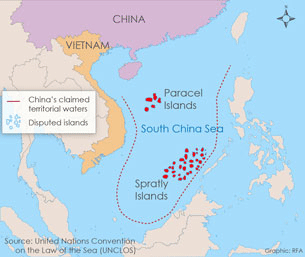
China's territorial claim to the South China Sea includes two disputed island chains. (RFA)

Prime Minister Hun Sen says his country is not taking sides in the South China Sea dispute.

2012-07-20
RFA

Prime Minister Hun Sen has defended Cambodia from criticism over its chairing of a Southeast Asian ministerial meeting which led to an unprecedented delay in the adoption of a joint statement over the region's dispute with Beijing on overlapping territorial claims in the South China Sea.

Some diplomats from the Association of Southeast Asian Nations (ASEAN) had charged that Cambodia had been influenced by its giant ally China not to incorporate the views of ASEAN member states the Philippines and Vietnam in the statement, causing an impasse at the meeting last week.

Endless arguments over the text on the South China Sea dispute prevented the ASEAN foreign ministers from issuing their customary joint statement for the first time in the 10-member bloc's 45-year history at the conclusion of their meeting in Phnom Penh on July 13.

In a face saving move, Cambodia announced Friday that the Southeast Asian states had finally emerged with a statement calling for restraint and dialogue over the South China Sea and vowed to work towards a "code of conduct" governing nations with overlapping territorial claims in the vast sea.

Tuesday, July 17, 2012

Asean's non-action

15/07/2012
Bangkok Post
EDITORIAL

It is not at all surprising that the foreign ministers and heads of state of Asean could not come to any agreement over the territorial disputes in the South China Sea at their meeting in Phnom Penh.

The failure to take a stand was basically a reaffirmation of the traditional Asean core value of non-interference. This is the policy which brought international criticism for many years to Asean with regard to its reluctance to address human rights abuses in its member states, particularly in Myanmar.

But there was another and probably much more important factor that encouraged non-action in Phnom Penh. Along the sidelines the meeting became a skirmish in a regional power struggle between two superpowers, China and the United States, and Asean leaders perhaps understandably are unwilling to appear to be taking sides.

Both China and the US sent high-level emissaries to the conference. The US team was headed by Secretary of State Hillary Rodham Clinton. She met foreign ministers in an attempt to persuade them to send a clear message to China that the Asean group rejects its increasingly strident maritime claims, but in the end she was disappointed.

Besides the Philippines and Vietnam, which have ongoing maritime disputes with China, Indonesia and Singapore were on board with a statement reflecting a compromise position, one with a non-confrontational tone, but the rest of the group waffled.

Most importantly, the foreign minister of the host country, Hor Namhong, declined to go along with a compromise, saying it was a ''matter of principle'' for Asean not to take sides in bilateral disputes.

Friday, July 13, 2012

ASEAN slammed over CoC

US Secretary of State Hillary Clinton speaks at a press conference yesterday after the 19th ASEAN Regional Forum Foreign Ministers Retreat, at the Council of Ministers in Phnom Penh. Photograph: Hong Menea/Phnom Penh Post

Friday, 13 July 2012
Cheang Sokha and David Boyle
The Phnom Penh Post

‘Utterly irresponsible” and “extremely disappointing” is how Indonesia’s foreign minister described ASEAN’s failure yesterday to agree to the terms for a Code of Conduct on the hotly disputed South China Sea.

China effectively claims all of the resource rich waters, and this week’s ASEAN summit was supposed to be a chance for member countries to present the burgeoning superpower with the terms of a CoC guiding the pursuit of their various claims.

A frustrated Marty Natalegawa, Indonesia’s foreign minister, told reporters late yesterday they should ask the “obvious” countries why ASEAN had failed to speak with one voice and agree to a common statement, or final communiqué.

“You ask the participants why it is they are not able to speak with one voice, whether it is the Philippines, whether it is the chair, Cambodia, whoever it is,” he said.

China, U.S. seek to calm South China Sea tensions

Secretary of State Hillary Clinton attends the 2nd East Asia Summit (EAS) Foreign Ministers' meeting at the office of the Council of Ministers in Phnom Penh July 12, 2012. REUTERS/Samrang Pring

By Arshad Mohammed and Martin Petty | Reuters – july, 12, 2012

PHNOM PENH (Reuters) - The United States and China signaled a willingness on Thursday to work together on "sensitive issues" in a move to cool tensions between rival claimants to the potentially oil-rich and increasingly militarized South China Sea.

Long-simmering tensions in the waters have entered a more contentious chapter this year as the six parties who claim the territory search deeper into the disputed waters for energy supplies while building up their navies and defense alliances.

Chinese Foreign Minister Yang Jiechi said Beijing was ready to work with Washington "to expand our common ground, respect each other, properly handle differences on sensitive issues, and push forward" relations.

Echoing Yang's conciliatory tone, U.S. Secretary of State Hillary Clinton stressed the importance of U.S.-China cooperation in regional institutions.

Wednesday, July 11, 2012

China lukewarm to ASEAN proposal to ease S. China Sea tensions through maritime rules

July 11, 2012
By Sopheng Cheang, The Associated Press

PHNOM PENH, Cambodia - China reacted cautiously Wednesday to a proposal by Southeast Asian nations to establish rules for maritime conduct in the South China Sea to avoid conflict among nations.

Chinese Vice Foreign Minister Fu Ying said foreign ministers from the member states of the Association of Southeast Asian Nations proposed that they hold talks on establishing a code of conduct for avoiding escalation of maritime disputes. The ministers made the proposal in talks earlier Wednesday with Chinese Foreign Minister Yang Jiechi.

China and several Southeast Asian countries have overlapping territorial claims in the South China Sea. Chinese and Philippine ships have been engaged in a standoff in one disputed area since April.

Clinton Discusses Bilateral, Regional Issues with Cambodian PM

2012-07-11
Xinhua

U.S. Secretary of State Hillary Clinton met with Cambodian Prime Minister Hun Sen here on Wednesday evening, discussing bilateral ties and regional issues.

During the one-hour meeting at the Peace Palace, Clinton highly evaluated good cooperation between the U.S. and Cambodia and emphasized that the two countries have much room to grow in terms of trade and investment, according to Eang Sophallet, spokesman for Hun Sen.

The U.S. is satisfied with the security cooperation with Cambodia and wishes to see further expansion in this cooperation, Clinton said.

ASEAN struggles over maritime dispute with China

July 11, 2012

PHNOM PENH (AFP) - China and Southeast Asian countries struggled to make progress Wednesday on a code of conduct designed to ease tension in the flashpoint South China Sea, diplomatic sources said.

The two sides were due to meet at a summit of the 10-member Association of Southeast Asian Nations (ASEAN) in Cambodia amid splits on what the code should include and how it should be implemented.

A joint statement to be issued by ASEAN foreign ministers was also held up as countries wrangled over whether to include a reference to recent spats over the resource-rich area pitting China against Vietnam and the Philippines.

"ASEAN foreign ministers are having an emergency meeting to resolve the wording on the South China Sea in the joint statement," one Asian diplomat told AFP on condition of anonymity.

Another spoke of "splits and divisions" in the organisation, principally between the Philippines and the chair of the meeting, staunch Chinese ally Cambodia.

Dick COC talk at ASEAN meeting

July 11, 2012
Edited and Translated by Zhu Rui
People's Daily Online

From July 9 to 13, a series of foreign ministers' meetings, including the 45th ASEAN Foreign Ministers' Meeting, the ASEAN-China, Japan and ROK (10+3) Foreign Ministers' Meeting, the ASEAN-China (10+1) Foreign Ministers' Meeting, the Second East Asia Summit (EAS) Foreign Ministers' Meeting and the 19th ASEAN Regional Forum (ARF) Foreign Ministers' Meeting, will be held in Phnom Penh, the capital of Cambodia.

Some foreign media speculate that each side concerned will conduct negotiations on the legally binding Code of Conduct (COC) in the South China Sea, which is expected to make further progress.

This year marks the 10th anniversary of Declaration on the Conduct of Parties in the South China Sea. It is the first political document about the issue of South China Sea, which aims to safeguard the stability of the South China Sea, increase mutual trust and push forward cooperation. The Chinese side clearly states that China is willing to accelerate the implementation of the Declaration and carry out pragmatic cooperation with ASEAN nations while attempting to formulate COC.

Tuesday, July 10, 2012

Sacrava's Political Cartoon: COC

Cartoon by Sacrava (on the web at http://sacrava.blogspot.com)

Asean OKs sea code

July 11, 2012
AP

PHNOM PENH – Ten Southeast Asian nations have agreed on a code of conduct to prevent armed clashes over the South China Sea but still seek to get China to agree to it, a Cambodian official said yesterday.

The agreement was reached at a meeting of foreign ministers of the Association of Southeast Asian Nations (ASEAN), to which China does not belong.

The issue of contending maritime claims is the major topic of the talks held in the Cambodian capital Phnom Penh, in large part because tensions over the sea have escalated in recent months.

Philippine and Chinese ships engaged in a standoff in Panatag Shoal starting in April, and Vietnam last month protested Chinese energy proposals for seas both nations claim.

ASEAN agrees on rules for South China Sea conduct

July 10, 2012
THE ASSOCIATED PRESS

PHNOM PENH--Ten Southeast Asian nations have agreed on a code of conduct to prevent armed clashes over the South China Sea but still seek to get China to agree to it, a Cambodian official said July 9.

The agreement was reached at a meeting of foreign ministers in the Association of Southeast Asian Nations, to which China does not belong. The issue of contending maritime claims is the major topic of the talks held in the Cambodian capital Phnom Penh, in large part because tensions over the sea have escalated in recent months. Chinese and Philippine ships engaged in a standoff in one disputed area starting in April, and Vietnam last month protested Chinese energy proposals for seas both nations claim.

In his opening speech at the ASEAN meeting, Cambodian Prime Minister Hun Sen urged Southeast Asian countries to do more to promote mutual economic growth and security and called for a code of conduct in the South China Sea to be implemented.

Asean seeks China agreement on South China Sea code

Cambodian PM Hun Sen said the South China Sea code was a key goal of the meeting

9 July 2012
BBC News

The Association of South East Asia Nations (Asean) is to seek China's agreement on rules governing maritime issues, after it adopted key elements of a code of conduct, officials say.

The pact agreed on Monday will address the resolution of disputes in the contested South China Sea.

China and several countries in the 10-nation bloc lay claim to disputed waters in the South China Sea.

Tension in the area is top of the agenda for a regional forum this week.

Foreign ministers of the group are meeting in the Cambodian capital before the arrival of their regional counterparts from 16 countries, including China.

South China Sea dispute: Tough issue for Asean

Tuesday, 10 July 2012
Mizzima News

A thorny agenda item has appeared at the Asean foreign ministers meeting in Cambodia: a code of conduct in the South China Sea.

Cambodia's premier said on Monday tensions need to be eased between China and Asean members Vietnam and the Philippines.

As foreign ministers met in Phnom Penh, Prime Minister Hun Sen said such a code was a goal for the 10-member Association of Southeast Asian Nations (Asean).

China has sparred with Vietnam and the Philippines over the ownership of small islands in the South China Sea, an area that offers oil and gas reserves and strategic control over the important waterways.

South China Sea Disputes to Dominate ASEAN Meeting

Association of Southeast Asian Nations (ASEAN) Foreign Ministers join hands for a group photo session during the opening ceremony of the 45th meeting at the Peace Palace in Phnom Penh on July 9. (Tang Chhin Sothy/AFP/GettyImages)

July 10, 2012
By Alex Johnston
Epoch Times Staff

Disputes in the South China Sea will be the main focal point of a regional meeting between foreign ministers in Southeast Asia, which began Monday and runs until Thursday.

There have been growing tensions in the region over competing territorial claims, principally between China and several other countries. Malaysia, the Philippines, Vietnam, Brunei, and Taiwan all have claims to part of the South China Sea. China has laid claim to nearly the entire sea and its islands.

The waters are believed to contain considerable reserves of oil and natural gas.

Diplomats at the Association of Southeast Asian Nations, or ASEAN, are looking to draft a maritime Code of Conduct, COC, during meetings in Cambodia’s capital, Phnom Penh.

Regional Ministers Meet Over South China Sea Ahead of Security Meeting

South-China-Sea-Chinese-simplified (Photo:VOA)

Monday, 09 July 2012
Kong Sothanarith and Men Kimseng, VOA Khmer
Phnom Penh and Washington, DC
“All efforts must be aimed at preventing incidents in the South China Sea.”
Asean leaders say they are moving toward agreement on a code of conduct for the South China Sea, as they prepare for a major regional security meeting later this week.

A code of conduct would help Vietnam and the Philippines, which are both members of Asean, and China prevent conflict in their overlapping claims to the South China Sea and its resources.

“I think we are coming to an agreement,” Malaysia’s foreign minister, Y.B. Datuk Anifah bin Haji Aman, told reporters after a long meeting Monday.

“All efforts must be aimed at preventing incidents in the South China Sea,” said Pham Binh Minh, Vietnam’s foreign minister.