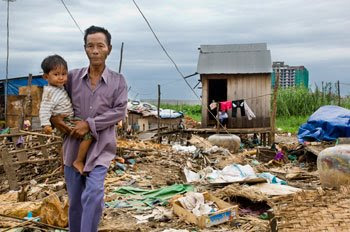
Showing posts with label Unfair eviction. Show all posts
Saturday, October 17, 2009
Monday, July 20, 2009
"If I become rich... I will demolish the former high-ranking officers’ houses": Evicted Group 78 resident
Two Group 78 residents look on as other residents dismantle their homes Thursday in advance of Friday’s eviction. (Photo by: Christopher Shay)Criticism of eviction mounts
Monday, 20 July 2009
The Phnnom Penh Post
Group 78 residents, rights groups accuse govt of deception, threats.
TWO days after Friday's eviction of the Group 78 community, former residents said they were struggling to rebuild their lives in their new homes, with many accusing the government of having conducted an intimidation campaign to force them from their valuable Bassac riverfront property.
"Our 12 family members are now living in a small rented room," said Sim Nhim, 60, adding that she had lived in Group 78 for more than 25 years. "We have no choice but to live here because [the government] demolished our homes."
She said she believed none of the residents had wanted to leave Group 78 but that the threat of an overwhelming police presence on eviction day "intimidated people into tearing down their own homes".
"We have empty hands, so we could not resist the authorities," she said.
Kheng Soroth, another former resident, said Sunday that City Hall had duped him into leaving his large house in Group 78 and that his family had been forced to take shelter in a squalid rental apartment.
"It is difficult for me to survive now because I have no money to buy a house," he said.
At dawn on Friday, police in riot gear marched into what remained of Group 78, a community that once held more than 80 families. A convoy of trucks carrying scores of demolition workers rolled in close behind them.
By Friday afternoon, the four holdout families had left, and workers in matching red T-shirts had finished dismantling Group 78, leaving only a few wooden poles poking out of the mud.
Phnom Penh Deputy Governor Mann Chhoeun has said that municipal officials want to develop the Bassac riverfront site to make it more attractive to tourists. But many residents said they had occupied their land since the 1980s, which, if true, would allow them to apply to become the legal owners of their respective plots.
In stark contrast to claims from residents, Mann Chhoeun said Friday that all Group 78 residents had agreed to let the government tear their homes down.
"Today, we evicted people without violence, because all the residents agreed to have their houses torn down," he said, adding that City Hall would give books, food and gifts to the families.
Though the eviction was nonviolent, residents and observers said the government's previous verbal threats combined with Friday's show of armed force intimidated the residents into leaving their homes and prevented last-minute negotiations from taking place.
Compensation questions
According to an independent property valuation conducted by Bonna Realty Group, the 260-metre-by-45-metre plot of land next to the Australian Embassy is worth more than US$15 million, or about $1,300 per square metre.
On Friday morning, the six families who had previously refused to accept government compensation met with Mann Chhoeun and discussed potential packages. While their community was being torn down, the families agreed to accept government money, though one family told the Post that City Hall tricked them into leaving their home.
Three families will receive $20,000, while two families agreed to accept $9,000, said resident Kheng Soroth.
But Kheng Soroth said City Hall reneged on an agreement made with his family. He said Mann Chhoeun promised his family $20,000 during the negotiations. After the home was demolished, however, he was told he would get only $8,000, which he said Sunday he expects he will never receive.
Resident Hem Many said she hoped one day to get back at municipal officials responsible for the destruction of her home.
"In the future, if I become rich or a high-ranking officer, I will demolish the former high-ranking officers' houses so they will know how it feels when they meet that situation," she said.
Local NGOs and international rights organisations strongly condemned the Group 78 eviction, while embassies and donors released a joint statement Thursday night calling for a moratorium on evictions until a better mechanism for resolving land disputes is put in place.
The statement - from six embassies and five international organisations - did not call any of Phnom Penh's previous land evictions illegal, nor did it mention Group 78 specifically. It did say that Cambodia's policies and practices "do not make effective use of the procedures and institutions allowed for in Cambodian law".
The group's choice to release the statement right as the community's houses were being dismantled and its refusal to condemn the Cambodian government in harsher terms were criticised by some civil society groups.
Dan Nicholson, a coordinator at the Centre on Housing Rights and Evictions (COHRE), said the statement was "completely irrelevant" for Group 78. David Pred, director of Bridges Across Borders Southeast Asia, said the statement would "ring hollow" if it was not "backed up by real consequences".
Others said they approved of the statement, and Naly Pilorge, director of the rights group Licadho, said she hoped it would be "the basis for discussions with government and relevant government institutions to put in place mechanisms to resolve land disputes and procedures to relocate people".
TWO days after Friday's eviction of the Group 78 community, former residents said they were struggling to rebuild their lives in their new homes, with many accusing the government of having conducted an intimidation campaign to force them from their valuable Bassac riverfront property.
"Our 12 family members are now living in a small rented room," said Sim Nhim, 60, adding that she had lived in Group 78 for more than 25 years. "We have no choice but to live here because [the government] demolished our homes."
She said she believed none of the residents had wanted to leave Group 78 but that the threat of an overwhelming police presence on eviction day "intimidated people into tearing down their own homes".
"We have empty hands, so we could not resist the authorities," she said.
Kheng Soroth, another former resident, said Sunday that City Hall had duped him into leaving his large house in Group 78 and that his family had been forced to take shelter in a squalid rental apartment.
"It is difficult for me to survive now because I have no money to buy a house," he said.
At dawn on Friday, police in riot gear marched into what remained of Group 78, a community that once held more than 80 families. A convoy of trucks carrying scores of demolition workers rolled in close behind them.
By Friday afternoon, the four holdout families had left, and workers in matching red T-shirts had finished dismantling Group 78, leaving only a few wooden poles poking out of the mud.
Phnom Penh Deputy Governor Mann Chhoeun has said that municipal officials want to develop the Bassac riverfront site to make it more attractive to tourists. But many residents said they had occupied their land since the 1980s, which, if true, would allow them to apply to become the legal owners of their respective plots.
In stark contrast to claims from residents, Mann Chhoeun said Friday that all Group 78 residents had agreed to let the government tear their homes down.
"Today, we evicted people without violence, because all the residents agreed to have their houses torn down," he said, adding that City Hall would give books, food and gifts to the families.
Though the eviction was nonviolent, residents and observers said the government's previous verbal threats combined with Friday's show of armed force intimidated the residents into leaving their homes and prevented last-minute negotiations from taking place.
Compensation questions
According to an independent property valuation conducted by Bonna Realty Group, the 260-metre-by-45-metre plot of land next to the Australian Embassy is worth more than US$15 million, or about $1,300 per square metre.
On Friday morning, the six families who had previously refused to accept government compensation met with Mann Chhoeun and discussed potential packages. While their community was being torn down, the families agreed to accept government money, though one family told the Post that City Hall tricked them into leaving their home.
Three families will receive $20,000, while two families agreed to accept $9,000, said resident Kheng Soroth.
But Kheng Soroth said City Hall reneged on an agreement made with his family. He said Mann Chhoeun promised his family $20,000 during the negotiations. After the home was demolished, however, he was told he would get only $8,000, which he said Sunday he expects he will never receive.
Resident Hem Many said she hoped one day to get back at municipal officials responsible for the destruction of her home.
"In the future, if I become rich or a high-ranking officer, I will demolish the former high-ranking officers' houses so they will know how it feels when they meet that situation," she said.
Local NGOs and international rights organisations strongly condemned the Group 78 eviction, while embassies and donors released a joint statement Thursday night calling for a moratorium on evictions until a better mechanism for resolving land disputes is put in place.
The statement - from six embassies and five international organisations - did not call any of Phnom Penh's previous land evictions illegal, nor did it mention Group 78 specifically. It did say that Cambodia's policies and practices "do not make effective use of the procedures and institutions allowed for in Cambodian law".
The group's choice to release the statement right as the community's houses were being dismantled and its refusal to condemn the Cambodian government in harsher terms were criticised by some civil society groups.
Dan Nicholson, a coordinator at the Centre on Housing Rights and Evictions (COHRE), said the statement was "completely irrelevant" for Group 78. David Pred, director of Bridges Across Borders Southeast Asia, said the statement would "ring hollow" if it was not "backed up by real consequences".
Others said they approved of the statement, and Naly Pilorge, director of the rights group Licadho, said she hoped it would be "the basis for discussions with government and relevant government institutions to put in place mechanisms to resolve land disputes and procedures to relocate people".
Monday, June 15, 2009
Evictees cry foul over homes
Borei Keila resident Horm Oun checks out the homes at Tuol Sambo, to which she could be relocated this week. (Photo by: CHRISTOPHER SHAY)Monday, 15 June 2009
Written by CHRISTOPHER SHAY AND KHOUTH SOPHAK CHAKRYA
The Phnom Penh Post
District officials deceived the HIV community of Borei Keila into thumbprinting an agreement to vacate homes, residents claim
MEMBERS of the Borei Keila community, where more than 30 families with HIV-positive members are facing eviction, say they were duped by district authorities Friday into agreeing to leave their neighbourhood near Olympic Stadium in exchange for larger homes at a relocation site outside the city.
"The authorities are cheating. When we agreed to thumbprint, the authorities told us they would remove the dividers to make two houses into one house," said resident Sok Sinethe.
But Horm Oun, another Borei Keila resident, said, "Lim Seda [the deputy chief of Prampi Makara district] told us after we gave our thumbprints we cannot make two houses into one".
"I felt hopeless when I heard this," she said.
The chief officer of the district's development programme, Sok Ath, said the Borei Keila residents were mistaken.
"We did not make promises or threaten them for their thumbprints. We only agreed to take their request for larger homes to City Hall for a decision," he said, adding that they would also ask City Hall that instead of buying two tuk-tuks to ferry people into the city for work, that it give each family US$250.
Sao Vanna, the chief of the HIV community, who does not live with the families facing eviction, said 20 families will be moved to Tuol Sambo perhaps as early as today.
Sao Vanna, who will set up an office at Tuol Sambo, blamed NGOs for the conditions at the relocation site.
"Before, City Hall had plans to construct 4-metre-by-12-metre homes and called upon the NGOs to fund the construction and infrastructure, but without NGO funding ... City Hall did not have enough money," he said.
But on Sunday during a visit to Tuol Sambo - about an hour's tuk-tuk ride away from Borei Keila - residents said that it was clear the municipality could do more to support them.
Ten paces from the green metal shelters that will house the families, workers are building brick homes for families from Russey Keo who lost their houses after a riverbank collapse. According to a construction worker, the Russey Keo homes will be 4 metres by 8 metres, almost double the floor space of the HIV community's homes, which are 3.5 metres by 4.8 metres.
"Why does the municipality make small houses for us and big homes for others?" Sok Sineth asked.
Residents also fear that their community, which is already known as "the AIDS village", will face discrimination.
Resident Touch Chhay Ran said when she visited Tuol Sambo last month she overheard local villagers insulting the Borei Keila community, giving her fears that she will need to endure discrimination on a daily basis.
"They said they were afraid that their community would catch AIDS from us, turning all of Tuol Sambo into ‘the AIDS village'," she said.
MEMBERS of the Borei Keila community, where more than 30 families with HIV-positive members are facing eviction, say they were duped by district authorities Friday into agreeing to leave their neighbourhood near Olympic Stadium in exchange for larger homes at a relocation site outside the city.
"The authorities are cheating. When we agreed to thumbprint, the authorities told us they would remove the dividers to make two houses into one house," said resident Sok Sinethe.
But Horm Oun, another Borei Keila resident, said, "Lim Seda [the deputy chief of Prampi Makara district] told us after we gave our thumbprints we cannot make two houses into one".
"I felt hopeless when I heard this," she said.
The chief officer of the district's development programme, Sok Ath, said the Borei Keila residents were mistaken.
"We did not make promises or threaten them for their thumbprints. We only agreed to take their request for larger homes to City Hall for a decision," he said, adding that they would also ask City Hall that instead of buying two tuk-tuks to ferry people into the city for work, that it give each family US$250.
Sao Vanna, the chief of the HIV community, who does not live with the families facing eviction, said 20 families will be moved to Tuol Sambo perhaps as early as today.
Sao Vanna, who will set up an office at Tuol Sambo, blamed NGOs for the conditions at the relocation site.
"Before, City Hall had plans to construct 4-metre-by-12-metre homes and called upon the NGOs to fund the construction and infrastructure, but without NGO funding ... City Hall did not have enough money," he said.
But on Sunday during a visit to Tuol Sambo - about an hour's tuk-tuk ride away from Borei Keila - residents said that it was clear the municipality could do more to support them.
Ten paces from the green metal shelters that will house the families, workers are building brick homes for families from Russey Keo who lost their houses after a riverbank collapse. According to a construction worker, the Russey Keo homes will be 4 metres by 8 metres, almost double the floor space of the HIV community's homes, which are 3.5 metres by 4.8 metres.
"Why does the municipality make small houses for us and big homes for others?" Sok Sineth asked.
Residents also fear that their community, which is already known as "the AIDS village", will face discrimination.
Resident Touch Chhay Ran said when she visited Tuol Sambo last month she overheard local villagers insulting the Borei Keila community, giving her fears that she will need to endure discrimination on a daily basis.
"They said they were afraid that their community would catch AIDS from us, turning all of Tuol Sambo into ‘the AIDS village'," she said.
Monday, January 12, 2009
Don't discriminate at Dey Krahorm
Monday, 12 January 2009
Written by David Pred
Letter to The Phnom Penh Post
Written by David Pred
Letter to The Phnom Penh Post
Dear Editor,
We were dismayed to read about the blatant discrimination exhibited by municipal authorities in the article "Artists' relocation prioritised" [January 8, 2009]. The article reported that recent moves to evict Dey Krahorm residents are being "sweetened" by offering the "most celebrated residents" of the community more expensive city-centre relocation housing. According to the article, the non-famous residents will have to settle for a compensation package worth around US$10,000 or distant alternative housing at Damnak Trayoeng.
The article neglected to include the views of these other residents of the community, who have roundly rejected the 7NG company's offer to them as unacceptable.
It is clear that Dey Krahorm's artist community, which includes popular musicians and comedians, presents a big problem for municipal authorities and 7NG, who seek to clear the residents out of the area to make way for commercial development. Needless to say, the image of forcibly removing the likes of Kong Nai from his Dey Krahorm home would not be a public relations score for the municipality.
After all, the Royal Government of Cambodia reported to the United Nations Committee on Economic, Social and Cultural Rights on December 2, 2008, that "in Cambodia, people have the rights to live in their home with law protecting them from eviction." The Government's State Party Report continues:
If eviction is required, the government pays just and equitable compensation for that as stated in Article 44, paragraph 2 and 3 of the Constitution of Cambodia. "The right to confiscate possessions from any person shall be exercised only in the public interest as provided for under law and shall require fair and just compensation in advance" [Para 528].
These legal protections must apply indiscriminately to all Dey Krahorm homeowners, not just the artists. The current residents of Dey Krahorm lawfully possess their property. They have either lived there for many years or they purchased their land from previous residents, and thus have valid claims of ownership under the Land Law.
Moreover, Dey Krahorm land was granted to the community as a Social Land Concession in 2003, following Prime Minister Hun Sen's welcome announcement to provide secure land tenure and to assist in the onsite upgrading of 100 inner-city poor communities each year until all of Phnom Penh's urban poor communities have secure land tenure and full basic services. Dey Krahorm was to be among the first urban poor communities to become beneficiaries of this plan. The intention to provide secure land tenure and onsite upgrading to the Dey Krahorm community was reiterated just last month in the government's report to the UN Committee. The report identified Dey Krahorm as a land-sharing project intended to "help the communities to build houses on their legally owned land" [Para 537].
Despite the strong support of the community and the 2003 endorsement of the prime minister, the onsite development plan has yet to come to pass.
While the community has demonstrated unambiguous claims to their land, the 7NG company has not. In light of the community's clear rights, 7NG's alleged lease could not have been lawfully granted without the express permission of all the homeowners. It is important to clarify that this is not a case of the government taking land in the public interest. It is a case of a private company seeking to acquire prime city-centre real estate, valued a year ago at more than $44 million, by coercing the poor people who own that land to swap it for flats they have built outside the city. Therefore, any eviction of Dey Krahorm residents, as opposed to a good-faith purchase offer, would be illegal.
It is a welcome development that the 7NG company and the municipality have offered the artists of Dey Krahorm a fairer deal including alternative city-center housing where they "can work as usual", but this must be extended to all residents regardless of their profession, talents or social status.
The "few hundred holdouts" of Dey Krahorm are hard working citizens of Cambodia. Like the artists, their jobs and small businesses are also based in central Phnom Penh, making relocation to distant Damnak Trayoeng unfeasible. They are entitled to be treated with the same respect and concern as their celebrity neighbors. This means offering them a price for their house that they can accept.
David Pred
Bridges Across Borders Southeast Asia
Natalie Bugalski
Centre on Housing Rights and Evictions
We were dismayed to read about the blatant discrimination exhibited by municipal authorities in the article "Artists' relocation prioritised" [January 8, 2009]. The article reported that recent moves to evict Dey Krahorm residents are being "sweetened" by offering the "most celebrated residents" of the community more expensive city-centre relocation housing. According to the article, the non-famous residents will have to settle for a compensation package worth around US$10,000 or distant alternative housing at Damnak Trayoeng.
The article neglected to include the views of these other residents of the community, who have roundly rejected the 7NG company's offer to them as unacceptable.
It is clear that Dey Krahorm's artist community, which includes popular musicians and comedians, presents a big problem for municipal authorities and 7NG, who seek to clear the residents out of the area to make way for commercial development. Needless to say, the image of forcibly removing the likes of Kong Nai from his Dey Krahorm home would not be a public relations score for the municipality.
After all, the Royal Government of Cambodia reported to the United Nations Committee on Economic, Social and Cultural Rights on December 2, 2008, that "in Cambodia, people have the rights to live in their home with law protecting them from eviction." The Government's State Party Report continues:
If eviction is required, the government pays just and equitable compensation for that as stated in Article 44, paragraph 2 and 3 of the Constitution of Cambodia. "The right to confiscate possessions from any person shall be exercised only in the public interest as provided for under law and shall require fair and just compensation in advance" [Para 528].
These legal protections must apply indiscriminately to all Dey Krahorm homeowners, not just the artists. The current residents of Dey Krahorm lawfully possess their property. They have either lived there for many years or they purchased their land from previous residents, and thus have valid claims of ownership under the Land Law.
Moreover, Dey Krahorm land was granted to the community as a Social Land Concession in 2003, following Prime Minister Hun Sen's welcome announcement to provide secure land tenure and to assist in the onsite upgrading of 100 inner-city poor communities each year until all of Phnom Penh's urban poor communities have secure land tenure and full basic services. Dey Krahorm was to be among the first urban poor communities to become beneficiaries of this plan. The intention to provide secure land tenure and onsite upgrading to the Dey Krahorm community was reiterated just last month in the government's report to the UN Committee. The report identified Dey Krahorm as a land-sharing project intended to "help the communities to build houses on their legally owned land" [Para 537].
Despite the strong support of the community and the 2003 endorsement of the prime minister, the onsite development plan has yet to come to pass.
While the community has demonstrated unambiguous claims to their land, the 7NG company has not. In light of the community's clear rights, 7NG's alleged lease could not have been lawfully granted without the express permission of all the homeowners. It is important to clarify that this is not a case of the government taking land in the public interest. It is a case of a private company seeking to acquire prime city-centre real estate, valued a year ago at more than $44 million, by coercing the poor people who own that land to swap it for flats they have built outside the city. Therefore, any eviction of Dey Krahorm residents, as opposed to a good-faith purchase offer, would be illegal.
It is a welcome development that the 7NG company and the municipality have offered the artists of Dey Krahorm a fairer deal including alternative city-center housing where they "can work as usual", but this must be extended to all residents regardless of their profession, talents or social status.
The "few hundred holdouts" of Dey Krahorm are hard working citizens of Cambodia. Like the artists, their jobs and small businesses are also based in central Phnom Penh, making relocation to distant Damnak Trayoeng unfeasible. They are entitled to be treated with the same respect and concern as their celebrity neighbors. This means offering them a price for their house that they can accept.
David Pred
Bridges Across Borders Southeast Asia
Natalie Bugalski
Centre on Housing Rights and Evictions
Wednesday, December 31, 2008
Eviction deadline passes quietly, but residents expect the worst
Wednesday, 31 December 2008
Written by Chhay Channyda The Phnom Penh Post
About 100 families remain in Dey Krahorm in defiance of authorities
AS the December 30 eviction deadline for Dey Krahorm residents came and went, locals expressed relief while hunkering down for a possible standoff with authorities.
District authorities ordered residents to vacate their homes by Tuesday or face forced eviction, but community leaders have vowed to defy the order.
"We are ready to fight eviction, but everything is normal," said Chan Vichet, who represents disgruntled Dey Krahorm residents.
Chan Vichet said that about 120 families out of the original 1,465 are living in fear of arrest as they defy the order by staying in their homes.
"All residents dare not go far from home for fear of eviction," he said.
"The company has no right to evict people. Only the authorities can do that," he said.
Local property developer 7NG plans to clear Dey Krahorm for unspecified purposes and has offered compensation to the mostly poor residents.
The company says it gave residents the option of receiving US$10,000 cash plus 770,000 riels ($192.50), or a house in Dangkor district plus 770,000 riels to leave their homes.
Community leaders have rejected the offer as insufficient.
Srey Sothea, 7NG chairman, said the compensation offer is fair.
"We own the land and are very sorry some people have not left," he said by phone, adding that he obtained the land title in 2006.
AS the December 30 eviction deadline for Dey Krahorm residents came and went, locals expressed relief while hunkering down for a possible standoff with authorities.
District authorities ordered residents to vacate their homes by Tuesday or face forced eviction, but community leaders have vowed to defy the order.
"We are ready to fight eviction, but everything is normal," said Chan Vichet, who represents disgruntled Dey Krahorm residents.
Chan Vichet said that about 120 families out of the original 1,465 are living in fear of arrest as they defy the order by staying in their homes.
"All residents dare not go far from home for fear of eviction," he said.
"The company has no right to evict people. Only the authorities can do that," he said.
Local property developer 7NG plans to clear Dey Krahorm for unspecified purposes and has offered compensation to the mostly poor residents.
The company says it gave residents the option of receiving US$10,000 cash plus 770,000 riels ($192.50), or a house in Dangkor district plus 770,000 riels to leave their homes.
Community leaders have rejected the offer as insufficient.
Srey Sothea, 7NG chairman, said the compensation offer is fair.
"We own the land and are very sorry some people have not left," he said by phone, adding that he obtained the land title in 2006.
Subscribe to:
Posts (Atom)





