Showing posts with label Beer girls. Show all posts

Sunday, August 26, 2012

Carlsberg for Better Beer Promoter Working Conditions in Cambodia

Beer promoter at work (Photo: The Phnom Penh Post)
25 August 2012
ScandAsia.com

Women sales promoters working in bars in Cambodia are occasionally exposed to harassment by customers varying from being coerced into drinking and in some cases, being subjected to sexual abuse.

Cambodia Carlsberg Group and The Danish Confederation of Trade Unions (LO) have joined forces in a unique partnership to improve these promoters' conditions by agreeing to cooperate on several areas.

These areas include:
  • Collaboration between management and employees, including the establishment of effective social dialogue between management and trade union representatives.
  • Improving labour, health and safety conditions in general for beer promoters in Cambodia.
  • The Beer Selling Industry Cambodia (BSIC's) Code of Conduct in relation to the ILO core conventions, OECD guidelines for multinational corporations and the UN Global Compact.
  • The right to freedom of association and collective bargaining in the sector and country as a whole.
  • Eliminating the negative stigma attached to beer promoters.

Thursday, August 23, 2012

Do not make her drink with you

DO NOT MAKE HER DRINK WITH YOU - SHE IS A DIGNIFIED WORKER. SHE HAS CHILDREN TO RAISE.

- Mu Sochua

An Anchor beer promoter serves a customer at a beer garden in Phnom Penh on Monday night. Photograph: Pha Lina/Phnom Penh Post

Wednesday, August 22, 2012

Statistics reval risky figures of beer promoters

An Anchor beer promoter serves a customer at a beer garden in Phnom Penh on Monday night. Photograph: Pha Lina/Phnom Penh Post
Wednesday, 22 August 2012
Shane Worrell and Mom Kunthear
The Phnom Penh Post
“Our research shows that beer promoters are consuming on average 1.5 litres of beer per night – that’s six glasses of beer, 27 nights per month
Malis, not her real name, appears forlorn as she describes what her daughters go through to secure tips from their customers.

The young women, promoters for a major beer company, reluctantly spend their nights getting drunk on their own product – it’s what customers demand and can be the difference between the promoters earning tips and leaving their restaurants empty-handed.

Malis would know – she sells for the same beer company.

“I very much pity my daughters for following me into this work, but what can I do?” the 42-year-old says.

Thursday, April 26, 2012

Wednesday, August 10, 2011

Carlsberg Beer Girls Won Their Battle

(Photo: The Phnom Penh Post)
10 August 2011
ScandAsia.com

ANGKOR Beer promoters, who had been striking against Cambrew for unpaid overtime and respect, have won their battle. Each will receive retroactive overtime pay totalling as much as US$320, following intervention by city officials, the president of the union representing them said yesterday, writes Phnom Penh Post.

Phnom Penh deputy governor Pa Socheatvong reached an agreement with the women about half way through a two-hour meeting yesterday afternoon, said Mora Sar, president of the Cambodia Food Workers’ Federation.

The deputy governor will now urge the company to honour a July ruling by the Arbitration Council that called on Cambrew to adhere to labour laws and pay its beer promoters US$2 overtime on Sundays, Mora Sar said. The council’s ruling was retroactive for three years.

The city will pay the beer promoters for the overtime they are owed if Cambrew is slow to pay, Mora Sar added. He said city officials said they intervened in the strike because it was affecting public order and also said that the deputy governor told the women yesterday that “the company needs to follow the law”.

Thursday, August 04, 2011

Carlsberg Beer Promoters On Strike in Cambodia

04 August 2011
ScandAsia.com

More than 30 beer promoters have been striking since Monday July 25, accusing Angkor brewer Cambrew of refusing to pay overtime despite a July 7 ruling by the Arbitration Council that it was legally required to do so, according to The Phnom Penh Post

Carlsberg has said it is investigating a strike by Angkor beer promoters, who yesterday vowed to continue in their bid for fair treatment.

We’ve had no response from the company so the strike will continue,” Ou Tep Phally, vice-president of Cambodian Food and Service Workers’ Federation, said to newspaper on July 31.

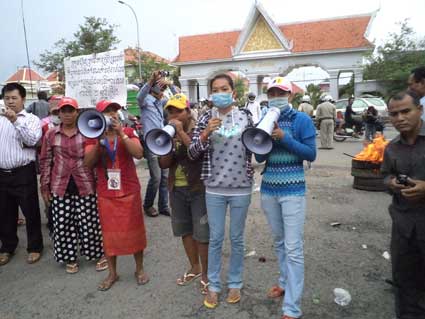
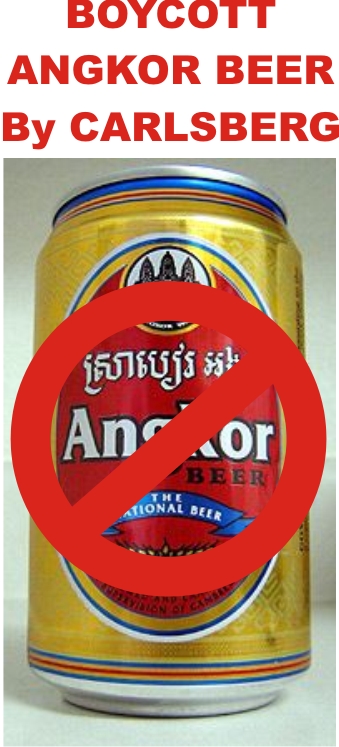
The women, who usually promote the brand in restaurants and nightspots, have been handing out leaflets calling for the public to boycott it instead. Beer promoter Sim Phan said strikers planned to burn tyres in front of the company’s headquarters on Norodom Boulevard today.

Wednesday, August 03, 2011

Beer promoter in hospital

Angkor Beer promoters look on while a stack of tyres burn outside the Cambrew headquarters in Phnom Penh yesterday during a protest to demand overtime wages. (Photo by: Meng Kimlong)

A group of Angkor beer promoters try to block a company vehicle from entering the Cambrew headquarters during a protest in Phnom Penh yesterday. (Photo by: Meng Kimlong)
Wednesday, 03 August 2011May Titthara
The Phnom Penh Post

One Angkor beer promoter was hospitalised yesterday after reportedly being struck by a company minivan and another three feinted from smoke inhalation when police attempted to extinguish flames from tyres they had set alight on the eighth day of their strike.

Yoeun Sreymon, 29, was taken to Bayon Hospital after being knocked down by a red Angkor minivan, fellow strikers said. They said she was pregnant and that she was unconscious when they took her to the private hospital for undisclosed injuries.

Phnom Penh Police commissioner Touch Naroth said last night he had told his officers to show restraint, but also to prevent the women from burning tyres. “I assure you that my officers did not cause any injuries,” he said.

Beer promoters burn tires in front of Angkor Beer


http://www.youtube.com/watch?v=Bbal4jfrxdo&feature=player_embedded

My dignity, my beer


My dignity, my beer

03 August 2011
By Mu Sochua
Letter to The Phnom Penh Post

WOMEN serving Angkor beer have been demonstrating for several days in front of the company’s main office in The Phnom Penh. Their demand: decent pay and better work contracts in compliance with the Cambodian Labour Code. Women who serve beer work under the most dangerous conditions in terms of health risks: nightly alcohol over-use, violation and abuse – verbal, physical and sexual. As women in the entertainment industry, they are devalued by society and, without union membership, they have no voice.

It is in our collective interest to give our support and to encourage the participation of women in the non-formal sector as they are the core breadwinners and contribute actively to our local economy. The first step is decent work and decent pay. Without a doubt, US$50 is not going to make ends meet; it’s not enough to save for the future or for potential shocks such as medical emergencies or poor harvest years.

Research by the Cambodian NGO SiRCHESI shows that since 2004, beersellers have consistently been without a living wage, underpaid by 50 per cent or more compared with the expenses they incur to support their families. With international beer companies aware of this situation, and restaurants displaying suggestive advertising posters, some Cambodian men still visit beer gardens believing that buying international brands for an evening may also bring sex.

Cambrew administrators still refuse to negotiate with Beer Girls

Beer Girls lighted old tires in front of Cambrew factory in protest (All photo: DAP-news)
Beer Girls protest for fair pay

Tuesday, August 02, 2011

Monday, August 01, 2011

Carlsberg investigates beer strike

A group of Angkor beer promoters protest for overtime payment outside the Cambrew headquarters in Phnom Penh last week. (Photo by: Meng Kimlong)

Monday, 01 August 2011
Mom Kunthear and Vincent MacIsaac
The Phnom Penh Post

Carlsberg has said it is investigating a strike by Angkor beer promoters, who yesterday vowed to continue in their bid for fair treatment.

“We’ve had no response from the company so the strike will continue,” Ou Tep Phally, vice-president of Cambodian Food and Service Workers’ Federation, told The Post yesterday.

More than 30 beer promoters have been striking since last Monday, accusing Angkor brewer Cambrew of refusing to pay overtime despite a July 7 ruling by the Arbitration Council that it was legally required to do so.

The women, who usually promote the brand in restaurants and nightspots, have been handing out leaflets calling for the public to boycott it instead. Beer promoter Sim Phan said strikers planned to burn tyres in front of the company’s headquarters on Norodom Boulevard today.

Friday, July 29, 2011

Angkor beer promoters on strike to demand overtime pay

http://www.youtube.com/watch?v=kdvq-pxu6Qo&feature=player_embedded#at=31

http://www.youtube.com/watch?v=U9_0bTuAfIo&feature=player_embedded

Thursday, July 28, 2011

Police warn beer protesters

Police stand guard while Angkor beer promoters protest for payment of overtime outside the Cambrew headquarters in Phnom Penh yesterday. (Photo by: Meng Kimlong)

Thursday, 28 July 2011
May Titthara
The Phnom Penh Post

After police ordered them to quiet down on the third day of their strike, the “beer girls” protesting in front of the head office of Cambrew Ltd took aim at the slogan of one of the Kingdom’s most popular brands, Angkor beer.

While about 25 police observed them from the other side of Norodom Boulevard yesterday morning, the women began singing “My country, my beer. My beer does not love Khmer”. The brand’s slogan is “My country, my beer”.

As they had on the previous two days, the women arrived at about 7am. The police arrived about three-and-a-half hours later. They ordered the more than 30 protesters to stop using drums and loudspeakers, telling them they were disturbing the neighbourhood. The women obliged, but soon after the police crossed to the other side of the street the women picked up their drums and started beating them again. They said they were becoming more determined each day of the strike.

Workers urge Angkor boycott


An Angkor beer promoter passes out leaflets to passers by during a small protest in front of the company’s office on Norodom Boulevard yesterday in Phnom Penh. (Photo by: Meng Kimlong)
Wednesday, 27 July 2011
Khoun Leakhana
The Phnom Penh Post
In a statement, the federation said Cambrew and Carlsberg had been breaking the law and exploiting the women who promote their brands for 14 years: for as long as the country’s labour laws have required overtime pay. Cambrew had ignored a July 7 Arbitration Council ruling that said it was obligated to pay its beer promoters double time on Sundays, the federation said.
Thousands of flyers calling for a boycott of Angkor beer were handed out to passers-by yesterday in front of the head office of the company that owns the brand, Cambrew Ltd, as a strike by women who promote the beer in restaurants and nightspots entered its second day.

More than 30 women who handed out flyers to occupants of passing vehicles in the capital’s Norodom Boulevard warned that they would start protesting at beer gardens tomorrow if the company did not double the rate of pay they receive for working on Sundays from US$2 to $4.

The Cambodian Food Service Workers’ Federation also began urging national and international NGOs to support the strikers by lobbying Carlsberg, which owns 50 percent of Cambrew, to ensure a fair settlement to the dispute.

Tuesday, July 26, 2011

Angkor protesters slighted

A group of Angkor beer promoters protest outside the company’s head office on Norodom Boulevard in Phnom Penh yesterday. (Photo by: Pha Lina)

Tuesday, 26 July 2011
Khoun Leakhana
The Phnom Penh Post

Trucks carrying Angkor beer yesterday morning pushed through a fragile blockade formed by “beer girls” trying to garner public support for what they described as an attempt to force one of the Kingdom’s largest brewers to show more respect to them and the law.

Drivers had stopped in front of more than 30 women who gathered for almost five hours in front of Angkor Brewery’s head office on Norodom Boulevard yesterday morning, but company executives ordered them to push through the group.

The women used loudspeakers and banners to draw attention to their protest. They said they were protesting because they could not survive on what the company paid them for promoting its brand in restaurants and nightspots.

Monday, July 25, 2011

Four protesting Beer Girls injured in front of the company’s office

Beer girls protest on 25 July 2011 (Photo posted on Facebook by Mu Sochua)
25 July 2011
By Chan
Free Press Magazine Online
Translated from Khmer by Soch
Click here to read the article in Khmer

At least 4 Beer Girls were injured when a beer company’s vehicle rammed into them when these women were standing in front the beer company’s office located north of the Kbak Thnol sky bridge on Monday. The Beer Girls were demanding that the beer company follows the labor arbitration committee’s order to double the salary of Beer Girls who work on Sundays to $4 per day.

About 40 demonstrators who work for the Angkor beer company held banners and shouted their demand for the beer company to provide them with long term contract rather the short term contract they now have. They also demanded the freedom to join labor unions as well.

Ms. Tan Chamrong, a representative of the Beer Girls, told reporters that this strike takes place after the labor arbitration committee issued its decision for Beer Girls working on Sundays to receive double [daily] wage at $4 per day. However, the beer company rejected this decision. Ms. Tan Chamrong added: “The (beer) company owner warned us not to join labor unions, otherwise he will fire us.”

Thursday, December 09, 2010

Cambodia: A better life for the beer girls

Beer girl serving in a beer garden (Photo: The Phnom Penh Post)
December 9 2010
By Elaine Moore
Financial Times

Every night, in one of Cambodia’s many open air restaurants, beer girls walk between tables of customers, topping up glasses and adding the huge chunks of ice Cambodians insist is dropped in their beer.

In their short red dresses, decorated with the logo of the brand they sell, the girls are easy to pick out in the near-darkness of the open-air restaurants, and many are invited to sit at the tables and talk. The chat may be over-familiar but it is, on the whole, respectful.

Treatment of beer promotion girls in Cambodia has markedly improved in recent years as a result of a successful partnership between the government, local non-government organisations, funded in part by the UN, and The Beer Selling Industry Cambodia, which represents Heineken and Carlsberg among others.


Beer girls are not sex workers, but their youth and line of work made them a regular target for unwanted advances, even abuse. The successful co-operation between rights groups and companies to provide training and other initiatives such as a harassment reporting hotline, have had a pronounced effect on the girls’ working lives.

Those involved hope the model of businesses taking advice from rights groups and improving the protection of their workers will be replicated.

At a time when cracks in the relationship between Cambodia’s government and the international development community working in the country are frequently in the local news, such schemes are an effective way to show that public and private sector aims can be compatible.

There are already several projects underway. LG Electronics recently announced a three-year partnership to support work by the UN World Food Programme in Cambodia to aid road links between markets and schools, and the World Health Organisation is supporting its national counterpart in working with the private sector to make anti-malarial drugs affordable to all Cambodians.

Private sector partnerships are an essential element of development in Cambodia, declares MP Joseph, chief technical advisor for the International Labour Organization. “They may be more difficult to establish and sustain in the early stages of development and growth of a country. But very soon, as is happening in Cambodia, development strategies need to bring in the private sector.”

Such strategies have been employed to work with foreign and local business owners in Cambodia as part of the ILO “better factories” campaign to improve working conditions for garment factory workers.

Relationships have also been forged with local companies in a scheme to help end child labour. Private micro-finance institutions such as Amret have been approached to help educate families in how they can replace income lost when a child returns to school.

In return, Mr Chea Phalarim, general manager at Amret, said working with the ILO had increased the organisation’s client base, bringing it into contact with eligible customers in remote locations. The benefits, he says, work both ways.

Aid remains crucial to Cambodia’s economy. Despite the global economic downturn and criticism from human rights groups, aid provision is expected to increase from $990m in 2009 to $1.1bn this year.

But foreign direct investment is also on the rise. Chinese and Korean investors are back after a hiatus caused by the global financial downturn, and are ready to fund large projects without governance strings attached.

In May 2010, at the inaugaration of the Cambodia-China Prek Kdam Friendship Bridge, funded largely by a loan from China, the Cambodian prime minister thanked the Chinese for lending money “without setting complicated conditions” – an implied dig at the requirements made by aid donors.

In 2008 China became the largest foreign investor in Cambodia, with more than $8bn invested, and bilateral trade between the two countries rose by more than a third in this first half of 2010 compared to the previous year.

Government tetchiness towards the development community, meanwhile, has been palpable. Prime minister Hun Sen, who has held power since 1993, has previously dismissed UN rights staff as nothing more than long term tourists.

This year he has asked the UN to limit the work done by the international tribunal trying former members of the Khmer Rouge regime and accused Christophe Peschoux, the country director of the Office of the UN High Commissioner for Human Rights, of being a spokesperson for the opposition party. In March, Cambodian foreign minister Hor Namhong criticised UN country head Douglas Broderick after he asked for more time to review a new anti-corruption law.

The situation for UN staff working in Cambodia is very different to that of the 1990s, when Security Council members expressed fear for the lives of staff. The country is stable, peaceful, and for many a pleasant place to live. Those working in the development sector are expected to be sensitive to the politics of their work and all UN staff receive an orientation session to provide them with an overview of Cambodia.

Nevertheless public attacks on work by certain agencies can make working lives difficult. One former staff member of the international tribunal said government disapprobation didn’t help the morale of staff already engaged in a difficult job.

Previous attacks on NGOs, and the expulsion of some organisations from the country, have demanded caution and diplomacy from international development organisations.

UN agencies in the country play down the friction, but few staff members would allow themselves to be quoted on the topic. Representatives say that open door policies are employed and that meetings are held when situations arise that might concern staff.

Outside the UN Human Rights office in Phnom Penh, focus of multiple threats of closure from the government, a group of Buddhist monks sits in the shade, waiting to collect information to take back to their pagodas. Inside, in an office stacked with reports, deputy country representative James Heenan insists that work continues as normal.

“Human rights work regularly involves the burden of working in difficult environments and being subject to pressure from many quarters. It’s part of the job.”

Wednesday, May 26, 2010

Cambodia's Female Beer Promoters are HIV Health Risk

A Cambodian "beer girl" fills a glass of Tiger beer at a restaurant in Phnom Penh. Each "beer girl" tries to sell a particular label of beer and hopes the customer will pick her to pour his beer all night. (Photo: AP)

Robert Carmichael, VOA
Phnom Penh Tuesday, 25 May 2010

"Women generally who are working in the entertainment industry in Cambodia - whether it is karaoke, massage parlors, in the beer promotion work - they are stigmatized by society. They are considered to be bad women."
Cambodia's drinking culture sees groups of men head to beer gardens after work. Once there, women in uniforms advertising global brands try to persuade the men to drink their brand, but risks to the health of these women have some worried.

Across Cambodia about 4,000 women work as beer promoters in hundreds of beer halls. Their job is to persuade men to drink their brand of beer.

But a new report by Professor Ian Lubek of Canada's University of Guelph says the low wages beer promoters receive force many into sex work.

The beer promoters are paid between $80 and $110 a month by local distributors. A family in Cambodia needs about $200 a month to get by.

The report says 57 percent of beer promoters interviewed last year in the town of Siem Reap engaged in sex work.

Lubek says the sex work leads to a high HIV risk. He believes HIV-related infections are behind a death rate of nearly 10 percent among 900 beer promoters in Siem Reap during the past seven years.

Speaking on Skype, Lubek says the women's average age at death was just 25.

"We feel that it is an economically driven activity. It is quite shameful to them - they lose respect in their home villages. They cannot get married because they agree to sell sex. But they have no other way."

The government's National AIDS Authority says an ongoing challenge is responding to sex work that now takes place outside brothels, after a 2008 law outlawed prostitution. It says one-in-five beer promoters reported not using condoms in a three-month survey period.

The National Aids Authority says the HIV rate among the general population is 0.9 percent. No one knows the actual rate among beer promoters, but figures as high as 20 percent have been cited.

The country head of non-governmental aid organization CARE International, Sharon Wilkinson, says her group found less than one-third of beer promoters interviewed in Phnom Penh had sold sex - about half the rate Professor Lubek reported. But she says beer-gardens are a tough workplace.

"It is an environment in which sexual harassment, including physical abuse, is high."

Wilkinson says the best way to improve the women's position is to change the way Cambodian men view them.

"Women generally who are working in the entertainment industry in Cambodia - whether it is karaoke, massage parlors, in the beer promotion work - they are stigmatized by society. They are considered to be bad women."

In response to criticisms, the major brewers in 2006 established the Beer Selling Industry of Cambodia. The association's stated objective is to improve the working conditions of beer promoters.

Among other things, that includes making sure the women have clear work contracts, are provided with transport to and from work, have clear grievance procedures, receive suitable training, and are provided with culturally-appropriate uniforms.

The association also bans women drinking alcohol at work, but Lubek found that prohibition was ignored by 99 percent of the women in the Siem Reap study. Most of them said they were pressured by customers to drink.

Lubek says the big four brewers; Holland's Heineken, Danish brewer Carlsberg, Belgium's AB-InBev, and London-based SAB-Miller whose beer the women represent, must take more responsibility for the promoters - starting with doubling their salaries.

Lubek also wants the brewers to improve training on sexual health issues and provide anti-retroviral drugs to women who need them.

But the brewers say the women do not work for them, they are employed by local distributors. All four brewers contacted for this story insist their beer promoters receive adequate wages and get good training.

The brewers say anti-retroviral drugs should be provided by health clinics - a stance with which Wilkinson at CARE agrees.

Sunday, May 23, 2010

Foreign brewers accused of exploitation in Cambodia

Sun, 23 May 2010
By Robert Carmichael
DPA


Phnom Penh - Enjoying an after-work beer is common enough in Cambodia, for men at least. In hundreds of beer gardens, female beer promoters in corporate uniforms bearing the names of international or local brands try to entice them to buy their beer.

But working as a beer promoter is frowned upon socially. Sharon Wilkinson, who heads Care International, a non-governmental organization (NGO) that works with the women, says they are typically viewed as little more than sex workers.

Wilkinson says beer gardens are an environment where "sexual harassment including physical abuse is high."

Hers is a point of view that resonates with researchers from Canada's University of Guelph.

In a recent report, they conclude that brewers, including the world's largest beer firms, are exploiting women by allowing local distributors to underpay them.

A key finding was that 57 per cent of 122 beer promoters surveyed last year in Siem Reap in north-western Cambodia were compelled to engage in sex work to supplement their average monthly incomes of 81 dollars.

Professor Ian Lubek, who led the research, says wages for the country's 4,000 beer promoters must double to reduce the risk of HIV infection.

"A living wage is required," he says, explaining salaries would need to rise to 200 dollars monthly. "Beer sellers, no matter what brand, have never received a living wage in Cambodia."

Lubek says the women support three to four people each and describes workplace conditions as "toxic" with sexual harassment and excessive drinking common.

For their part, the world's four biggest brewers reject the claim that low wages force some beer promoters to engage in sex work.

The brewers - Belgium-based Anheuser-Busch InBev NV, London's SAB-Miller PLC, Dutch firm Heineken NV and Danish brewer Carlsberg A/S - together sell half the world's beer and enjoy the lion's share of the Cambodian market.

They say beer promoters, who they stress are employed by distributors and not the brewers, receive adequate wages.

The brewers have been criticized before and in 2006 set up an association to improve conditions. The objectives of the Beer Selling Industry of Cambodia include ensuring women have work contracts, receive proper training and have clear grievance procedures.

Carlsberg spokeswoman Berky Kong says an association survey showed average monthly incomes, including commission, were 110 dollars.

"The pay we are offering is actually very good money for them, considering their actual working hours per day are four to six hours," Kong said of Carlsberg's 635 beer promoters. Garment workers, by contrast, receive around 50 dollars a month for longer hours, she said.

Kong says beer promoters are "normally not the only person bringing income to the family" but declined to say how many of Carlsberg's promoters are single women and, therefore, more likely to be in such a position.

Association rules also prohibit beer promoters from drinking alcohol at work although Lubek found 99 per cent still drink daily and most to excess, citing pressure from customers. That adds to the risk of contracting HIV, he said.

Beer promoters have long been among those most at risk of contracting HIV in Cambodia. The government's National Aids Authority says 0.9 per cent of the adult population is HIV-positive. Although the rate among beer promoters remains unknown, rates of 20 per cent have been cited by NGOs.

Cambodia is undergoing a shift in sexual behaviour since a 2008 law banned prostitution. Organizations such as the Joint United Nations Programme on HIV/AIDS are worried that fewer measures could be taken to combat the risks as sex work moves from brothels into beer gardens and karaoke parlours.

Lubek's report states that 80 beer promoters of 900 interviewed in the past seven years in Siem Reap have since died. He says he believes HIV-related infections are the reason although a lack of death certificates means their causes of death remain unknown.

"But that so many women should die so young - average age 25 years - is startling," he says.

The brewers say providing anti-retrovirals - another demand of Lubek's report - is unsuitable. Heineken's press officer Jeroen Breuer says the firm leaves that to the health service.

"What Heineken does is focus on providing information and education," Breuer says.

It is a position with which Care International agrees, not least since HIV-positive Cambodians remain stigmatized. Besides that, relying on an employer for life-saving medication might prevent women from moving jobs.

"If we are really going to make the change, we have to change the behaviour of the drinking man," Wilkinson says. "That's where the change comes, and that's what we are working on."