Showing posts with label Chanda Chhay. Show all posts

Saturday, April 14, 2012

Khmer Rouge Re-visit

The house in which I used to live at Phum Ponlear Chey
A reunion: The host, Om Po, and the sojourner (author) met again after 33 years.
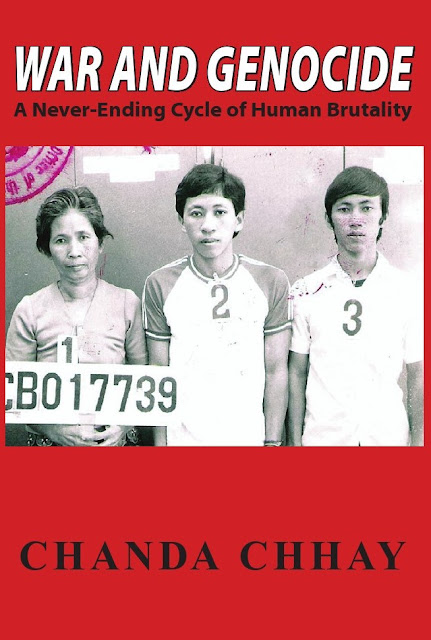
Chanda Chhay is the author of War and Genocide which can be obtained from Amazon at a special price on 16 April 2012

Thursday, April 12, 2012
Originally posted at:  http://cambodianchildren.blogspot.com/

Khmer Rouge Re-Visit

To commemorate the events of the beginning of the Khmer Rouge’s reign of terror in Cambodia on April 17th 1975, I am posting below an excerpt from the book: WAR AND GENOCIDE: A Never-Ending Cycle of Human Brutality. For those of you who wanted to read this book in its entirety, you could go to amazon.com to obtain it in Kindle format. As a tribute to this event, the author will make it available for 24 hours at the cost of $0.99 (99 cents). The time for this promotion is between 8:00pm April 16th to 8:00pm April 17th Eastern Time Zone in USA.

The Last Gun Shot

After the Khmer Rouge’s artillery shell had claimed the life of a schoolgirl in the neighborhood, my father decided to stop letting me go to school for a while and wait for the safety situation to improve. As for me, having been so close to a fatal danger for the first time, the experience almost scared me to death. I sometimes had nightmares and kept hearing the word “Goodbye” the little girl had said to her friends. Though my parents still let me go and play around the house, I was so fearful of the Khmer Rouge’s artillery shell. I was even afraid to go down and swim in the Mekong River which was located just about a hundred yards from my doorstep. So instead of having fun swimming in the river, which I normally did, I spent most of my spare time sitting behind a pile of plywood on the ground floor of my house or playing marbles with the kids who lived next door. Life, for me, was again worrisome and confining. A few weeks had passed but the safety situation had yet to improve. The Khmer Rouge regularly fired their rockets into the city still to terrorize the people who lived across the river.
One day, a Khmer Rouge’s bullet hit the front pillar of our house at the ground floor and produced a small explosion. My brothers and I along with a few other people stood nearby the place of impact. Luckily, nobody was hurt. My father rushed to the scene and told us to go and stay behind a pile of plywood. Later on, as things were quiet, we went to see the spot where the bullet hit and found a fairly large scar on the pillar. We felt that scar with our fingers and thought, among ourselves, that if that bullet were to hit someone, it could have killed or caused serious injury to that person.

******************

On April 13, 1975, as people around the country were quietly celebrating the Cambodian New Year, the Khmer Rouge cold bloodedly delivered their final military assault on Phnom Penh. According to the government’s radio, the Khmer Rouge relentlessly intensified their attack on Phnom Penh. Four days later, on April 17, we heard that the government in Phnom Penh had surrendered to the Khmer Rouge.

Wednesday, January 18, 2012

Postcards from Cambodia


A Cambodian musician playing Plom Sleuk, leaf blowing.
A palm juice vendor. Palm juice is one of my favorite drinks in Cambodia.
Making a toast to my childhood career as a palm sap collector.
 A monkey of Phnom Santuk, showing off his macho monkey prowess. (Ooops!)

Tuesday, January 17, 2012

Khmer Rouge Re-Visit

Om Po and I: sharing laughter while recalling my childhood's trial and tribulation.
The house where I used to live in.
The site where my father was cremated in the compound of Wat Ponlear Chey.
Pu Phy, The man whose oxen I looked after during the Khmer Rouge's era.
The temple of Wat Ponlear Chey.


One of the Best Moments in My Life


Tuesday, January 17, 2012
Story by Chanda Chhay
Originally posted at http://cambodianchildren.blogspot.com/

After 33 years, I have finally had an opportunity to revisit Phum Ponlear Chey again, a place where my family was exiled during the Khmer Rouge’s era. I spent about 3 years living in Ponlear Chey during my early teen. For those of you who have read my book: War and Genocide, Ponlear Chey was one of the places which held many secrets in my life. Anyway, I just wanted to share with you what it was like to return to visit a place where the Khmer Rouge’s reign of terror made a lasting impact in my memory.

My visit to Ponlear Chey was unplanned. While on my way to Siem Reap, I made an impromptu decision to visit Phum Ponlear Chey, which is located about 5 kilometers north of National Highway 6 in Staung District, K. Thom Province. My initial intention was to just drive through the village and return to Highway 6 to continue on my journey to Siem Reap. However, after reaching Wat Ponlear Chey, a place where my father was cremated in 1977, I decided to go visit his cremating site to pay respect to his spirit. It was a somber place. The site where my father was cremated remains almost exactly the same as it was 33 years ago. While I was wandering around the pagoda’s compound, an elderly man came up to me and called out my older brother’s name. Because I look similar to my older brother, the old man mistook me as him. So I introduced myself and inquired about his identity. The old man’s name was Phy, and it turned out that I used to look after his oxen, Ah Popeal and Ah Kaek, during my stay in Ponlear Chey. I spent about half an hour talking with Pu Phy, making some inquiries about my childhood friends. To my absolute surprise, I learned that Om Po, the host whose house we lived in during our sojourn in Ponlear Chey, was still alive. So I asked Pu Phy to take me to visit with Om Po.

Saturday, December 24, 2011

New Book on Cambodian History


New Book on Cambodian History

Dear interested readers:

I have just finished publishing a book on recent Cambodian history: WAR AND GENOCIDE: A Never-Ending Cycle of Human Brutality. This book, a memoir, covered the events happened in Cambodia from 1970 to 1989. It deals with the topics of Cambodian Civil War (1970-75), the Khmer Rouge rule (1975-79), life in post Khmer Rouge’s Cambodia (1979-1985) and life in the refugee camps along the Thai-Cambodian border from 1985 to 1989.

This book is being printed by a small print shop in Virginia, and I have not yet contacted any bookstore to distribute them. For those who are interested in obtaining a copy, you can order it on the Internet by going to: http://cambodianchildren.blogspot.com and follow the link by clicking on the cover image of the book. The book would be available for delivery in February 2012. For those of you who have Amazon’s Kindle, iPad, or other electronic book reading devices, you can purchase electronic version of this book on Amazon.com.

I plan to donate a copy of this book to the Cambodian National Library in Phnom Penh, some U.S. Presidential Libraries, Mark Twain Library in Long Beach, and maybe a few other public libraries in the U.S.A. where large community of Cambodians is located. So if you live near one of these libraries mentioned above, you can check it out some time in March or April if your local library received a copy. I do not know how many US Presidential Libraries there are, but if anyone happens to live near one, I would appreciate it if you could send the Library’s address to me via this e-mail: khemara_kakvey@yahoo.com.

Thank you.
Chanda Chhay

Tuesday, January 25, 2011

Announcement on Cambodian children book series

 Announcement


After almost a decade of collaborative works, a series of Cambodian children books have finally come into existence. These books are collection of fables and folktales based on Aesop’s fables and Buddhist Jataka (Jeadak) with the infusion of some real life modern stories. There are 100 stories in the collection, one third of which were written in poetry form modeled after those of famed French writer, Jean de la Fontaine.

Due to limited funds, only about 3000 copies of these books had so far been printed in Cambodia and distributed informally to schools and charity organizations. However, the digital version of these books has now been established as learning resources for Cambodian students as well as the general public. Those who have Internet access could now read these stories on line at:

OR
and follow the link.

I would like to take this opportunity to publicly thank my collaborators who have worked tirelessly for the past several years to bring this project to completion. Their dedication to writing the stories for these books was truly a rarity given the fact that we all live thousands of miles away from one another, and many of us have never met each other face to face.

I would like to also take this opportunity to make an announcement for a possible future collaborative work focusing on basic scientific stories for Cambodian children. Anyone who is interested in sharing his/her scientific talents with Cambodian children, please contact us via e-mail on the websites.

Thank you.

Chanda Chhay

Saturday, April 17, 2010

Life under the Khmer Rouge (Part 1) - Excerpt from an upcoming book by Author Chanda Chhay

Author’s Notes: For those who are interested in reading the story in its entirety, this manuscript will be published into a book soon. I will make an announcement in KI-Media when the book comes out.

Thank you.


The End of a Beginning

The next morning, I woke up to the tumultuous sounds of gun shots and chaotic noises. There was a commotion of panic and emergency everywhere. I heard people scream and yell in every direction in the neighborhood. Some people told their children to pack up their clothes and blankets while others asked their neighbors what the hell was going on. Nobody seemed to know for sure what the hell was going on, but one thing everyone knew for sure was that the Khmer Rouge had just come into town, and that those sounds of gun shots were either a salute to victory or an act of intimidation.

Still harboring a thought of going to see and welcome the Khmer Rouge, I walked into the living room with little concern about what was or would be happening. As I entered the living room, I saw my mother and brothers busily packing up clothes, foods, and utensils. My mom told me to go hurriedly brush my teeth, take a quick bath, and put on good comfortable clothes because we might have to evacuate the city pretty soon. At first, I was a little skeptical about leaving the city; but, after seeing most people in the neighborhood packing up, I became convinced that the situation was indeed serious. Thus, I went to the bathroom, quickly doing what I was told to do, and returned to the living room to help my brothers pack up stuffs. Minutes later, a man, who at the time shared the apartment with us, returned from investigating what was going on in the streets outside and told us that the Khmer Rouge were about to evacuate all the people from the city. He then hurriedly went up to his quarter to collect his wife and children.

Soon after the man went up to his apartment, my brother, Heang, a college student and part-time government auxiliary soldier arrived after spending the night guarding his post on the western edge of the city. Heang seemed a bit nervous and worrisome-an unusual sign for a brave young man whose elegant bravado was going off to work with a rifle strapped behind his back. In addition, he appeared to be psychologically terrified as if he had just seen a ghost.

Seeing that my brother, Heang, must have gone through a terrifying experience, both of my parents went up to him to find out what had gone wrong. My brother said that he had encountered a group of Khmer Rouge soldiers last night as they tried to enter the city before they were allowed to do so. When he and his comrades denied them permission to enter the city, the Khmer Rouge became angry and threatened to rope everyone (the Khmer Rouge don’t use handcuffs) as soon as they got their way in. So, without taking any chance, Heang and his comrades secretly abandoned their post before sun rise, turned their gun in at a designated area, and went their separate ways through the back streets to avoid being spotted by their commander or the Khmer Rouge because uniform soldiers or officers were supposed to stay at their stations or cantonment areas. Heang also said that, along the way home, he saw some Khmer Rouges carrying microphones announcing that people must evacuate the city immediately. Sensing that things might not change as smooth as everyone expected, my parents told my brother, Heang, to take off his uniforms and put on civilian clothes as a precaution.
***********

The Khmer Rouge’s harsh treatment and apathetic attitude toward the people whom they forced evacuated from the city seemed to take everyone by surprise, for no one had anticipated or foreseen them to be that cruel and ruthless, especially toward civilians. But, as reality began to unfold, we gradually realized that the Khmer Rouge had little or no regard for our calamity. To them, we were no more than a conquered population who was to be subjected to harsh treatment. Every time we met them, we saw a familiar stern, stoic, and indifferent look on their faces-a kind of chilling reception normally issued by one mortal enemy to another. As we walked pass the Khmer Rouge soldiers who sometimes stood on the sides of the road, I couldn’t help but noticing their facial expressions. They were cold, reserved, and resentful. They were also full of hatred.

After spending a whole tumultuous day walking chaotically in a crowded street, we came upon an open area on the outskirt of the city where the Khmer Rouge had set up a checkpoint. We were told, as we approached the checkpoint, to turn in any electronic and communication devices such as radios, cameras, and wrist watches to the soldiers who manned the checkpoint, as we were not allowed to have them in our possession. When my parents told them that we did not have any electronic devices in our possession, two of the Khmer Rouge soldiers came to inspect our bags. They poked their hands into our bulky bags which were filled with blankets and mosquito nets. After seeing that we hadn’t got anything they were looking for, the two soldiers let us continue on our journey. We passed the Khmer Rouge checkpoint just before sun set. Exhausted and disoriented, my parents and some of our neighbors who had traveled along with us decided to look for a suitable place to rest and spend the night. We stopped near a tiny township which was located along a little dry canal known as Prek Doeum Chan. There was a small abandoned marketplace nearby which was burned down and riddled with bullet marks. The town itself was partly deserted because, during the war, soldiers from both sides used the canal as a bumper zone which, in effect, turned the town into a no man’s land.

We found a lodging place under the shade of a tree. After setting up a temporary make-shift shelter, we settled down around a dim candle light to eat our pre-cooked dinner which my mom had prepared in the morning before we left our home. It was our first dinner in the Khmer Rouge’s liberated post-war Cambodia. The evening was filled with silence and sadness. Although there were many other families settling along side with us, we hardly heard anyone say anything to disquiet the eerie atmosphere. Even little children stopped crying, too, as if they knew that their daily routines were undergoing a traumatic transformation. As darkness befell upon us, we built a small fire near our shelter to keep wild creatures such as snakes and scorpions away from our camping ground. We lay down around the tree trunk and went to sleep under the bright blue sky which was filled with millions of stars and a crescent moon.
**********

Angkar’s Viney

Angkar’s Viney or the Organization’s rules (in short, the Khmer Rouge’s rules), were absolute, and they were not something to be questioned. As we soon learned, those who disobeyed or committed infractions against the Khmer Rouge’s rules would usually pay with their lives. So, we began to take great care regarding our daily conducts in order to avoid being seen as not obeying the organization’s rules. One dilemma for us and the rest of the evacuees was that those rules were not written. They were what local Khmer Rouge’s cadres and villagers told us. So, we had to follow whatever directions the local Khmer Rouge’s cadres and villagers ordered us to do.

One of the first steps we took to comply with the Khmer Rouge’s rules was to transform ourselves to become farmers, as the new society envisioned by the Khmer Rouge was supposed to be classless. Unlike industrialized countries, Cambodia’s economy was largely based on agriculture; therefore, the so-called proletarian class in Cambodia composed mostly of farmers and peasants. Hence, joining the ranks of farmers and peasants would be a good first step in integrating into and becoming members of the Khmer Rouge’s classless society. At first, we were rather confused on what the term classless meant. But, we soon realized that by classless, the Khmer Rouge meant that people were no longer allowed to have options in making their own decisions regarding matters concerning their lives. Everything would be decided upon by the organization or Angkar, the almighty monster representing the collective Khmer Rouge’s leadership from village’s chiefs to head of state.

As we transformed ourselves to become members of a classless society, one of the most vivid and everlasting memories was following the Khmer Rouge’s dress code: Black. To adhere to the spirit of a classless society, the Khmer Rouge made everyone dress in black uniform. There was no exception to the rule. Also, no fashionable clothes were allowed. Every black uniform had to be modeled after peasant’s pajama garbs. So, in a frenzy bit to rid ourselves of the outlawed clothes, we pulled out every piece of our clothes and tried to figure out how to make them comply with the Khmer Rouge’s uniform regulation. As city dwellers, we didn’t usually wear black clothes. So, most of our clothes were in various colors. At the same time, we couldn’t find black clothes to replace them either as the Khmer Rouge had already abolished money and market.

While we were pondering on how to find solution to our predicament, Om Voan broached us with an idea that we could dye our clothes black by using a tree fruits called makloeur which, to our relief, were found in abandon in Prek Rumdeng. One of the makloeur trees even grew amid other fruit trees in Om Voan’s garden. So, my older brothers went up its branches and collected enough of its fruits to dye our clothes black. Thanks to the magic power of makloeur’s fruits, once we soaked our clothes in their crush-up solution, they all turned black. Our clothes were transformed, and so were we, reluctantly!

Life under the Khmer Rouge (Part 2) - Excerpt from an upcoming book by Author Chanda Chhay

Author’s Notes: For those who are interested in reading the story in its entirety, this manuscript will be published into a book soon. I will make an announcement in KI-Media when the book comes out.

Thank you.


Trial and Tragedy

As it was universal in Khmer Rouge’s Cambodia, people were divided into work brigades according to their ages, not their abilities. My father once again went to work at the village’s crafting center, while my mother and the rest of my older brothers went to work in the rice fields. Once the rice harvesting was done, all the adults were mobilized to build dikes or dig small canals in preparation for the upcoming planting season. As for the children, we were once again ordered to go into the fields to collect dried cattle’s dung and bring them to the compose pits to be turned into fertilizer. Thus, every morning, I set off along with Oss to look after the water buffalos while, at the same time, collecting any dried cattle’s dung we might find in the fields to bring back to the compose pits. Oss taught me how to ride and handle water buffalos while we were out in the fields. Though I was still afraid of the beasts, my experience with the young oxen in Prek Rumdeng had given me some confidence to overcome my fear. So, with Oss as my instructor, I climbed up on the back of one of the buffalos and ride along with him. It was my maiden ride on the back of a water buffalo, and the experience was rather exhilarating for me. However, as I belatedly learned upon the conclusion of my ride, the water buffalo’s back and its skin gave me the greatest surprise of a life time. Oss showed me how to ride on the water buffalo’s back, but he didn’t tell me how or where to sit on it. Naively, I sat close to its shoulder where the beast’s vertebrate protruded up. Hence, the end of my behind smacked right against the protruded vertebrate which caused inflammation to that sensitive area rather severely. As soon as I dismounted from the water buffalo’s back, I knew that something was wrong with my rear end. The pain was so excruciating that it gave me renewed respect for the expression “pain in the butt.” In addition, I was wearing shorts while riding on the water buffalo’s back, and as my skin touched the beast’s hide, it developed rashes and blisters all over my legs. Upon arriving home, I was in very bad shape and crying in pain. After inspecting the rashes and blisters on my legs, Om Po brought me a handful of rice kernels and told me to put the grains into my mouth and chew on them until they became milky powder, then spray it onto my affected legs. I did as told, and afterward, lied down on my stomach to recover from the ordeal.
************

In a somber mood, my brother, Hong, went to ask for permission to take my father to the district’s hospital. The village’s authority gave him a written pass and a bicycle to take my father to the hospital, as my father was too weak to be able to walk all the way to the hospital which was located about 5 miles away. At about 10 o’clock in the morning, Hong and my father set off for the hospital. As my father about to ride on the bicycle behind Hong, my mother handed him a tiny bag containing a small blanket and a pair of clean clothes for him to change into when he washed the ones he was wearing. Without saying a word, my father took one last look at us pleadingly as if he was begging for mercy. We all tried to maintain eye contacts with him as short as possible and acted optimistically in front of the many villagers who came to see him off. Amidst well wishes from villagers, Hong pedaled the bicycle slowly with my father sitting precariously behind him. From the corner of my eyes, I saw my mother turned around and walked back into the house with a heavy heart. Her eyes were filled with pain and sadness.

We sat quietly for the rest of the day waiting for Hong’s return, so that we could learn what the condition at the district’s hospital was like. By about 4 o’clock in the afternoon, Hong returned from the hospital. Surprisingly, and to my mother’s great relief, my father also came back with him. Hong told us that the district’s hospital was overflowed with patients. The hospital had run out of spaces to accommodate new patients. Hence, the hospital staffs just simply refused to admit my father, despite his urgent need of care. In a rather cruel twist of fate, the hospital’s refusal to admit him was a blessing, for in a crowded Khmer Rouge’s hospital, my father would certainly be left to die like a vermin. By being back at home, my father could at least die knowing that his family was nearby.
************

At about 4:30 in the early morning hours, we all woke up to a rather strange sound. It was my father making painful sounds. At that instance, we all knew that something had gone terribly bad with his health. Through my mother’s trembling voice asking my father to respond to her, we all knew that the devil was about to claim his soul. Om Po burned a torch to give the house some illumination as my mother continued to ask my father to respond to her. But there was no discernible answer coming out of my father’s mouth. He continued to moan in pain. He arched his back up slightly and his body appeared stiff. At that point, his moan died out slowly. In his final attempt to stay alive, my father struggled to take in a gulp of oxygen; but it was in vain. He died in the middle of his breathing with his eyes still open as if his body refused to die. My mother put a white handkerchief to cover my father’s face and we all sat around his lifeless body to let reality sink in.
***********

The Silent Genocide

During my stay at the vegetable garden, the Khmer Rouge’s round up of new people for execution intensified. Many families, all of them were new people, began to disappear quietly. We were told that they were being relocated to live and work in some faraway communes. But, in reality, they were sent to the execution sites somewhere in the region. It appeared that most of the people who were slated for execution were those whom the Khmer Rouge authority deemed unproductive, or they were suspected of working for the previous regime. So, to keep a low profile, Ta Plaok told me to avoid going into the village so that I would be out of sight from the Khmer Rouge’s vigilantes. As a gesture of help, Yeay Nhong, who had just been forced by the Khmer Rouge’s Angkar to relinquish her large home to be used as communal dining hall and lived on a small plot of land about half a mile from the village, agreed to take my little brother, Buntha, under her wing by having him help her son look after her cows. Hence, no one was around in the village. We all were out and about doing works for Angkar every day.

Administratively, Ponlear Chey Village was divided into three groups. Each group was overseen by a headman. We were living in Group 2 while Aunt Muoy and her husband were living in Group 3. Out of the three groups, Group 1 was the most unfriendly place for new people to be in, for it was overseen by a callous man named Choy who had the least sympathy for new people. Of all the new people who lived in his group, about 2/3 had been sent away for execution. We were sort of lucky to be dropped off just a few houses away from that brutal man.
***********

As we were making the grave’s mount, I noticed that the man’s eyes were fixed on a frog Oss caught in a pond earlier and hanged it on his waist’s band. After we finished making the grave’s mount, the man thanked us profusely. Afterward, in a rather hesitant voice, he asked Oss if he (Oss) would skin his frog now and give him the discarded frog’s head, skin, and stomach’s contents. Oss agreed to the man’s request, and, as soon as he got the frog’s head, skin, and stomach’s contents, the man built a small fire, wrap the frog’s head and stomach’s contents in its skin and toss it in the fire. A few minutes later, he picked it up and ate the whole thing. Oss and I were dumbfounded to see the man actually eat the frog’s skin and stomach’s contents. If we didn’t see it with our own eyes, we would not have believed it. Seeing how hungry and desperate the man was, Oss decided to give him the frog as well. I also gave him a few snails and crabs which I had caught in a stream earlier and kept them in a small pouch. At that point, it was late afternoon; thus, we said goodbye to the man and the little girl and went to herd our water buffalos home. That day, we went home empty handed without any wild critter to supplement our diet. However, Oss and I did not feel bad at all, for we knew that we had done something right to help a desperate man.

Life under the Khmer Rouge (Part 3) - Excerpt from an upcoming book by Author Chanda Chhay

Author’s Notes: For those who are interested in reading the story in its entirety, this manuscript will be published into a book soon. I will make an announcement in KI-Media when the book comes out.

Thank you.


Disobeying Angkar’s Viney

One afternoon, after coming to fetch our lunch from the camp’s kitchen, I felt my legs were shaking and a sheer fatigue throughout my body, a sign of weakness due to prolonged malnutrition. So, I told my team leader that I didn’t feel well and would like to take the rest of the afternoon off. Afterward, I went to the hut which was our sleeping quarter and lied down to give my body a much needed rest. A couple of hours later, I heard someone yelled at the far end of the hut calling everyone in there to come out and assemble in front of it. From the tone of his voice, I knew instantly that there was trouble ahead. I got up slowly and made my way to the gathering place. There I found a man named Chay, who was our brigade’s leader, and a few of my colleagues who, like me I presumed, were feeling unwell as well. Chay told us to sit in a half circle in front of him as he was preparing to interrogate us what were the causes of our staying in the hut while everyone else was out working in the fields. Amongst the six or so people who were being interrogated, I was the youngest and smallest. So, Chay picked on me first. He asked me what kind of sickness I had that warranted my absence from going to work. I told him that I had a temperature and that I felt fatigue so badly this afternoon. Chay put the palm of his hand on my forehead to feel my temperature and afterward chastised me that I was pretending to be sick, and that my sickness was not real. It was an emotional sickness, chheur sateh arom. As he vented his rage at me, Chay drew his hand in a motion of slapping me in the face for not convincing him enough of my sickness. Instantly, I closed my eyes and waited for the inevitable punishment. But Chay somehow stopped short of slapping me. He then turned to a young man named Met who sat next to me. “What is the matter with you?” he asked Met. “I am sick.” Met answered him matter-of-factly. “Liar!” Chay screamed. “You all are lazy pretending to be sick.” He went on. In an attempt to defend his innocence, Met interjected that if he were not sick, he would not stay away from work. Chay was enraged upon hearing Met’s rebuttal to his accusation. In a split second, he stepped forward and kicked Met right on the chest. Met fell backward and struggled to sit up again as he was assessing the damages to his mouth and chest resulted from the impact of Chay’s kick. His mouth bled profusely. But no one dared say a word. We all sat still like stone waiting for Chay to make his next move.

After venting his rage at Met, Chay seemed to have fulfilled his callous behavior. In a contemptible mood, he ordered us to get out of his sight and don’t ever again use illness as a pretext to stay away from work. Under Chay’s sharp gaze, we sheepishly and quietly went back into the hut. As we were walking into the hut, I stole a quick glance at Met to see how badly hurt he was. His lips were badly swollen as Chay’s knee might have hit them when he delivered his kick. He was really in bad shape. But nothing we could do to help him. Not even a word of sympathy. In the Khmer Rouge’s silent code of conduct, anyone who was punished by a cadre or cadres should be shunted. Hence, it was prudent to stay away from a person being punished whether that person was guilty or not. With a helpless feeling, I went to my sleeping quarter and lied down waiting for the rest of the afternoon to pass by.
***********

My mother was surprised to see me coming home in the dark and soaking wet. I told her that I came home to have her mended my torn shirt which I was wearing. But my mother seemed to know that my real motive was not only to have that torn shirt mended but rather to have some food in my stomach. After giving me some dry clothes to change into, my mother went to the kitchen and opened up a crevice where she hid some rice. She cooked the rice and a piece of dried fish in a kettle as the Khmer Rouge authority did not allow people to have any pot and pan at home beside a kettle to boil water. After the rice and the dried fish were cooked, my mother told me to go to the kitchen and eat the food quietly lest there was any Khmer Rouge vigilante called chhlob spied on us while she was mending my shirt.

Despite my enormous hunger, I was overcome by fear and anxiety about the consequence of my action once I returned to the camp. Khoeun was one of the camp’s supervisors. The fact that he spotted Teav and me running away from the camp was a serious cause for concern. Although the Khmer Rouge had, at that point, stopped classifying people as being new or based, my predicament was compounded by the fact that Teav was the child of base people who had some privilege while facing disciplinary action regarding wrong doing. Hence, should there be any punishment for our action, I would certainly be the one who will bear the brunt of it. The more I think about the consequence and punishment I might face, the more worrisome I became. All of a sudden, my stomach began to churn and my throat was tightened. The fear had finally broken me down, mentally and physically. I struggled to swallow the food in my mouth and left the rest uneaten while sitting quietly in the kitchen to regain my composure.
************
Returning Home

By early January 1979, we began to hear the sounds of transport trucks going along the dirt road leading northwestward, which were unusual given the fact that that desolated dirt road rarely saw any motorized vehicles traveling in it beside the oxcarts. When Ret went to fetch our weekly rations at the communal warehouse, we asked him to inquire about those transport trucks as to why they were traveling through this isolated dirt road. To our surprise, Ret told us that those transport trucks carried loads of people and materials apparently on the run. That evening, Iev went to see the commune’s chief and other Khmer Rouge’s notables to find out what was going on. He returned to the camp at about 7 o’clock in the evening and told us to pack up and go home as there was no one remained in the commune’s office. Apparently, the Khmer Rouge’s cadres in the commune had hotfooted away or went into hiding.

Not knowing what to do, Ret divided the rice rations among everyone, and we all went our separate ways toward home. Ponlear Chey, the village from where I came, was located farthest away from the camp. To get there, I had to walk through three other villages, Phum Bonteay Staung, Phum Chonloss, and Phum Po. Between each village, there was an empty span of rice field with a distance of about one mile. Amongst the kids in my camp, two of them lived in Phum Po, and I was the only one who was from Ponlear Chey. Hence, this would mean that I had to walk across that empty span of rice field between Phum Po and Phum Ponlear Chey alone. But I had no choice. Staying in the camp alone was out of the question. So, with fear and anxiety, I returned home in the dark with the two kids who were from Phum Po. After the two kids reached their houses, I walked alone toward home in pitch darkness with only some stars overhead. That last few miles of walking home toward freedom was perhaps the scariest experience I had ever had in my life. I still have goose-flesh when recalling that particular experience.

Friday, January 01, 2010

The Farmers and the Politician


Thursday, December 31, 2009
Justice Speech by Chanda Chhay
Originally posted at http://cambodianchildren.blogspot.com

In a corrupt justice system, the application of the law tends to be heavily biased against those who are poor, powerless and politically unimportant. These facts have been well known in Cambodia; but what makes these injustices more painful is the fact that the one who leads the fight against such injustices run away from the problems when the going get tough.

Let me be blunt. I am talking about Mr. Sam Rainsy and the poor, powerless and politically unimportant farmers in Svay Rieng Province, who have been accused of and charged with destroying state property after they pulled out six wooden stakes marking the border between Cambodia and Vietnam. From the video clips, the statements, and the actions of all involved, it is obvious that the farmers who pulled out the wooden stakes which were planted in their rice field took such action at the behest of Mr. Sam Rainsy. They (farmers) were led to believe that what they were doing was right, as a law maker was encouraging them to do so. Alas, when the state deemed the action a criminal act, it is quite unfortunate that the ones who have to face the consequences are the farmers.

Both Mr. Sam Rainsy and the farmers were equally charged with destroying state property by the Cambodian court in Svay Rieng province. It doesn’t matter if the Svay Rieng Court is a Kangaroo Court; Mr. Sam Rainsy and the farmers should confront the court’s proceedings together. A friend in need is a friend in DEED. Mr. Sam Rainsy should not let the poor, powerless, and politically unimportant farmers face the prosecution alone. As a politician, a political party leader, and a person with political means to defend and protect those powerless farmers, Mr. Sam Rainsy has a moral obligation to confront the issues head on. If this means going to prison, so be it. A person, especially a political party leader whose goal is to seek national leadership should not walk away from the sticky situation he has created. Claiming responsibility for one’s action in absentia while letting other partners-in-crime face the consequences alone is not the answer. We all know that in a dire situation and trying time, issuing statements and proclamation are cheap and meaningless. They have little effect in solving the problems. Only concrete actions count and could make a difference.

If my memory is correct, Mr. Sam Rainsy has engaged in Cambodian politics for almost 20 years now. As a politician and a law maker, he should at least be aware of how the Cambodian legal system operates. If he knows, as he claimed, that the Cambodian legal system is corrupt, incompetent, and prone to political influences, Mr. Sam Rainsy should use the opportunity the Svay Rieng Court has given him and his political clout as leader of a political party to expose these abominable weaknesses and bring changes to it. Otherwise, go to Greece and kowtow in front of Socrates statue to seek some divine guidance. Don’t let the poor farmers, especially Ms. Meas Srey, in Svay Rieng down. Those farmers might be naïve, but many of them do take responsibility for their action bravely knowing quite well that their plight depends very much on the whims of the flip-flop, full of promise-breaking politicians.

Chanda Chhay
Washington, D.C.

Wednesday, September 16, 2009

Tuesday, September 15, 2009

Saturday, June 20, 2009

Open Letter to Dr. Helen Jarvis, Appointed Head of the Victims Unit at the Extraordinary Chamber in the Court of Cambodia

Cartoon by Sacrava

CC: ECCC

Dear Dr. Jarvis:

In light of recent revelations of your background as an advocate for Marxist ideology, it becomes painfully clear that your new role as head of the victims unit for the Extraordinary Chamber in the Court of Cambodia (ECCC) presents a disturbing and grave conflict of interest. It is both absurd and insulting to have a Marxist advocate representing the victims of a Marxist regime, which was being tried by the court of law.

If the reports of your continued advocacy for Marxist ideology up to the early 2000s were true, it is unquestionably clear that you are unfit to represent the victims of the Marxist Khmer Rouge regime at the ECCC. To continue to do so, it is not only a disgrace to your honor, but also an insult to all of us who have survived and demised under the brutality of the Khmer Rouge’s government.

As a victim of the Khmer Rouge regime, I am speechless and utterly appalled to see a well-educated person like you failed to realize that what you are doing is not only wrong, but also an affront to the dignity of humanity, especially, those who had perished in the Cambodian killing fields. Thus, on behalf of myself, a victim of the Khmer Rouge regime on whose behalf you represent, and on behalf of my father and millions of other Cambodians who died painfully under the abuses of the Khmer Rouge regime, I would like to tell, ask, or beg you to please remove yourself as head of the ECCC’s victims unit or from any function within the ECCC altogether.

Sincerely,

Chanda Chhay
Washington, DC (U.S.A.)

Tuesday, May 26, 2009

Roeung Chorchork Neung Kaun Chiem - The Wolf and the lamb

Click on the story to zoom in

For additional stories in Khmer please visit
http://cambodianchildren.blogspot.com

Free Journalism Training Via Skype

Monday, May 25, 2009
By Chanda Chhay
Originally posted at http://cambodianchildren.blogspot.com


Students in Cambodia who would like to learn basic journalism, please send a short bio/letter of introduction to: khemara_kakvey@yahoo.com

និស្សិតនៅកម្ពុជាដែលមានបំណងចង់សិក្សាវិជ្ជាជីវៈសរសេរពត៌មាន សូមសរសេរលិខិត ទាក់ទង មកអ៊ីម៉ែលខាងលើ។ លិខិតអាចសរសេរជាភាសារខ្មែរក៏បានដែរ ប្រសិនបើអ្នកមានកម្មវិធីយូនីកូត ។

Saturday, April 25, 2009

Buddhism in brief


Dear Readers,

Below is a link to an excerpt on Buddhist philosophy which was written by Professor Sar Sarun that you can download for your own reading.

We would like to thank Lok Chanda Chhay for sending it over.

Thank you!

Wednesday, March 18, 2009

Recipients of a free copy of the Cambodian Royal Chronicle by Chanda Chhay


Re: The Cambodian Royal Chronicle

Dear Readers:

Below are the locations of the 5 recipients who will receive a copy of The Cambodian Royal Chronicle.
  1. Santa Ana, CA
  2. Lacey, WA
  3. Dekalb, IL
  4. North Attleboro, MA
  5. Toul Kork, Phnom Penh
I sent the books out today via USPS. So, with the exception of the one going to Phnom Penh, you should receive this book over the weekend. I am sorry for those whose names did not make the list. I wish I had more books to send out. The responses have been overwhelming. I would like to also take the opportunity to thank everyone for his/her interest in the book. Due to time constraints, I could not respond to your e-mail individually. And I ask for your forgiveness on that.

Regards,
Chanda Chhay

Tuesday, March 17, 2009

The Cambodian Royal Chronicle - by Chanda Chhay

Dear Readers:

Below is an information on a newly release book on Cambodian history. The publisher has sent me a number of complimentary copies. I have 5 copies of this book left. If anyone would like to obtain a copy of this book, please send your name and address to the e-mail below:

Khemara_kakvey@yahoo.com

Notice: Only the first five persons whose names appear on the e-mail will receive a copy of the book as I have only five copies. Names and addresses will be kept confidential.

Chanda Chhay


Click to zoom in

Author and reporter Chanda Chhay is an American of Cambodian descent who spent the first twenty-five years of his life in Cambodia, and lived through "one of the most horrific social upheaval that has ever happened to humankind." The experience has led an indelible mark on Mr. Chhay’s memory—and was the great impetus to write The Cambodian Royal Chronicle.

This invaluable work covers three main topics: the history ol the Cambodian monarchy an analytic essay on the Cambodian people, society, culture and civilization; and a fascinating report by a Chinese envoy on the customs of the people of Cambodia at the turn of the 13th century.

As a Cambodian who had lived through the destruction of Cambodian society under the Khmer Rouge rule in the late 1970s, Mr. Chhay draws from his vast knowledge of his people's colorful, vio¬lent, and culturally rich history to present a substantive book for students of Cambodian history, as well as for the educated reader.

Chanda Chhay was born in Kompong Cham province, Cambodia. He lived through and witnessed the Cambodian political upheavals in the 1970s and 1980s as a teenager. In 1989, after spending four years in a refugee camp in Thailand, he emigrated to the United States and earned a bachelor’s degree in communications, government, and politics from George Mason University in 1995. Soon afterward, he began working as a conference reporter in Washington. D.C. Mr. Chhay currently resides in northern Virginia and visits Cambodia regularly. This is his first published book.

Monday, October 27, 2008

With a Friend like Thailand, Cambodia WILL NOT Need an Enemy

Sun, 26 Oct 2008
Op-Ed by Chanda Chhay

The shootouts between the Thai and Cambodian armed forces which resulted in casualties on both sides beg an urgent question: What made two members of the Association of South East Asian Nations (ASEAN), whose charter is to never permit its members to use military action against one another, engage in an armed clash? Now that it has happened, one must wonder aloud whether ASEAN’s charter is worth as much as the pieces of paper on which it was written.

From the surface of it, the rancor between Thailand and Cambodia was over a parcel of disputed land near the Khmer Temple of Preah Vihear which Cambodia has enlisted it as a World Heritage site. However, as events unfold, it is painfully clear that the real issue behind Thailand’s motive appears to be not so much about the disputed land but rather to divert and avert political meltdown in Bangkok, which has been threatening the stability of Thai politics for quite some time now.

To fully understand how the armed confrontation which led to fire fights between Thailand and Cambodia come about, one must trace through a series of events. Clearly, the trigger point was the listing of Preah Vihear Temple as a World Heritage site, and the subsequent illegal trespass of two Thai nationals into the temple’s premise which was internationally recognized as Cambodian territory. The culprits were arrested and sent back to Thailand within a couple of hours—a normal procedure between neighboring countries which are not hostile to each other. In response to the incident, Thailand returned its gratitude to Cambodia by sending armed forces into a Cambodian pagoda which is located in Cambodian territory. Though Thailand never clearly stated what the motive behind sending its troops into a Cambodian pagoda was, this provocative action appears to have only one aim: To entangle Cambodia in a political tango dance so that it could be used as a sideshow to alleviate and, perhaps, solve Thailand’s domestic political crisis.

There is a well known mantra within ASEAN community that no nation should interfere in the affairs of others. But there is no provision forbidding member nations from using others as pawns to solve their domestic political crises. This is what appears to be at the core of the current rancor between Cambodia and Thailand. Unless there is a solution to Thailand’s domestic political problem, the confrontation between Thailand and Cambodia over a parcel of land near Preah Vihear Temple will not likely come to an end any time soon.

Chanda Chhay
Washington, DC (USA)

Saturday, July 26, 2008

CAMBODIA: ENOUGH IS ENOUGH!!!

Friday, 25 July 2008
Op-Ed by Chanda Chhay

There are many ways to deal with a thug. But, there is only one proper way to deal with a misbehaving, neighboring nation. That is to stand firm and be fair with it, and, if necessary, deprive it of what it wanted most.

It is as clear as daylight that the 4.6 square kilometer of so-called disputed land around the Khmer Temple of Preah Vihear was not what Thailand wanted. What it really wanted is a guaranteed access to Prasat Preah Vihear—the main attraction and an economic lifeline for the arid Si Saket province of Thailand. Without Preah Vihear, the surrounding areas would be just like any other part of the Dangrek Mountain ranges—rocks and trees.

The flagrant incursion of Thai armed forces onto the sacred ground of Preah Vihear has been going on long enough. The Thai government should know better by now that it could only defy words of condemnation or warning, but it could not defy international norms and laws. By the same token, the Cambodian government should know that the muddled head Thai leaders wanted to turn every legal and internationally-recognized document pertaining to the sovereignty of Cambodia upside down and subject Cambodia to the whim of their myopic thoughts.

So, what is Cambodia to do in order to deal with the situation? One very simple and effective solution to this problem is to publicly announce to the international community and to Thailand, in particular, that the access to Preah Vihear from Thailand is no longer open due to the difficulty in preventing illegal trespassing and thefts to the temple’s artifacts, which is now a World Heritage site. As proprietor of the temple, Cambodia has an obligation and a right to safeguard it. If Thailand, as a good neighbor, wanted to offer assistance and collaboration in protecting this World Heritage site, it MUST recognize and respect the treaties of 1904 and 1907 regarding the common border of Cambodia and Thailand. Period!

Preah Vihear is not a political football to be kicked around and see who will win or lose. It has suffered neglect and abuses by humans long enough. It is now time for us to restore and preserve it for posterity. This current crisis is perhaps the best opportunity for us to look beyond the tourist dollars and to give Preah Vihear what it deserves most: Restoration and research on the site, so that humankind could have a better understanding of its history and functionality.

Chanda Chhay
Washington, DC (USA)