


 | |
| Part I: The Challenge | |
| Chapter 1, Repeated violence threatens development, explores the challenge: repeated cycles of organized criminal violence and civil conflict that threaten development locally and regionally and are responsible for much of the global deficit in meeting the Millennium Development Goals. Download chapter one. | |
| Chapter 2, Vulnerability to violence, reviews the combination of internal and external stresses and institutional factors that lead to violence. It argues that capable, accountable, and legitimate institutions are the common “missing factor” explaining why some societies are more resilient to violence than others. Without attention to institutional transformation, countries are susceptible to a vicious cycle of repeated violence. Download chapter two. | |
| Part II: Lessons from National and International Reponses | |
| Chapter 3, From violence to resilience: Restoring confidence and transforming institutions, presents the WDR framework, or “virtuous cycle.” It compiles research and case study experience to show how countries have successfully moved away from fragility and violence: by mobilizing coalitions in support of citizen security, justice, and jobs to restore confidence in the short term and by transforming national institutions over time. This is a repeated process that seizes multiple transition moments and builds cumulative progress. It takes a generation. Download chapter three. | |
| Chapter 4, Restoring confidence: Moving away from the brink, reviews lessons from national experience in restoring confidence by mobilizing ‘inclusive-enough’ coalitions of stakeholders and by delivering results. Collaborative coalitions often combine government and nongovernmental leadership to build national support for change and signal an irreversible break with the past. Restoring confidence in situations of low trust means delivering some fast results, since government announcements of change will not be credible without tangible action. Download chapter four. | |
| Chapter 5, Transforming institutions to deliver security, justice, and jobs, reviews national experience in prioritizing foundational reforms that provide citizen security, justice, and jobs—and stem the illegal financing of armed groups. In moving forward institutional transformation in complex conflict settings, case studies emphasize that perfection should not be the enemy of progress—pragmatic, “best-fit” approaches should be used to address immediate challenges. Download chapter five. | |
| Chapter 6, International support to building confidence and transforming institutions, turns to lessons from international support to national processes. While registering some notable successes, it argues that international interventions are often fragmented, slow to enter, quick to exit, reliant on international technical assistance, and delivered through parallel systems. The chapter considers why international action has been slow to change. International actors have to respond to their own domestic pressures to avoid risk and deliver fast results. Different parts of the international system—middle-income versus OECD actors, for example—face different domestic pressures, undermining cohesive support. Download chapter six. | |
| Chapter 7, International action to mitigate external stresses, provides lessons from international action to combat external security, economic, and resource stresses that increase conflict risk. The stresses range from trafficking in drugs and natural resources to food insecurity and other economic shocks. The chapter also addresses lessons from regional and cross-border initiatives to manage these threats. Download chapter seven. | |
| Part III: Practical Options and Recommendation | |
| Chapter 8, Practical country directions and options, provides practical options for national and international reformers to take advantage of multiple transition opportunities, restore confidence, and transform institutions in countries facing a range of institutional challenges, stresses, and forms of violence. Download chapter eight. | |
| Chapter 9, New directions for international support, identifies four tracks for international action. First, to invest in prevention through citizen security, justice and jobs. Second, internal agency reforms to provide faster assistance for confidence-building and longer term institutional engagement. Third, acting at the regional level on external stresses. Fourth, marshalling the knowledge and resources of low, middle, and high-income countries. Download chapter nine. | |
| Bibliography | |
| Selected world development indicators |
Showing posts with label Development. Show all posts
Showing posts with label Development. Show all posts
Thursday, July 14, 2011
The World Development Report 2011: Conflict, Security, and Development


Monday, May 31, 2010
Cambodia coastal province will be put for sale next?
Cambodia coastal development strategy moves ahead
May 31, 2010
Xinhua
May 31, 2010
Xinhua
Cambodia has begun implementing its master strategy for attracting development in the country's four coastal provinces over the next 20 years, local media reported on Monday, citing officials at the Ministry of Land Management, Urban Planning and Construction.
"This is a good plan and a way to develop Cambodia into the future," the Phnom Penh Post quoted Land Management Minister Im Chhun Lim as saying at a conference detailing the plan on Thursday.
Calling Sihanoukville the "dragon's head", Im Chhun Lim said that the plan priorities improving development in Sihanoukville, Kampot, Kep and Koh Kong provinces in order to increase economic activity and provide jobs.
"We're insuring a balance between protecting the environment in coastal areas with attracting both local and foreign investors," he said at the conference.
The strategy will focus on attracting local and foreign investment to the region, with an eye to strengthening export industries, said Pen Sophal, director at the ministry's Urban Planning Department.
"Government wants sustainable, transparent development on coastal areas to attract investors," he said on the sidelines of a conference on drafting a final strategy for the "National Integrated Coastal Area".
He added that the plan is slated to run until 2030.
The plan, called The Study of Strategy National Integrated Coastal Area and Master Plan Sihanoukville Sustainable Development, focuses on strengthening infrastructure and special economic zones servicing Sihanoukville Port.
"We focus on Sihanoukville because the province has potential for growing faster due to its proximity to the international port for industry, agriculture and services," he was quoted as saying.
"This is a good plan and a way to develop Cambodia into the future," the Phnom Penh Post quoted Land Management Minister Im Chhun Lim as saying at a conference detailing the plan on Thursday.
Calling Sihanoukville the "dragon's head", Im Chhun Lim said that the plan priorities improving development in Sihanoukville, Kampot, Kep and Koh Kong provinces in order to increase economic activity and provide jobs.
"We're insuring a balance between protecting the environment in coastal areas with attracting both local and foreign investors," he said at the conference.
The strategy will focus on attracting local and foreign investment to the region, with an eye to strengthening export industries, said Pen Sophal, director at the ministry's Urban Planning Department.
"Government wants sustainable, transparent development on coastal areas to attract investors," he said on the sidelines of a conference on drafting a final strategy for the "National Integrated Coastal Area".
He added that the plan is slated to run until 2030.
The plan, called The Study of Strategy National Integrated Coastal Area and Master Plan Sihanoukville Sustainable Development, focuses on strengthening infrastructure and special economic zones servicing Sihanoukville Port.
"We focus on Sihanoukville because the province has potential for growing faster due to its proximity to the international port for industry, agriculture and services," he was quoted as saying.
Thursday, May 21, 2009
A future in the balance
Thursday, 21 May 2009
Written by Rod Brazier
The Phnom Penh Post
THE Cambodian People's Party (CPP) has consolidated its position as the dominant political force in Cambodia. Until the global financial crisis struck, political stability had led to a dramatic increase in investor interest, generating a surge in investment and economic growth.
The CPP won a resounding victory in the July 2008 national elections, elections which were recognised by the international community as free and fair. The CPP enjoys widespread support today owing to the stability and economic growth that have occurred in recent years. Outside, it's not well understood that this government is truly very popular, despite some authoritarian tendencies.
That's because Cambodia has made remarkable progress over the past 15 years. Starting from a very low base, key indicators of human welfare, such as maternal and child mortality, have improved dramatically.
The opening of the economy in the 1990s gave initial impetus to economic growth and job creation. The main drivers of growth have been the garment sector, tourism, construction in Phnom Penh and Siem Reap, and public spending.
Remittances from garment factory workers to the rural country-side have been an important source of income transfer to those areas, while the very large agricultural and fisheries sectors act as buffers against economic turmoil.
All round, a very good picture for a country that was still at war with itself little more than a decade ago.
The political consolidation by the CPP over the last several years has changed the context in which Cambodia will develop over the next few years. One-party rule has replaced fractious politics. Growth and development are top priorities.
The emphasis on economic growth holds promise for increasing prosperity for ordinary Cambodians, but possibilities for re-emergence of an open pluralistic polity are greatly reduced.
In addition, the global financial crisis threatens to undermine the anti-poverty gains of recent years and to exacerbate the nascent social tensions arising from the visible gap between rich and poor.
Therefore, the main challenges for the country over the next few years will be to sustain the current pace of economic development and reduce poverty, while addressing the worst abuses arising from a system of governance that has resisted reform in the past.
I have a few scattered observations about Cambodia, gleaned from almost three years in Phnom Penh. Many of you have been here longer than I have, so forgive me if any observations are shallow.
The international community is woefully under-informed about Cambodia
Compared to the international communities in neighbouring countries, the international community here in Phnom Penh is terribly ignorant about the political economy of Cambodia.
I hasten to add that I include myself in this category. As a group - for there are very few exceptions - we know very little about the politics that matters in Cambodia. There is, of course, the noisy, quarrelsome discourse that is carried out in the headlines between the government and the opposition. Despite the high volume and frankness of the exchanges, I don't think this is where the action is politically. To me, the internal politics of the CPP are more intriguing and far more consequential, for several reasons:
Relations between the CPP and NGOs - both local and international - have been occasionally thorny. Broadly, though, relations are improving, and I see two reasons for this:
Reading the latest draft, one can't find so much that's objectionable. One clause on political activity is problematic, and the sanctions for some types of non-compliance are rather heavy, but it is still a draft. I have begged my colleagues to view it as a draft and to take up the government's offer to consult. But perceptions are stubborn, and some letters have been written that have been counter-productive. The Asia Foundation has not signed those letters because we want to enter consultations in good faith.
Inequality and under-investment in education are growing as concerns
Cambodia is probably on a very positive and well-trodden Asian path to development. In several respects, though, it is deviating in ways that could threaten long term development prospects:
It's only a little more than a decade since Battambang was captured briefly by the Khmer Rouge. Cambodia is small, and positive developments here are seldom heard in the din of the 24-hour news cycle. This is unfortunate. A vivid demonstration of this is the Economist Intelligence Unit (EIU) report.
The EIU published two reports in March 2009. One was the regular Country Report about Cambodia. Nothing in that report was objectionable.
In fact it was a sober, sensible report that no one in this room would likely find controversial.
The report that has caused so much anger here is called Manning the Barricades, a 32-page report that mentions Cambodia once.
Manning the Barricades with global coverage that purports, among other claims, to rank countries by the risk of political instability. Some of the indicators included were: inequality, state history, trust in institutions, and corruption. These are reasonable.
The government erred badly in complaining so loudly about this report because the complaints brought prominence to a single mention of Cambodia on page 16 of the report that would otherwise have gone largely unnoticed. The rush by business groups and others to condemn the EIU was equally unhelpful and merely nourished an incorrect perception.
Sustaining rapid economic growth: not a straight shot
The CPP's legitimacy depends largely on maintaining rapid improvements in the quality of life. Basic, first generation economic reforms are in place, but the high-growth trajectory of recent years will hit limits imposed by rampant corruption and cronyism. Extracting continued rapid growth will require painful choices by the Cambodian leadership that will impinge on the interests of entrenched party elites. This is where the rubber will hit the road for reform: when economic growth is crimped by cronyism.
This problem is most dramatically illustrated in problems related to land issues. Foreign investors say that uncertainties over land are the single biggest concern, and often the reason that potential new investors walk away. It's worth noting that the prime minister himself has warned countless times about the dangers of continued land-grabbing. Yet it persists. Other similar pressures will emerge over time to test the government's commitment to market-led growth.
The government must reduce these vulnerabilities by fixing fundamental policy weaknesses. A key to improving economic governance will be to nurture and empower the small group of Western-educated technocrats within the Ministry of Economy and Finance, and scattered throughout other ministries and departments.
This group is more outward looking and reform-minded and is believed to have close ties to the pragmatic Prime Minister Hun Sen. We need to nurture and support these people, for they will face heavy challenges in the coming years that will determine the pace and trajectory of economic reform and development in Cambodia.
I have spent some time listing weaknesses and vulnerabilities. But we must also acknowledge the enormous strides that the Cambodian people have taken.
From civil war and unimaginable sorrow and misery just a generation ago, to a normal, developing country encountering the typical range of challenges that every other country in the region has faced. The good news is that others have shown it is possible to overcome these impediments.
But it is long, slow work and, in some respects, the early years are the easiest. I am cautiously optimistic about Cambodia. The focus of government has shifted from winning the political contest and seizing power to governing well and staying popular by delivering infrastructure and services.
This is a watershed transition that hasn't been noted enough. In the words of my friend His Excellency Roland Eng, who said five years ago: "We used to talk politics, now we talk policy."
---------------
The Asia Foundation's Cambodia country director Rod Brazier has been in Cambodia for three years. He is leaving the Kingdom shortly to take up a position with the Australian government in Canberra. On April 24, 2009, he spoke to the American Cambodian Business Council. What follows is an excerpted version of his speech to AmCham members.
Written by Rod Brazier
The Phnom Penh Post
"The CPP's legitimacy depends largely on maintaining rapid improvements in the quality of life. Basic, first generation economic reforms are in place, but the high-growth trajectory of recent years will hit limits imposed by rampant corruption and cronyism. Extracting continued rapid growth will require painful choices by the Cambodian leadership that will impinge on the interests of entrenched party elites. This is where the rubber will hit the road for reform: when economic growth is crimped by cronyism."A few final reflections on the situation in Cambodia from the Asia Foundation's outgoing country director.
THE Cambodian People's Party (CPP) has consolidated its position as the dominant political force in Cambodia. Until the global financial crisis struck, political stability had led to a dramatic increase in investor interest, generating a surge in investment and economic growth.
The CPP won a resounding victory in the July 2008 national elections, elections which were recognised by the international community as free and fair. The CPP enjoys widespread support today owing to the stability and economic growth that have occurred in recent years. Outside, it's not well understood that this government is truly very popular, despite some authoritarian tendencies.
That's because Cambodia has made remarkable progress over the past 15 years. Starting from a very low base, key indicators of human welfare, such as maternal and child mortality, have improved dramatically.
The opening of the economy in the 1990s gave initial impetus to economic growth and job creation. The main drivers of growth have been the garment sector, tourism, construction in Phnom Penh and Siem Reap, and public spending.
Remittances from garment factory workers to the rural country-side have been an important source of income transfer to those areas, while the very large agricultural and fisheries sectors act as buffers against economic turmoil.
All round, a very good picture for a country that was still at war with itself little more than a decade ago.
The political consolidation by the CPP over the last several years has changed the context in which Cambodia will develop over the next few years. One-party rule has replaced fractious politics. Growth and development are top priorities.
The emphasis on economic growth holds promise for increasing prosperity for ordinary Cambodians, but possibilities for re-emergence of an open pluralistic polity are greatly reduced.
In addition, the global financial crisis threatens to undermine the anti-poverty gains of recent years and to exacerbate the nascent social tensions arising from the visible gap between rich and poor.
Therefore, the main challenges for the country over the next few years will be to sustain the current pace of economic development and reduce poverty, while addressing the worst abuses arising from a system of governance that has resisted reform in the past.
I have a few scattered observations about Cambodia, gleaned from almost three years in Phnom Penh. Many of you have been here longer than I have, so forgive me if any observations are shallow.
The international community is woefully under-informed about Cambodia
Compared to the international communities in neighbouring countries, the international community here in Phnom Penh is terribly ignorant about the political economy of Cambodia.
I hasten to add that I include myself in this category. As a group - for there are very few exceptions - we know very little about the politics that matters in Cambodia. There is, of course, the noisy, quarrelsome discourse that is carried out in the headlines between the government and the opposition. Despite the high volume and frankness of the exchanges, I don't think this is where the action is politically. To me, the internal politics of the CPP are more intriguing and far more consequential, for several reasons:
- The CPP is extremely disciplined and little internal friction ever becomes apparent - at least in decipherable ways - in public. A few ripples appeared on the surface after the sudden death of Hok Lundy last November, but otherwise very little specific information about internal dissension ever becomes known outside tight circles. The workings of the CPP are especially mysterious to those of us who do not speak Khmer.
- The CPP's grip on power means that mid-term change and reform is likely to emerge from within the CPP rather than through formal competition with the other parties.
- Those of us who engage with different parts of the government see great variation from one ministry to the next - there are many opportunities to work cooperatively and fruitfully with the government on reform activities. Partners need to do their homework on who should be engaged beyond those listed on the government organagrams.
"I am cautiously optimistic about Cambodia. The focus ... has shifted from winning the political contest and seizing power to governing well and staying popular by delivering infrastructure and services."The government is not hostile towards all NGOs
Relations between the CPP and NGOs - both local and international - have been occasionally thorny. Broadly, though, relations are improving, and I see two reasons for this:
- The CPP is more confident as it ascends politically and so feels less vulnerable to criticism.
- Reform-minded officials see value in close relations with some NGOs, both as sources of feedback on performance and as providers of expertise. We see this very vividly in our interaction with the Ministry of Interior, where the appetite for cooperation seems to be insatiable. We also see it in our work with the Ministry of Women's Affairs (MOWA) on counter-trafficking. Of course, there are dinosaurs and hold-outs.
Reading the latest draft, one can't find so much that's objectionable. One clause on political activity is problematic, and the sanctions for some types of non-compliance are rather heavy, but it is still a draft. I have begged my colleagues to view it as a draft and to take up the government's offer to consult. But perceptions are stubborn, and some letters have been written that have been counter-productive. The Asia Foundation has not signed those letters because we want to enter consultations in good faith.
Inequality and under-investment in education are growing as concerns
Cambodia is probably on a very positive and well-trodden Asian path to development. In several respects, though, it is deviating in ways that could threaten long term development prospects:
- Inequality. Newly Industrialising Countries (NICs) have typically seen gini co-efficient, a numerical expression of inequality used by social scientists, narrow; it's getting wider in Cambodia. Eventual social consequences but also political and welfare concerns should be a cause for concern in this area.
- Education. Investment in education is dismal. All the latest and finest academic work shows that governments can make no better single investment than in education. Dollar for dollar investment in education brings greater benefit to a country and its people than any other. I don't see Cambodia investing enough in its people's education. Certainly, we see a hunger for personal improvement and a new generation of bright and ambitious young Cambodians seems to be emerging. But not all will be able to secure international education.
It's only a little more than a decade since Battambang was captured briefly by the Khmer Rouge. Cambodia is small, and positive developments here are seldom heard in the din of the 24-hour news cycle. This is unfortunate. A vivid demonstration of this is the Economist Intelligence Unit (EIU) report.
The EIU published two reports in March 2009. One was the regular Country Report about Cambodia. Nothing in that report was objectionable.
In fact it was a sober, sensible report that no one in this room would likely find controversial.
The report that has caused so much anger here is called Manning the Barricades, a 32-page report that mentions Cambodia once.
Manning the Barricades with global coverage that purports, among other claims, to rank countries by the risk of political instability. Some of the indicators included were: inequality, state history, trust in institutions, and corruption. These are reasonable.
The government erred badly in complaining so loudly about this report because the complaints brought prominence to a single mention of Cambodia on page 16 of the report that would otherwise have gone largely unnoticed. The rush by business groups and others to condemn the EIU was equally unhelpful and merely nourished an incorrect perception.
Sustaining rapid economic growth: not a straight shot
The CPP's legitimacy depends largely on maintaining rapid improvements in the quality of life. Basic, first generation economic reforms are in place, but the high-growth trajectory of recent years will hit limits imposed by rampant corruption and cronyism. Extracting continued rapid growth will require painful choices by the Cambodian leadership that will impinge on the interests of entrenched party elites. This is where the rubber will hit the road for reform: when economic growth is crimped by cronyism.
This problem is most dramatically illustrated in problems related to land issues. Foreign investors say that uncertainties over land are the single biggest concern, and often the reason that potential new investors walk away. It's worth noting that the prime minister himself has warned countless times about the dangers of continued land-grabbing. Yet it persists. Other similar pressures will emerge over time to test the government's commitment to market-led growth.
The government must reduce these vulnerabilities by fixing fundamental policy weaknesses. A key to improving economic governance will be to nurture and empower the small group of Western-educated technocrats within the Ministry of Economy and Finance, and scattered throughout other ministries and departments.
This group is more outward looking and reform-minded and is believed to have close ties to the pragmatic Prime Minister Hun Sen. We need to nurture and support these people, for they will face heavy challenges in the coming years that will determine the pace and trajectory of economic reform and development in Cambodia.
I have spent some time listing weaknesses and vulnerabilities. But we must also acknowledge the enormous strides that the Cambodian people have taken.
From civil war and unimaginable sorrow and misery just a generation ago, to a normal, developing country encountering the typical range of challenges that every other country in the region has faced. The good news is that others have shown it is possible to overcome these impediments.
But it is long, slow work and, in some respects, the early years are the easiest. I am cautiously optimistic about Cambodia. The focus of government has shifted from winning the political contest and seizing power to governing well and staying popular by delivering infrastructure and services.
This is a watershed transition that hasn't been noted enough. In the words of my friend His Excellency Roland Eng, who said five years ago: "We used to talk politics, now we talk policy."
---------------
The Asia Foundation's Cambodia country director Rod Brazier has been in Cambodia for three years. He is leaving the Kingdom shortly to take up a position with the Australian government in Canberra. On April 24, 2009, he spoke to the American Cambodian Business Council. What follows is an excerpted version of his speech to AmCham members.
Friday, June 06, 2008
Cambodia: An improbable paradise or a vassal state?
 Beach in Kep (Photo: Helen Kudrich for TIME)
Improbable Paradise
Thursday, May. 29, 2008
By Krista Mahr/Kep
Time Magazine
"This is their chance to be a real country. This is their chance to have a real economy. If they screw it up, they'll be a vassal state" - Joseph Mussomeli, U.S. Ambassador to CambodiaWhoever says money can't buy happiness hasn't shelled out for their own beach in Cambodia. Before the crew of the Sea Breeze can even drop her anchor, Alexis de Suremain is in the water, swimming straight for 90 yards of white sand: his 90 yards of white sand. A wall of tangled jungle rises to the east; to the west, the sun sinks into its own reflection over the Gulf of Thailand. "See that?" de Suremain asks, waving at the sun as it bisects the beach view. "Right down the middle."
If all goes according to plan, these 35 acres (14 hectares) of sand, rock and jungle will in a few years host a plush eco-resort of palm trees and solar-powered bungalows. De Suremain, a French expat who runs guesthouses in Phnom Penh, says he combed Cambodia's shores for three years before he settled on building his resort on the remote island of Koh Rong. "I wanted something where you couldn't hear karaoke, where the neighbor's dogs don't bark and where the cocks aren't crowing in the morning," he says. "I wanted something completely isolated."
He's got it — for now. The postcard-perfect beaches of Cambodia's scores of islands and 270 miles (435 km) of southern shore have gone largely unnoticed by developers for the past 40 years. But in 2007, a record 2 million tourists visited Cambodia, signaling that the country was beginning to shake its killing fields image as an impoverished backwater where wandering off the beaten path could mean finding yourself astride an unexploded land mine. Cambodia is starting to register as a must-see destination, and it's not all about Angkor Wat. Brackish mangrove swamps and remote beaches are being envisaged as golf courses and plots for five-star bungalows with private pools. Indeed, there are signs of vitality in other sectors of the impoverished country's once moribund economy. Cambodia's GDP grew 10.4% in 2006 — the highest rate in Southeast Asia that year — and foreign investment shot up some 400% to nearly $4 billion. Thirteen foreign companies, including Chevron, have licenses to explore Cambodia's offshore blocks for oil and natural gas; the government says domestic oil production could begin within three years. The rush for Cambodia's gold coast is on, raising hopes that the economic torpor of this aid-supported nation will finally end. "This part of the country has been a revelation for me," says Steve Smith, a Londoner who finances his endless summer as a dive instructor in southeast Asia. "I didn't even know there were beaches in Cambodia."
The Undiscovered Country
To witness this awakening up close, I recently borrowed a wreck of a bicycle for a slow ride through the sleepy Cambodian seaside town of Kep, near the Vietnamese border. After limping along the potholed coastal road past unkempt plots of oceanfront land with crumbling colonial-era manses, I stopped to look at a billboard — the only one in sight. On it was a picture of a home that would not have looked out of place in a Denver subdivision. A young man pulled up on a motorbike next to me. "You want to buy?" he asked. I told him I wasn't in the market, and so he handed me a flyer for his business, Sunny Tours, that bore a stern warning: NOW IS THE TIME TO ENJOY KEP!!
Five years ago, Sunny Tours' catch-it-while-you-can marketing wouldn't have been very effective. In the early 20th century, Kep-sur-Mer was established as a getaway for French civil servants running the colony, and it served as an enclave for rich Khmer after independence in 1953. (The former King, Norodom Sihanouk, built a royal residence there that, like most of the old estates in town, now stands empty.) The holidays ended in the 1970s after an American bombing campaign brought the first wave of more than two decades of war, including the Khmer Rouge-led genocide that killed nearly 2 million Cambodians between 1975 and 1979.
Stability has been slow to return to Kep and to the country as a whole. But today nearly every Asian nation has a stake in Cambodian industries, from hydroelectric dams to oil exploration to real estate development. In Kep, three Modernist homes have been restored into Knai Bang Chatt, a striking boutique hotel owned by two Belgians. At the other end of town, the early 20th century La Villa de Monsieur Thomas is being revamped into a five-star resort by a Khmer developer. And in February, Sokimex, a powerful Cambodian company that imports most of the nation's petroleum, began converting a colonial casino on Bokor Mountain into a flashy new resort. "All of a sudden there's interest," says Joseph Mussomeli, the U.S. ambassador to Cambodia, who last year hosted the first American business conference in Phnom Penh. The country is "lucky to be stuck between 85 million Vietnamese and 65 million Thai," he says. "It's hard to ignore this place now."
More projects are in the works. About an hour's motorbike ride down a red dirt road that trails off the coastal highway, residents of the fishing village of Angkoal have started selling their small holdings to real estate developers. One family, residents of a palm-fringed knob of land that slopes into the water, says their property is regularly visited by speculators. "They come every day," says Sry Mau — even though the place where the young woman's family has lived for 23 years has already been purchased by a Cambodian hotelier for $8,000. With the money, they bought a new, considerably smaller piece of land across the road and a new fishing boat.
In a country where 4.7 million people live on less than 50 cents a day, the surge of investment is changing lives and could help create jobs. The country desperately needs more employment opportunities. About a third of Cambodians are 15 years old or younger, and they'll be entering the workforce in droves over the next two decades. Hundreds of NGOs are already busy trying to fix Cambodia, and about 20% of the government's total budget still comes from foreign aid. The prospect of a tourism boom coupled with the start of domestic oil production offers the tantalizing possibility of a more independent way forward. With foreign aid, "you'll always be living according to somebody else's rules," says Rithivit Tep, director of the private-equity firm that owns Kep's Thomas villa and development rights to two islands. "We have wasted a lot of time."
Paradise or Vassal State?
A few hours drive down the coastal road, I was sitting inside the dusty office of Sokun Travel and Tours when the lights cut out. "No good," said the woman behind the desk, looking into the dark street. "Every day, two or three times." We conducted the rest of our transaction by candlelight. Mourn Sokun, who owns the travel agency, says Sihanoukville, the current hub of south-coast tourism, can't keep up with the rush of tourists. The number of foreign visitors to the city shot up by 50% between 2006 and 2007, and infrastructure, including electricity generation, is overtaxed. In 2007, the local airport reopened to shuttle tourists between Angkor Wat and the coast, only to close months later when a domestic flight went down, killing 22 people on board. It's still closed today. Som Chenda, Sihanoukville's minister of tourism, says the city needs more of everything — more hotel rooms, more restaurants, more hospitality training, more language teachers. "We need it all," says Som. Right now, Sihanoukville doesn't even have enough fresh produce coming in: "There are too many tourists and not enough food."
In a line of work that relies on clean beaches and clear water, Mourn, the travel agent, worries the authorities aren't working hard enough to protect the environment. As more guesthouses and bars pay their license fees to operate at the popular beaches, Mourn says raw sewage is being piped into the water and trash is being dumped onto the sand. "People pay their money, and the government closes their eyes," Mourn says. Government officials say they are aware of the growing problem. "The coast is not so good now because of the fast development," says Prak Visal, who heads the Sihanoukville branch of a regional coastal-management project. Solid-waste dumping, mangrove destruction, unsustainable fishing practices and illegal logging are a few of the challenges he says the area faces. But slowing things down? Not an option. "We protect, but we develop, too," Prak says.
Though some are happy with the money they've made, others living in valuable areas fear they'll lose their land, or lose it without being fairly compensated. Few families hold formal land titles, leaving many to rely on local authorities to vouch for them as landowners if a developer comes calling. Though efforts to provide documentation for landowners have been ramped up — almost 1 million land titles have been granted since 2004, according to the World Bank — there are millions more to go. Cambodians' scramble to secure their rights speaks to a fundamental anxiety: faith in the law is dismally low. For the past two years, the country has ranked near the bottom of Transparency International's Corruption Perception Index, and in a 2007 World Bank study, only 18% of respondents said they thought judges were honest. "Corruption is so pervasive it's part of the culture," says Theary Seng, executive director of the Center for Social Development, a Phnom Penh-based NGO. She worries that the billions coming in from private investment — particularly in oil — will not trickle down to the countryside where 80% of the nation lives. "If they want to do it right, they have lots of good models in the world," says Mussomeli, the U.S. ambassador, warning against Cambodia going the way of oil-cursed nations like Nigeria and Chad. "Or they could do it wrong and they could suffer the political consequences in 20 years. This is their chance to be a real country. This is their chance to have a real economy. If they screw it up, they'll be a vassal state."
The Road Ahead
Alongside road 4, the 143-mile (230 km) ribbon of asphalt connecting Sihanoukville and Phnom Penh, water buffalo graze in rice paddies that stretch from horizon to horizon. Kids in white school uniforms pedal their bikes in the dirt, moving alongside traffic like birds riding on air currents. It's places like these — in other words, most of Cambodia — where the five-star visions of the coast begin to get a bit blurry. Neither tourism nor oil alone can drive the national economy in a meaningful way. There must also be investment in agriculture and other sectors that employ most Cambodians, says Arjun Goswami, country director for the Asian Development Bank. "If one of these days I can go into Whole Foods and see a Cambodian export on the shelves, that's when I'll be a happy man," says Goswami.
In Phnom Penh, I stop by the offices of Rory and Melita Hunter, an Australian couple whose real estate company was recently granted a 99-year lease to build a luxury boutique hotel on Song Saa, a tiny pair of islands off the coast. They show me elaborate renderings of the future 40-room complex, replete with a wine cellar, air-conditioned library and 15 over-water bungalows designed to reflect the architecture of a nearby fishing village. The Hunters paid relocation costs for the 15 or so families living on the islands. They hauled away tons of trash that had been piling up for years, and started to revive the local coral reef that had been all but destroyed by overfishing. "Knowing that there had been all these other issues about how people had been relocated, we wanted to do it properly from the start," says Rory Hunter. "We're going to be doing business here for a long time." Maybe money will buy happiness for Cambodia; maybe it won't. But nobody said paradise was built in a day.
Thursday, May 29, 2008
PM appeals for commitment to financial reforms
Thursday, 29 May 2008
Chun Sophal
The Mekong Times
Chun Sophal
The Mekong Times
In what he said was a bid to reduce poverty and kick-start development, Prime Minister Hun Sen yesterday appealed for greater participation in the government’s upcoming ‘second-step’ financial reform program.
“We cannot gain victory in financial management if some reforms and developments do not reach their targets,” he said, adding that Cambodia’s development partners must continue to provide long-term support, financing and technical assistance.
John G. Nelmes, International Monetary Fund Resident Representative to Cambodia, agreed that a stronger public financial management system would play a vital role in Cambodia’s development.
“Development partners continue to maintain a firm stance that public financial management is a priority for strengthening governance and upgrading public services,” said Nelmes. “We are fully determined to continue supporting the government’s efforts in order to achieve all targets in the public financial management reform programs.”
Cambodia, where an estimated 35 percent of citizens live below the poverty line, plans to begin second-step public financial management reform programs in December of this year.
Minister of Economy and Finance Keat Chhon said true reform is a challenge that will be amply rewarded. “We think that reaching the next level of development needs active participation from all ministries and institutions,” he added.
Hun Sen said that “each ministry and institution [must] take ownership of the second-phase public financial management reform.”
“We know that to address this problem is difficult,” the premier acknowledged. “But we have to begin with transparency and goodwill to ensure the sustainable development of our country and effective alleviation of poverty.”
“We cannot gain victory in financial management if some reforms and developments do not reach their targets,” he said, adding that Cambodia’s development partners must continue to provide long-term support, financing and technical assistance.
John G. Nelmes, International Monetary Fund Resident Representative to Cambodia, agreed that a stronger public financial management system would play a vital role in Cambodia’s development.
“Development partners continue to maintain a firm stance that public financial management is a priority for strengthening governance and upgrading public services,” said Nelmes. “We are fully determined to continue supporting the government’s efforts in order to achieve all targets in the public financial management reform programs.”
Cambodia, where an estimated 35 percent of citizens live below the poverty line, plans to begin second-step public financial management reform programs in December of this year.
Minister of Economy and Finance Keat Chhon said true reform is a challenge that will be amply rewarded. “We think that reaching the next level of development needs active participation from all ministries and institutions,” he added.
Hun Sen said that “each ministry and institution [must] take ownership of the second-phase public financial management reform.”
“We know that to address this problem is difficult,” the premier acknowledged. “But we have to begin with transparency and goodwill to ensure the sustainable development of our country and effective alleviation of poverty.”
Saturday, March 29, 2008
The Mekong: charting a sustainable future
GMS SUMMIT, LAOS
Saturday March 29, 2008
ERIC COULL
Bangkok Post
Saturday March 29, 2008
ERIC COULL
Bangkok Post
Not far from where regional heads of state are meeting for the triennial Greater Mekong Sub-region (GMS) summit in Vientiane runs the Mekong River, a flowing thread that weaves its way through China, Burma, Laos, Thailand, Cambodia and Vietnam. The Mekong River is a powerful symbol of national pride, connectivity and vitality _ the most productive inland fishery in the world, the river with the highest biodiversity in Asia, and home to at least 1,300 species of fish including the Mekong giant catfish, the largest freshwater fish on Earth.
Tomorrow, the leaders of the GMS, an ambitious intra-regional trade plan, have an opportunity to make sure that the Mekong River remains a source of life - but what will this take?
As the GMS becomes one of the fastest growing regions in the world, the challenge facing the governments is increasingly clear; how to sustain rapid economic growth while making sure the Mekong River and the region's ecosystems continue to support the needs of people and nature.
At stake are rivers and forests that provide vital ecosystem services which we all rely on, supporting economies, and yet that often remain overlooked in investment decisions. It is for this reason that the World Wildlife Fund encourages the leaders of the GMS to recommit to a vision of growth where environmental sustainability is the foundation for development.
There is no time to lose. A report by the non-governmental organisation Oxfam that was published in 2007 stated that ''the ability of natural resources to continue to support poor peoples' livelihoods in the Mekong is at a crisis point. Forests and rivers are in a state of rapid ecological decline caused by human over-exploitation''.
In many parts of the world, fast growth with little regard to environmental concerns has seriously limited long-term economic achievements. With major infrastructure projects in the region - 82 existing large hydropower dams in the GMS and 179 more at different stages of planning - and road networks expanding increasingly further into previously isolated areas, there is an urgent need for sustainable solutions.
While infrastructure construction can negatively affect the environment, natural processes can also seriously impact roads (e.g. landslides, inundation) and hydropower installations (e.g. filling in of dam reservoirs).
It is encouraging that the GMS is showing momentum with pioneering solutions that integrate sustainability with growth. These have the potential to set an example for the rest of the world.
Some leaders in the region are already redefining hydropower development in visionary ways. For example, the chairman of the Provincial People's Committee in Quang Nam Province, Vietnam, has boldly adopted the recommendations from the hydropower assessment for the Vu Gia-Thu Bon river basin. It is this kind of decision that sets bold precedents in terms of how infrastructure development is approached in the GMS.
Environment-friendly road development in the Mekong flood plains is another priority for the region. Roads can stimulate commerce, especially in remote areas - but they are also regularly damaged after floods and can fragment ecosystems. By considering the environment at an early stage of planning, this avoids unnecessary damages and the expensive and sometimes disruptive measures needed to mitigate them. WWF hopes that the GMS governments will apply these recommendations in the Mekong flood plains.
Three years ago, GMS leaders committed themselves to one vision: an integrated, harmonious and prosperous sub-region that is partly based on Biodiversity Conservation Landscapes. These are large expanses of forest and freshwater _ approximately 60,000 square kilometres _ that were identified as being vital for ecological functions and ecotourism. Now, in the face of climate change and its projected impact on the people of the GMS, the foresight of designing these landscapes is increasingly relevant.
Identifying conservation landscapes is the necessary first step; but there is an urgent need to take more tangible measures within a new management framework. This framework would not only define the landscapes and river basin priorities, but also regional standards for sustainable infrastructure and climate change adaptation measures over the long term.
A true vision of the GMS is one where the Mekong River continues to meet the needs of the region over the coming decades in a sustainable way. The question is, can the GMS ensure the integrity of diverse and productive ecosystems in order to foster sustainable growth? Can it buffer countries and people against the worsening impact of climate change?
Only the leaders attending the Greater Mekong Sub-region summit have the answer.
Eric Coull is Regional Representative for the WWF Greater Mekong Programme, which covers Cambodia, Laos, Thailand and Vietnam.
Tomorrow, the leaders of the GMS, an ambitious intra-regional trade plan, have an opportunity to make sure that the Mekong River remains a source of life - but what will this take?
As the GMS becomes one of the fastest growing regions in the world, the challenge facing the governments is increasingly clear; how to sustain rapid economic growth while making sure the Mekong River and the region's ecosystems continue to support the needs of people and nature.
At stake are rivers and forests that provide vital ecosystem services which we all rely on, supporting economies, and yet that often remain overlooked in investment decisions. It is for this reason that the World Wildlife Fund encourages the leaders of the GMS to recommit to a vision of growth where environmental sustainability is the foundation for development.
There is no time to lose. A report by the non-governmental organisation Oxfam that was published in 2007 stated that ''the ability of natural resources to continue to support poor peoples' livelihoods in the Mekong is at a crisis point. Forests and rivers are in a state of rapid ecological decline caused by human over-exploitation''.
In many parts of the world, fast growth with little regard to environmental concerns has seriously limited long-term economic achievements. With major infrastructure projects in the region - 82 existing large hydropower dams in the GMS and 179 more at different stages of planning - and road networks expanding increasingly further into previously isolated areas, there is an urgent need for sustainable solutions.
While infrastructure construction can negatively affect the environment, natural processes can also seriously impact roads (e.g. landslides, inundation) and hydropower installations (e.g. filling in of dam reservoirs).
It is encouraging that the GMS is showing momentum with pioneering solutions that integrate sustainability with growth. These have the potential to set an example for the rest of the world.
Some leaders in the region are already redefining hydropower development in visionary ways. For example, the chairman of the Provincial People's Committee in Quang Nam Province, Vietnam, has boldly adopted the recommendations from the hydropower assessment for the Vu Gia-Thu Bon river basin. It is this kind of decision that sets bold precedents in terms of how infrastructure development is approached in the GMS.
Environment-friendly road development in the Mekong flood plains is another priority for the region. Roads can stimulate commerce, especially in remote areas - but they are also regularly damaged after floods and can fragment ecosystems. By considering the environment at an early stage of planning, this avoids unnecessary damages and the expensive and sometimes disruptive measures needed to mitigate them. WWF hopes that the GMS governments will apply these recommendations in the Mekong flood plains.
Three years ago, GMS leaders committed themselves to one vision: an integrated, harmonious and prosperous sub-region that is partly based on Biodiversity Conservation Landscapes. These are large expanses of forest and freshwater _ approximately 60,000 square kilometres _ that were identified as being vital for ecological functions and ecotourism. Now, in the face of climate change and its projected impact on the people of the GMS, the foresight of designing these landscapes is increasingly relevant.
Identifying conservation landscapes is the necessary first step; but there is an urgent need to take more tangible measures within a new management framework. This framework would not only define the landscapes and river basin priorities, but also regional standards for sustainable infrastructure and climate change adaptation measures over the long term.
A true vision of the GMS is one where the Mekong River continues to meet the needs of the region over the coming decades in a sustainable way. The question is, can the GMS ensure the integrity of diverse and productive ecosystems in order to foster sustainable growth? Can it buffer countries and people against the worsening impact of climate change?
Only the leaders attending the Greater Mekong Sub-region summit have the answer.
Eric Coull is Regional Representative for the WWF Greater Mekong Programme, which covers Cambodia, Laos, Thailand and Vietnam.
Saturday, December 22, 2007
Community Participation Tapped To Improve Condition In Poor Cambodian Provinces
December 21, 2007
Paul Icamina - AHN News Writer
Paul Icamina - AHN News Writer
Tonle Sap, Cambodia (AHN) - Community participation to drive development is the centerpiece of an ambitious project aimed to improve the conditions of one of Cambodia's poorest provinces surrounding Tonle Sap Lake.
The Japan Fund for Poverty Reduction will provide a $1.5 million grant for the Building Community Capacity for Poverty Reduction Initiatives in the Tonle Sap Basin. The Asian Development Bank (ADB) will manage the funding.
"Building the capacity of the communities through the proposed grant will be crucial to accelerate poverty reduction in the Tonle Sap Basin," said Urooj Malik, Director of ADB's Southeast Asia Department.
Tonle Sap Lake is the largest freshwater lake in Southeast Asia and directly benefits 40 percent of Kampong Chhang, Kampong Thom and Pursat provinces that adjoin the lake.
Its waters flow between the lake and the Mekong River. Many of the people in the lowland rural communities that surround Tonle Sap depend on its waters for agriculture.
Despite the richness of the lake, the Tonle Sap region has the highest poverty rate in Cambodia at 38 percent.
The Japan Fund for Poverty Reduction will provide a $1.5 million grant for the Building Community Capacity for Poverty Reduction Initiatives in the Tonle Sap Basin. The Asian Development Bank (ADB) will manage the funding.
"Building the capacity of the communities through the proposed grant will be crucial to accelerate poverty reduction in the Tonle Sap Basin," said Urooj Malik, Director of ADB's Southeast Asia Department.
Tonle Sap Lake is the largest freshwater lake in Southeast Asia and directly benefits 40 percent of Kampong Chhang, Kampong Thom and Pursat provinces that adjoin the lake.
Its waters flow between the lake and the Mekong River. Many of the people in the lowland rural communities that surround Tonle Sap depend on its waters for agriculture.
Despite the richness of the lake, the Tonle Sap region has the highest poverty rate in Cambodia at 38 percent.
Tuesday, August 21, 2007
SRP concerned about sales of islands
Tuesday, August 21, 2007
Everyday.com.kh
Translated from Khmer by Socheata
Everyday.com.kh
Translated from Khmer by Socheata
The SRP expressed its concerns over the government’s decision to sell 6 offshore islands located in Kampot province and in Sihanoukville to private investors. SRP MP Son Chhay wrote a letter to prime minister Hun Sen expressing his concerns and his desire for the government to explain clearly about this issue because he is concerned about the loss of the natural habitat on these islands, as well as his concerns about the national anarchy (involved in these unexplained sales of state properties). Son Chhay’s letter was sent since 15 August, and so far, no answer has been provided back yet. The Council for the Development of Cambodia (CDC) indicated that 6 private companies will invest a total of $627 million to develop these 6 islands. Government officials attempted to appease Son Chhay’s concerns by saying that these developments will help the country’s economy. Say Hak, Sihanoukville governor, said that these developments will attract tourists and will generate jobs. He also said that Son Chhay should not be concerned because whatever is being done is to eliminate poverty [and the poor people?]. Thach Khon, Kampot governor, said that the development of these islands will bring in progress. He said that developments are not all bad.
Thursday, July 19, 2007
WB aid grant: Is it really to reduce poverty or fatten the rich government officials?
World Bank Gives $15 Million Aid Grant
Heng Reaksmey, VOA Khmer
Original report from Phnom Penh
18 July 2007
Heng Reaksmey, VOA Khmer
Original report from Phnom Penh
18 July 2007
The World Bank has promised $15 million in poverty reduction and development grants that will focus on good governance.
"Firstly, we foresee higher rates of growth and poverty reduction through an improved investment climate, higher agricultural productivity and more effective public service delivery," World Bank Vice President for the East Asia and Pacific Jim Adams said in a statement. "Secondly, a reform dialogue with Government that's focused on governance and results, and thirdly, greater alignment of development partner policies and financial support."
Finance Minister Keat Chhon said in a statement the country's poverty reduction strategies had led to "substantial" improvements in Cambodia's economy.
Cambodia's economy has seen rapid growth rates in recent years, while fewer now live below the poverty line, the World Bank said.
Other economists, however, have cautioned that increased growth rates don't always translate into prosperity for Cambodia's poor. The higher economic growth rate, in reality, has meant a widening gap between the rich and poor, they warn.
"Firstly, we foresee higher rates of growth and poverty reduction through an improved investment climate, higher agricultural productivity and more effective public service delivery," World Bank Vice President for the East Asia and Pacific Jim Adams said in a statement. "Secondly, a reform dialogue with Government that's focused on governance and results, and thirdly, greater alignment of development partner policies and financial support."
Finance Minister Keat Chhon said in a statement the country's poverty reduction strategies had led to "substantial" improvements in Cambodia's economy.
Cambodia's economy has seen rapid growth rates in recent years, while fewer now live below the poverty line, the World Bank said.
Other economists, however, have cautioned that increased growth rates don't always translate into prosperity for Cambodia's poor. The higher economic growth rate, in reality, has meant a widening gap between the rich and poor, they warn.
Wednesday, May 23, 2007
Frenchman: Phnom Penh is a remarkable city -sic!-
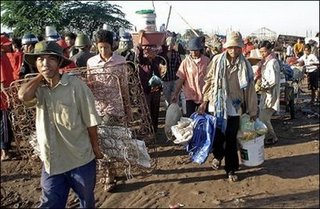 Sambok Chab forced eviction: one of Kep Chuktema's trademark for the development of the city of Phnom Penh. Yvon Roé d'Albert, the outgoing French ambassador, praised Kep Chuktema for turning Phnom Penh into a remarkable city. Ambassador Roé d'Albert seems to be totally oblivious of the miseries suffered by Phnom Penh citizens during these forced evictions.
Wednesday, May 23, 2007
Everyday.com.kh
Translated from Khmer by Socheata
Yvon Roé d’Albert, the French ambassador to Cambodia, said that Phnom Penh city is currently turning into a remarkable city which attracts more attention than before when people mainly talked about Siem Reap city. The French ambassador made this statement on Monday to Kep Chuktema, the Phnom Penh city governor, when he was bidding goodbye to the governor during the occasion marking the end of his diplomatic mission in Cambodia. The French ambassador said that people have praised the Phnom Penh governor because he brought in a lot of development to the city in the past few years. In turn, Kep Chuktema thanked the French party for helping set up the master plan for the city of Phnom Penh, and that this master plan constitutes an important document setting the development directives for the city of Phnom Penh from 2005 to 2015.
Saturday, May 19, 2007
Don't Fill In Phnom Penh Wetlands, Concerned Lawmakers Say
Mony, VOA Khmer
Original report from Phnom Penh
18/05/2007
Original report from Phnom Penh
18/05/2007
National lawmakers are asking Phnom Penh authorities not to fill in rivers, creeks and marshes surrounding the capital, which could invite increased flooding.
National Assembly lawmakers met Friday to discuss water maintenance in the country, where they aired their concerns.
Development in the capital has encouraged landfill in some of the outlying areas which can act as a floodplain during the rainy season. Small groups of residents complained recently the waterways they use for their livelihoods were being filled in by private companies.
"When there are floods, can authorities stationed there face them when the water overflows?" asked Funcinpec lawmaker Maonh Saphan says. "I am concerned."
Sam Rainsy Party legislator Son Chhay said the lakes around Phnom Penh had been filled in a lot already and that just a few rainfalls in the dry season would flood the city.
National Assembly lawmakers met Friday to discuss water maintenance in the country, where they aired their concerns.
Development in the capital has encouraged landfill in some of the outlying areas which can act as a floodplain during the rainy season. Small groups of residents complained recently the waterways they use for their livelihoods were being filled in by private companies.
"When there are floods, can authorities stationed there face them when the water overflows?" asked Funcinpec lawmaker Maonh Saphan says. "I am concerned."
Sam Rainsy Party legislator Son Chhay said the lakes around Phnom Penh had been filled in a lot already and that just a few rainfalls in the dry season would flood the city.
Monday, May 07, 2007
Booming Asia, at crossroads of poverty and prosperity, spurs debate over development
Monday, May 7, 2007
The Associated Press
The Associated Press
KYOTO, Japan: The dual realities speak for themselves. Asia's poverty rate has plummeted from about 50 percent to less than 19 percent, while average income has skyrocketed nearly sixfold in the past four decades.
But in the shadows of the advances, nearly 2 billion people still live on less than US$2 (€1.47) a day.
Today, like never before, Asia stands at the crossroads of poverty and prosperity — and its arrival is widening divisions over how to manage the region's miraculous economic boom and ensure that no one is excluded from its successes.
The debate climaxed Monday as the Asian Development Bank wrapped up its annual meeting with no clear consensus on its future direction. The bank, founded in 1966 to end poverty, now says prosperity, not penury, poses the newest threat to the rapidly growing continent.
On one side are those saying development must now meet the needs of an increasingly wealthy region; on the other are voices warning that the fight against poverty is far from won. Activists, meanwhile, accuse institutions like the ADB of pushing "slash-and-burn" policies that prioritize growth over the environment or traditional culture.
According to the ADB's own figures, extreme poverty is projected to be all but wiped out in Asia within 15 years. Whereas famine and disease used to be top worries in developing Asia, industrial pollution, overstrapped infrastructures, weak financial systems, and a growing urban-rural divide are now key concerns.
"The challenges are considerable but they are challenges partly born in the ADB's own accomplishments," said Kenneth Peel, head of the U.S. delegation at the ADB conference in Kyoto.
Which way development heads next is important because it will shape the future of a region that accounts for about a quarter of international trade, a third of the global economy and more than half the world's people.
To solve the new onslaught of problems — as well as stay relevant as a premier development agency — the ADB is hoping to give itself a facelift for the 21st century. Recommendations include focusing more on sustainable growth, emphasizing environmentally friendly development and drawing on Asian capital instead of foreign funds.
More controversial are suggestions the ADB move beyond simply helping the poor.
Many of the 3,000 delegates agreed on a need for the Manila, Philippines-based bank to change with the times. But the four-day annual meeting ended Monday with the region's poor countries and their richer neighbors disagreeing over how the bank should be reformed.
The United States even suggested the ADB might wind down its work as Asian nations get richer.
The U.S., one of the ADB's top shareholders, said the bank should stick to its original task of helping the poor and not seek new mandates that stray from that mission.
"We should celebrate when countries no longer need ADB to finance their development needs, not seek ways to artificially create incentives to lend to them," Peel said. "The ADB should step aside and declare victory."
Poor countries, meanwhile, are afraid of being left behind. Some questioned the ADB's forecast that 90 percent of the region's population will be "middle income" by 2020.
"There will still be a significant number of poor," said Keat Chhon, Cambodia's governor to the ADB. "The ADB should continue to focus on poverty alleviation in these low-income economies until this mission is accomplished."
Afghanistan's governor, Anwar-ul-Haq Ahady, said the ADB needs to boost its engagement with its poorest members, which he called "fragile states" so far bypassed by Asia's rapid growth.
Indonesian Finance Minister Sri Mulyani Indrawati warned the ADB against expanding too rapidly into areas in which it has no expertise and risks duplicating tasks of the World Bank and International Monetary Fund.
South Korea, Thailand and other so-called Asian Tiger economies that were battered hardest by the 1997 Asian financial crisis supported a stronger ADB. They envision a bank that might help manage part of the region's vast foreign currency reserves and protect against wildly fluctuating exchange rates.
Some even want the ADB to help set up a regional bond market to finance development spending.
ADB President Haruhiko Kuroda called the discussions "lively." Many nations reacted to the recommendations by pointing out issues that were "missing or merit more careful consideration," he said. The ADB hopes to hammer out a consensus before its next annual meeting in Madrid, Spain.
"We must respond to the changing needs of the region," Kuroda said. "But that does not mean the bank can dilute its devotion to poverty reduction."
One area of agreement was concern about the environmental impact of Asian development.
The ADB is now making energy efficiency and green energy a top priority of its development programs. And in Kyoto, the Japanese government donated US$100 million (€74 million) to help the ADB fight global climate change and fund environmentally friendly investment.
But even that drew fire from activists who condemn the ADB's continued funding of affordable coal energy, a top producer of the greenhouse gases that fan global warming.
"Supporting renewable energies without phasing out coal is only half of the solution," said Athena Ballesteros, a climate change specialist with the environmental group Greenpeace. "The climate cannot be half-saved."
But in the shadows of the advances, nearly 2 billion people still live on less than US$2 (€1.47) a day.
Today, like never before, Asia stands at the crossroads of poverty and prosperity — and its arrival is widening divisions over how to manage the region's miraculous economic boom and ensure that no one is excluded from its successes.
The debate climaxed Monday as the Asian Development Bank wrapped up its annual meeting with no clear consensus on its future direction. The bank, founded in 1966 to end poverty, now says prosperity, not penury, poses the newest threat to the rapidly growing continent.
On one side are those saying development must now meet the needs of an increasingly wealthy region; on the other are voices warning that the fight against poverty is far from won. Activists, meanwhile, accuse institutions like the ADB of pushing "slash-and-burn" policies that prioritize growth over the environment or traditional culture.
According to the ADB's own figures, extreme poverty is projected to be all but wiped out in Asia within 15 years. Whereas famine and disease used to be top worries in developing Asia, industrial pollution, overstrapped infrastructures, weak financial systems, and a growing urban-rural divide are now key concerns.
"The challenges are considerable but they are challenges partly born in the ADB's own accomplishments," said Kenneth Peel, head of the U.S. delegation at the ADB conference in Kyoto.
Which way development heads next is important because it will shape the future of a region that accounts for about a quarter of international trade, a third of the global economy and more than half the world's people.
To solve the new onslaught of problems — as well as stay relevant as a premier development agency — the ADB is hoping to give itself a facelift for the 21st century. Recommendations include focusing more on sustainable growth, emphasizing environmentally friendly development and drawing on Asian capital instead of foreign funds.
More controversial are suggestions the ADB move beyond simply helping the poor.
Many of the 3,000 delegates agreed on a need for the Manila, Philippines-based bank to change with the times. But the four-day annual meeting ended Monday with the region's poor countries and their richer neighbors disagreeing over how the bank should be reformed.
The United States even suggested the ADB might wind down its work as Asian nations get richer.
The U.S., one of the ADB's top shareholders, said the bank should stick to its original task of helping the poor and not seek new mandates that stray from that mission.
"We should celebrate when countries no longer need ADB to finance their development needs, not seek ways to artificially create incentives to lend to them," Peel said. "The ADB should step aside and declare victory."
Poor countries, meanwhile, are afraid of being left behind. Some questioned the ADB's forecast that 90 percent of the region's population will be "middle income" by 2020.
"There will still be a significant number of poor," said Keat Chhon, Cambodia's governor to the ADB. "The ADB should continue to focus on poverty alleviation in these low-income economies until this mission is accomplished."
Afghanistan's governor, Anwar-ul-Haq Ahady, said the ADB needs to boost its engagement with its poorest members, which he called "fragile states" so far bypassed by Asia's rapid growth.
Indonesian Finance Minister Sri Mulyani Indrawati warned the ADB against expanding too rapidly into areas in which it has no expertise and risks duplicating tasks of the World Bank and International Monetary Fund.
South Korea, Thailand and other so-called Asian Tiger economies that were battered hardest by the 1997 Asian financial crisis supported a stronger ADB. They envision a bank that might help manage part of the region's vast foreign currency reserves and protect against wildly fluctuating exchange rates.
Some even want the ADB to help set up a regional bond market to finance development spending.
ADB President Haruhiko Kuroda called the discussions "lively." Many nations reacted to the recommendations by pointing out issues that were "missing or merit more careful consideration," he said. The ADB hopes to hammer out a consensus before its next annual meeting in Madrid, Spain.
"We must respond to the changing needs of the region," Kuroda said. "But that does not mean the bank can dilute its devotion to poverty reduction."
One area of agreement was concern about the environmental impact of Asian development.
The ADB is now making energy efficiency and green energy a top priority of its development programs. And in Kyoto, the Japanese government donated US$100 million (€74 million) to help the ADB fight global climate change and fund environmentally friendly investment.
But even that drew fire from activists who condemn the ADB's continued funding of affordable coal energy, a top producer of the greenhouse gases that fan global warming.
"Supporting renewable energies without phasing out coal is only half of the solution," said Athena Ballesteros, a climate change specialist with the environmental group Greenpeace. "The climate cannot be half-saved."
Saturday, March 03, 2007
Study to be performed on visa exemption for Vietnamese businessmen
Friday, March 02, 2007
By Kong Sothanarith
Cambodge Soir
Translated from French by Luc Sâr
Visa exemption for Vietnamese businessmen? That was the question asked during the visit of Nguyen Minh Triet, Vietnam president, who was accompanied by some 50 Vietnamese businessmen. The Cambodian government will think about this issue which was raised during a Cambodian-Vietnamese business forum where businessmen from both countries met.
“The government sets in motion a policy that encourages investors to come to Cambodia. We will discuss in detail this issue with the Ministry of Foreign Affairs and of Commerce,” Thong Khon, the Minister of Tourism, said.
On Wednesday, President Nguyen Minh Triet said that Cambodia provides good investment opportunities in various sectors – agriculture, tourism, mining, commerce and industry – and he launched an appeal to Vietnamese businessmen to explore these opportunities.
A visa exemption for these businessmen could generate significant revenues, Thong khon said. “One visa earns us $20 or $25. However, if an exemption will allow us to develop the country’s economy, then we will earn even more,” Thon Khon noted.
Nevertheless, not everybody shares his enthusiasm. Moeung Sonn, President of the tourism industry association of Cambodia, is more reserved on this issue. “Businessmen have money. $20 is nothing to them. Why are don’t they want to pay?” he said. For Moeung Sonn, the government must look closely into this issue before giving its green light. “First of all, we must ascertain that we will come out winner at the economic level. Furthermore, we must be careful that this visa exemption does not turn out to be a means to enter Cambodia illegally,” Moeung Sonn said.
Currently, four border posts located in Svay Rieng (Moc Bai), Kompong Cham (Trapaing Phlong), Kandal (Ka’om Samnor) and Takeo (Phnom Den) allow access between the 2 countries.
By Kong Sothanarith
Cambodge Soir
Translated from French by Luc Sâr
“First of all, we must ascertain that we will come out winner at the economic level. Furthermore, we must be careful that this visa exemption does not turn out to be a means to enter Cambodia illegally” - Moeung Sonn, President of the tourism industry association of Cambodia
Visa exemption for Vietnamese businessmen? That was the question asked during the visit of Nguyen Minh Triet, Vietnam president, who was accompanied by some 50 Vietnamese businessmen. The Cambodian government will think about this issue which was raised during a Cambodian-Vietnamese business forum where businessmen from both countries met.
“The government sets in motion a policy that encourages investors to come to Cambodia. We will discuss in detail this issue with the Ministry of Foreign Affairs and of Commerce,” Thong Khon, the Minister of Tourism, said.
On Wednesday, President Nguyen Minh Triet said that Cambodia provides good investment opportunities in various sectors – agriculture, tourism, mining, commerce and industry – and he launched an appeal to Vietnamese businessmen to explore these opportunities.
A visa exemption for these businessmen could generate significant revenues, Thong khon said. “One visa earns us $20 or $25. However, if an exemption will allow us to develop the country’s economy, then we will earn even more,” Thon Khon noted.
Nevertheless, not everybody shares his enthusiasm. Moeung Sonn, President of the tourism industry association of Cambodia, is more reserved on this issue. “Businessmen have money. $20 is nothing to them. Why are don’t they want to pay?” he said. For Moeung Sonn, the government must look closely into this issue before giving its green light. “First of all, we must ascertain that we will come out winner at the economic level. Furthermore, we must be careful that this visa exemption does not turn out to be a means to enter Cambodia illegally,” Moeung Sonn said.
Currently, four border posts located in Svay Rieng (Moc Bai), Kompong Cham (Trapaing Phlong), Kandal (Ka’om Samnor) and Takeo (Phnom Den) allow access between the 2 countries.
Friday, March 02, 2007
Report: Development Policies Increasingly Displace the Poor
Win Thida
VOA Khmer
Washington
01/03/2007
 Tem Vuthy, 24, one among 1,000 people faced with eviction, holding her two year-old daughter, turns herself into a human shield in an attempt to prevent workers from destroying her house at the squatter village along the Basac river in the capital Phnom Penh (2006)
Government development policies dispossessed more than 4,600 families from the capital in 2006, a worsening trend that denies basic rights to a high number of poor, according to a recently issued report.
People were ejected from their homes without consent or compensation in 10 cases in Phnom Penh, and the same fate befell the provincial poor six times, the report, issued recently by the rights group Adhoc, says. The relocations violated economic, social and economic rights outlined in the International Declaration of Human Rights, the report says.
Urban development when it displaces people and deprives them of jobs, shelter, businesses and access to food, health care and education is misguided, Kem Sokha, director of the Cambodian Center for Human Rights, told VOA. When pursuing development projects, he said, the government continually fails to provide transparent records or bids for projects and ignores the needs of those already living in the area.
"I support the policy of development," he said, "but I would like to see the government make some studies again in order to solve the problems of the people in this country."
 A Cambodian woman and her children eat lunch under a makeshift tarpaulin roof in a squatter village in Phnom Penh, Cambodia, Wednesday, May 31, 2006.
The most recent displacement has been in the Beng Kok district, where many displaced have voiced their grievances. Longtime residents have been moved from the area as long ago as 1989, thanks to a contract between the city and a private company, according to NGO reports.
"I know that development is a good policy, but only if this development serves the people," one Beng Kok resident told VOA, asking not to be named.
Phnom Penh Vice Governor Pa Socheatvong declined to comment on the relocations, saying he was busy with meetings.
 Cambodian refugees crowd into Khueng Hoeichueng, Thailand, Thursday Aug. 21, 1997.
SRP legislator Keo Remy said he supports development—when it serves the people. Recent development, he said, has been spoiled by anger and violence, and people were "dumped" outside the city without access to electricity, water, roads and communication. Children were a special concern, he said, as they were pulled from their schools. In some cases, pregnant woman were attacked during forced relocation.
"I think they should compromise on things that we do not agree on, while avoiding violence toward pregnant women," he said. "This is clearly a violation of human rights."
Muth Chantha, a spokesman for the Norodom Randariddh Party, said in every case of government development, no studies on negative impacts on the population or environment are undertaken. This kind of development violates commune law and the constitution, he said.
 Villagers ride a dugout up the Mekong River near Sambor,Cambodia on Nov. 3, 1996, where a major dam has been proposed. If built, the dam would displace 60,000 riverside residents and flood an area rich in wildlife, fish and history.
"Development in the main city and provinces that can promote investment, that can be a place that serves as a sea port or freshwater port or any port, that can have a center for culture or an international center, the government should make a good example of this," he said.
Funcinpec spokesman Nov Sovatharo said developments were a display of prosperity for a country, but development here always attracts protests, so the solution is for the government and its people to come to an understanding.
"The government has a need to develop cities, but the government should know that the people need help from them too, in some ways," he said.
Government spokesman Khieu Kanharith defended urban development, saying the government always seeks impact studies and takes the people's interests into consideration—but not individuals or small groups. Development leads to factories, jobs and income, he said.
The government does compensate those it moves, he said, and if people disagree, they have the right to protest.
VOA Khmer
Washington
01/03/2007
"If people disagree, they have the right to protest" - Khieu Kanharith, Gov't spokesman speaking about land eviction
 Tem Vuthy, 24, one among 1,000 people faced with eviction, holding her two year-old daughter, turns herself into a human shield in an attempt to prevent workers from destroying her house at the squatter village along the Basac river in the capital Phnom Penh (2006)
 Government development policies dispossessed more than 4,600 families from the capital in 2006, a worsening trend that denies basic rights to a high number of poor, according to a recently issued report.
People were ejected from their homes without consent or compensation in 10 cases in Phnom Penh, and the same fate befell the provincial poor six times, the report, issued recently by the rights group Adhoc, says. The relocations violated economic, social and economic rights outlined in the International Declaration of Human Rights, the report says.
Urban development when it displaces people and deprives them of jobs, shelter, businesses and access to food, health care and education is misguided, Kem Sokha, director of the Cambodian Center for Human Rights, told VOA. When pursuing development projects, he said, the government continually fails to provide transparent records or bids for projects and ignores the needs of those already living in the area.
"I support the policy of development," he said, "but I would like to see the government make some studies again in order to solve the problems of the people in this country."
 A Cambodian woman and her children eat lunch under a makeshift tarpaulin roof in a squatter village in Phnom Penh, Cambodia, Wednesday, May 31, 2006.
The most recent displacement has been in the Beng Kok district, where many displaced have voiced their grievances. Longtime residents have been moved from the area as long ago as 1989, thanks to a contract between the city and a private company, according to NGO reports.
"I know that development is a good policy, but only if this development serves the people," one Beng Kok resident told VOA, asking not to be named.
Phnom Penh Vice Governor Pa Socheatvong declined to comment on the relocations, saying he was busy with meetings.
 Cambodian refugees crowd into Khueng Hoeichueng, Thailand, Thursday Aug. 21, 1997.
SRP legislator Keo Remy said he supports development—when it serves the people. Recent development, he said, has been spoiled by anger and violence, and people were "dumped" outside the city without access to electricity, water, roads and communication. Children were a special concern, he said, as they were pulled from their schools. In some cases, pregnant woman were attacked during forced relocation.
"I think they should compromise on things that we do not agree on, while avoiding violence toward pregnant women," he said. "This is clearly a violation of human rights."
Muth Chantha, a spokesman for the Norodom Randariddh Party, said in every case of government development, no studies on negative impacts on the population or environment are undertaken. This kind of development violates commune law and the constitution, he said.
 Villagers ride a dugout up the Mekong River near Sambor,Cambodia on Nov. 3, 1996, where a major dam has been proposed. If built, the dam would displace 60,000 riverside residents and flood an area rich in wildlife, fish and history.
 "Development in the main city and provinces that can promote investment, that can be a place that serves as a sea port or freshwater port or any port, that can have a center for culture or an international center, the government should make a good example of this," he said.
Funcinpec spokesman Nov Sovatharo said developments were a display of prosperity for a country, but development here always attracts protests, so the solution is for the government and its people to come to an understanding.
"The government has a need to develop cities, but the government should know that the people need help from them too, in some ways," he said.
Government spokesman Khieu Kanharith defended urban development, saying the government always seeks impact studies and takes the people's interests into consideration—but not individuals or small groups. Development leads to factories, jobs and income, he said.
The government does compensate those it moves, he said, and if people disagree, they have the right to protest.
Saturday, February 24, 2007
Cambodia's poverty reduction did not happen with massive foreign aid, why would it happen when oil money arrives?
February 24, 2007
Potential oil reserves put Cambodia into limelight
Potential oil reserves put Cambodia into limelight
Some 700 million to 2 billion barrels of estimated oil reserves off the Cambodia coast have attracted worldwide attention, putting the impoverished kingdom into limelight.
While attending the 2007 Cambodia Economic Outlook Conference here Thursday, Prime Minister Hun Sen confirmed in high tone the discovery of oil reserves in his country to over 100 domestic and international decision-making participants.
"The revenues from the recently confirmed discovery of oil reserves will provide additional money for financing development projects in Cambodia. These revenues will be directed to productive investment and poverty reduction," he said.
This presents opportunity to bolster Cambodia's medium- and long-term growth, promote greater economic diversification and poverty reduction, he said.
"We will make sure that oil is a blessing but not a curse," he added, obviously relating recent reports that the upcoming wealth acquired through extraction of the natural resource might only benefit the powerful groups and thus create more disparity between the rich and the poor.
On Friday at the same meeting, U.S. Ambassador Joseph Mussomeli expressed his concern in this regard, saying that the Cambodia government should avoid the situation that "a small corrupt elite siphons off revenue that should go to improving the welfare of all the people."
Leaders of the countries should have the political will to demand that the revenues from these extractive industries be used solely for the improvement of the country, he said.
"In his open and eloquent speech yesterday (Thursday), Prime Minister Hun Sen showed his intent to demonstrate just such political will" and many officials within the government also " recognize and have been working to responsibly manage Cambodia's extractive industries," he said.
In addition, the ambassador recommended the kingdom to properly manage the development of its extractive industries.
"First, we applaud the Cambodian government for considering the Extractive Industries Transparency Initiative (EITI) and we hope that Cambodia will soon become an EITI Implementing Country," he said.
The ambassador noted in his speech that the extractive industries, namely oil, gas and various types of mining, in the next three years could more than triple the annual revenue received by the Cambodian government.
He also quoted a UN Development Program (UNDP) study as saying that future oil revenues alone could provide over three times the kingdom's official development assistance received in 2005.
Also on Friday, Douglas Gardner, UNDP Resident Representative in Cambodia, told reporters that Cambodia is likely to see revenues from its potential oil wealth as early as in 2010, which could lift the kingdom out of poverty.
He estimated that oil production could annually bring 1.7 billion U.S. dollars for Cambodia at 60 U.S. dollars per barrel.
Oil buzz started in Cambodia in 2005, when U.S. energy giant Chevron Corp discovered petroleum off its coast, striking black in four of five test wells.
Since then, firms from France, South Korea and Japan have been reportedly seeking for exploration licenses from the Cambodian government.
The government declines to give exact figures about the oil reserves. The World Bank has put them at 2 billion barrels while the UNDP confirmed 700 million barrels.
Currently, some 35 percent of Cambodia's 14 million people live in poverty and 50 percent of its national budget comes from foreign aid.
Source: Xinhua
While attending the 2007 Cambodia Economic Outlook Conference here Thursday, Prime Minister Hun Sen confirmed in high tone the discovery of oil reserves in his country to over 100 domestic and international decision-making participants.
"The revenues from the recently confirmed discovery of oil reserves will provide additional money for financing development projects in Cambodia. These revenues will be directed to productive investment and poverty reduction," he said.
This presents opportunity to bolster Cambodia's medium- and long-term growth, promote greater economic diversification and poverty reduction, he said.
"We will make sure that oil is a blessing but not a curse," he added, obviously relating recent reports that the upcoming wealth acquired through extraction of the natural resource might only benefit the powerful groups and thus create more disparity between the rich and the poor.
On Friday at the same meeting, U.S. Ambassador Joseph Mussomeli expressed his concern in this regard, saying that the Cambodia government should avoid the situation that "a small corrupt elite siphons off revenue that should go to improving the welfare of all the people."
Leaders of the countries should have the political will to demand that the revenues from these extractive industries be used solely for the improvement of the country, he said.
"In his open and eloquent speech yesterday (Thursday), Prime Minister Hun Sen showed his intent to demonstrate just such political will" and many officials within the government also " recognize and have been working to responsibly manage Cambodia's extractive industries," he said.
In addition, the ambassador recommended the kingdom to properly manage the development of its extractive industries.
"First, we applaud the Cambodian government for considering the Extractive Industries Transparency Initiative (EITI) and we hope that Cambodia will soon become an EITI Implementing Country," he said.
The ambassador noted in his speech that the extractive industries, namely oil, gas and various types of mining, in the next three years could more than triple the annual revenue received by the Cambodian government.
He also quoted a UN Development Program (UNDP) study as saying that future oil revenues alone could provide over three times the kingdom's official development assistance received in 2005.
Also on Friday, Douglas Gardner, UNDP Resident Representative in Cambodia, told reporters that Cambodia is likely to see revenues from its potential oil wealth as early as in 2010, which could lift the kingdom out of poverty.
He estimated that oil production could annually bring 1.7 billion U.S. dollars for Cambodia at 60 U.S. dollars per barrel.
Oil buzz started in Cambodia in 2005, when U.S. energy giant Chevron Corp discovered petroleum off its coast, striking black in four of five test wells.
Since then, firms from France, South Korea and Japan have been reportedly seeking for exploration licenses from the Cambodian government.
The government declines to give exact figures about the oil reserves. The World Bank has put them at 2 billion barrels while the UNDP confirmed 700 million barrels.
Currently, some 35 percent of Cambodia's 14 million people live in poverty and 50 percent of its national budget comes from foreign aid.
Source: Xinhua
Thursday, February 22, 2007
Asia's majestic Mekong begins to feel pinch of development
 Thai fisherman are seen in their boat along the Mekong River at Chiang Khan, near Thai-Laos border on 12 February 2007. China has built two dams on the river, and has blasted rocks and sandbars in portions of the 4,000-km (2,400-mi) river to make it easier to navigate, opening a shipping channel to Southeast Asia. Fishermen here say the increased traffic on the river is one of the reasons why their work has become more difficult.(AFP/File/Pornchai Kittiwongsakul)
 by Thanaporn Promyamyai
CHIANG KHAN, Thailand (AFP) - Phol Nasa cannot recall a time when his family wasn't fishing on the Mekong River where it sweeps through the misty hills along Thailand's northern border with Laos.
"I've watched my grandfather, my father and my brothers fishing on the river since I was very, very young," the 24-year-old said as he perched on the bow of a longtail boat in the middle of the river.
The family boat sets out every morning laden down with their nets which they men use to trawl the river bed for catfish and gourami.
Phol says the daily catch used to be enough to provide food for his family, and if he was lucky there would be enough fish to sell at the local market to earn a bit of money as well.
But now, he says, most days his nets come back empty.
Phol began joining the other men in his family when he was 10, when the river was very different and the fish were plentiful, he remembers.
"Fishing was easier when I was young. We had plenty of fish to catch, enough for everybody," he said.
Phol's family lives in one of the dozens of villages that stretch out near the river banks.
This region of northeastern Thailand is one of the poorest in the country, largely left out of the rapid modernisation that has taken place elsewhere.
The fishermen here say they don't know why the Mekong has begun changing, but say the water level is lower than it used to be, making it harder to catch fish.
"It should be easy to catch fish while the water is low, if there were any fish to catch," says Thom Nonla, a 55-year-old fisherman.
Experts say the low water levels are the result of unusually light rains last year, highlighting the chronic cycle of flood and drought in this part of Southeast Asia.
The unpredictable cycle is one reason that governments of countries along the Mekong, and especially China where the river begins, want to build dams, which they say will help regulate the waters.
China has already built two dams on the river, and is considering several more. It has also blasted rocks and sandbars in portions of the 4,000-kilometre (2,400-mile) river to make it easier to navigate, opening a shipping channel to Southeast Asia.
Fishermen here say the increased traffic on the river is one of the reasons their work has become more difficult.
"The big boats keep the fish away. We cannot fish because they make too much noise," Phol says.
Compared with the other major rivers flowing from China, the Mekong's ecology is in remarkably good condition, experts say.
It remains one of the world's most bio-diverse, and overfishing, rather than pollution, is to blame for the difficulties facing fisherman, experts say.
Relatively little industry lines the Mekong's banks -- partly because navigating the river is so treacherous.
As it runs from China through Myanmar, Laos and Thailand, the water alternates between silky smooth and white-water rapids, eventually leading to a major waterfall in Cambodia before stretching out into the swampy delta in Vietnam.
Sumatr Phulaiyao, coordinator of the Southeast Asia River Networks (SEARIN), says 500 Thai villagers have already been affected by the dams and the blasting, and the resulting changes in water levels.
"The blasting causes the river to run faster, and the water will hit the bank harder," causing erosion that will cause the river to swell, Sumatr says.
In areas where the river water becomes shallower, fish will push their way farther down river, he adds.
Whether this section of the river changes more over the next decade depends largely on how China proceeds with its planned development.
Phol says he has already been forced to look for extra work, finding odd jobs to earn extra money.
"I do whatever I can get hired to do. Fishing alone was not enough," he says as he pulls in his nets at the end of another day without a catch.
"I've watched my grandfather, my father and my brothers fishing on the river since I was very, very young," the 24-year-old said as he perched on the bow of a longtail boat in the middle of the river.
The family boat sets out every morning laden down with their nets which they men use to trawl the river bed for catfish and gourami.
Phol says the daily catch used to be enough to provide food for his family, and if he was lucky there would be enough fish to sell at the local market to earn a bit of money as well.
But now, he says, most days his nets come back empty.
Phol began joining the other men in his family when he was 10, when the river was very different and the fish were plentiful, he remembers.
"Fishing was easier when I was young. We had plenty of fish to catch, enough for everybody," he said.
Phol's family lives in one of the dozens of villages that stretch out near the river banks.
This region of northeastern Thailand is one of the poorest in the country, largely left out of the rapid modernisation that has taken place elsewhere.
The fishermen here say they don't know why the Mekong has begun changing, but say the water level is lower than it used to be, making it harder to catch fish.
"It should be easy to catch fish while the water is low, if there were any fish to catch," says Thom Nonla, a 55-year-old fisherman.
Experts say the low water levels are the result of unusually light rains last year, highlighting the chronic cycle of flood and drought in this part of Southeast Asia.
The unpredictable cycle is one reason that governments of countries along the Mekong, and especially China where the river begins, want to build dams, which they say will help regulate the waters.
China has already built two dams on the river, and is considering several more. It has also blasted rocks and sandbars in portions of the 4,000-kilometre (2,400-mile) river to make it easier to navigate, opening a shipping channel to Southeast Asia.
Fishermen here say the increased traffic on the river is one of the reasons their work has become more difficult.
"The big boats keep the fish away. We cannot fish because they make too much noise," Phol says.
Compared with the other major rivers flowing from China, the Mekong's ecology is in remarkably good condition, experts say.
It remains one of the world's most bio-diverse, and overfishing, rather than pollution, is to blame for the difficulties facing fisherman, experts say.
Relatively little industry lines the Mekong's banks -- partly because navigating the river is so treacherous.
As it runs from China through Myanmar, Laos and Thailand, the water alternates between silky smooth and white-water rapids, eventually leading to a major waterfall in Cambodia before stretching out into the swampy delta in Vietnam.
Sumatr Phulaiyao, coordinator of the Southeast Asia River Networks (SEARIN), says 500 Thai villagers have already been affected by the dams and the blasting, and the resulting changes in water levels.
"The blasting causes the river to run faster, and the water will hit the bank harder," causing erosion that will cause the river to swell, Sumatr says.
In areas where the river water becomes shallower, fish will push their way farther down river, he adds.
Whether this section of the river changes more over the next decade depends largely on how China proceeds with its planned development.
Phol says he has already been forced to look for extra work, finding odd jobs to earn extra money.
"I do whatever I can get hired to do. Fishing alone was not enough," he says as he pulls in his nets at the end of another day without a catch.
Wednesday, February 14, 2007
CDC: Entrepreneurs need to deposit for island investment
Tuesday, February 13, 2007
Cambodian Press Review
By Media Consulting and Development
Cambodian Press Review
By Media Consulting and Development
The Council for the Development of Cambodia (CDC) has announced that companies wishing to invest in islands on the country’s sea territory must provide a deposit of US$500,000 to US$2 million, which will be included into state budget if they fail to implement their projects, newspapers report.
“If six months has passed, [and] nothing has appeared in form, we will include that money into state budget, and we will arrange a bidding to seek a new investor,” CDC Undersecretary General Suon Sothi told investors during a meeting last week, reports Cambodge Soir.
The CDC has set the financial requirement based on a deposit of US$1,000 for one hectare of land on a island selected for project development, because some local and foreign firms have failed to develop islands as stated in investment proposals sent to the government, according to Suon Sothi, writes Rasmei Kampuchea.
“The new measure is to ‘run and follow the footstep of some investors’ [or] prevent them from requesting investment principles but leaving it unimplemented or selling and transferring it,” he said, according to the newspaper. “This is a new initiative to attract real, new investors.”
Cambodia has more than 60 islands, which can provide valuable advantages for the country’s growing tourism, Touch Seantana, secretary of state for the Council of Ministers, said, noting that neighboring Thailand and Vietnam have already benefited from these resources, continues Cambodge Soir.
Touch Seantana suggested that there should be human resource training to advance this kind of tourism, emphasizing: “Travel by boat from beaches to islands will generate a lot of profits for local citizens,” reports the French-language daily.
Om Pharin, president of the Cambodian Association of Travel Agents (Cata) , expressed satisfaction with the idea to place significant importance onto islands.
“This is in response to what we have wanted for long. Tourists not only feel interested in Siem Reap province [which houses Cambodia ’s world famous ancient temples] and Phnom Penh , but also like coastline resorts and a paradise atmosphere on islands,” he said, adding that travel agencies are ready to add those tourist destinations to their guidebooks.
Moeung Son, president of the National Association of Tourism Enterprises and Eurasia Travel, echoes Om Pharin.
“We should not pay sole attention to Siem Reap province. If one day Siem Reap suffers accidentally from serious incidents such as a terrorist attack, then the whole national tourism industry will decline,” Moeung Son told Cambodge Soir.
“If six months has passed, [and] nothing has appeared in form, we will include that money into state budget, and we will arrange a bidding to seek a new investor,” CDC Undersecretary General Suon Sothi told investors during a meeting last week, reports Cambodge Soir.
The CDC has set the financial requirement based on a deposit of US$1,000 for one hectare of land on a island selected for project development, because some local and foreign firms have failed to develop islands as stated in investment proposals sent to the government, according to Suon Sothi, writes Rasmei Kampuchea.
“The new measure is to ‘run and follow the footstep of some investors’ [or] prevent them from requesting investment principles but leaving it unimplemented or selling and transferring it,” he said, according to the newspaper. “This is a new initiative to attract real, new investors.”
Cambodia has more than 60 islands, which can provide valuable advantages for the country’s growing tourism, Touch Seantana, secretary of state for the Council of Ministers, said, noting that neighboring Thailand and Vietnam have already benefited from these resources, continues Cambodge Soir.
Touch Seantana suggested that there should be human resource training to advance this kind of tourism, emphasizing: “Travel by boat from beaches to islands will generate a lot of profits for local citizens,” reports the French-language daily.
Om Pharin, president of the Cambodian Association of Travel Agents (Cata) , expressed satisfaction with the idea to place significant importance onto islands.
“This is in response to what we have wanted for long. Tourists not only feel interested in Siem Reap province [which houses Cambodia ’s world famous ancient temples] and Phnom Penh , but also like coastline resorts and a paradise atmosphere on islands,” he said, adding that travel agencies are ready to add those tourist destinations to their guidebooks.
Moeung Son, president of the National Association of Tourism Enterprises and Eurasia Travel, echoes Om Pharin.
“We should not pay sole attention to Siem Reap province. If one day Siem Reap suffers accidentally from serious incidents such as a terrorist attack, then the whole national tourism industry will decline,” Moeung Son told Cambodge Soir.
Thursday, February 08, 2007
Another shady 99-year land lease for Boeung Kak Lake, residents are shocked by the news
 Kep Chuktema, Phnom Penh governor, is seen signing the deal for the shady 99-year lease of Boeung Kak Lake, home to 4,000 families. Current residents of Boeung Kak Lake only recently learn about the deal made by the municipality on their properties. Some residents claim to have live in the neighborhood for as long as 30-year. (Photo: Narith, Koh Santepheap newspaper)
Thursday, February 8, 2007
Firm Lands 99-Year Lease on Boeng Kak Lake
By Prak Chan Thul and James Welsh
THE CAMBODIA DAILY
Phnom Penh Municipality awarded a 99-year lease to a little-known private firm Tuesday to develop 133 hectares around and including the Boeng Kak backpacker area, officials said Wednesday.
Pa Socheatvong, Phnom Penh deputy governor, said the agreement with Shukaku Inc will benefit the city, though he declined to reveal how much the firm is paying or what it plans to do with the land and the Boeng Kak lake.
Money from the deal will be used to provide alternative housing for people currently living in the area in Daun Penh district's Srah Chak commune, he said.
"Our state will benefit from the rent, which will be used to build infrastructure and especially to provide housing for the residents who live there," he said.
Pa Socheatvong would not say what kind of alternative housing would be provided for those affected by the land deal, but added: "We will organize the housing in an orderly and right way."
Phnom Penh Governor Kep Chuktema, who Pa Socheatvong said signed the agreement, said he was too busy to speak to a reporter.
Lao Meng Khin, director of Shukaku Inc, did not answer repeated phone calls, and an address for the firm's office could not be located.
Khmer-language newspaper Rasmei Kampuchea reported Wednesday that Shukaku Inc paid $79 million for the lease, and plans to build a luxury resort as well as commerce and cultural centers on Boeng Kak.
Ek Khun Doeun, Daun Penh district deputy governor, said there are approximately 4,000 families living and working in the affected area who do not own their land.
"Boeng Kak land belongs to the state," he said. They came to grab land there between 1993 and 1994," he claimed.
Srah Chak commune chief Chhay Thirith said he did not know what would become of the people currently living and working at the lake.
Residents and business owners around the lake said they were shocked by the news of the lease, and had only heard about it in local papers.
Den Phou, a 24-year-old staffer at a money exchange shop at the lakeside, said he was concerned residents will be violently evicted if they refuse to relocate.
"We don’t have any plans yet. We just wait," he said.
One 46-year-old man living along the lakeside said on condition of anonymity that the municipality should inform those living at the lake of its plans.
"We are afraid of being evicted and we want sufficient money to be able to buy other land in the capital," he said.
"I have been living here for almost 30 years already. According to the Land Law, I’ve owned the land for five years now," he added.
Pa Socheatvong, Phnom Penh deputy governor, said the agreement with Shukaku Inc will benefit the city, though he declined to reveal how much the firm is paying or what it plans to do with the land and the Boeng Kak lake.
Money from the deal will be used to provide alternative housing for people currently living in the area in Daun Penh district's Srah Chak commune, he said.
"Our state will benefit from the rent, which will be used to build infrastructure and especially to provide housing for the residents who live there," he said.
Pa Socheatvong would not say what kind of alternative housing would be provided for those affected by the land deal, but added: "We will organize the housing in an orderly and right way."
Phnom Penh Governor Kep Chuktema, who Pa Socheatvong said signed the agreement, said he was too busy to speak to a reporter.
Lao Meng Khin, director of Shukaku Inc, did not answer repeated phone calls, and an address for the firm's office could not be located.
Khmer-language newspaper Rasmei Kampuchea reported Wednesday that Shukaku Inc paid $79 million for the lease, and plans to build a luxury resort as well as commerce and cultural centers on Boeng Kak.
Ek Khun Doeun, Daun Penh district deputy governor, said there are approximately 4,000 families living and working in the affected area who do not own their land.
"Boeng Kak land belongs to the state," he said. They came to grab land there between 1993 and 1994," he claimed.
Srah Chak commune chief Chhay Thirith said he did not know what would become of the people currently living and working at the lake.
Residents and business owners around the lake said they were shocked by the news of the lease, and had only heard about it in local papers.
Den Phou, a 24-year-old staffer at a money exchange shop at the lakeside, said he was concerned residents will be violently evicted if they refuse to relocate.
"We don’t have any plans yet. We just wait," he said.
One 46-year-old man living along the lakeside said on condition of anonymity that the municipality should inform those living at the lake of its plans.
"We are afraid of being evicted and we want sufficient money to be able to buy other land in the capital," he said.
"I have been living here for almost 30 years already. According to the Land Law, I’ve owned the land for five years now," he added.
Subscribe to:
Posts (Atom)








