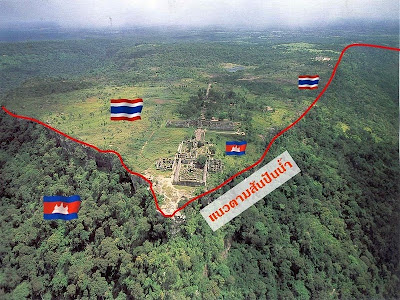
Showing posts with label PAD politicizing Preah Vihear issue. Show all posts

Monday, September 06, 2010

[Bangkok Post] Welcome overtures [between Cambodia and Thailand]

5/09/2010
Bangkok Post
Editorial

Mr Abhisit may well also need to show his leadership skills in dealing with the People's Alliance for Democracy (PAD). The PAD has capitalised on the Preah Vihear issue by stoking nationalist sentiments and adding unnecessary tension to the situation. If the PAD persists in this course and creates obstacles to a fair settlement, then Mr Abhisit must show he can act independently and in the best interests of the country.
The news released by Prime Minister's Office Minister Ong-art Klampaibul on Friday that Prime Minister Abhisit Vejjajiva would meet his Cambodian counterpart Hun Sen at the United Nations General Assembly in New York on Sept 24 is most welcome, and shows a strengthening of the recent trend that has seen diplomatic relations thawing between the two countries. Mr Ong-art made the announcement upon his return from Cambodia, where he reportedly met and had talks with Hun Sen for about an hour.

The news of the PM's upcoming face-to-face follows on the heels of the reinstatement of the ambassadors for both countries and the normalisation of diplomatic ties.

The ambassadors had been recalled in a tit-for-tat fashion following the appointment of fugitive ex-PM Thaksin Shinawatra as Hun Sen's economic adviser last November. The reinstatement was a consequence of Thaksin's decision to quit the post.

Although the current state of relations is not quite jovial, it is a big improvement from the low point reached in late July after the contention over Cambodia's management plan for the Preah Vihear temple proposed to the World Heritage Committee at the WHC's annual meeting, held in Brasilia this year. Even before this the back and forth between the two countries was quite honestly making both sides look petulant and even childish.

While both sides deserve blame for the lack of diplomatic maturity, it was clearly the Cambodian PM's ill-advised appointment of Thaksin that set the stage for the worst of it. He could not have been unaware that taking on a fugitive from the Thai justice system, and one who is still greatly admired by the opposition to the present government, would provoke hostility from the Abhisit government. The fact that he announced his plan to appoint Thaksin as his economic adviser with great fanfare to a media horde as soon as he arrived at the Hua Hin airport to attend the 15th Asean summit, the first hosted by Thailand, is proof that provocation was his intent.

It can only be assumed that the reason for these actions was that Hun Sen was expecting Thaksin to regain power. The recent formal disassociation with Thaksin shows that he has reassessed the political situation in Thailand.

Mr Ong-art reported on Friday that the Cambodian prime minister said that Mr Abhisit should not be discouraged by criticism about his early rise to become prime minister.

''He has voiced confidence that Mr Abhisit will stay in the post for a long time and that the prime minister has grown stronger and proved his leadership skills,'' Mr Ong-art said.

Now is the time for Mr Abhisit to display these leadership skills. It might be tempting for him to hold a grudge against the Cambodian PM for the obvious attempts to humiliate his government, but Mr Abhisit would do much better to accept Hun Sen's peace offering and make moves to strengthen the natural ties between the two countries.

This, of course, will have to start with a negotiated agreement over the Preah Vihear temple. Indications are that this will be a prime topic between the two men in New York.

Mr Ong-art said he explained the legal requirements of the Thai side in the bilateral Joint Boundary Commission (JBC) to Hun Sen. A boundary agreement is key to resolving the dispute over the Preah Vihear buffer zone. A JBC meeting is scheduled for the coming week in Bangkok, but there is speculation it will be postponed until after the two leaders meet in New York.

Mr Abhisit may well also need to show his leadership skills in dealing with the People's Alliance for Democracy (PAD). The PAD has capitalised on the Preah Vihear issue by stoking nationalist sentiments and adding unnecessary tension to the situation. If the PAD persists in this course and creates obstacles to a fair settlement, then Mr Abhisit must show he can act independently and in the best interests of the country.

These interests very much include good relations with Cambodia. It is important that cooperative frameworks are put in place in many areas, especially economic and environmental, as Cambodia opens itself up to tourism and foreign investment. The two countries share a long border that will be getting busier and busier in the coming years. They also share the Gulf of Thailand, which besides having some of the world's best beaches, is also reported to have large undersea oil reserves.

Saturday, August 28, 2010

A MUST READ: PAD and Prasat Preah Vihear Khmer

Saturday, August 28, 2010
Opinion by Pang Sokhoeun
Originally posted at The Son of the Khmer Empire blog


It´s very interesting to know how the extremist PAD think about us Khmer people, Khmer legacies in Thailand and Prasat Preah Vihear Khmer. So we Khmer people don´t think it lightly with these thief-born people.

Through my brief reading of their ideas posted in the extremist PAD website, I can sum up as the following:
  1. They accepted that they lost the case of Prasat Preah Vihear but accused the International Court of Justice (ICJ) as ignorance and bias for favoring Cambodia.
  2. They said if the ICJ accepted the Parent Treaty which recognizes the watershed as the borderlines of the two countries while it accepted the annex 1 map which is not following the watershed principle, so why should Thais respect the ICJ´s decision?
  3. Thai must take for granted the initiative ideas of Princes Diana of landmine issues to the world’s attention as new findings for an objection in order to stop Cambodian move for further development of Prasat Preah Vihear.
  4. Thai must reclaim Prasat Preah Vihear no matter what happens this temple must be returned to Thailand as the future owner.
  5. Thai must stop saying that Khmer are the builders of these temples -Khmer temples in Thailand today and Prasat Preah Vihear, but must say other thing around and stop calling them as Khmer temples. Thai must call them Hindu temples and rewrite new findings (history) about South East Asian for the benefits of Thailand. Thai must say that this temple belongs to them even it is not, and say it with will but not with emotion to the world.
  6. Thai must form Prasat Preah Vihear committee combining of intellectuals from within and with-out the country in order to study and counter Cambodian plan and especially establish strategy to reclaim Prasat Preah Vihear.
I recommend our people to read these stuff as a MUST in order to understand the extremist PAD´s views on how they think and plan to rob our property. Please read it Here. Below are some pics from the shameless extremist PAD the Thief.


Thursday, September 24, 2009

Two faces of Thailand

Red Shirt protesters outside the Government House in Bangkok earlier this year

September 24, 2009
SocialistWorker.org
Giles Ji Ungpakorn is a Thai academic and dissident who was targeted by the government for the supposed crime of "lese majesty"--essentially, "disloyalty" to Thailand's head of state, King Bhumibol. To avoid censorship and a possible prison sentence of 15 years, he fled to Britain earlier this year. Here, he analyzes the latest developments in Thailand, three years after a military coup.
ON SEPTEMBER 19 of this year--the third anniversary of the military coup that wrecked Thai democracy--two demonstrations took place. They sum up the two faces of Thailand.

One demonstration, by tens of thousands of Red Shirts in Bangkok, was organized in order to continue the demand for full democracy. It was a peaceful and friendly demonstration. Yet the military-backed Democrat Party government, headed by Abhisit Vejjajiva, declared a state of emergency and lined up thousands of police and soldiers to deal with the demonstrators.

Previously, back in April, Abhisit had urged soldiers to fire on the Red Shirts. Two people were subsequently killed and 70 injured by government soldiers.

The other demonstration was organized by People's Alliance for Democracy (PAD) fascist thugs. The PAD are the Yellow Shirt royalists. The aim of this demonstration was to attack Cambodian villagers living and working at the ancient Kao Prawiharn temple inside Cambodia.

Since last year, the PAD has been trying to cause a war with Cambodia by whipping up extreme nationalism. The temple was built by the ancient Khmers and clearly belongs to Cambodia, both from a legal and historical point of view. On September 19, the PAD went to the border armed, as usual, with guns, bombs and clubs. They attacked the police and then a group of local villagers who were opposed to them. Local villagers on both sides of the border have traditionally held joint religious ceremonies together at the temple on this day. This has not happened since the PAD forced the closure of the temple last year.

Teptai Senpong, personal spokesman for Prime Minister Abhisit, earlier stated that there was no reason to declare a state of emergency in the border area, "as the PAD were defending Thai national interests." The present foreign minister is a PAD supporter who took part in the illegal occupation of the international airports last December. He is famed for being rude about the Cambodian government.

Suriyasai Takasila, PAD spokesperson, said that the PAD leadership would not turn its back on Wira Somkwamkit, the PAD leader who headed the violent raid on the border. Naturally, the PAD riot and its extreme nationalism was supported by ASTV. The government will not prosecute the PAD and their leaders for their illegal violence. They never have. At the same time, numerous Red Shirts are in jail or face prosecution.

Just like when the PAD took over the airports, they cared little for the impact on local people's employment and livelihood. They cared little if the sons of poor farmers, conscripted into the Thai army, were to die in any pointless shoot out with their brothers in the Cambodian army.

The progressive, peaceful and democratic face of Thai society is the Red Shirts. The violent, fascist and authoritarian face is the face of the Yellow Shirt conservative royalists who control the state, the army, the monarchy, the government and the media. The one thing they do not control is the hearts and minds of most Thai citizens.

Most Thais are waiting for the king to die. But that in itself will solve nothing, despite the fact that his son his universally hated and held in contempt. No real democracy can be built without dismissing the generals, the judges, the privy council, the royal family and the corrupt politicians.

Will the Red Shirts be up to this People's Revolution? Can it be an overwhelming movement of citizens in order to minimize bloodshed? These are the issues on many people's minds today.

Deputy PM calls for halt to jingoism

Suthep: Favours talks, not picketing

24/09/2009
Bangkok Post

Whipping up nationalist fervour over the Cambodian border issue is a risky game which could harm trade relations with our neighbour, says Deputy Prime Minister Suthep Thaugsuban.

Negotiations were the way to handle the dispute, not picketing, he said yesterday.

Mr Suthep was commenting on Saturday's clash between the People's Alliance for Democracy (PAD) and Si Sa Ket residents near a disputed 4.6 square kilometre border area with Cambodia.

PAD held the protest in Kantharalak district of Si Sa Ket to pressure authorities to force Cambodians from the disputed area, which is near Preah Vihear temple.

The protesters confronted a group of residents who tried to stop them. A clash between PAD protesters and the villagers left scores of people on both sides injured.

Mr Suthep said the government had tried to solve the border problem through negotiation to prevent the dispute from escalating into a conflict between the countries.

People should not let their emotion drive them to stage protests over sovereignty, he said.

Demarcating the boundary with Cambodia could take as long as 10 years, as the two sides could not agree on who owns what.

PM's Office Minister Sathit Wongnongtoey said the government would bring together Foreign Minister Kasit Piromya and PAD co-leader Veera Somkhwamkid, who led the PAD protest on Saturday, to explain problems concerning Preah Vihear temple. They would appear together in a television broadcast after the prime minister returned from his overseas trip this weekend.

Natthawut Saikua, of the anti-government United Front for Democracy against Dictatorship (UDD), yesterday demanded Mr Abhisit clarify reports that Cambodia was building a road to Preah Vihear through the disputed area.

Wednesday, September 23, 2009

PAD's temple clash gained little but some internal kudos

September 23, 2009
By Supalak Ganjanakhundee
The Nation


The nationalist People's Alliance for Democracy (PAD) failed to achieve any goals over the past weekend as its actions led to bloodshed among protesters and villagers in northeastern Si Sa Ket province.

At least five people on both sides were injured in the clash in Ban Phumsarol on Saturday. The bloody incident ended with a number of lawsuits filed by protesters, villagers and government officials against each other for criminal assault.

The PAD, led by activist Veera Somkwamkid, rallied near the Hindu temple of Preah Vihear to demand the Cambodian community move out from the disputed area claimed by Thailand and Cambodia.

Initially, the protesters threatened to remove the Cambodian community by themselves if the Thai government took no action.

The disputed area of 4.6 square kilometres adjacent to the Preah Vihear has been at the core of the dispute between Thailand and Cambodia for a long time and has yet to be demarcated.

The two countries signed a memorandum of understanding after 2000 to prohibit both sides from changing the status quo in the area. Cambodia has built a community, a Buddhist temple and security outposts in the disputed area, prompting diplomatic protests from Thai Foreign Ministry since 2004.

The PAD realised Thailand could lose sovereignty over the territory - shortly after making some bruising nationalist accusations against Samak Sundaravej's government.

The PAD accused Samak and his foreign minister Noppadon Pattama of losing the territory to Cambodia when his government signed a joint communique supporting Phnom Penh's listing of the Hindu temple as a world heritage site.

Finally, the World Heritage Committee granted the inscription to the Preah Vihear as proposed. The PAD launched a protest at the site and clashed with local residents in July last year, but failed to achieve anything - only sour relations between Thailand and Cambodia .

This year, its ally Democrat Party is in the power, but still the Preah Vihear maintains its world heritage status, and the Cambodian community and the Buddhist temple remain.

The PAD demanded the government under Abhisit Vejjajiva, who once shared the same dream, to kick Cambodia out of the area. However, the government realised the best solution was negotiation through diplomatic channels.

Many leaders of the PAD admitted demands to remove the Cambodian community by force are unrealistic and could- rather than solve the problem - create more troubles. Foreign Minister Kasit Piromya, a close associate of the PAD, explained many times he was working to solve the problem with Cambodia through the joint boundary committee. Diplomacy might take time, but it could guarantee Thailand not losing anything.

However the PAD has no unity. There are numerous rival factions, many competing for good positions in the New Politics Party. To be more precise, those playing around the Preah Vihear temple merely want to remind senior people in the PAD they have the potential to create trouble for those in power, so reward them with good positions in the new party, including some crucial roles.

Up to now, the Preah Vihear crusade benefits nobody as five leaders of the PAD did not approve the performance. The protest on Saturday and Sunday caused unnecessary damage and failed to remove the Cambodian community from the disputed area. It is too expensive to use blood to pave the way for reading a few statements at Pha Mor Ee Daeng, a cliff next to Phrea Vihear.

It also damaged legitimacy of the PAD, since the villagers who opposed the protest are normal people who cannot tolerate disturbance to their lives. Villagers in Ban Phumsarol are not manipulated by any political forces. They simply want the Preah Vihear to be open, enabling them to earn income from tourism and have routes to their farms.

Veera and all Preah Vihear crusaders need to answer questions from Veerayuth Duangkaeow, Sao Thong Chai sub-district chief. He asked: "What have you done for Ban Phumsarol? And what did you get from driving from elsewhere to read your statements on the cliff? And have you got the Preah Vihear back?"

Right-wing PAD must not resort to irredentism

23/09/2009
Thitinan Pongsudhirak
Bangkok Post

Irredentism (from Italian irredento, "unredeemed") is any position advocating annexation of territories administered by another state on the grounds of common ethnicity or prior historical possession, actual or alleged. (Source: Wikipedia)
By demonstrating over a land area adjoining the ancient Preah Vihear temple complex last week ahead of the third anniversary of Thailand's latest military coup on Sept 19, a faction of the royalist-nationalist People's Alliance for Democracy (PAD) shrewdly stole the thunder that was supposed to belong to the pro-Thaksin Shinawatra red-shirted movement. Weeks of build-up to the red shirts' anti-coup anniversary protest were eclipsed by the yellow shirts' days of escalation from patriotism and nationalism to chauvinism and veiled irredentism.

Under the aegis of the United Front for Democracy against Dictatorship (UDD), the red shirts and their sit-ins at public gathering areas are a recurrent phenomenon. Their largest and most sustained street demonstration from late March to the Songkran riots has been instructive for them. They can protest all they want but they do not have the tipping point that comes with the right backing.

The red shirts have since acted with more restraint. As an evolving social movement, their numbers are wide but increasingly divided along the fault lines of Thaksin Shinawatra and the coup.

All reds are anti-coup. Yet there are many more non-reds who are also anti-coup and anti-post coup. Thaksin is thus a walking divisiveness in exile, even to the reds, and especially among anti-coup groups. The reds will now work on another build-up for their protest next month. Their disbandment around midnight last Saturday, early by their own standards, stood in deliberate contrast to what the yellows were doing near Preah Vihear temple.

Also a developing social movement, the PAD has become a leading agenda setter with quasi-veto power over political outcomes. They can prevent outcomes as well as determine them under certain circumstances. The drawn-out police chief appointment is a case in point.

Preah Vihear is an ongoing controversy. At issue is how far to reach back in history. Going back a century means righting the wrongs of French imperialist cartography that betrayed agreed watershed demarcation. Going back to 1962 means abiding by international law that awarded the temple to Cambodia. In the decades since, both Thais and Cambodians have roundly benefited from border trade and tourism. While Phnom Penh has registered the temple as a World Heritage Site, both the Thais and the Cambodians need to jointly develop the adjoining 4.6sqkm. The area is not much good to Thailand without the temple. Possession of the temple is equally not as useful without its land approach. And Bangkok would oppose unilateral registration of the contested land if it emerges.

While it has been detrimental to local livelihoods, the continuing stalemate over Preah Vihear and its landscape has fuelled the Thai political crisis. It was a hot potato for the two elected governments last year, and it will be a thorn in the side of Prime Minister Abhisit Vejjajiva's government in the coming weeks.

What the PAD protesters have done near Preah Vihear bears a number of ramifications. In the short term, it diverted the spotlight from the reds. In the longer term, however, it may well turn off some of the rank-and-file yellows and the pro-Establishment non-yellows who are pro-coup and anti-Thaksin. This dilemma was reflected in the absence of the PAD's main leadership who did not join the protest in Si Sa Ket province. Instead, a second-tier leader spearheaded the march.

Thai-Cambodian relations will not benefit from the PAD's posturing. The bilateral relationship has deteriorated steadily since the torching of the Thai embassy in Phnom Penh in early 2003. Historical tensions run deep on both sides. The bilateral spat and occasional armed skirmishes will cast a cloud over the upcoming Asean summit next month. It will also expose yet another dimension of Asean's structural impotence and operational inefficacy, notwithstanding the problematic Asean Charter. The Thai-Cambodian stand-off will thus have to be resolved bilaterally. Nationalist sentiments that verge on xenophobia, chauvinism and irredentism must be kept at bay.

At home, the Preah Vihear imbroglio is likely to be played for domestic gains. The PAD protests in Si Sa Ket were under the nose of the 2nd Infantry Division, whose units entered service in the dispersal and suppression of the red-shirted riots in Bangkok on April 13. That these units were uninvolved in preventing the yellows to go so far, suggests the PAD can simply get away with more than their arch-nemesis. They seem to have an enigmatic entitlement about them, an aura and attitude that they can always get their way.

The political capital from the PAD's Preah Vihear wrath may also be parlayed to determine domestic outcomes. With its locomotives all revved up and ready to rumble, the PAD can now turn to its domestic preferences. It can now bring even more pressure to bear on the Abhisit government to go its way, particularly on the appointment of the new police chief, concurrently stirring a royalist-nationalist tide for its New Politics Party ahead of the next polls.

The writer is Director of the Institute of Security and International Studies, Faculty of Political Science, Chulalongkorn University.

Tuesday, September 22, 2009

Don’t Turn Patriotism into Madness [in Thailand]

September 21st
From Post Today newspaper (Thailand)
Analysis
Translated and edited by Wacharapol Isaranont

The international dispute over the ownership of a 4.6-kilometer overlapping land adjacent to the ancient Preah Vihear Temple between Thailand and Cambodia has been a sensitive and longstanding issue that needs more than a truce to settle.

And while the tension is about to calm down after several deadly confrontations between Thai and Cambodian troops have seen both countries lose more than gain and efforts to peacefully resolve the issue through international political instrument are widely exercised, domestic movements to protest Cambodians encroaching on the unsettled area have reignited the flame of dispute.

During the past weekend, a group of the People's Alliance for Democracy supporters, led by Veera Somkwamkid, staged a protest at the Khao Phra Viharn national park in Si Sa Ket Province and called on the Thai government to forcefully drive Cambodian villagers and troops away from the disputed land.

The move may be motivated by patriotism with good intentions to protect the country’s sovereignty, but in the big picture it turned out to foil the plan to peacefully settle the issue by both the Thai and Cambodian governments. Besides, it created a reverse effect by leading to a rift among Thai people themselves, evidenced by a confrontation betwwen the yellow-shirt group and local villagers in Si Sa Ket Province.

Sadly, the PAD’s protest seems to infused with anger and foolhardy resistance to unknown facts behind the dispute, particularly the fact that the conflict took place as Thailand and Cambodia referred to different versions of maps when negotiating the border demarcation.

The yellow-shirt group should not let anger cloud their judgment about the cause of problem and the proper solution, for it could turn inspiring patriotism into uncontrollable madness, which are two sides of the same coin.

All parties must be sensible and look at the issue without distortion in their points of view. They must learn to equip themselves with correct information and to follow the progress of efforts by the government to dismantle the conflict.

Meanwhile, the government should promote transparency and provide the public with accurate accounts and developments of the situation, in order to prevent any dispute that could arise from lack of knowledge and misunderstanding.

So far, various agencies have worked on their own and kept information behind the door. In fact, such a longstanding issue as the Preah Vihear dispute needs collaboration from agencies with varying expertise including history, archaeology, politics and international laws. And all them must work in a unified manner in any efforts to protect the nation’s territorial rights.

All this is to prevent Thai people from unnecessarily getting involved in fights, especially against their fellow countrymen.

Cambodian govt denies "crazy" PAD sovereignty claim

Government Denies Claims of Border Protest

By Chun Sakada, VOA Khmer
Original report from Phnom Penh
21 September 2009


The government on Sunday denied claims made by Thai protesters that Cambodians had encroached on Thai soil near the temple of Preah Vihear, where soldiers on both sides have amassed since July 2008.

About 30 Thai protesters of the People’s Alliance for Democracy were allowed access to the temple on Sunday morning, as 5,000 demonstrators gathered on the Thai side of the border. The government dismissed claims by the protest leaders as “crazy.”

Thailand and Cambodia both have troops amassed around a disputed 4.6 square kilometers of land near Preah Vihear temple, in a standoff that has simmered over into battles on several occasions, killing a total seven soldiers.

Agence France-Presse quoted protest leader Veera Somkwamkid as saying Cambodia had allowed soldiers and citizens to stay in the disputed area and urging Thailand to reclaim the area around the temple.

Chhum Socheath, a spokesman for the Ministry of Defense, told VOA Khmer Sunday from Preah Vihear temple, Sunday’s demands were “unacceptable.”

“The statement announced by the Thai yellow-shirt protesters is a very crazy stance,” he said. “We have a clear treaty, convention and borderline. So we rule out this problem.”

Koy Kong, a spokesman for the Ministry of Foreign Affairs, said the statements were baseless and unfair, and added that the protests came from only one political movement and would not therefore affect relations between the two governments.

The protesters had hoped to cross into Cambodia, which officials worried could further destabilize efforts to resolve the border crisis. However, Thai soldiers and police, as well as local villagers, prevented this.

“This shows the will of the Thai government, which has the intention of solving the border issue with Cambodia peacefully and within existing mechanisms,” he said.

PAD temple protest was blatant provocation

September 22, 2009
EDITORIAL
The Nation


The government must stop its ally from causing any more trouble at disputed border site

The People's Alliance for Democracy (PAD) should have learnt a lesson after its clash with local residents over the weekend near the disputed temple of Preah Vihear on the Cambodian border. The PAD's protest at the site was wrong. It was no way to protect Thailand's national sovereignty.

Blood should not be spilled over this stupid demand to have sovereignty over the disputed territory. It remains unclear to which country the temple actually belongs. It is embarrassing to see Thai people fighting each other in this area, even though Thailand and Cambodia are at odds over the historical site.

The nationalist elements of the PAD made a silly and unnecessarily provocative move to protest at the Pha Mor Ee Daeng site on Saturday and Sunday, demanding the removal of a Cambodian community from the disputed area of 4.6 square kilometres.

The area adjacent to the Preah Vihear temple is claimed by both Thailand and Cambodia. But the two countries signed a memorandum of understanding in 2000 to leave the site free from occupation until the boundary demarcation is finished and agreed upon.

It is true that Cambodia has built up a settlement, temple and military outpost in the disputed area since 2004. But the PAD should be well aware that the Thai Foreign Ministry has lodged a series of diplomatic protests over the Cambodian construction.

The Cambodian action might be regarded as a violation of the 2000 memorandum of understanding, but it is wrong for Thai people to try to remove the settlers from the area by force. We must be civilised in solving the problem by negotiation through the proper diplomatic channels.

Instead of helping to solve the problem, the PAD action has simply made the issue more complicated. The protest degenerated into clashes with local residents in Si Sa Ket's Kanthalalak district, who have lived there for generations.

Local residents in many sub-districts in the area around Preah Vihear and the Phra Viharn National Park view the PAD protesters as troublemakers. The PAD caused the closure of the temple.

Many Thai people in the area rely on the Preah Vihear temple for a number of reasons. Some are traders who rely on tourists who visit the World Heritage site; some need to travel through the area to get to their farms; some gather food and other items from the forests; others are relatives of people in the Cambodian community in the disputed area. Sovereignty over the boundary is meaningless for local people. They are able to get on with their daily lives even with the blurred boundary line.

The clash over the weekend between the local villagers and the PAD protesters, who mostly came from elsewhere, was not the first time that such trouble has flared, but the second. The history of conflict between the two groups began last year when the PAD protested to Cambodia over the World Heritage inscription proposal. The PAD protest forced the authorities in Cambodia to shut Preah Vihear to tourism. The military on both sides have set up security outposts throughout the area, blocking local residents from travelling freely.

It is understandable that local people blame the PAD for creating trouble. An angry mob attacked PAD protesters in July last year when the PAD rallied at the site shortly after the World Heritage Committee announced Preah Vihear's inscription as a heritage site. Many people were injured in the clashes and ugly pictures were televised as Thais used flagpoles to beat each other.

Unfortunately, the PAD has not learned a lesson from the bloodshed last year, and has simply repeated the same mistake this year. The thousands of PAD marchers clashed with the same group of villagers in almost exactly same place, Ban Phumsarol. At least five people on both sides were injured this time. The most serious case was an injury to a protester's right eye, and some villagers were reportedly shot at by unknown gunmen.

Nobody is taking responsibility for the incident, as leaders of both sides have filed lawsuits for criminal damage against each other. Such actions will consequently create more conflict between the two groups of Thais.

The PAD leader of the demonstration, Veera Somkwamkid, says he will not give up national sovereignty over the disputed territory and will stay the course in the fight. The local residents are unlikely to throw the towel in either. The rift will go on.

The government of Prime Minister Abhisit Vejjajiva has underestimated the level of conflict between the PAD and the villagers. It made no serious effort to prevent either the protest or the clashes. Minor injuries in Si Sa Ket might mean nothing to those in power who once agreed with this nationalist agenda - especially as a tactic against their political rivals - but people should not be scarified in this unnecessary conflict. Nobody will gain anything from such thoughtlessness.

Thailand will not benefit from this PAD protest over the boundary demarcation with Cambodia. The government must step in to stop any further provocation by its closest ally before the dispute degenerates into worse bloodshed.

Monday, September 21, 2009

PAD vows to uphold Thai sovereignty over disputed area [-The thieves are throwing a tantrum?]

September 21, 2009
The Nation

Yellow-shirt activist Veera Somkwamkid yesterday vowed to uphold Thai sovereignty over 4.6 square kilometres of terrain near Preah Vihear Temple claimed by Cambodia. Veera also threatened to take legal action against officials condoning the encroachment.

Prime Minister Abhisit Vejjajiva said his government was trying to resolve border problems via the legal process and not force.

Former premier Thaksin Shinawatra said on Twitter that Preah Vihear actually does belong to Cambodia by a decision of the International Court of Justice.

He accused the government of favouritism for letting the yellow shirts, who clashed with local villagers in Si Sa Ket on Saturday, read out a statement reaffirming Thailand's dominion over the temple area.

Local villagers had tried to block access to the area by the yellow shirts.

To pacify the rival groups, authorities allowed Veera and about 30 yellow shirts to climb up to Pha Mor-I-Daeng, a cliff inside the Phra Wiharn National Park located in Kantharalak district opposite the temple, to read the declaration.

"We Thai patriots want to declare our intent to form a people's network to restore Thai sovereignty to the surrounding areas of Prasat Phra Wiharn," Veera said.

He pledged to pursue every legal means to reclaim Thai territory. He also warned officials that they would be penalised if they were caught involved in the territorial violations.

He went on to complain against the Cambodian government for allowing Cambodian villagers and soldiers to settle and build a road on Thai soil.

He called for an immediate withdrawal by Cambodia from Thai property. He urged the Thai military to take action under martial law to repel the transgression.

The five co-leaders of the People's Alliance for Democracy have remained in close contact with Veera and the people's network over the temple issue, PAD spokesman Suriyasai Katasila said.

The PAD fully backed the attempts to protect Thai territorial integrity and was not back-pedalling from Veera as alleged, he said.

The scuffle between the villagers and yellow shirts was instigated by the authorities, he said, adding that the yellow shirts were not going on the warpath to recover land lost to neighbouring countries.

"We agree with the option for a negotiated settlement of the border dispute and do not want war, but the government must be clear about the timetable and guidelines for negotiations," he said.

Abhisit said police were trying to mediate between the rival groups but the running battle broke out because the barricades were inadequate.

He insisted that Thailand has not surrendered sovereignty over the disputed areas and that the two countries have already agreed to forge a peaceful settlement.

He said his government had no hidden agenda but just the desire to safeguard Thai territory.

He admitted, however, that several border issues were too sensitive to bring up in public, so interested parties should hold discreet discussions with the government in order to update themselves on the status.

Democrat MP Boonyod Sukthinthai said Veera and the PAD should soften their stance on the temple issue in order to avoid inflaming the stand-off.

"It looks like Thais are fighting Thais and becoming the laughing stock for Cambodians," he said.

PAD calls off Preah Vihear temple protest

Veera: Accusations against Cambodia.

Hard-liners vow to 'maintain the rage'

21/09/2009
KING-OUA LAOHONG and PRADIT RUANGDIT
Bangkok Post


The People's Alliance for Democracy has called off its protest to force Cambodians out of a disputed area near Preah Vihear temple, but is vowing to return should the government fail to ensure Thai sovereignty in the area.

Veera Somkwamkid, who led the protest in Si Sa Ket near the border with Cambodia, was allowed yesterday to read a protest statement at Pha Mor E Daeng inside Khao Phra Viharn National Park, which is close to the 4.6 square kilometres of disputed territory and stairway leading to the ruins of the ancient Hindu temple of Preah Vihear.

The permission followed Saturday's clash between PAD supporters and Si Sa Ket residents which left many injured. The movement demanded in its statement that Cambodian soldiers and villagers leave the disputed zone.

"We do not accept the World Heritage Committee's decision to grant Cambodia the right to list the Preah Vihear temple as well as land around it as a World Heritage site," the statement said.

The statement was read out in the presence of 2nd Army Corps commander Wiwalit Chornsamrit.

Mr Veera accused the Cambodian government of allowing its people to build houses, roads and temples in the disputed area, and said the protesters were only exercising their constitutional right in their struggle to protect Thai sovereignty.

He also accused Thai authorities of mobilising villagers to confront the PAD protesters in a clash which left scores injured on both sides.

Mr Veera later said army chief Anupong Paojinda should use martial law as a tool to push back the Cambodians into their own territory. He said protesters would return if the government failed to do what had been demanded.

Prime Minister Abhisit Vejjajiva yesterday said the government was not turning a blind eye to the dispute and was using every possible channel to resolve the problem.

It had sought to nullify the joint statement a former government signed with Cambodia to back Phnom Penh's bid to have the temple listed as a World Heritage site, he said.

The prime minister said peaceful negotiations were being undertaken to achieve the ultimate goal of seeing Thailand and Cambodia withdraw their troops from the area.

He said Thailand had not lost an inch of territory to Cambodia.

Boonrerm Khobut, a village headman in tambon Phupha Mok in Kantharalak district, said villagers had warned the PAD not to return to renew its protest and stir up trouble between Thailand and Cambodia.

PAD coordinator Suriyasai Katasila said Chamlong Srimuang, a joint PAD leader, was misquoted in media reports as saying PAD leaders would distance themselves from Mr Veera after Saturday's protest turned nasty.

Although none of the PAD leaders sanctioned the Si Sa Ket protest, all five leaders backed calls to reclaim Thai sovereignty over the disputed area, Mr Suriyasai said.

If state officials had not coerced the villagers to turn against the PAD and mobilised them to confront the protesters, violence would not have broken out, he said.

The government should set a clear time frame for negotiations to settle the border dispute with Cambodia and the army needed to force Cambodians occupying the disputed area to move out, he said.

The PAD leaders will hold a meeting soon to discuss a plan to renew their struggle to reclaim Thai sovereignty over the area, Mr Suriyasai said.

Thai nationalists disperse

Army keeps tight lid on border protesters; 'red shirts' vow to hold further protests in Bangkok

Sep 21, 2009

By Nirmal Ghosh, Thailand Correspondent
Straits Times (Singapore)

BANGKOK - THAI nationalists who clashed on Saturday with locals and police near an ancient temple on the Cambodian border dispersed on Sunday, after making speeches in an event tightly controlled by the army.

The group from the royalist yellow-shirted People's Alliance for Democracy (PAD) said it had come to the border to fight for Thailand, and that it was the 'duty of every Thai'.

It brushed off resentment from locals, who were fearful that the activists would provoke a war with Cambodia, saying local villagers did not understand the issue.

And though the mood at the border was calm on Sunday - in contrast to the violent clashes a day earlier - there was every indication that the contentious Preah Vihear temple issue will continue to pose a challenge for the Thai government as domestic political players use it to inflame passions.

On Sunday, a group of 33 activists from the People's Rights and Liberty Protection Group, led by Mr Veera Somkwamkid, was taken by the army in a bus to a cliff called Mo I Daeng, from where the main structure of the Preah Vihear temple was visible on the next ridge. Journalists travelled in a separate bus.

From the cliff, the activists unfurled a white banner that said 'Get out of our land'. Some carried pictures of King Bhumibol Adulyadej, and one held aloft a figure of a garuda, which is half-man and half-bird and carries the Hindu god Vishnu. It signifies the King's reign and is Thailand's official symbol.

The group is part of the PAD and while senior PAD leaders have distanced themselves from Mr Veera, he and others said on Sunday that they remained very much a part of the PAD. The PAD activists demanded that the military push out Cambodians from the disputed land, an area of about 485ha.

Citing a 1904 border demarcation, Mr Veera said: 'The PAD would like the Cambodian government to quickly move its people and soldiers out of this area, or else Thai people will have to do their duty in protecting the country's sovereignty.'

Asked whether he was conscious that his actions might ignite a war with Cambodia, Mr Veera replied that the war had already been started - by Cambodia.

Locals in the area remained deeply resentful of the PAD, and the military personnel at the site also appeared clearly unhappy with the turn of events on Saturday. Between 3,000 and 5,000 of the nationalists fought local Thai residents and police that day after trying to reach the temple. Dozens of people were injured.

Cambodia observing the PAD situation in Thailand: Thai commander

Yellow shirts protest near Hindu Khmer temple

2009-09-21
CCTV.com (China)

Dozens of Thai activists have marched to a lookout point close to a disputed area near an ancient Hindu Khmer temple on the Cambodian border. This in a bid to urge the Cambodian military to leave the region.

The representatives of the People's Alliance for Democracy, or PAD, also known as the "yellow shirts", climbed up a hill on the Thai side of the border with a military escort to make their appeal.

Cambodia has not responded, but a Thai commander said Cambodia was observing the situation and is in contact with them.

Tensions over temple ownership heated up in July last year when UNESCO approved Cambodia's bid to have the Preah Vihear temple named as a World Heritage Site.

Thai leader calls for peace after activists' clash

Thai villagers fall on the ground after clashing with protesters, left, as riot police officers try to save him during a protest against the occupation of land by Cambodian people in Sisaket province, northern Thailand Saturday, Sept. 19, 2009. Violence broke out as a political group broke through police lines to march to a temple on the Cambodian border and demand the Thai government recover disputed territory. (AP Photo)

By GRANT PECK
AP


BANGKOK — Thailand's prime minister called for peace and reconciliation on Sunday, a day after a nationalist group provoked clashes with police and villagers during a march to the Cambodian border.

"We can express different opinions but please don't hurt each other. Don't hurt our own people," Abhisit Vejjajiva said.

At least 17 people were injured in northeastern Sisaket province when several hundred members of the People's Alliance for Democracy tried to march to a border area claimed by both Thailand and Cambodia to demand that the Thai government seize the territory. They clashed with police and with hundreds of local Thai villagers who oppose them.

Both the protesters and villagers were armed with sticks, slingshots and other homemade weapons.

The alliance also led demonstrations three years ago that helped spark a military coup that ousted Prime Minister Thaksin Shinawatra for alleged corruption and disrespect for the country's monarch. After Thaksin's allies returned to power, it occupied the prime minister's office for three months last year and seized the capital's two airports for a week.

Abhisit, a Thaksin rival who took office after those demonstrations, sought to appease the protesters, saying Sunday that they should "be assured we are not losing out territory" and that the government was continuing to work on the issue.

"I'm sorry that police couldn't prevent the violence. They were really outnumbered and couldn't block the protesters," he said, adding that they were under strict instructions not to use force.

Police mostly carried only riot shields, making it difficult for them to fend off attacks by the alliance's marchers. Television footage showed alliance members thrusting staffs bearing the Thai flag.

The clashes were linked to a decades-old territorial dispute. The World Court in 1962 awarded control over the nearby 11th century Preah Vihear temple to Cambodia, but some surrounding land remains in dispute.

The People's Alliance for Democracy seized on the land issue last year to stir up nationalist sentiment and attract support, accusing the government of failing to defend Thailand's sovereignty.

Abhisit after the clashes told the army and police to negotiate with the protesters, who agreed to send a small group Sunday to a spot near the temple to make their statement. About 30 of the group's representatives, escorted by soldiers, carried an assortment of royal symbols to the area Sunday.

"We demand that the government and army press the intruders to move out. We are not making war but are protecting our sovereignty," protest leader Veera Somkwamkit said.

The Saturday confrontation came on the same day that about 20,000 pro-Thaksin demonstrators in Bangkok marked the third anniversary of the military coup, saying it set back the cause of democracy.

The protesters want Abhisit to step down, claiming he came to power illegitimately.

More than 6,000 police were on hand to prevent a repeat of rioting that killed at least two and injured hundreds in the last major anti-government protests in April. There was no violence.

Thaksin, who is in self-imposed exile, addressed the crowd by video.

"The whole world thought Thailand was already developed, or almost developed, but it has gone backward to dictatorship," he said.

PAD ends Phrea Vihear protest

20/09/2009
Bangkokpost.com

The People's Alliance for Democracy has ended its protest to force Cambodians out of the disputed area near the Phrea Vihear temple yet vowed to return if the government fails to resolve the matter.

Veera Somkwamkid who led the yellow-clad PAD protest in Si Sa Ket was allowed to read a protest statement at Pha Mor E Daeng inside Khao Phra Viharn National Park which is close to the 4.6 square kilometre disputed area and stairway leading into the ancient Preah Vihear temple.

The permission followed the Saturday clash between PAD protesters and Si Sa Ket residents near the natural park which has resulted in scores of injuries.

The group statement demands that the Cambodian soldiers and villagers evacuate the disputed 4.6 square kilometre dispute area.

"We do not accept the World Heritage Committee's decision to grant Cambodia the right to list the Preah Vihear temple as well as land around it as the part of World Heritage site,'' said the statement.

Second Army Corps commander Lt Gen Wiwalit Chornsamrit listened to the PAD's statement reading.

Mr Veera accused the Cambodian government of allowing its people to build houses, roads, and temples in the disputed area and said the PAD only exercised the constitutional rights of Thai people to fight to protect Thai sovereignty.

He also accused Thai authorities of mobilising villagers in the nearby community to clash with the PAD protestors on Saturday which has resulted in scores of injuries.

Mr Veera later told media that Army chief Gen Anupong Paochinda should use martial law as a tool to push back the Cambodians to return to their homeland.

He added the PAD protesters would came back to the area if the government fail to follow their demand.

Sunday, September 20, 2009

Protesters read statements; PM expresses regret over clashes near temple


BANGKOK, Sept 20 (TNA) -- Representatives of the People’s Alliance for Democracy (PAD) read out two statements at Pha Mor E-Dang, close to the disputed area, claiming Thai sovereignty in the matter while Prime Minister Abhisit Vejjajiva said Sunday he is saddened over clashes between protesters and local residents near the disputed Thai-Cambodian border zone in Si Sa Ket.

Thirty protesters of the PAD Sunday read out two statements at Pha Mor E-Dang, close to the disputed area, asserting the demand that the disputed area around Preah Vihear temple belongs to Thailand.

Veera Somkwamkid, a leader of the PAD protesters, told a news conference that Thai Army chief Gen Anupong Paochinda should use martial law as a tool to push back the Cambodians to return to their homeland.

Meanwhile, Prime Minister Abhisit Vejjajiva said Sunday he is saddened over clashes between protesters and local residents, and police who tried to end the discord near the disputed Thai-Cambodian border zone adjacent to the ancient temple of Preah Vihear which left many persons injured on Saturday.

In his weekly television and radio address, Mr. Abhisit said his government is not sitting idly over the disputed 4.6-square-kilometre area and that negotiations continue with the Cambodian government which will lead to an eventual troop withdrawal from the area.

Several dozen PAD protesters and villagers living in Si Sa Ket province and police were injured in Saturday’s clash.

Emphasising that Thailand has not lost its sovereignty in the area, Mr. Abhisit said the border problem is being solved through negotiations and that Thailand would be impacted if clashes occurred and it would also affect relations with its neighbour as well as the Association of Southeast Asian Nations (ASEAN).

Both Thailand and Cambodia are ASEAN members. Security officials permitted the demonstrators to read statement so that the situation could return to normal, said Mr. Abhisit, adding that the protesters should end their activities after reading them.

The International Court of Justice ruled in 1962 that the Preah Vihear temple belongs to Cambodia. Tensions along the Thai-Cambodian border, especially at the disputed area, have been seen after the United Nations Educational, Scientific and Cultural Organisation (UNESCO) granted Cambodia’s application for Preah Vihear temple to be designated a World Heritage Site in July 2008.

PAD makes demands on Preah Vihear [-Dream on PAD!]

20/09/2009
BangkokPost.com

The yellow-shirt People's Alliance for Democracy (PAD) called on the Cambodian government to quickly move its villagers and troops out of the disputed border area around Preah Vihear temple.

About 300 Thai soldiers at Preah Vihear national park in Si Sa Ket province allowed 33 PAD protesters led by Veera Somkwamkid to enter the site on Sunday.

After arriving at Mo I Daeng cliff in the national park, PAD core member Veera announced that the ancient temple and the areas around it are within Thailand's territory in reference to the border demarcation in 1904.

"Now, the Cambodian people have encroached on our country. The PAD would like the Cambodian government to quickly move its people and soldiers out of this area, or else Thai people will have to do their duty in protecting the country's sovereignty," Mr Veera said.

The Suranaree Task Force commander, Maj Gen Chavalit Choonhasarn, and a group of army officials were present when Mr Veera read the PAD's statement.

The PAD members later left the national park.

Thai 'Yellow Shirts' allowed near Cambodia temple [-Veera Somkwamkid needs a reality check!]

Sunday, September 20, 2009
AFP

BANGKOK — Thai authorities allowed "Yellow Shirt" protesters to gather near a disputed temple on the Cambodian border Sunday, a day after clashes with police and villagers left dozens injured.

Around 30 members of the movement which blockaded Bangkok's airports last year were granted access to the entrance of ancient Preah Vihear temple and read a statement urging the government to ensure Thai sovereignty in the area.

"The government and army should do everything under the law to regain the area around the temple for Thailand," protest leader Veera Somkwamkid said, reading from the statement in footage shown on local television.

Veera also attacked Cambodia for allowing its residents and soldiers to stay on the disputed five square kilometres (two square miles) around the 11th-century temple.

Around 5,000 Yellow Shirts fought with Thai residents and police on Saturday after trying to reach the temple.

The ruins were granted to Cambodia by the World Court in 1962 but tensions resumed when they gained UN world heritage status last year. At least seven people have died in skirmishes between Thai and Cambodian forces since then.

Saturday's violence took place as 26,000 rival "Red Shirts" rallied peacefully in Bangkok on the third anniversary of the coup that toppled former premier Thaksin Shinawatra.

The royalist Yellow Shirts led street campaigns that helped oust Thaksin in 2006 and also pushed out a government of his allies in December last year, but have now grown angry with the current government.

Prime Minister Abhisit Vejjajiva, who came to power on the back of the airport blockade, apologised for the temple incident.

"I am sorry that there was a clash and injuries to people," Abhisit said in his weekly television programme.

"The government is not ignoring this problem, we are working on it. What we are doing is not causing the country to lose territory or sovereignty."

Cambodian foreign affairs ministry spokesman Kuoy Kong said police from his country had been deployed at the temple.

"But we're not worried at all because the Thai government said they would handle it and prevent the protesters from entering the temple," Kuoy Kong said.

Sacrava's Political Cartoon: Abhisit's Knife

Cartoon by Sacrava (on the web at http://sacrava.blogspot.com)

[Thai] PM thanks all parties for keeping peace at Saturday's rally

A Thai villager fights his way with a knife during clash with protesters, not seen, as riot police officers look on during a protest against the occupation of land by Cambodian people in Sisaket province, northern Thailand, Saturday, Sept. 19, 2009. Violence broke out as a political group broke through police lines to march to a temple on the Cambodian border and demand the Thai government recover disputed territory. Hospitals said 15 people were slightly injured.

BANGKOK, Sept 20 (TNA) - Prime Minister Abhisit Vejjajiva on Sunday thanked all parties, demonstrators and security officials as well, that there was no violence during the Bangkok protest of the United Front for Democracy against Dictatorship (UDD) on Saturday, but called for Thais not to engage in further physical violence against one another, after many were injured near Preah Vihear temple in a scuffle.

The prime minister thanked officials and demonstrators for maintaining order and for following the rules for staging a peaceful protest in his weekly TV programme, broadcast from a Modernine TV Channel Nine studio on Sunday.

Responding to the clash between the members of the People’s Alliance for Democracy (PAD) and local residents in the northeastern province of Si Sa Ket, the prime minister said he did not want to see Thais harming Thais.

“The government is not ignoring the conflict. Expressing different opinions is acceptable,” he said, “but we are all Thais. Don’t hurt others and cooperate with officials.”

Security personnel were directed to prevent further clashes between any groups, he added.

Four people were severely injured in the clash between the PAD and local villagers. The PAD was marching to Pha Mor E Daeng near the disputed area at Preah Vihear temple to read aloud their statement. The PAD demanded that Cambodian soldiers and villagers remove themselves from the disputed area.